The benign adventures and ponderings of a wildlife ecologist who is interested in old school, down-and-dirty field research. Not cutting edge, but occassionally forced to blaze a trail when in the outdoors.
I've gotten twins of several species numerous times in the past. In fact, last year I had a mother with five baby Raccoons at two of my study sites (see here). Furthermore, at one of these sites, the baby raccoons were a constant fixture in front of my camera traps.
This year, however, there have been very few Raccoon babies to speak of. One of the sites with the momma and five offspring is now devoid of Raccoons....so I wonder if she got hit by a car, or met some other untimely demise.
Regardless, it was not until a little over a week ago, that a camera at a completely new study location yielded some baby raccoons. Not quintuplets this time, but twins....
White-Tailed Deer offspring also seem to come in "multiples" frequently. I had twins at two sites last year (here)....and have even had triplets at a site in North Carolina (here).
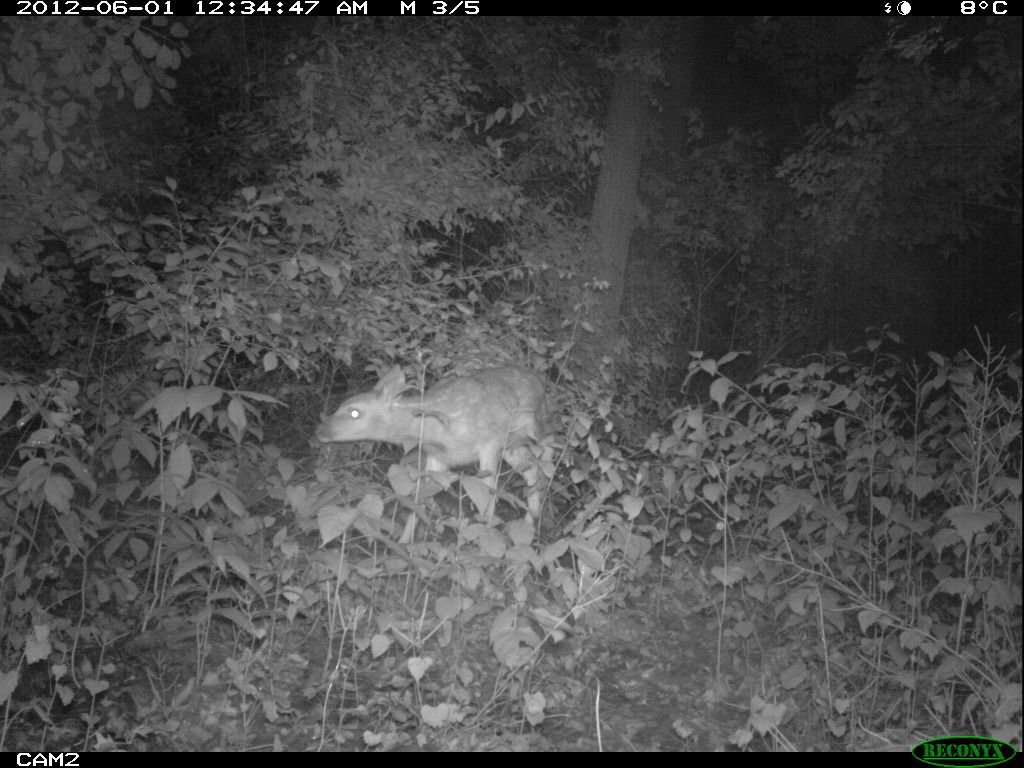
This year, however, I have gotten relatively little in the way of fawns (in general) at the site where they were very common last year. In fact, at a site where I not only had twins last year, but several other fawns, I've only got pictures of a momma with a single baby once (here).
Once again, the completely different sites (with the twin Raccoons) is where I've gotten pics of twin fawns this year.
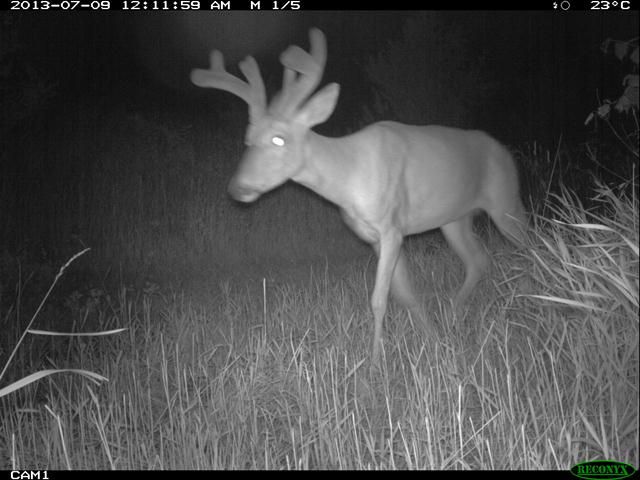
On a different subject, it appears that a large buck who was at one of my study sites last year survived the hunting season and is back. This could be the third year in a row that he's been around (see 2011 shots here, and 2012 examples here).....
You may remember that there were two at this site last year, but one was taken down by an automobile in late fall (here).
We often observe lots and lots of random mammal sign when going about our daily field activities.
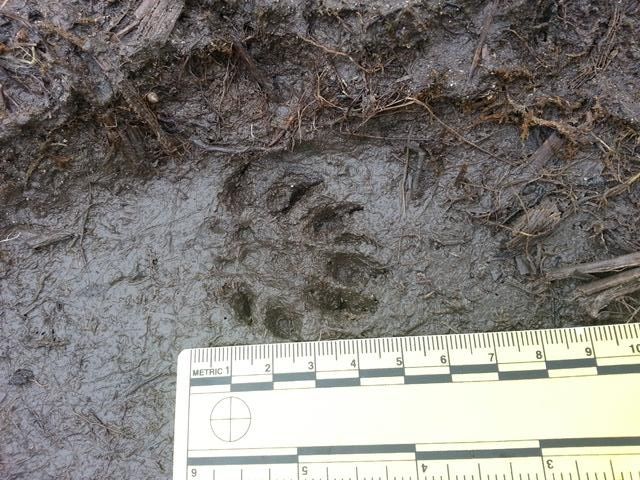
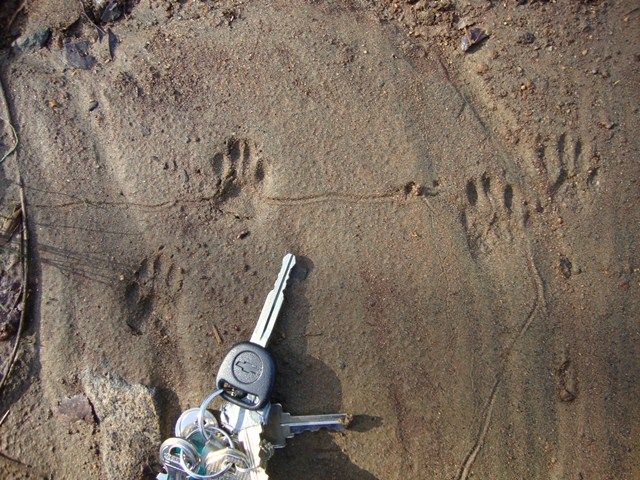
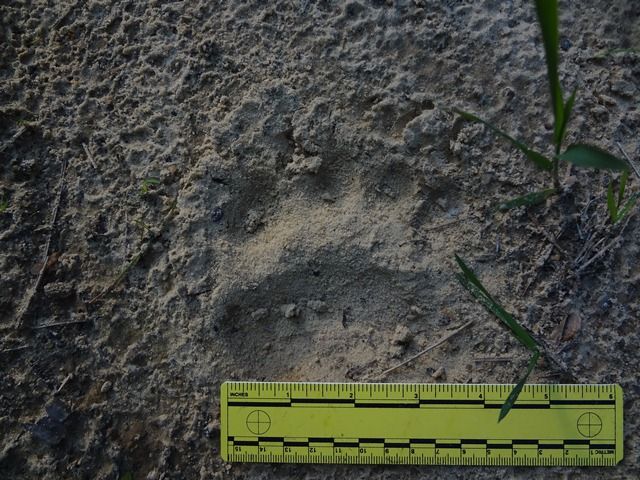
At one of the sites where we have drift fences installed...there's a beaten down path that we follow back to the fence arrays. This path is often muddy and can be a great place for tracks. This week we found some rather nice Mink (Neovison vison) tracks.
The tracks below are a double-register (where the back foot lands almost directly on top of where the front foot had been), which is why there appears to be so many toes in this track.
Photo by K. Rutzen
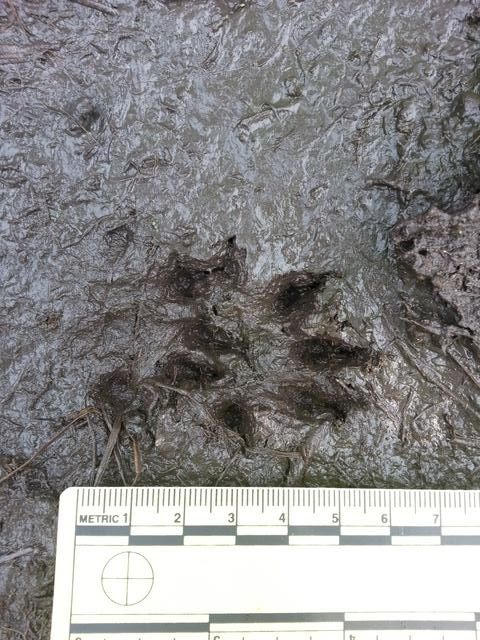
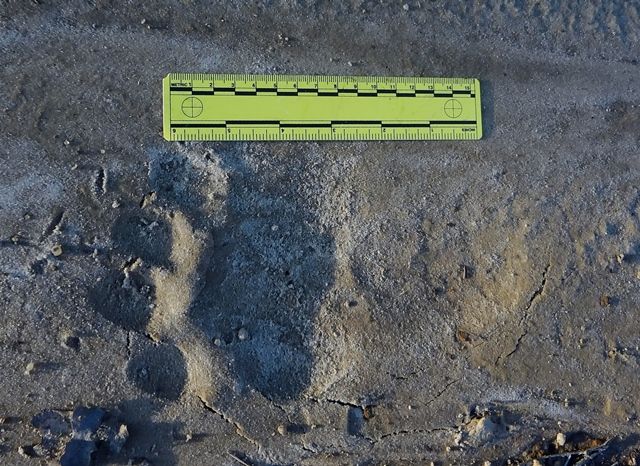
The tracks below show the front and back foot with better separation. Here you can pretty clearly see the five toes from each foot, which helps identify the tracks as belonging to a Mustelid (weasel/mink/otter family).
Photo by K. Rutzen
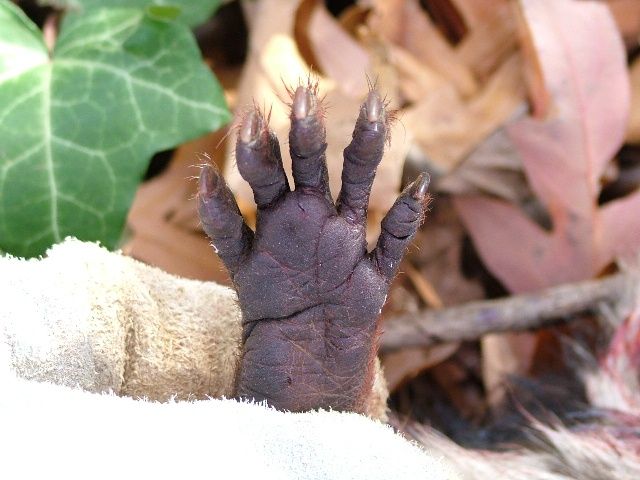
Other critters have five toes....such as the very common Raccoon (Procyon lotor). Yet, Raccoon toes tend to be (proportionally) much longer than the toes of Mustelids. Raccoons also have plantigrade locomotion/stance, where the entire podials and metapodials (basically the entire soles of their feet) come into contact with the ground at each step. This creates a long flat impression, compared to the Mink above.
See an example of a plantigrade stance below (the squirrel is the example here). Also note the digitigrade stance of the canines (basically standing on their toes, or digits, which is often associated with speed and maneuverability) and the unguligrade stance of the deer (standing on the nails, or tips of the toes) which futher increases the length of stride for super-fast running!
Mink have more of a digitigrade stance, which is particularly obvious when compared to a Squirrell or Raccoon.
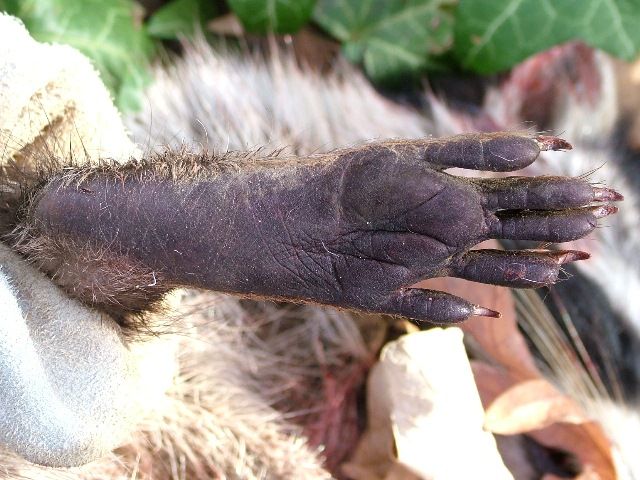
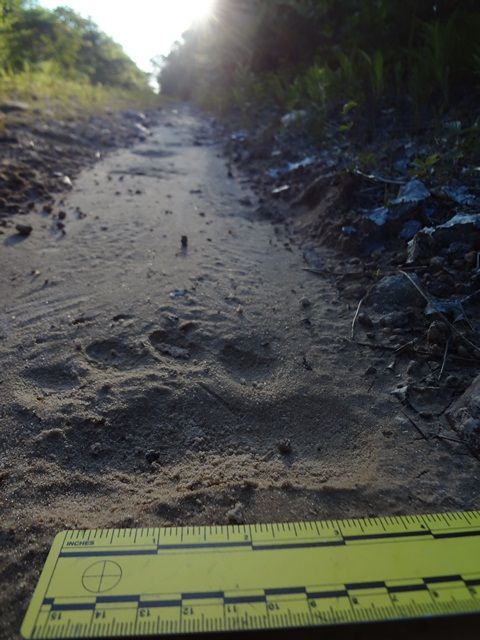
In fact...see the pictures (below) of a Raccoon hind foot from a roadkilled individual I happened across back in North Carolina several years ago. Note how these feet have long fingers and very long "soles"..... You can also see the types of imprints Raccoons make in the third picture below. See the long toes and long foot impression (the key in the picture is almost exactly 3 inches)?
Raccoon forefoot
Raccoon hindfoot
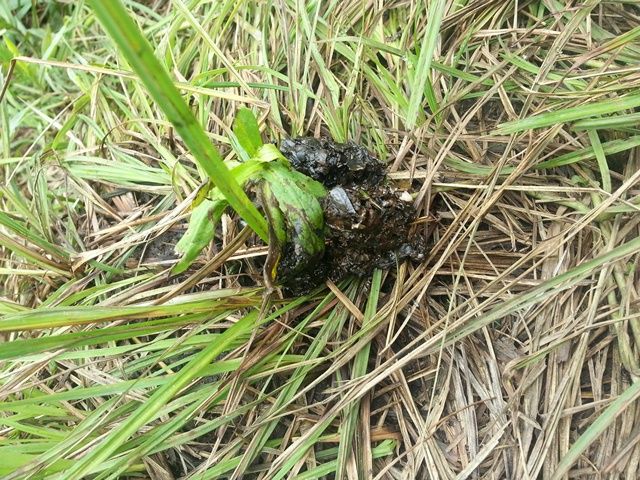
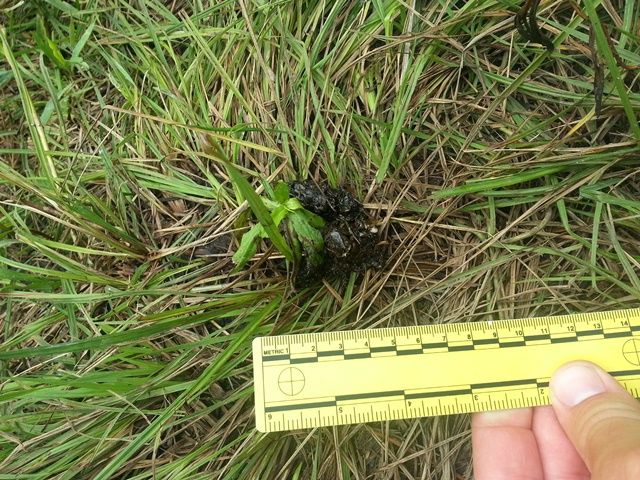
As we reached the banks of the stream we have to cross during our trek, we came across a possible Mink scat (likely from our little friend whom left the tracks). Note the bits of crayfish and possibly some snailshells in there. Seemed too small for Otter scat to me. Couple this with the nearby tracks, and I'm leaning towards Mink on the ID for the scat.
Photo by K. Rutzen
Photo by K. Rutzen
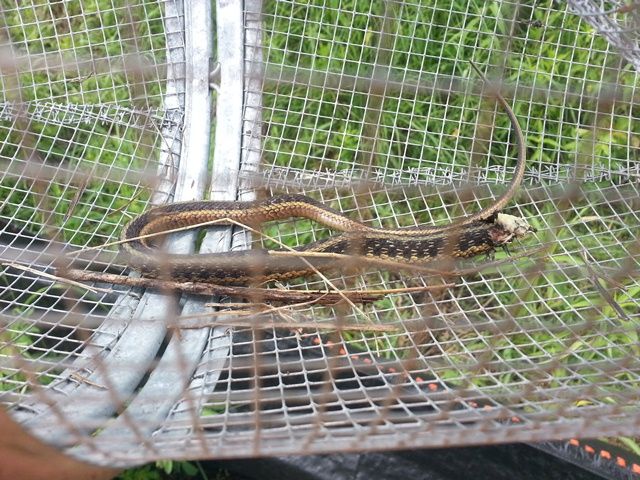
Of course, these fuzzy cutesy critters can also be a wee bit O' trouble. Something ate half of a snake captured in our drift fence trap the day we found the tracks. I'm hoping a Raccoon, just because I don't want to have to blame the Mink, which I have such a soft-spot for :) .....but regardless, this could become a problem.
Photo by K. Rutzen
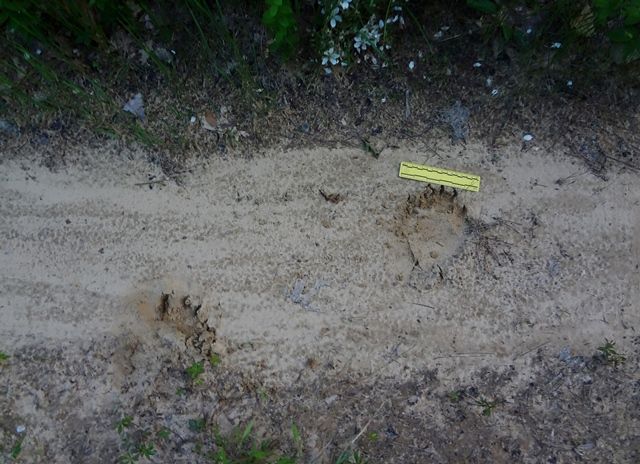
The students working on the Wolf Project also see lots and lots of cool tracks when up north. The soils up there are very sandy, which can be great for tracking.
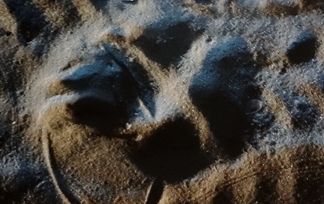
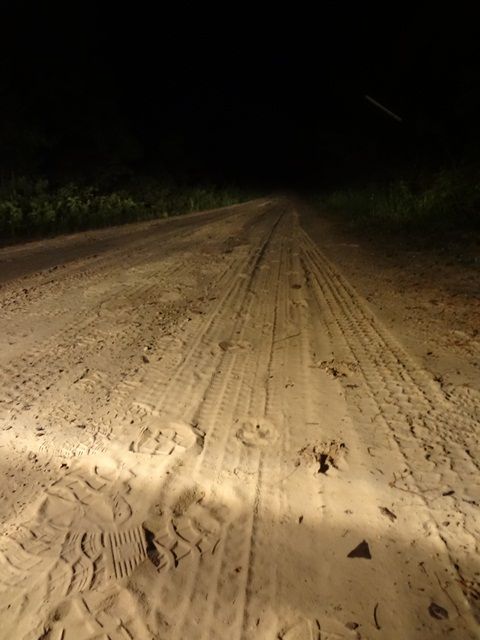
They see the tracks of Wolves (Canis lupus). The ones below were apparently freshly laid over their tire tracks when they returned to the campsite after an evening of field work. The thing I really like about this picture is it clearly shows the obvious "X" (between the toes and inter-digital pad) that is indicative of canine tracks.
Photo by S. Wyrick
Photo by S. Wyrick
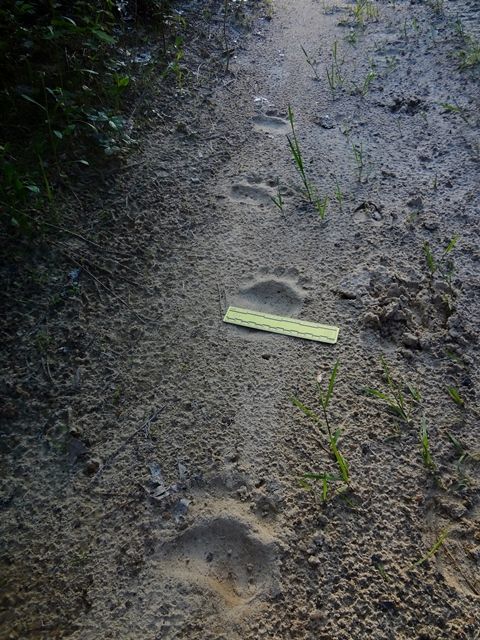
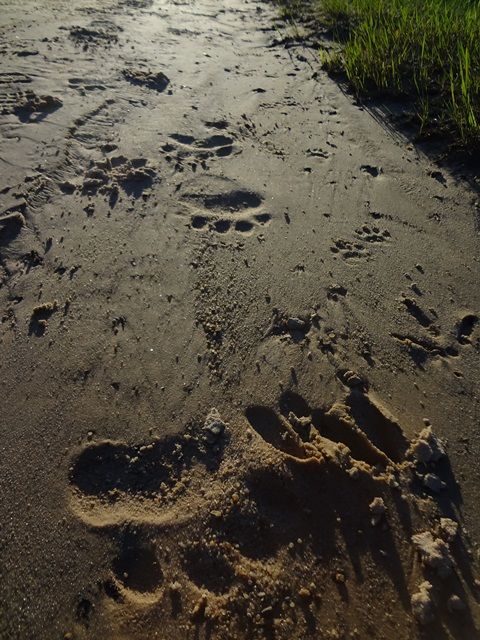
They also see lots and lots of nice Black Bear tracks (Ursus americanus). Bear tracks are fairly obvious and easy to identify. They are big, first of all....and sort of pigeon-toed. There's nothing like them at that size in our neck o' the woods.
Photo by S. Wyrick
Photo by S. Wyrick
Photo by S. Wyrick
Photo by S. Wyrick
Photo by S. Wyrick
Photo by S. Wyrick
Photo by S. Wyrick
Photo by S. Wyrick
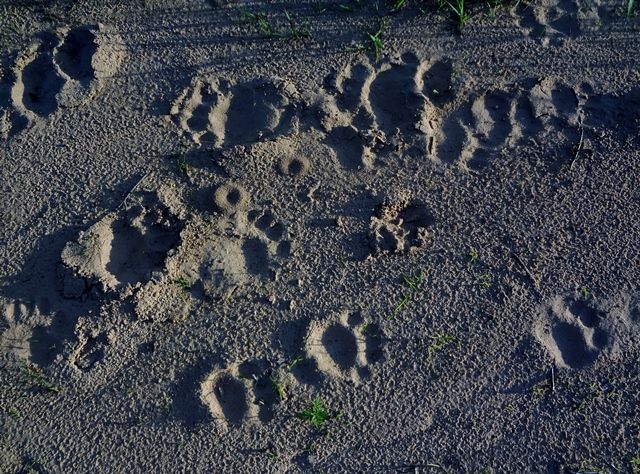
This last picture above is great. There are a few different critters in there. The Bear and White-tailed Deer are obvious. There is also a bird (to the right), that could be a Wild Turkey, a Sandhill Crane....or perhaps a Great Blue Heron. There are also some smaller tracks that are hard to identify, but Bobcat is not out of the question. The tracks are comparable to Bobcat tracks, although there is barely a hint of maybe a fifth toe (and the Bobcat has only four toes). Yet, the gait could be what Paul Rezendes shows as a "fast walk" for the Bobcat on Figure 7.15 (1999, Tracking and the Art of Seeing; Harper Collins Publishing).
Another mystery! Any thoughts on ID of those tracks are welcome!
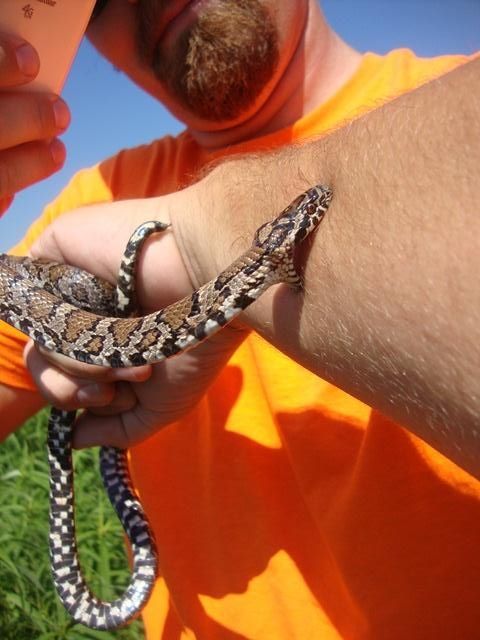
Oh yeah....and just for the heck of it....thought I'd tell you that we caught an Eastern Milksnake (Lampropeltis triangulum triangulum) in the drift fences today.
I also thought you'd enjoy knowing how much it appreciated being caught.
We have several specific purposes with our lab exercises in this class. They were, firstly, designed to give students practical experience that mimics what professional ecologists, natural resource regulators or environmental consultants would do. The students conduct a variety of environmental assessments throughout the semester....use their results to make recommendations and write a professional-style report of their findings.
They apply skills that they've learned in past classes (such as in our 200-level Field Methods in Ecology class), and new techniques they are taught in this class throughout the semester.
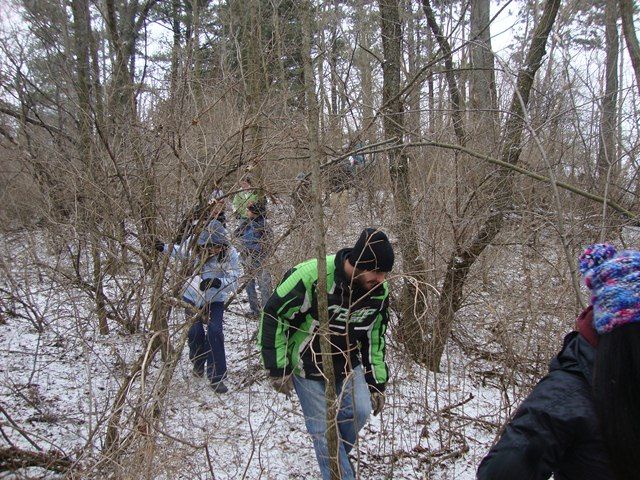
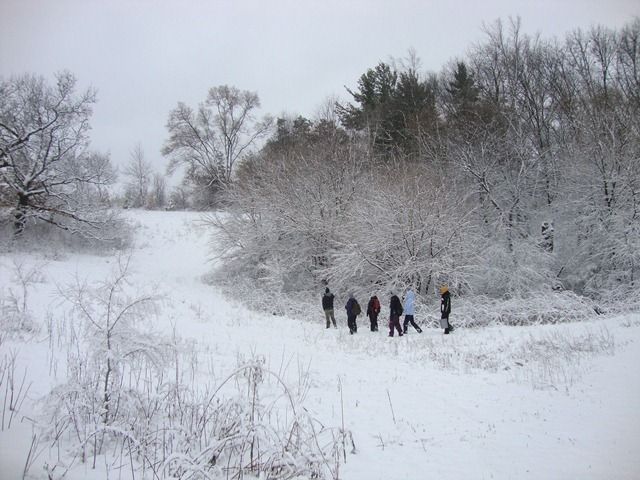
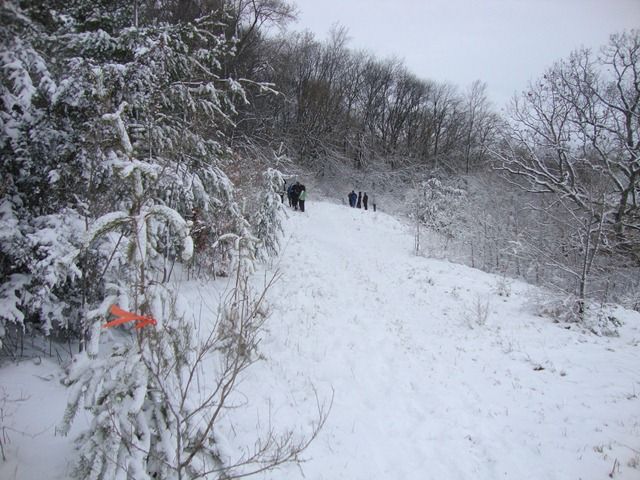
Week one is primarily devoted to a site visit and reconnaisance. The entire property is walked....different community types are identified...and a guess is made as to how the site fits into a landscape context.
Based on this assessment, they break into groups and find locations for their first long-term monitoring initiative on-site: camera traps!
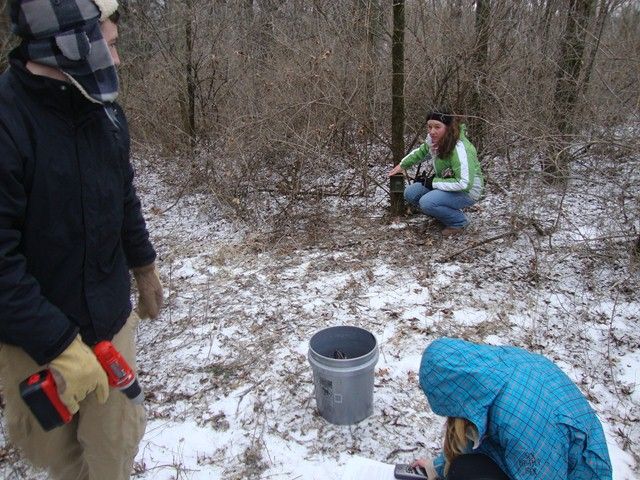
During week two....it was time to head back....service the cameras and delineate the boundaries of the habitats/communities on-site.
BUT, the weather found a way to make things more interesting. Twenty-four hours before lab this week....the temperature was in the mid-50s. Normally, I would say this is unheard of for January 'round here, but looking back at a blog post from last January reminded me that this is becoming the norm.
And they say climate change is a myth!
Anyhoo, the warm temperature was not all that was in store for us. When I left the house on the morning before we had lab, it was still warm and misting. All of the snow that we had gotten previously was completely gone.
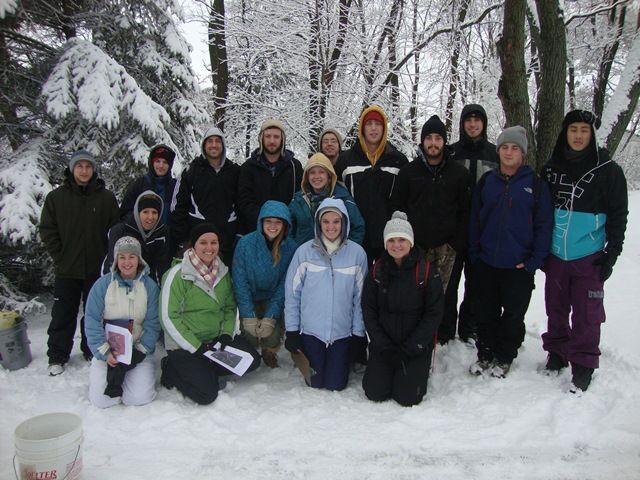
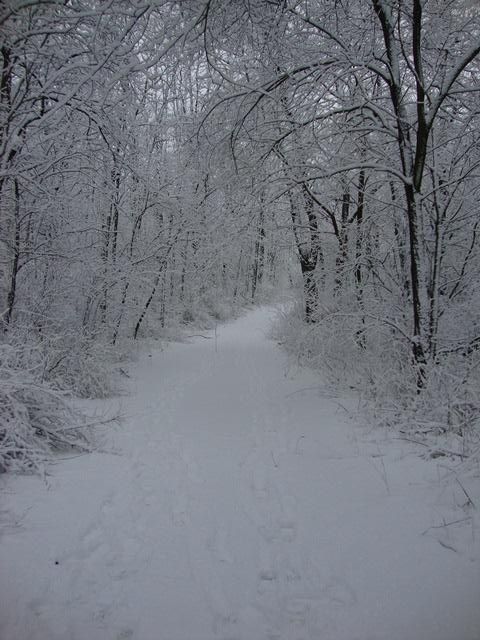
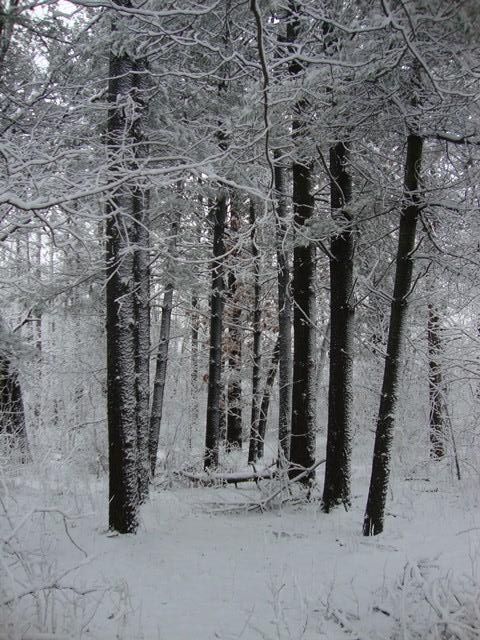
But things changed suddenly. The temperature dropped drastically over the course of a few hours and the mist turned to snow. By mid-afternoon, it looked incredible outside!!
Perfect weather for field work!
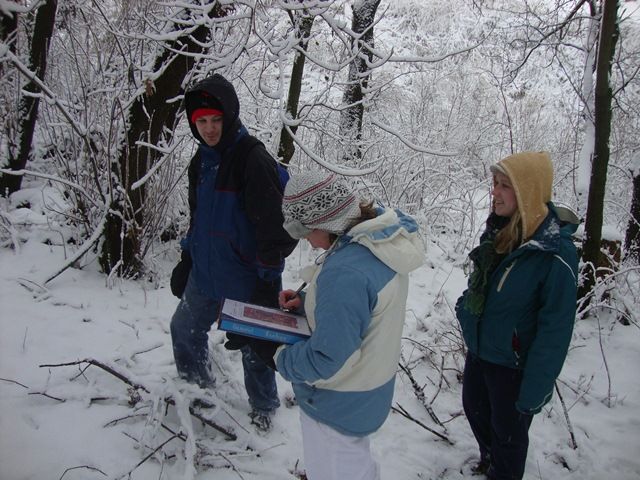
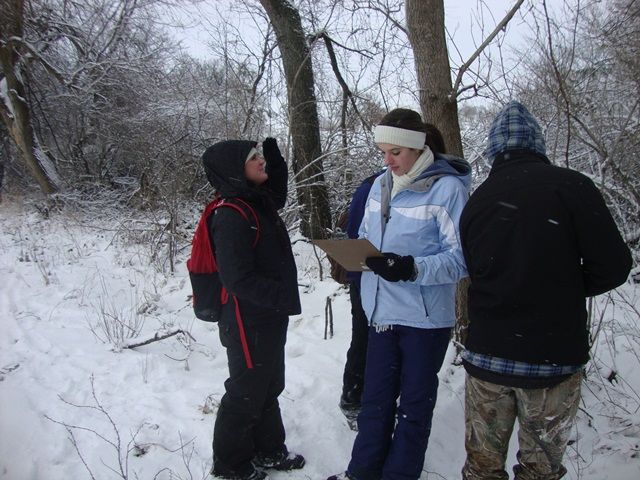
This required students dividing into groups and selecting one of their habitats/communities....following the periphery and recording GPS points.
They also had to flag the common boundaries between different habitats so that they could easily coordinate their data later....
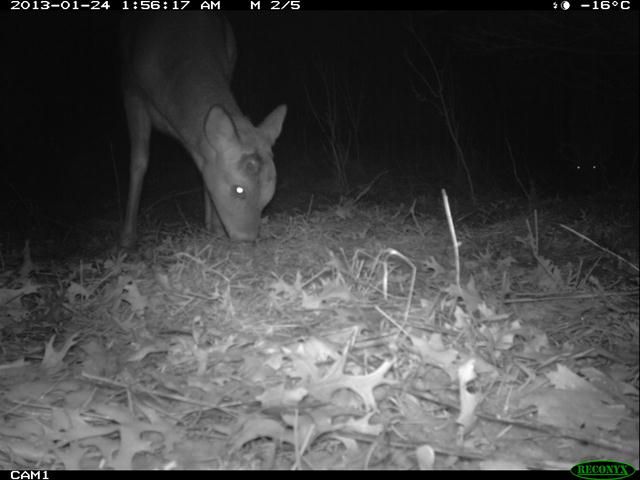
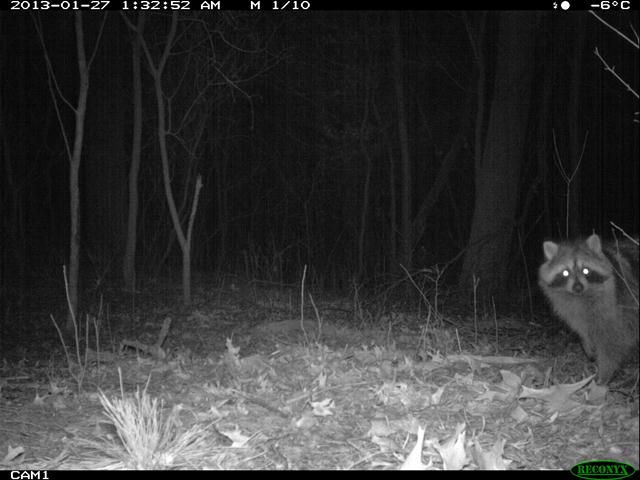
We also checked the cameras....and the usual suspects showed up....
The White-Tailed Deer (Odocoileus virginianus)...note the raw-looking pedicel where the antler recently came off....
I was fortunate enough recently to be able to get away to northern Wisconsin for some fishing with high school buddies. The set-up available to us was spectacular: huge house on the lake with a fishing boat and pontoon boat. Also, unlimited dry firewood...a healthy supply of food and drink....and a fair amount of untouched northern forests to play in (when not fishing, of course).
I can't help but bring my cameras when I go on these kinds of trips. In fact, I did it on a different fishing trip with high school buddies at a completely different location this January.
I'm realistic when I put cameras out in these situations. I know the likelihood of actually catching things is pretty low. I typically have one or two nights to work with (assuming we reach the site on Friday with enough daylight). I also don't know the location particularly well, so may not have enough time to find the best place for a camera and have to stay close to our base camp (where I know I'm not tresspassing).
But I'm willing to risk disappointment, because there's always a chance that I'll get some Bob-tailed Cats (Lynx rufus), Fisher Cats (Martes pennanti), or....fingers crossed...Wolves (Canis lupus).
This time, I brought four cameras along. Two of the cameras went in a boggy, sphagnum and fern carpeted forest across the street from our "cabin". One was placed on the grass "driveway" used to back the fishing boats into the lake from the roadside. The fourth camera was placed along the bank of the lake not far from our fishing dock.
The latter two cameras were very close to the house. Just down a short (but steep) slope from the fire pit behind the house.
The first night, we sat up pretty late at the fire (1:30 am, to be exact) and I figured the nearby cameras were going to be complete busts.
The first few critters did little to quell my disappointment.
Feral Cat (grrrr...)
Eastern Cottontail (Sylvilagus floridanus)
......and a Mouse (Peromyscus sp.)
So, imagine my surprise when I saw this:
About 20 yards from where we had been making lots of noise just a few hours before!
Only my third camera trapped Bobcat (Lynx rufus)! Needless to say, I was thrilled as I had actually gotten pictures of a species on my "wish-list" for the weekend!
Bobcat densities are generally reported to be on the rise in most of the continental United States, including Wisconsin (see further discussion of this here, and in Roberts and Crimmins, 2010). Thus, I'm not surprised that Bobcats are in the area. However, although their densities are on the rise, this is usually a loner species, that naturally exists in relatively low densities in parts of its range (Anderson and Lovallo, 2003). This is particularly true of the Midwest, where densities as low as 4-6 individuals/km-squared have been reported (Berg, 1979).
The undisturbed plot of boggy woodland across the street from the cabin didn't yield Bobcats, unfortunately.
Numerous game trails.....if only I had more time to trap and more cameras to hang! I decided to help the process along with a few little remnants left-over after cleaning the fish we caught.
The first taker is actually this Blue Jay (Cyanocitta cristata). Neat to see them shredding and swallowing bits of fish flesh.
And the next visitors are what one could refer to as "the usual suspects" (but look at the size of that second one!).
At another nearby camera, baited with more fish, the Bandits again quickly zero-in on the free meal.
What's interesting about this clip is that it really shows how important the combination of scent and tactile sensation (i.e. "touch") is to a Raccoon! Watch how he runs his fore paws over that fish, really trying to get a sense of it.
We have to remember that, out in the remote north woods, there's very little light....and the IR filter is giving us the false-impression that the area is lit-up like a Christmas Tree.
Not so! It's blacker than pitch out there at night (by our standards), and although Raccoons have better low-light vision than us....being able to smell and feel a potential food item is important.
Finally, I'll leave you with a first for me (I think). It's hard to tell from these pictures and video clips....but I'm fairly certain that the cameras are picking up a Shrew. I don't know what species, but given the size....I'm going to guess the Short-tailed Shrew (Blarina brevicauda), although there are Sorex in this part of the state too.
The critter I'm referring to is in the circled location on the picture below.
See a blown up version of this circled area here....
Now, take a look at it moving around in this video clip....which may help....
Interestingly, I tried to place another camera over a bit of fish remnants along the lakeshore. Hoping for a mink, but didn't get any. However, I *think* I got a video clip of a shrew chewing on the carcass. He's close to the camera (so alittle washed out and out of focus).
His backside is facing us, which also makes it difficult to ID him. But, from this vantage we can see there's not an obvious long tail. This would also suggest the Short-tailed Shrew.
Short-tailed shrews are formidable little predators. They eat, not only many invertebrates, but will also take small vertebrates (including smaller shrews, rodents, amphibians, and small snakes; Kurta, 2005). I could find limited information that this species eats carrion, however. They are known to hoard food, so they apparently have no aversion to eating dead stuff. Jackson (1961) also reports recieving a letter from an individual whose property was apparently "overrun" with Short-tailed Shrews. He recounts throwing the carcass of a freshly killed Western Fox Snake (Elaphe vulpina = Pantherophis vulpinus) onto a refuse pile that was "shortly devoured", aside from the skin.
BTW....for those interested....the snake was dispatched for eating a fledgling Rose-breasted Grosbeak. The nerve of that snake!
Anderson, E.M., and M.J. Lovallo. 2003. Bobcat and Lynx (Lynx rufus and Lynx canadensis). Pages 758-786. In: Wild Mammals of North America: biology, management and conservation (second edition). G.A. Feldhammer et al. (editors). Johns Hopkins University Press, Baltimore.
Berg, W.E. 1979. Ecology of bobcats in northern Minnesota. Pages 55-61 In P.C. Escherich and L. Blum (eds.). Proceedings of the 1979. bobcat research conference (Science and Technology Series 6). National Wildlife Federation, Washington, DC.
Jackson, H.H.T. 1961. Mammals of Wisconsin. University of Wisconsin Press, Madison.
Kurta, A., 2005. Mammals of the Great Lakes Region (revised edition). University of Michigan Press, Ann Arbor.
Roberts, N.M. and S.M. Crimmins. 2010. Bobcat population status and management in North America: evidence of large-scale population increase. Journal of Fish and Wildlife Management 1:169-174.
There appears to be a rather sizeable misunderstanding between these two young Raccoons.....
What's more, this misunderstanding still was not cleared up several days later....
Even momma looks beside herself on this next one (pacing around the wrestling juveniles)....
Not all interactions appear to be such massive misunderstandings as the ones in the clips above. Some actually just appear to be "play"-type behaviors.
The clips below starts off pretty benign, with a nice up-close shot of momma. Yet, it ends with her two two scamps accidentally sucking her into their ruckus.
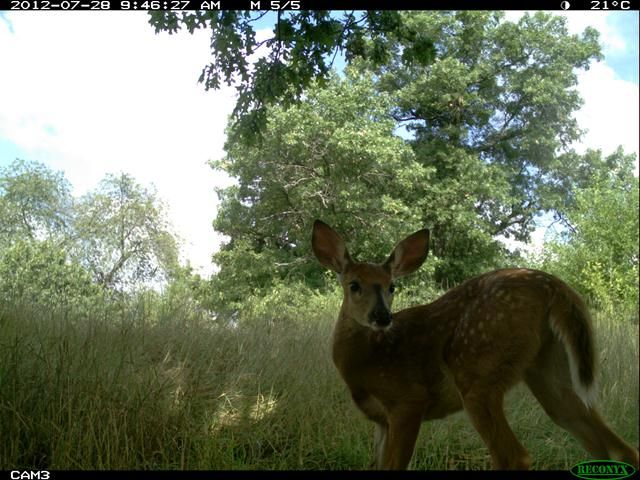
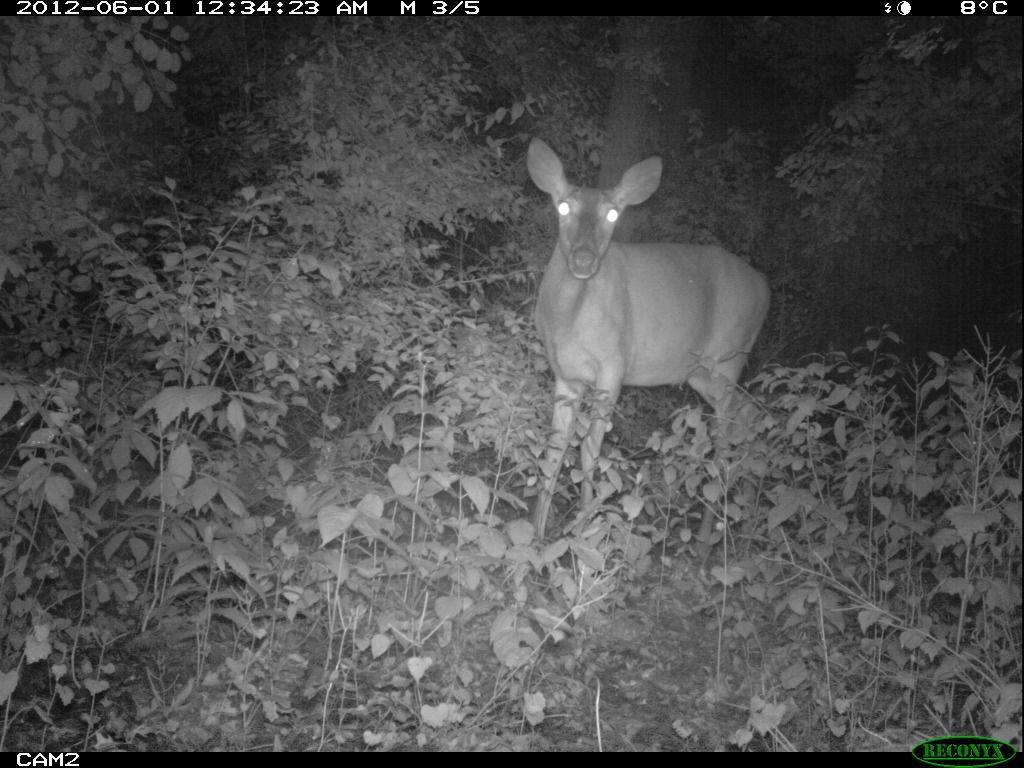
First, one of the many fawns active at my research sites......
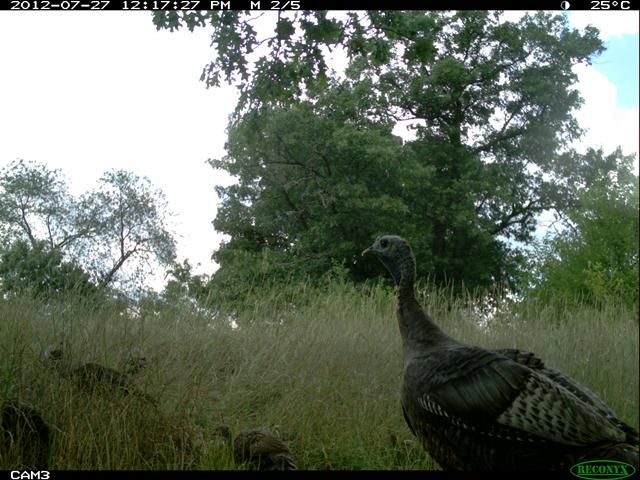
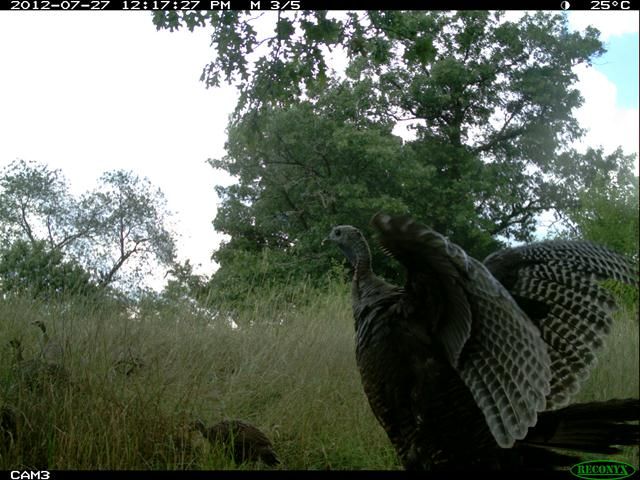
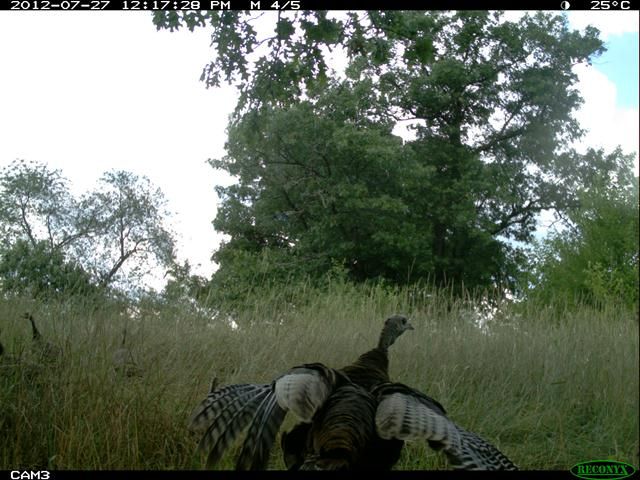
Then, a first for me this year, a picture of a momma walkin' bird with poults....
And...of course....Raccoons. I know I post alot of clips of Raccoons, but they provide so much entertainment (especially for video footage). They never sit still, engage in interesting behavior, and are super abundant!
Below, a momma with five juveniles at a completely different site than the one I have posted on before (see here, and here).
....sometimes the youngsters play alittle too rough with momma.....
I've posted a video clip of these quadruplets not long ago at this site (see previous clip of them here).
They are still hanging out near the camera. You can see from these more recent clips that they have been mostly content to be together (i.e., all the little ones are following momma in a nice line wherever she goes).
But only a day or so after the clips above were taken, momma decides that she isn't in the sharing mood and her patience is running alittle thin. I suppose having four kids will do that to a parent. Regardless, she comes down hard on one youngster that tries to sneak in on whatever morsel she's munching (note: you may have to maximize the size of this clip and the one below it to better see what's happening).
After that reprimand, all of the little ones seem to learn that momma needs some space when eating......
General Notes On Raccoon Reproduction, Parturition and Parental Care:
Raccoons typically breed from Feburary to March. The female will give birth several months later (60 to 73 days) and from that time on is constantly with her offspring (unlike the male, who has almost no direct contact with his progeny after they are born). Litter sizes of 4 to 5 are common. The female nurses for roughly 5 weeks, at which time the babies are weaned. The female and young remain together through the fall, and sometimes during their first winter.
So, the babies above have alot of time left with their mother, but have already learned a valuable lesson!
Actually, the individuals captured on these video clips are probably depositing scent from their glands.....
There are scents in the stakes in these video clips, which I believe are eliciting this response.
Regardless of whether they are scratching or depositing scent....seeing these clips makes me happy that I wear gloves when I change out the scents in those stakes!!
There seems to be some disagreement among raccoon authorities about whether they are primarily solitary....or whether they run in loose social groups (particularly females). In the first video clip above, we clearly have an example of two individuals moving together. According to Zeveloff (2002) they frequently have overlapping home ranges, so don't regularly defend territories (especially when resources are high). Odors (like gland secretions, urine and feces) can be used to mark home range boundaries and leave information about their presence to other raccoons. I would assume the individual above is marking his/her home range. The second video clip could be of a different individual depositing a reply to the first raccoon that left his or her message.
Literature Cited
Zeveloff, S.I. 2002. Raccoons: a natural history. Smithsonian Books, Washington, D.C..
I've got alot of stuff to share with you all, but no time to post it!
Figured I could at least get this quickie post in, as it requires little explanation.
The babies started showing themselves for several species just in the last week 'round these parts.....
To start things off: my first camera-trapped fawn of 2012.
The momma comes forward with some trepidation.....
...but she's followed closely by junior......
At a completely different site, several species have acted like "proud parents" for the camera.
First a video clip of a Whistlepig (Marmota monax) with two youngsters close behind.... I've actually managed to get pics of baby 'pigs before, back in NC (see here).
...and just this morning.....a momma Racoon (Procyon lotor) with a group of little ones in-tow.....
More to post again soon (hopefully)....as soon as I catch my breath, that is!
This would be one of my favorite personal camera trap pictures ever, if it weren't so washed out. But...the Cuddeback at close range can't do much better than this....
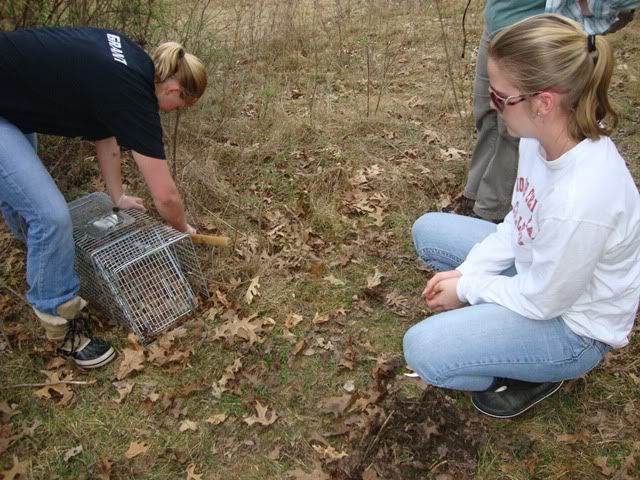
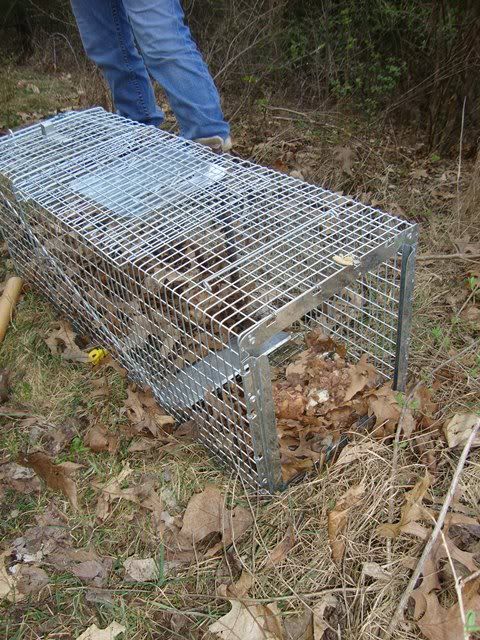
This week was basically a repeat of last week. The goal being to increase the chances of catching critters in the wire cage traps, while allowing the students a chance to further test their skills at setting traps again.... and perform maintenance on other long-term data collection projects.
So, once again the traps went out for two back-to-back days. This time, we sweetened the bait by mixing dog food, sardines, and drippings from St. Patty's Day Corned Beef and Cabbage.....pulling out all the stops.
The feral cats stayed away, which I was happy for...and we actually caught some wildlife, although not a ton.
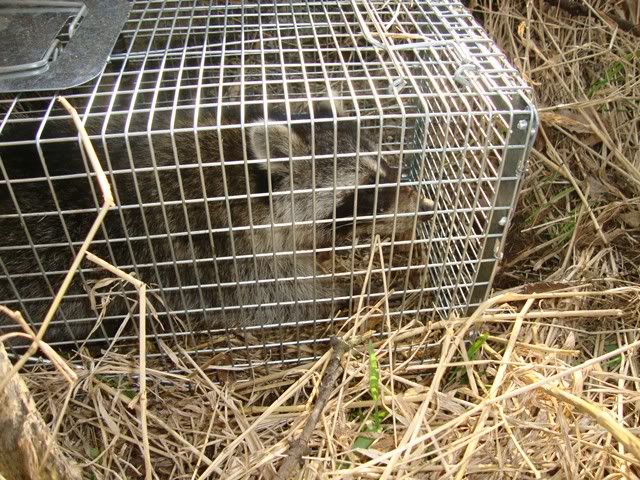
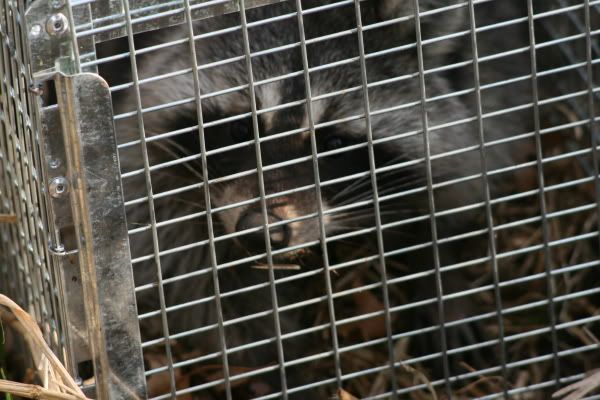
Still, one Raccoon is better than nothing!
Now....a Raccoon in a trap can go either way. Sometimes you'd think a Looney Toon-style Tazmanian Devil was in the trap.
Other times, they are as docile as a kitten.
Photo by J. Scherer
This individual was actually fast asleep when we walked up to the trap in the morning, his belly full of dog food and sardines. I joked with my students that, becuase he was a 'coon living in a suburban/rural mosaic landscape, he probably gets trapped and relocated once a month, so knows the drill.
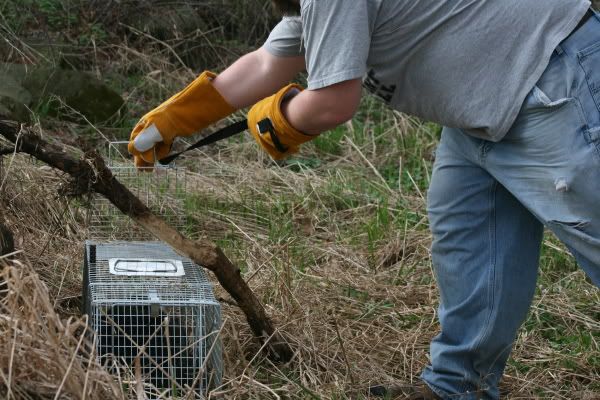
Regardless, approaching with caution is always important (those deft little paws can reach through some pretty tight places). With the threat of rabies (a serious issue with Raccoons), kevlar gloves are warranted.
Photo by J. Scherer
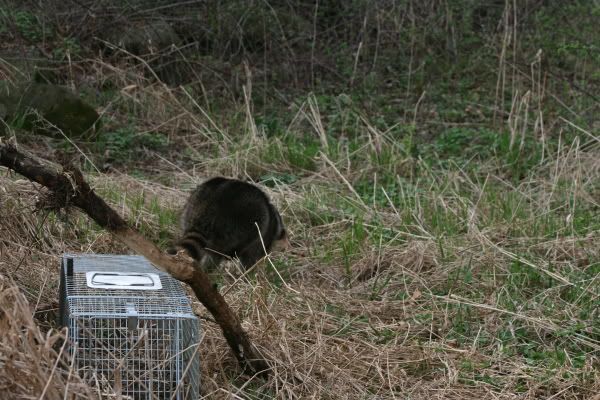
But, if everything goes as planned, the bandit is gone before you have a chance to think about what might happen.....
Photo by J. Scherer
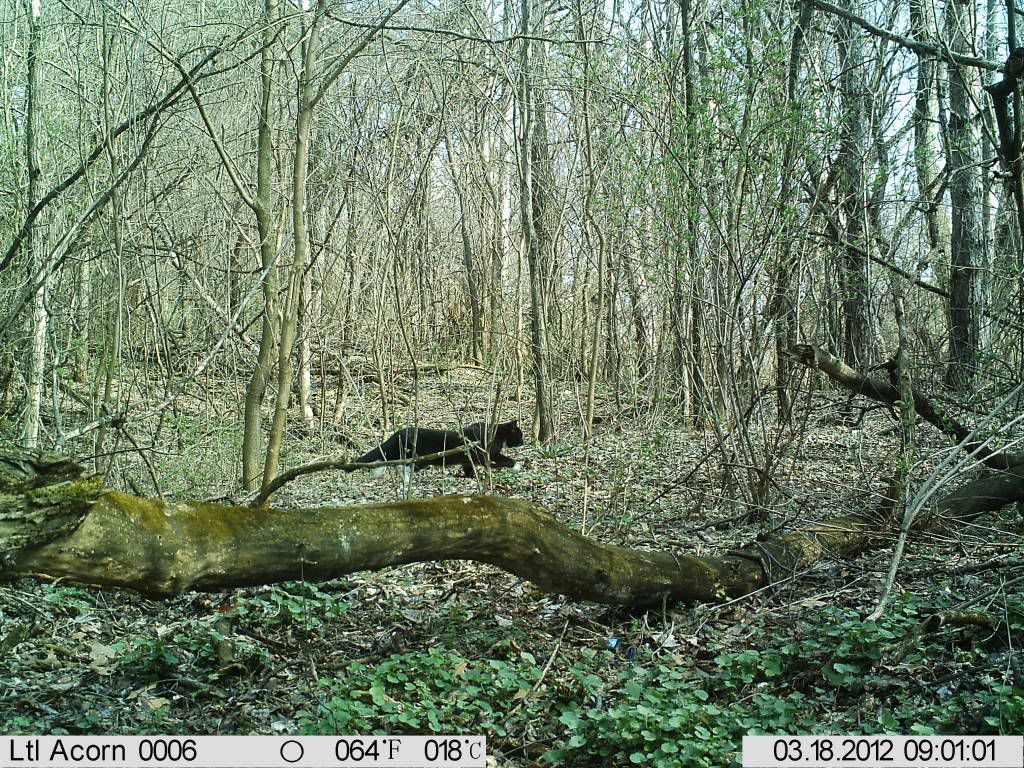
Also, plenty of stuff on the camera traps. A smattering of examples includes....
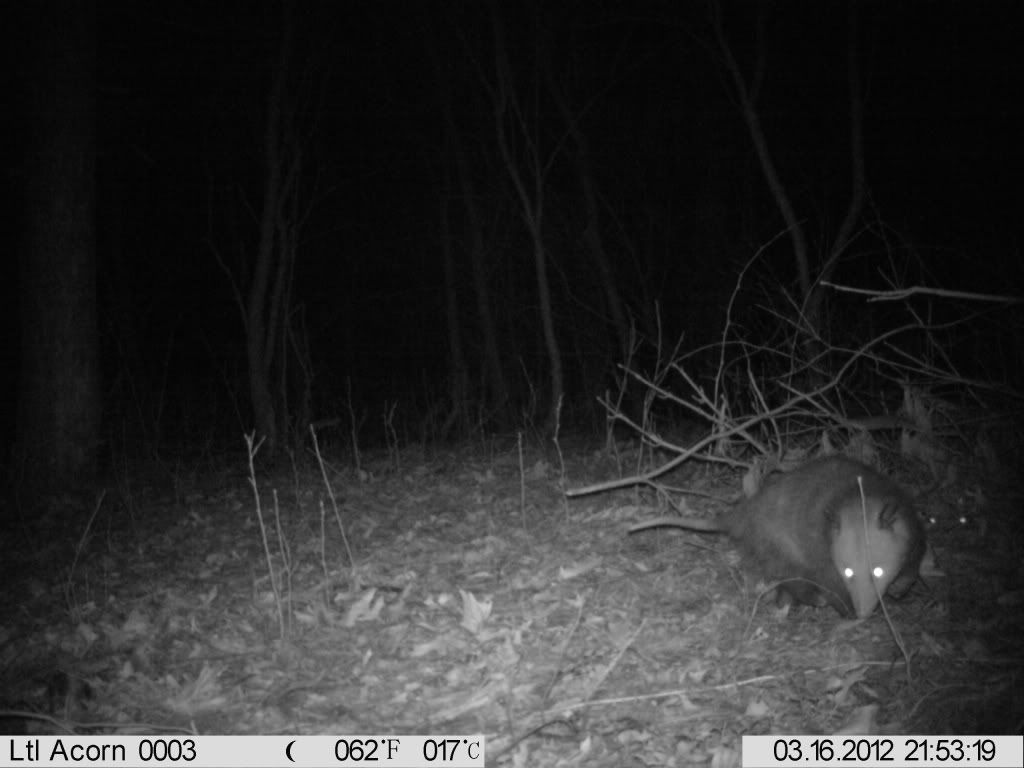
'Possum...
Blue Jay (Cyanocitta cristata)
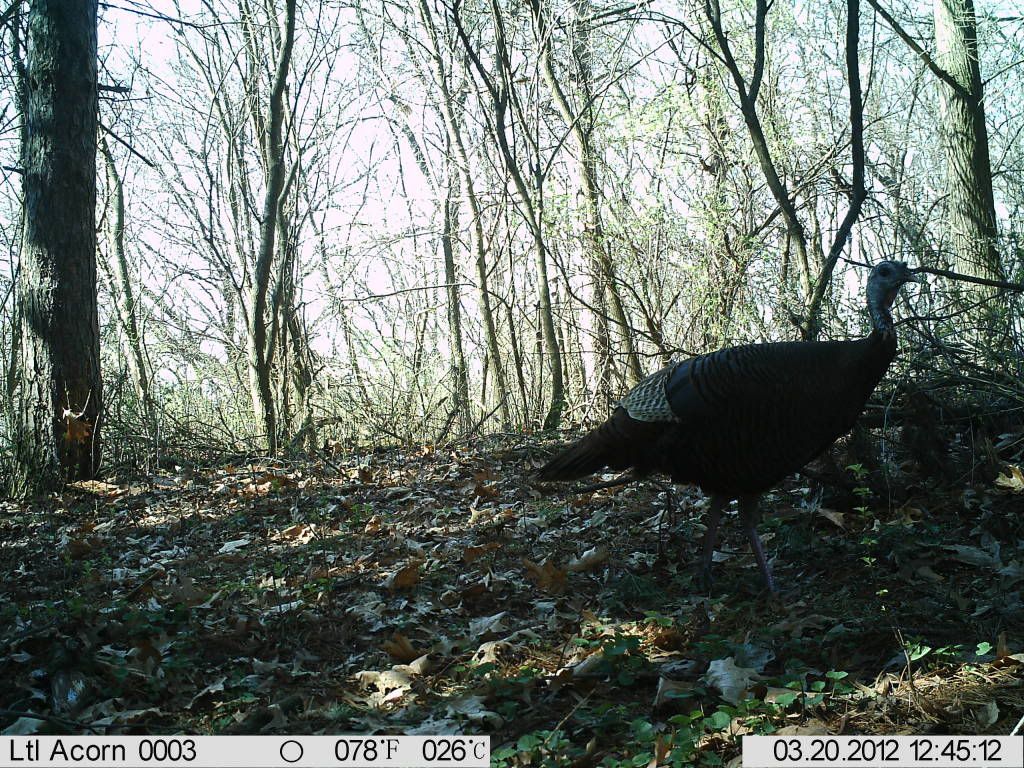
Walkin' Bird (Meleagris gallopavo)
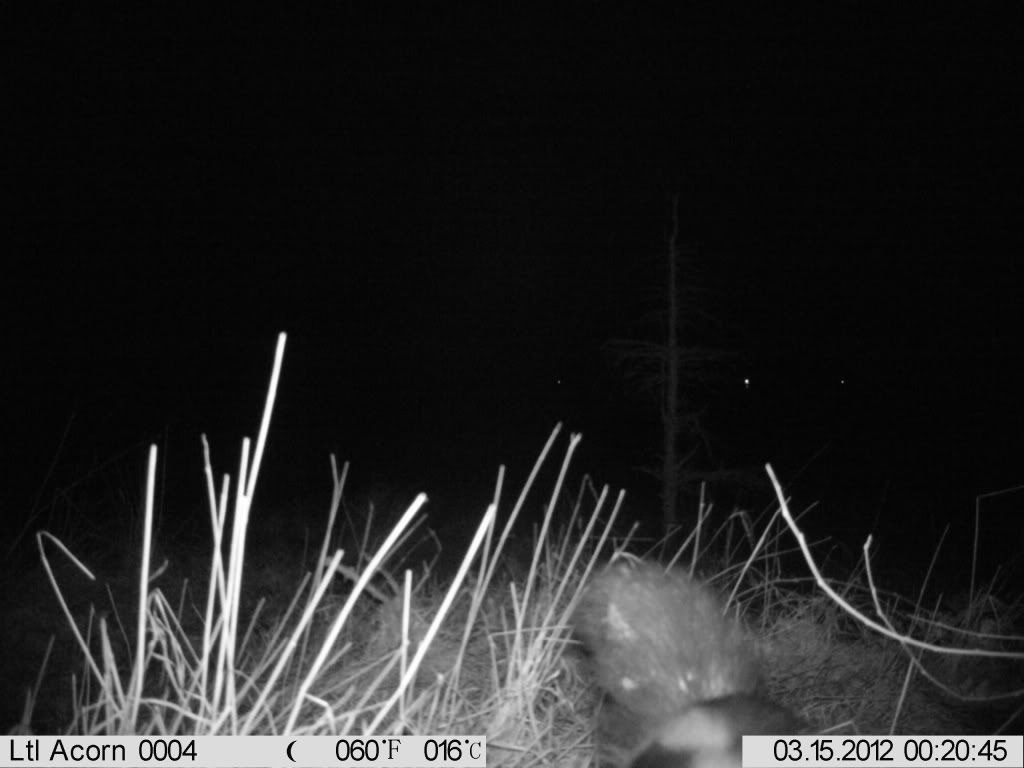
Stinker (Mephitis mephitis)
Deer....
One of the minions of El Diablo....
We also had one of our most productive canine weeks on the camera traps.
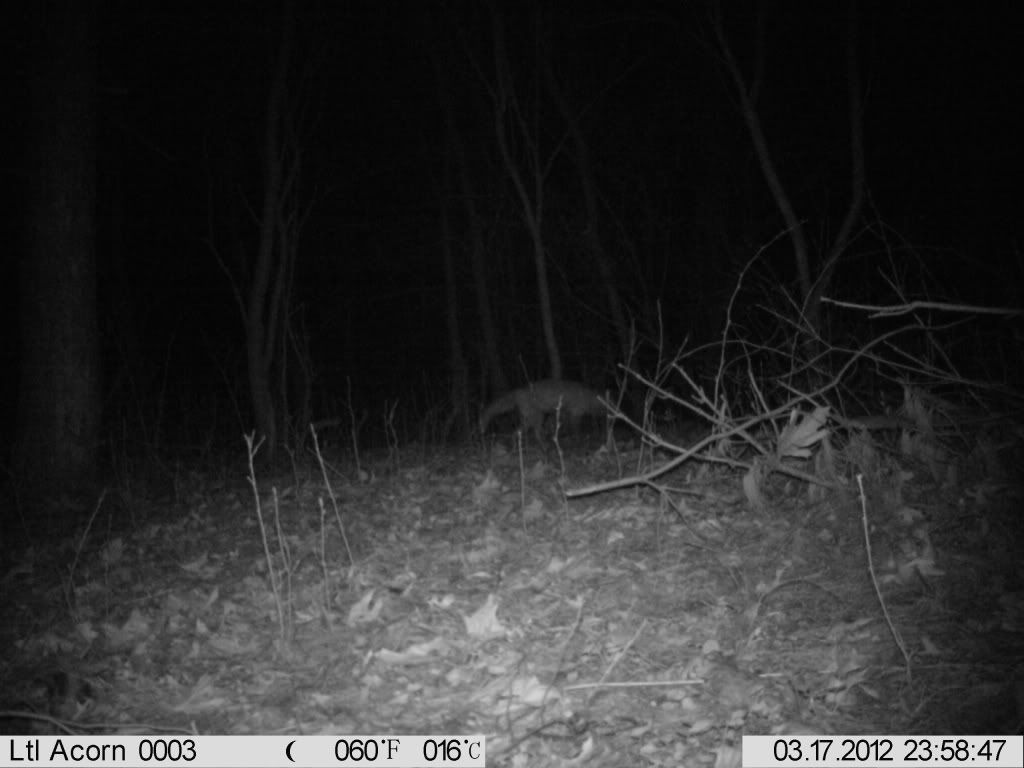
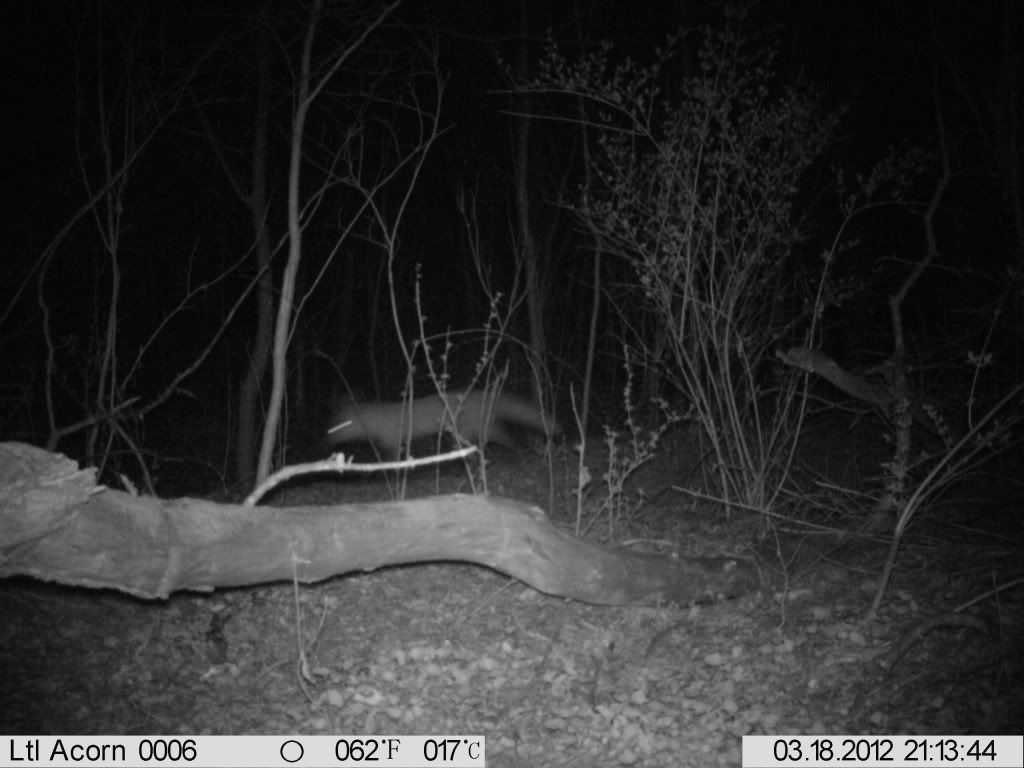
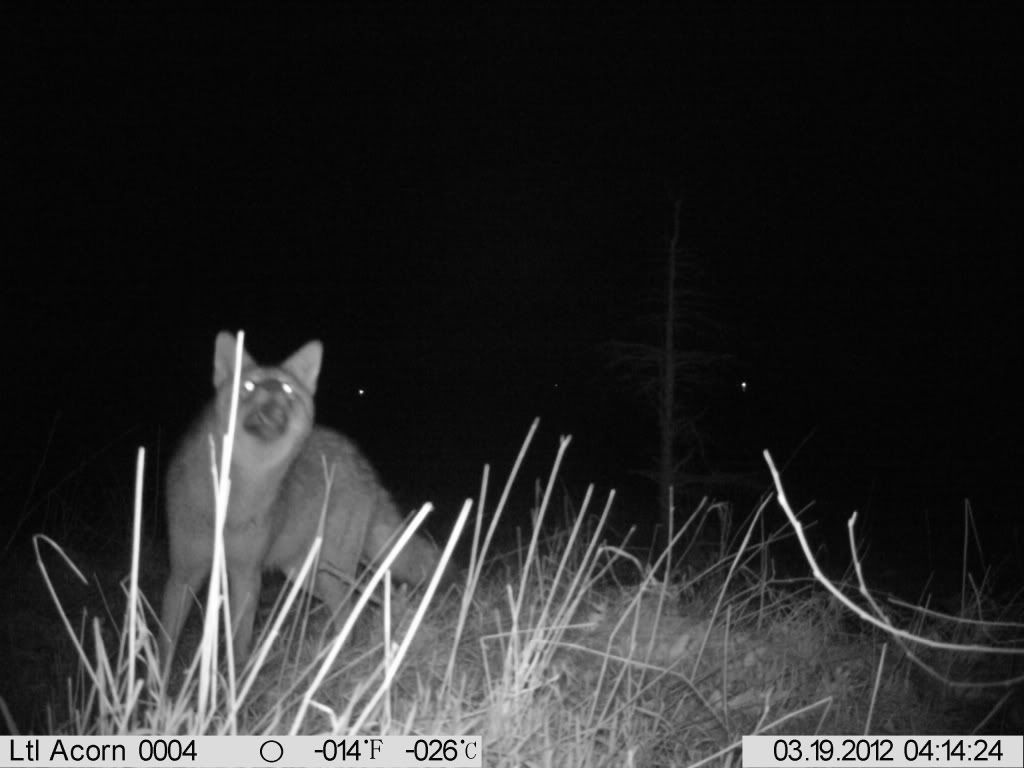
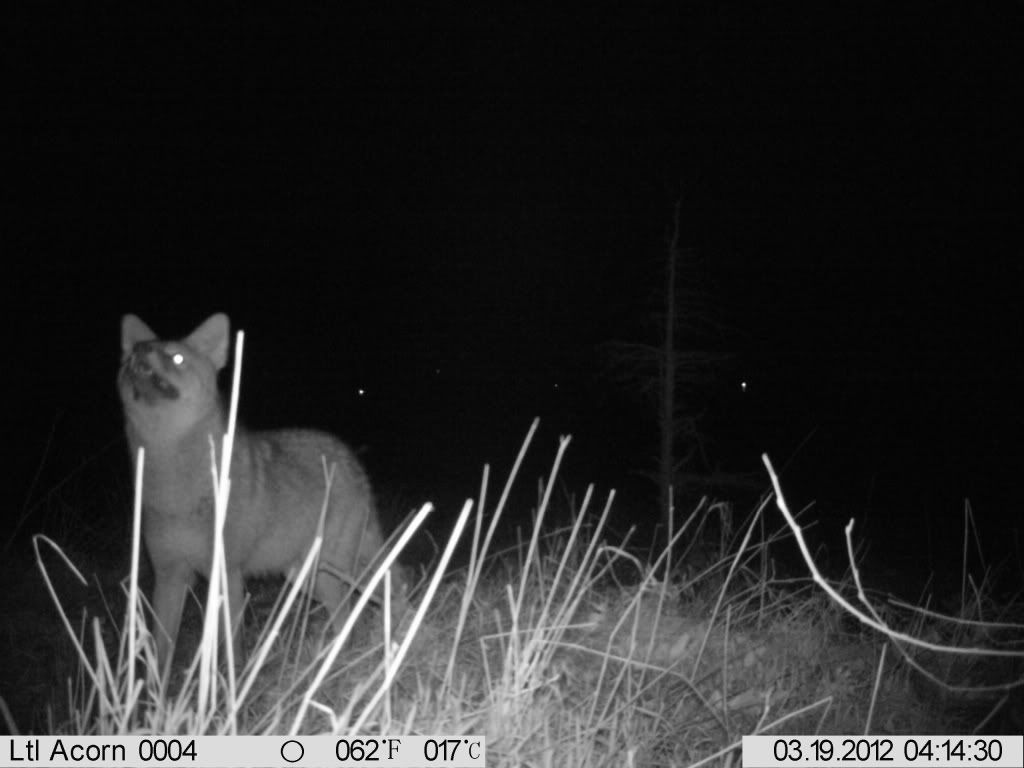
First, The Tod was all over the site (including the picture at the top)....unfortunately, none of these pictures are all that great. The video clip is sort of cool though.......
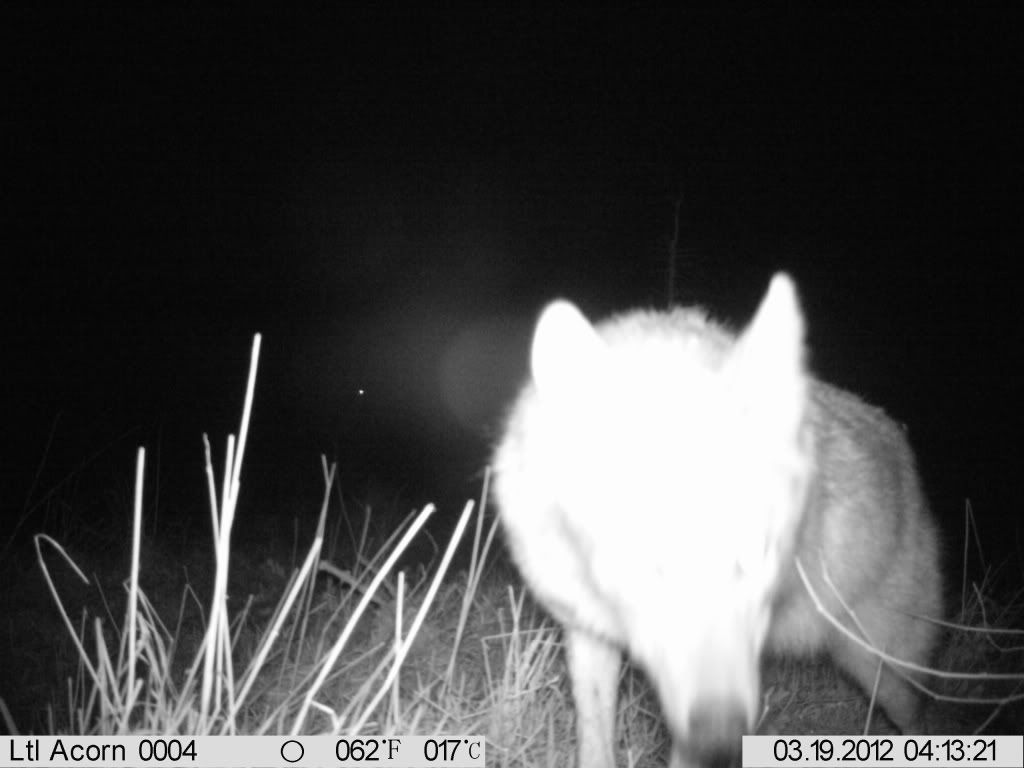
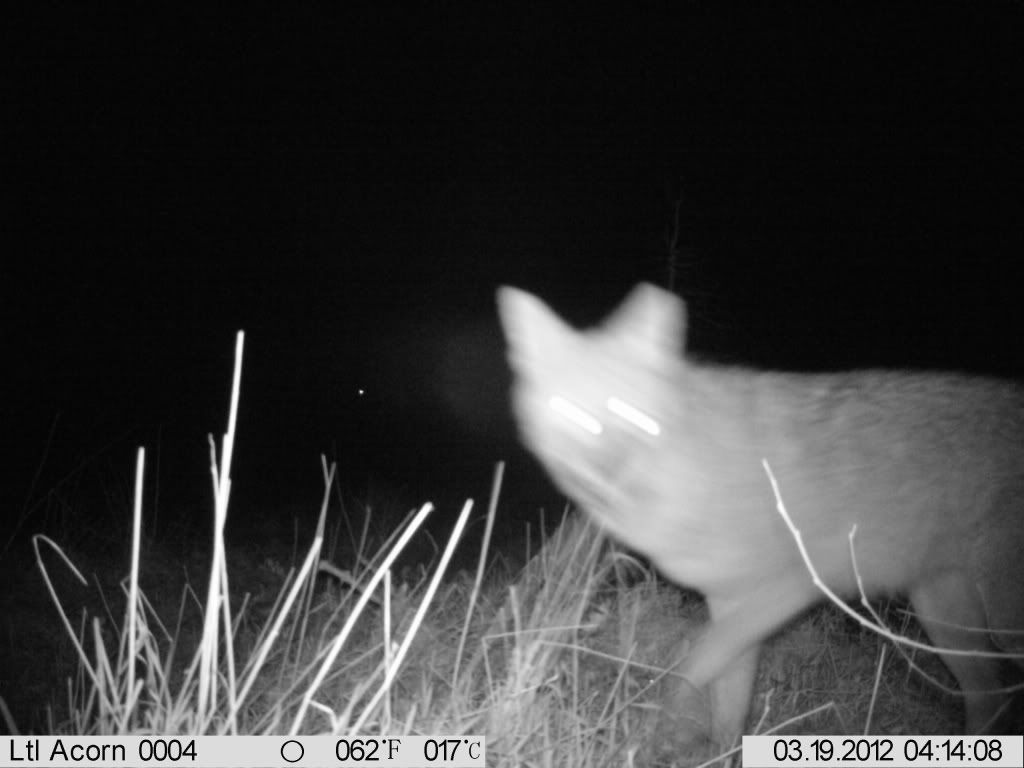
Finally, we got some close up shots of a 'yote on-site. This camera is the one the students mounted on the tree near the location of the rabbit burrow that had been dug up by a canine of some kind (see here). This 'yote is attracted to the spot....but the red LED's must give him a start. As I've posted before, they are incredibly wary of the red LEDs, for some reason.
Then, he puts his nose to work from a slightly safer distance....
The canine pics are often blurry. They are just too skittish to hold still for very long!