Showing posts with label turtle dogs. Show all posts

Monday, June 10, 2013

Return of the Turtle Dogs!!

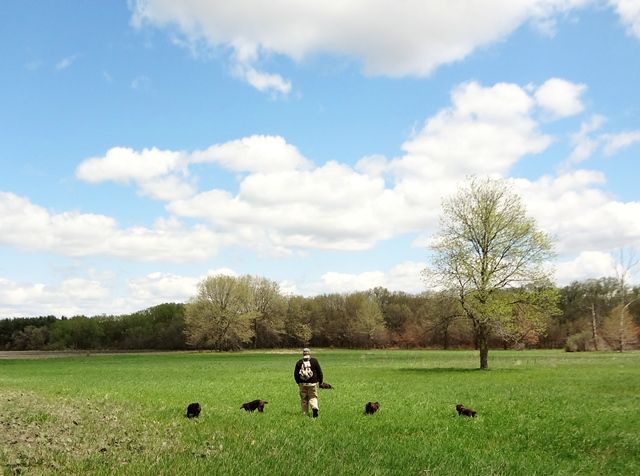
Photo by S. Wyrick

Sometimes I can't believe my good fortune.

But, as a wiser man than myself once said: "It's better to be lucky than good".  Can't remember who actually said it....but I'm pretty sure I first heard it from my dad.

Anyways.....those of you that have read my blog from the beginning (a small group, to be sure :)  ) might remember my past adventures with John Rucker and his Turtle Dogs.  This was back in 2011, when I still lived in North Carolina.  After my experience with John, I raved about the Turtle Dogs to my colleagues who work for the regulatory agency in the state where I currently live.

Well, this apparently snow-balled until....lo-and-behold.....John and his Turtle Dogs were up here this spring helping the state wildlife folks with surveys.  This time, however, we were not looking for the Eastern Box Turtle (Terrapene carolina) from down in NC.  The goal this time was the incredibly rare, and protected Ornate Box Turtle (Terrapena ornata). 

Turtles, in general, have it pretty rough.  They are slow to mature (taking decades in some species), they often experience reproductive failure (their nests are the focus of many mesopredators, like Raccoons, Skunks, Red Fox, Opossums); and even if the eggs survive, the hatchling turtles are bite-sized morsels for all of those same predators.  If anthropogenic influences were not a factor, being long-lived (and, thus, having many possible reproductive events possible in one's life) can help off-set high nest and juvenile mortality.  Yet, we no longer live in a land where anthropogenic influences can be avoided.  Habitat loss (particularly nesting habitat) have forced turtles to concentrate nesting activities in smaller and smaller suitable areas...where they are easy to find by mesopredators (who learn to return annually and can decimate a population's reproductive success).

One strategy to help off-set the low recruitment that many turtle populations experience is referred to as "head-starting".  Head-starting programs usually involve the harvesting of eggs from fresh turtle nests, the incubation of those eggs in captivity (so they avoid the nest-predators) and the eventual release of the hatchlings.  There are many pros and cons to head-starting of turtles that can be discussed.....but I feel this post is already growing a bit "wordy"...so we'll plunge on. 

But, the strategy of head-starting turtles becomes important later in my post.

John and his dogs worked with state regulators for the better part of a week in early May, surveying various sites for turtles.  Trying to assess populations and re-confirm box turtle presence at some of these sites.  Another goal of the dog surveys was to catch as many previously head-started box turtles as possible.  The head-starting program for this species in the state was instigated about 12 years ago....and many of the first head-started individuals should be of (or near) sexual maturity.

The best part?  Well, my colleagues at the state agency agreed to allow myself and a number of my students come with for a day.  This was a rare opportunity: using a unique survey method to catch rare species.  We needed to be at the top of our game! 

And, as usual, the weather was not on our side.....cold, windy and rain the night before.  Rain isn't good if you need dogs to follow a scent trail.  But...not much could be done about it. 

We also planned on spending alot of time pounding the ground doing visual surveys for turtles that the dogs may have missed due to poor environmental conditions.

We were scheduled to meet the dogs et al., at about noon.....but decided to start early and survey a site without the aid of dogs to help supplement their later surveys.

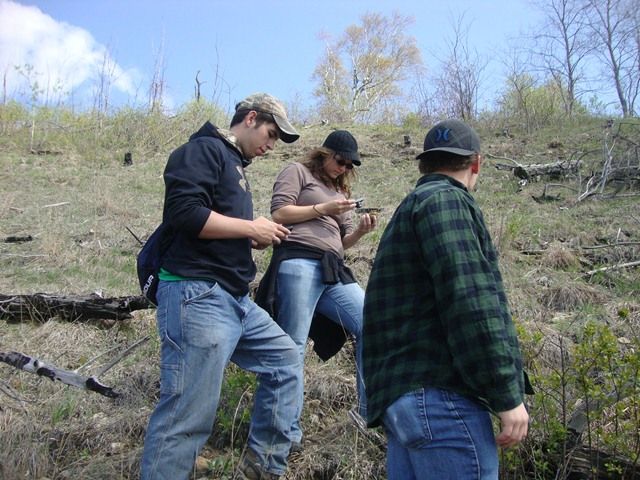
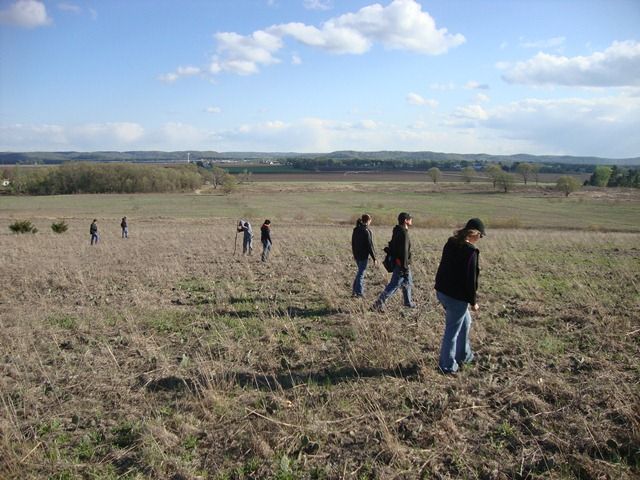
So our boots were on the ground by 10 am, and we walked parallel to eachother across the survey area.....
 
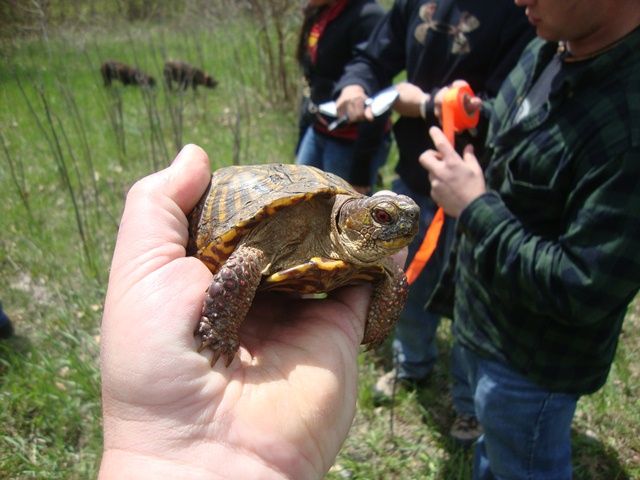
Luckily, the herps were still out, despite the cold....although we had to get on some steep slopes to find them (like this little box turtle).
 
A nice Racer (Coluber constrictor)....
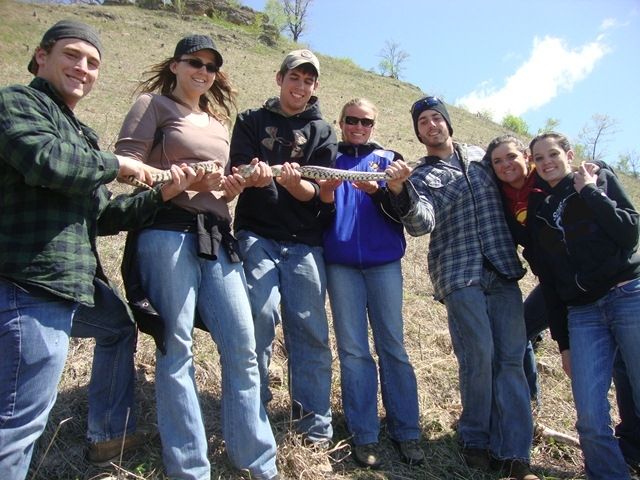
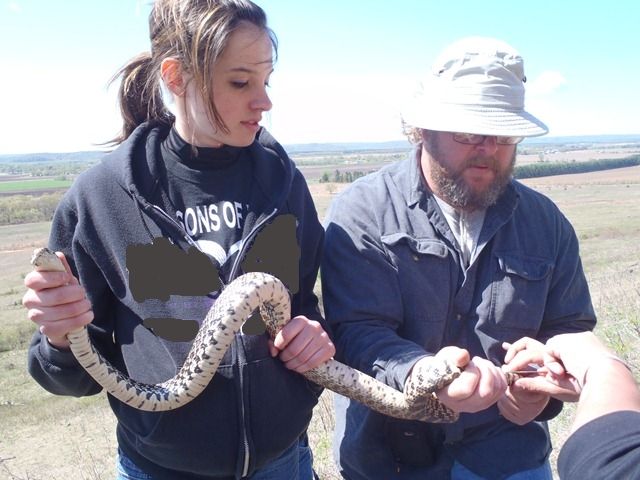
...and even a beauty of a Bullsnake (Pituophis catenifer sayi).....
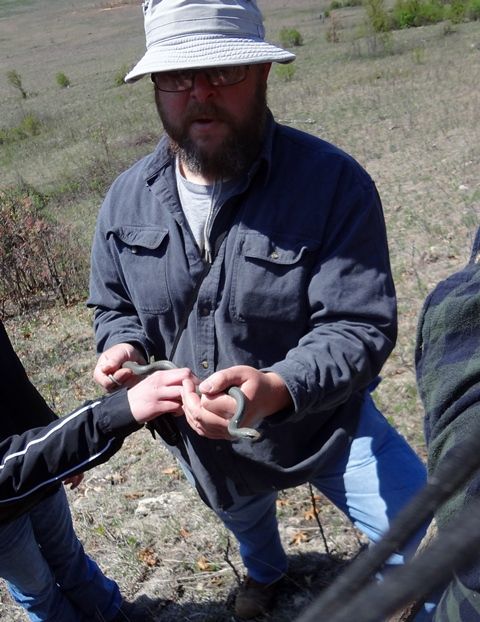
...this individual was nice enough to let us "probe" him.  Allow me to explain (very breifly below). 

The most definitive way to determine gender on a snake is to take a smooth and blunt metal stick (called a probe).  This stick is very thin and can be inserted into the cloaca of a snake (the area where the snake goes to the bathroom out of; see pic above).  If the probe goes in a distance that is approximately 1/3 of the snake's tail length, it's a male.  Why?  Because males have a bifurcated reproductive structure (or a structure with two "halves") called a hemipenis located there.   The hemipenis is essentially everted into the cloaca of the female during copulation.  They are often spikey...to help the male get a grip (no arms or legs, remember) while sperm is transferred.  When males are not copulating, these hemipenes are inverted inside the base of the tail....it is the inverted hemipenis that accommodates the probe so that it slides into the cloaca. 

If it's a female snake....the probe wont slide in.

Make sense?  See more here.

ANYWAYS......our first visual survey was successfull.  Overall, we found five box turtles....one Bullsnake and a few Racers.  By then, it was time to leave so we could meet John and the state wildlife folks at a different site. 

After our arrival, and general plan of attack was formulated, we headed out.  As a group, we hit the prairie, following John and the pooches as they went to work.
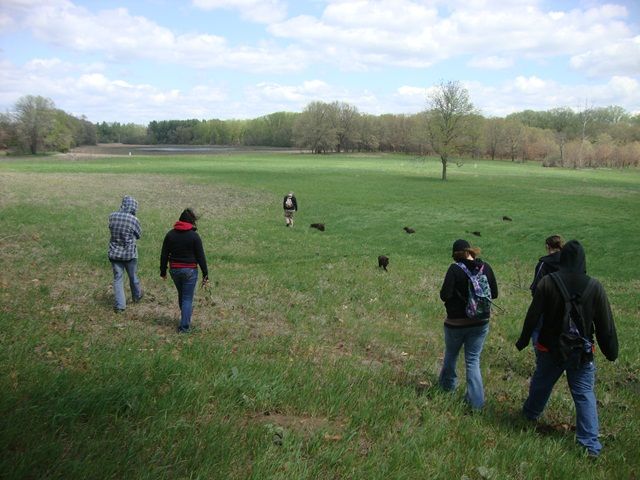
Part of our job was to supplement the dog surveys again with visual surveys.  The wet weather cold weather was hampering success.  Aside from affecting how long scent persists, the cold also meant the box turtles were probably not moving much (in other words, not leaving very long scent trails).
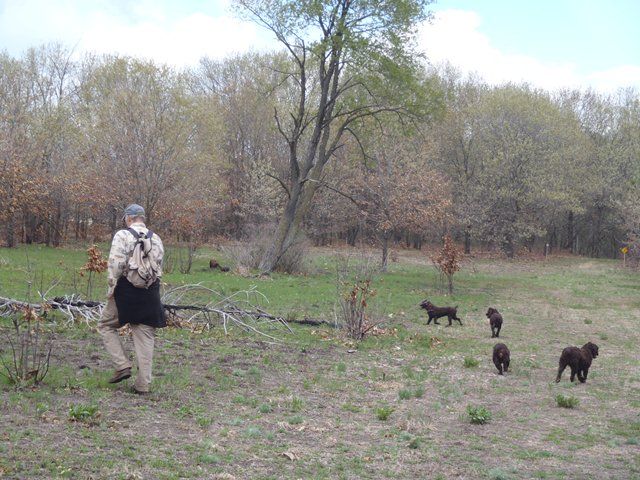
Yet, the dogs were happy and would not be deterred!
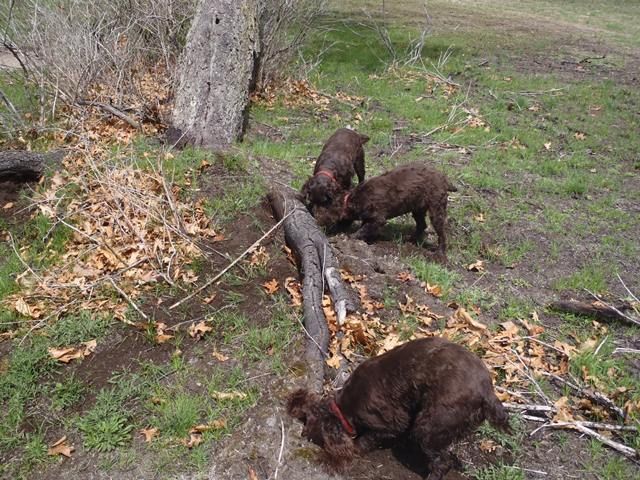
 
....soon a cry went up that they had found a turtle!  A sweet little female....
 
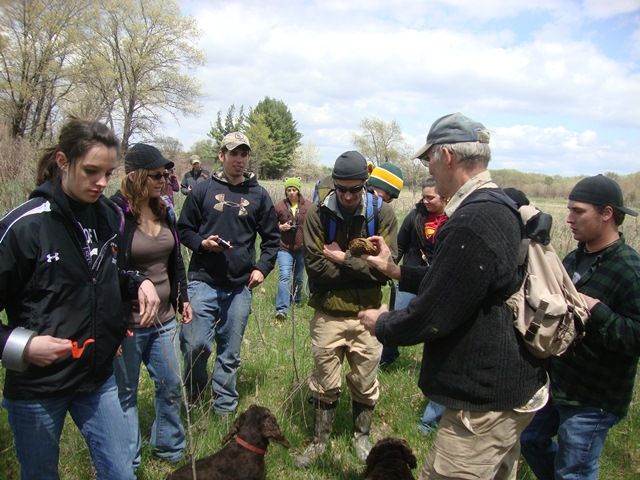
So...it was our turn to shine.  Every time a turtle was caught (via dogs or visually) our students were jumping to their tasks.  In addition to assisting with the visual surveys, the students were responsible for flagging the location of capture with a number, putting that number on the turtle with marker on duct tape, getting a GPS reading, and bringing the turtle back to "base camp" for later processing.

Once the first turtles were taken back for processing, we continued on-ward....looking for more turtles....
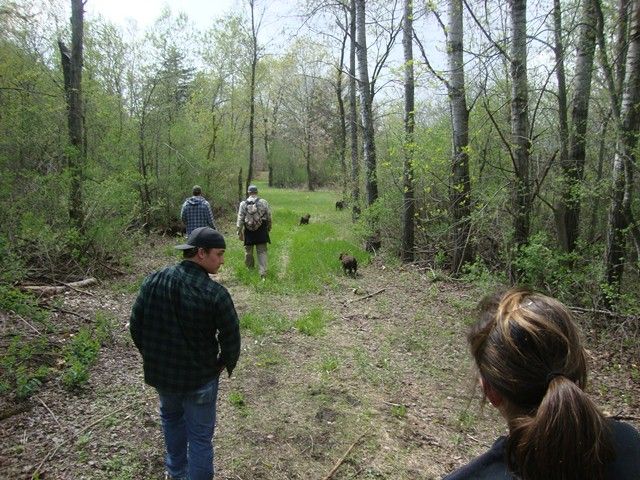
Although the dogs were successful, we had nearly equal success doing visual surveys as the dogs did that day.  This is was much different than what I experienced in NC, and really enforces the importance of environmental conditions in the success of the dogs.

Ultimately, between the dogs and our own prowess, we found a decent number of turtles across the sites we surveyed.
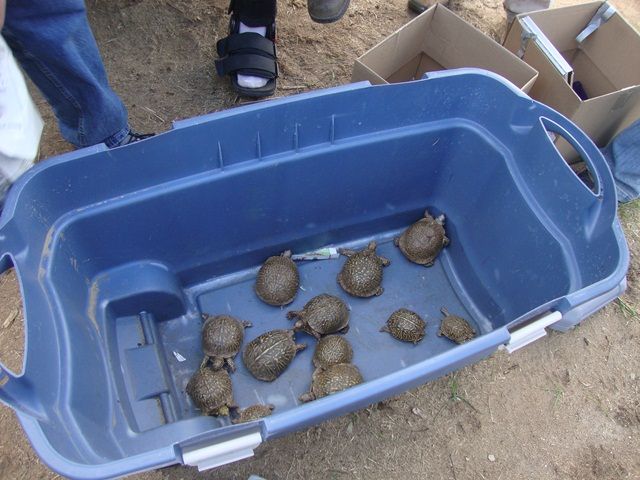
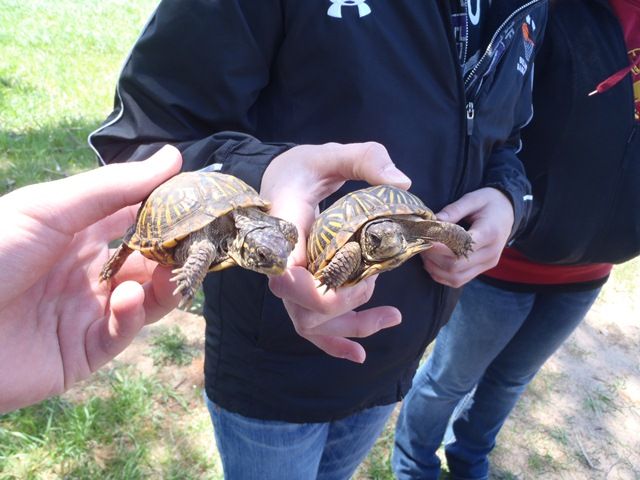
These turtles above were all found at one of two sites we visited that day.  These were found by a combination of dogs and people
Photo by R. Jacques

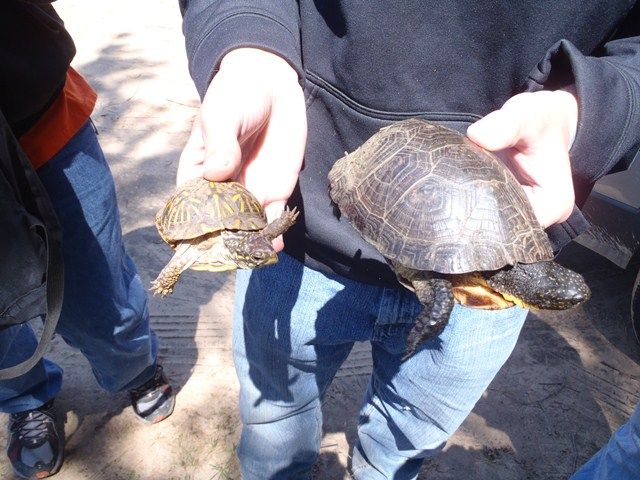
The students also got to see a nice adult Blanding's Turtle (Emydoidea blandingii) that just happened to be on the roadside as we entered one of the box turtle sites....
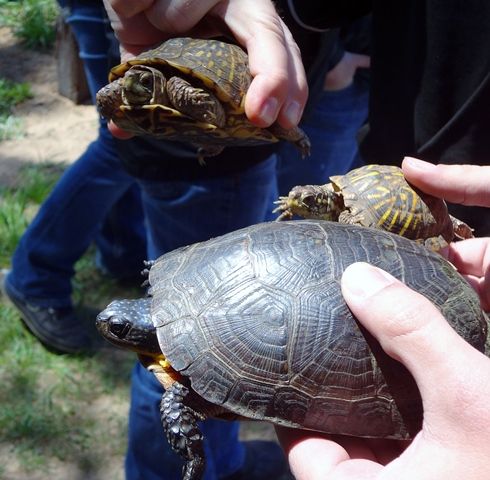
A Blanding's Turtle (foreground) and two Ornate Box Turtles (Background)
Blanding's turtlees are aquatic, unlike the Ornate Box Turtle, which is fully terrestrial (land-dwelling).  Yet, the Blanding's Turtle has a higher domed shell than most of the aquatic turtles that folks are familiar with, such as Painted Turtles (Chrysemys picta).  The Blanding's also has a bright yellow chin and yellow plastron (lower shell) with dark patches on each scute. 

Note the yellow just barely visible on the chin of this Blanding's Turtle above (right)
Both of these species are very rare in our neck of the woods.  Loss of habitat (prairie for the Ornate Box Turtle and wetland for the Blanding's Turtle) have greatly impaced both species.  Their very slow development and high nest/offspring mortality rate also works against them, as with the Ornate Box Turtle.  Blanding's Turtles, for example, can take nearly 20 years to reach sexual maturity!

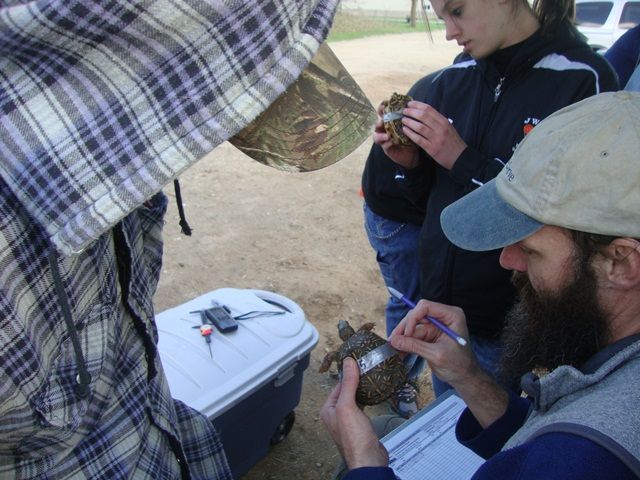
So....the turtles were gathered up and the students helped in weighing, measuring and marking the turtles prior to their return...
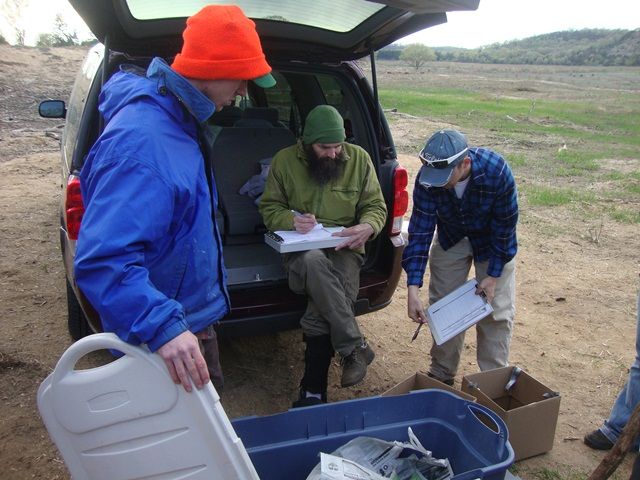


And, finally, the Pièce de résistance.....

One of the goals of these dog surveys was to assess how effective the headstarting program had been for the Box Turtles.  We were about 12 or 13 years post-initiation of this program in the state, which means that some of these headstarted individuals released at the beginning could now be sexually mature.

If it could be determined that some of the headstarted females were gravid (holding eggs), that would be a very good benchmark for success.

Luckily, the folks from a university further south were there with a portable ultra-sound unit to see if any of the gals might be carrying babies....
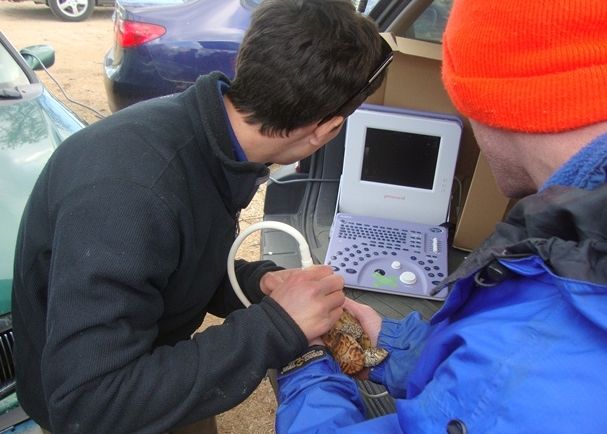
Now...while I don't want to give away all of the suprises....I will say that the gals examined with the ultra-sund looked to be carrying alittle extra baggage :)

And, so it was that our first day of turtle surveys ended.  The surveys were mostly successfull and my students made me very happy, by doing such a great job (the state regulators we were out with commented on this to me as well).

Did I say "first day"?  That's right!

More to come!
Thursday, July 14, 2011

The Turtle Dogs!

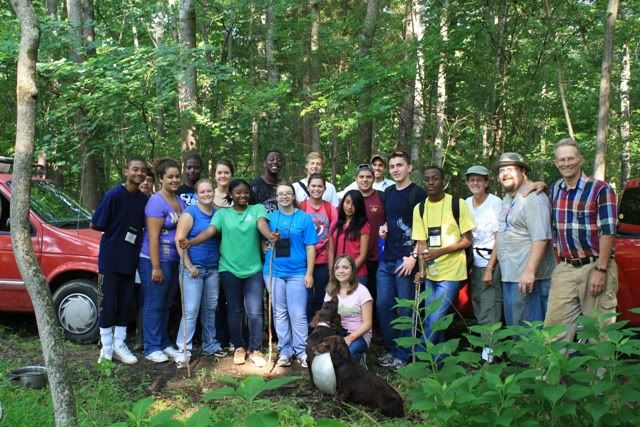
Above: the students, the teachers, the turtle dogs and the turtle dog master!
Photo courtesy of T. Tomasek

_________________________________________________________________________

Well, this week it was hot.  Hot!  Hot!!  And humid.  Sticky, wet, humid.

Heat indices of over 100 on several days....and in the upper 90s every other day.

The worst is that humidity.  Air so thick ya feel like yer swimmin'!  You just can't cool off.  Especially when one is an over-weight male of Germanic/Irish descent (like me :)  )  the humidity is brutal.

Anyhoo, that really did a number on how many critters we caught this week during our normal drift fence and coverboard surveys.  The total captures were down from the last two weeks.

So, that should result in a boring survey round up for this week right?

WRONG!

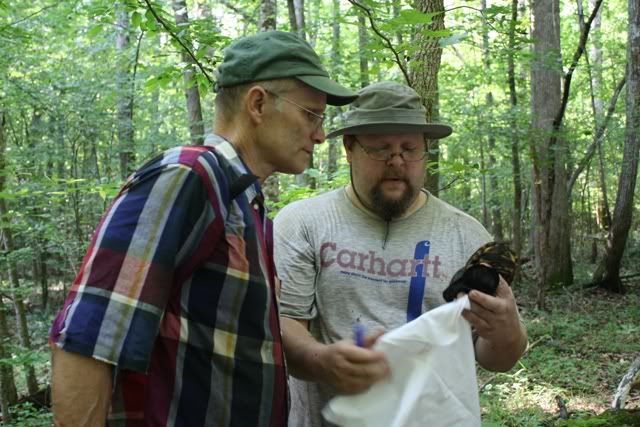
This week we got to take part in one of the coolest things I've been involved with in years.....the use of "turtle dogs" to survey for Eastern Box Turtles (Terrapene carolina) at one of our survey sites.

__________________________________________________________________________

A colleague here at the university has a doctorate in Science Education.  Luckily for me, she also likes amphibians and reptiles!  She created a summer herpetology class for high school students who are interested in going to college. She recently wrote a successful grant to help design and fund this curricula..... and with some of that money she wanted to expose her students to doing surveys with turtle dogs.

Lucky for me, she also wanted to use one of my study sites (which is great, 'cause as much as I wanted to experience turtle-dog surveys....I have not got any money!).

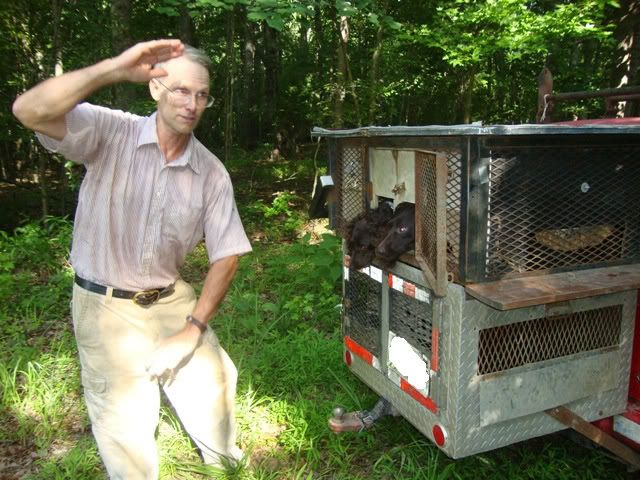
Meet John Rucker (below):  box turtle enthusiast, naturalist, outdoorsman, and turtle dog master!!


Above: John preparing to release the dogs from their holding crates on the back of his van.

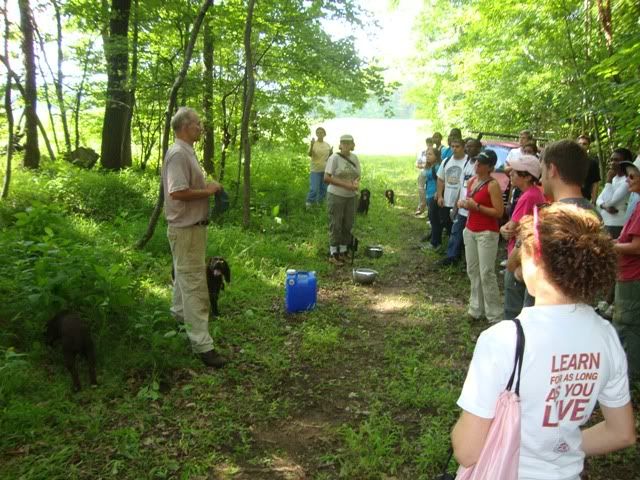
Above: John explaining the process to some students.

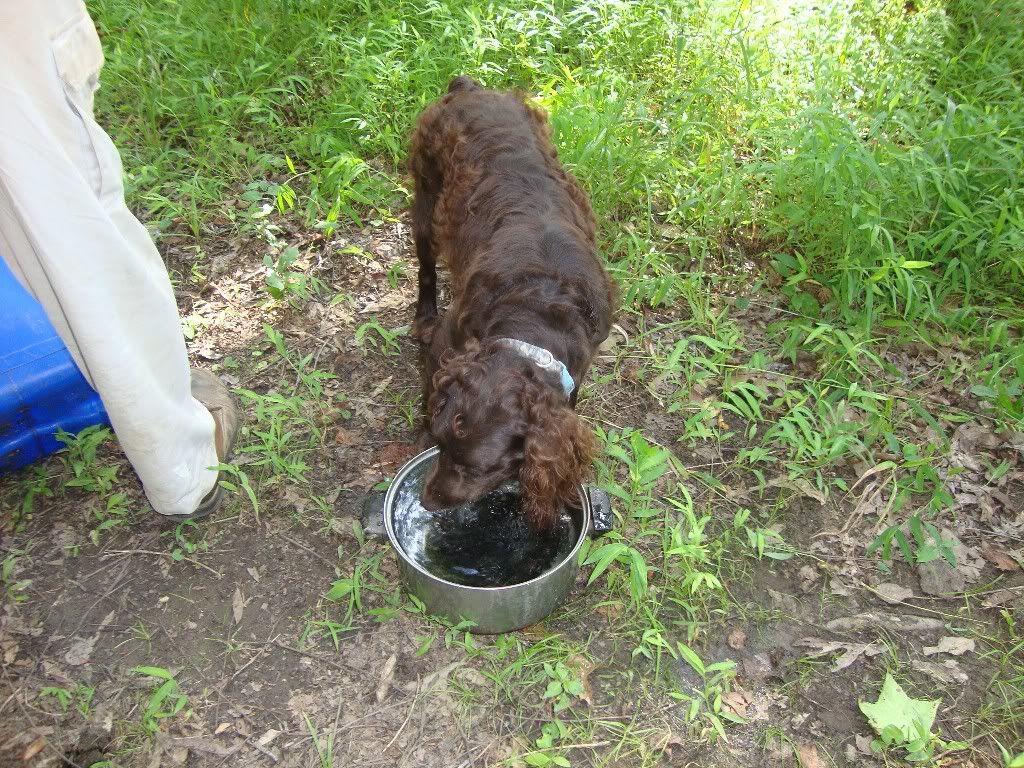
Above: one of the Boykin spaniels who ran turtles for us.  I can't remember this one's name.  Although John brought 8, we worked most closely with three: Mink, Greta, and Ginny Ray.


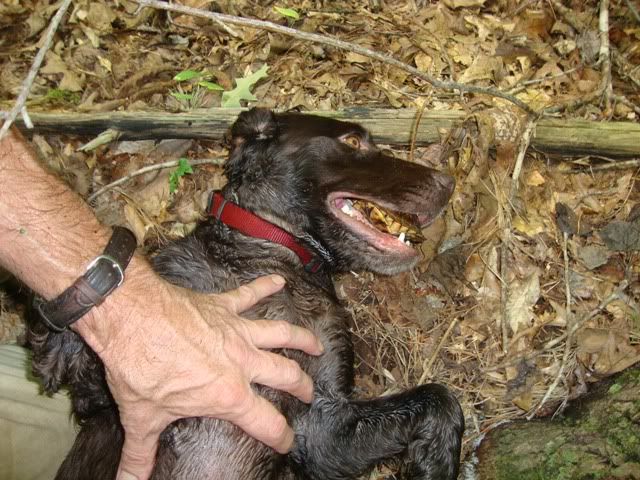
John drove from Tennessee with his fine pack of 8 Boykin Spaniels.  With noses like these canines have...they can sniff out whatever you teach them to find.  Some folks teach their spaniels to retrieve waterfowl they've shot.....some teach theirs to flush quail or pheasant.....John taught his to find turtles!   John charges a very reasonable price for his services, and because of this has done work all over the U.S.

Above: although we only ran a few dogs a day, the others got to be let out of their crates and staked to the ground with a lead to stretch their legs and get some water.


Not only can they find turtles, but they can do it while still thinking for themselves.....and surviving.

John told a story about a little gal of his named Greta that brought this point home brilliantly.  He was in the Badlands of South Dakota...working for a group that was having his dogs look for Ornate Box Turtles (Terrapene ornata).  At one point, Greta caught the scent of a Pronghorn and was gone.....John said they were specks on the horizon before he even realized it.  He waited (his dogs usually come back), and looked for hours....no Greta.  He slept in his van out at the spot he last saw her, hoping she'd return....no Greta.  He figured she had been taken by the land, some Coyotes....or perhaps a Cougar.  But just in case, John had his girlfriend place an ad in the local paper and hoped for the best.

Fourteen days later, he gets a phone call.  The dog had showed up on a rancher's property some 30 miles away.

Now, this work was conducted in an area where a lot of feral dogs run.  The rancher apparently has a policy that any feral dog that comes on his land is shot just as fast as he can get to his pistol.  But serendipity worked in Greta's favor.  The back door of their house happened to be open.  Apparently, the rancher's wife was working at the laundry machine when she felt something nudge the back of her leg.  She turned around and there was sweet little Greta.  Face covered in ticks....ears sticking straight out from all the cockle-burrs....alittle skinny and dehydrated....but alive.

The rancher announced he was going for his gun, but his wife told him to wait.....there was just something different about this dog.  Not a few hours later the rancher's neighbor happened to have seen the ad in the paper about the missing Boykin Spaniel and happened to call the rancher to let him know about it.

And that's how Greta survived her 14 day solo tour of the Badlands.

_______________________________________________________________________

We had John and his dogs come to our study site for two back-to-back days.  During both days, we ran the same number of dogs, through the same area, for the same amount of time and let them catch as many turtles as they could find.

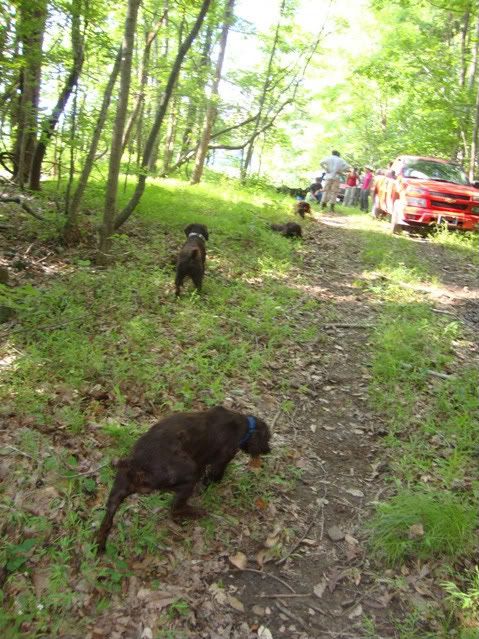
We started each day by taking the dogs to the area we wanted them to search (so they wouldn't become distracted with other scents).  Once we were to the right spot, the dogs went to work...and boy did they work!  The remainder of our time in the morning of both days was spent following and encouraging the dogs....letting them catch stuff...while we followed as fast as we could, flagging the site and bagging the turtles for processing.


Above: walking the dogs down to where the official surveys started.
Photo courtesy of T. Tomasek.

Above: the dogs at work!

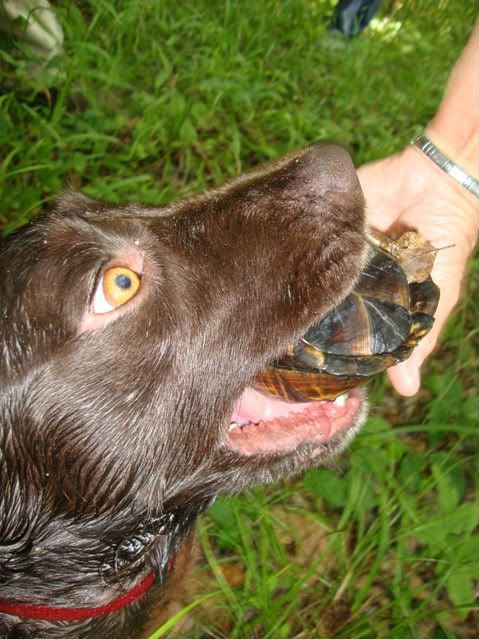
Above: Success!

Above: more success!!

Above: Bagging a breeding pair of turtles that one of the girls found.
Photo courtesy of T. Tomasek
__________________________________________________________________________

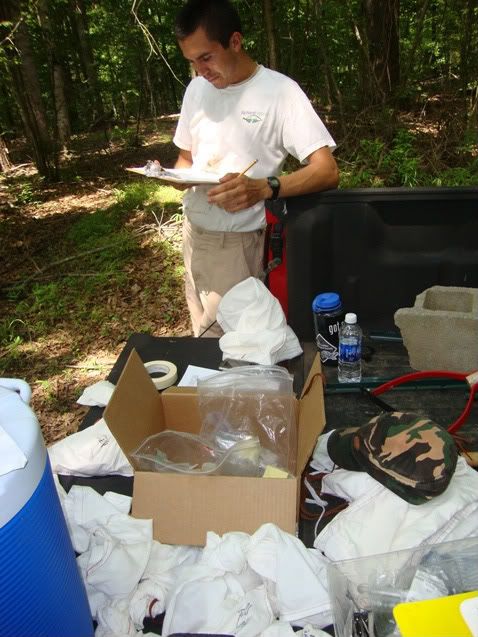
After a few hours of that (in brutal heat, I'll mention again)....the turtles were brought to a central location and important morphological data was recorded.  After the turtles were weight and measured, we gave each a unique mark so they could be identified in the future.  We ended by walking each turtle back to its original capture location using a GPS and looking for the appropriate flagging.

Above: My undergraduate research assistant, Dave, processing the turtles

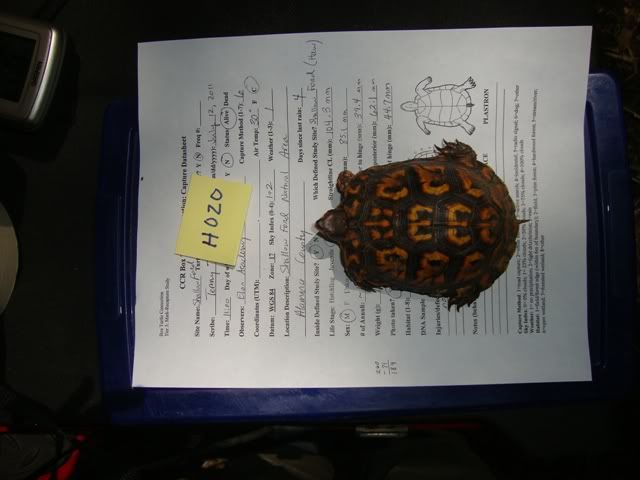
Above: a turtle with standard data sheet.

By the end of that...usually anywhere from 1:30-2 pm...we were all tired and soaking wet with sweat....but did we ever have fun!

So let me put this into perspective for you:  from last August (2010) until this Monday...between myself, Dave, and all of my Wildlife Ecology students last fall....putting in a total of over 300 person hours on this property....have found about 22 Eastern Box Turtles.

In a total of 3 hrs over two days....these dogs found 25!  This includes 5 juveniles (of which I think I've seen ONE previously).

You know what I say to that?   Who's a good dog!?  Who's a good doggie? 


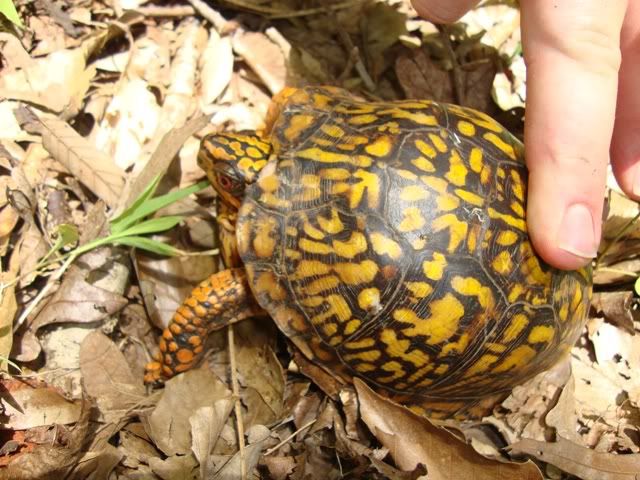
Above: Turtle number H023.  One of the turtles originally captured on day one, who was recaptured during day two of the surveys.