Showing posts with label teaching. Show all posts

Wednesday, February 5, 2014

A Year-Old Tale of Romance (and how my students uncovered the continuing story....)

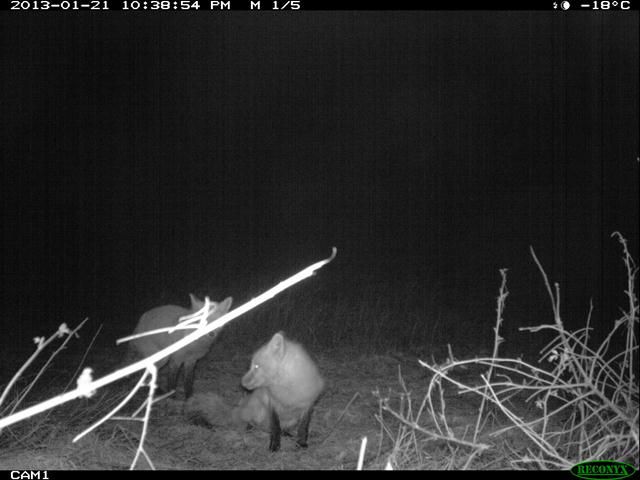
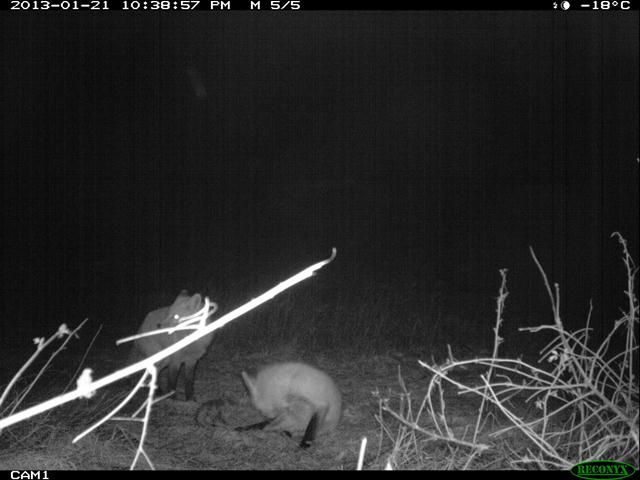
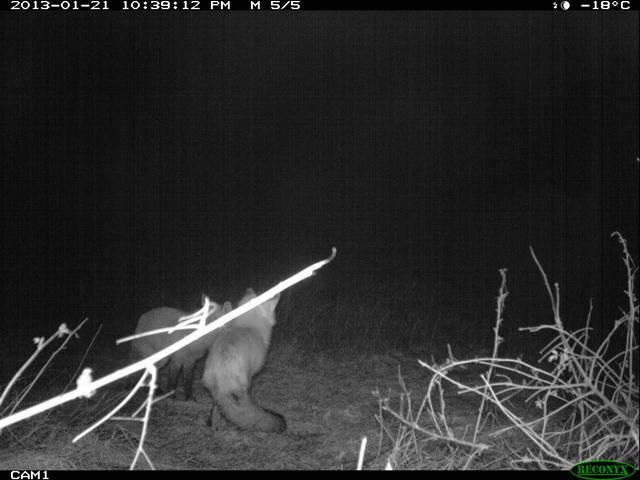
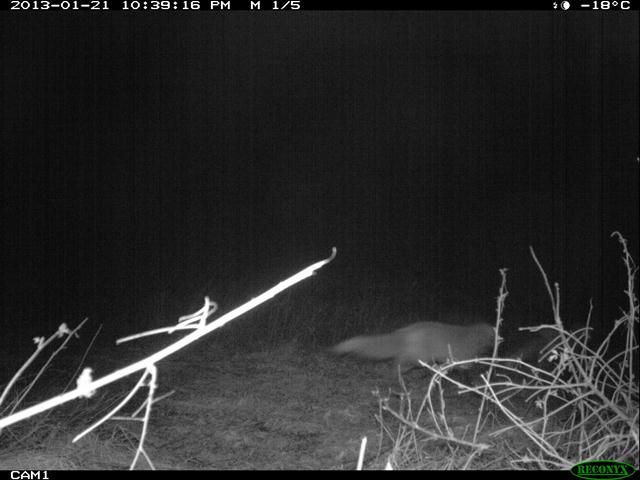
Happened across these pictures recently and can't believe I didn't post them before...

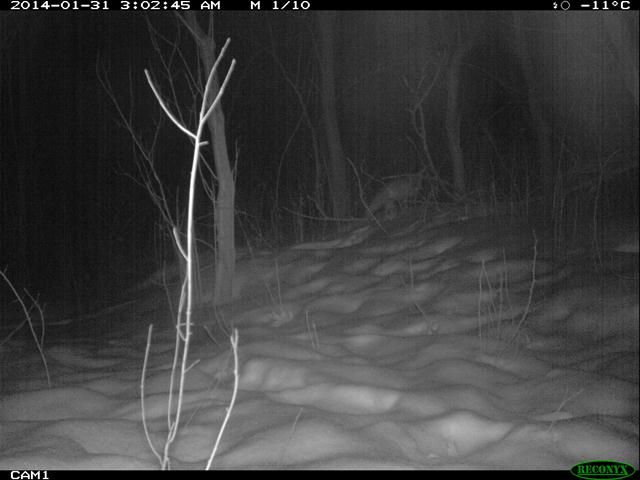
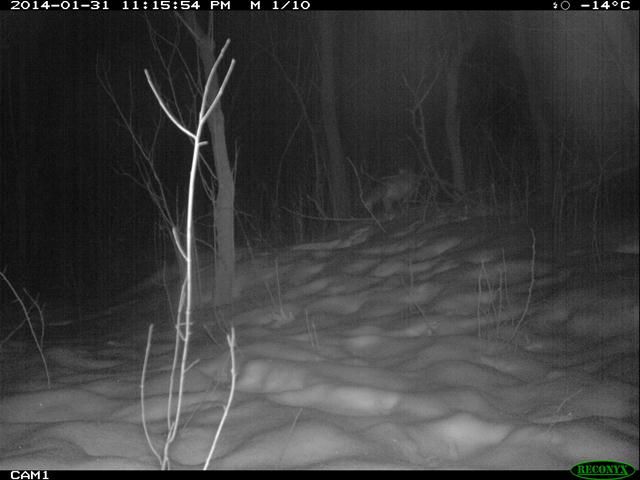
Last January, I happened to get pictures of two twitter-painted Red Fox (Vulpes vulpes)...they were together smack-dab in the middle of the fox breeding season 'round here (which is usually January/February).


I'm willing to bet that this is the pair whom are responsible for the pup we caught pictures of on the same site several months later (see here)....

So...the ATV activity this summer really cut down on the number of fox pictures we got on the cameras for awhile.

But....much like with the Coyotes....that has changed this winter.  However, I wasn't sure if we would see any kind of breeding activity or evidence this year.  I thought that if the ATVs scared them off this summer, they might not consider it safe enough for breeding again.

Which leads us to my Advanced Ecology class this year (which is a class I've posted about during past years...see examples here and here).

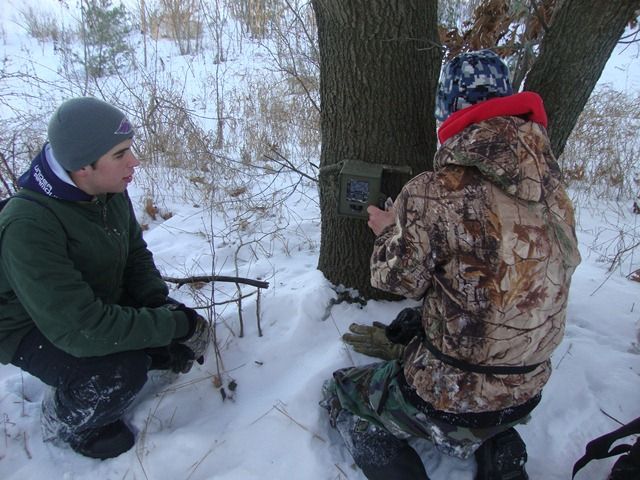
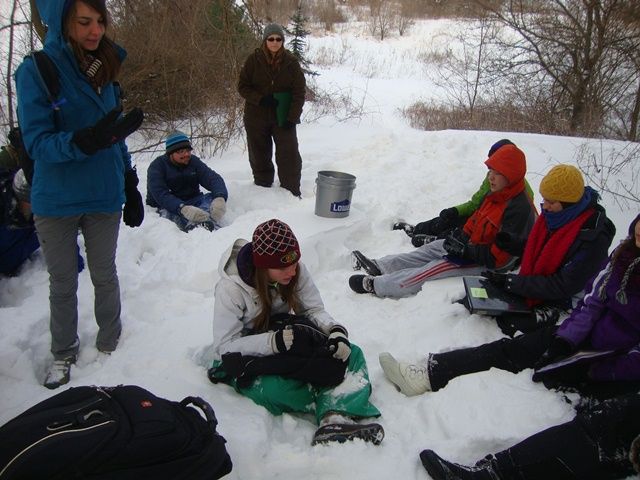
Two weeks ago, the students deployed their camera traps for a semester of monitoring. 

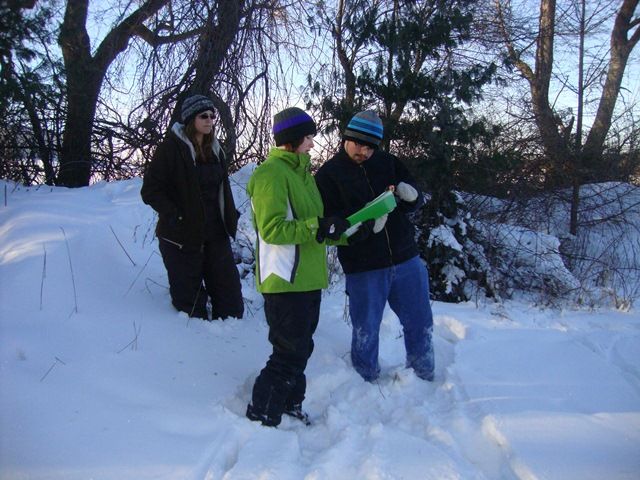
They also spent some time assessing the habitat communities on-site and using GPS units to delineate community boundaries.


This gave them a chance to get a good feel for the property we are working on, and make some important observations.

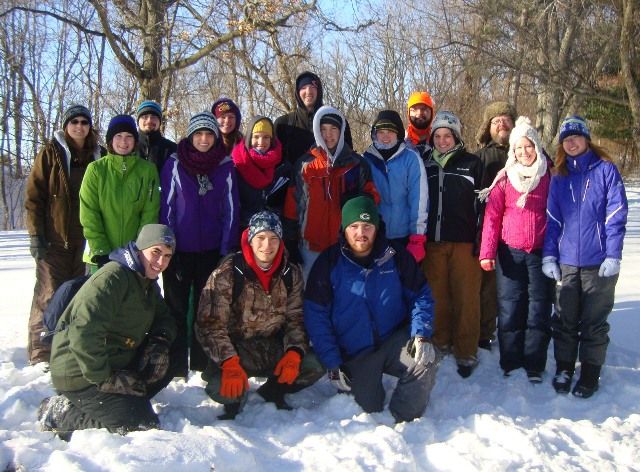
Now, zoom forward to this week.  We gathered on-site to begin our weekly exercise, while also checking camera traps, etc.

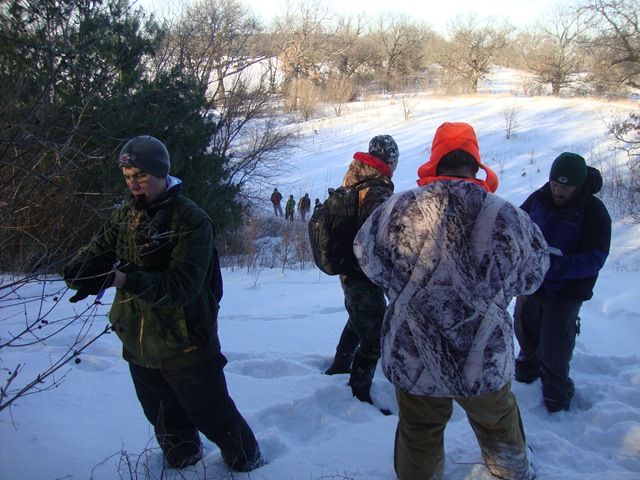
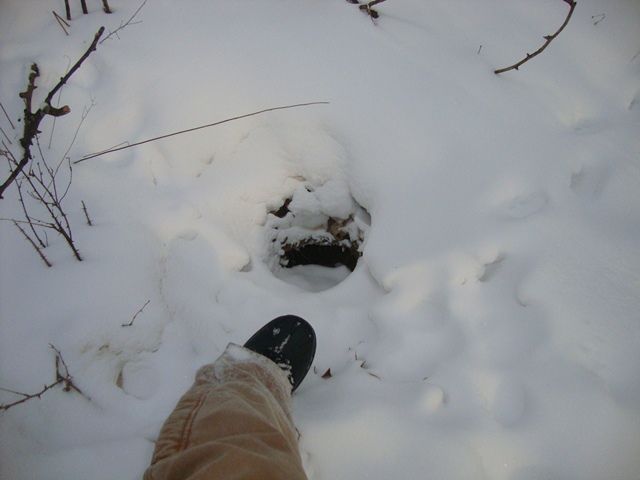
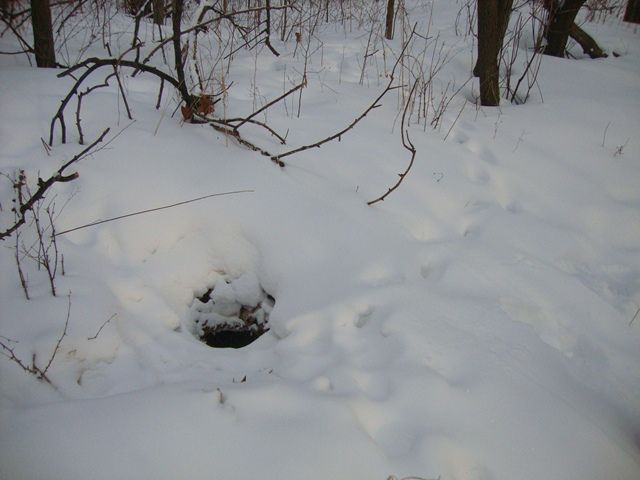
Not long after we got started, one of the students called me over to their camera trap location to show me a burrow he had found.  In the picture below, the student is standing about where the entrance to the burrow is located.

He's pretty critter-savvy (experienced hunter and trapper).  We agreed it was in the size range for Red Fox....

There were clearly tracks heading to the entrance and it appeared to be active.  But we had snow the night before, so it was hard to tell (a) what species left the tracks and (b) how recently the burrow was used.
 

Could it be a pair of Reds is making a nice little love nest in which to rear their pups again this year?

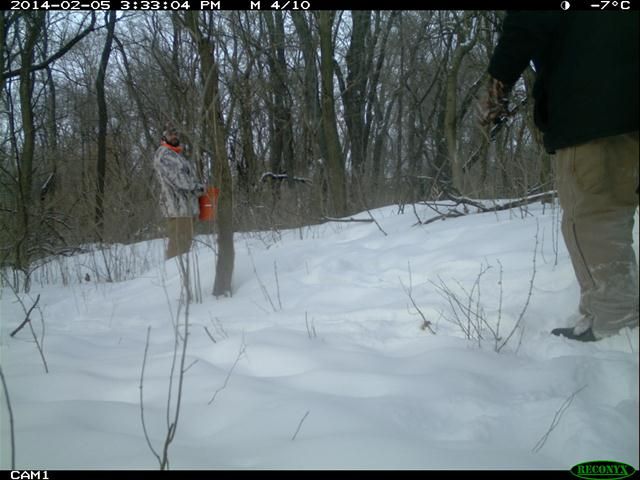
The nearby camera trap the students put up gave us reason to be hopeful.

Here is our first glimpse of a fox leaving the den.  Not a great picture, unfortunately, but you can tell its coming out of just about parallel to where the student is in the picture above.
...and again later that evening...

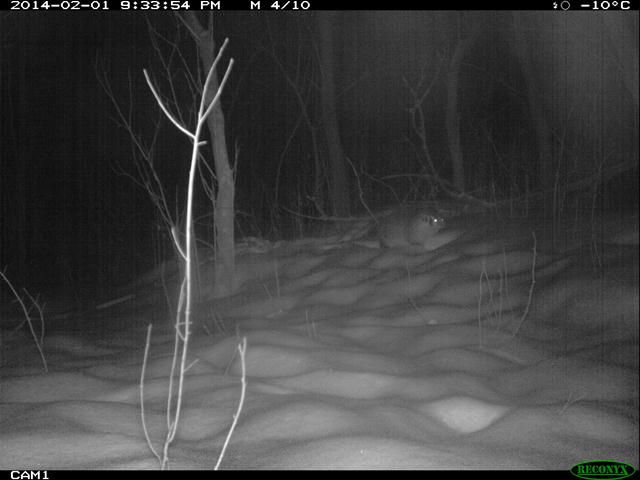
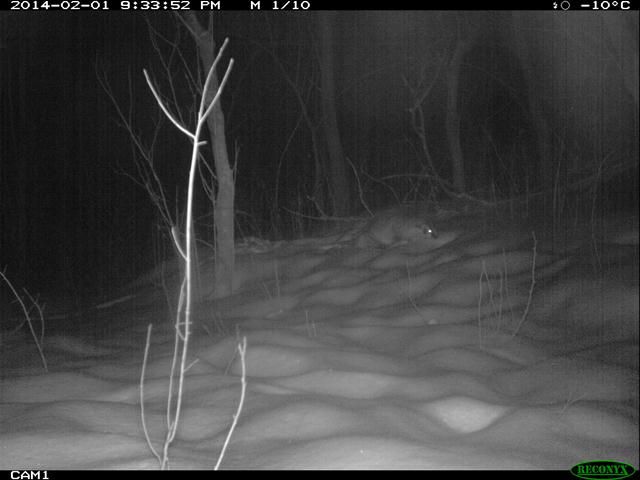
 Then...just to give us something to brag about....our resident Badger (Taxidea taxus) lumbered by for a sniff.
 

 So fingers crossed that we will get a repeat of the fox pups this year!  Always fun to get pictures of them....

Sunday, September 22, 2013

The End of the 2013 Herp Season Approach-eth....but there are still TURTLES!

The beginning of the semester sort of stinks.....

The collision of the field season and the school season means there isn't a free second.  We have three projects still in the active data-collection phase, which we are trying to coordinate schedules for....and everyone has class (students) or teaching/grading (me).

All of that will change sooner than we think, though.  We are in that time of the year when weather becomes highly variable.  Last week, for example, we had a high of 90 deg. F on Tuesday, and a high of 63 deg F on Friday.  This week we had two days in the mid-80s, while today it was in the mid-60s over the weekend.

That means Fall is coming, which also means the cold-blooded critters will be going down for the winter very soon.

So....thought I'd share some late-season "herpstuff".  Mostly a random conglomeration of neat things seen over the last few weeks.

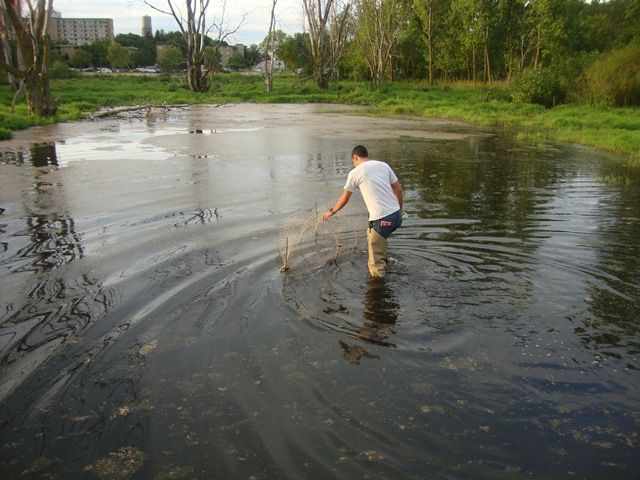
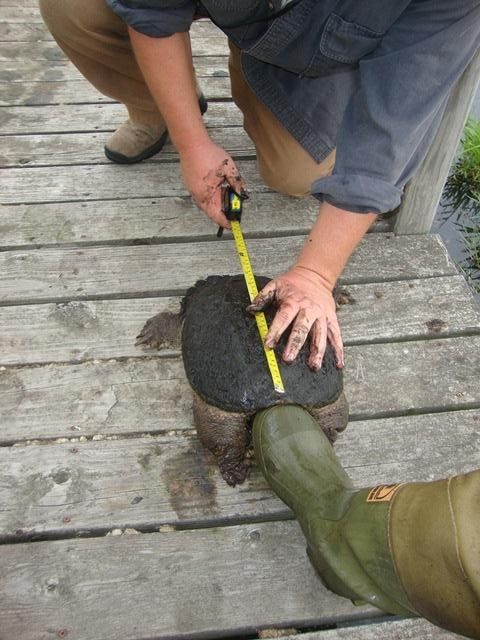
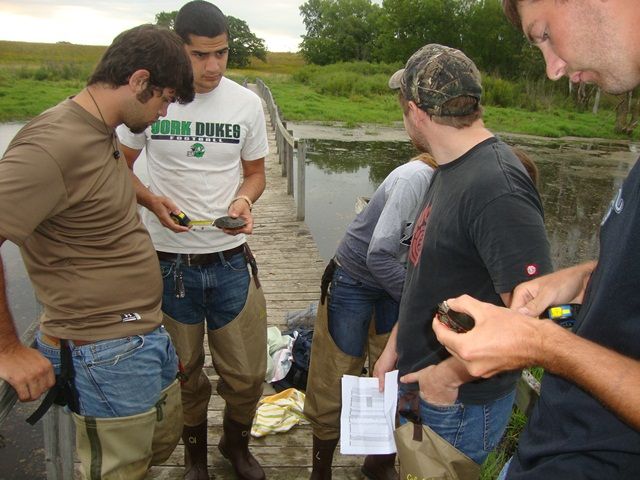
Our 200-level Field Methods in Ecology class had their annual day of turtle trapping and marking (see here for last year's haul).  This year was another great one.  By luck, we got to take advantage of the last few good days left for trapping before the turtles started to focus on hibernation (and, thus, aren't as attracted to bait). 


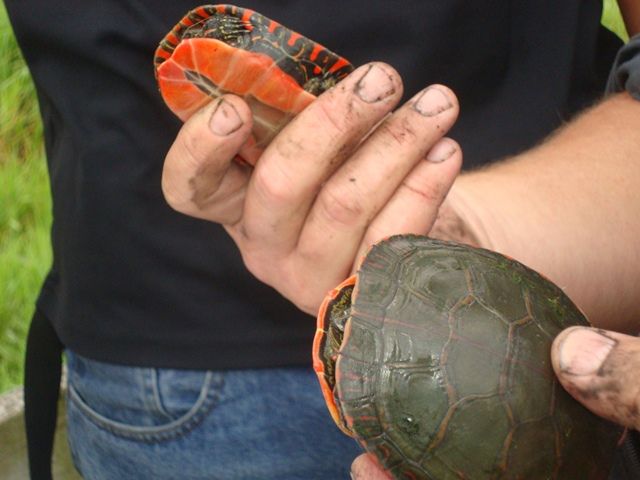
We set traps out for two days straight.  Day 1 yielded some nice little Painted Turtles (Chrysemys picta)........

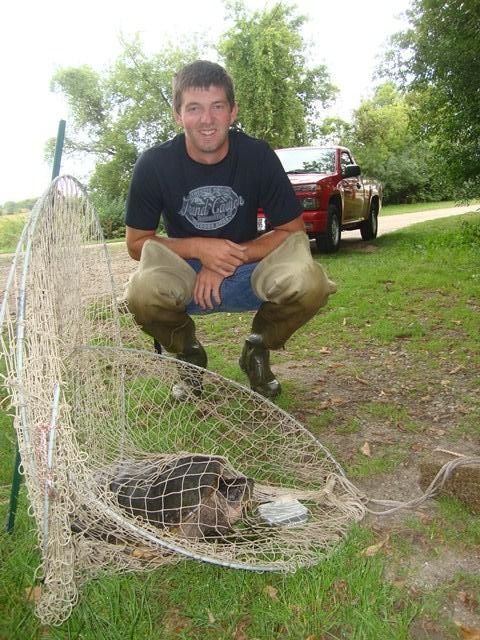
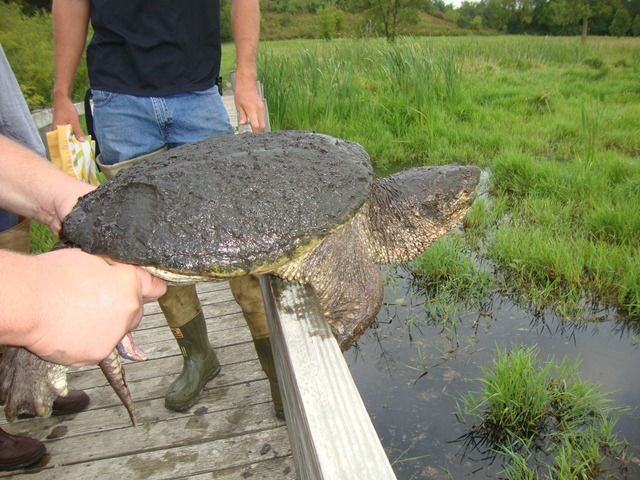
........ and of course some nice Common (northern) Snapping Turtles (Chelydra serpentina).


On Day 2, however, our traps were nearly exploding with turtles! 

A ton more Paints....

.....no Snaps (suprisingly)...BUT...a much rarer find: a Blanding's Turtle! (Emydoidea blandingii). 
Photo courtesy of T. Gotrik
In three years of trapping this location, we've never caught a Blanding's Turtle before.....

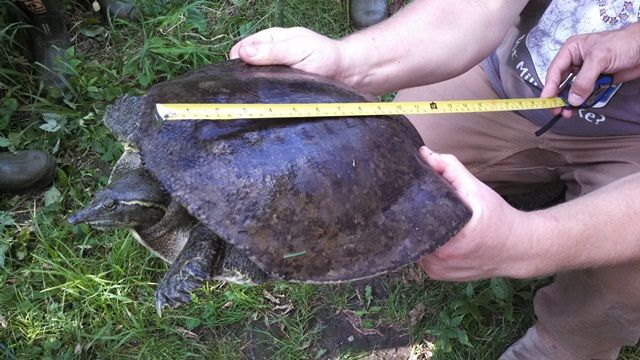
We also trap the nearby creek...and this year got another first: a Spiny Softshell Turtle (Apolone spinifera).
Photo courtesy of T. Gotrik

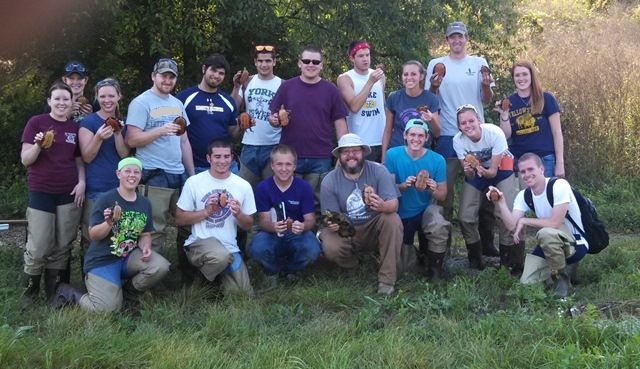
The students were pretty excited (and so was I).  In the end, we caught 26 Paints, 2 Snaps, 1 Blanding's Turtle and 1 Spiny Softshell.

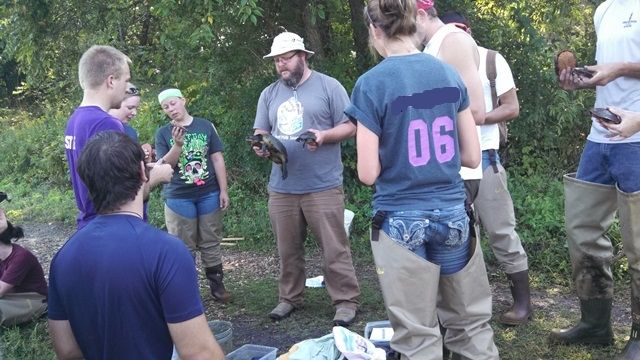
Enough turtles for everybody to be able hold at least one in a group photo!
Photo courtesy of T. Gotrik

The students worked hard and enjoyed themselves....even when hip waders weren't quite enough to keep them dry....


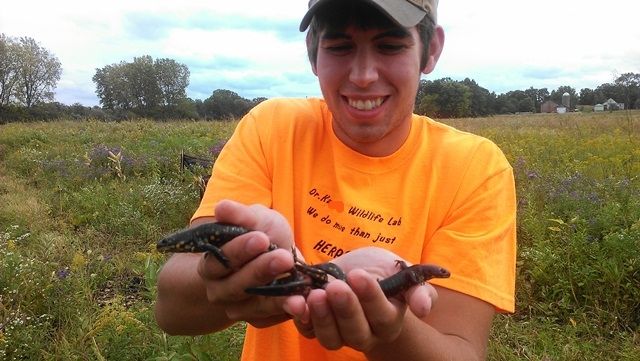
OH...and it's the time of year when salamanders are migrating from their summer ponds, to where they will spend the winter.

As we found out when checking our drift fences recently.....
Tiger Salamanders (Ambystoma tigrinum).
Photo courtesy of N. Rudolph


Blue-spotted Salamanders (Ambystoma laterale)
Photo courtesy of N. Rudolph

Monday, June 10, 2013

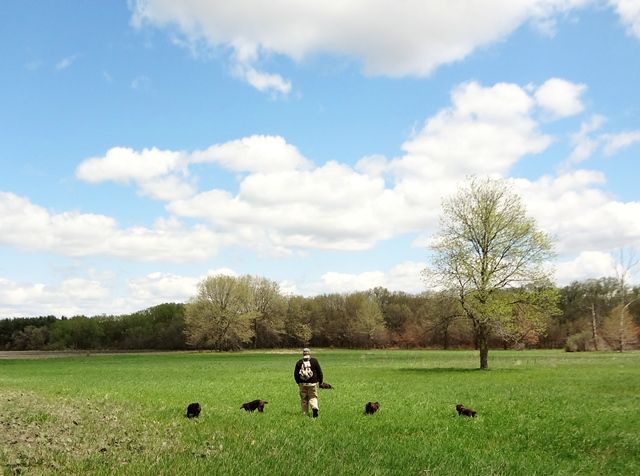
Return of the Turtle Dogs!!

Photo by S. Wyrick

Sometimes I can't believe my good fortune.

But, as a wiser man than myself once said: "It's better to be lucky than good".  Can't remember who actually said it....but I'm pretty sure I first heard it from my dad.

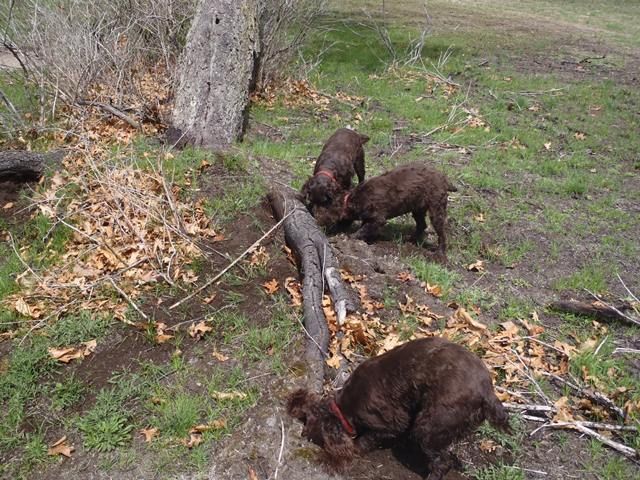
Anyways.....those of you that have read my blog from the beginning (a small group, to be sure :)  ) might remember my past adventures with John Rucker and his Turtle Dogs.  This was back in 2011, when I still lived in North Carolina.  After my experience with John, I raved about the Turtle Dogs to my colleagues who work for the regulatory agency in the state where I currently live.

Well, this apparently snow-balled until....lo-and-behold.....John and his Turtle Dogs were up here this spring helping the state wildlife folks with surveys.  This time, however, we were not looking for the Eastern Box Turtle (Terrapene carolina) from down in NC.  The goal this time was the incredibly rare, and protected Ornate Box Turtle (Terrapena ornata). 

Turtles, in general, have it pretty rough.  They are slow to mature (taking decades in some species), they often experience reproductive failure (their nests are the focus of many mesopredators, like Raccoons, Skunks, Red Fox, Opossums); and even if the eggs survive, the hatchling turtles are bite-sized morsels for all of those same predators.  If anthropogenic influences were not a factor, being long-lived (and, thus, having many possible reproductive events possible in one's life) can help off-set high nest and juvenile mortality.  Yet, we no longer live in a land where anthropogenic influences can be avoided.  Habitat loss (particularly nesting habitat) have forced turtles to concentrate nesting activities in smaller and smaller suitable areas...where they are easy to find by mesopredators (who learn to return annually and can decimate a population's reproductive success).

One strategy to help off-set the low recruitment that many turtle populations experience is referred to as "head-starting".  Head-starting programs usually involve the harvesting of eggs from fresh turtle nests, the incubation of those eggs in captivity (so they avoid the nest-predators) and the eventual release of the hatchlings.  There are many pros and cons to head-starting of turtles that can be discussed.....but I feel this post is already growing a bit "wordy"...so we'll plunge on. 

But, the strategy of head-starting turtles becomes important later in my post.

John and his dogs worked with state regulators for the better part of a week in early May, surveying various sites for turtles.  Trying to assess populations and re-confirm box turtle presence at some of these sites.  Another goal of the dog surveys was to catch as many previously head-started box turtles as possible.  The head-starting program for this species in the state was instigated about 12 years ago....and many of the first head-started individuals should be of (or near) sexual maturity.

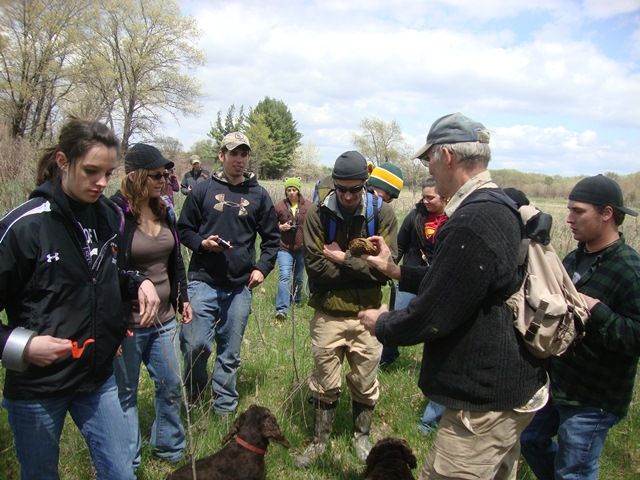
The best part?  Well, my colleagues at the state agency agreed to allow myself and a number of my students come with for a day.  This was a rare opportunity: using a unique survey method to catch rare species.  We needed to be at the top of our game! 

And, as usual, the weather was not on our side.....cold, windy and rain the night before.  Rain isn't good if you need dogs to follow a scent trail.  But...not much could be done about it. 

We also planned on spending alot of time pounding the ground doing visual surveys for turtles that the dogs may have missed due to poor environmental conditions.

We were scheduled to meet the dogs et al., at about noon.....but decided to start early and survey a site without the aid of dogs to help supplement their later surveys.

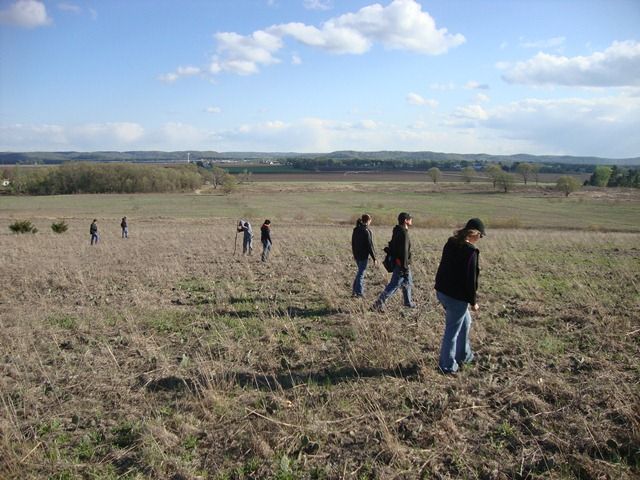
So our boots were on the ground by 10 am, and we walked parallel to eachother across the survey area.....
 
Luckily, the herps were still out, despite the cold....although we had to get on some steep slopes to find them (like this little box turtle).
 
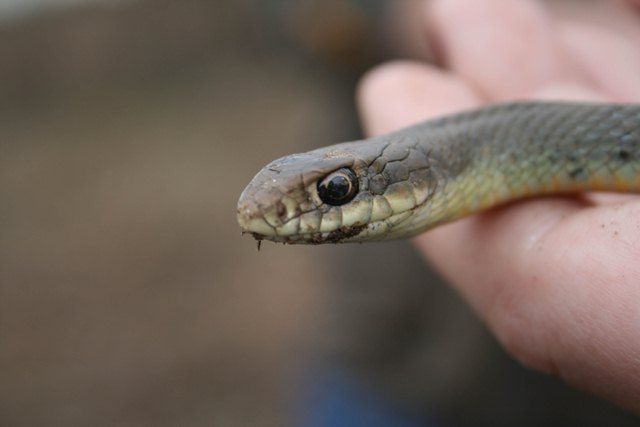
A nice Racer (Coluber constrictor)....
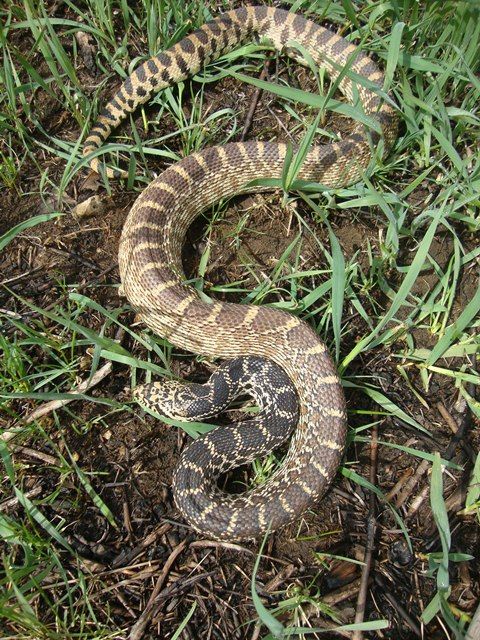
...and even a beauty of a Bullsnake (Pituophis catenifer sayi).....
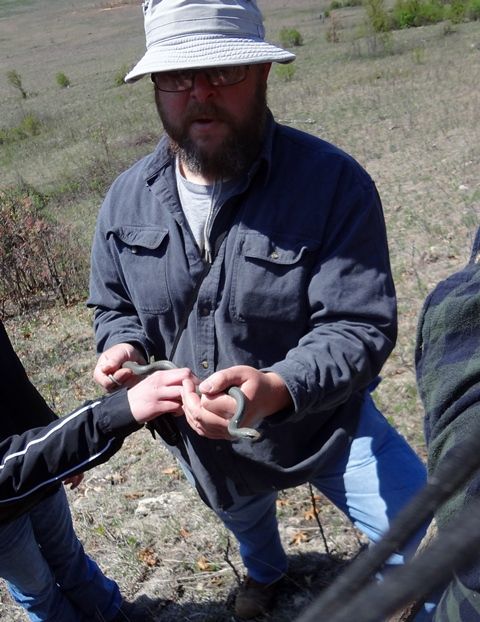
...this individual was nice enough to let us "probe" him.  Allow me to explain (very breifly below). 

The most definitive way to determine gender on a snake is to take a smooth and blunt metal stick (called a probe).  This stick is very thin and can be inserted into the cloaca of a snake (the area where the snake goes to the bathroom out of; see pic above).  If the probe goes in a distance that is approximately 1/3 of the snake's tail length, it's a male.  Why?  Because males have a bifurcated reproductive structure (or a structure with two "halves") called a hemipenis located there.   The hemipenis is essentially everted into the cloaca of the female during copulation.  They are often spikey...to help the male get a grip (no arms or legs, remember) while sperm is transferred.  When males are not copulating, these hemipenes are inverted inside the base of the tail....it is the inverted hemipenis that accommodates the probe so that it slides into the cloaca. 

If it's a female snake....the probe wont slide in.

Make sense?  See more here.

ANYWAYS......our first visual survey was successfull.  Overall, we found five box turtles....one Bullsnake and a few Racers.  By then, it was time to leave so we could meet John and the state wildlife folks at a different site. 

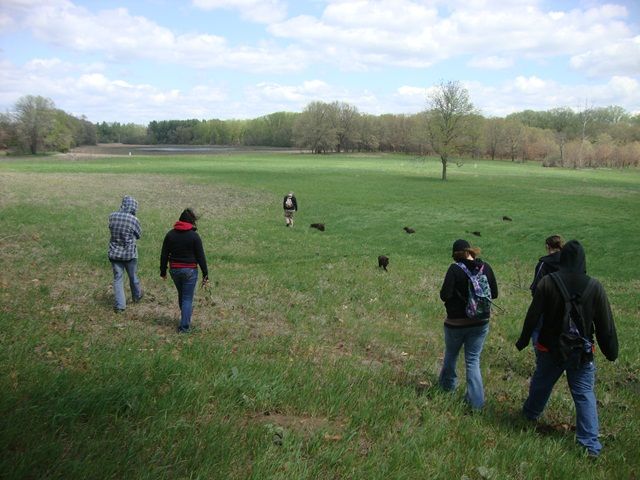
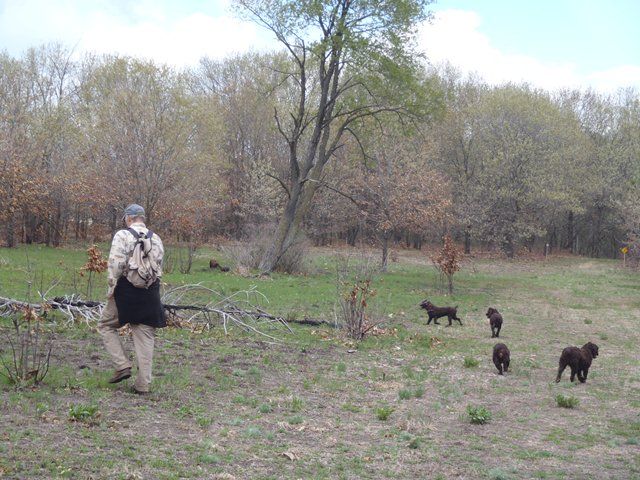
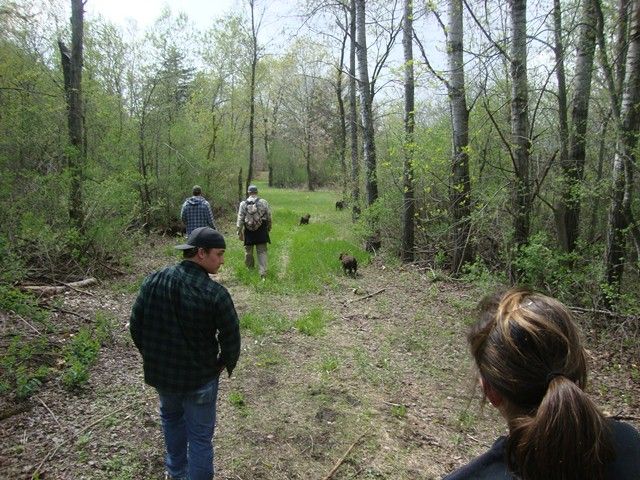
After our arrival, and general plan of attack was formulated, we headed out.  As a group, we hit the prairie, following John and the pooches as they went to work.

Part of our job was to supplement the dog surveys again with visual surveys.  The wet weather cold weather was hampering success.  Aside from affecting how long scent persists, the cold also meant the box turtles were probably not moving much (in other words, not leaving very long scent trails).

Yet, the dogs were happy and would not be deterred!
 
....soon a cry went up that they had found a turtle!  A sweet little female....
 
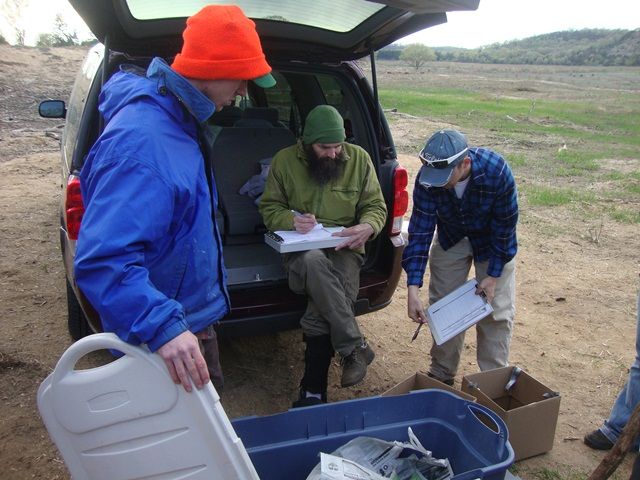
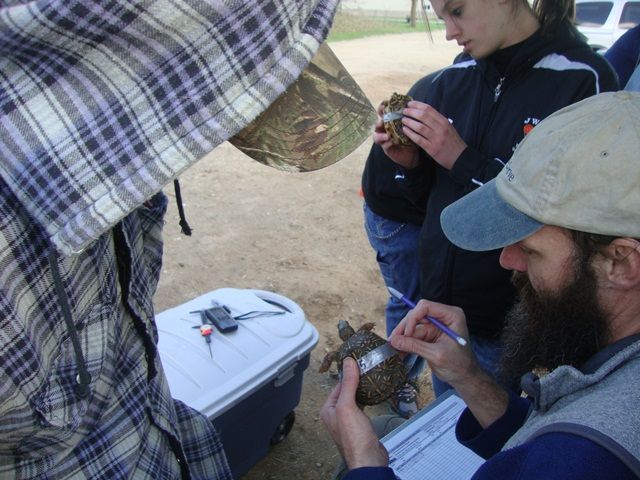
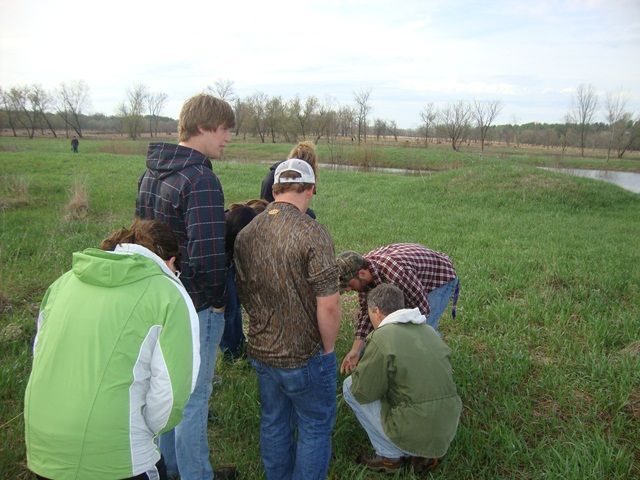
So...it was our turn to shine.  Every time a turtle was caught (via dogs or visually) our students were jumping to their tasks.  In addition to assisting with the visual surveys, the students were responsible for flagging the location of capture with a number, putting that number on the turtle with marker on duct tape, getting a GPS reading, and bringing the turtle back to "base camp" for later processing.

Once the first turtles were taken back for processing, we continued on-ward....looking for more turtles....

Although the dogs were successful, we had nearly equal success doing visual surveys as the dogs did that day.  This is was much different than what I experienced in NC, and really enforces the importance of environmental conditions in the success of the dogs.

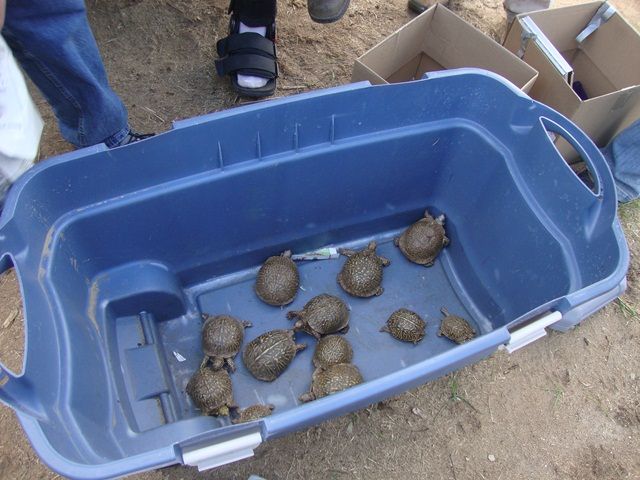
Ultimately, between the dogs and our own prowess, we found a decent number of turtles across the sites we surveyed.

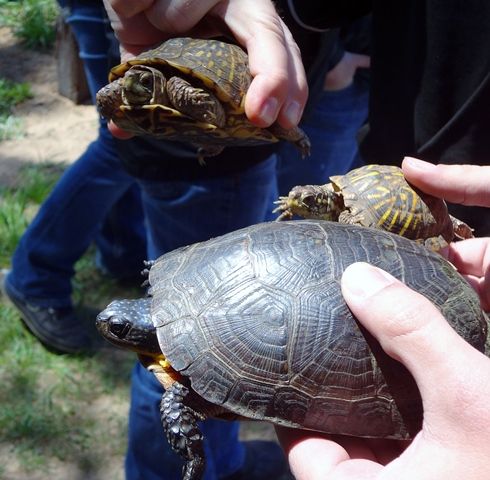
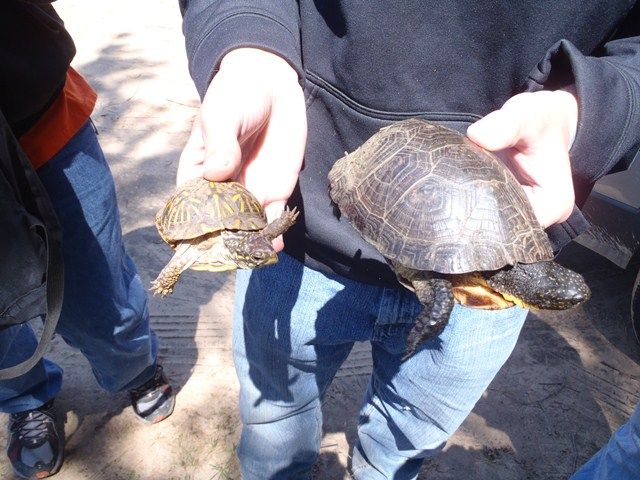
These turtles above were all found at one of two sites we visited that day.  These were found by a combination of dogs and people
Photo by R. Jacques

The students also got to see a nice adult Blanding's Turtle (Emydoidea blandingii) that just happened to be on the roadside as we entered one of the box turtle sites....

A Blanding's Turtle (foreground) and two Ornate Box Turtles (Background)
Blanding's turtlees are aquatic, unlike the Ornate Box Turtle, which is fully terrestrial (land-dwelling).  Yet, the Blanding's Turtle has a higher domed shell than most of the aquatic turtles that folks are familiar with, such as Painted Turtles (Chrysemys picta).  The Blanding's also has a bright yellow chin and yellow plastron (lower shell) with dark patches on each scute. 

Note the yellow just barely visible on the chin of this Blanding's Turtle above (right)
Both of these species are very rare in our neck of the woods.  Loss of habitat (prairie for the Ornate Box Turtle and wetland for the Blanding's Turtle) have greatly impaced both species.  Their very slow development and high nest/offspring mortality rate also works against them, as with the Ornate Box Turtle.  Blanding's Turtles, for example, can take nearly 20 years to reach sexual maturity!

So....the turtles were gathered up and the students helped in weighing, measuring and marking the turtles prior to their return...


And, finally, the Pièce de résistance.....

One of the goals of these dog surveys was to assess how effective the headstarting program had been for the Box Turtles.  We were about 12 or 13 years post-initiation of this program in the state, which means that some of these headstarted individuals released at the beginning could now be sexually mature.

If it could be determined that some of the headstarted females were gravid (holding eggs), that would be a very good benchmark for success.

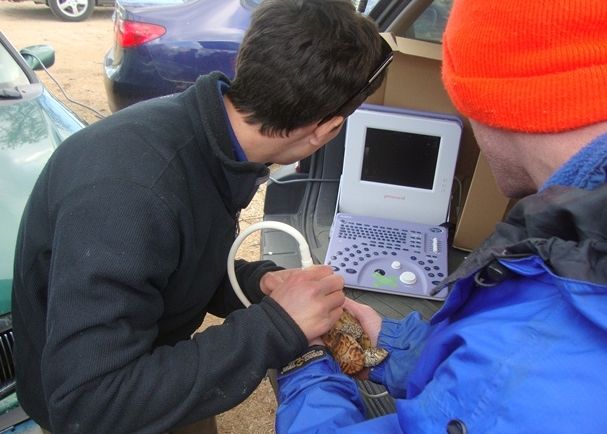
Luckily, the folks from a university further south were there with a portable ultra-sound unit to see if any of the gals might be carrying babies....

Now...while I don't want to give away all of the suprises....I will say that the gals examined with the ultra-sund looked to be carrying alittle extra baggage :)

And, so it was that our first day of turtle surveys ended.  The surveys were mostly successfull and my students made me very happy, by doing such a great job (the state regulators we were out with commented on this to me as well).

Did I say "first day"?  That's right!

More to come!

Saturday, May 25, 2013

Winter is for mammals....but summer is for HERPS!!!!

So much going on....

I guess I should start at the beginning of the real herp field season this year....and it began with a field trip that I took my advanced ecology class on.  This is the same trip we took last year, although back then we didn't have much luck finding the cold-blooded crawly critters.

The conditions were alot better this year, so we pulled out of the parking lot with feelings of hopefullness a few weeks ago.

After nearly 2 hours in the car, we reached the first of our destinations: a sand prairie/savanna located immediately adjacent to a large river.  The part of the property where we were given access to is primarily used by a retriever club.  As a result, there was alot of more typical "grasses" that one might fing in a homeowner lawn.  As we moved further away from where the club operates, we ran into the results of recent habitat management.  These activities involved removal of some un-desirable/exotics: common buckthorn (Rhamnus cathartica) and Honeysuckle (Locinera sp.).  While it's good to get rid of these troublesome species of vegetation, it didn't provide great "herping" habitat.....

Yet, there were several pot-hole wetlands on site and lots of downed debris that the critters we wanted could be hiding in.  The morning was still a tad cool, but the sun was quickly warming things.  I felt confident we'd find something....

It wasn't long before....success!  One of my students called out that they found a snake...

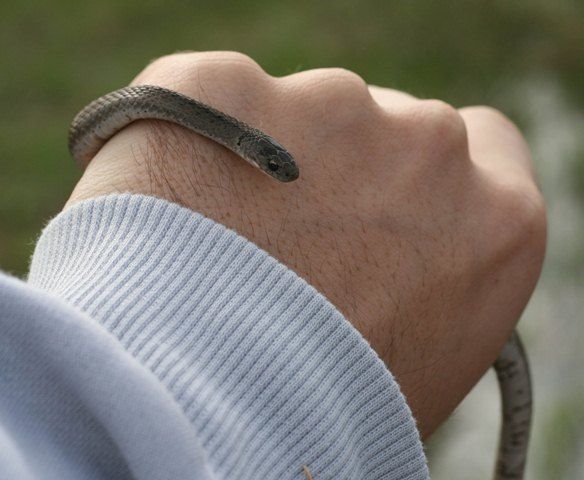
A small species, the Northern Brown (or Dekay's) Snake (Storeria dekayi).

Photo by K. Kron
Brownsnakes are highly fossorial (living below ground or ground debris) and rarely seen for that reason.  They are relatively common, however....but still a great find!

We also found several other species at this site: a Common Gartersnake (Thamnophis sirtalis), a Northern Leopard Frog (Lithobates pipiens), various birds, and some interesting plants (although this site was a tad disturbed for any really cool plants).

We ended our time there with only a handful of captures.   BUT...it was still early and there were several more sites to check.
_______________________________________________________________

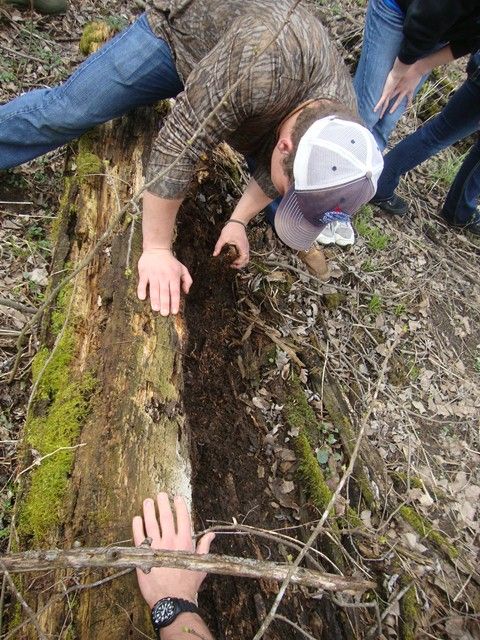
Next we headed towards a floodplain forest habitat along a major river in the state.  The primary objective here was salamanders and frogs, which require a bit of log-rolling (and "log-returning" after checking underneath).

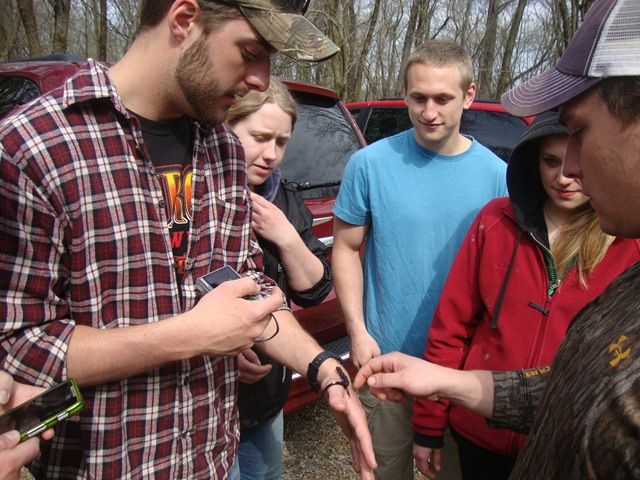
So it was that we hopped out of the vehicles and plunged into the deer tick infested forest in search of sallies....

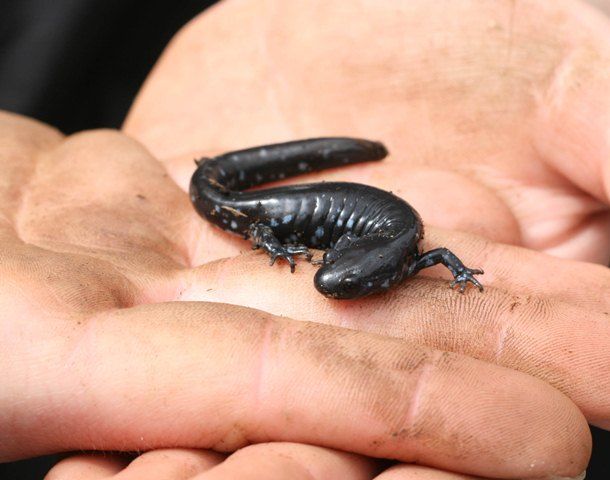
With 19 plus sets of boots on the ground, our chances of finding something were high.  It wasn't long before calls started going up that critters had been found.  The most commonly encountered was the cute little Blue-Spotted Salamander (Ambystoma laterale).
Photo by K. Kron
Another commonly captured critter was the terrestrial phase of the Eastern Newt (Notophthalmus viridescens).  The one pictured below is employing an interesting anti-predation behavior.  I believe the goal is to make themselves too awkard for certain predators to swallow whole.

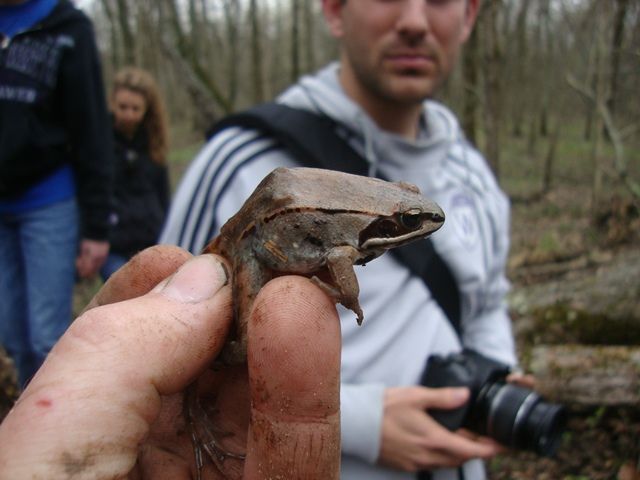
A variety of frogs were also hopping around in the forest.  This included the Wood Frog (Lithobates sylvatica), easily identifiable by it's coppery color and black mask.....

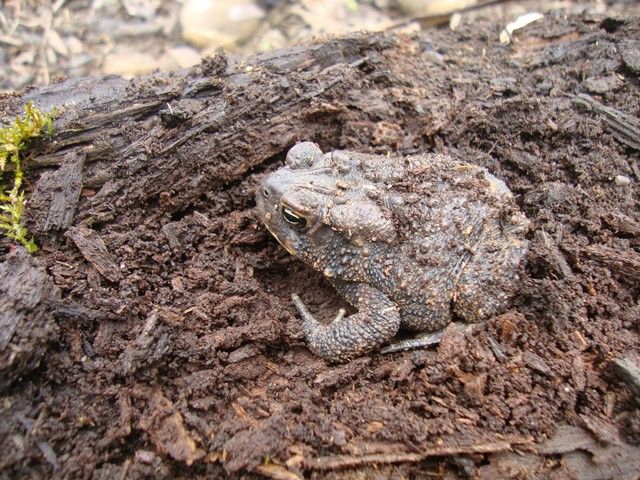
We also found Spring Peepers (Pseudacris crucifer) and a few American Toads (Anaxyrus americanus)....

So....the flood plain forest was mostly successful.  Thus, we moved on, hoping to grab some lunch and get to the next site: a sand prairie.
__________________________________________________________________
Then....the equivalent of a herpetological distaster occurred!  On an already almost too cold day, clouds rolled in.  Next came the water-works, and the rain began to pour!  As we drove to the new location we were bombarded with a deluge.  Thus, we ate lunch and I watched through the windows glumly as the rain came down. 

We hadn't seen many snakes so far.  If the rain kept up this way, we were sunk.

But...then...as we were finishing our meals and throwing away our trash...things changed.  The sun suddenly poked through, the clouds started to break....and I got excited as the air temperature began to climb.

So it was that our boots hit the ground at the next location....
 
Although it was still a bit cloudy, the sun was peeking through occassionally and it became noticeably warmer.  Due to this positive change in the weather, it didn't take long for us to start catching things.

Within 20 minutes of arriving...one of the students yelled out: 

"Doc, there's a snake over here!" 

"Well, grab it!" I replied.

"There's actually two snakes!"

"Well, grab THEM!" 

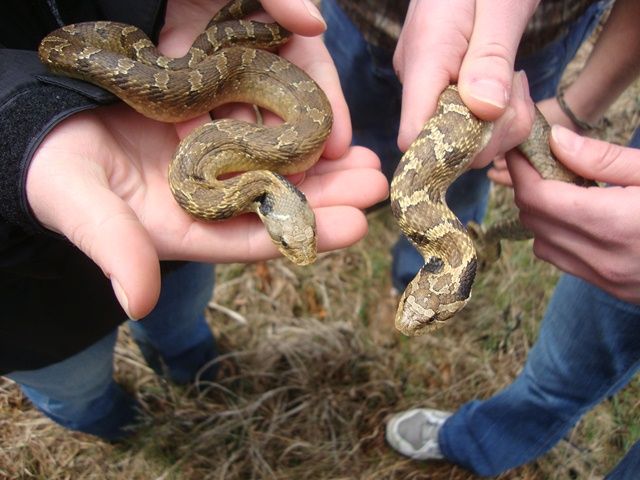
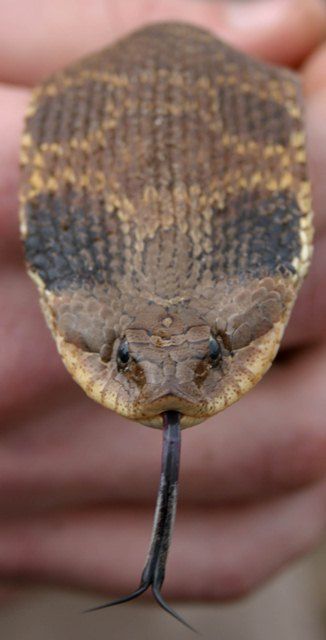
I don't know if they heard me or not over the commotion, but when I got there, we had two nice Eastern Hognose Snakes (Heterodon platyrhinos) to admire!
 
One was a very pretty orange-brown......
Photo by K. Kron
Photo by K. Kron
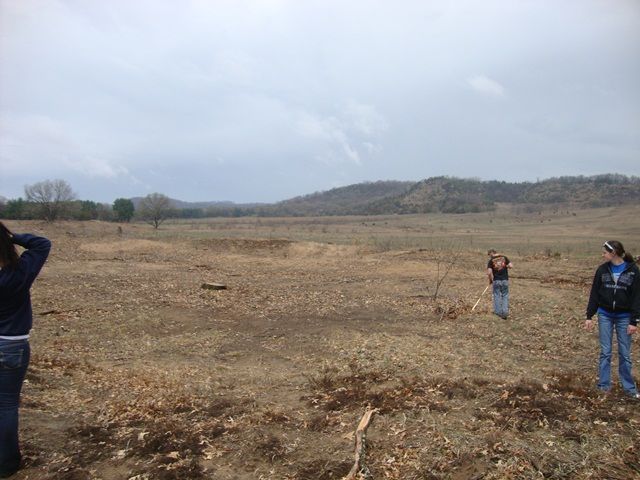
In total, we found four (or maybe even five?) Hognose Snakes in a matter of an hour.  Presumably, they were congregated in such a tight area for breeding....although we didn't actually see them doing so.

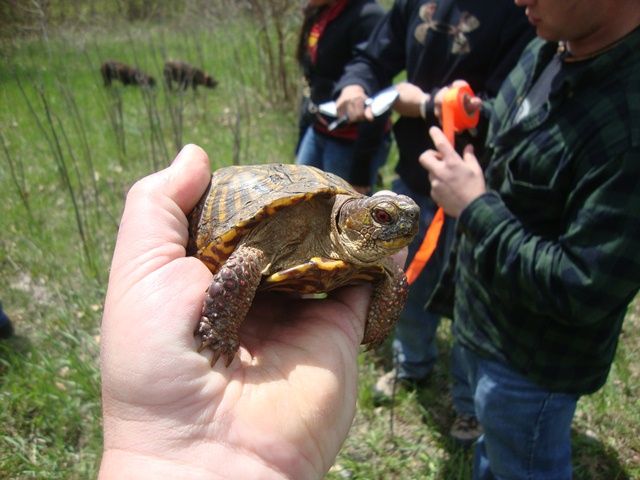
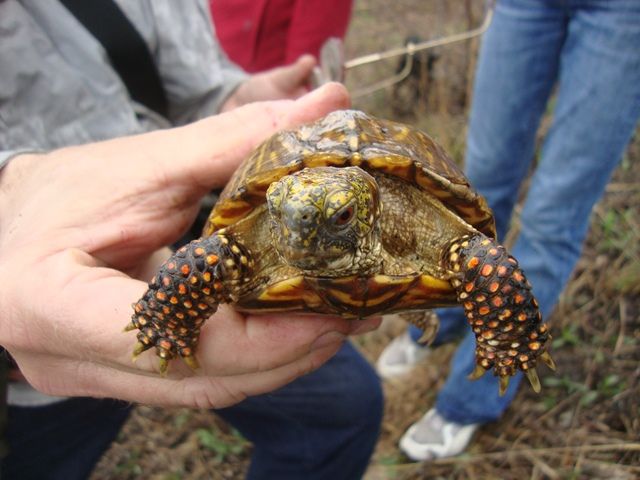
Next we moved to the north a bit, searching for some of the other critters that I knew were on-site. It was not long before we found one: the incredibly rare Ornate Box Turtle (Terrapene ornata).  The Ornate is the only fully-terrestrial turtle in the upper Midwest.  It generally requires deep, sandy soils to burrow below the frost-line in the winter.  Because such habitats have mostly been converted to agriculture or housing developments around here, this species has been nearly extirpated from the region.  In addition to habitat loss, herp-enthusiasts who collect them to keep as pets have severely impacted their populations.  Luckily, our fine state protects this species, and large fines can be incured for removing them from the wild.

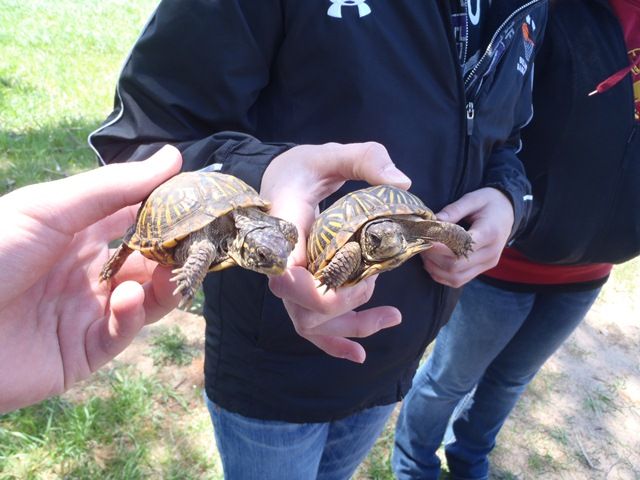
Given how rare they are, it was encouraging to find a juvenile individual.....

Also...a very nice looking adult male.  Males have bright-red eyes and reddish orange on their front-legs.

As we moved along, we found another rare species: the Racer (Coluber constrictor).

Photo by K. Kron
.....but we weren't done there!
A rare snake and a rare turtle....not to mention a few Hognose Snakes.  I was feeling pretty good about our trip, but not completely satisfied.  There were two other species that I knew were present, but we hadn't seen yet.  If we found only one of these, I decided that I would consider the day a success.

Luckily, the Herp-Gods smiled on us, and it was not long before we found one of the two sought-after species. 

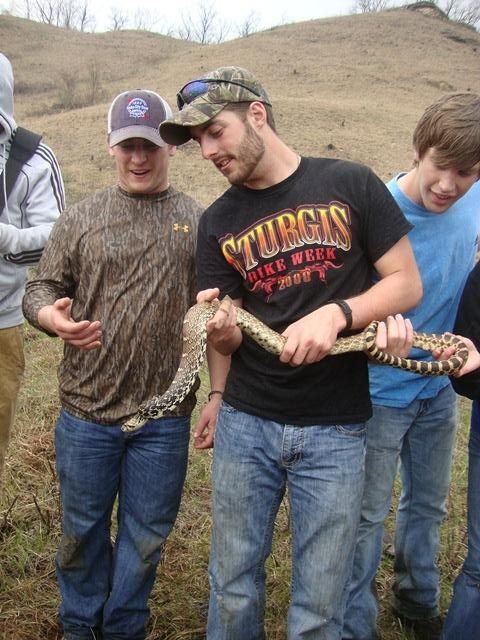
Someone found a Bullsnake (Pituophis catenifer sayi)....my favorite snake in North America....

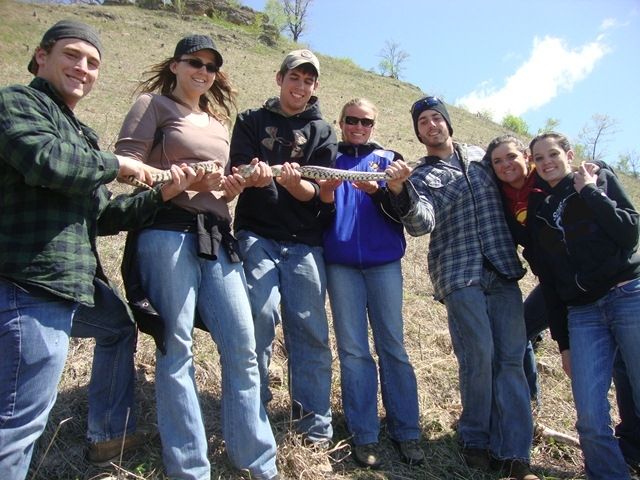
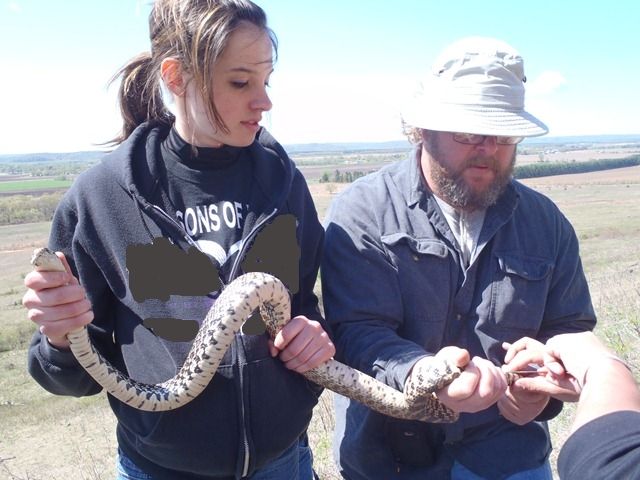
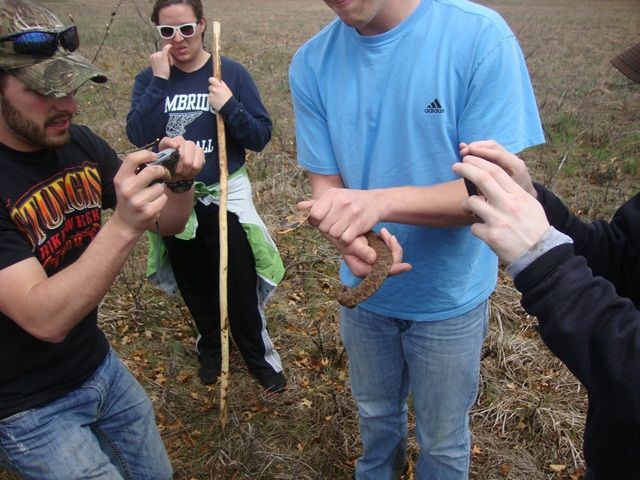
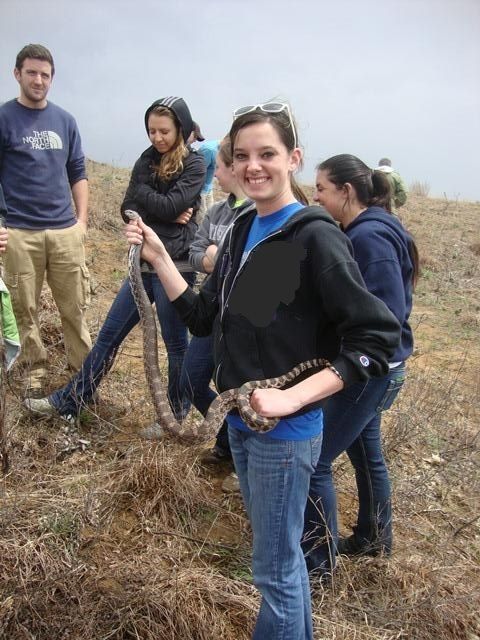
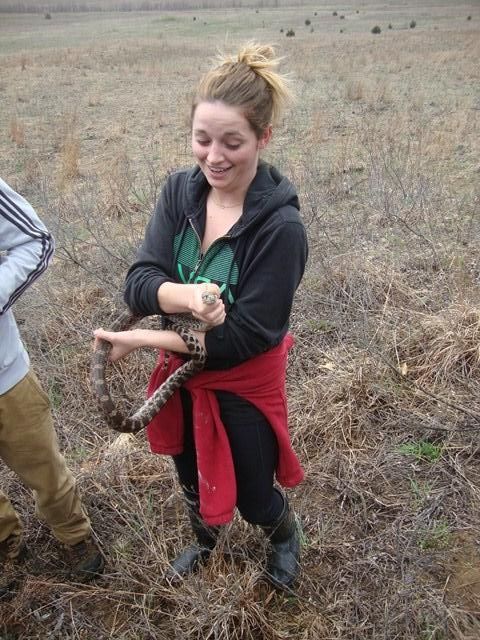
This one was polite enough for several of the students to get a chance at holding it.  Many of them were shocked that a snake species of this size lives in our region.  Unfortunately, this is another species that has been significantly (and negatively) impacted by the activities of humans.  The reasons run the gamut:  habitat loss is a key factor again....direct killing/persecution by folks afraid of snakes is another (to have such an unreasonable fear of something that you would kill it outright has never made much sense to me).  And...as with the poor Ornate Box Turtle....the Bullsnake has suffered greatly at the hands of collectors.  Unscrupulous "herp-enthusiasts" just can't resist bringing these back to keep in an aquarium....a damn shame, if you ask me.

It was not long after that when I heard more yelling "Doc! There's another big snake over here!".  Again, I yelled "grab it!", while running up towards the student waving his hands in the air. 

Another Bullsnake!

In total, we found five Bullsnakes! 

Even the students that were alittle uncomfortable with snakes, at least sucked it up and held one (even without any chiding from me! :)  ).

With every capture and encounter, they became more confident and several even grabbed the snakes without help.

All-in-all, I'd say it was a very successfull trip!  Probably one of the most important achievements of this trip is that those who are afraid of snakes (hopefully) see them in a more positive light.  Snakes really aren't scary....heck, they aren't even aggressive, if you leave them be.  Every snake we encountered on this trip first made a mad-dash for escape...it was only after we started to "mess" with them that any took a defensive posture.   Some never even did that. 

It also exposes younger folks to rare herps, and helps them understand the importance of conserving all components of an ecosystem....not just the furry/feathery charismatic ones....

I look forward to bringing a new crop of students on the trip again next year!