This week the-powers-that-be decided we needed something alittle different to occur, which would greatly influence our survey results. After we opened the traps along the drift fences on Monday....we got back-to-back huge rainstorms Monday and Tuesday night.
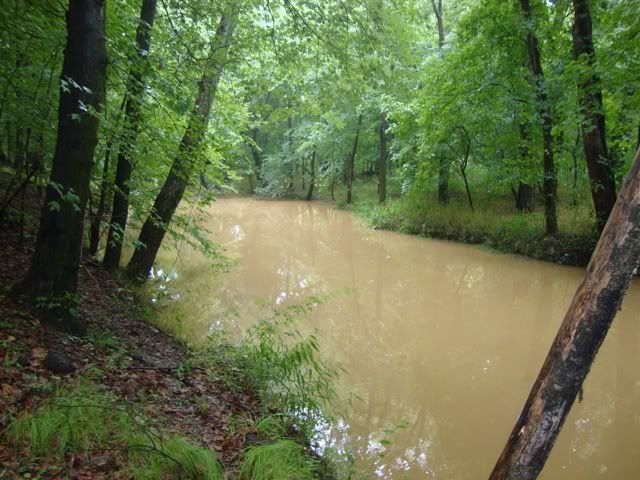
Below is a great before/after comparison of a stream at one of our sites:
A stream before the rains started pictured below. I was actually standing in the stream bed when I took this picture.
Below is the same stream after the second night of storms. This time, I obviously couldn't stand in the stream....you'll notice the same leaning trees on the left bank. But, you may also notice that the fallen log/snag that was in the first picture was apparently washed away by the current!
The wet conditions really brought out the amphibians!
Here are a few of the highlights.
___________________________________________________________________________
The Green Frog (
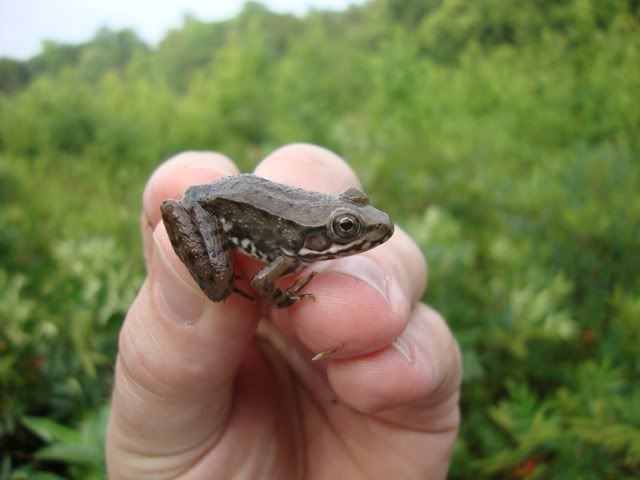
Rana=Lithobates clamitans): Green frogs are relatively common 'round here. We'd caught them at this site in minnow traps placed in woodland ephemeral wetlands last year. We hadn't caught any this year, however. Unlike many frogs who's tadpoles hatch, develop and turn into froglets in the same year, Green Frog tadpoles usually remain in this larval state over their first winter. The following spring they metamorphose and become terrestrial. With the rain, these juvenile green frogs must have decided it was time to migrate away from where they had spent their larval days.....and try to find a new home suitable for froglets!
We caught several in one of our grassland drift fences this week. All were about as big as the one in the picture. They can get much bigger than this...and a large adult male can be confused for a bullfrog to the untrained eye!
___________________________________________________________________________
The Eastern Narrowmouth Toad (
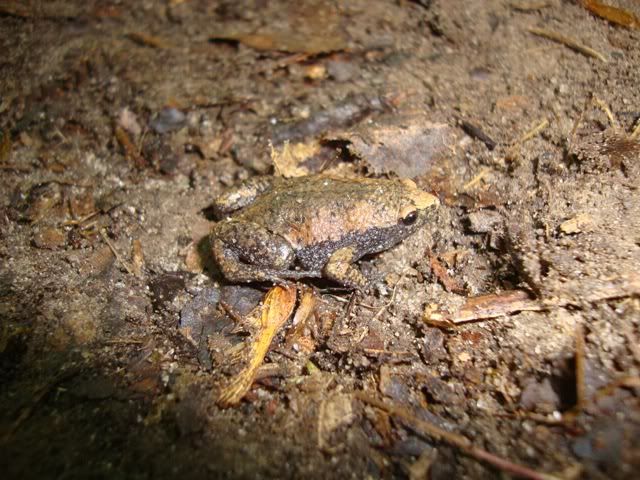
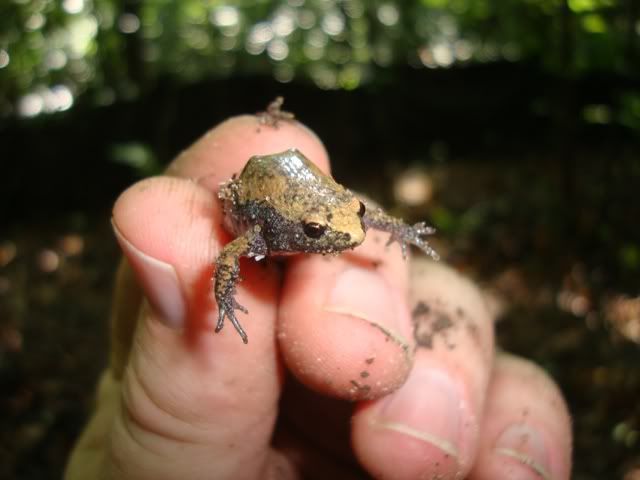
Gastrophryne carolinensis): The biggest treat for me this week was our Narrowmouth toad captures. We had gotten one individual last year in a pitfall trap at one of our sites. We hadn't seen a single narrowmouth toad since. They remain underground and usually only move around above ground when there are wet conditions. So this week, we were fortunate enough to catch two in the same pitfall trap of one of our drift fences in a lowland decidous hardwood forest.
Despite their common name, these aren't really a toad (i.e. they are not a member of the Genus Bufo). They are, in fact, the only member of the taxonomic Family Microhylidae in our region...so they are not directly related to any of the other amphibians in the state.
Above: these critters spend most of their time below ground and are not very big. Therefore, they are difficult to find during surveys without the aid of drift fences or coverboards.
Above: The aptly named Narrowmouth Toad. This roughly adult size for this species. You may have guessed that this species can't eat big prey with a mouth like that. In fact, their primary food source is ants and other small insects (Dorcas and Gibbons, 2008).
________________________________________________________________________
The American Toad (
Bufo americanus): I've written about a related species in the past (
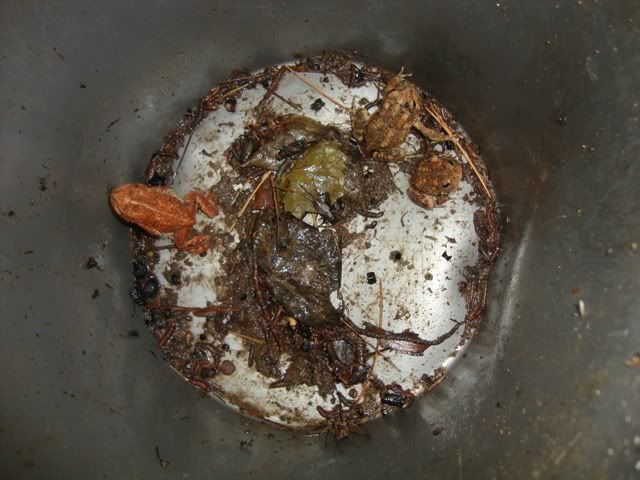
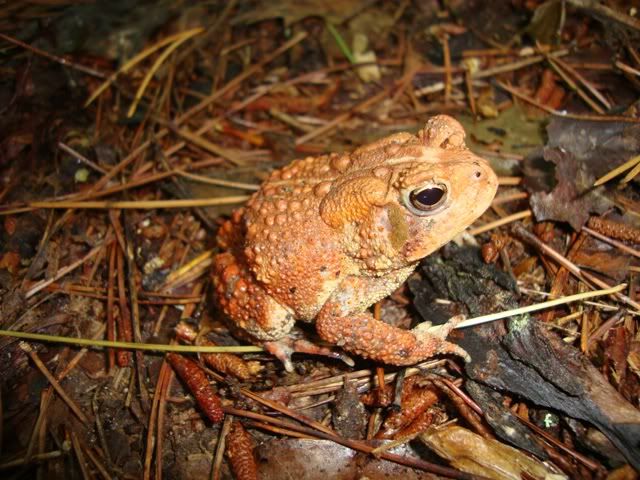
the Fowler's Toad; Bufo fowleri), but have not said much about these guys. The American Toad is a very common species at one of our sites....while the Fowler's toad is dominant at the other. After a rain, the toads really move around and we get them in decent numbers within our drift fences.
Above: Three American Toads captured in one pitfall trap along a upland deciduous hardwood forest drift fence.
Above: American Toads are usually a bit drab compared to Fowler's Toads, in my opinion. However, this individual was a nice orange/red color....very cute little bugger too.
_________________________________________________________________________
The Marbled Salamanders (
Ambystoma opacum): It's been some time since we've caught any of these critters at either of our sites (the last ones were captured in late March, see
here). In fact, we'd never caught them at one of our sites until this week.
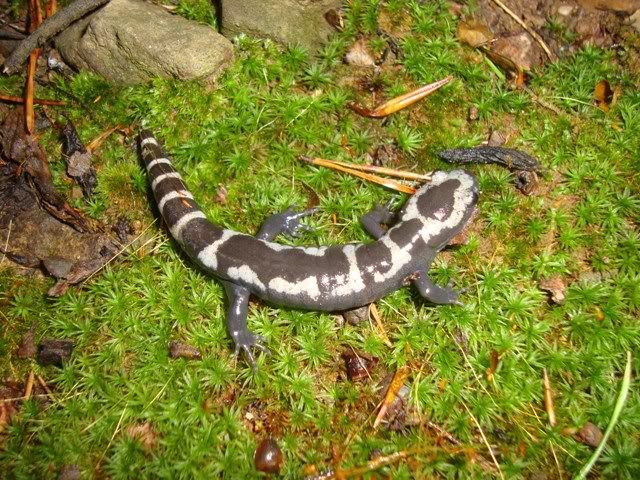
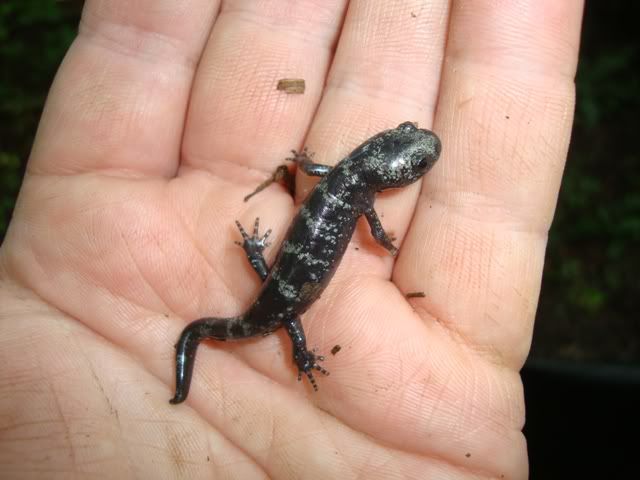
The heavy rain that bombarded us drew them out. We caught numerous individuals in just about every day that the drift fence traps were open, at both of the sites. So we added them as a resident species to one of our study locations (after nearly a year of surveys without finding them at this spot). it just goes to show how important random environmental events and conditions are in the activity of wildlife (particularly amphibians and reptiles). Not only did we capture numerous adults, but also juveniles.
It is interesting to note that not a single individual was found under our woodland cover boards. In other words, these critters had been patiently waiting for a rain event to get moving.
It's also interesting to note that we didn't see a single individual of any other resident salamander species this week. I guess it wasn't there time to move around, like it was for the Marbled Sallys. By why was it their time to move? This species typically spends its time underground or below debris, when it is outside of the breeding season (and these guys don't breed until the fall around here). Yet, it had been so very dry for the month of June. Perhaps after waiting-out the dry spell....they really needed to bust out and find some food after the rain hit.
But, then why didn't we catch other salamader species doing the same thing?
Above: an adult Ambystoma opacum. Such a very handsome little salamander.
Above: Two pictures of juvenile Marbled Sallys. The picture on top shows a slightly younger individual...see the heavy flecking and lack of any resemblance of adult pattern. The picture on the bottom shows an older juvenile. You can still see some flecking...but that pattern of adulthood is starting to creep in too.
________________________________________________________________________
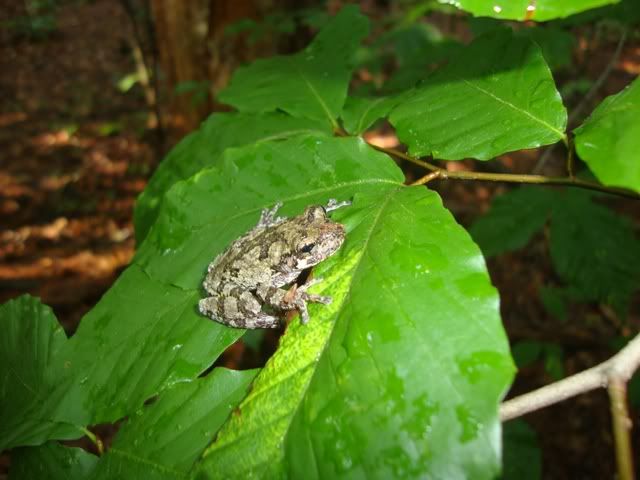
Cope's Gray Treefrog (
Hyla chrysoscelis): Another species that we haven't physically seen since late March (see
here), although we often hear them calling at both of the sites. This was a sub-adult, but still looking very much like an adult in coloration.
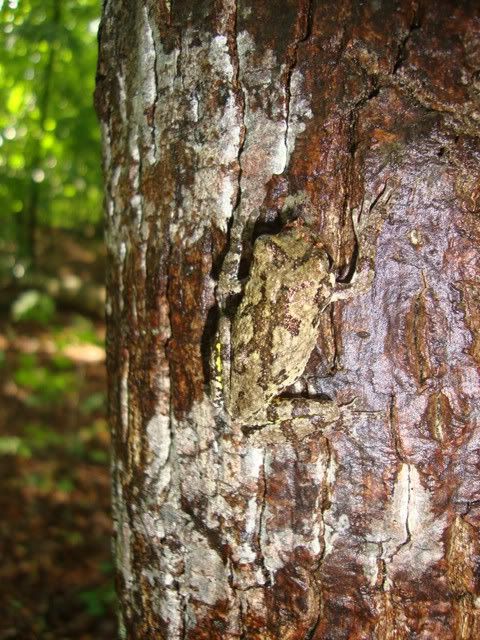
Above: they show up great against a green background...but put them on the bark of a tree and watch them disappear (below).
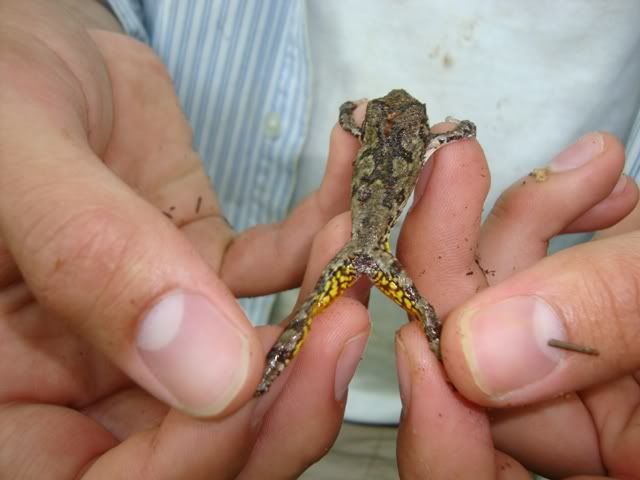
Above: the yellow around the inner-thighs and groin is diagnostic for both species of Gray Treefrog in this region (The Gray Treefrog and the Cope's Gray Treefrog). They are very difficult to tell apart in-hand...but the calls of males differ. I've only ever heard Cope's Gray Treefrogs calling at this site, so I'm going to assume this is one of those.
_____________________________________________________________________
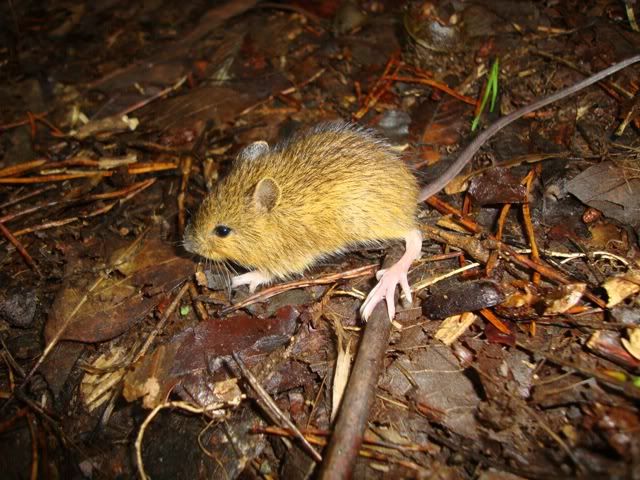
The Meadow Jumper (
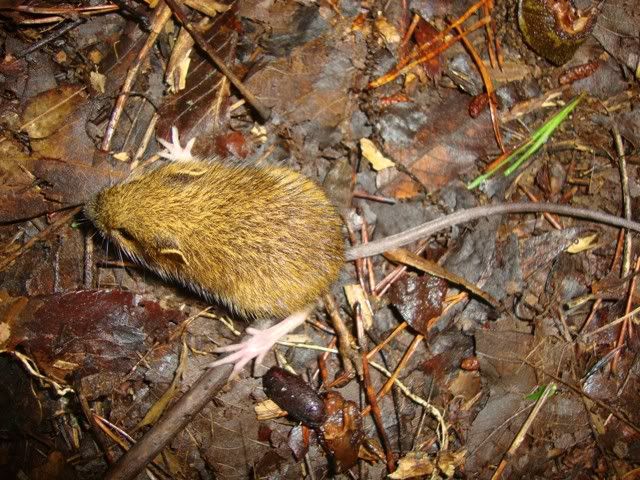
Zapus hudsonius): We've now captured three Meadow Jumping Mice at this site. Given the very spotty distributional information for this species in our state, these are cool findings! Interestingly, this individual was in one of our upland deciduous forest drift fences....not in the grassland drift fence (like the other ones we've caught). Not sure what a Meadow Jumping Mouse is doing in the woods, but these things happen. In fact, I've captured them frequently in woodlands during vertebrate survey work at a site in the U.P. of Michigan back in 2009.
I love the Genus name Zapus. Feels cool to say...rolls off of the tongue nicely. It has a Greek origin, with
Za meaning "very" and
Paus meaning "feet" (Schwartz and Schwarts 2001). This can be loosely translated into something with big feet, or very large feet (from the pictures below, you should be able to see that this is very descriptive name).
I at first had a glimmer of hope that perhaps we had found a Woodland Jumping Mouse (
Napaeozapus insignis). The genus name translating from latin into "wooded glen" and "big feet". The Woodland Jumper species is not known from our region of the state at all, according to Webster et al. (2003). But, so little survey work for small mammals like this has really been conducted throughout the state, so I thought there was always a chance. Both species look very similar: long feet, a darkish band of pelage down the middle of the back, and strongly bi-colored tail (dark on top, light on the bottom).
The kicker is in the tuft of hair at the tail tip. In the Meadow Jumper, this tuft is comprised of dark hair (not whitish hair, as in the Woodland Jumper) As you can see from the second picture below, this individual had some pretty dark hair on its tail tip.
Above: check out the feet on the Meadow Jumper!
Above: the bi-colored tail, and dark hair at the tail tip are visible in the picture above. The dark tuft of hair is a giveaway for the Meadow Jumper (rather than the Woodland Jumper).
______________________________________________________________________
The Eastern Box Turtle (
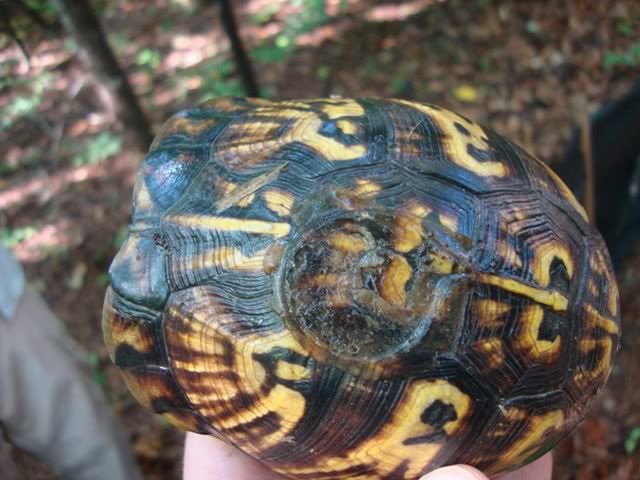
Terappene carolina): The rain brought out the box turtles too! We found three (one along the road, one in a pitfall trap, and one sitting along an upland forest drift fence). The one we found sitting along the fence was actually turtle E006, which we had a radio transmitter on last fall. This February, however, we found the transmitter with no turtle attached to it. We weren't sure what happened to the turtle...we thought it was possible a raccoon or something got it when it was lethargic during the winter.
Not true, it would seem. It turns out, blame can be laid on the crappy Loctite Epoxy we used to stick the transmitter on the turtle (or perhaps the person applying the epoxy...i.e., me).
Either way, it's nice to know the turtle is okay!
Above: you can see where the transmitter was epoxied to the shell of this individual last year. We lost it this February when the epoxy failed.
The individual in the picture below represents only the second box turtle we've captured in drift fences (although we find a fair number through just random visual surveys while walking around in the woods). It's also the first one we've caught in this grassland drift fence.
Literature Cited:
Dorcas, M., and W. Gibbons. 2008. Frogs and Toads of the Southeast. University of Georgia Press.
Schwartz, C.W., and E.R. Schwartz. 2001. The wild mammals of Missouri (2nd Edition). The University of Missouri Press, Columbia, Missouri.
Webster, W.D., J.F. Parnell, and W.C. Biggs. 2003. Mammals of the Carolinas, Virginia and Maryland. University of North Carolina Press.