Showing posts with label Mammals. Show all posts

Sunday, September 1, 2013

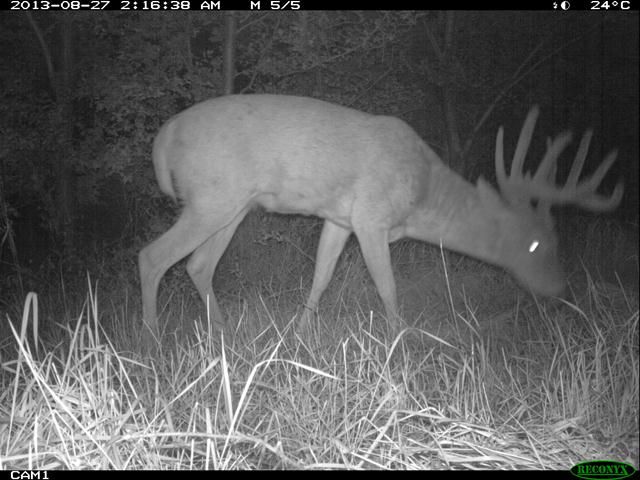
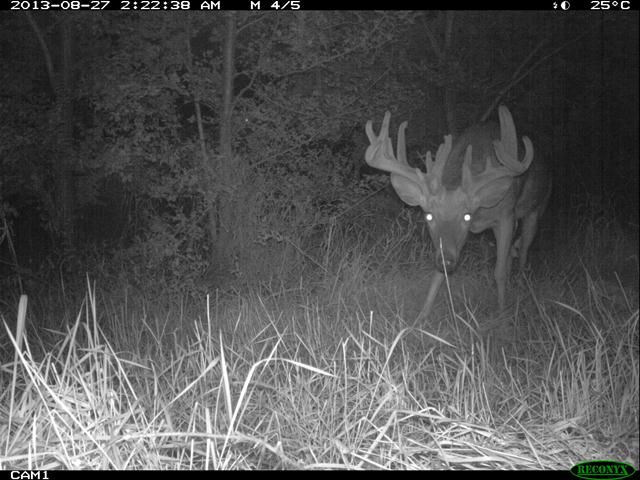
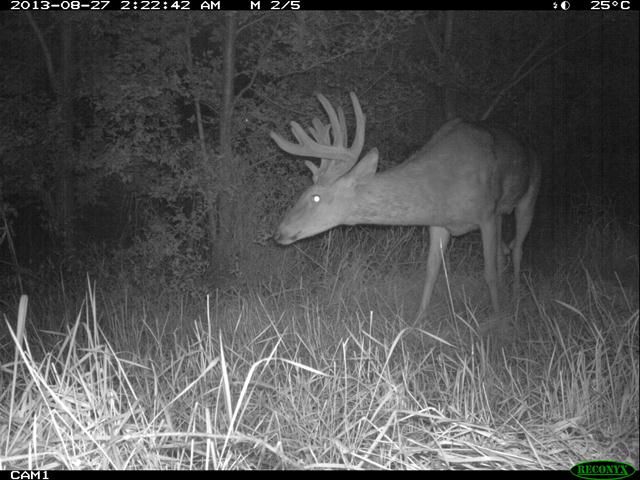
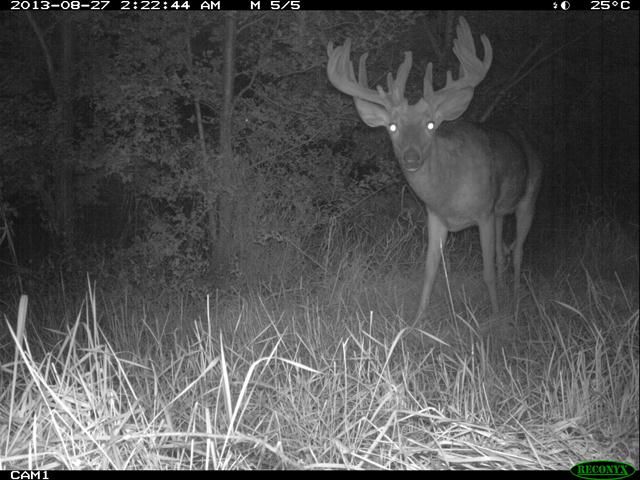
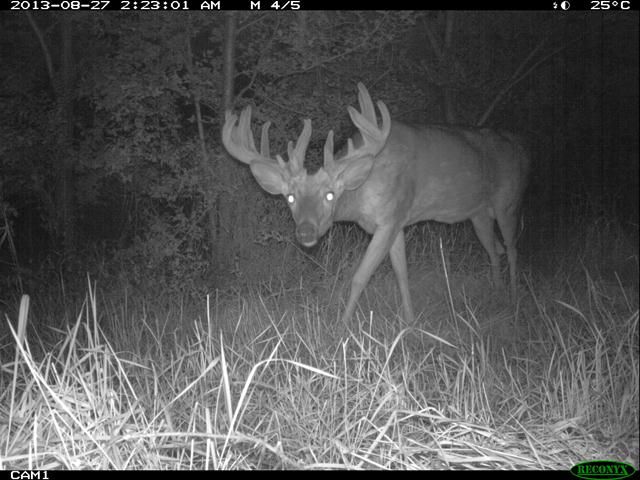
Holy 18-Point Buck, Batman!!

I had to sneak this one in quick.....

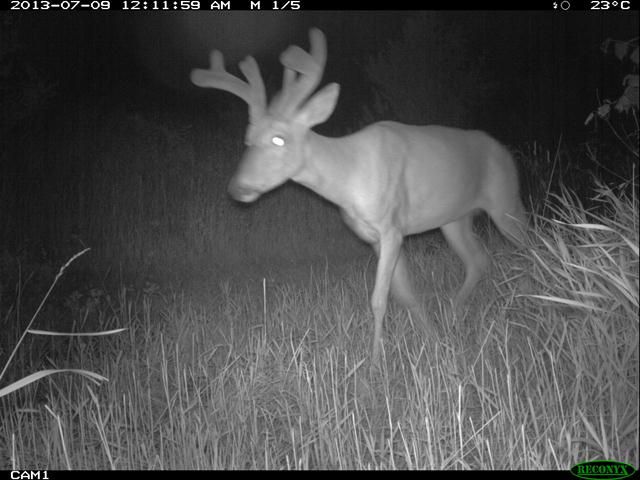
Two impressive animals on the cameras.

The first one would make most hunters drool.....


The second one, however, would probably give the average hunter a heart attack, if they saw it from a deer stand.


Despite the title of this blog post, I'm honestly not sure how many points this one has.  I count anywhere from 16 to 18, depending on the picture. 

Here are more....he's still in velvet, by the way.


This is the same site where I've been getting these nice bucks on camera year after year (see here, here, and here).  I will point out that we have a plethora of Coyotes on this same site.  There is also a fair number of hunters in the general area, and the property in-question is hunted. 

Still...every year I get these massive bucks on my camera traps, although the pictures are always in the middle of the night.

Saturday, July 20, 2013

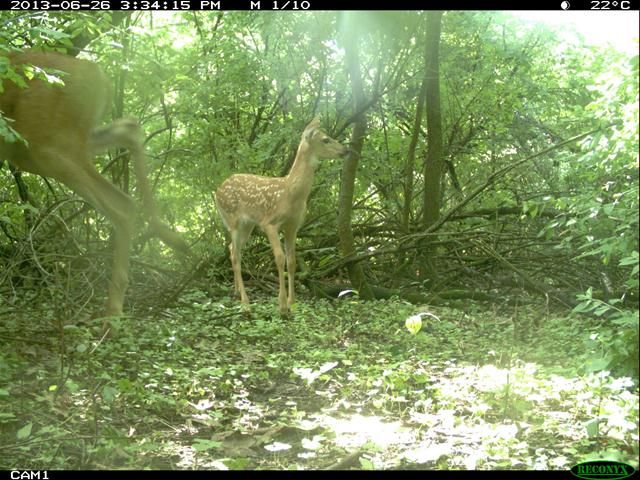
Wildlife Babies 2013: Twin Critters

I've gotten twins of several species numerous times in the past.  In fact, last year I had a mother with five baby Raccoons at two of my study sites (see here).  Furthermore, at one of these sites, the baby raccoons were a constant fixture in front of my camera traps.

This year, however, there have been very few Raccoon babies to speak of.  One of the sites with the momma and five offspring is now devoid of Raccoons....so I wonder if she got hit by a car, or met some other untimely demise.

Regardless, it was not until a little over a week ago, that a camera at a completely new study location yielded some baby raccoons.  Not quintuplets this time, but twins....


White-Tailed Deer offspring also seem to come in "multiples" frequently.  I had twins at two sites last year (here)....and have even had triplets at a site in North Carolina (here).

This year, however, I have gotten relatively little in the way of fawns (in general) at the site where they were very common last year.  In fact, at a site where I not only had twins last year, but several other fawns, I've only got pictures of a momma with a single baby once (here).

Once again, the completely different sites (with the twin Raccoons) is where I've gotten pics of twin fawns this year.
 
On a different subject, it appears that a large buck who was at one of my study sites last year survived the hunting season and is back.  This could be the third year in a row that he's been around (see 2011 shots here, and 2012 examples here).....
 
 
You may remember that there were two at this site last year, but one was taken down by an automobile in late fall (here).


Wednesday, July 3, 2013

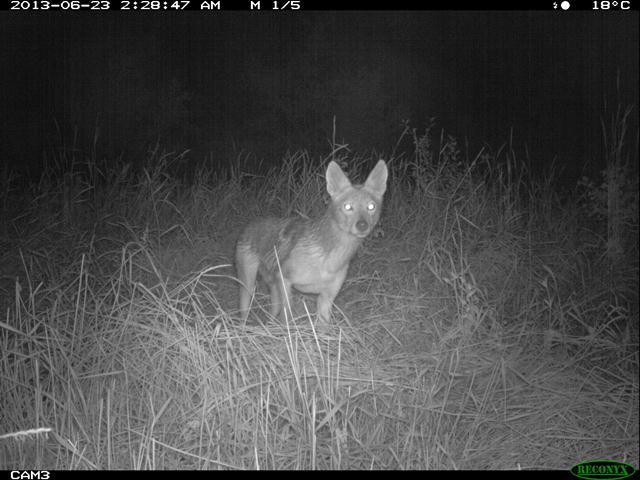
Baby Stinkers, Sibling Rivalries, and a 'Yote in Summer Coat

As with last year, wildlife offspring are starting to show up frequently on the camera traps.

This year, "Skunk" has been the word in baby critters.

Here a momma with a bunch of tag-a-longs shuffle by the camera (I count six baby tails).

Not long after, two baby skunks (Mephitis mephitis) whom are likely siblings start to get after eachother.  There's nothing funnier to me than watching these little puff-balls tumble around in front of the camera.


I've posted similar incidences of sibling rivalries last year, albeit with Raccoons (Procyon lotor)....see here, here and here....

Now that I mention Raccoons.....where are the Raccoon babies this year on my sites?  Last year, there was a momma with at least five offspring all over the same site where I got the skunk babies this year.

We shall see.....


I saw my first fawn of the year back on May 19th....but didn't get my first on a camera trap until recently.

Another random event.....this appears to be a Great Crested Flycatcher (Myiarchus crinitus).  See the tuft of feather on the crown (top of the head), the yellow belly and the brownish tail feathers.  This species is fairly common 'round here....but a first on the camera trap for me.  Interesting tid-bit about this species, their nests apparently almost always contain snake skins (or strips of plastic that might resemble a snake skin).


Finally, some very nice shots of a 'Yote (Canis latrans) in summer coat.  They look much different now than they look in the winter (especially considering this one is soaking wet and looks even more scraggly).  But I love those ears! 
 
 
I don't get too many pictures of 'yotes at this site, so I'm always happy when I'm lucky enough to get one coming through.

Friday, June 28, 2013

The Beaten Bear, Poor Ol' Slim, and a Size-13 Snapper!

A random conglomeration of stuff from recent happenings during summer field work.  There's been alot of things going on.  There's so much to share that I can't fit it into a blog post in any type of logical order.

We've been running the drift fences surveys since the beginning of May, which has resulted in many excellent captures (one of which is below).

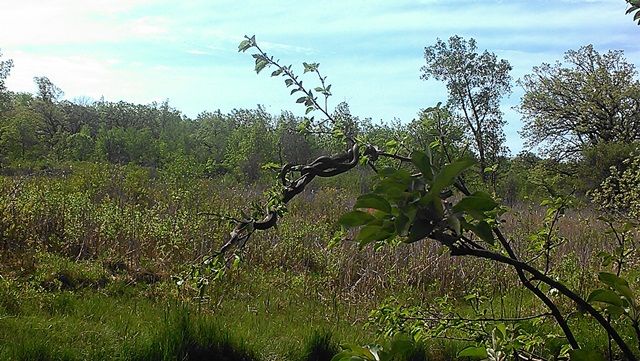
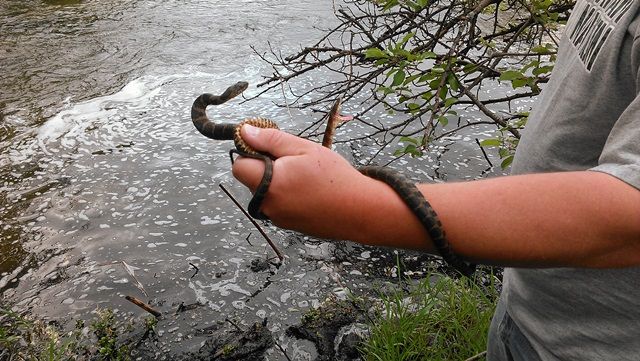
Yet, we also see cool stuff while we are walking out to our fences.  For example, there's an old gnarled tree that overhangs the creek near one of our fences.  Every day there are multiple Northern Watersnakes (Nerodia sipedon) hanging on the branches catching some rays.

Photo by N. Rudolph

They never really appreciate my grabbing them...and the result is usually a bit of drawn blood (as you can see on my hand below).  The bite looks much worse than it is, however.  They are non-venomous, and their teeth feel like nothing more than tiny pin-pricks.
Photo by N. Rudolph

The poor watersnake frequently suffers greatly at the hands of humans.  When the average person sees a snake near the water with a body pattern that is NOT similar to a gartersnake, they often think: "cottonmouth!" or "water moccasin!" and the snake is killed.  There are NO cottonmouths or moccasins in the upper Midwest, unless one inlcudes southern Illinois (and I don't think they do?). 

Amazingly, folks often argue with me about this!  Here are example responses I get to telling them it wasn't a cottonmouth they saw: "Nope, I saw a cottonmouth on that canoe trip.  There's nothing else it could have been." ...or..... "Well, I'm pretty sure that it was a moccasin that swam along the bank next to me while I was fishing." 

But, let me re-iterate: the snakes in my hand above are NOT cottonmouths/moccasins!  We do not have said venomous species 'round these parts.

BUT....none of this is even the point of my current post!  So, I'll get on with it....

_________________________________________________________________________

The Beaten Bear:

Below is an impressive and "battle worn" Black Bear (Ursus americanus) that the wolf researchers captured on one of the camera traps.

Take a look at the lip on the left side of his face (right at the beginning of the clip).  It looks to be torn....and his ears have clearly seen better days.  He must be a wily sort to have avoided the hunters all these years.

I wonder whom he had a run-in with to have acquired all of that damage?  Males compete for breeding rights, and perhaps his
I wonder whom he had a run-in with to have acquired all of that damage?  Males compete for breeding opportunities and perhaps this was from another male Black Bear?  They certainly run afoul of wolves, which may be particularly problematic when wolves have pups in the den. Hunting dogs are another possibility, I suppose.  But all of that damage is to the face and head.  Is this type of damage typical of such encounters?  Could the torn up ears be where identifying ear tags were yanked out?

I love a natural history mystery!
________________________________________________________________________

Poor Ol' Slim:

Poor Slim.....the unfortunate Short-tailed Weasel (Mustela erminea) that I found dead on the road not far from my house.  I caught a glimpse of it while my daughter and I were driving home one day....and I thought it looked like a weasel, so we had to turn around so I could pull over and snap a picture (it wasn't in good enough condition to turn into much of a specimen).

Slim is either a juvenile Long-Tailed Weasel (Mustela frenata) or an adult Short-Tailed Weasel (M. erminea), based on the size and the black tip on the tail.  The other weasel in our state...the Least Weasel (M. nivalis) has no black tail tip. 

Adult Long-Tailed Weasels attain average sizes (13-16 inches) and this individual is not that large.  Yet, this could be a juvenile Long-tailed Weasel....which would also make sense, seeing that the Long-Tailed Weasel is more common in the southern part of the state (where I am located) than the Short-tailed.  But the tail on this specimen looks to be particularly short. 

Hmmm.....

Another good mystery!

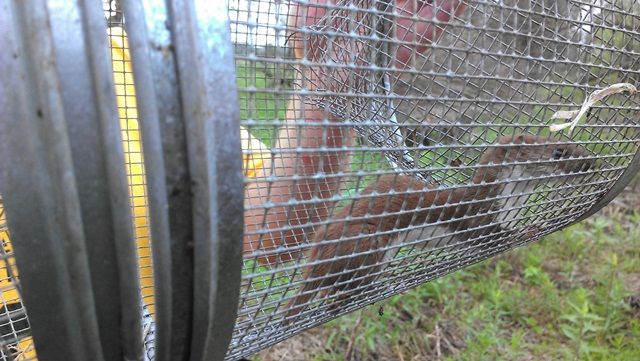
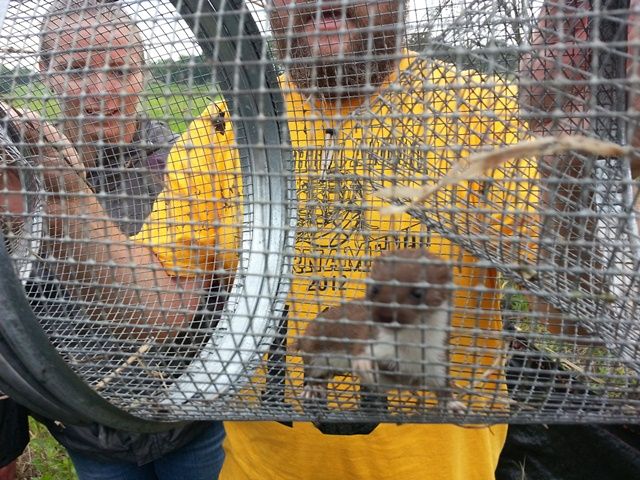
Fortunately, the summer hasn't been only negative encounters with weasels.  Below are pictures of a little Least Weasel my students and I captured in a drift fence a few weeks ago (note the lack of black-tip on the tail).  The drift fences are primarily for amphibians and reptiles, but we get just as many small mammals.  In fact, the hidden secret of this herpetological technique: it's probably just as effective and less work day-in and day-out for small mammals as Sherman Traps.  Although the fence takes alot of effort to install initially, there isn't the hassle of setting and re-baiting traps all the time.  Plus, we get many intectivores (Shrews) and the occassional weasel, which Sherman Traps aren't effective at catching.

I imagine these little carnivores are attracted to the fence due to the smell of vole, which we catch many of.  According to King and Powell (2007, The Natural History of Weasels and Stoats, Oxford University Press) the Least Weasel is the weasel that is the most narrow in its dietary preferences....eating almost exclusively on rodents and then focused primarily on voles (especially Microtus sp.).  I've caught Least Weasels on several occassions in drift fences in years past, so I wasn't totally shocked.  This is also not my first weasel post in the last year (see here).

But that doesn't mean I wasn't incredibly excited to see one!  The Least Weasel, in particular, is rare 'round here....so it was quite a treat!  Holding still is not the strong-suit of these frenetic little carnivores....so forgive the blurry pics (these were the best of about 30 attempts).
Photo by N. Rudolph

Photo by K. Rutzen
 
Photo by K. Rutzen
I love me some Mustelids.....

A Size-13 Snapper:

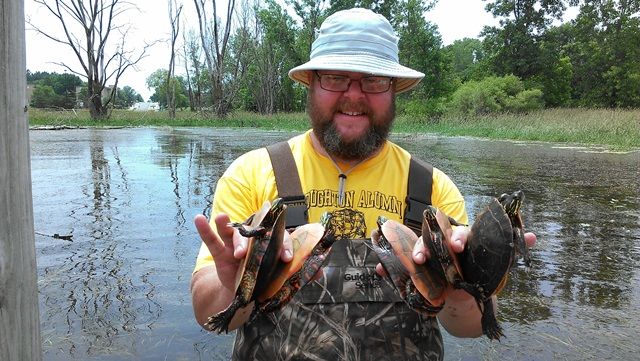
Mid-summer is when I often do most of my turtle trapping.  As part of survey work this summer, I've been trapping in wetlands with the hopes of catching some Blanding's Turtles (Emydoidea blandingii).  I've caught a few (as you can see)....

We also catch many, many Painted Turtles (Chrysemys picta)....

Photo by N. Rudolph
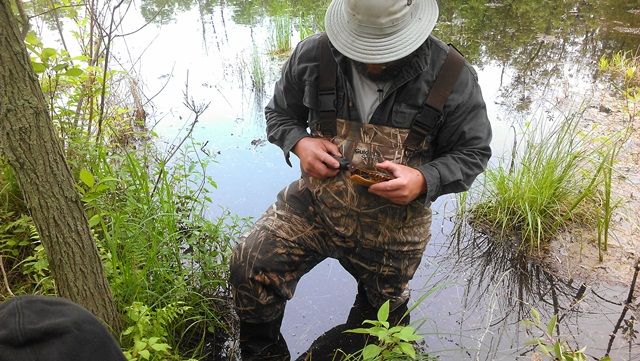
Frequently these are given a unique mark.  This is done by notching the edge of their shells in a certain order with a file or dremel tool so that we can identify the turtles in the future.
Photo by N. Rudolph
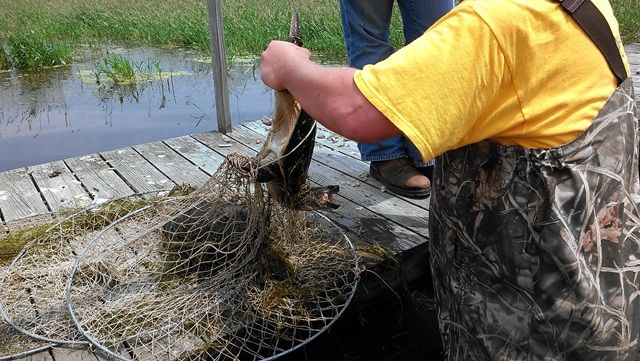
But, in addition to the Painted Turtles, I almost always also catch Northern Snapping Turtles (Chelydra serpentina).  In fact, I would not be shocked if just about every water body in the state (from tiny pond to giant river) has at least one snapper lurking in the depths.  The Northern Snapping Turtle (previously called the "Common" Snapping Turtle) rarely leaves the water.  It doesn't usually sit on logs and bask in the sun, like many other pond turtles.  It mostly remains unseen in the mud and muck on the murky bottom.  The females are seen more frequently on land during the nesting season, when they must traverse the dangers of an over-land movement to lay their eggs.  It's during these times that snappers must frequently head out into vehicular traffic.  Poor snappers.  Especially considering that people apparently swerve to hit turtles crossing roads.

Regardless, the Northern Snapping Turtle is one of my favorite turtles: ornery, cantakerous, dirty, smelly, mean-looking.....everything I like in a critter :)
Photo by N. Rudolph
This summer, we've been lucky enough to catch many snapping turtles, like the individuals above.  At one particular pond, I caught at least five individual snappers in a single night that had carapaces (upper shells) which ranged from 8 to 12.5 inches.  The one below is a prime example.....
 
But that one pictured above wasn't even the biggest captured this summer.

That prize belongs to the individual below.  To put this into perspective, the boot on my chest-waders in this photo is a size 13.

It would be nice if more snapping turtles could make it to this size (or bigger). 

I guess we have to start by getting folks to restrain from hitting them on purpose (I can't believe I had to actually say that). 

Next we can try and come up with ways in which the average person can avoid hitting them on accident.

-sigh-


Sunday, June 23, 2013

Hunk O' Steamin' Bear

I wish I had more time for an in-depth post.

For now, the best I can do is show you a few video clips that my students working on the wolf project captured of curious upper Midwestern Black Bears (Ursus americanus).

Obviously, these critters weren't moving around too much in the winter during their first round of camera trapping on this project.

But, much to our satisfaction, they are showing up now....
....and about two days later....

We also got a clip of (what appears to be) a pretty massive individual.

For comparison, here's a White-Tailed Deer (Odocoileus virginianus) on the same camera at, what I *think* is, about the same distance.....

Followed by the steaming hulk....

Most of my projects don't occur in bear country, so these clips were a real treat.

Lots more to share when I get a sec.

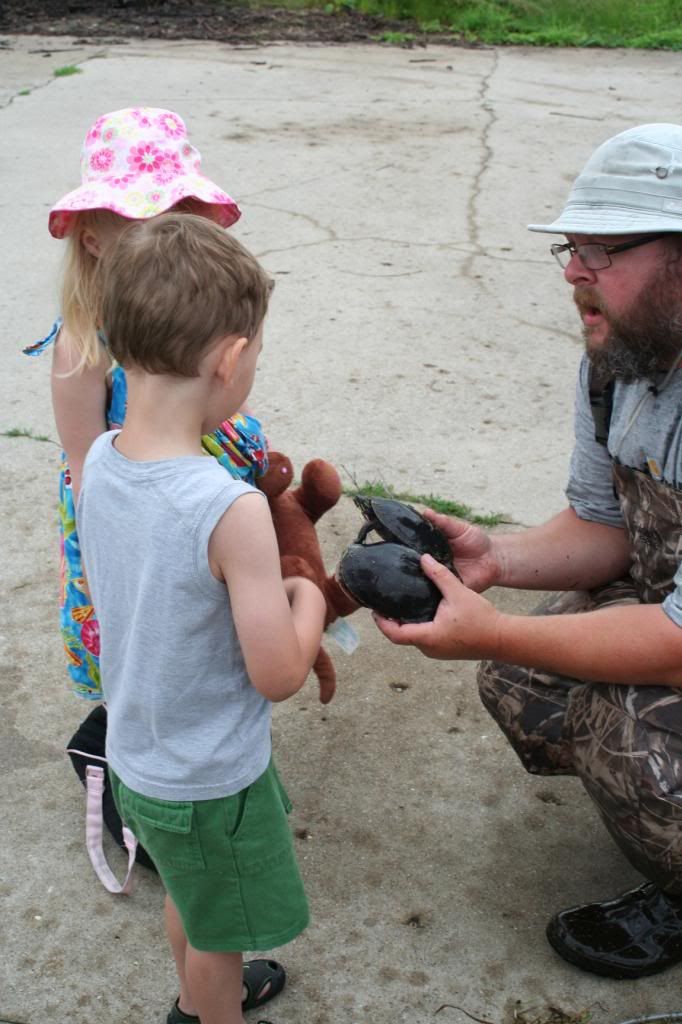
For now I'll leave you with a few images of future naturalists helping me check turtle traps over the weekend.
 

Friday, April 5, 2013

Phenology 2013: Faltering Frogs and Wary Leapers....

Today I heard the first calling Anurans (Frogs/Toads) of the season.  Chorus Frogs (Pseudacris triseriata) are generally the earliest frogs to call in the spring 'round these parts.  I've been listening intently at various wetlands nearby for the last week.....but these tiny amphibians have been extremely hesitant (and rightfully so, given our very cold spring this year).  Despite this, I've been anticipating their calls for several days now seeing that it has started to sneak above 50 deg F more frequently over the last week.

Today I finally heard them.....

In some parts of the region they are rivaled for first position by the Wood Frog (Lithobates sylvatica).  But we do not have Wood Frogs in the immediate area....so I always consider the arrival of spring to be heralded by the Chorus Frog.

Interestingly, this is much different than their date of first call last year (which was a much warmer spring)....but on par with past dates I've recorded.

2012: March 14th
2009: April 14th
2008: April 8th
2007: April 27th
2006: April 12th
2005: April 7th
2004: March 28th
2002: April 6th
2001: April 14th

Beyond that....sometimes all that's needed are a few cool camera trap pictures.

First, an Eastern Cottontail (Sylvilagus floridanus).....


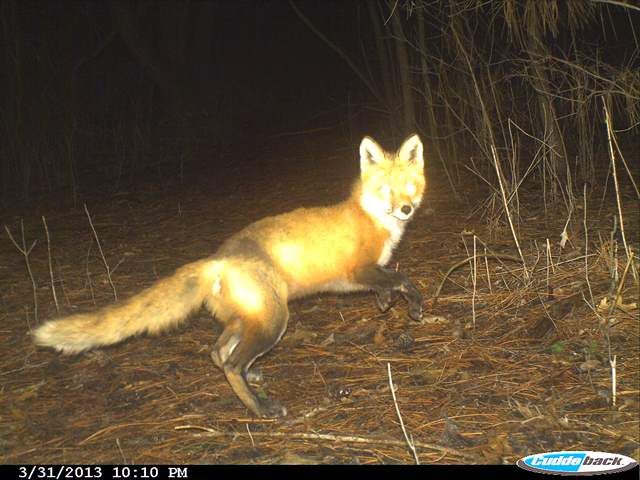
Then, what might be one of my favorite Red Fox (Vulpes vulpes) pictures to-date.......

Foxes are so amazingly cognizant of their surroundings.  The Cuddeback has a lightning-fast trigger speed (< 1 sec.), which is the primary strength of this make and model of camera trap.  Thus, it almost appears as if this fox started to leap, sensed the flash, and faced the camera.....all as it was springing into action.

That is what I'd call complete situational awareness!

Tuesday, April 2, 2013

Phenology 2013: Preggers Coyote....

The Coyote (Canis latrans) activity has picked up substantially at several of our camera trapping locations.  This makes sense, as it has corresponded with the mating season and (soon) parturition for our region.  As Jackson (1961) reports, breeding primarily occurs in February, and most pups are born in April (gestation period of 60-63 days).

So, the timing is perfect.

Below are two clips of males at the same site for comparison.


....and now the pregnant female.....she just looks uncomfortable, doesn't she?

The den must be nearby, and I hope we can get clips of the pups......

As most know, the Coyote is often vilified and looked upon with scorn.  Jackson (op. cit.) mentioned several historic accounts of negative attitudes towards Coyotes in our region (note the "wolf" referenced in the passsages below is the "prairie wolf", which is an old common name for the Coyote).

"Among the other evidences of the rude and primitive condition of the town [of Mineral Point-TB] was the almost unceasing howling and barking of the wolves during the night, around and within its very borders, sounding at times as though the town was invested by scores of the brutes, much to the annoyance and alarm of timid strangers." (S.M. Palmer, 1872; 302).

Jackson also recounts some of the methods used in the past to eradicate these rude, brutish and annoying animals....

"A grand wolf hunt will come off Monday the 17th of December, 1863. There will be a line formed, commencing at ...... the town of Fulton, extending up .....in the town of Janesville.  Said line will be formed and ready to march at 10 o'clock A.M. There will also be a line formed on the west side of the river to act in conjunction with the first. ........ We invite all to take part, for the wolves are troublesome (Janesville Daily Gazette, Dec. 7, 1863)."  

The distance that this line of 'yote-hunters would have spanned was probably anywhere from 12-14 miles, as the crow flies.  Now, I don't want to sound hippy-dippy......but that's alot of effort to kill little ol' Wil E., which would suggest a very deep-seeded dislike or fear.

I wonder if the folks who orchestrated those hunts (or anyone today who dislikes Coyotes) would feel differently about them if they saw them acting just like their beloved domestic dog?

This doesn't appear to be skittishness. This behavior looks just like that of my dog when he's excited to go outside.

Wednesday, March 20, 2013

The Unwelcome Old Man and Skunks by the Crescent Moon

Old man winter still has a firm grip on the upper Midwest.

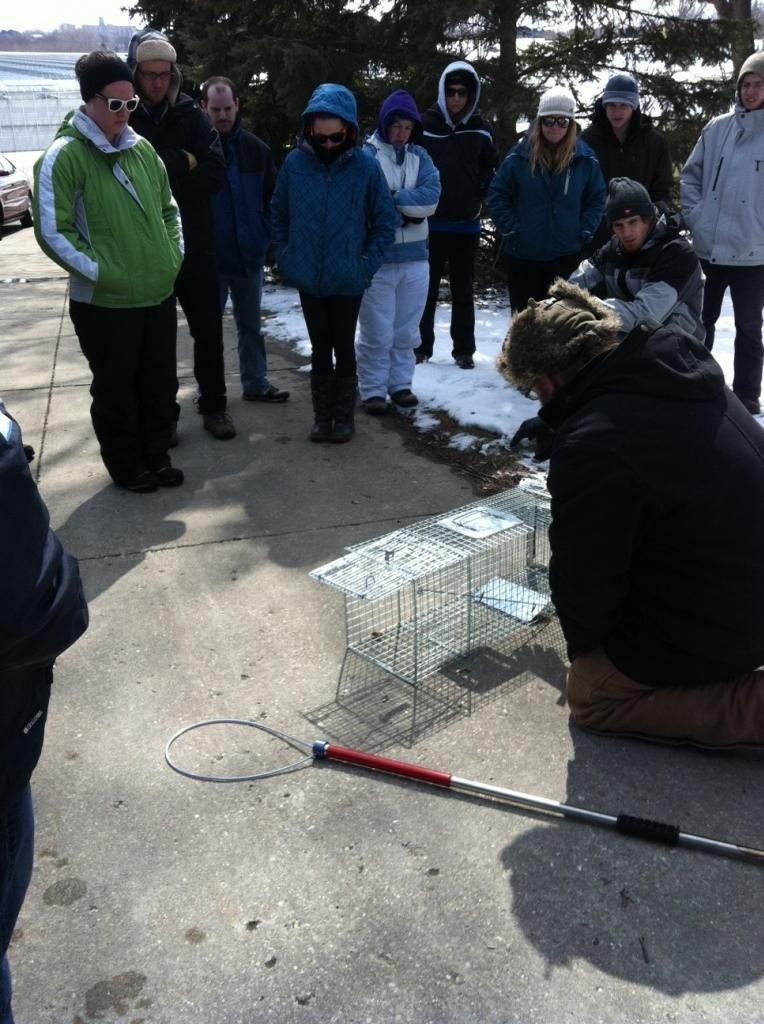
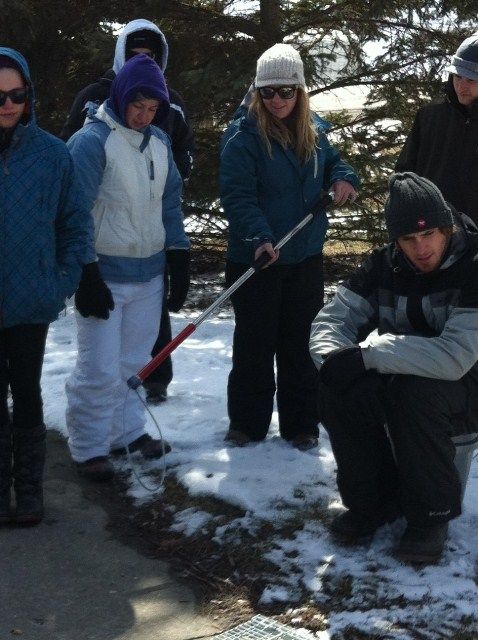
I love the snow and cold, but this time He's screwed up one of our lab exercises........

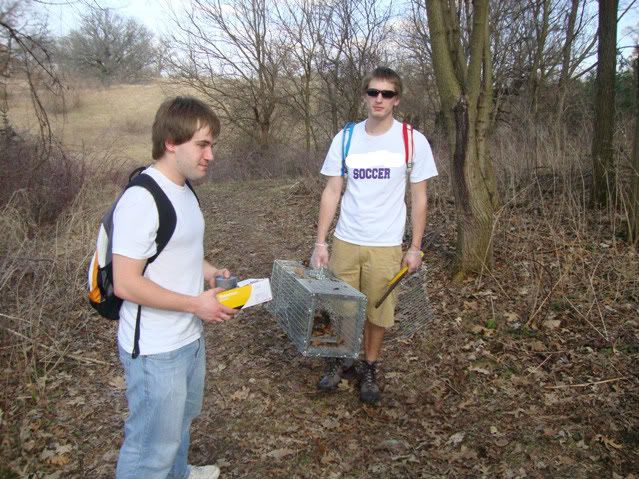
Normally, this week is for medium-sized mammal trapping with wire cage traps.  In fact, last year...the weather was perfect for such an endeavor, as depicted in this picture from almost exactly a year ago today.

But because the Old Man keeps peeking in on us this year, we have recently experienced another bit of snow and nighttime temperatures dipping to below 10 degrees (F) for two days in a row.  Even as I type this....it is only 11 degrees (F) outside and I'm wearing my extra-heavy smartwool socks!

There is no small amount of irony in the fact that today is technically the first day of spring, or the vernal equinox.

Granted, it's possible we could have set this up so that any captured critters wouldn't freeze to death (placing alpaca wool into the cages...putting the cages in sheltered locations....place spruce boughs around them to block the wind) but I don't want to take any chances.
Photo by L. Schulte
Thus, today involved review of how the traps work, a discussion of various other traps employed to catch mammals, and scoping the site for locations (in addition to upkeep of their ongoing monitoring projects on-site).
Photo by L. Schulte

Luckily, I had somewhat planned for this possibility and scheduled two weeks of mammal trapping (and seeing next week is Spring Break....we may have enough time for things to warm up before we try this again!).

I shouldn't be shocked by anything this year, I guess.  There has been quite a trend for cold and snow (unlike last year).  You can see some past examples here and here.  There have been other snowy lab periods since then.

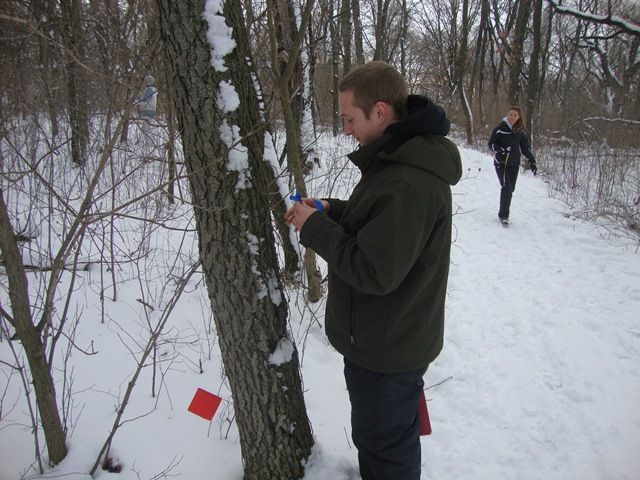
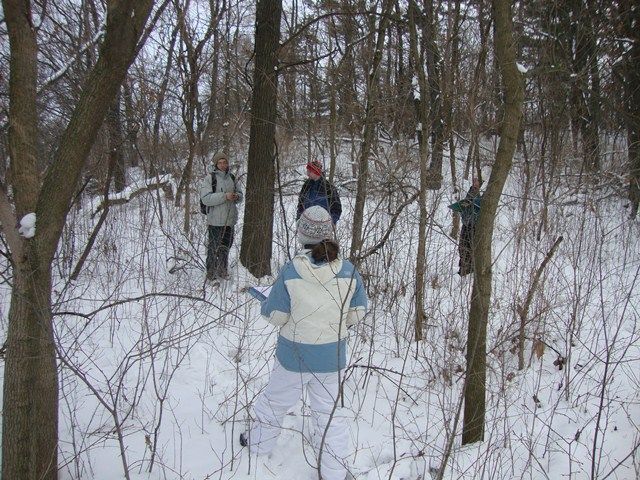
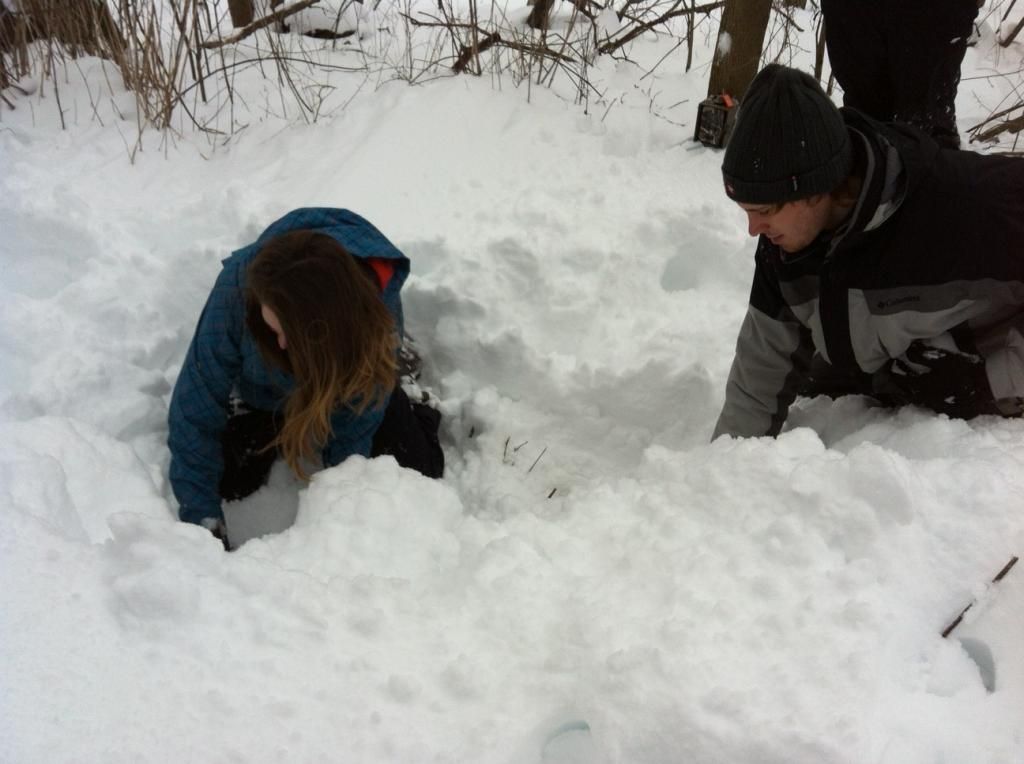
For example, we collected data in the snow to quantify forest community type and composition a while back......
Photo by L. Schulte


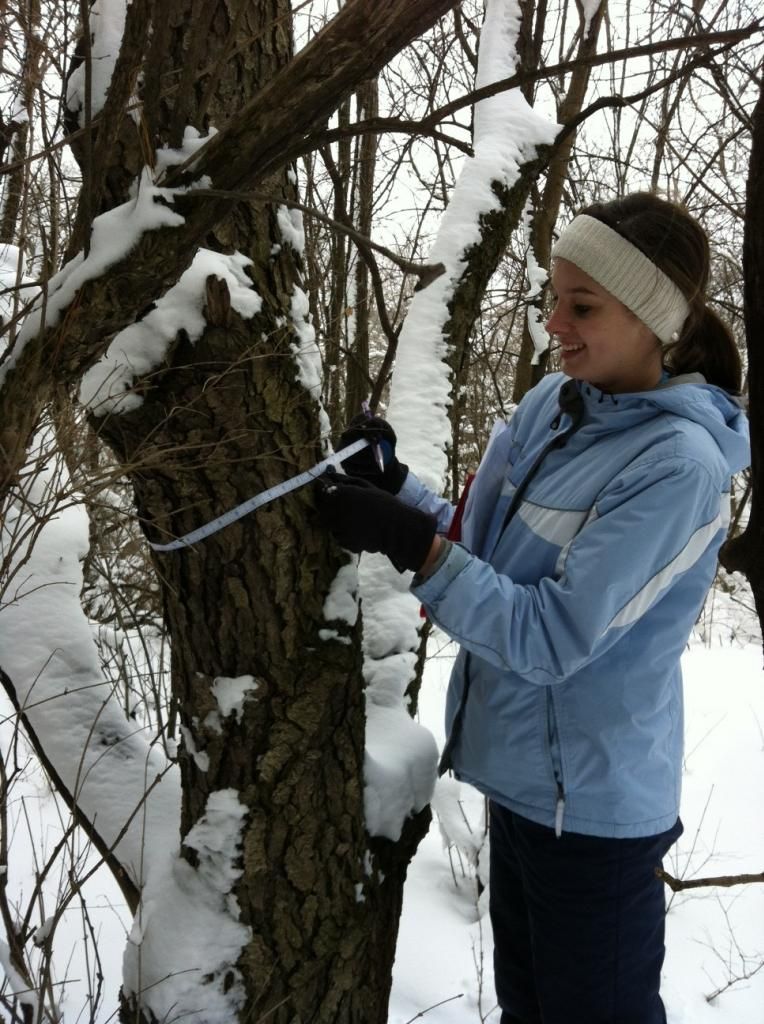
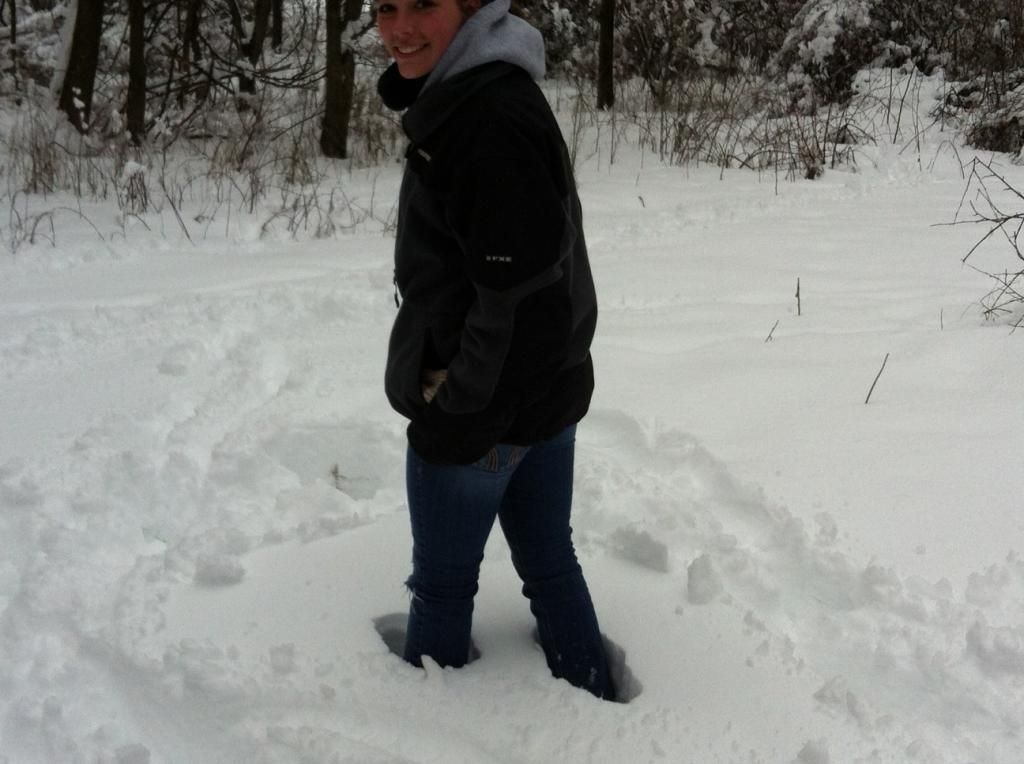
And several weeks ago, as we worked on determining the age distribution of Black Cherry Trees (Prunus serotina), we dealt with probably the deepest snow of the 2012/2013 winter (and it all fell within 24 hrs).  See examples of how deep that snow was below...
Photo by L. Schulte
Photo by L. Schulte
The critters are still moving about, though....

I particularly like the pictures below.

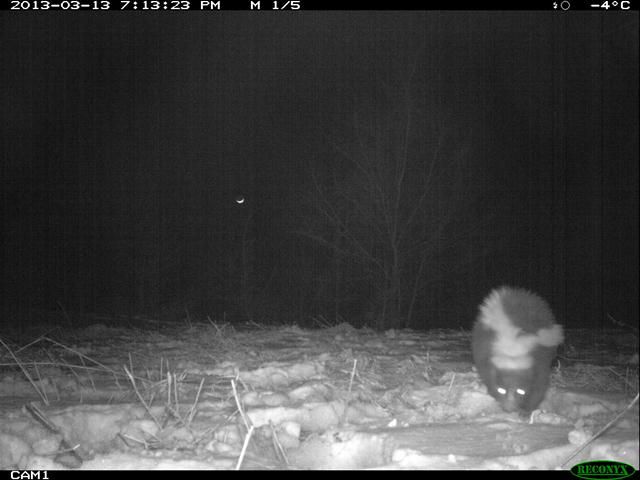
The crescent moon behind this Striped Skunk is kinda neat....

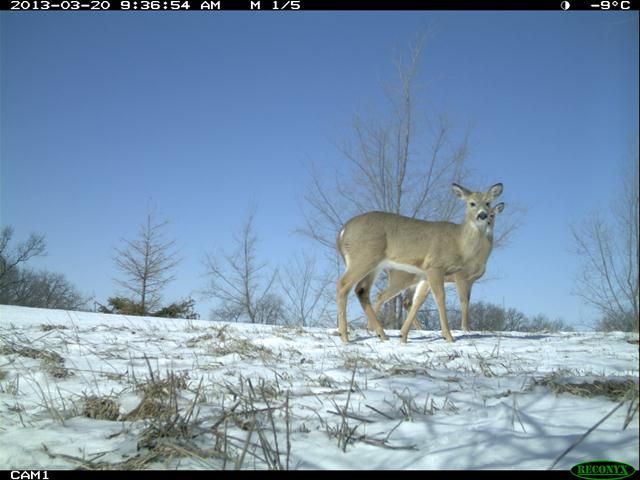
...and these White-tails look nice against that bright blue sky.....

Interestingly, the entire site was criss-crossed with Canine tracks today (Red fox and possibly 'Yote), but we didn't get a single picture on our cameras over the last week.  We had several come close (based on tracks) and one actually marked within ~22 meters on two sides of one of our cameras.

More Phenology Updates:

On Monday, March 18th, I saw my first Killdeer (Charadrius vociferus) of the year.

Bit of a slow week out there.

Stay tuned.

Friday, March 15, 2013

The Fisher-Cat and More Phenology 2013

The student Wolf project finally generated a clip of a Fisher (Martes pennanti) that was worth posting.

This was taken at 7 am on February 18th, 2013.

Given the soft-spot I have for Mustelids.....I thought it was pretty neat to get a Fisher clip, and the students were excited as well.  Fishers are particularly interesting because they are a carnivore that has figured out how to get around that battery of quills protecting the North American Porcupine (Erethizon dorsatum).  The Fisher apparently achieves this by focusing its efforts on the Porcupine's face, where there are no quills, with repeated attacks until the prickly rodent is worn down by blood loss and/or shock.

The history of the Fisher, the Porcupine and overharvesting is particularly interesting, as it starts way back in 19th and early 20th centuries (reviewed by Nowak 2005).  Fishers were heavily harvested by early trappers in North America during this time, which also happened to other furbearing species, such as the Beaver (Castor canadensis, a story I've recounted for you all before).  As a result, the Fisher-Cat was nearly extirpated from the U.S., and with numbers dramatically lowered in Canada.  At this point, it is probably important to appreciate the effect that Fishers can apparently have on Porcupine populations.  An interesting study was published by Earle and Kramm (1982) that compared porcupine populations in two locations:  one with Fishers (due to a re-introduction) and one without.  They estimated Porky population densities of 40 / 100 km-squared in the area with Fishers, and densities of 350 / km-squared in areas without Fishers!  According to Nowak (op. cit.) the loss of the Fisher to excessive trapping lead to a concomitant rise in Porcupine numbers, who proceeded to do "considerable forest damage".  This made the Porcupine unpopular within the timber industry (Roze 2009).  Thus, efforts were made to protect the Fisher in order to control the number of Porcupines.  Such efforts included more stringent laws and closed trapping seasons to help conserve the Fisher.....which were coupled with several successful re-introductions....has lead to the re-bound of Martes pennanti in the U.S.
________________________________________________________________________

Phenology:

The last week (March 10th through the 15th) has also yielded a host of new phenological events for 2013.

On Sunday (March 10th) I saw the first Sandhill Cranes (Grus canadensis) of the year.
Photo source: Wikipedia

On March 10th I also saw the first American Robin (Turdus migratorius) of the season.
Photo source: Wikipedia

Today (March 15th) I observed two other "firsts" for the year: I heard the first Red-winged Blackbirds (Agelaius phoeniceus) calling of 2013, and the first strutting/displaying Tom walkin' birds (Meleagris gallopavo) of the year (THREE Toms displaying amongst a group of 15 birdds near campus).  As an aside, the first Red-winged Blackbird call I heard last year was March 1st.
Photo source: Wikipedia

Things have been chaotic busy!  Hopefully more to post soon!
_______________________________________________________________________

Literature Cited:

Earle, R.D., and K.R. Kramm. 1982. Correlation between fisher and porcupine abundance in upper Michigan. The American Midland Naturalist 107:244-249.

Nowak, R.M. 2005. Walker's Carnivores of the World. Johns Hopkins University Press, Baltimore.

Roze, U. 2009. The North American Porcupine (second edition). Comstock Publishing, Ithaca.

Wednesday, March 6, 2013

Skulls and Skull Cleaning: Part II

In my last skull post, I didn't get to outline any of the techniques I use for actually cleaning and whitening skulls.

So, figured I should get to that now, for anyone interested.

Before I begin, I should preface this by saying that you should always wear gloves when handling animal carcasses (whether recently dead or otherwise).  I prefer nitrile gloves, but latex or rubber gloves would probably suffice, as long as you don't keep them and re-use them.  The risk of zoonotic infection from a number of species can be rather high, and it's just not worth the risk.  I wear gloves when I'm handling carcasses, heads or skulls (until the skulls are completely finished).  I even put bags over my boots if I'm using a foot to hold a road-killed animal still while sawing off a head for cleaning.  The saws, etc. are all cleaned with laboratory grade detergent, or a bleach solution.  I know some folks that scoff at this....but that's being reckless, in my opinion.  For interested folks, The Wildlife Professional recently published a good review on the risks that zoonotic infections pose to wildlife biologists (Yabsley, Fischer, Hernandez, 2012. The lethal jump from wildlife to humans. The Wildlife Professional, Spring 2012 Issue; pg 24-28).  There's some serious stuff out there, and a large number of wildlife biologists have died as the result of infection from such diseases.

De-fleshing:  This is probably the task that keeps most people from getting into cleaning skulls.  It can be incredibly messy and is often a stinky proposition.  Yet, there are a number of ways to go about removing the flesh from a skull you find....one very fast and stinky.....one moderately quick and stinky....the other takes alot time, but one can avoid the associated stinky.

Let's start with the last one first: obviously one can just collect a carcass they find....set it in a place they know is protected from scavengers (and also away from any open windows) and let nature take its course.  This can be very effective....but there's always the scavenger problem.  Plus, it's easy for little teeth, etc. to fall out and get lost.  I've had some success avoiding this by first putting the carcass in a small container covered in screen (like a funnel trap used to catch minnows).  This technique worked fine for me with a weasel skull I cleaned many years ago....but another time was a total disaster with a mink skull I attempted to clean.  In the latter example, when I went back several weeks later, the skull had fallen to peices because I had waited too long to pull it.  Then there's the fact that this method takes a fair amount of time.

The next option is the very fast and stinky one: boiling the skull.  I've only ever been involved in an attempt to do this once.  It seemed to work very well (and was quick) but the smell was very strong (even though we were outside).  We used an old stock pot over a camp stove in a friend's driveway.  The flesh came off pretty well, although some of the brain matter became sort of hard, like cooked meat, inside the skull.  Thus, we had to try and pick it out through the foramen magnum (large opening at the back of the skull, where the brain stem exits and becomes the spinal cord).  Ultimately we were forced to bring the skull inside and use a utility sink in the basement to to start scrubbing/washing away the tissue.  Had we more time to let them boil, and also added some chemicals to the mix, the flesh may have just fallen off.  Yet, although it's quick.....the stink is an issue, it's also alot of messing around.  You don't want to boil a skull on your stove.  You'd fill your house with that stink!  You can do it outside on a grill or a propane stove, but that requires some work to set up and tear down.  You also have to clean that pot out!

You can see a recent post on Nature In a Nutshell where Alyssa incorporated this boiling method.

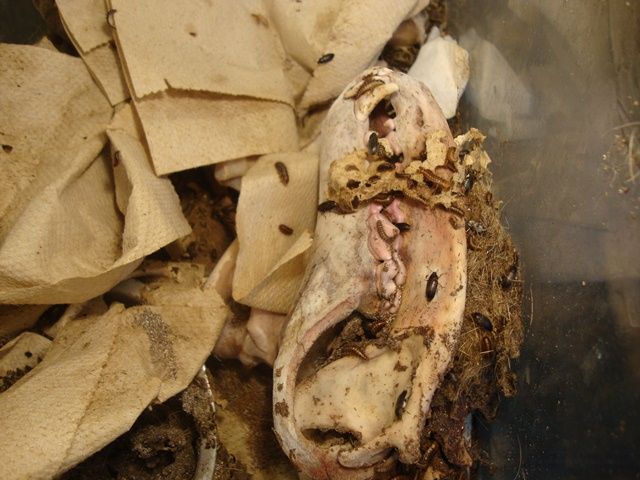
My preferred method of de-fleshing is to use flesh-eating (Dermestid sp.) beetles. 

These are actually relatively easy to get ahold of.  Some folks even collect their own from around carcasses found in the wild.  I prefer to just have them purchased from a biological supply company (such as Wards Scientific).  They are fairly easy to culture.  We have a colony at the university that is housed in a 10 gallon fish tank.  We have a sheet of glass over the tank (slightly cock-eyed so that a sliver of air can get in).  Because the room we keep them in gets a tad cold, we also put a heat lamp over the tank.  When you start the colony....it may require adding a few paper towels for them to hide in....but other than that, they don't need much.  You just have to throw them dead things every once in a while.  The number of beetles in your colony will dictate how quickly they clean your skulls.  The more you feed them, the bigger the colony will get.  But, a large colony can clean a fully-fleshed skull in a week or less.  For example, a week ago I put four smallish heads and one medium-sized head in the colony and they came out today free of tissue.

Some points to consider about Dermestids: 
  • If they escape....they may attack taxidermied specimens, or skin collections!  We've had this problem in the past.  One way to keep them in the tank is to rub vasoline around the upper edge of the glass around the tank.  The glass lid we use also makes a tight seal, which helps keep them inside (but we still have to leave a little crack for air).  We also keep our colony in a back lab under a fume hood (they stink!).
  • As they eat and excrete they create alot of fine particulate debris.  This can build up in the tank. If your skull happens to get a bit buried in that fine debris the Dermestids don't seem to be adept at getting underneath to clean flesh off the buried surface.  So I have to go in and rotate the skulls every so often.  It might help if we put some sort of grate in the bottom, so the skulls rest on top and the detritis falls through....but we haven't done that yet.
  • They wont eat hair or feathers.  So...those will build up quickly in the enclosure (we usually remove as many as we can before putting a carcass in the colony for cleaning).

But....the Dermestid colony does a good job.  Plus, I can put a head in and not worry about it getting damaged by the elements or stolen by a scavenger.....and I don't have to stink up the house or ruin a good stock pot from boiling heads!


De-scenting: There are a few steps I take after removing skulls from the Dermestid colony to reduce the smell.  Seems like no matter how long you leave them in the colony for, the stink of carrion is still pretty strong.  I find that sometimes eliminating that stink just takes time....as the skull dries out over time, the smell goes away.  But, to help it along, I take these extra measures. 

First put the skulls in the freezer overnight.  As much as anything, this also helps kill any small Dermestid larvae that may be hanging around (can't have those escapees getting on the skin collection!).
The next morning, I remove the skulls and let them warm up a bit.  Then I go through a two-step cleaning process.  I first put the skulls in a strong bleach solution (90%) for a short amount of time, during which I check them frequently.  The amount of time I leave them in for varies (5 to 30 minutes depending on how things look).  Some folks will recommend you never use bleach on a skull, and I can't fault them in their logic.  I wear rubber gloves and frequently remove the skull to check on how it's holding up (paying particular attention to the lower jaw to make sure the two mandibles are not starting to separate).  But, basically I find you can't beat the bleach for really reducing the smell.  Plus, the bleach helps sanitize, in the off chance there's a disease-causing agent hanging around somehow.  Basically, so long as I watch the skull carefully, the damage is not noticeable (in fact, I've never noticed any serious damage to my skulls from the bleach solution).
After pulling them from the bleach, I rinse them thoroughly for 5 minutes or so with water.  I then put them into a strong ammonia solution (90%).  I leave them in this for about the same amount of time as the bleach, again making sure to check on them frequently. Once I feel they are as good as they'll get, I rinse them in water again.

The next step is to let them dry for a few hours.

Whitening: I've used two methods for whitening skulls.  First, I've just set the skull out in a sunny spot for a few weeks to let nature take it's course.  Usually the sun really helps whiten the skull, but this takes time.  Also, if it's a little skull, it could get damaged by the elements.  So I employ an alternative method told to me by a friend who used to do taxidermy.  It requires two ingredients: chalk and peroxide.  However, not just any chalk will do.  It has to be magnesium bicarbonate, which is chalk often used by weight lifters or rock climbers for helping get a grip.  I found a nice sized container at REI.  You also can't use your run-o-the-mill peroxide.  You need a special type of peroxide called "40 Peroxide" that's usually avialable from a beauty supply store or a hair salon supply store.

The peroxide and the chalk must be mixed together to form a sort of paste. I usually do this in a plastic cup.  I next spoon this paste over the skull.  It has to rest in place and dry on the skull, so the consistency of the paste must be such that it doesn't just run off of the skull.  You also have to get it in all the cracks and crevices.  Sometimes this requires back-to-back treatments. 

After the paste is in place, I let everything sit and dry at least overnight....sometimes for two nights.

Once the paste is completely dry, it's a matter of simply knocking and brushing it off.  I try to knock the large chunks onto a plate, as I've found I can re-use the chalk.  Then I take a fine bristle brush and lightly scrub the chalk off of the entire skull surface.  I also usually wear gloves as the powder can burn alittle if you brush it all over your hands and hold the skull for a while (especially if your fingers also somehow get damp).

Once the dry paste has been completely brushed off, it's a matter of using super glue to make sure all the teeth, etc. stay in the right place.  I also use glue to secure the seams between the different major bones in the skull (i.e., the frontals, the parietals, etc.).  Note that there still may be some stink (particularly from inside the brain case).  I try and reduce this further by spraying Krylon Clear Coat into the brain case several times.  Even that may not completely do it, and the smell may only go away with time.

The final product looks pretty good and creates a nice teaching specimen.

See the comparison below.  On top is the picture of the skulls right out of the ammonia solution (they are a little wet, which makes them darker than usual).  Below that is the end result after the paste has dried and been brushed away.