The benign adventures and ponderings of a wildlife ecologist who is interested in old school, down-and-dirty field research. Not cutting edge, but occassionally forced to blaze a trail when in the outdoors.
Things have been pretty busy lately. End of the semester, field work starting, and so on. I've got alot to share with you from the last several weeks....but first: something so cute it will make your eyes pop out.
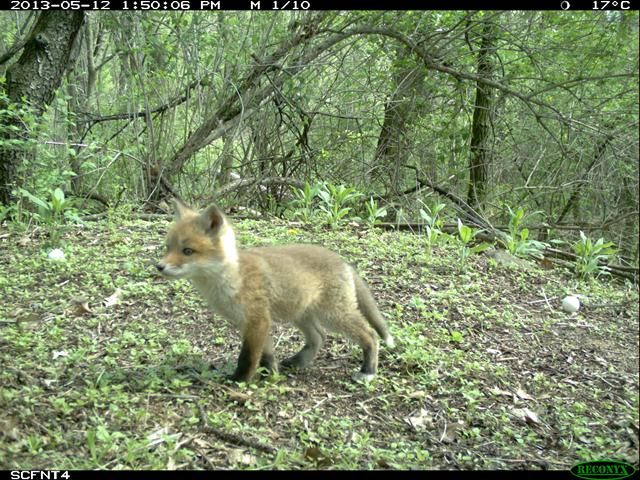
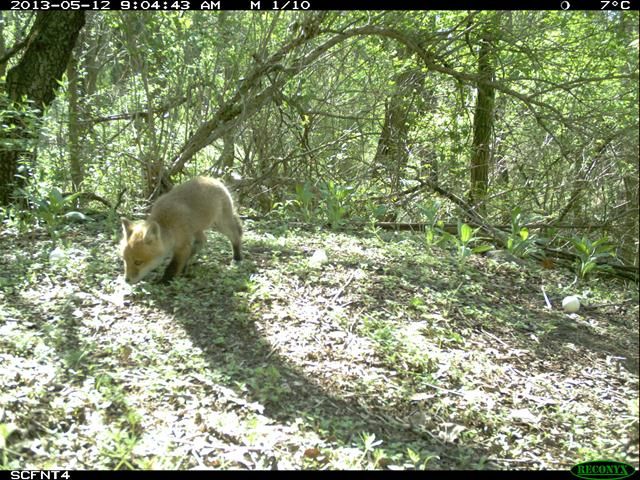
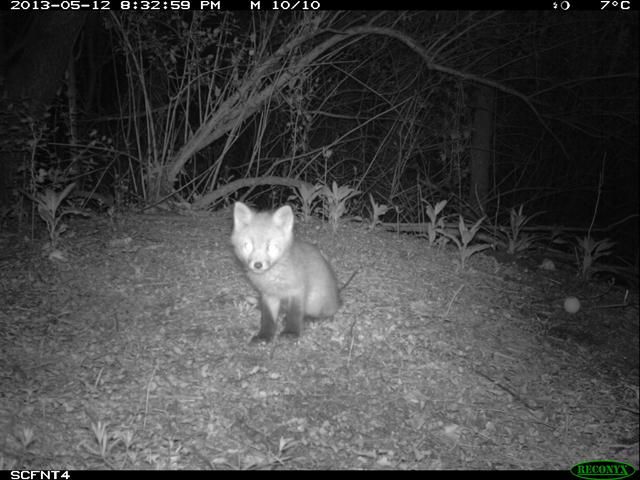
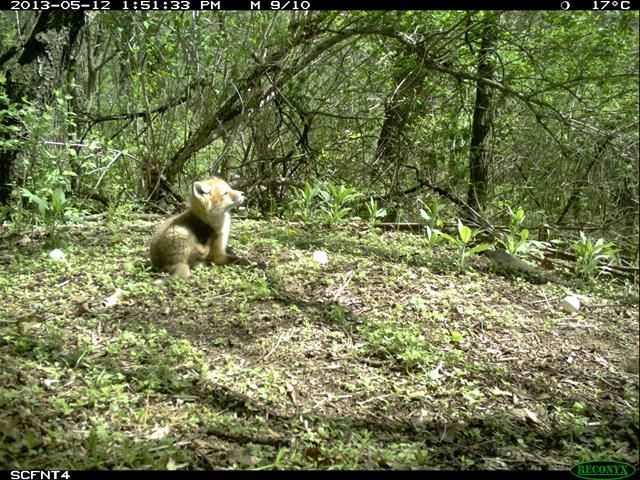
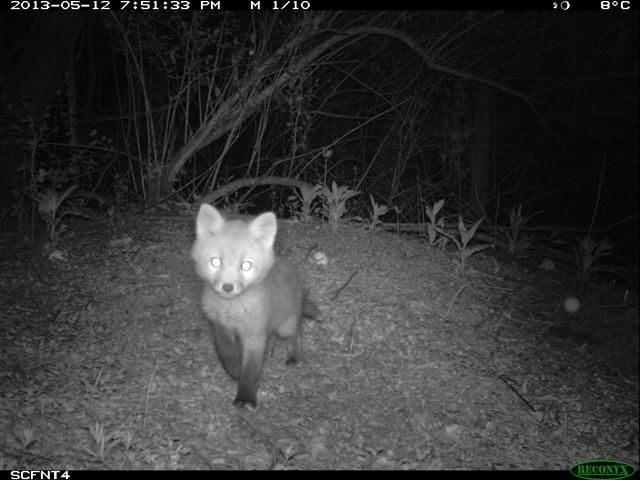
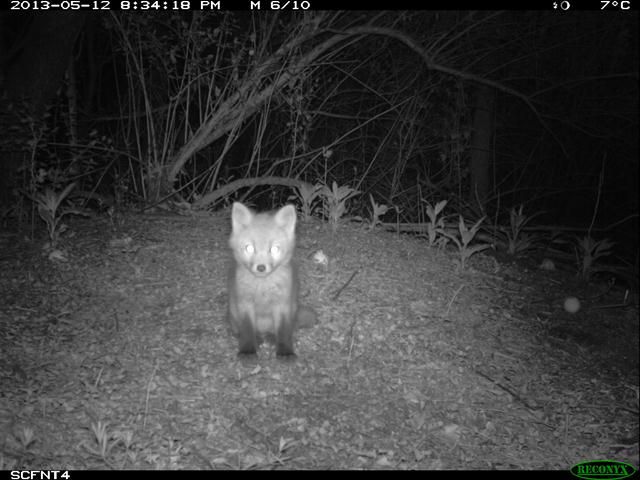
On Thursday, I checked some cameras that students put out at the end of the semester. They had found a possible Red Fox (Vulpes vulpes) den nearby and decided it was a good place to hang the camera.
They were right on the ID for the den inhabitants.
Just about 6 days ago (after several weeks with the camera in-place), this little one showed up.....
This pup showed about at about the right time, based on the breeding phenology of this species in the state.
The adults typically pair-up for breeding as early as December. The main part of the breeding season is January/February.....with parturition occuring sometime in March/April.
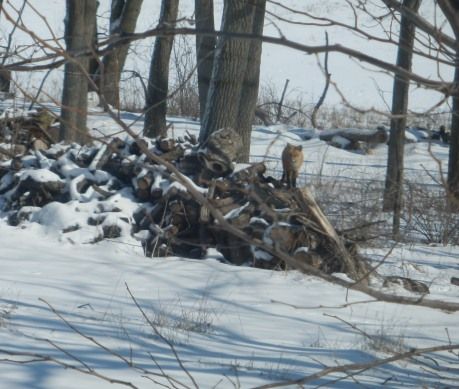
In fact, back in February, a colleague of mine snapped these pictures (not far from where the pup above is located). These show a pair of Reds hanging around a wood pile. He informed me that closer inspection around the woodpile revealed they were working on cleaning out a nearby den (likely in preparation for the coming babies)....
Today I heard the first calling Anurans (Frogs/Toads) of the season. Chorus Frogs (Pseudacris triseriata) are generally the earliest frogs to call in the spring 'round these parts. I've been listening intently at various wetlands nearby for the last week.....but these tiny amphibians have been extremely hesitant (and rightfully so, given our very cold spring this year). Despite this, I've been anticipating their calls for several days now seeing that it has started to sneak above 50 deg F more frequently over the last week.
Today I finally heard them.....
In some parts of the region they are rivaled for first position by the Wood Frog (Lithobates sylvatica). But we do not have Wood Frogs in the immediate area....so I always consider the arrival of spring to be heralded by the Chorus Frog.
Interestingly, this is much different than their date of first call last year (which was a much warmer spring)....but on par with past dates I've recorded.
2012: March 14th
2009: April 14th
2008: April 8th
2007: April 27th
2006: April 12th
2005: April 7th
2004: March 28th
2002: April 6th
2001: April 14th
Beyond that....sometimes all that's needed are a few cool camera trap pictures.
First, an Eastern Cottontail (Sylvilagus floridanus).....
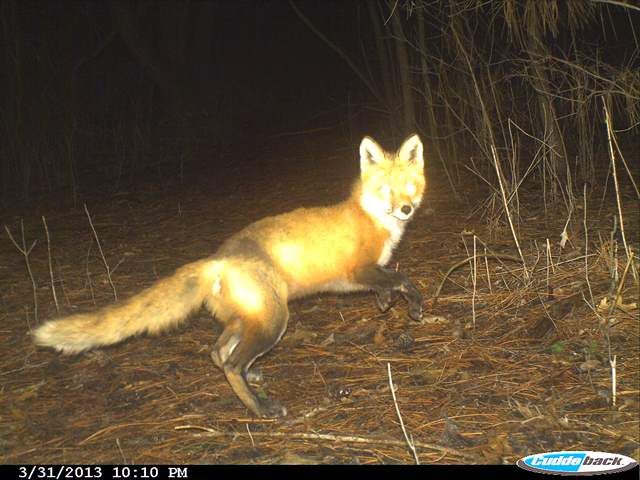
Then, what might be one of my favorite Red Fox (Vulpes vulpes) pictures to-date.......
Foxes are so amazingly cognizant of their surroundings. The Cuddeback has a lightning-fast trigger speed (< 1 sec.), which is the primary strength of this make and model of camera trap. Thus, it almost appears as if this fox started to leap, sensed the flash, and faced the camera.....all as it was springing into action.
That is what I'd call complete situational awareness!
The Coyote (Canis latrans) activity has picked up substantially at several of our camera trapping locations. This makes sense, as it has corresponded with the mating season and (soon) parturition for our region. As Jackson (1961) reports, breeding primarily occurs in February, and most pups are born in April (gestation period of 60-63 days).
So, the timing is perfect.
Below are two clips of males at the same site for comparison.
....and now the pregnant female.....she just looks uncomfortable, doesn't she?
The den must be nearby, and I hope we can get clips of the pups......
As most know, the Coyote is often vilified and looked upon with scorn. Jackson (op. cit.) mentioned several historic accounts of negative attitudes towards Coyotes in our region (note the "wolf" referenced in the passsages below is the "prairie wolf", which is an old common name for the Coyote).
"Among the other evidences of the rude and primitive condition of the town [of Mineral Point-TB] was the almost unceasing howling and barking of the wolves during the night, around and within its very borders, sounding at times as though the town was invested by scores of the brutes, much to the annoyance and alarm of timid strangers." (S.M. Palmer, 1872; 302).
Jackson also recounts some of the methods used in the past to eradicate these rude, brutish and annoying animals....
"A grand wolf hunt will come off Monday the 17th of December, 1863. There will be a line formed, commencing at ...... the town of Fulton, extending up .....in the town of Janesville. Said line will be formed and ready to march at 10 o'clock A.M. There will also be a line formed on the west side of the river to act in conjunction with the first. ........ We invite all to take part, for the wolves are troublesome (Janesville Daily Gazette, Dec. 7, 1863)."
The distance that this line of 'yote-hunters would have spanned was probably anywhere from 12-14 miles, as the crow flies. Now, I don't want to sound hippy-dippy......but that's alot of effort to kill little ol' Wil E., which would suggest a very deep-seeded dislike or fear.
I wonder if the folks who orchestrated those hunts (or anyone today who dislikes Coyotes) would feel differently about them if they saw them acting just like their beloved domestic dog?
This doesn't appear to be skittishness. This behavior looks just like that of my dog when he's excited to go outside.
Old man winter still has a firm grip on the upper Midwest.
I love the snow and cold, but this time He's screwed up one of our lab exercises........
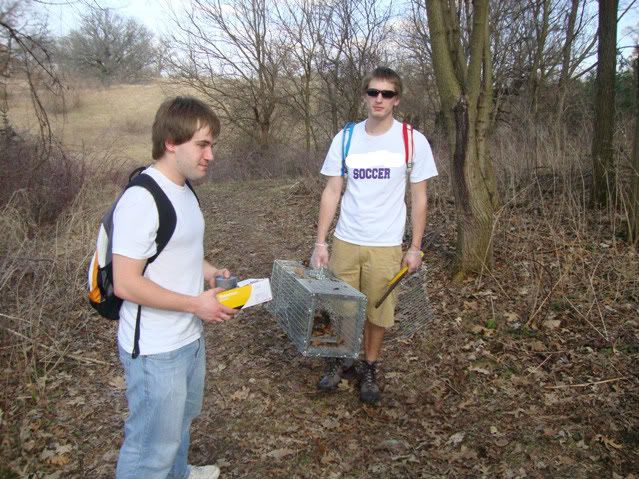
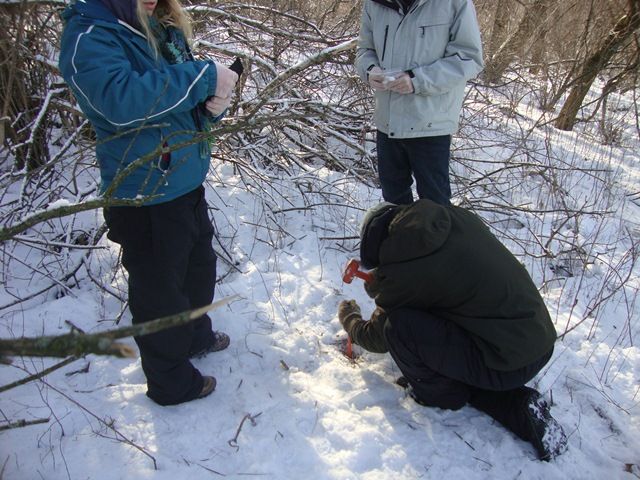
Normally, this week is for medium-sized mammal trapping with wire cage traps. In fact, last year...the weather was perfect for such an endeavor, as depicted in this picture from almost exactly a year ago today.
But because the Old Man keeps peeking in on us this year, we have recently experienced another bit of snow and nighttime temperatures dipping to below 10 degrees (F) for two days in a row. Even as I type this....it is only 11 degrees (F) outside and I'm wearing my extra-heavy smartwool socks!
There is no small amount of irony in the fact that today is technically the first day of spring, or the vernal equinox.
Granted, it's possible we could have set this up so that any captured critters wouldn't freeze to death (placing alpaca wool into the cages...putting the cages in sheltered locations....place spruce boughs around them to block the wind) but I don't want to take any chances.
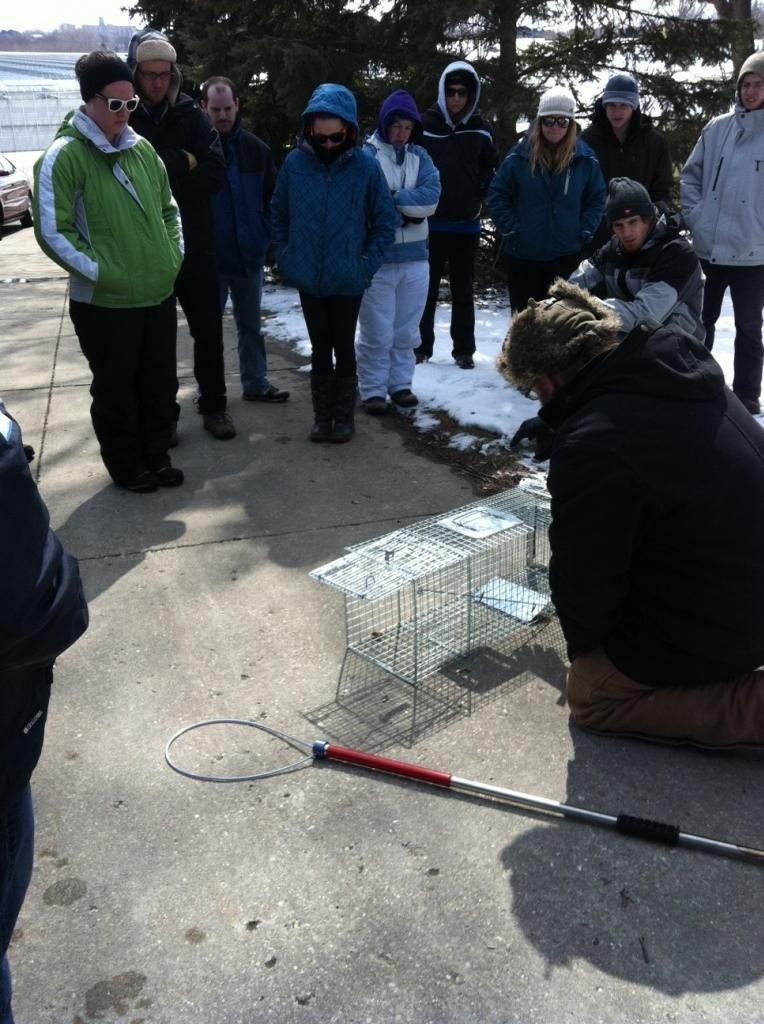
Photo by L. Schulte
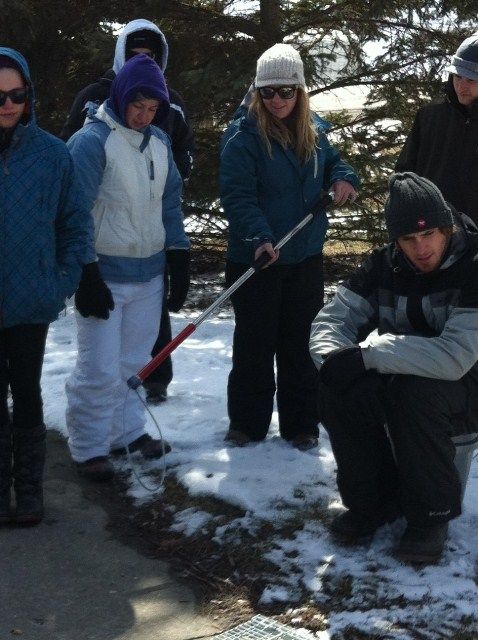
Thus, today involved review of how the traps work, a discussion of various other traps employed to catch mammals, and scoping the site for locations (in addition to upkeep of their ongoing monitoring projects on-site).
Photo by L. Schulte
Luckily, I had somewhat planned for this possibility and scheduled two weeks of mammal trapping (and seeing next week is Spring Break....we may have enough time for things to warm up before we try this again!).
I shouldn't be shocked by anything this year, I guess. There has been quite a trend for cold and snow (unlike last year). You can see some past examples here and here. There have been other snowy lab periods since then.
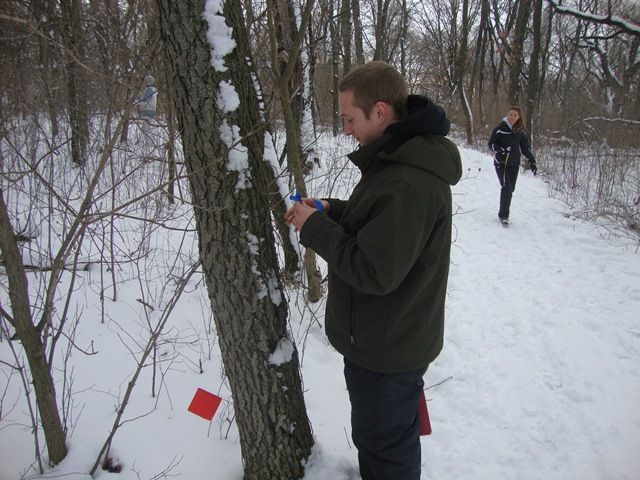
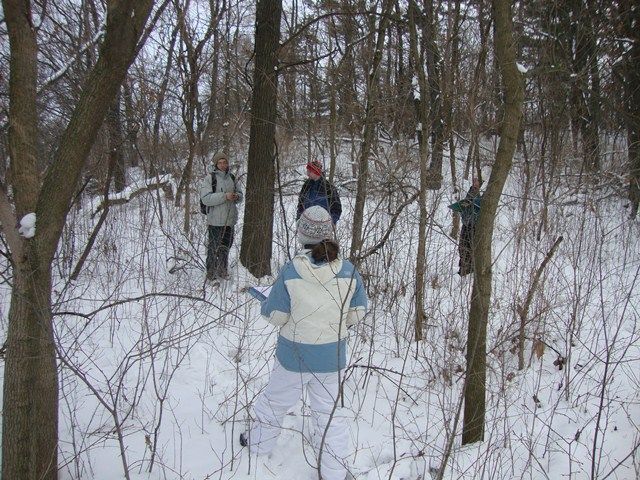
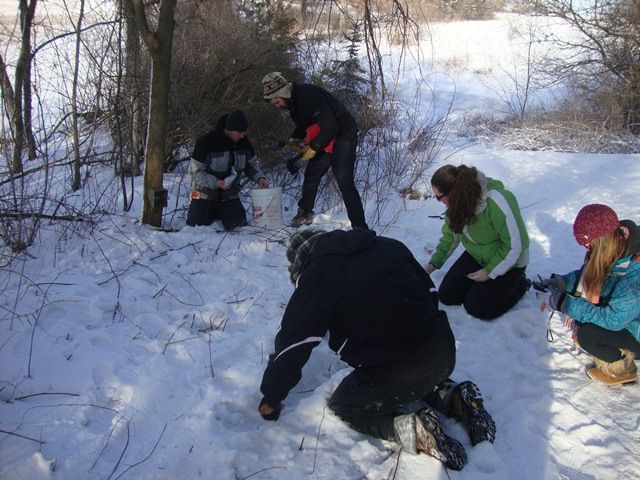
For example, we collected data in the snow to quantify forest community type and composition a while back......
Photo by L. Schulte
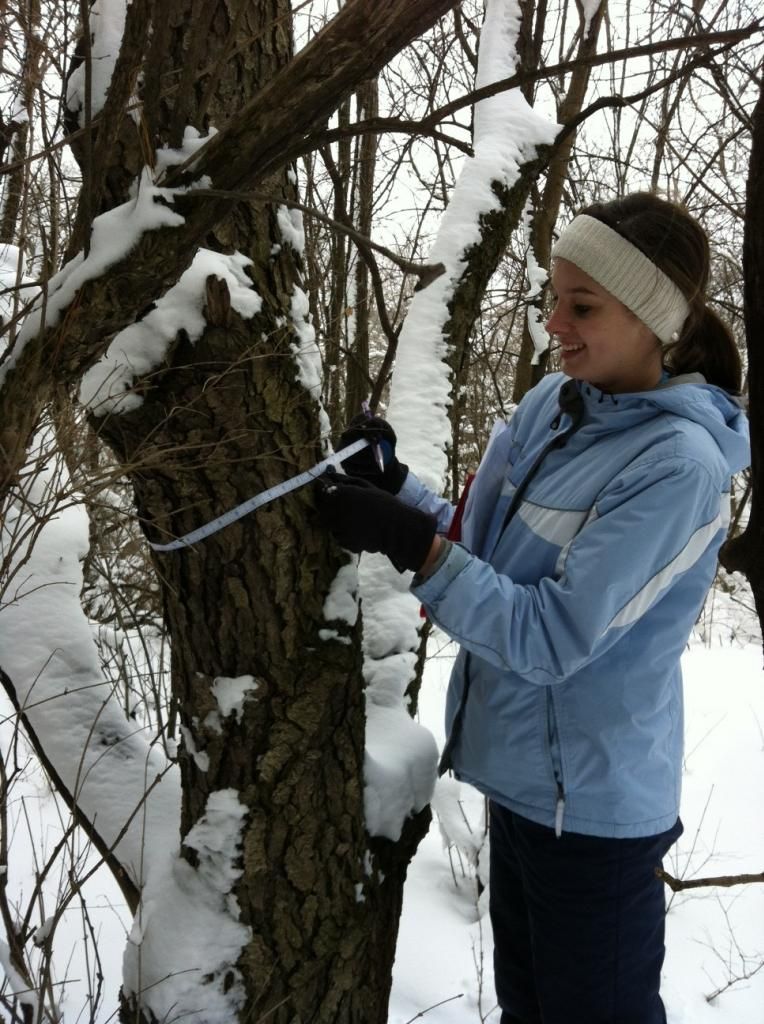
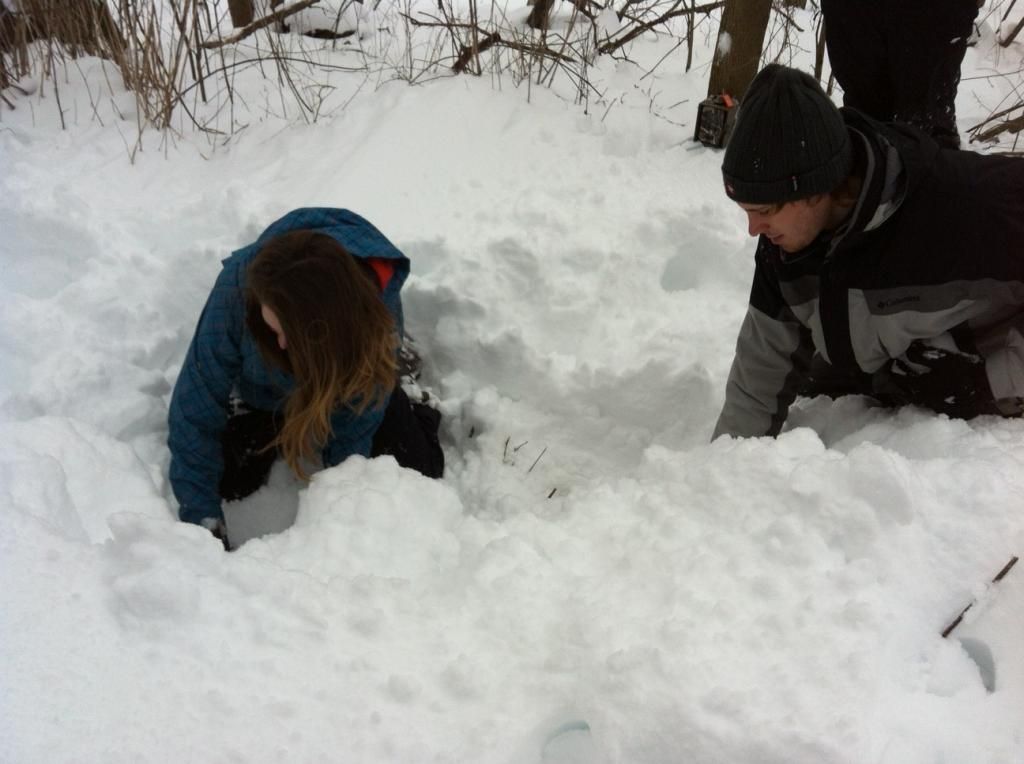
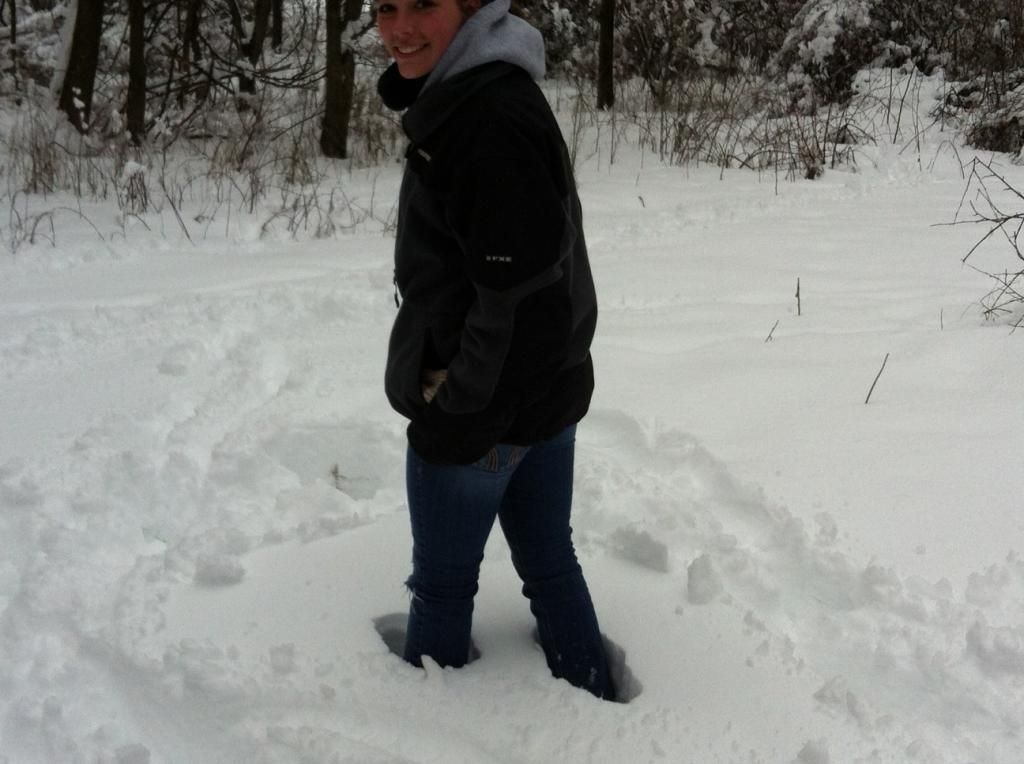
And several weeks ago, as we worked on determining the age distribution of Black Cherry Trees (Prunus serotina), we dealt with probably the deepest snow of the 2012/2013 winter (and it all fell within 24 hrs). See examples of how deep that snow was below...
Photo by L. Schulte
Photo by L. Schulte
The critters are still moving about, though....
I particularly like the pictures below.
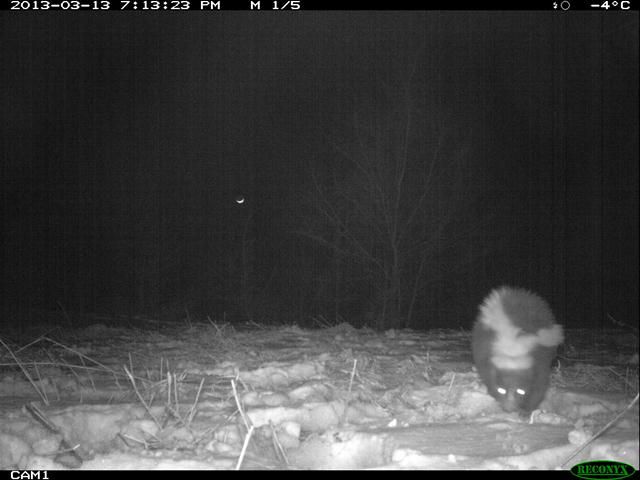
The crescent moon behind this Striped Skunk is kinda neat....
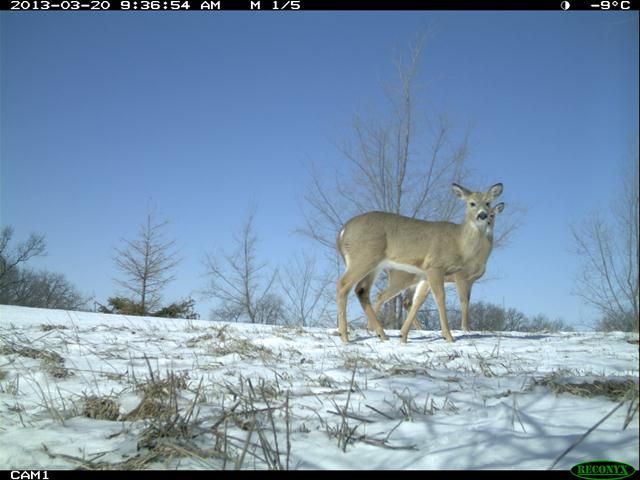
...and these White-tails look nice against that bright blue sky.....
Interestingly, the entire site was criss-crossed with Canine tracks today (Red fox and possibly 'Yote), but we didn't get a single picture on our cameras over the last week. We had several come close (based on tracks) and one actually marked within ~22 meters on two sides of one of our cameras. More Phenology Updates:
On Monday, March 18th, I saw my first Killdeer (Charadrius vociferus) of the year.
The student Wolf project finally generated a clip of a Fisher (Martes pennanti) that was worth posting.
This was taken at 7 am on February 18th, 2013.
Given the soft-spot I have for Mustelids.....I thought it was pretty neat to get a Fisher clip, and the students were excited as well. Fishers are particularly interesting because they are a carnivore that has figured out how to get around that battery of quills protecting the North American Porcupine (Erethizon dorsatum). The Fisher apparently achieves this by focusing its efforts on the Porcupine's face, where there are no quills, with repeated attacks until the prickly rodent is worn down by blood loss and/or shock.
The history of the Fisher, the Porcupine and overharvesting is particularly interesting, as it starts way back in 19th and early 20th centuries (reviewed by Nowak 2005). Fishers were heavily harvested by early trappers in North America during this time, which also happened to other furbearing species, such as the Beaver (Castor canadensis, a story I've recounted for you all before). As a result, the Fisher-Cat was nearly extirpated from the U.S., and with numbers dramatically lowered in Canada. At this point, it is probably important to appreciate the effect that Fishers can apparently have on Porcupine populations. An interesting study was published by Earle and Kramm (1982) that compared porcupine populations in two locations: one with Fishers (due to a re-introduction) and one without. They estimated Porky population densities of 40 / 100 km-squared in the area with Fishers, and densities of 350 / km-squared in areas without Fishers! According to Nowak (op. cit.) the loss of the Fisher to excessive trapping lead to a concomitant rise in Porcupine numbers, who proceeded to do "considerable forest damage". This made the Porcupine unpopular within the timber industry (Roze 2009). Thus, efforts were made to protect the Fisher in order to control the number of Porcupines. Such efforts included more stringent laws and closed trapping seasons to help conserve the Fisher.....which were coupled with several successful re-introductions....has lead to the re-bound of Martes pennanti in the U.S.
________________________________________________________________________
Phenology:
The last week (March 10th through the 15th) has also yielded a host of new phenological events for 2013.
On Sunday (March 10th) I saw the first Sandhill Cranes (Grus canadensis) of the year.
Photo source: Wikipedia
On March 10th I also saw the first American Robin (Turdus migratorius) of the season.
Photo source: Wikipedia
Today (March 15th) I observed two other "firsts" for the year: I heard the first Red-winged Blackbirds (Agelaius phoeniceus) calling of 2013, and the first strutting/displaying Tom walkin' birds (Meleagris gallopavo) of the year (THREE Toms displaying amongst a group of 15 birdds near campus). As an aside, the first Red-winged Blackbird call I heard last year was March 1st.
Photo source: Wikipedia
Things have been chaotic busy! Hopefully more to post soon!
_______________________________________________________________________
Literature Cited:
Earle, R.D., and K.R. Kramm. 1982. Correlation between fisher and porcupine abundance in upper Michigan. The American Midland Naturalist 107:244-249.
Nowak, R.M. 2005. Walker's Carnivores of the World. Johns Hopkins University Press, Baltimore.
Roze, U. 2009. The North American Porcupine (second edition). Comstock Publishing, Ithaca.
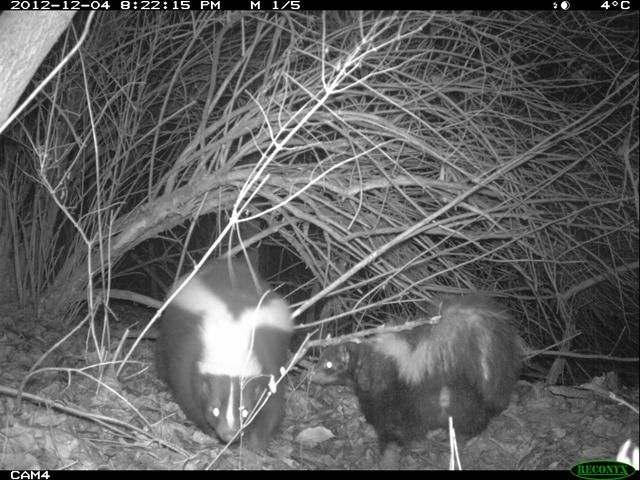
During the week February 20th, we saw evidence of active Striped Skunks (Mephitis mephitis) for the first time since December.
For example, while out and about with my advanced ecology students, I found some nice tracks.
These are some of the better skunk tracks I've come across. As Halfpenny and Biesiot (1988)mention, skunks have a plantigrade print. In other words, as they walk, their flat foot (heel and all) comes entirely into contact with the ground. Contrast this with the digitigrade tracks of canines, whom basically walk on their toes (or digits....see the fox prints below and elsewhere on this blog). Skunk tracks can be fairly easy to identify, if you get a good print, due to the chunky-looking pads on the heel and ball of the foot (which are clearly separated from eachother). Yet, Halfpenny and Biesiot also also state that skunk tracks are often "indistinct due to the sloppy walking and long hairs on the feet".
So, I felt fortunate to find such nice prints.
The last good evidence of active skunks on-site was a brief glimpse during our first snow-storm of the winter (seen below investingating an old burrow) back in late December.
Prior to that, it was early December. This was an also during an uncharacteristically warm beginning to the winter.
But...now they are on the prowl again. February can be an important breeding period for them 'round here. Interestingly, it is also the same time (within a couple of days) that I first got pics of them active in 2012 at this site (see here).
The students were also setting up some scent stations last week during "lab" (outdoor lab, that is....indoor labs give me a case of the BORINGS! :) ). This is similar to the experiment we set up last year.
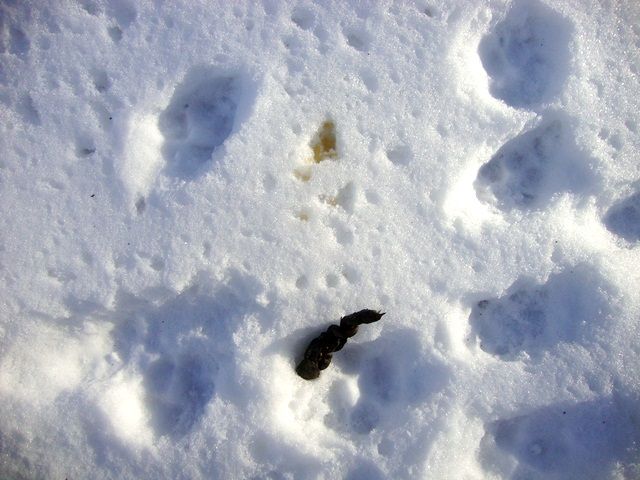
A good indication that you've found a decent spot is the presence of scat....tracks....or a urine mark. So, how about all three?!
I'd say that if a Red Fox (Vulpes vulpes) decides to leave that much sign around, it's a good spot for a camera set and scent station. An interesting thing to note: look at how small that urine spot is? Probably not alot of urine deposited when marking that location. Do you y'all think that might give a good indication of how much scent one should put down to attract fox?
This year, unlike last year, frozen ground was a force to be reckoned with.
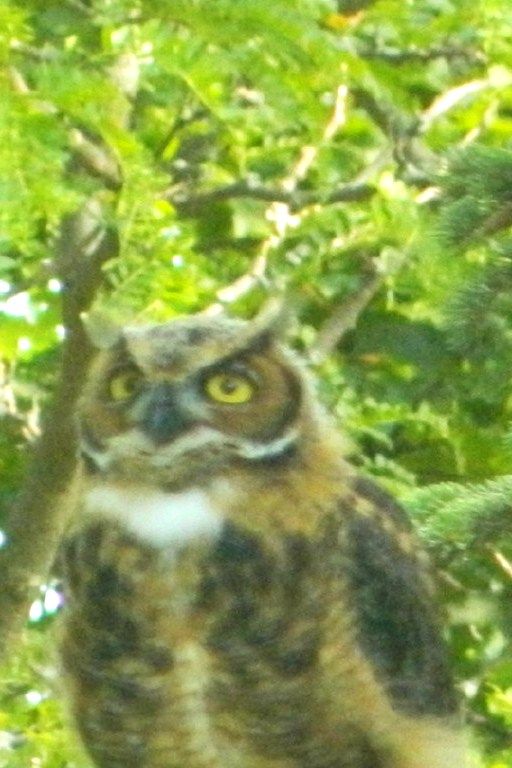
Today (January 7th), as I went on a forced walk in a futile effort to undue the damage of the Holidays, I heard my first Great Horned Owl (Bubo virginianus) call of the year. I had heard them calling in the woods behind the house at roughly this time last year, as well.
Great Horned Owls have a fairly early calling/nesting season here in the upper Midwest. The Phenology calendar for our state indicates that courtship activities for this species begins around January 30th. The Department of Natural Resources suggests that calling individuals can be heard from late November through December and January.
Nesting is also a very early affair for this species. In fact, my friend Bill over at The Future of Birds once told me that it's not unheard of for females to incubate eggs with a thin layer of snow covering their heads and shoulders! Stout (2008) reported an average egg-laying date of February 7th for various monitored nests from 2002-2005. He also reported average hatching dates to be March 12th.
Yet, this is not the earliest known report for this species, from our neck of the woods.
Again, Stout (2008) has the honor. He details a nesting pair observed copulating on December 22nd (2007) and then observed one of these incubating eggs on January 1, 2008 (estimated clutch initiation of December 29th)! At another location in the same year, he also reported eggs observed in a nest on January 8th.
This is the earliest reported and confirmed nesting activity for Great Horned Owls in our state (by over 20 days!).
Both nesting locations that Stout observed were in relatively warm and protected micro-climates, and both were in anthropogenically altered landscapes (one located in a cemetary, the other associated with a power plant). He suggests the protected nature of the nesting sites may have encourage these early egg-laying dates.
Photo by C. Weimar
The Great Horned Owl is known to occupy tree cavities for nesting, but will very often take-over abandoned nests of other species (such as Red-Tailed Hawks, Herons and Crows). Interestingly, Stout postulates that prior to extensive logging in our region, this species may have had larger trees (with larger tree cavities) available to nest in. Such large cavity nesting sites may have been traditionally preferred by Great Horned Owls over the abondoned nests of other species. Because sites within such tree cavities were likely more sheltered than an abandoned hawk nest, Stout suggests that very early nesting dates may have historically been the norm for this species. Yet as the original forests were logged from the landscape, so to were all of those large trees and nice nesting cavities.....and the owls were forced to adapt.
It's always fascinating (and alittle depressing) to think about how the wild critters carried on before our arrival....and how massively different things must have been.
Regardless, I was happy to hear the Great Ones calling again this year.
I accummulate hundreds and hundreds of White-Tail Deer pictures and video clips throughout the year. I realize that countless pictures of deer get a bit boring and repetitive. This is evidenced by the fact that my blog entries related to deer consistently have the lowest numbers of views compared to my other entries.
Therefore, I try to limit the number of entries I write that are focused solely on deer. I obviously can't help showing you all any large bucks I happen to get (at least once or twice a year)....they are just too impressive when in their prime not to be enamoured with them. Yet, I try and focus deer-related posts to something specific regarding interesting behavior or phenomena....and I think the interactions below fall into that category.
The video clips below provide a bit of insight into how frequently bucks and does return to investigate a scent location....and also for how long they will return to this spot over time. Granted, this is a sample size of 1....but it's still neat to see.
You'll also note that there is not a single clip that occurs during the daylight. Even though the behavior below is occuring outside of the rifle hunting season in our area, most of my pics/videos of deer activity throughout the fall and winter (particularly for the large bucks) happens at night. There's tons of deer out there....but they're just too dang "smart". I often wonder if pressure from hunting hasn't acted as a force that drives natural selection to "favor" individuals that more often operate at night....and thus don't get shot!
But, that's a different topic of discussion.
__________________________________________________________________________
The camera that took these clips is mounted on the trunk of a very young tree. The trunk is pretty narrow and the branches are low to the ground (in fact, I had to trim some away just to access the tree trunk for camera mounting).
The camera was deployed to this location on the morning of 9/26/2012.
9/26/2012
9:23 pm: Doe browsing a bit, but also stopping by to investigate some fox urine that I put out.
11:28 pm: One of The Brutes comes by to investigate....
9/27 to 9/28/2012 (evening to early morning)
7:24 pm: A doe (perhaps the same one from the previous night) once again is sniffing around the same spot...
10:07 pm: The Brute comes by to get a nose-full.....
He then moves towards another low-hanging branch. He appears to browse a bit, but also deposit scent from his forehead glands....
11:32 pm: A small buck stops by. I think he's part of set of twins that belong to the doe that visits this spot. He does some browsing, but also appears to investigate the scent from the larger male....
1:42 am: The young feller comes back to sniff around a bit.
1:46 am: There's a-doings a-transpirin' off to the right of our field of view! Something is shaking the limbs of the tree the camera is mounted on, and kicking up the grass. You can also barely see a pair of eyes watching cautiously in the background (far left).
You can probably guess who's responsible for the ruckus (the little buck also skee-daddles in the background).
......wait for it.....
"Holy .....! What was that all about?!"
9/28/2012 (evening)
8:59 pm: A doe sniffs the branch that appears to be a despository for scent from the forehead glands of the big male...
For the next two days, the doe and the young bucks come back and sniff around some more.
9/30 to 10/1/2012 (evening to early morning)
11:39 pm: The Brute comes back to invesitage his scent branch...
1:03 am: There's another ruckus off-screen....and then....
Although the buck meandered by this spot again once or twice, I never saw the back and forth investigation of scent after the first of October. The camera was moved from this location on November 14, 2012. So all of that activity was occuring over a period of about 5 days. An important caveat: almost immediately after I mounted the camera...I was getting clips of this behavior. Who knows how long it was going on prior to me mounting the camera.
It is worth noting that I started seeing the first actual buck scrapes on the ground in about mid-October at this site. You may also recall that I first started seeing velvet rubbed off of antlers (at a different site) on September 8, 2012.
It is also fun to go all the way back to the beginning of the year and look at when the antlers first starting showing on these bucks. At the site where the video clips above were taken, antler nubs first became evident on April 17, 2012.
I recently obtained the first evidence of a White-tailed Deer buck without velvet in 2012.
These clips were taken on Sept. 8, 2012.
September is the primary month in which buck White-tailed Deer rub the velvet from their antlers in preparation for the rut (although there is variation in this date, and velvet may be rubbed off as early as late August, or as late as November). The triggers for this rubbing behavior are the result of a battery of hormones, but changes in testoterone levels (often triggered by changes in daylength) are important. For example, according to Miller et al. (2003) the "hardening of the antler and shedding of velvet are a direct result of rising testosterone levels cued by shortening daylength."
Compare this to the first hint of antlers since this year, way back in April.....
Literature Cited:
Miller, K.V., L.I. Muller, S. Demarais. 2003. White-tailed Deer (Odocoileus virginianus). In Feldhamer, et al. Wild Mammals of North America: biology, management, and conservation (second edition). Johns Hopkins University Press.
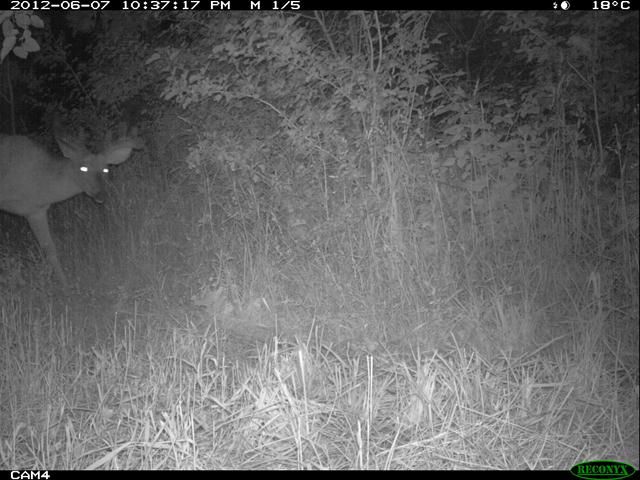
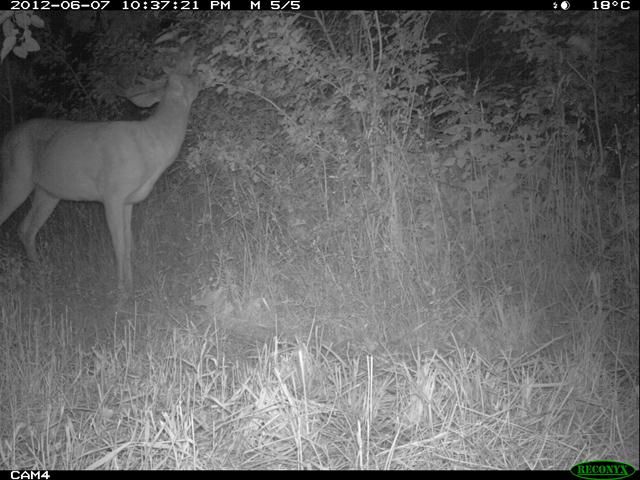
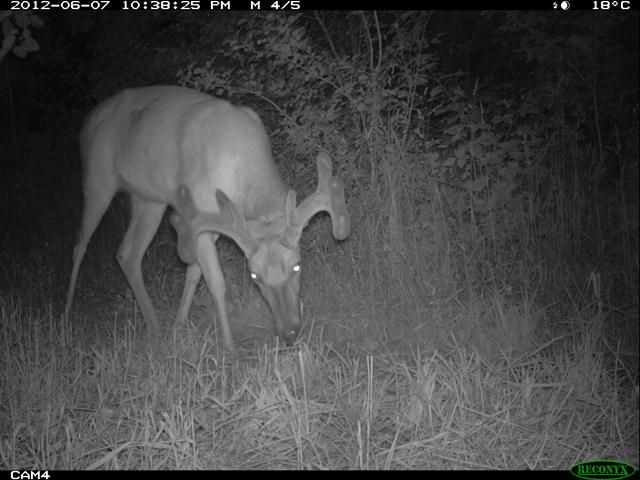
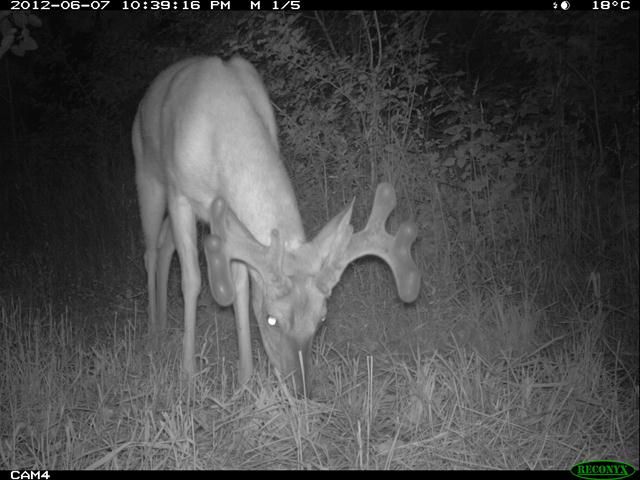
This fella's going to be a beauty. In fact, it could be one of the brutes I got pictures of from behind the house last fall (see here, and here) and I'm pretty sure it's the same fella I captured on this camera over a month ago (see here). I guess he survived last year's hunting season (see here and here). Assuming this is the same individual...it seems he's back.
On 6/12/2012 as we drove home from my daughter's swimming lesson...we saw a Red Fox (Vulpes vulpes/fulva) bound across the road. It was heading into a woodland preserve near campus and as we pulled up, the fox stopped to look at us from the roadside. It held that spot for a good 10 seconds, not 15 yrds away and we saw it had a meal dangling from its jaws. Appeared to be a young Whistlepig (Marmota monax). After a quick look-see, the fox turned and trotted back into the woods. I'm assuming it had pups nearby.
I've got alot of stuff to share with you all, but no time to post it!
Figured I could at least get this quickie post in, as it requires little explanation.
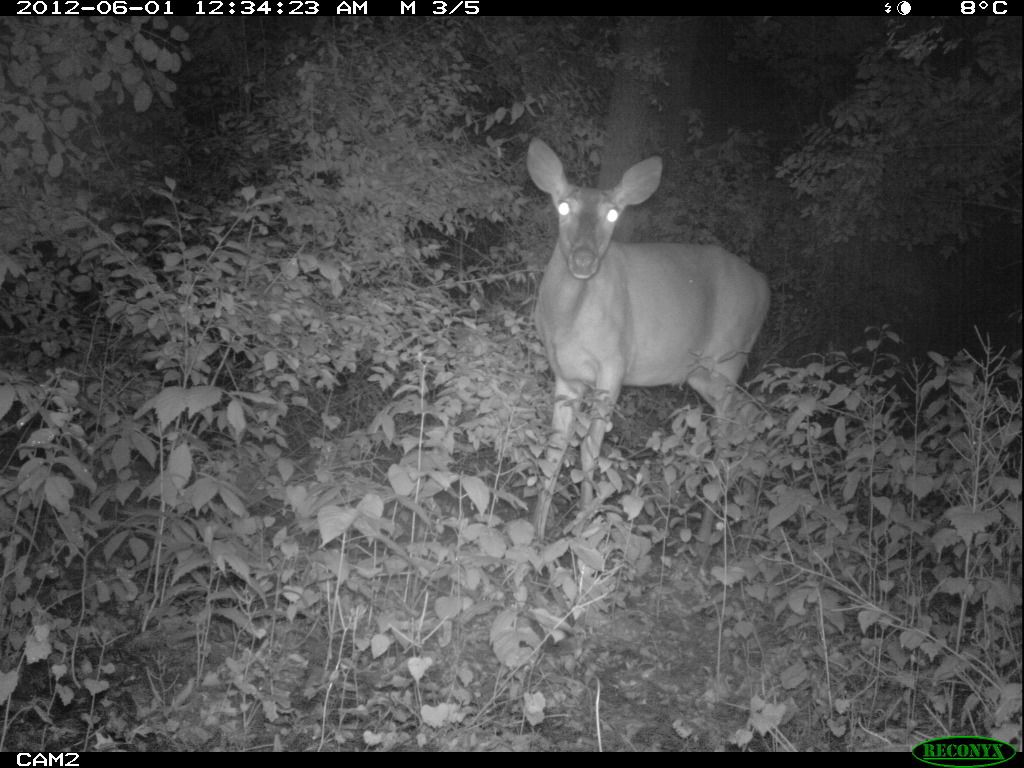
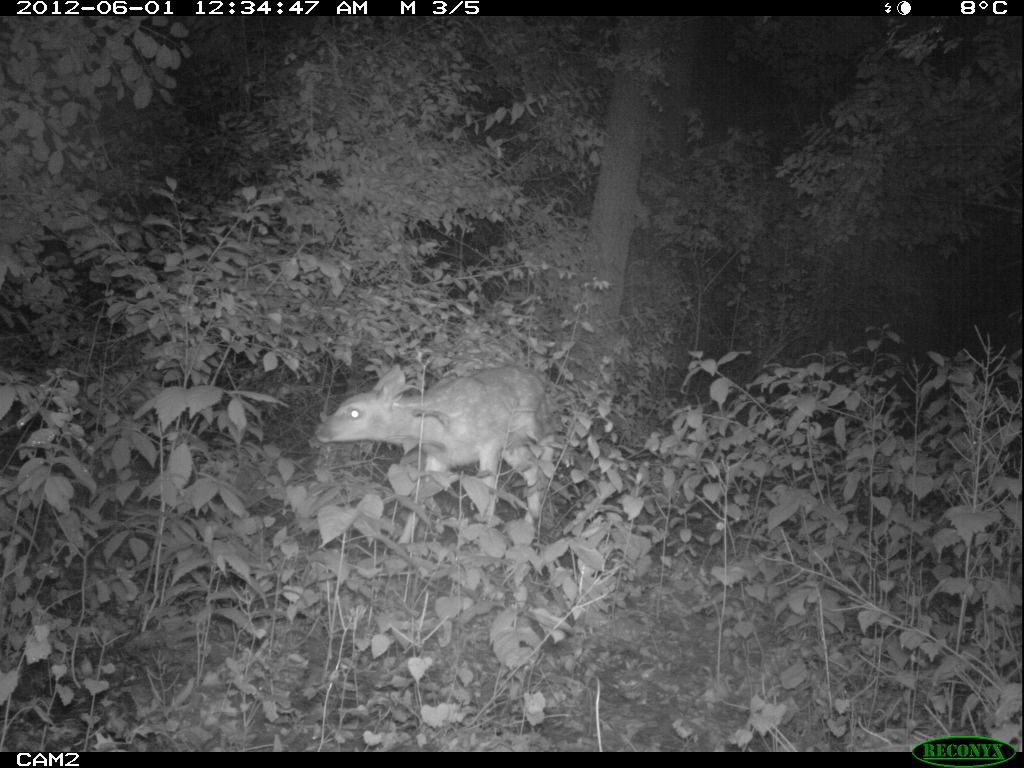
The babies started showing themselves for several species just in the last week 'round these parts.....
To start things off: my first camera-trapped fawn of 2012.
The momma comes forward with some trepidation.....
...but she's followed closely by junior......
At a completely different site, several species have acted like "proud parents" for the camera.
First a video clip of a Whistlepig (Marmota monax) with two youngsters close behind.... I've actually managed to get pics of baby 'pigs before, back in NC (see here).
...and just this morning.....a momma Racoon (Procyon lotor) with a group of little ones in-tow.....
More to post again soon (hopefully)....as soon as I catch my breath, that is!
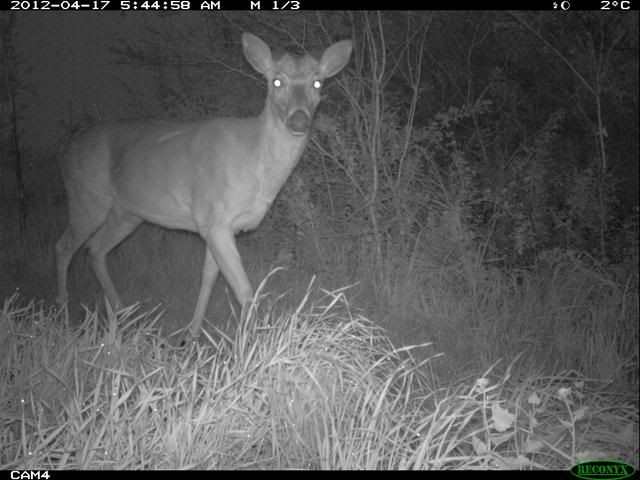
It seems like some of these bucks just lost their antlers! There were individuals showing up on our cameras in February that were still holding their racks....and already they've started to come back in some males.
No doubt it's a high-resource environment, with an associated risk of mortality that must be pretty small..... Also, I guess the testosterone has started flowing again!
This is not too far off from when I first started seeing the antler buds peek through on the bucks when living down in NC last year....
On the evening of 4/15/2012, I heard the first American Toads (Bufo=Anaxyrus americanus) calling of the season. These were pretty early like many of the other frogs this year....but not as far out of their normal time as the Chorus frogs (Pseudacris triseriata) have been. They did not call for very long (one or two strong nights) and then the weather cooled, which seems to have slowed them. I imagine I'll hear them again.....
It's also worth noting that I am also still hearing Chorus frogs calling with some intensity....despite the fact that they began so early this year.
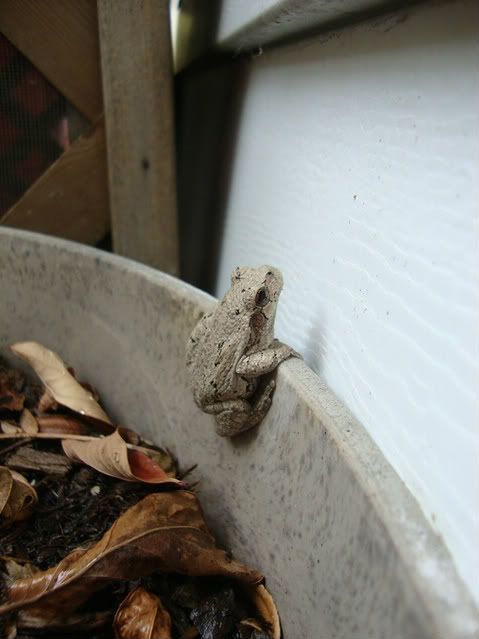
Although I have not heard Gray Treefrogs (Hyla versicolor) calling yet this year (that would be WAY, WAY early)....I saw my first adult of the year. Just behind he house on our deck. We have been preparing some of our potted flowers and vegetables for the coming summer and I moved our potted blueberries out of the garage and onto the porch today. There was a pile a leaves near the vent for our clothes dryer that was about where I wanted to put the blueberry pots. I was brushing these leaves out of the way by hand, when out tumbled a nice little treefrog. The leaves were damp and the dryer vent must have provided alittle warmth as we were doing laundary.
Much to my daughter's delight, we got to look closely at him as we moved the blueberry pots into place. I left some of the leaves in a pile near where I had moved them from (so they were next to the blueberry pots). Then I carefully placed the little fella in one of the pots, figuring he could move on his way as he saw fit.
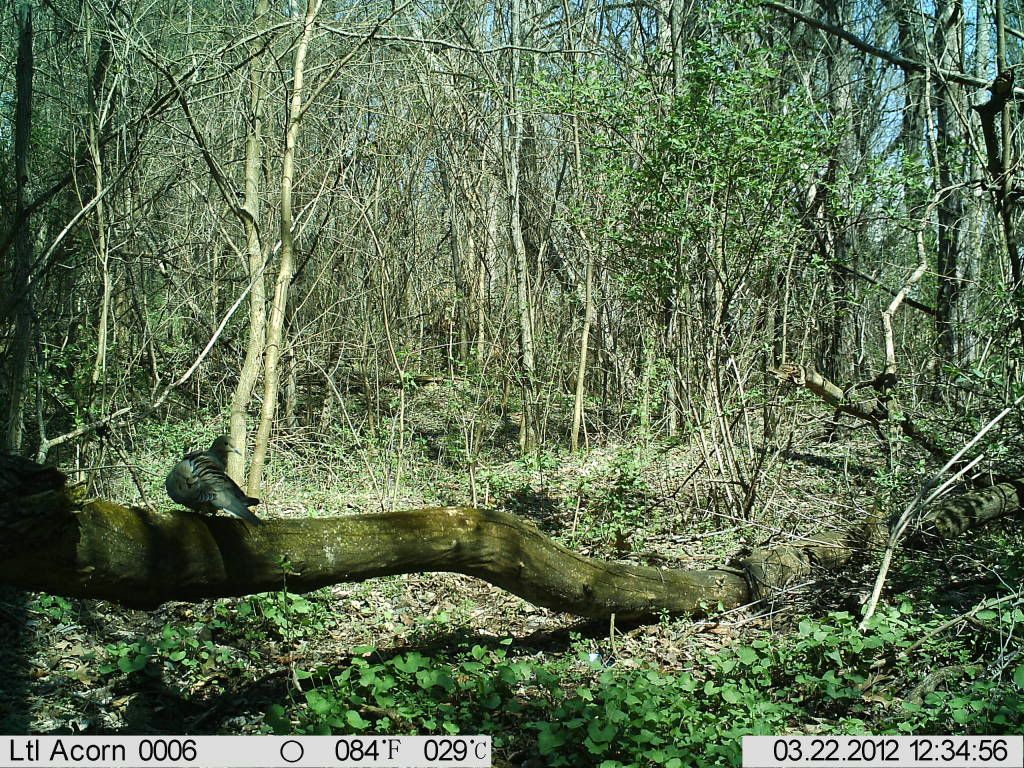
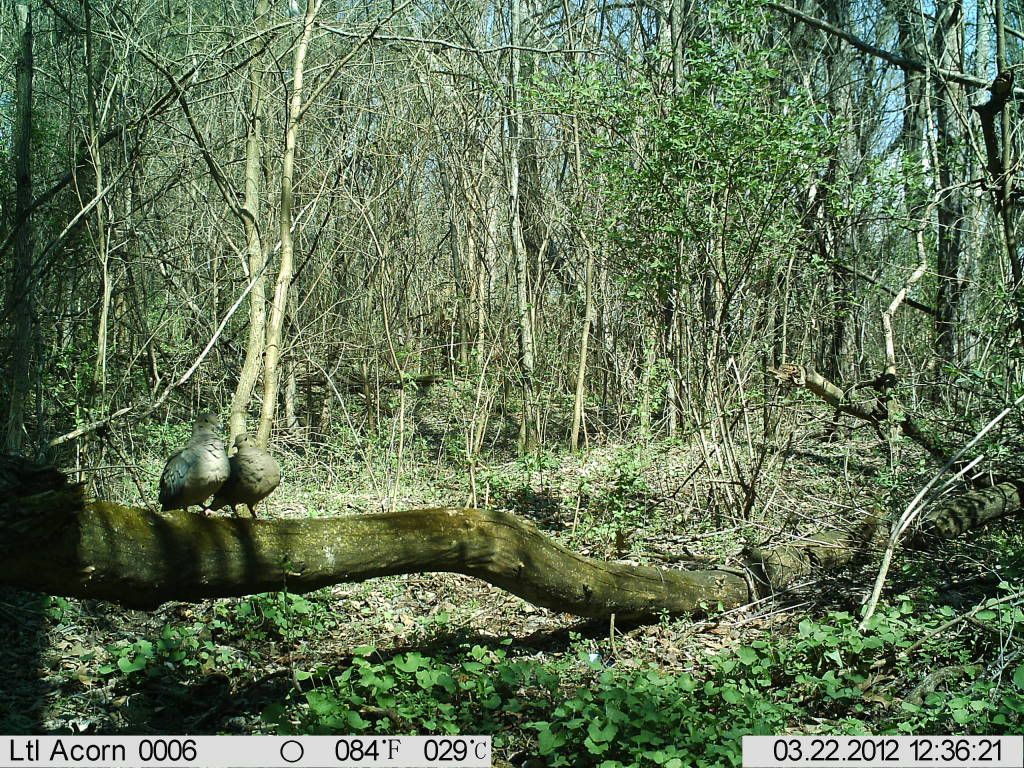
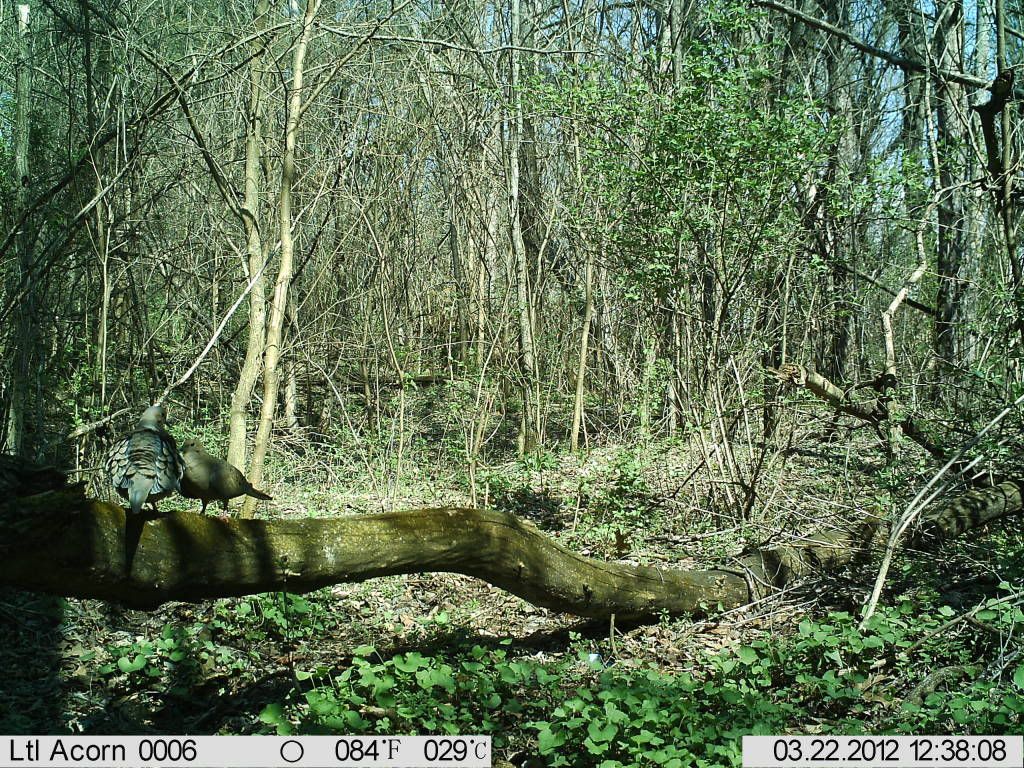
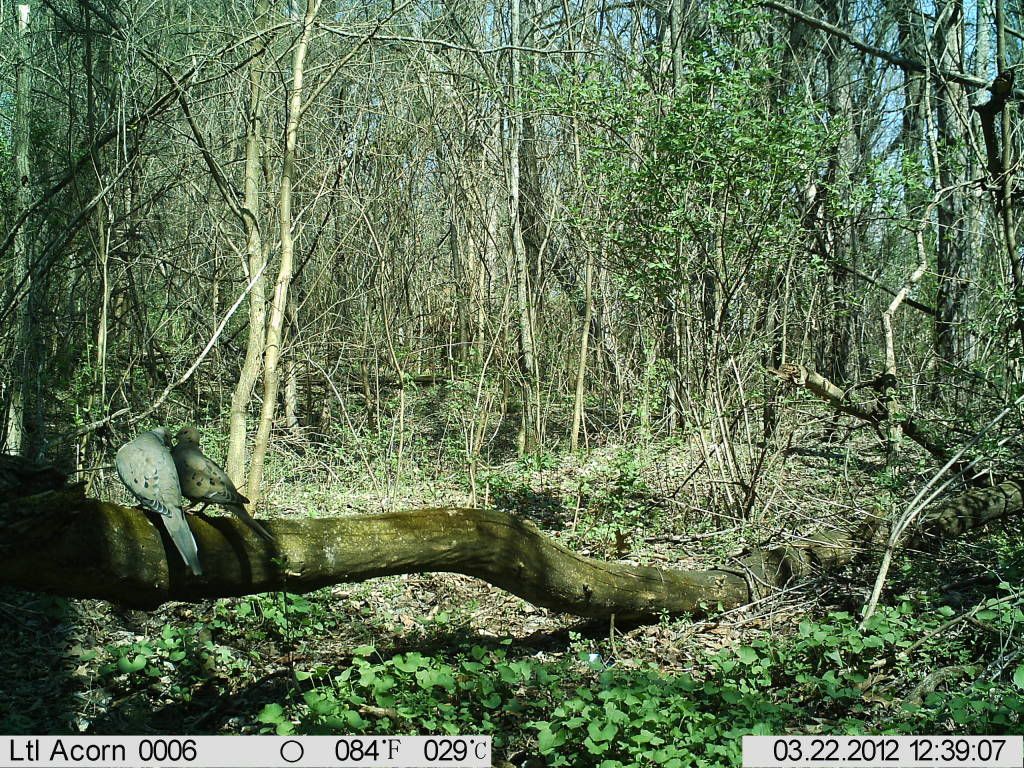
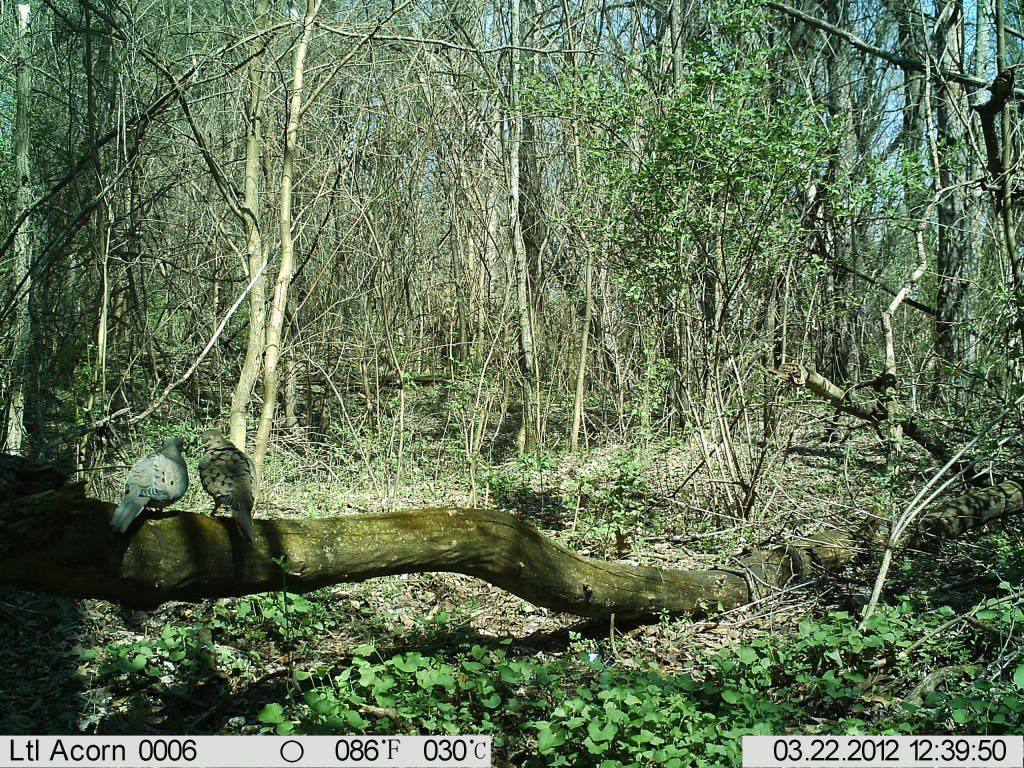
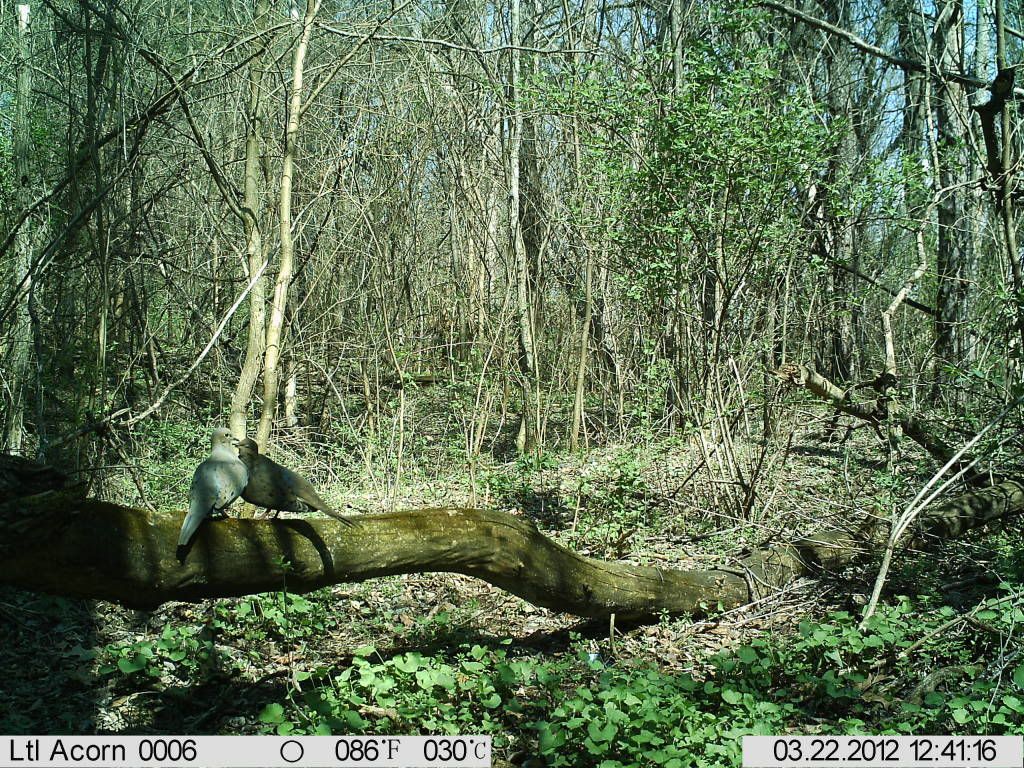
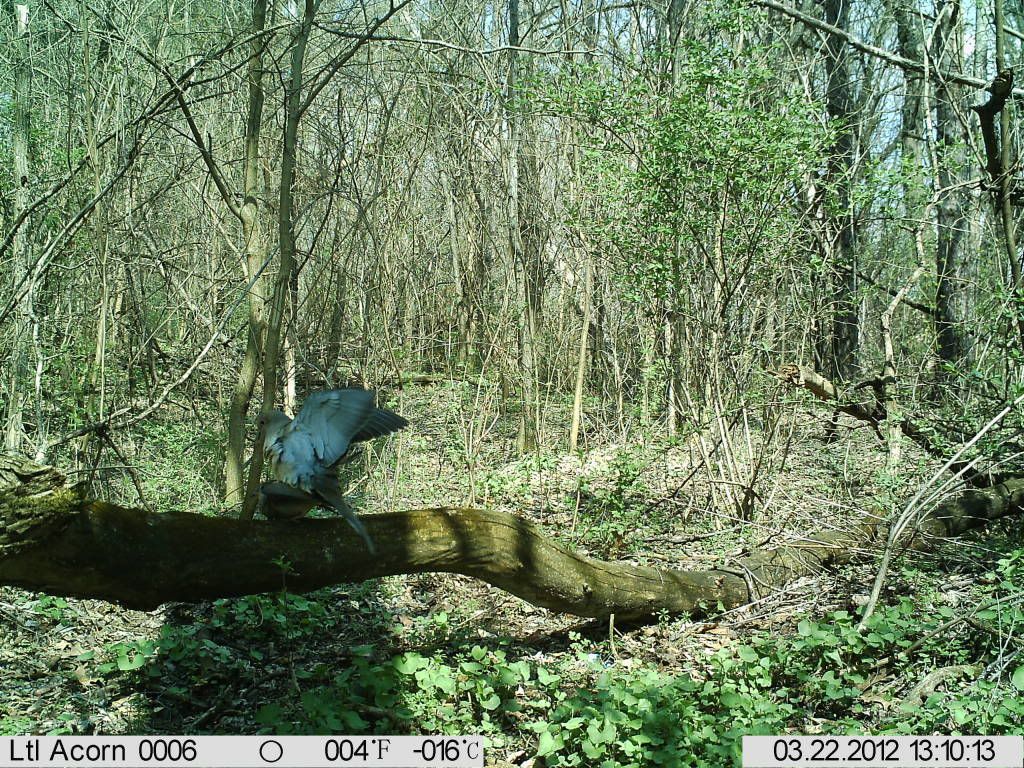
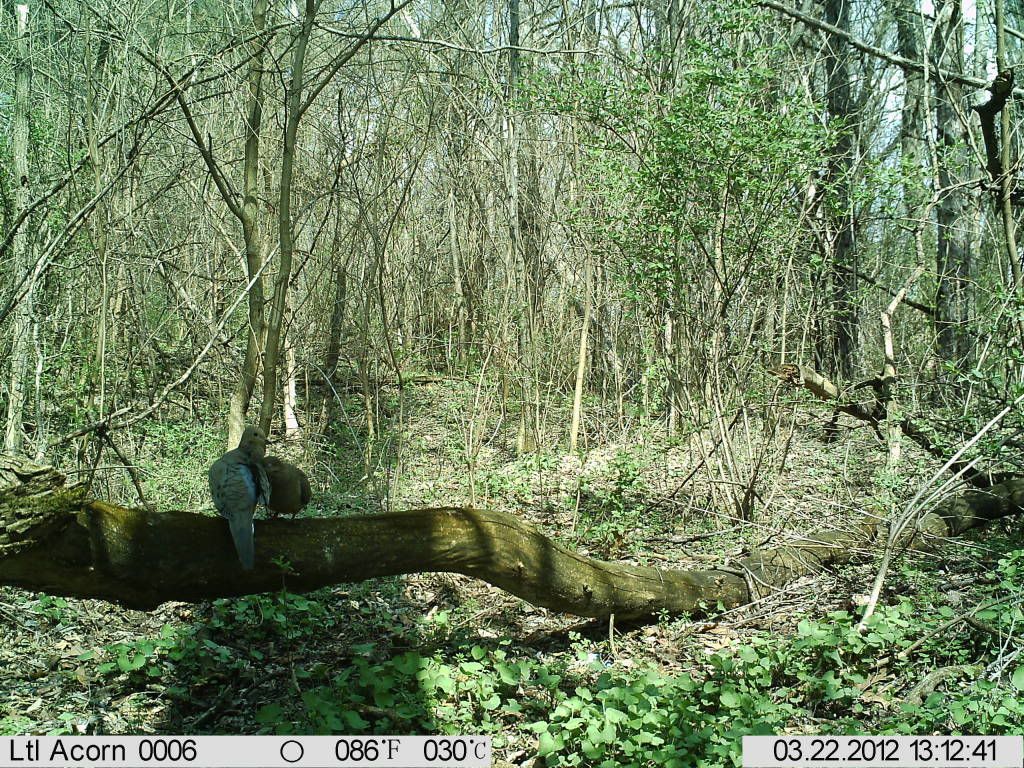
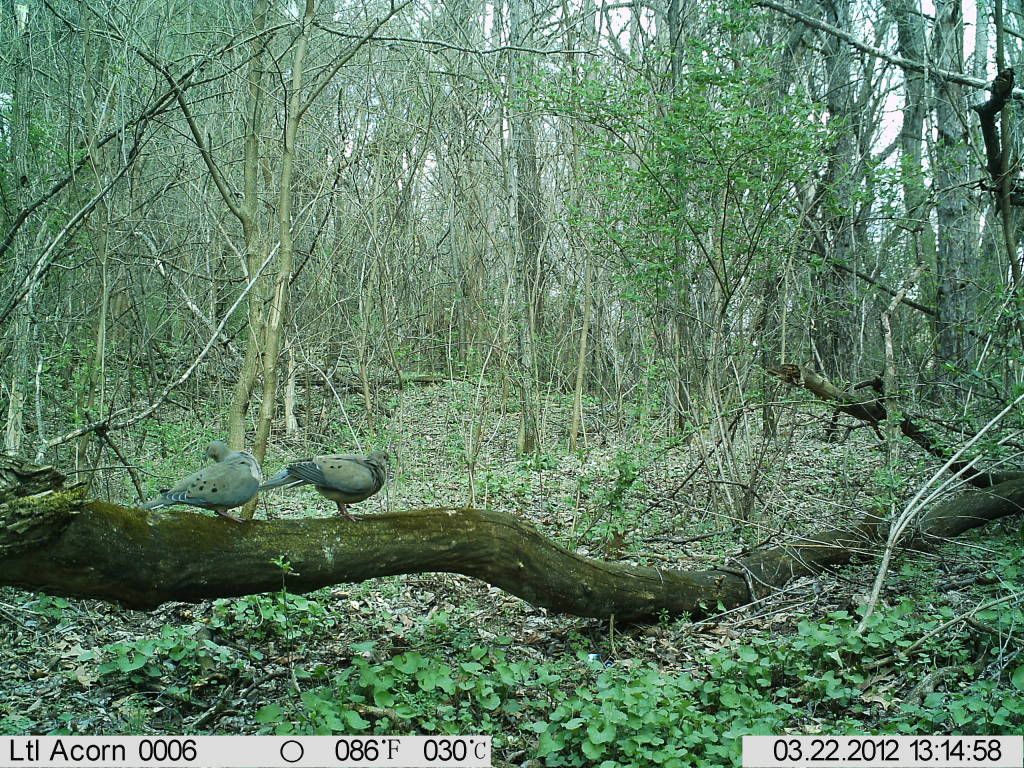
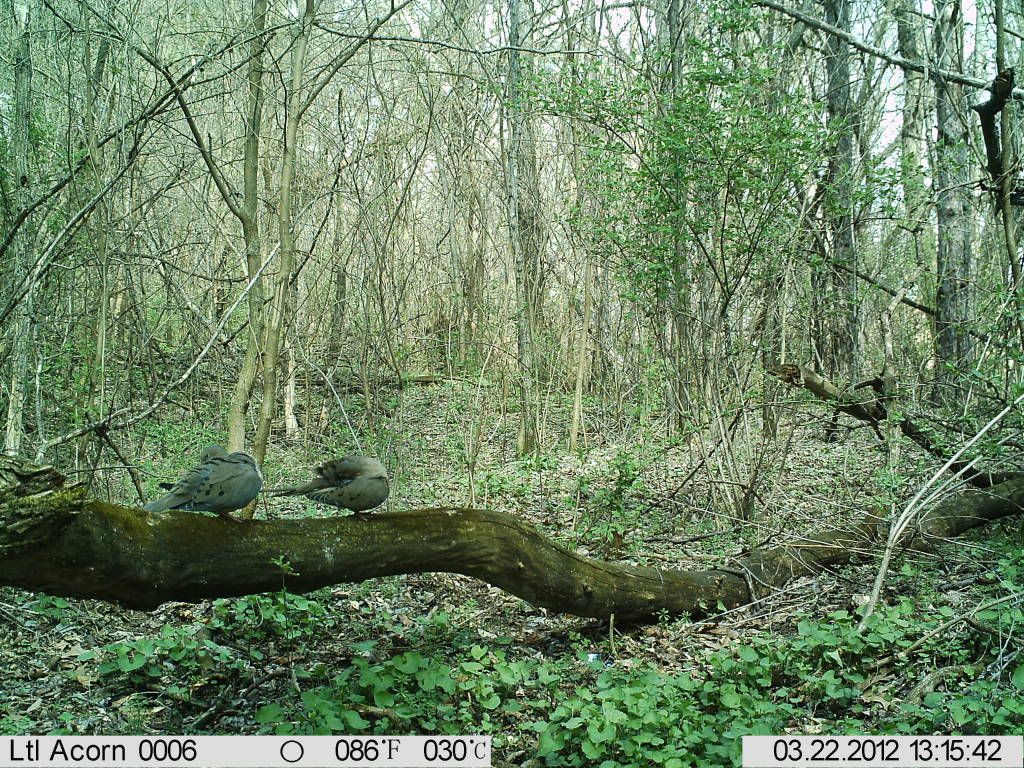
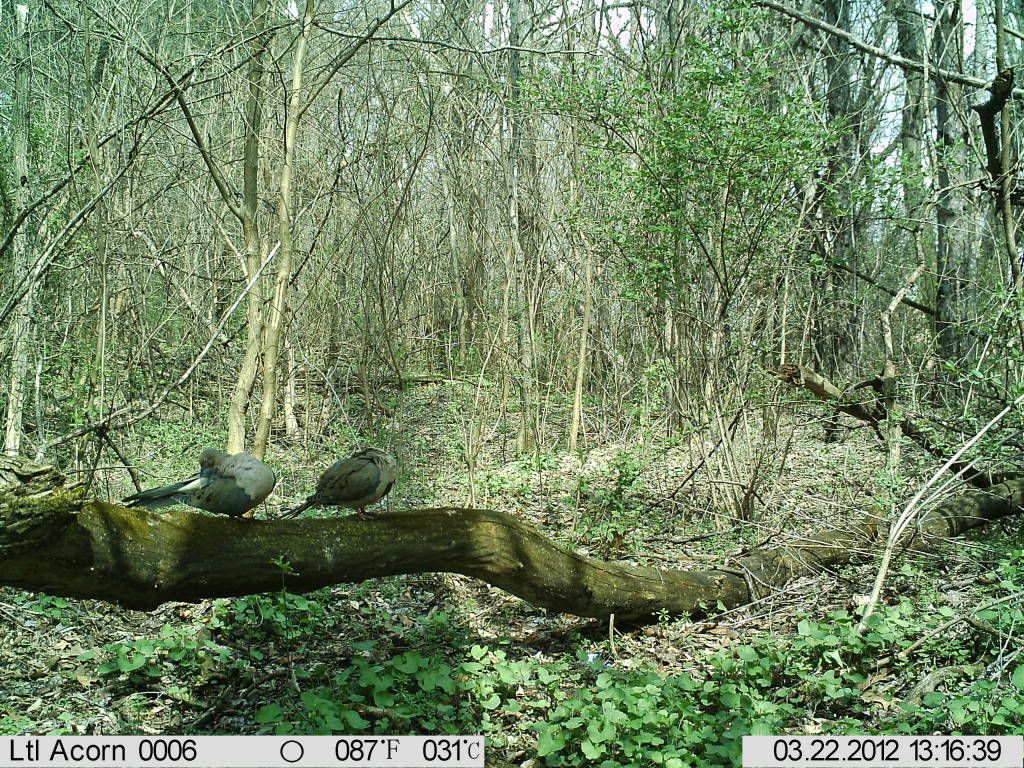
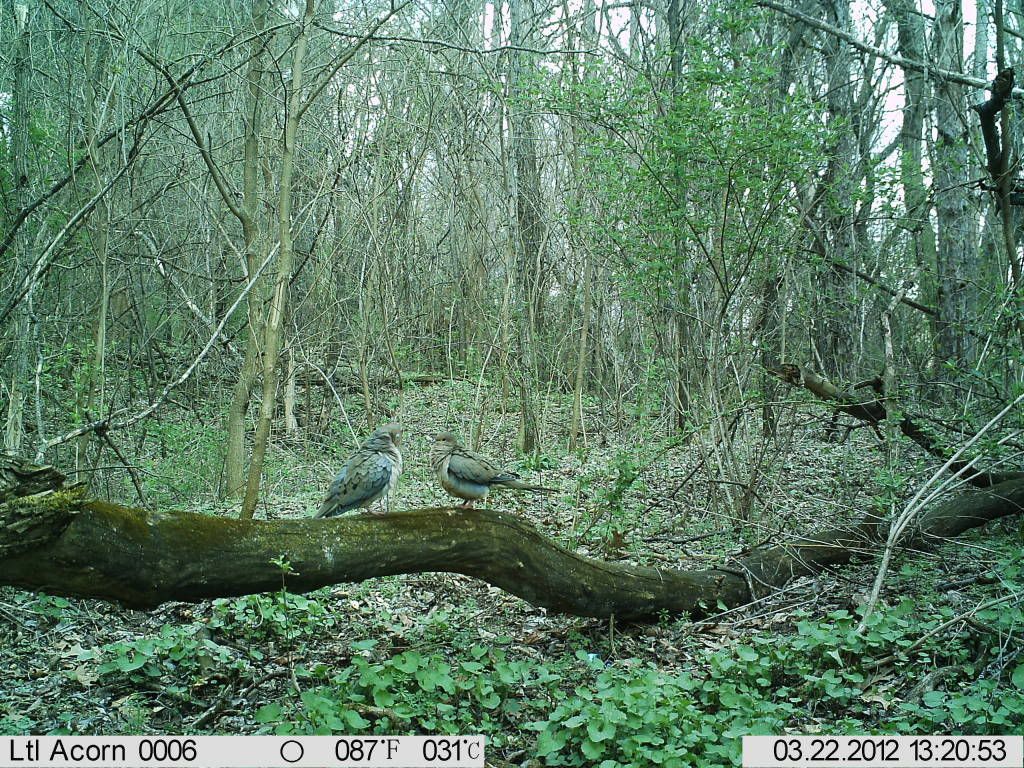
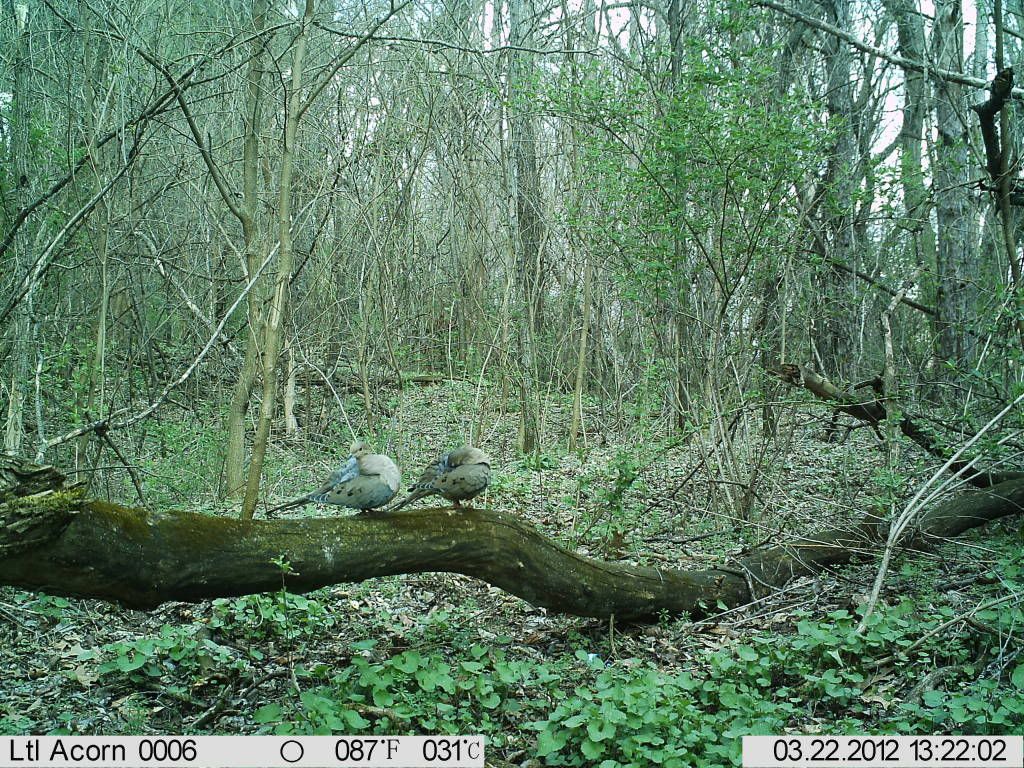
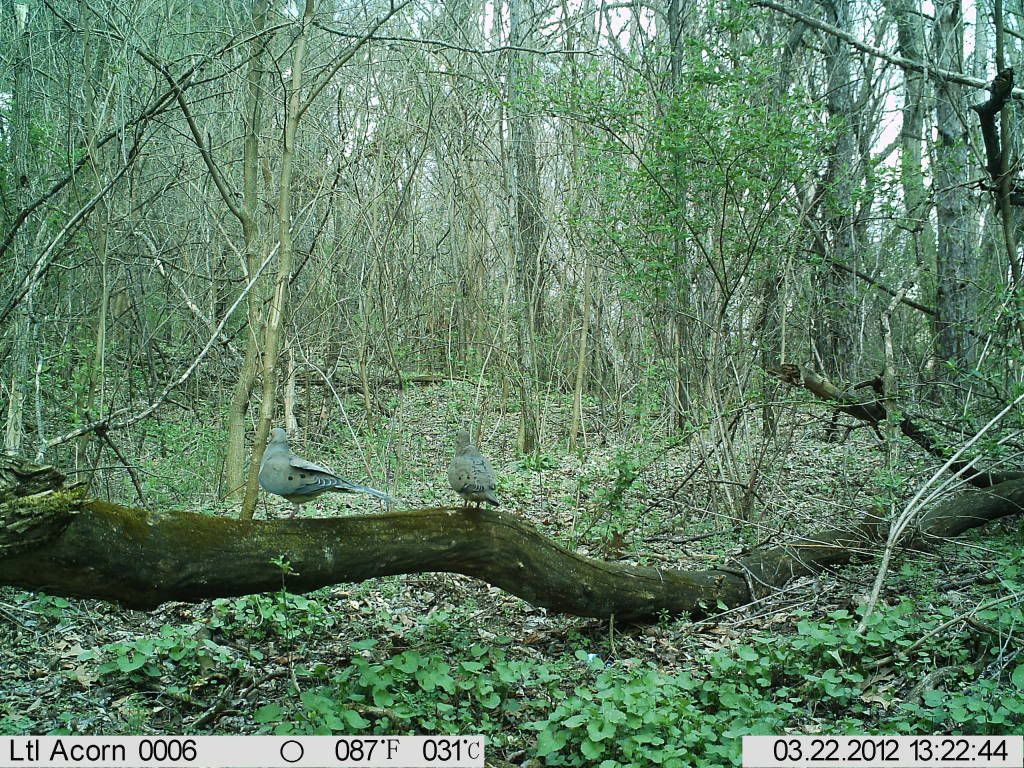
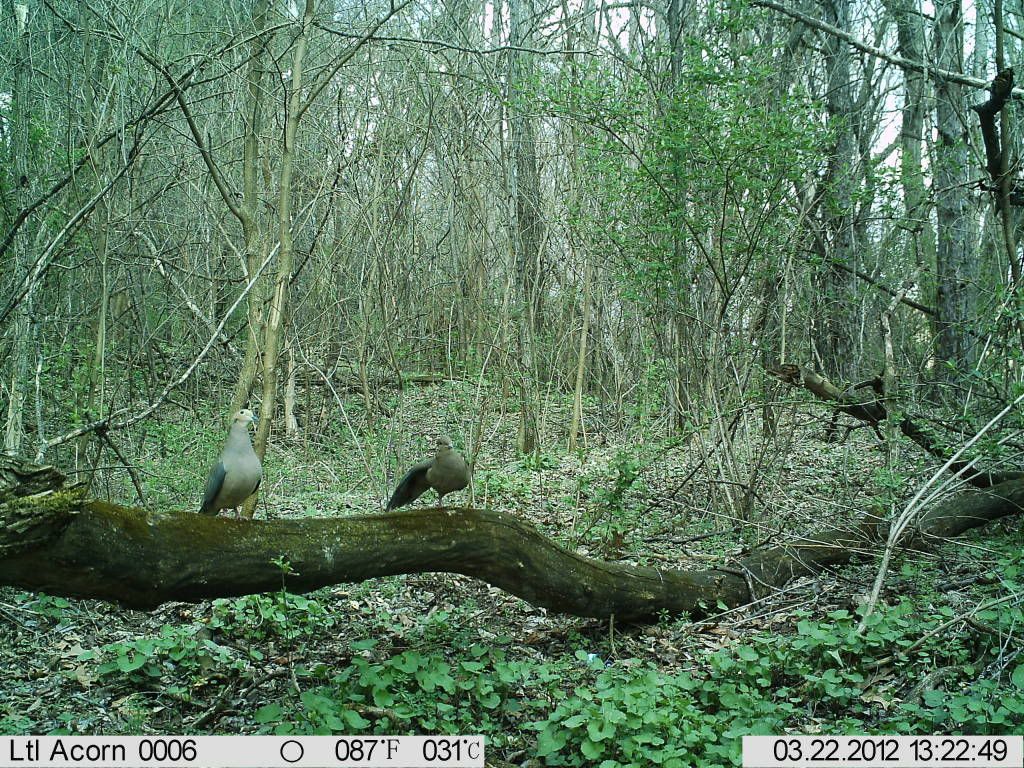
It's a copulation "log" in two ways: (1) that it is my logging of a copulation event between two Mourning Doves (Zenaida macroura), and the fact that (2) the copulation literally took place on.....a log!
So, the event begins down at the old make-out spot with a single male, checking out the scene.........
His patience pays off....
Then, the showing off begins....
....and continues.....
Then, the preening of eachother begins....
The girl also decides to show off a bit....
This is followed by alittle more co-preening......
....and more.....
The picture says it all, I should think!
....next the cuddling.....
But eventually, that inevitable awkwardness sets in....
They apparently try to ignore eachother with alittle self-preening. Perhaps hoping the other will get the hint and leave. They both work pretty hard at putting out the "take a hike" vibe, but it doesn't seem to work.
....but neither is willing to give it up.....
For a moment, it appears they might confront the elephant in the room....but the male gets the wrong idea.
...and so it's back to pretending the other isn't there.....
Finally, they put a bit of space between themselves.....
...and the male starts to plan his exit strategy....
They both must have left, because that was the last picture of either!
Notes on Mourning Dove reproduction. In our neck of the woods it is common for this species to reproduce from April through September, so this is a tad early compared to a "normal" year. The reproductive behavior outlined above is typical, although there is often much head-bobbing, etc. that doesn't really come out in still photos. Although my commentary above gives the impression that they don't want to be around eachother after copulation, the Mourning Dove is actually a seasonally monogamous species (they remain in the same pair during a single nesting season). So, these two will probably be together for much of the rest of the season, and there is even some evidence that this species will re-pair with the same individuals in subsequent years. The co-preening behavior and the self-preening behavior outlined above is typical of this species during pair-bond formation and copulation. Nests are often a loosely aggregated bundle of materials (pine needles, etc.) that are placed in dense foliage. Females usually lay one to two eggs at a time.
For more information see:
Otis, David L., John H. Schulz, David Miller, R. E. Mirarchi and T. S. Baskett. 2008. Mourning Dove (Zenaidamacroura), The Birds of North America Online (A. Poole, Ed.). Ithaca: Cornell Lab of Ornithology; Retrieved from the Birds of North America Online: http://bna.birds.cornell.edu/bna/species/117doi:10.2173/bna.117