Showing posts with label Short-Tail Shrew. Show all posts

Wednesday, January 15, 2014

Getting Rid of the Winter Blues: 2014 Edition

 
Back to the cabin we go for another year of fun, fishing and catching up with long-time friends.  The same six of us high school buddies made the trek north for three days of fishing and frivolity, as we have done for almost a decade.

The trip would not start easily, however, as Old Man Winter decided to show his face during our drive up. As a result, we pulled in at the cabin amidst a bout of freezing rain and snow.  Although we arrived unscathed, we were all glad to be out of the storm.
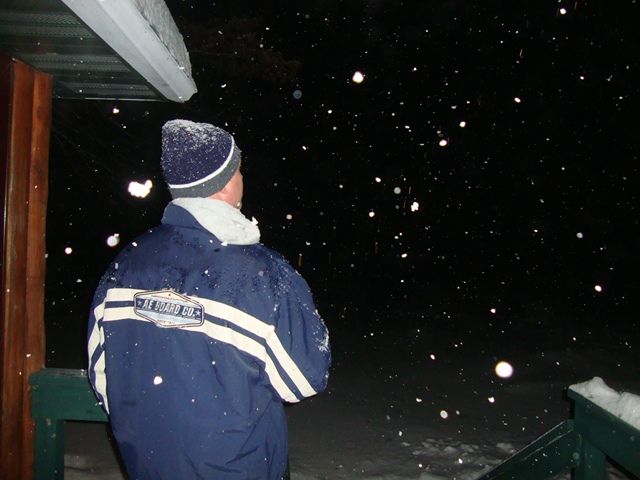
Andy looking out at the lake through a snowstorm
After unpacking, my first order of business was to set out camera traps.  The short duration of our stay means there is a low probability of catching things on the cameras.  In fact, you'll note that past years have yeilded very little (see here and here).  Regardless, the quicker the cameras are out....the more time we have to catch something. 

So, Justin and I made a rather hasty trip into the dark with a bucket of cameras and smelly stuff.  Whether I catch anything or not, it's fun to try.  Its also fun to bring a different scent lure each year.....just to mix things up a bit.  This year my lures of choice were Beaver castor, Muskrat Gland and Fish Oil.
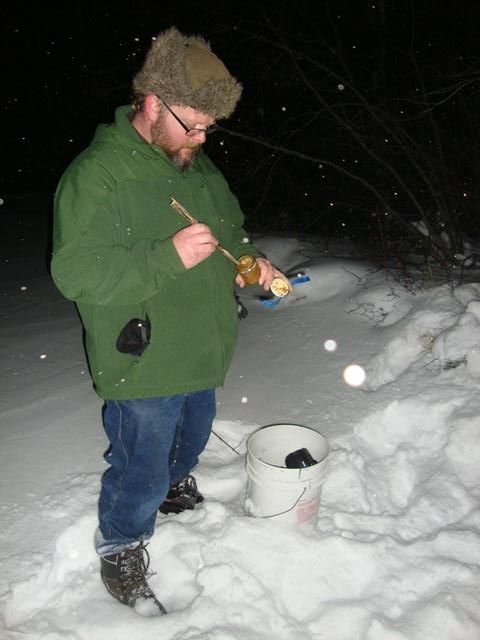
Applying some Muskrat gland to a stick that will be stuck in the snow in front of a camera
After our quick adventure, it was back to the cabin for some catching up with the others.

"Catching up" often includes long, even-keeled debates on topics such as which NFL quarterbacks should be considered among the top 10 or 15 in the league.
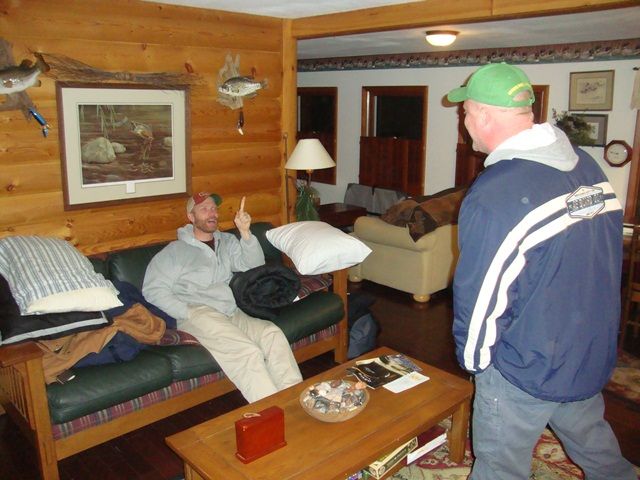
Chad and Andy discuss things....


Chad and Andy discuss things further.....

After a discussion that left all parties satisfied, we played cards and then turned-in at a reasonable hour.  One needs plenty of rest to effectively fish in the morning.
__________________________________________________________________________

We awoke to the sight of frosted trees, thanks to the Old Man's activities.....
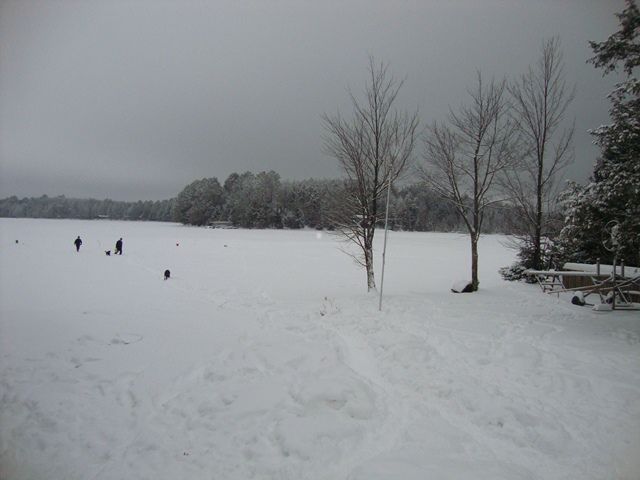
 
....and the view from the lake was very nice.... 
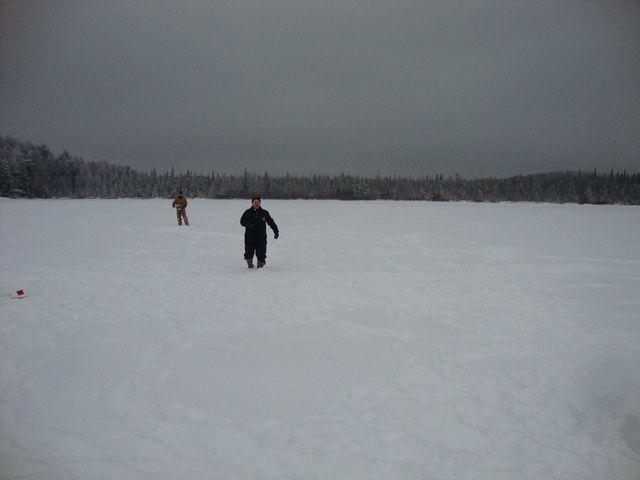
 

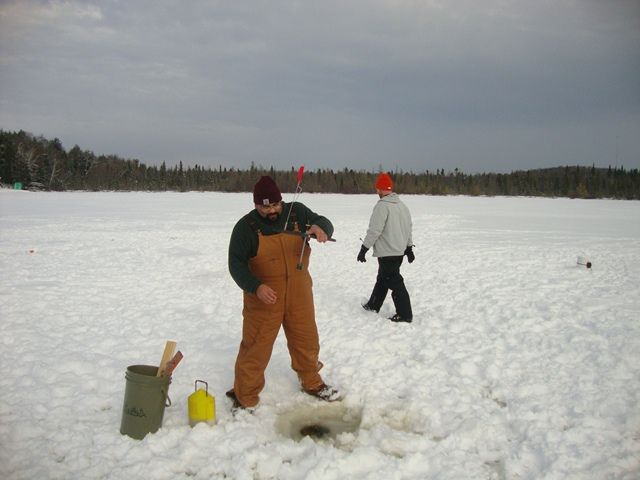
Once out on the ice, we began to drill holes with the ice auger so that our fishing tip-ups could be set....
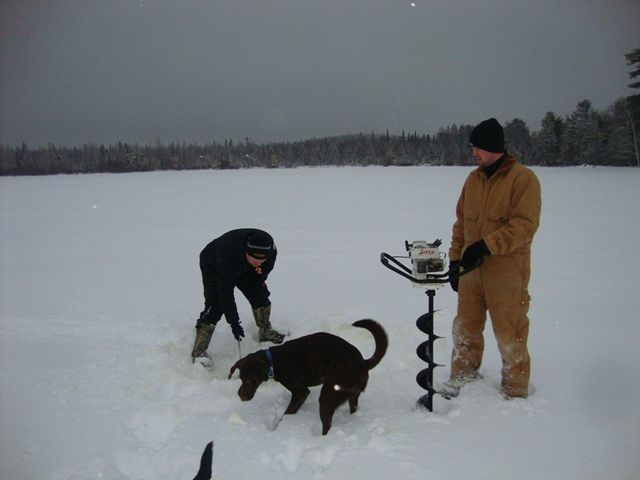
Justin (background) and Hank (foreground) help Dan (right) drill and clean out a hole in the ice

Then it was back inside for some breakfast.......
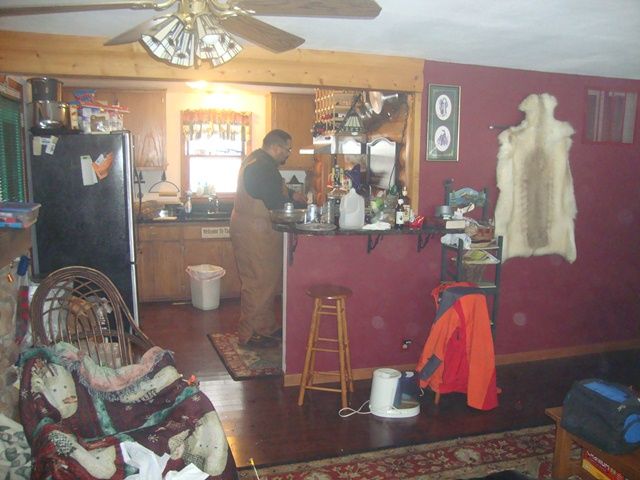
Nate is nice enough to cook most of the meals on the trip, and boy-howdy....they are good!

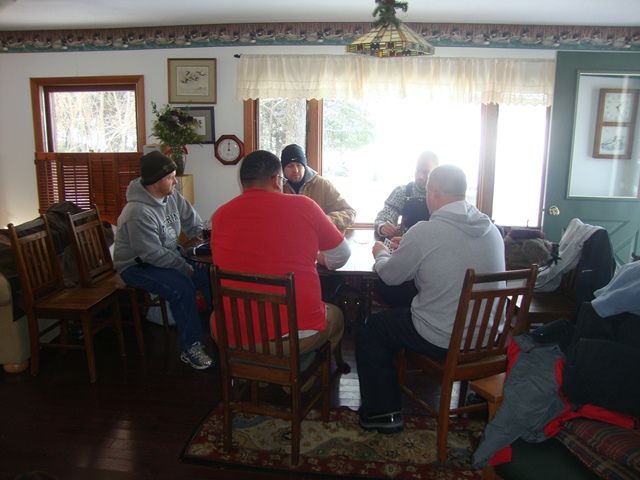
After breakfast, we waited....and played cards.  Cribbage is a favorite, as is Euchre. 
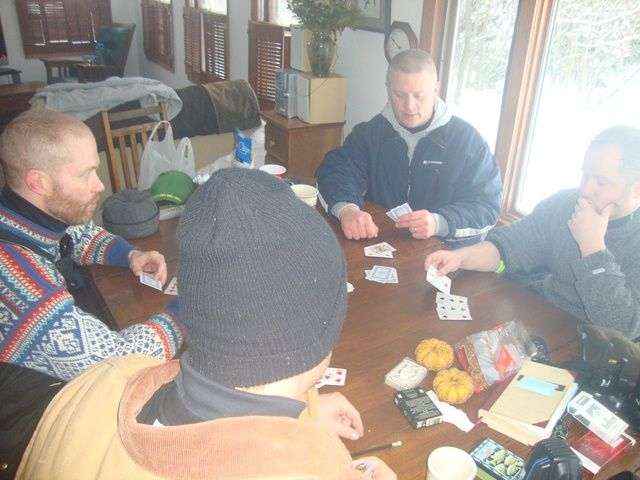
Dan, Chad, Andy and Justin wait for some action on the ice....

We have almost no demands on our time, which allows us to undertake whatever whim comes to mind.  For example, I was able to do some random meandering and hunt for tracks in the fresh snow.  Most of what I found belonged to White-tailed Deer (Odocoileus virginianus).
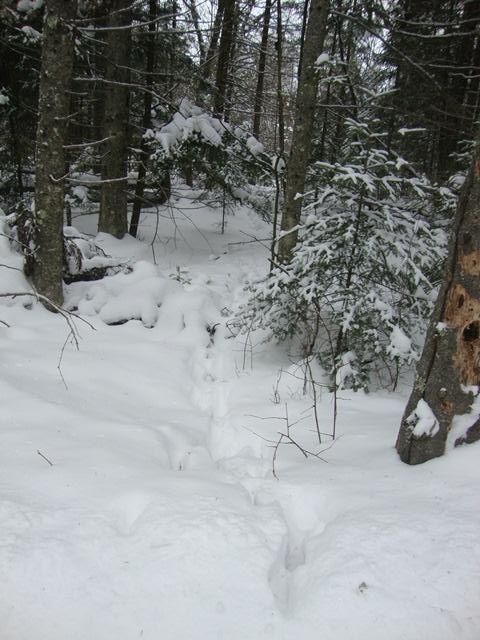
A heavily used Deer trail into the woods (note the woodpecker tree to the right).

Rodents and Shrews were among the more interesting trails I found in the snow, and although I was hoping for Fisher or weasel, I'll take what I can get....
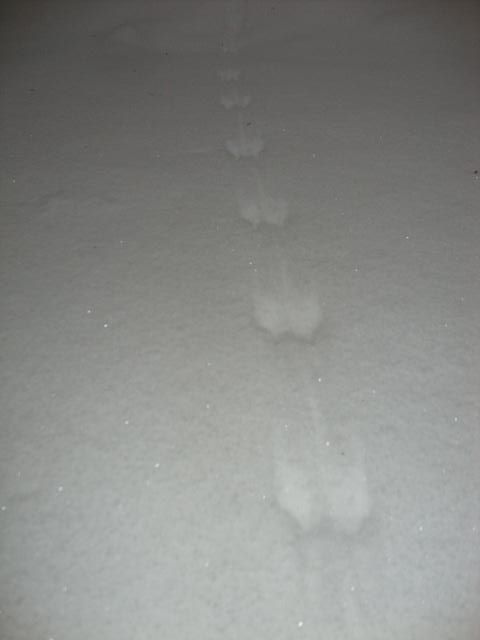
A rodent trail (probably a Peromyscus of some sort...either white-footed or deer mouse).  Normally all four feet are more obvious in the trail, but the snow was deep here. Thus, the treail looks alittle more dumb bell shaped.  You can also see the drag mark from the tail. 


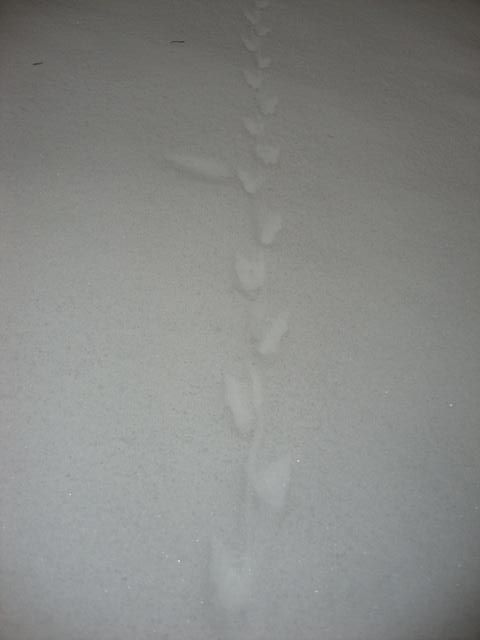
I believe this is the trail of a shrew (Sorex or Blarina sp., but probably the latter).  The tracks are roughly comparable in size to those above, which is very small.  But, the footsteps alternate rather than bound as in the rodent above.


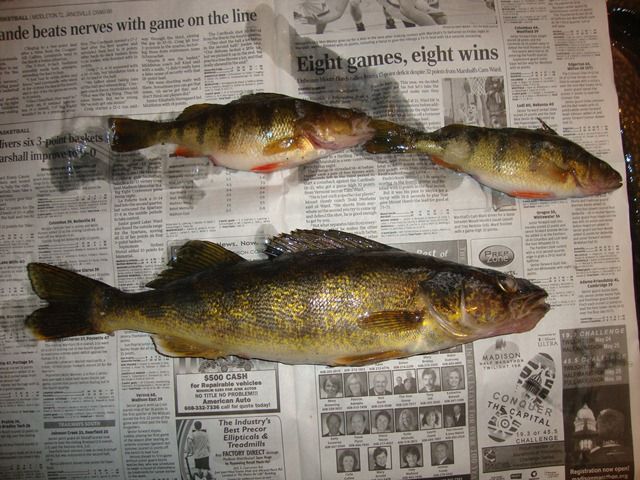
 By the end of day 1, we had done pretty well fishing.  A total of 11 fish...including the Yellow Perch (Perca flavescens) and Walleye (Sander vitreus) below.
 
Thus, we went to sleep satisfied.
_____________________________________________________________________

The next morning broke clear and breezy.  The weather front, which had hung over us the day before, moved on.
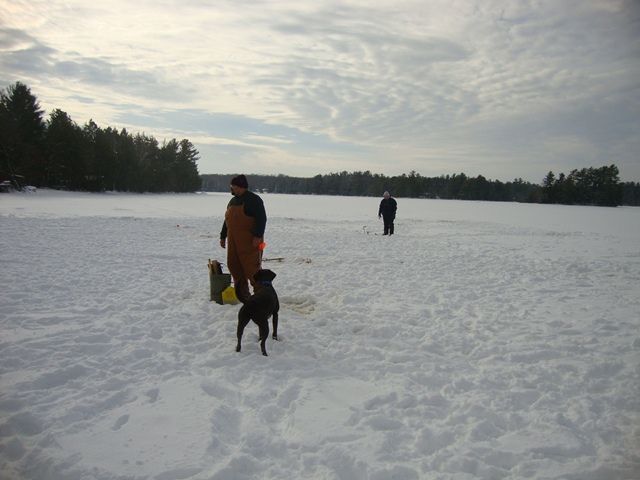
Nate and Andy working on clearing the holes in the ice
 
So we marched back out onto the ice to re-deploy our fishing gear...

Nate and Chad checking the gear before deployment
 
...and then marched back inside to play the waiting game again....
The gang playing cribbage, patiently waiting for the next fish
 
Luck would not be with us for most of the morning or afternoon, however.  By late afternoon, we decided to try a different location nearby.  This required we haul our gear to the opposite side of the peninsula.  Here we drilled new holes, deployed the fishing tip-ups and....again....waited (this time continuously exposed to the elements, not inside of a cabin).

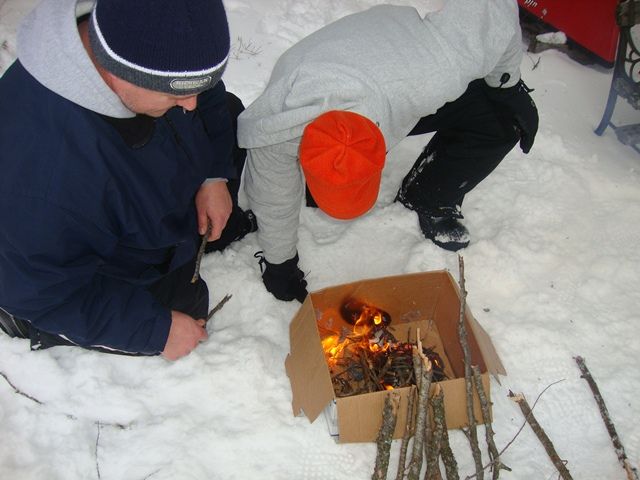
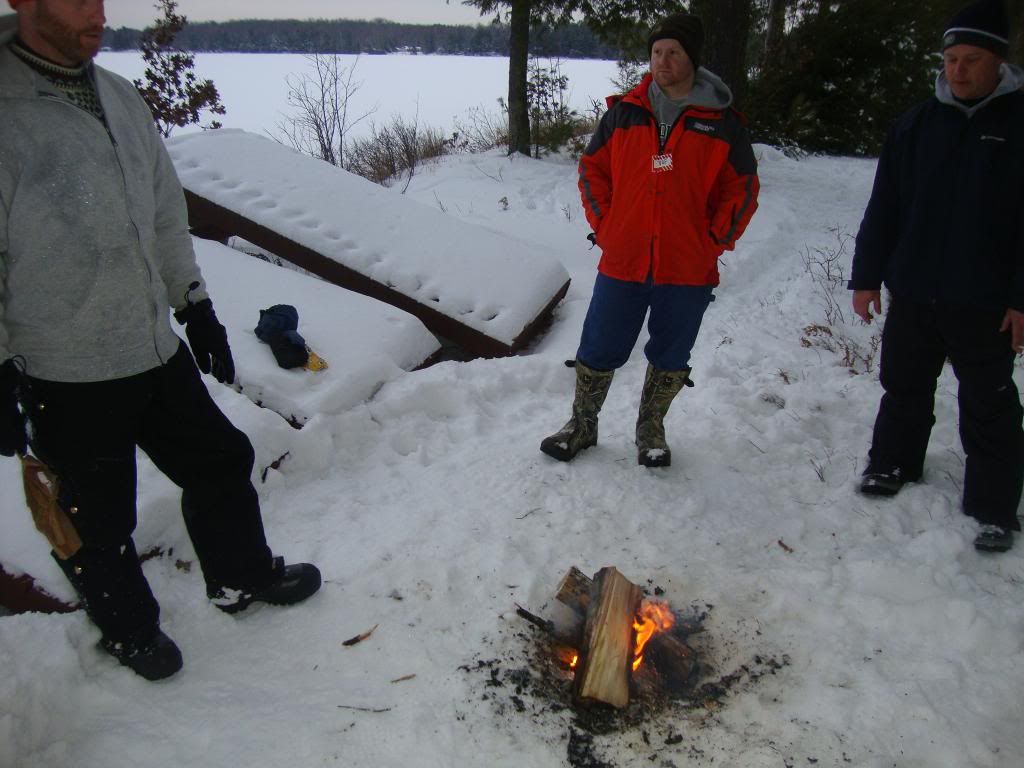
Thus, a nice fire was in order....

Andy and Chad work on the fire, no easy feat when it is on top of snow and there is very little dry wood around

The fire takes on life!

Although the fire and conversation were great fun, our last full day of fishing ended with only one capture: a single Northern Pike (Esox lucius).
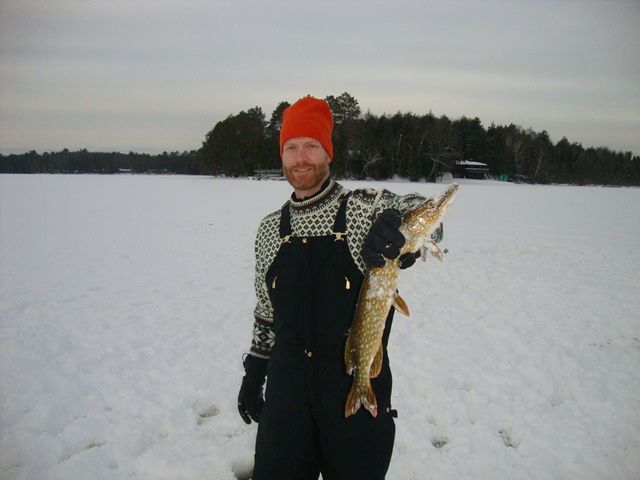
Chad holds our only capture on the second day of fishing.
 
Despite a slow second day, our good cheer would not be diminished!
________________________________________________________________________

The camera traps deployed were a similar story.  Very little activity and what we got was mostly White-tailed Deer (which is a small improvement over the last two years).
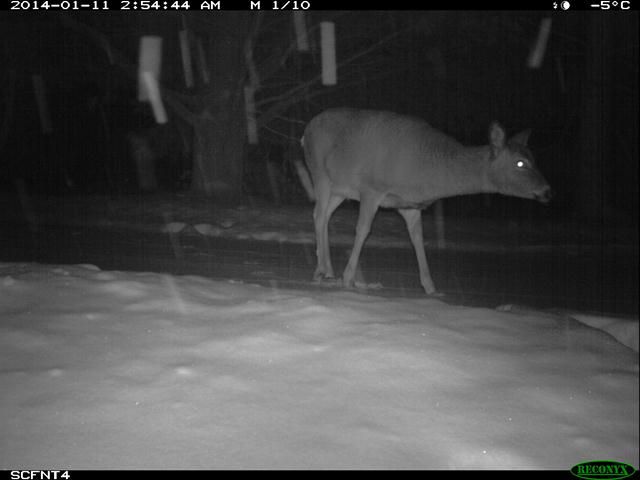
 
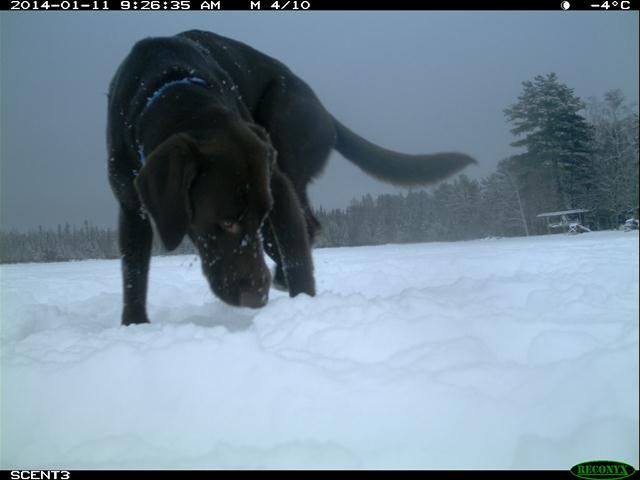
They even did me the courtesy of investigating the scent I put out.  In the clips below, it's muskrat gland.
 
They even came in for a sniff of the camera.....


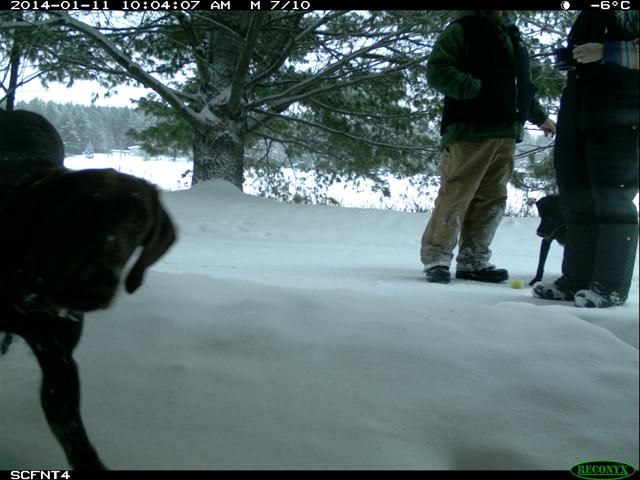
Of course we also got lots of pics of the two pooches that come along for the trip.....and their ball.

As you can see: few things in life trump Ball.....
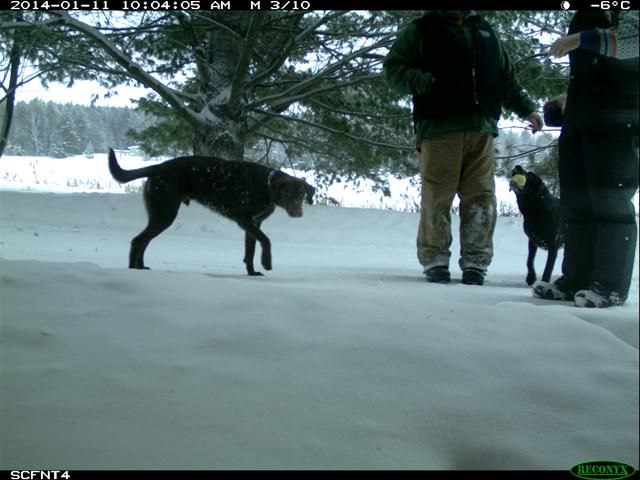
Note: Wrigley (on the right) with Ball and Hank (center) whom first wanted Ball, but now sees the camera

Ball is all-consuming....


Wrigley repeatedly picking up and re-presenting Ball to us, while Hank investigates the camera

It matters not if the Master ignores them at first.  So long as they continually present Ball to the Master...the Master will eventually be driven to madness, and they will recieve their reward.....Ball.

Maybe....
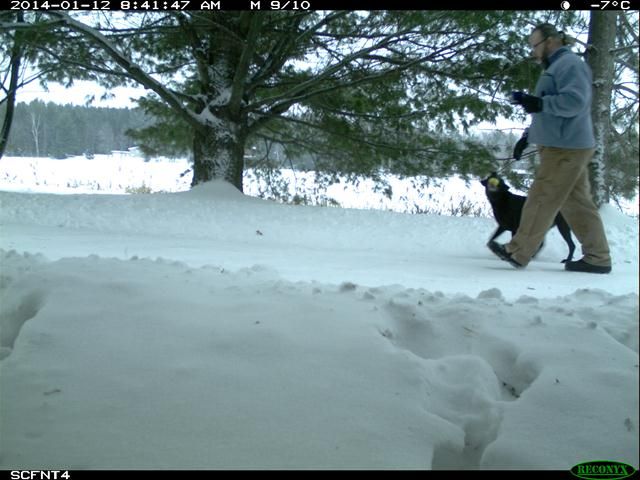
There is one OTHER thing that almost rivals the importance of Ball for these dogs....and that's thieving bait that I've put in front of my camera traps.

Even if that bait is frozen Fish Oil.

Note the bottle in my hand, as I dump out some fish oil sporadically.
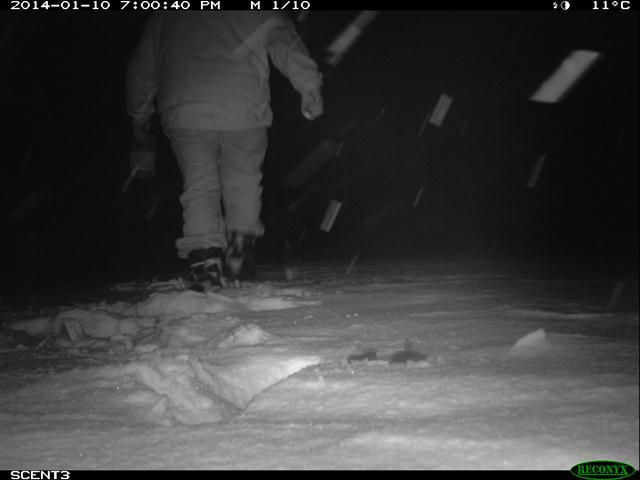
Now, note the giant frozen sheet of fish oil that Wrigley has decided to liberate.
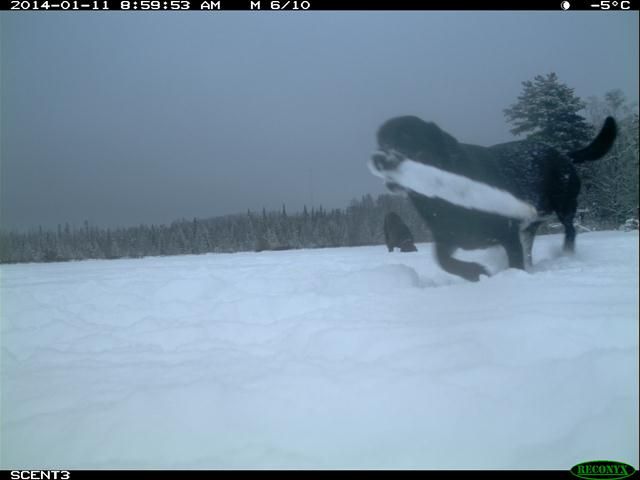
After this year, I'll also give up using our left-over minnows as camera bait (or will only do it in front of cameras that are further away).  I've seen past evidence of Red Fox (Vulpes vulpes) on the ice near our tip-ups scavenging the left-overs, which gave me the idea in the first place.

BUT...any camera trap on the ice with minnows in front only attracts two naughty canines.... :)

Hank (left) and Wrigley (right) stealing my bait....

And no matter how many times one yells "Leave it!", they are just so sneaky....
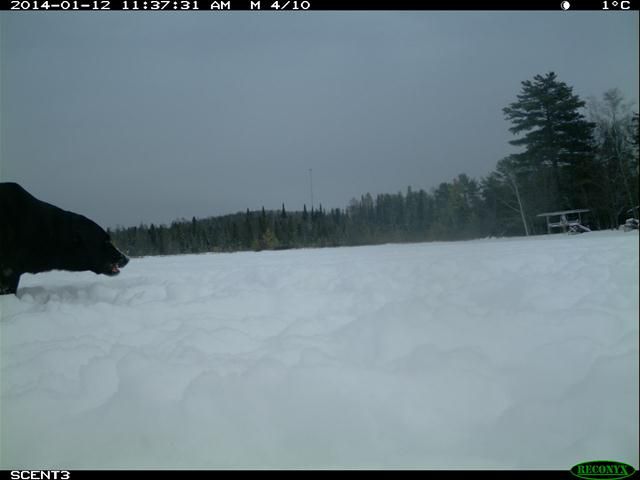
 

...and eventually they cleaned out every jowl-lickin' one of those fish-cicles.
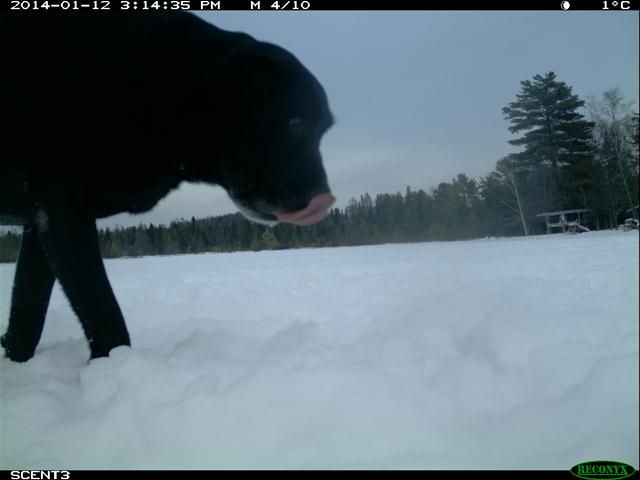
It's also worth noting that the pictures above are but a few of several hundred that the cameras snapped of Hank and Wrigley.

Still...it's pretty hard to be mad at them.  I'm asking alot of the dogs by putting out food and expecting them to ignore it.  Plus, they know how to find the soft-spot.....
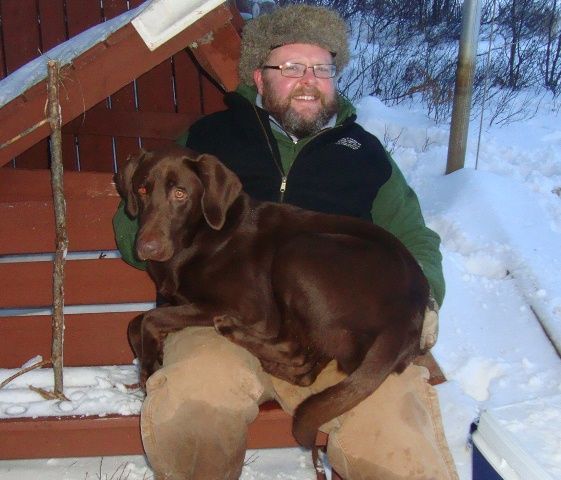
And so it was that our time at the cabin ended for 2014.  We pulled out of the driveway with heavy-hearts and drove off to face the real world again. 

It seems a shame that every day can't be like the time we spend ice fishing in January.

But...if that were so....we wouldn't have anything to look forward to next year, would we?   If I frame it in this way, then the road back to reality doesn't seem so dismal.

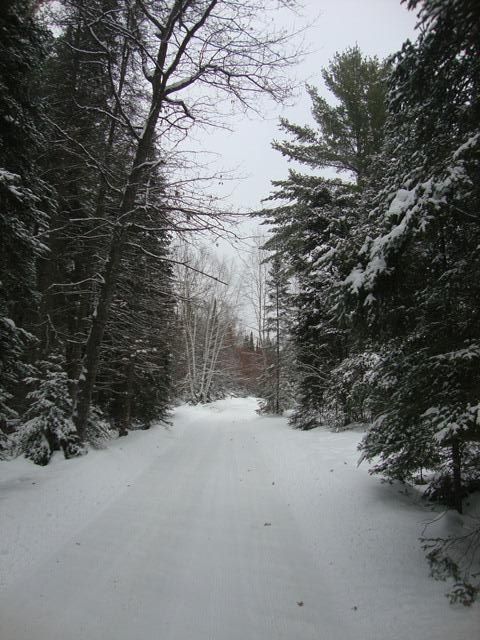
In fact......it's actually kinda pretty....


Wednesday, October 3, 2012

A Lucky Shot in the Dark!

I was fortunate enough recently to be able to get away to northern Wisconsin for some fishing with high school buddies.  The set-up available to us was spectacular: huge house on the lake with a fishing boat and pontoon boat.  Also, unlimited dry firewood...a healthy supply of food and drink....and a fair amount of untouched northern forests to play in (when not fishing, of course).

I can't help but bring my cameras when I go on these kinds of trips.  In fact, I did it on a different fishing trip with high school buddies at a completely different location this January.

I'm realistic when I put cameras out in these situations.  I know the likelihood of actually catching things is pretty low.  I typically have one or two nights to work with (assuming we reach the site on Friday with enough daylight).  I also don't know the location particularly well, so may not have enough time to find the best place for a camera and have to stay close to our base camp (where I know I'm not tresspassing).

But I'm willing to risk disappointment, because there's always a chance that I'll get some Bob-tailed Cats (Lynx rufus), Fisher Cats (Martes pennanti), or....fingers crossed...Wolves (Canis lupus).

This time, I brought four cameras along.  Two of the cameras went in a boggy, sphagnum and fern carpeted forest across the street from our "cabin".  One was placed on the grass "driveway" used to back the fishing boats into the lake from the roadside.  The fourth camera was placed along the bank of the lake not far from our fishing dock. 

The latter two cameras were very close to the house.  Just down a short (but steep) slope from the fire pit behind the house. 

The first night, we sat up pretty late at the fire (1:30 am, to be exact) and I figured the nearby cameras were going to be complete busts.

The first few critters did little to quell my disappointment.

Feral Cat (grrrr...)

Eastern Cottontail (Sylvilagus floridanus)

......and a Mouse (Peromyscus sp.)

So, imagine my surprise when I saw this:


About 20 yards from where we had been making lots of noise just a few hours before!

Only my third camera trapped Bobcat (Lynx rufus)!  Needless to say, I was thrilled as I had actually gotten pictures of a species on my "wish-list" for the weekend!

Bobcat densities are generally reported to be on the rise in most of the continental United States, including Wisconsin (see further discussion of this here, and in Roberts and Crimmins, 2010).  Thus, I'm not surprised that Bobcats are in the area.  However, although their densities are on the rise, this is usually a loner species, that naturally exists in relatively low densities in parts of its range (Anderson and Lovallo, 2003).  This is particularly true of the Midwest, where densities as low as 4-6 individuals/km-squared have been reported (Berg, 1979).

____________________________________________________________________________

The undisturbed plot of boggy woodland across the street from the cabin didn't yield Bobcats, unfortunately.

Numerous game trails.....if only I had more time to trap and more cameras to hang!  I decided to help the process along with a few little remnants left-over after cleaning the fish we caught.

The first taker is actually this Blue Jay (Cyanocitta cristata).  Neat to see them shredding and swallowing bits of fish flesh.

And the next visitors are what one could refer to as "the usual suspects" (but look at the size of that second one!).

At another nearby camera, baited with more fish, the Bandits again quickly zero-in on the free meal.

What's interesting about this clip is that it really shows how important the combination of scent and tactile sensation (i.e. "touch") is to a Raccoon!  Watch how he runs his fore paws over that fish, really trying to get a sense of it.

We have to remember that, out in the remote north woods, there's very little light....and the IR filter is giving us the false-impression that the area is lit-up like a Christmas Tree. 

Not so!  It's blacker than pitch out there at night (by our standards), and although Raccoons have better low-light vision than us....being able to smell and feel a potential food item is important.

___________________________________________________________________________

Finally, I'll leave you with a first for me (I think).  It's hard to tell from these pictures and video clips....but I'm fairly certain that the cameras are picking up a Shrew.  I don't know what species, but given the size....I'm going to guess the Short-tailed Shrew (Blarina brevicauda), although there are Sorex in this part of the state too.

The critter I'm referring to is in the circled location on the picture below.

See a blown up version of this circled area here....

Now, take a look at it moving around in this video clip....which may help....


Interestingly, I tried to place another camera over a bit of fish remnants along the lakeshore.  Hoping for a mink, but didn't get any.  However, I *think* I got a video clip of a shrew chewing on the carcass.  He's close to the camera (so alittle washed out and out of focus). 

His backside is facing us, which also makes it difficult to ID him.  But, from this vantage we can see there's not an obvious long tail.  This would also suggest the Short-tailed Shrew. 

Short-tailed shrews are formidable little predators.  They eat, not only many invertebrates, but will also take small vertebrates (including smaller shrews, rodents, amphibians, and small snakes; Kurta, 2005).  I could find limited information that this species eats carrion, however.  They are known to hoard food, so they apparently have no aversion to eating dead stuff.  Jackson (1961) also reports recieving a letter from an individual whose property was apparently "overrun" with Short-tailed Shrews.  He recounts throwing the carcass of a freshly killed Western Fox Snake (Elaphe vulpina = Pantherophis vulpinus) onto a refuse pile that was "shortly devoured", aside from the skin.  

BTW....for those interested....the snake was dispatched for eating a fledgling Rose-breasted Grosbeak.  The nerve of that snake!
____________________________________________________________________________

Literature Cited

Anderson, E.M., and M.J. Lovallo. 2003.  Bobcat and Lynx (Lynx rufus and Lynx canadensis). Pages 758-786. In: Wild Mammals of North America: biology, management and conservation (second edition). G.A. Feldhammer et al. (editors). Johns Hopkins University Press, Baltimore.

Berg, W.E. 1979. Ecology of bobcats in northern Minnesota.  Pages 55-61 In P.C. Escherich and L. Blum (eds.). Proceedings of the 1979. bobcat research conference (Science and Technology Series 6). National Wildlife Federation, Washington, DC.

Jackson, H.H.T. 1961. Mammals of Wisconsin. University of Wisconsin Press, Madison.

Kurta, A., 2005. Mammals of the Great Lakes Region (revised edition). University of Michigan Press, Ann Arbor.

Roberts, N.M. and S.M. Crimmins. 2010. Bobcat population status and management in North America: evidence of large-scale population increase. Journal of Fish and Wildlife Management 1:169-174.

Friday, June 3, 2011

Week's End Survey Round Up II: Of Turtle Traps, Sexually Mature Sallys, and Poisonous Mammals

So, I'm going to continue my series of posts regarding our captures during weekly surveys (so long as we actually continue to catch stuff).

Dave (the undergraduate researcher working with me this summer) and I have been busting our back-sides the last two weeks. 

We start at 7 am every day because the heat has gotten brutal.  High of 97 degrees F this wednesday...and let me tell you that is NOT a dry heat.  We should probably start even earlier, but after field days in that brutal heat one just has a helluva time climbing outta bed earlier than 6 am to prepare for the day (I'm glad I don't study birds). 

Mondays are the most work.  We deploy traps along the drift fences.  We do our weekly rounds to all the camera traps.  Finally, we track all our radio tagged box turtles (see The Turtle in the Box posted on February 23, 2011; and Up and About for Spring posted on May 10, 2011 posted here).  The rest of the week involves daily checking of drift fences and cover boards.  Last year we also Sherman trapped the area, but the results became predictable (always White-footed Mice, Peromyscus leucopus).  We catch plenty of Peromyscus in our drift fences, in addition to many other small mammals that we don't catch in Shermans.  This coupled with the tediousness associated with baiting and setting Sherman Traps lead us to discontinue it.

This week...however....we FINALLY got the turtle traps deployed for an official first run.  I'd thrown them in about a month ago and gotten nothing, but hadn't had the time to run them again since.  Now they are part of our circuit and we'll run them the rest of the summer (barring unforseen circumstance).

So, we bust our humps all morning.  On a good day we're done with field work by 10:30 am and beat the worst heat (by 11 am, you're looking at near mid/upper 80s and high humidity).  On bad days, we'll be out until nearly noon.  As an overweight male of germanic/irish descent....I'm usually completely drenched in sweat and stumbling around in fogged-up glasses by about 9 am.

The afternoons are spent inputting data, working on analyses and etc. until about 5 pm....then we call it a day.  This will be our schedule for the rest of the summer. 

Not very glamorous, and a ton of work, but incredibly fun!  Plus, I usually give Dave Fridays off (it is supposed to be his summer break, afterall :)  ).  Although, honestly, I think he'd just as soon do field work on Friday too.
________________________________________________________________________

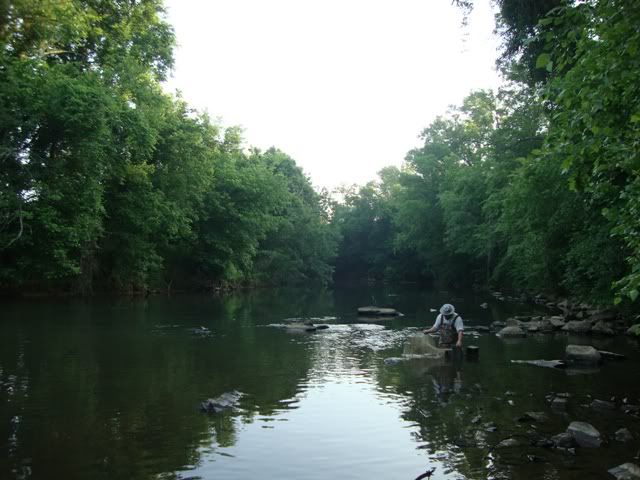
Anyhow, below is a picture of a location we've been trapping for turtles.  The river bed here is hard and rocky...so we've had to anchor the trap by fastening the hoops to cinder blocks with rope.  If we were trapping a pond or lake, we could probably just jam stakes through the hoops and into the soft sediment to secure the traps.  But we ain't so lucky this time.


This trap caught a decent-sized common snapping turtle (Chelydra serpentina) after the first day. 

Unfortunately, we didn't get a picture of it. 

Thought the location was pretty nice, though.

________________________________________________________________________

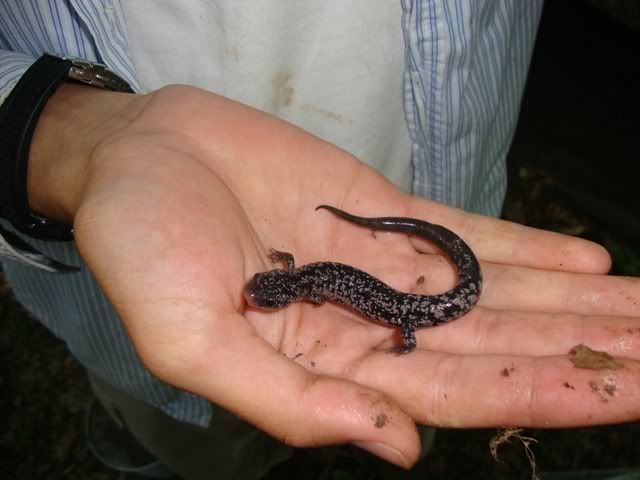
The White-spotted Slimy Salamander (Plethodon cylindraceus).  This isn't a rare find.  In fact, I've reported finding them in the drift fences already.  What makes this a particularly interesting capture was the fact that we caught a fully mature adult male (we usually get juveniles). 


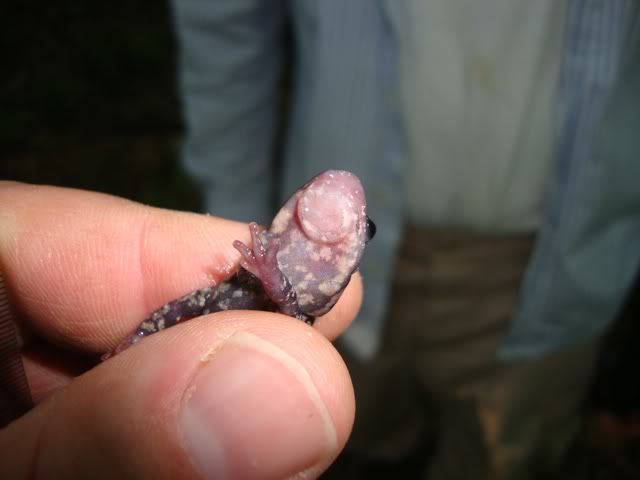
Adult males of many plethodon species have large mental glands under the chin (occassionally referred to as hedonic glands, so you can probably imagine what their function is).  What many may not realize is that salamanders can have very complicated courtship behaviors.  In many species, it's almost like a dance that they play out, where the female follows the male closely, rubbing her chin on the base of his tail, as they move together in circles (this is sometimes called the tail straddling walk).  It is during the tail straddling walk that the mental gland of the male comes into play.  The male will turn around periodically and slap the female on the nose with his mental gland.  Thus, it's believed that important olfactory cues, such as pheromones, are tranferred from male to female in this fashion.  The male then eventually deposits a spermatophore (i.e. packet of sperm) on the ground that the female walks over and picks up with her cloaca....and.....bingo!  Fertilization!
Above Two Pictures: the obvious mental gland on the chin of this adult male white-spotted slimy salamander.

For more information about the courtship behaviors of Plethodon salamanders, see here.  Also check out the bible of amphibian biology/ecology: Duellman and Trueb's (1994) Biology of Amphibians (second edition).  A wealth of information is carried therein.
_______________________________________________________________________

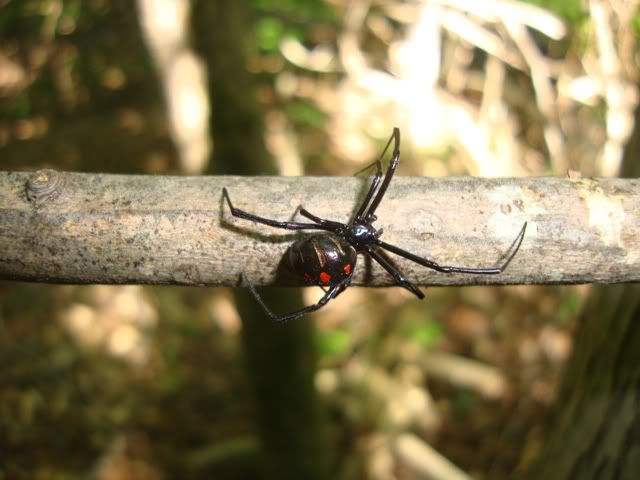
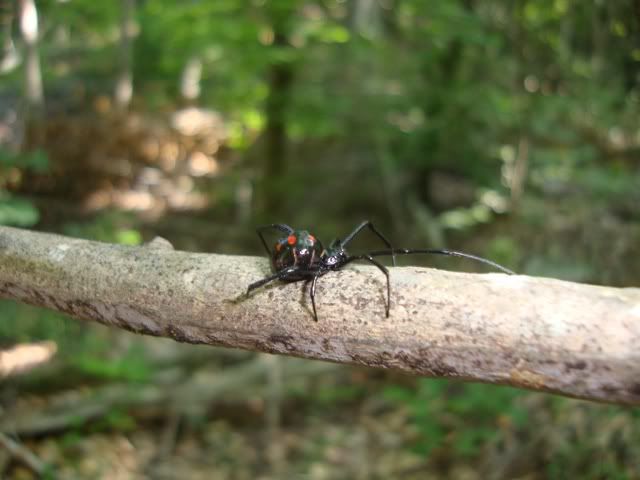
The Black Widow (Latrodectus mactans): We found two large gals in their webs along the same drift fence this week.  Each time, I carefully transfered them on a stick to some location far away from the fence.  I'm sure other widows will move in to take their place.  As usual, they were completely unaggressive during the relocation process.  Yet, they still must be treated with a hefty dose of respect!
Above Two Pictures: one of the Black Widows that had set up shop along one of our drift fences this week.

___________________________________________________________________________
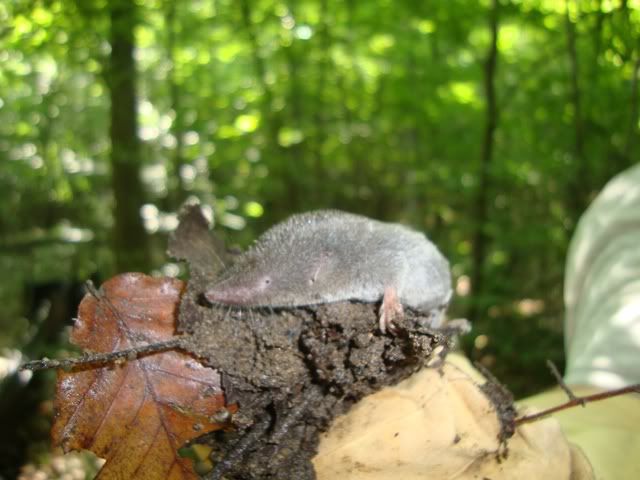
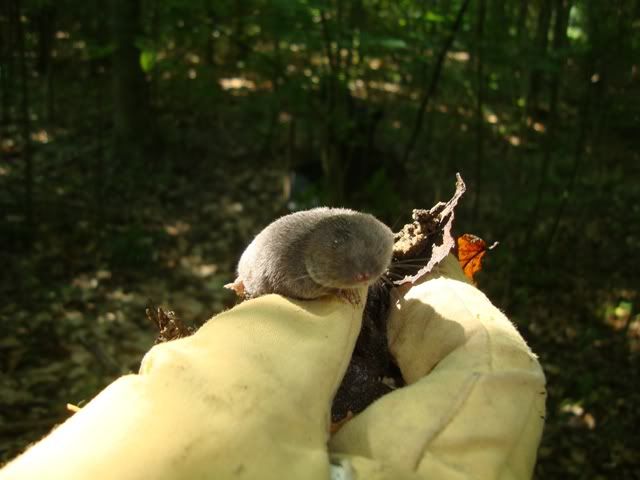
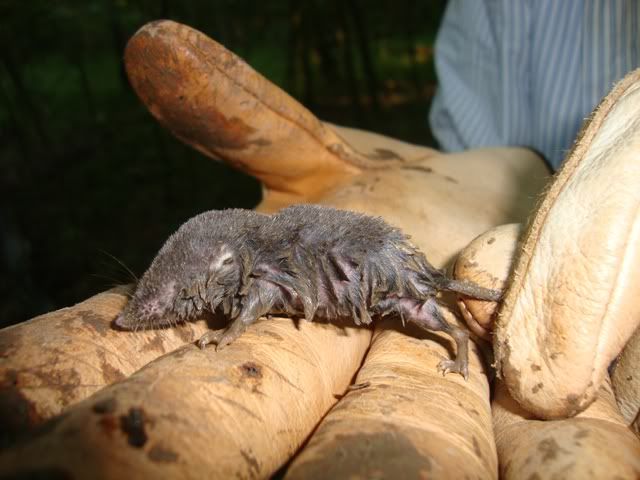
The Southern (or Carolina) Short-Tailed Shrew (Blarina carolinensis).  Although we captured some eastern Harvest Mice again, the most commonly captured small mammal this week was the Short-tailed Shrew.  All ended up in the pitfall traps along the fences.  At our sites, this is the most commonly captured member of the Order Insectivora (which includes primarily shrews and moles in our neck of the woods).  They are often reported from woodland habitats with moist soil and lots of ground debris (which is where the captures pictured below came from).  However, we've also seen them under our coverboards laid out in grasslands/old fields...sometimes with little "nests" of shredded vegetation (often grass) gathered up nearby.

Although we have two species of Short-tail Shrew in the state: The Southern Short-Tail (B. carolinensis) and the Northern Short-Tail (B. brevicauda), their ranges do not overlap (Webster et al. 2003, Mammals of the Carolinas, Virginia and Maryland). 

Above Two Pictures: Note the incredibly small eyes, but large whiskers.  As burrowing mammals, sight is less important than the tactile sensitivity that whiskers can provide when hunting soil invertebrates!

Above: a different individual that we captured.  Note the conical head shape of this species, which (in my opinion) separates them from other shrews, such as the Pygmy Shrew, which have more "elephantine" noses.  The short tail relative to body length is also a helpful clue.


As some of the only poisonous mammals species in the world, members of the Genus Blarina must be handled carefully.  They do not have a sophisticated venom-delivery system as do snakes of the Families Viperidae (vipers and pit-vipers) or Elapidae (cobras, kraits, mambas, etc.).  The toxins are in the saliva (according to George et al. 1986, the account published for the American Society of Mammalogists), and they have grooved teeth that allows it to flow into the bite wound more effectively.  This is somewhat similar to the venom-delivery system of Gila Monsters and Mexican Beaded Lizards, and I'm still up-in-the-air about whether this means they are considered "poisonous" or "venomous".  The toxins are reportedly both hemotoxic (destroys tissue) and neurotoxic (impairs neurological function), and function primarily to aid in prey capture.  It has also been suggested that, becuase they cause paralyses in their prey, these toxins may serve as a means by which Short-tails can cache (or save food) for later.  Their diet includes mostly invertebrates, such as earthworms and millipedes, but they will also eat vertebrates larger than they are, such as mice and voles.  It is believed that their toxic saliva allows for this.

As George et al. (1986) summarize, humans have reported experiencing "serious effects" after being bitten by these shrews.
_______________________________________________________________________


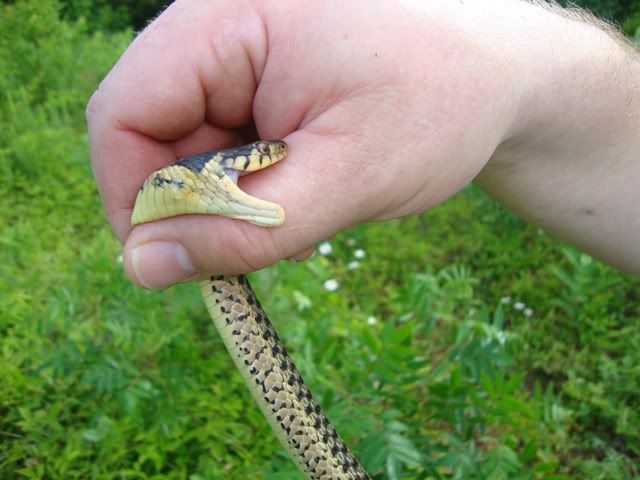
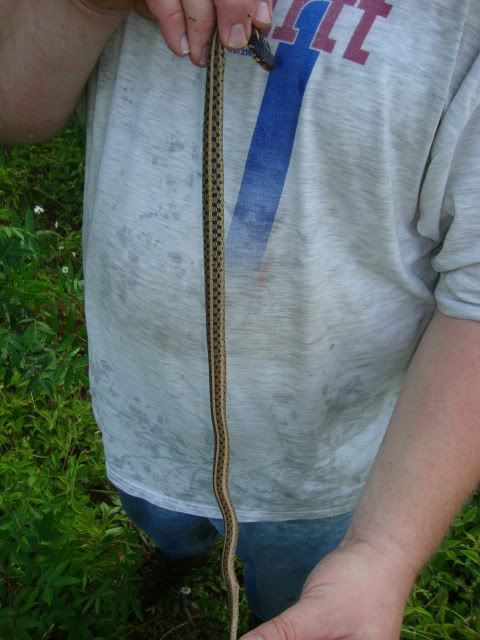
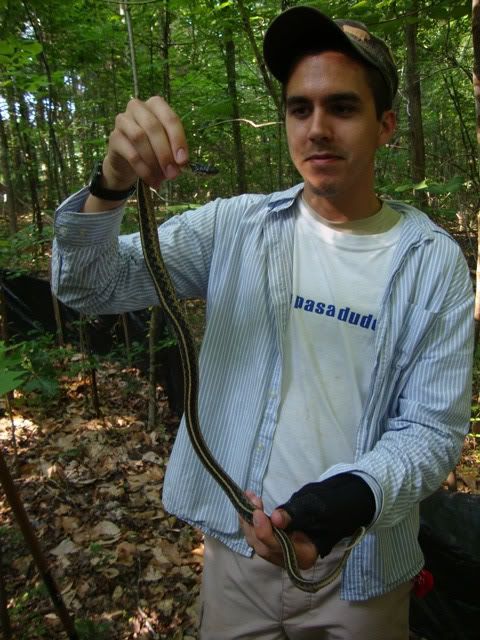
The Common Gartersnake (Thamnophis sirtalis): The Common Gartersnake is probably one of (if not the) most widely distributed snakes in North America (Ernst and Ernst, 2003, Snakes of the United States and Canada).  It's geographic range includes the entire Eastern US, the Entire Midwestern US, a good portion of the Western US....while also reaching far into Canada from coast to coast. Aside from the more northern reaches of Canada, the only regions in North America that the Common Gartersnake is absent from are the hot/dry habitats of the southwestern US, and much of the Rocky Mountains (as far north as Wyoming and the southeastern corner of Montana).

Needless to say, I've spent alot of time with this species (both in WI and in the Southeastern US).  They are ecologically very similar here, as in the upper Midwest: liking damp habitats, but also grassland edges and even disturbed environments.  They are not as abundant down here as up there, but we still catch them often.

One difference I've noticed is that the Southeastern individuals are much quicker to slap a bite down on your finger.  Luckily they don't have much in the way of teeth...and it rarely breaks the skin.

I guess I'd be ornery too if I had to live outside in this hot & humid part of the US 24 hours a day, 7 days a week. 


They also seem to have this very handsome checkerboard pattern more often (at least in my experience).  Nice looking snakes.

The above individual was captured in a grassland drift fence.  The one below, however, came from a lowland deciduous forest drift fence.  It was much bigger than the first snake.

So...that's it for this week.  There will hopefully be more captures to report in the future.

Enjoy the weekend!