Showing posts with label Copperhead. Show all posts

Saturday, July 9, 2011

Week's End Survey Round Up VII: Copperheads and Cyst-laden Salamanders

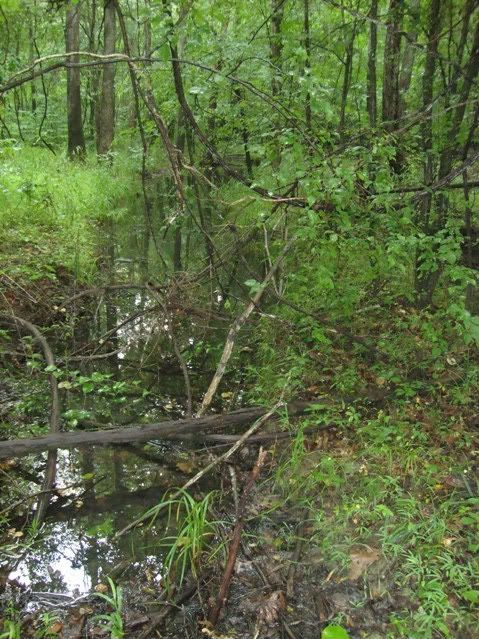
Much like last week, we had a lot of rain and wet to deal with during our surveys.  As you can see from the pictures above, a bunch of standing water and dripping vegetation.

Interestingly, we didn't catch as much this week, as we did last week.  I imagine that because it had been so dry for nearly a month prior to the rains last week....once it got wet, the critters exploded out of hiding and became very active.  Now that the wet conditions are sort of old hat, they aren't quite as active.

Regardless, we still caught some cool stuff....but nothing really new.
____________________________________________________________________________

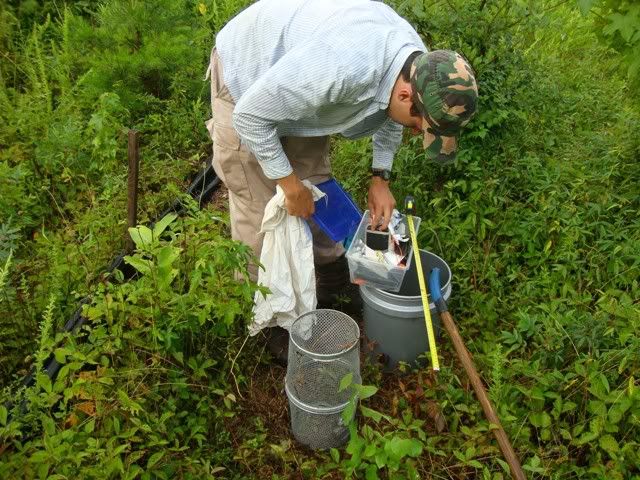
Another nice sub-adult or, perhaps, young adult Eastern Ratsnake (Pantherophis alleghaniensis).  We carry a bucket of our gear with us in the field.  Every time we get a critter to deal with, we set up a little workstation to collect appropriate data.  One person takes measurements and yells out numbers, while the other records.  It works out pretty well.  Often, a back-pack of gear is a good option too...but I sort of like the bucket (I can fit more in it and whatever I put in stays dry).  It can be a bit cumbersome, though.
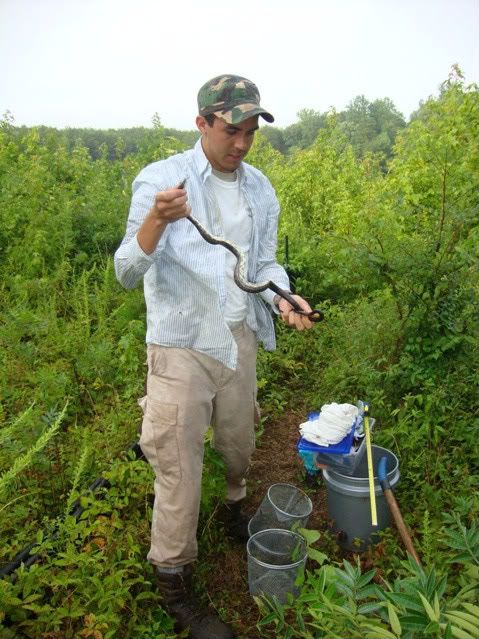

Above: our bucket O' gear that we carry with us in the field.  Also you can see the handle of the potato rake, which is the most versatile and important tool a field herper can have!  It will flip rocks, turn logs, act as a walking stick, and help balance you when rock-hopping across streams.  It can also be used to carry funnel traps with venomous snakes AND act as a snake hook for venomous snakes, if necessary. 

_______________________________________________________________________

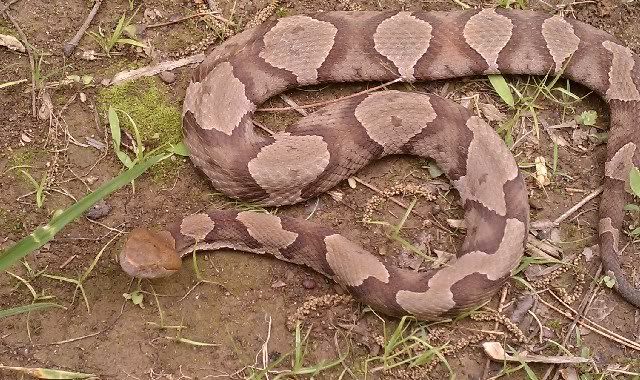
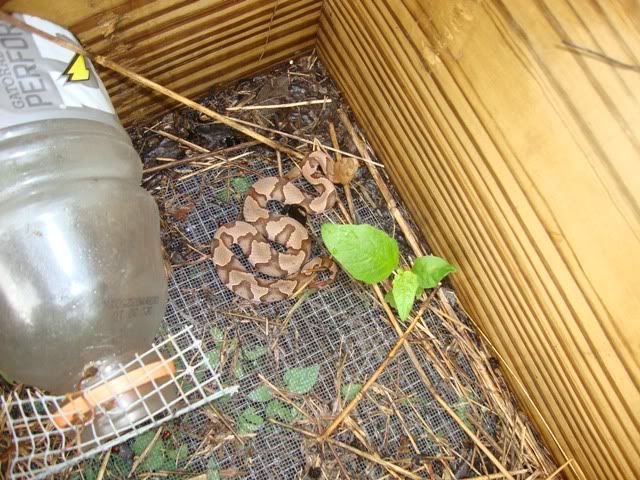
The Copperhead (Agkistrodon contortix).  I just can't get enough of Copperheads.  I'll post pictures of every one I see.  They are absolutely beautiful.  This little juvenile was in our grassland/old field drift fence after a few days of heavy rain.  Could have been after some frogs that crawled in....who knows.
____________________________________________________________________________

The Box Turtle in the funnel trap.  Well, it wasn't quite in the funnel trap, I guess.....  But it sure seemed like it was trying to get caught!  When we found it, the turtle had been meandering along the fence right up to where entrance to the funnel (which it couldn't fit into, as you can see below).

This adult male ended up getting marked number 13 and left to go on about his business.


___________________________________________________________________________

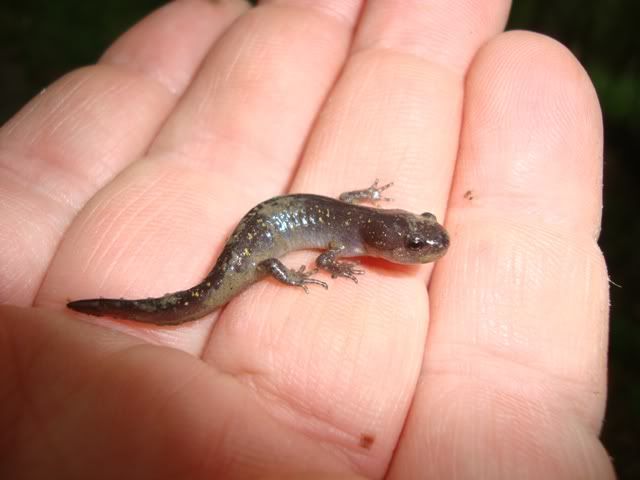
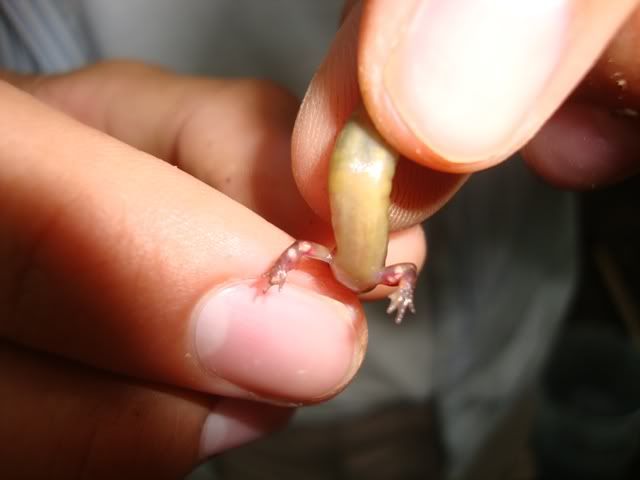
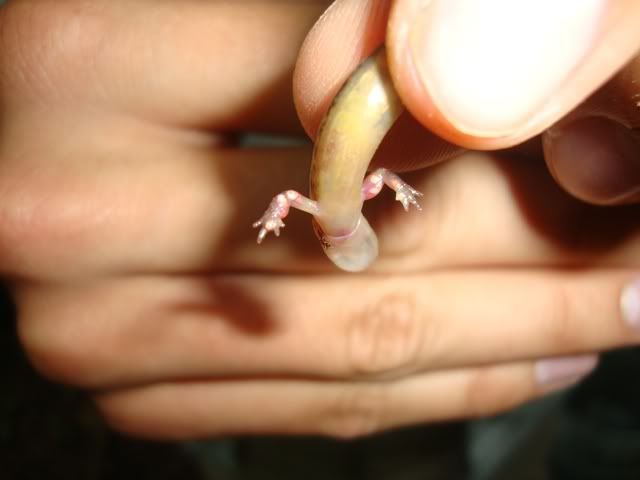
The cyst-laden Two Lined Salamander (Eurycea cirrigera).  This week Dave actually randomly saw two of these guys wriggling around in the leaf litter near our fences and grabbed them.  A consequence of the more moist conditions out there these days is that salamanders hang out closer to the surface of the ground.

After giving one of them a little scrutiny, we noticed these white dots that appeared to be just below the surface of the skin of this little guy's front legs.  I'm fairly positive these are the larval stage of some type of parasitic flatworm.  Either a trematode (a.k.a. fluke) or a cestode (a.k.a. tapeworm)...probably the former.  While I can't be 100% sure of this, because we didn't want to necropsy the animal to be sure, I've worked with two parasitologists in the past.  Both were involved in research on amphibian parasites, and these little critters pick up alot of invertebrate baggage throughout their lives.
The lifecycles of parasitic flatworms are fascinating.  Particularly those considered digenetic trematodes.  These may have two or more larval stages that will exist in as many hosts...and an adult stage that occurs in yet a third host....throughout their lifecycle.

Let us begin with a simple example: a group of adult flukes living in the intestines of a predatory wading bird (like a Great Blue Heron).  The flukes in the intestines reproduce and shed eggs...these eggs then exit the Heron when it defecates.  In this way, thousands of eggs are broadcasted into the environment.  Herons often defecate in or near water...when these eggs hit the water, they hatch into their first larval form, which is a tiny free-swimming stage called a miracidium.  The miracidium is microscopic and ciliated.  It uses these cilia (little hairs) to swim around in the water like a paramecium.   They are on the look-out for an appropriate invertebrate host, which is often an aquatic snail of some kind (the first intermediate host for these critters is usually an invertebrate).  When the find a snail, they burrow into their tissues and start to develop.

After a period of development inside of the snail, the parasite is shed and returns to the water as a form called a cercariae. The cercariae are basically microscopic and look almost like tiny little tadpoles..little tail and all.  Now these little guys also start swimming around the water looking for a host (called a second intermediate host)..but this time they don't look for a snail.  This time they're after a cold-blooded vertebrate (often a fish or larval amphibian).  The cercariae penetrates the skin of the larval amphibian, burrows into its muscle and encysts into a resting stage called a metacercariae. I *believe* it was the metacercarial cysts that we saw on the arms of the salamander pictured above.

A larval parasite can remain as a metacercarial cyst for a fairly long period of time (what this period of time is, on average, I don't know).  Basically, it bides its time until an appropriate terminal host consumes the second intermediate host.  The terminal host is usually a predatory bird or mammal...but may also be a larger fish, snake, turtle, etc..  So...for example...a heron eats an infected fish...or an infected tadpole/frog.  When that infected muscle is consumed, the metacercariae pops out of the cyst in the terminal hosts stomach and becomes an adult fluke.  Once it is an adult, it can reproduce in the intestines and start generating its own eggs that can then be shed in the feces of the heron and the lifecycle starts anew!

Click here for more information on how these parasites may cause malformations in amphibians.  This is the website of Dr. Pieter Johnson at the University of Colorado.  He has studied digenetic trematodes of amphibians for some time.  There is more information on the lifecycles and also a picture depicting a lifecycle at this link.

I've given you only one example.  Certain parasite species may have more or less hosts....these hosts may be of a variety of critters, or specific to one or two.  Depending on species, adult parasites may end up in places aside from the intestines, such as the lungs, the bladder, the stomach, the esophagus and so on.  And any one host can carry many individuals of many different species of parasite at any given time!

Very fascinating and very complicated life cycle for such a small little critter.  I'll say it again, the importance of wildlife diseases cannot be overstated!

Saturday, June 25, 2011

Week's End Survey Round Up V: The Copperhead, the Peeper of Spring, and the Misfortuned Furbearers


Well, despite the theft of our survey equipment, this week wasn't all bad!

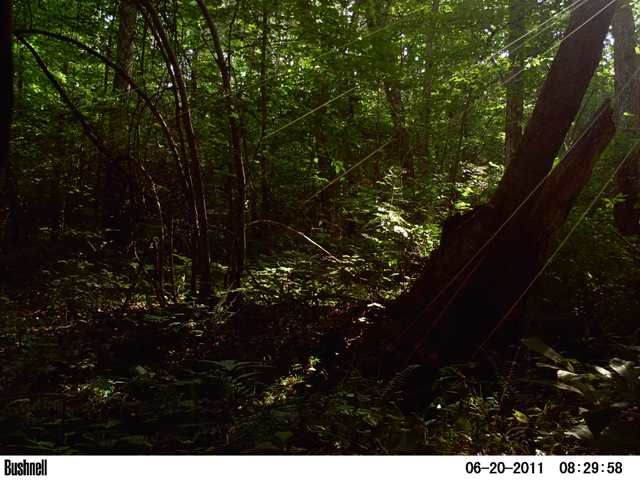
Let me start with another bit of scenery.

Surprinsingly, the location above resulted in another interesting scenic photograph (see last week's post). 

This one, however, is interesting because of the pronounced rays of light coming from the upper right.  I also find it interesting because if one compares this picture to the one taken at the same location only a week ago, you can get a feeling for how much variation there is in the appearance of photos on these cameras.

__________________________________________________________________________
The Juvenile Copperhead (Agkistrodon contortix).  We captured this little guy in one of our grassland drift fences.  He was in a funnel trap.  This is the fourth Copperhead captured in this particular drift fence since last August.  So, not very common.  I've posted about finding Copperheads before, and catching a venomous snake never really looses its thrill.  Plus, these snakes are gorgeous!  Juveniles have an additional dimension to their beauty: the tail   The tails of juvenile copperheads are a bright yellow-white (see below).

This is because juvenile Copperheads hunt using a strategy called caudal luring. Copperheads are ambush predators, so they sit in one spot and wait for prey to come by.....then they strike.  Juvenile Copperheads increase their chances of ambushing prey with the aid of caudal luring.  This is accomplished by moving their yellow-white tail-tip in a serpentine fashion so that it resembles a worm....or some other bit of prey.  This tail movement then attracts frogs and lizards (which are a staple food item for young Copperheads).  Once the frog or lizard is close enough, the baby Copperhead strikes.

For a great document that summarizes and investigates information on the ecology of the Copperhead, see Fitch (1960).

Above: the juvenile Copperhead captured in our drift fence this week.  Note the yellow-white tail tip.

Above: a nice head shot of the little Copperhead.  I'll say it again, they are a handsome-looking snake!
_________________________________________________________________________

The metamorphosed Spring Peeper (Pseudacris crucifer):  It's the time of year when the amphibians species who laid eggs in the early spring are now having larvae metamorphose into tiny juveniles.  This week, for the first time, we started seeing froglets and tiny terrestrial salamanders.

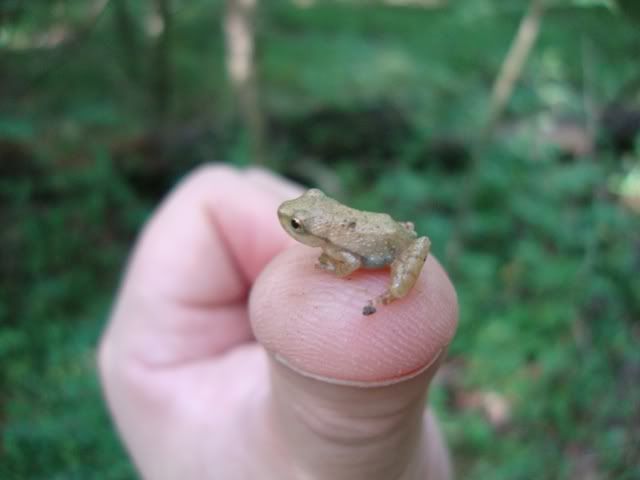
One example was this tiny Spring Peeper froglet that I captured while tracking Box Turtles with radio telemetry equipment.  I happened to look down just as the little critter hopped out of my way.  It took alittle effort to catch such a minute (and delicate) amphibian while not injuring it, but I managed.

These frogs are some of the earliest breeders in the state, along with the Upland Chorus Frog (Pseudacris feriarum).  I heard both species calling in the ephemeral wetlands on-site as early as February of this year.  This is only the second individual of this species that we've captured at this site.  The individual captured previously was an adult....so click on the link to see the difference in size from the juvenile pictured below.

Above: newly metamorphosed frogs are usually small, but they are even smaller for members of the Genus Pseudacris.  These frogs are diminutive as adults, and as juveniles....well you can see the size compared to my thumb in this picture.

___________________________________________________________________________

The D.O.R. Mink (Neovison vison).  A Dead-On-Road, or DOR, animal is something one never wants to come across.  It really puts a downer on the day.  So...if I'm not at risk of putting myself or others in danger...I try and at least get something useful out of the carcass.  I don't have the facilities to make mammals into suitable museum specimens, but if it is an uncommon species and the carcass is still in good shape...I try to at least snap photos, get location information, note associated habitat, and take some measurements.  I then send this to the appropriate regulatory and/or museum folks.

For herps....it's alittle easier (no skinning involved, you just need access to a chemical fixative and preservative and some jars).  I always try to make specimens out of the DOR herps I find, if possible.

Anyways, we saw this poor mink dead in the middle of the road as we drove to the sites this Monday.  It was killed near a stream-crossing....with a fairly dense wooded riparian (i.e., stream-associated) buffer.  The carcass was fresh and in good shape.  We got some photos of the feet, head and etc..

Also turns out, it was a female with enlarged nipples, which meant that she was nursing young nearby.  Those young may not have very good odds of survival anymore.

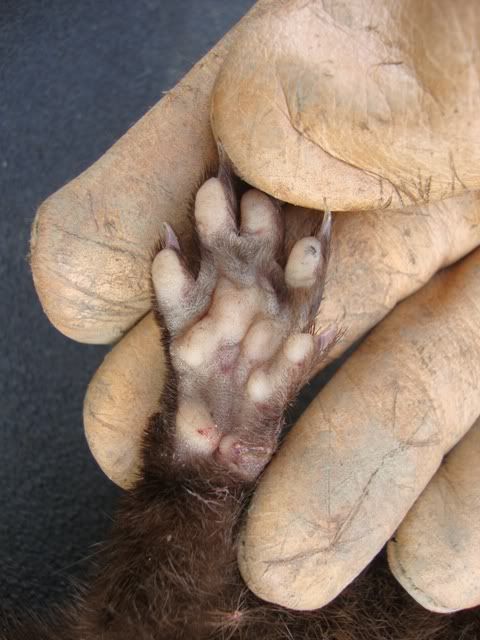
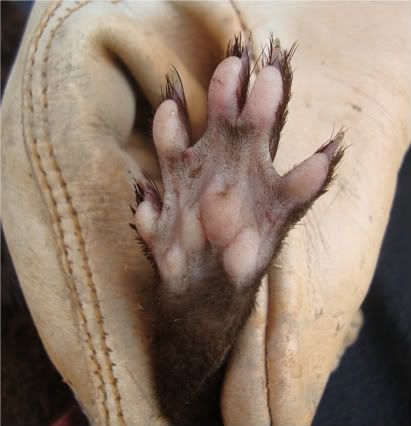
While taking pictures, I attempted to snap some of the critters feet (with Dave's help).  Having pictures of the feet really helps one see what they should be looking for when identifying tracks in the mud.

Thought I'd share the feet/paw pictures.

I'll post more information about Mink in the future....
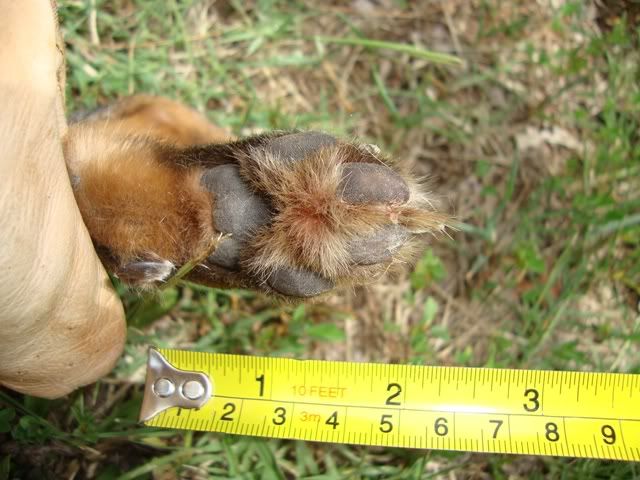
Above: the right front paw of the road-killed mink.  Check out the slight webbing between the toes.  Also important to note is the shape of the inter-digital pad (i.e., pad between the toes).  It's that pad which gives mink tracks that crescent-shaped imprint directly below where the toes register in their tracks.

Above: The rear left paw of the road-killed mink.  Again, note the webbing and crescent-shaped inter-digital pad.  Also, five toes...but you may be able to see why one of those toes doesn't always make an impression.

_______________________________________________________________________

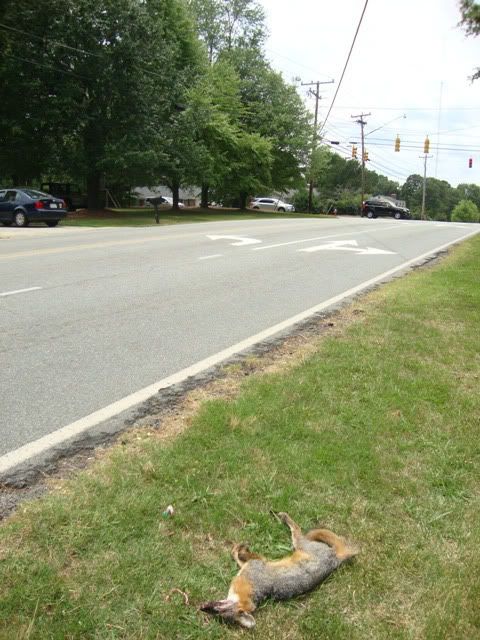
The D.O.R. Gray Fox (Urocyon cinereoargenteus).  The downside of being a wild animal in suburbia, is that you face mortality from a variety of sources that you otherwise wouldn't face in a more natural setting.  A great example of which is mortality due to vehicular traffic (see also Temple et al. 2010).  I'll post more specifics about carnivores in suburban lanscapes at a later date...but for now....I'll tell you about the road-killed Gray Fox we had the opportunity to see this week.

Above: the road-killed Gray Fox that we were told about on 6/23/2011.

This individual was not encountered at our normal study sites (nor on the road as we drove to our study sites).  Dave and I were working in the office one afternoon...data entry...data analysis....etc., when a colleague stopped by.

He told us of a freshly dead fox on the road not far from campus.  He said it had not been there in the morning, but was there now (several hours later).  He said it looked mostly intact.

Dave and I jumped up and hopped in my truck to check it out. 

Within about 30 seconds we found him......laying stiff in the road just about at the middle of a busy suburban intersection.  So busy, in fact, it had a stop light.  On one side of the road was suburbia...densely packed with houses.  On the other side was a large wooded buffer associated with a corporate headquarters of some kind.

We drug the little fella off of the road with garden rake and donned some gloves.  Took some measurements, got a GPS reading, and snapped some photos.  The body was pretty stiff with rigor mortis, but I was able to pry the legs apart enough to see that it was a male.  It was in perfect condition....the skull appeared intact...the pelt in good shape aside from being split along the shoulder and part of the front leg.  Would have made a fantastic museum specimen.  Unfortunately, I don't have a good facility to deal with a dead critter this large.

So we had to leave him there.  Seems like a massive waste, but we submitted our data to the state wildlife commission.

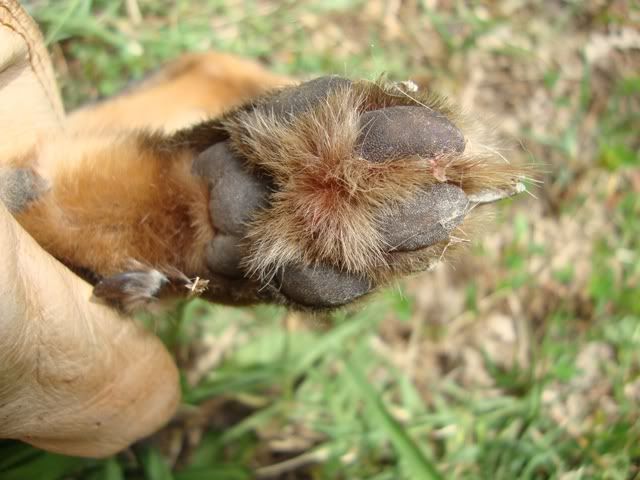
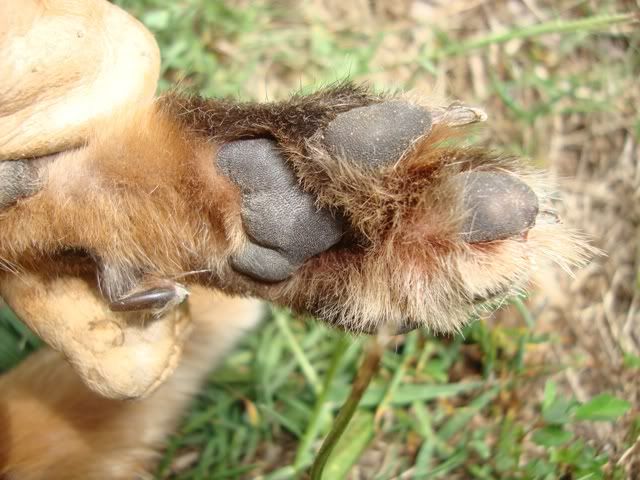
Among the photos we took were some good shots of the paws.  As with the mink, I think seeing the actual paws of an animal can be very helpful in learning to identify tracks in the wild.

The pictures below are all of the front right paw.  Due to rigor mortis, I couldn't get a very good shot of the back paws (and we were trying to do this along a busy roadway...so we were working quickly).

Above: in this picture, the pads of the digits (i.e. toes) are in focus.  You can really see the details of these pads, including the dermal pappillae (i.e. which essentially are the "finger prints" of this individual fox). 


Above: in this picture, the interdigital pad (closer to the heel) is in better focus and you can also see the dewclaw (near the thumb of my glove).  The dewclaws don't usually register in the track the animal makes.


Above: the same paw with a ruler for scale.  The Gray Fox really is a pretty small critter.
__________________________________________________________________________

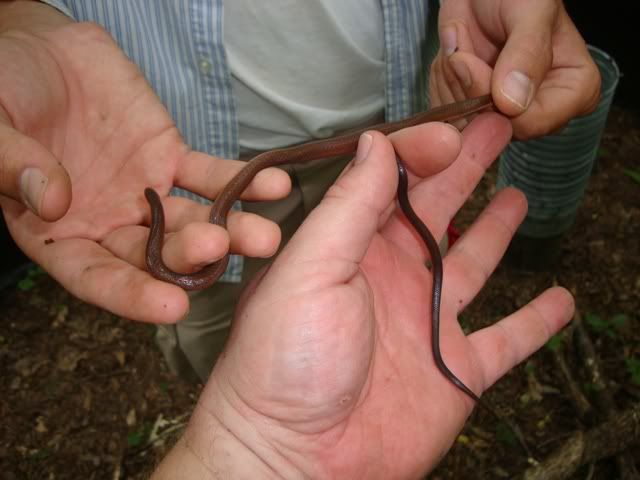
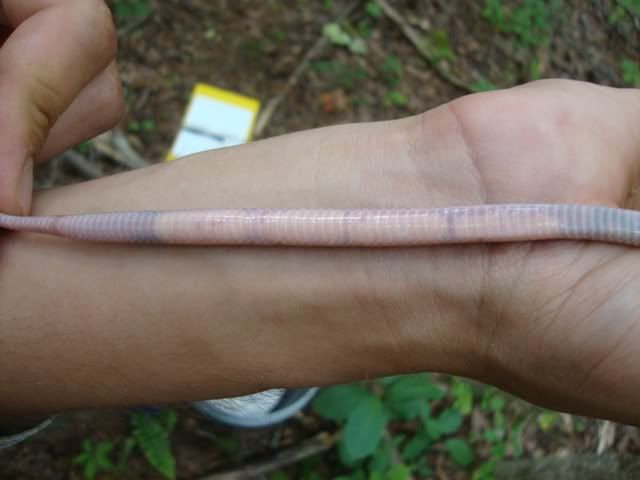
The Gravid Wormsnake (Carphophis amoenus):  This is a very commonly captured species at our sites, and I've reported capturing them in the past.  However, on Thursday we first noticed definitive evidence that the females at one of our sites are gravid (i.e. carrying eggs).  I had thought previous females looked as if they might have eggs....but the one we caught this Thursday has eggs that are clearly visible in the second picture below.  

It's that time of year for the egg-laying snakes and turtles!

Above: the gravid female and juvenile wormsnakes captured in an upland forest drift fence this week.  They were found in one of the pitfall traps.

Above: the whitish blobs in her belly (visible through her ventral scales) are individual eggs.  It appears she has four eggs ready to be laid.

____________________________________________________________________________

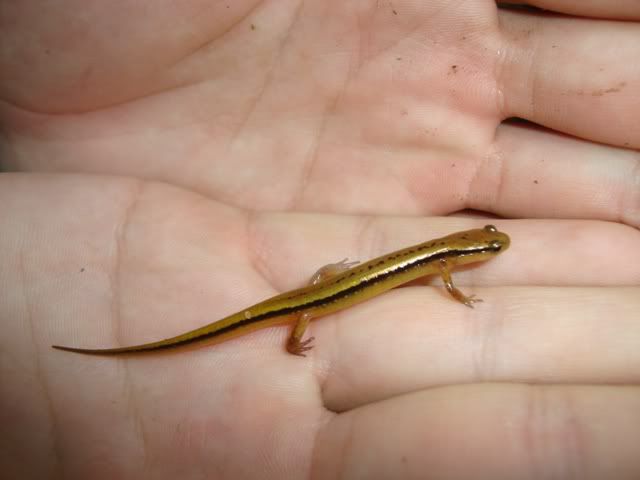
The Southern Two-lined Salamander (Eurycea cirrigera).  We captured this juvenile in a pitfall trap along one of our lowland forest drift fences.  It is the first time we've captured Two-Lined Sallys in the drift fences at this site (although we'd found them flipping rocks in the stream edge nearby).  We hadn't seen any this year at this site.  At our other site, we captured an adult in an upland drift fence back in May.

There's not much to add.....the pictures are just cool.

In addition, it's just another example of the juvenile amphibians we're seeing this week.


_________________________________________________________________________

The metamorphosed Spotted Salamander (Ambystoma maculatum).  You may recall that last week we were still seeing larval Spotted Salamanders (note: as larvae most salamanders are fully aquatic, breathing with gills and spending all of their time in water).  Last month we found many larvae in the ephemeral wetlands on-site, but slowly the numbers we captured began to dwindle, which meant they were metamorphosing (i.e. transforming from aquatic larvae to land-dwelling adults and leaving the water).  But until this week, we hadn't captured any juveniles that had metamorphosed and began living terrestrially (i.e. on land).

Finally, we captured a pair of them in the pitfall trap of a lowland forest drift fence.

Above: a small juvenile Spotted Salamander, just beginning his new life as a land-dwelling organism.

____________________________________________________________________________

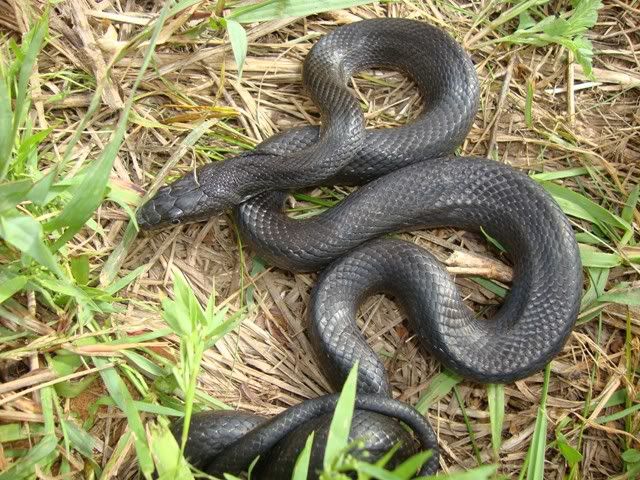
The Adult Eastern Ratsnake (Pantherophis alleghaniensis).  You may recall that we captured a juvenile Eastern Ratsnake a few weeks back in a lowland forest drift fence.  In that post, I made mention of how different adult individuals look compared to juveniles.  Well, here's another chance to see what I mean!

This adult female was captured in a funnel trap along a grassland drift fence at the same site that we caught the juvenile.

You can see, she's very black....no real discernible pattern.

A very cool snake!  Back home, these are very rare (listed as "Special Concern" by the Wisconsin Department of Natural Resources).  Here, they are one of the most common large constrictors encountered (I've even caught them in the university's "community garden" just outside my office door).

Funny what a difference geography makes.

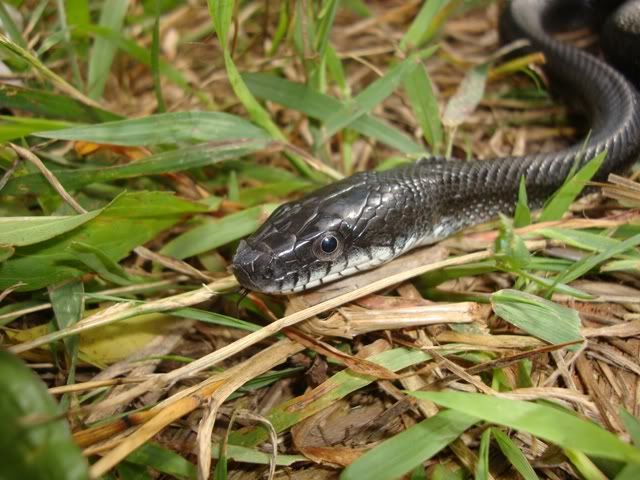
Above: although it may be possible to confuse the Eastern Ratsnake with the Black Racer (Coluber constrictor), there are two basic differences that most folks can figure out.  (1) if its warm out, the Racer will be gone almost immediately after you see it....they are FAST....while the Ratsnake is a bit more pokey.  (2) if you can capture the snake (and you will probably get bitten in the process...trust me) look at the underside.  The Racer's belly is basically solid-black with the exception of the area around the chin.  Although it also has a white chin, the Ratsnake often has a "checkerboard" pattern along parts of the belly....not the solid-black scales of the Racer.


Hopefully, we'll have more to report from our surveys next week.  And hopefully we wont have any more camera thefts!
____________________________________________________________________________

Literature Cited:

Fitch, H.S. 1960. Autecology of the copperhead.  University of Kansas Publications of the Museum of Natural History 13:85-288.

Temple, D.L. et al. 2010. Spatial ecology, survival and cause-specific mortality of gray foxes (Urocyon cinereoargenteus) in a longleaf pine ecosystem.  American Midland Naturalist 163:413-422.

Sunday, May 22, 2011

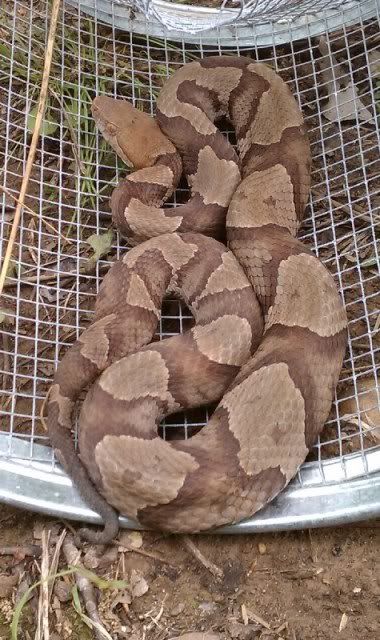
Copperhead!

Photo courtesy of M. Forsberg.

Checked the drift fences with two of my students on Friday, May 13th.

We were all excited to find a Copperhead (Agkistrodon contortix) in one of the funnel traps.

The individual was a sub-adult female.

In our neck of the woods, it's a relatively common species and may even end up in suburban/urban areas. 


As a venomous snake, Copperheads are often treated harshly by humans.  Even by folks that claim to like "wildlife".  I can understand the fear venomous critters promote and, as a father, I can understand the concern folks have about them in suburban/urban landscapes.  I wish there was a good solution for this problem....but there doesn't seem to be.  This is mostly due to the fact that there's not many places to go in the eastern US if you're a snake that aren't frequented by...or at least visted by.....people. 

This means there is lots of potential for interaction between humans and things that may accidentally do humans harm.  I say 'accidentally' because, let's face it, venomous snakes don't seek out humans to bite.  Bites occur when the snake is threatened.  Unfortunately, the snake may feel threatened even if you don't know it's there.  The Copperhead blends in so well, that it's not suprising folks unknowingly step on them, or place their hands near them. 

But, to put this in perspective, I've spent literally hundreds of hours at my study sites near campus, which are confirmed Copperhead locations.  These sites are comprised mostly of good Copperhead habitat (better habitat than found in many urban/suburban backyards).  Despite this, I have yet to just walk up on one in the field, and all of the individuals I've seen were captured in drift fences.  I imagine I've walked by oodles of them without knowing.

Regardless, dealing with a Copperhead in your backyard is a much different issue than killing a Copperhead that you happen to come upon while hiking in the woods.

But, I'm a strange person and I empathize with the critters that folks fear or dislike.  Especially the critters that, despite being loathed by humanity, are able to hang on. 

Regardless....if one can separate themselves from the fact that it's a venomous snake, its an incredibly handsome critter.

Photo courtesy of M. Forsberg