Showing posts with label Hawks. Show all posts

Wednesday, November 13, 2013

Bucky, the Red-Tail and Others....

Mostly random stuff to post today....

I can't help but post another clip of the resident Badger (Taxidea taxus).  I just don't get them that often, so I get excited about any clip we get.


Then, another rarity, a raptor on the cams.  I have gotten Red-tailed Hawks (Buteo jamaicensis) in the past (as well as a few other raptors, see here and here).  This is the first video clip, I think.

From what I can tell, this Red-tail appears to have nabbed something....


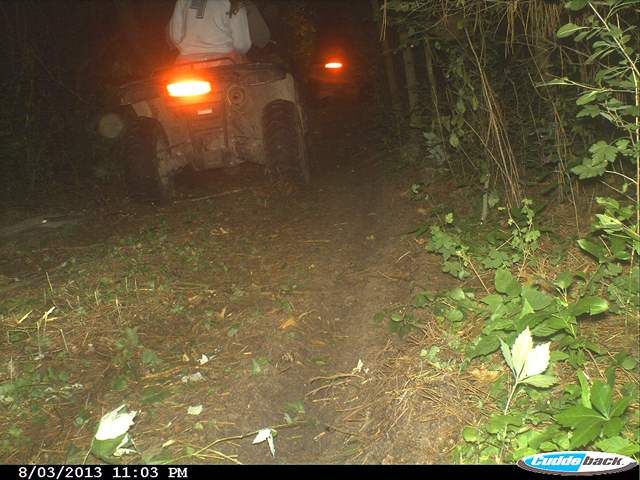
We still get some Canids, but they have become rare on this site lately....mostly becuase there has been an increase in human activity from the landowners.

I can't blame them at all for wanting to ride their ATVs on the property.  Plus, they are nice enough to let me use the land for my research, so I can't really complain.  Just a shame to see a real decline in the activity of some species on-site due to the ATVs....  Especially considering the the diversity I had seen on that tiny parcel prior to the ATVs (including Otters, Mink, Long-tailed Weasel, and Badgers).

Recently, we got a few fleeting shots of Red Fox (Vulpes vulpes) and Coyotes (Canis latrans) on-site.  We hadn't seen either species since July, whereas the Red Fox in particular was a constant fixture in the previous two years.  We even had pups this spring, but shortly after the pups showed up, there was a real decrease in Canid activity on-site (which coincided with the greater ATV activity).

So, I was very happy to see some Canids on the cams this week, even if the Red Fox does look a little mangy....
 
Wil E. appears characteristically cautious....


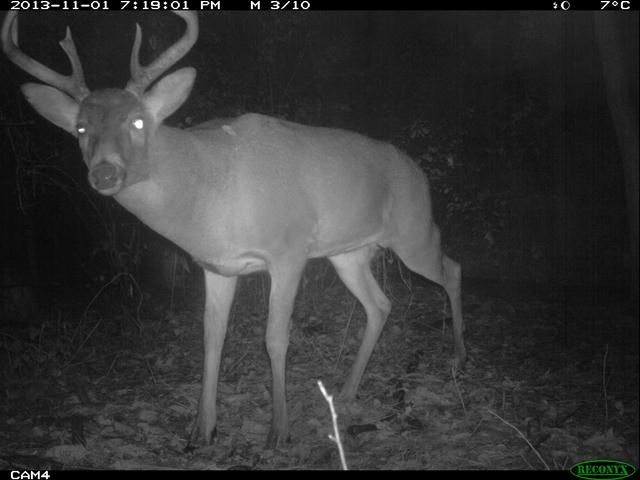
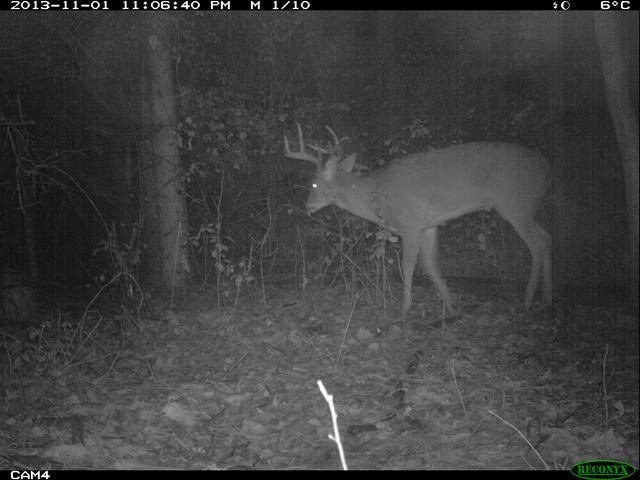
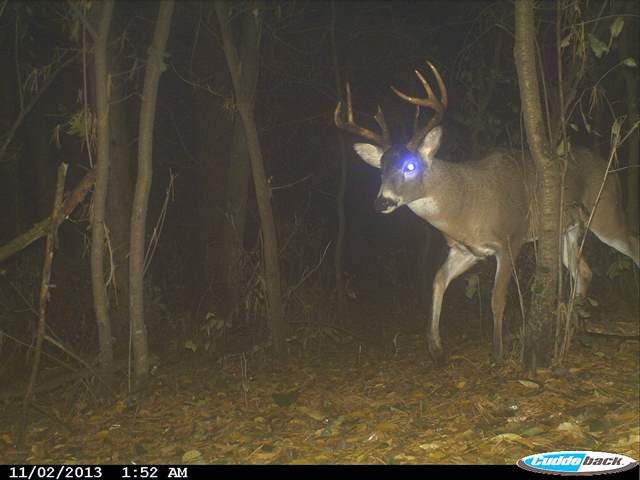
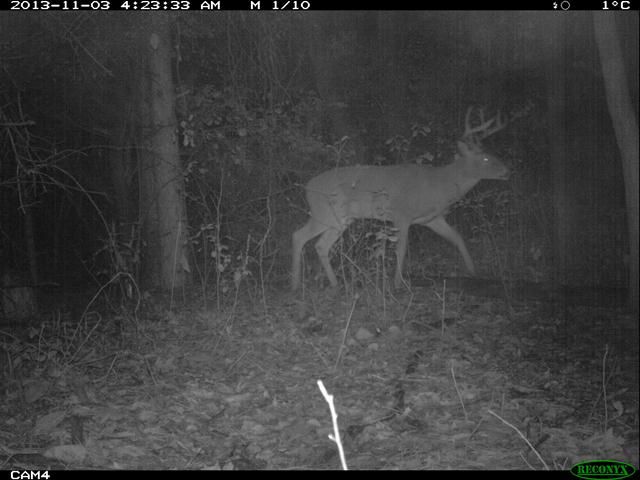
There's also an impressive (but lazy-eyed) buck still occassionally running through the site.  He's also been pretty rare since the ATVs started moving around.  We now only see Bucks like this after there has been no ATV activity for a few days in a row. 


He's avoided the arrows so far (probably because he only appears to be active when its dark out, from what I can tell).  We'll see if he lasts the gun season.  Interestingly, I don't think he's one of the two bucks seen earlier in the year (see here).

That 18-pointer hasn't been back since the summer.

Monday, February 27, 2012

Riparian Walkers

I had almost forgotten about this camera set.  The pictures below were part of a monitoring project I ran on property owned by the North Carolina Zoo.  From February 2010 to July 2011, we conducted a vertebrate invenotry on this property, which included drift fences and coverboards for small vertebrates, radio telemetry on Eastern Box Turtles (Terrapene carolina carolina) and, of course, camera traps for the big guys.

The camera that took most of the pictures below was placed along a nice riparian corridor for a few months during this period (Feb 17 to April 19, 2011) to see who was hanging around.  This was one of several cameras  deployed at various locations throughout the property.  Unfortunately, most of our camera trap captures on the site were of White-tailed Deer (Odocoileus virginianus).

The Riparian corridor provided our best variety.  It also represents my only venture into the realm of ScoutGuard cameras.  I can't even remember what model it was (the SG550?).  Anyways, I have to admit that I was at first very impressed....but this waned after a series of malfunctions, returns and straight-up inconveniences on the part of the camera (including an external remote..which you had to bring into the field with you and plug into the camera to program it).

Anyhoo....some neat pictures were captured near this heavily wooded stream crossing.

A juvenile Red-Shouldered Hawk (Buteo lineatus) flew down to the stream on back-to-back days for a drink?  Trying to grab a frog?  With alittle help from my buddy Bill over at The Future Of Birds, I was able to definitively identify this species!  They like woodlands associated with water, so it makes sense to see them here.
Above: Find the Buteo!  See the lower left-hand corner of the pic....

Above: Find the Buteo II!  In the background, standing in the water again.

The red-shouldered was by far the most unique thing captured by this camera.  Although, there were some neat pics of Racoons (Procyon lotor) wading around for frogs and fish.


And, of course, what series of pictures from a set in North Carolina would be complete without White-tailed Deer?  I quite liked the one below....with the reflection on the water......

Was also neat to get a shot of an American Crow (Corvus brachyrhynchos) coming down for a sip.....

Throw in a ubiquitous Eastern Gray Squirrel (Sciurus carolinensis).......

...and a feral puddy tat....

...and that about 'rounds it out for this camera set (and, in fact, for the site).  Although we did get pics of two other species from other locations at this site, they weren't some of the riparian walkers.

There were a few precious shots of "talking dogs" (Canis latrans).....


...also one lonely Gray Fox photo (Urocyon cinereoargenteus) at a scent station.....

And....so long as I'm posting pics of feral puddy tats.....I might as well show a 'coon hound, that had to belong to a tresspassing hunter.  He stopped by for a sniff at the scent station I put out at this spot.  Although there are stray dogs on-site, there's no way that a stray has a reflective collar with a GPS unit strapped to his neck......

Sunday, February 12, 2012

Advanced Ecology Lab Week 3: Red-tails and Tree Quadrats


There is no type-o in the title.  I meant to jump from week 1 to week 3 in my posts.  The stuff the class did during week 2 is associated with week 4...so I'll talk about it later!

The cameras picked up some interesting stuff over the past week.  Again, the White-tailed Deer was in greatest abundance.

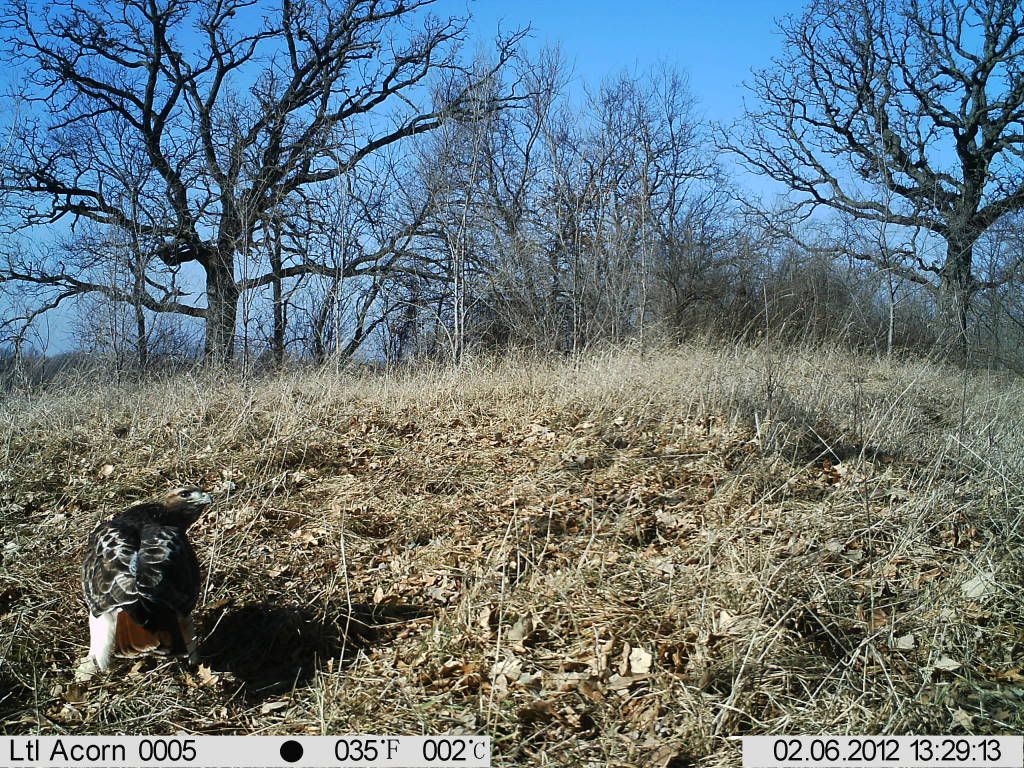
But...this week we were also fortunate enough to get a nice shot of a Red-Tailed Hawk (Buteo jamaicensis).  The first Red-tail I've caught pictures of on a camera trap (although not the first bird).


Interestingly, two weeks ago, we saw a pair of red-tails flying overhead on-site and screaming at eachother.  One had a small mammal in its talons and the other didn't.  I wonder if there was some kleptoparasitism about to happen?
______________________________________________________________________

Tree Sampling:

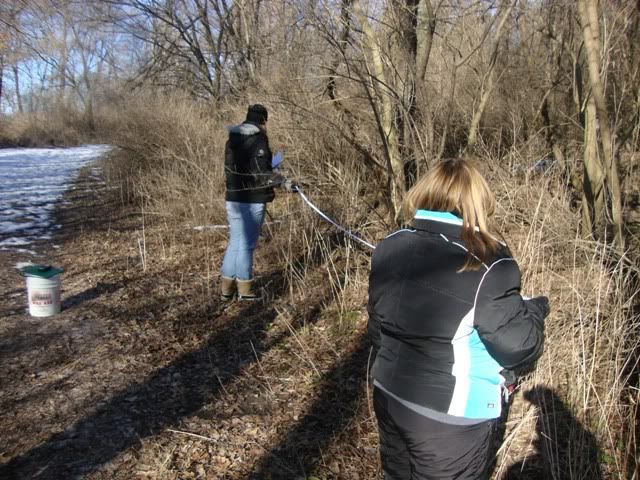
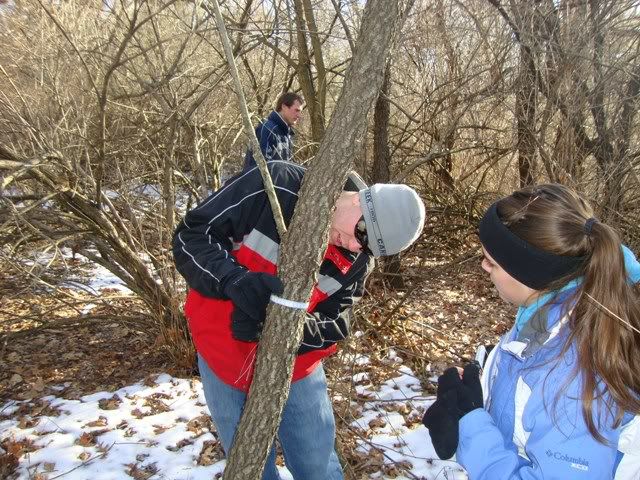
This week, as part of the battery of assessments being conducted of the property we are focused on, students conducted a tree survey.  This involved each group measuring out five non-overlapping "quadrats".  A quadrat (or sample plot) is a way to radomly select certain areas in a tree stand to sample, considering that measuring every tree in a forest is not practical.  Each quadrat measured 33 ft X 33 ft (or 1/40 of an acre).

So, the first step is to measure out the quadrat.


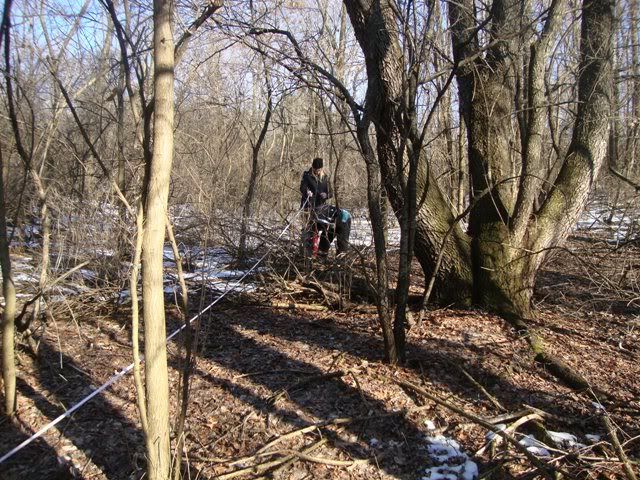
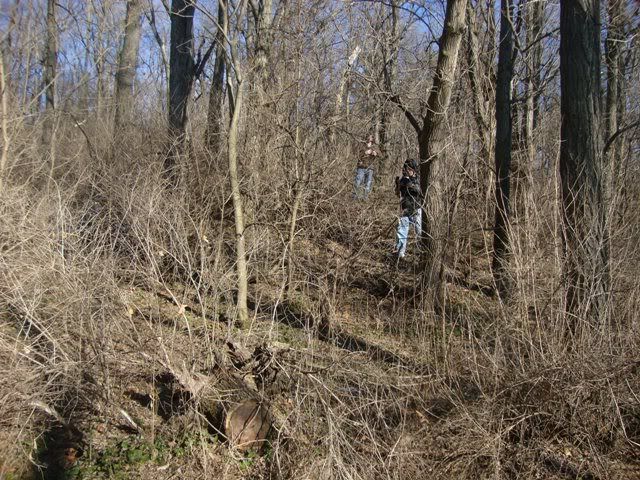
This can be difficult with thick underbrush....

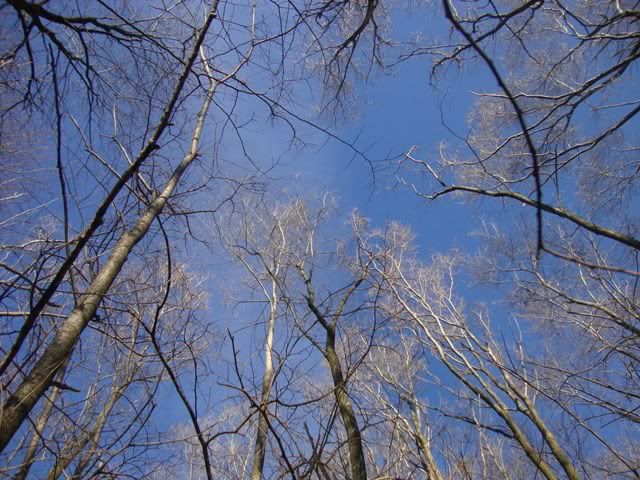
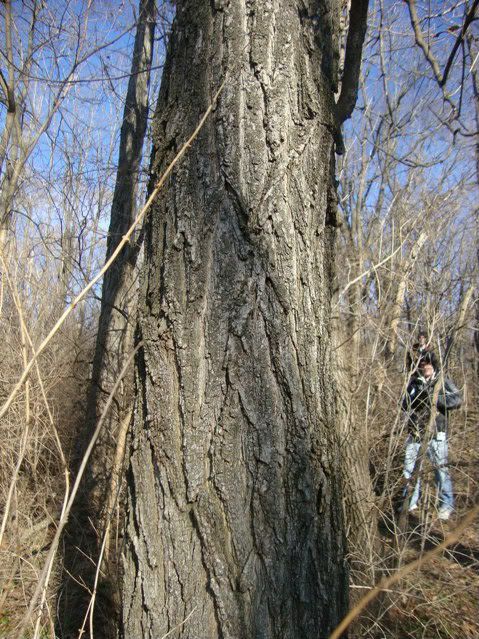
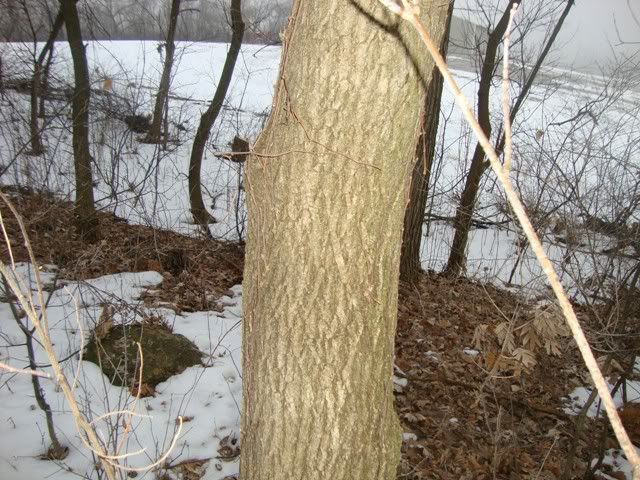
Then, comes tree identification.  Obviously, identifying trees in winter can be challenging.  There are no living leaves to work with.  So, one is stuck using bark, twigs and leaves near the base of the tree that you hope came from the tree in-question.

Luckily for us, the diversity of trees on-site was not huge (probably the only time something like low diversity can be considered "lucky").

There is the Locust (Robinia sp.)....with its deeply furrowed bark.....

...the Box Elder (Acer negundo)....Box Elders tend to hold on to seed pods (the commonly referred to "helicopters") in the winter.

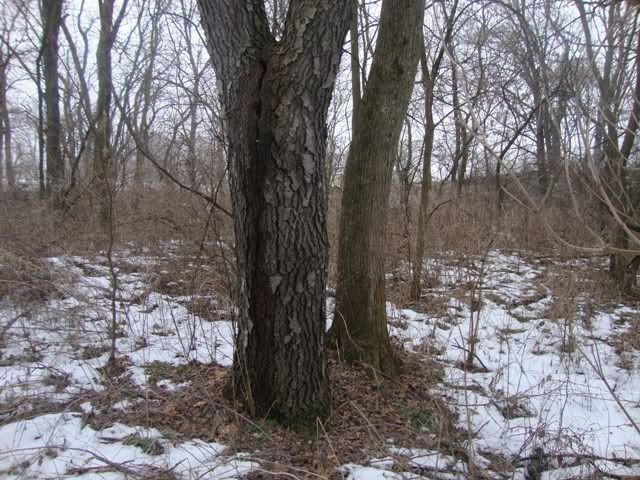
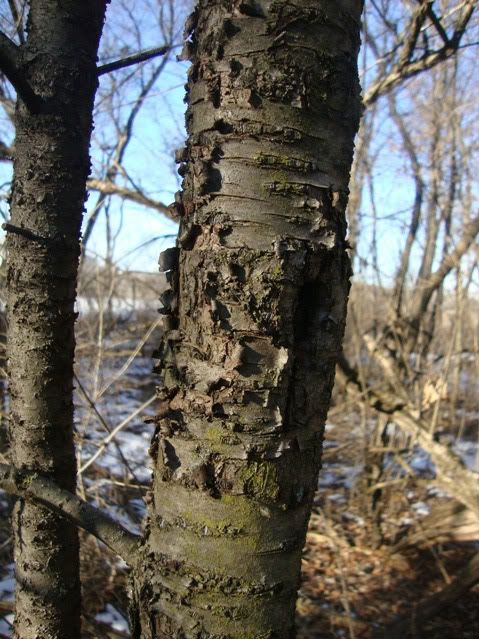
...the Black Cherry (Prunus serotina)...check out how much darker its trunk is compared to the Elm (I think) just behind it and to the right.  The bark will also look scaly, like potato chips.

....the Mullberry (Morus alba)...although this picture doesn't show it well, they have a more "yellowish" tinge to their bark.

...the Hackberry (Celtis occidentalis)....no mistaking that warty bark, with the roundish nodules....

...the Red Oak (Quercus rubra).....oaks often hold their leaves in the winter....although there are a few sporadic White and Bur Oaks (Q. alba and Q. macrocarpa) on-site, the leave shape of these three species differ.

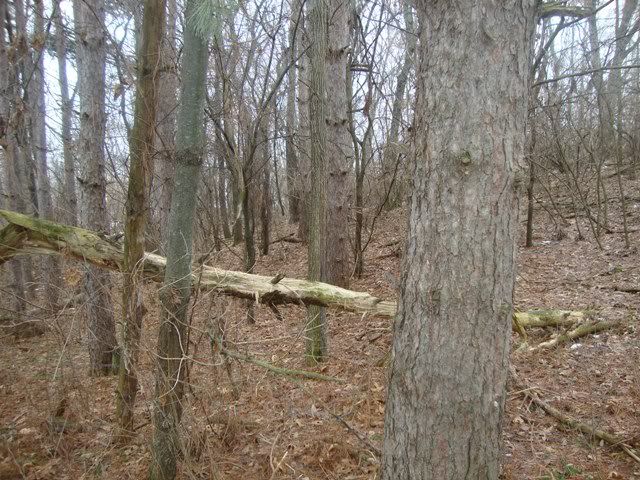
...the White Pine (Pinus strobus; the thin tree with the smooth bark in the background to the left) and the Red Pine (Pinus resinosa; rough bark more in the right foreground)...also White Pine needles occur in bundles of five, and Red Pine needles occur in bundles of two.

...and, of course, the terribly invasive Cathartic (or European) Buckthorn (Rhamnus cathartica).....its bark almost looks like it would belong to a black birch tree, or something....


For every tree within their quadrat that was of the appropriate size, students measured diameter at breast height (DBH).

The data the students generate can then be used to calculate tree frequency, also relative and absolute density, and dominance.  Students can also calculate average number of trees (and circumference) per acre.  Finally, using adaptation scores for each species, students can calculate compositional indices for the site, that can help classify what type of vegetative community is present.

...and although it was alittle cool out and the underbrush ocassionally got alittle thick, you can see they had a miserable time.....


Tuesday, January 10, 2012

Aerial Backyard Denizens: the suburban Red-tail

Been months since I posted in my Suburban/Urban Wildlife "series" (see here, here, and here) .....and now that we don't live in North Carolina, we don't live in suburbia.  Although that is to my un-ending joy (that we no longer live in suburbia), it makes it difficult to get new Urban Wildlife tales to tell.

However, I have a few stories that I've saved ........from back during the time when we lived in a suburban environment.....that I can share with you all.

This one is from late July and it involves a Red-tailed Hawk (Buteo jamaicensis).

I would almost go so far as to call red-tailed hawks commonplace these days.  I would be willing to guess that 80% of the times I'm in the car for more than 20 minutes driving through an agricultural landscape, I see red-tails.  Just two weeks ago, I was driving somewhere and actually saw one sitting on a street sign at an intersection, not 10 feet off of the ground.  If I had a camera with me, I would have pulled over to try and get a picture. 

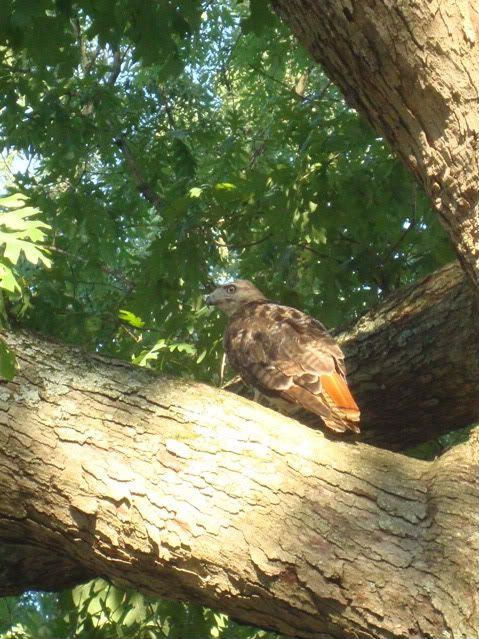
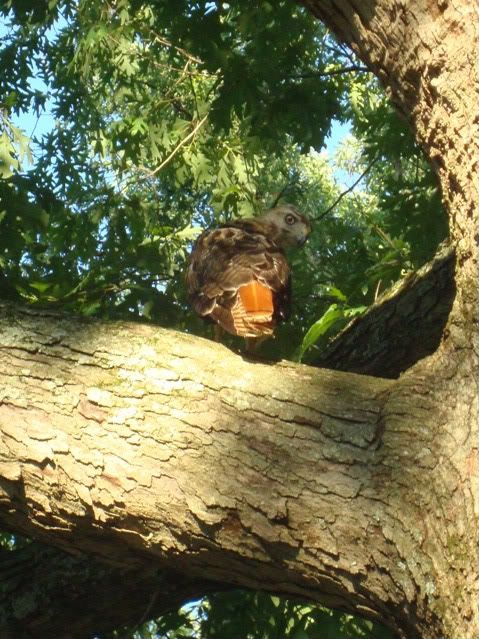
I'm not sure exactly what was going through the mind of the individual pictured below.  He was perched in a tree roughly 20 ft off of the ground.....which was the lowest I had ever encountered one perching, until I saw the individual on the street sign not long ago!

I had been having a conversation with a colleague in the parking lot near our offices at the University.  We had been talking for 10 minutes, at least, when I happened to look up at the trees to see this Red-tail staring back at me.  Shocked, I alerted my colleague to the bird and the two of us stared in amazement.


As you can see, I was able to get pretty close.  The hawk seemed more annoyed with us than scared of us.  There was a community garden near our building, which I imagine was great for hunting rodents.


The Red-Tailed Hawk has one of the largest distrubtions of any raptor in the New World (found from Alaska and the Yukon to Central America).  It's a species that can apparently handle anthropogenic disturbance.  It enjoys woodland edges and may have benefited from clearing of woodlands to create suburban and agricultural landscapes (probably also the reason why they are so frequently seen along roads).  It can handle the city life as well, and has even been found to breed in very urban environments such as New York City and Philadelphia. 

But I don't think red-tails were always so common.

Back when I was a kid....hawks and eagles always seemed pretty rare...at least I think they were rare.  I can vividly remember the excitement associated with actually seeing one.  For example, I recall a handful of occassions from my youth when dad saw a hawk (probably a red-tail) soaring overhead as we were driving in the car.  I remember that the rest of us family passengers were just happy to get a brief glimpse of it before it soared out of view. 
I don't know if red-tailed hawk populations have made a massive comeback in the upper Midwest, or if I'm just better at looking for them now?  Maybe they were never as rare as I remember them being. 

Interestingly, a fella named Gordon Orians published a paper in volume 17 of the Passenger Pigeon (the publication of the Wisconsin Society of Ornithologits) that gives an intriguing historical perspective on the attitudes of people toward this species.  Orians recounted the results of a questionnaire survey that was given to rural residents in the state of Wisconsin in 1955.  The results indicated that not one of the individuals who took the survey "were able to or cared to distinguish one species of hawk from another.  All were unanimous in saying that hawks are shot whenever possible in their area.  The attitude that the only good hawk is a dead hawk still prevails". 

These previous attitudes towards birds of prey give some indication as to why even the red-tail (a common species that benefits from the increased amount of habitat created by agriculture), could be in a precarious situation based on the prevailing mind-set of people.  I would also be willing to bet that this anti-hawk sentiment is in stark contrast to the general attitude towards hawks today.  Although I suppose folks that keep poultry aren't fond of red-tails swooping down on the chicken coop....most people are probably ok with hawks.

Thursday, May 19, 2011

The Right-of-Way Wanderers.

The Cuddeback is one of my "rover" cameras.  I move it around every few months at this site trying to find interesting stuff.  My Bushnells are the workhorse "fixed" cameras that remain in one place at my sites (hopefully for a year per location).

On September 23th, 2010 I moved my Cuddeback to a location along a transmission line Right-of-Way (ROW).  This ROW runs through the study site, and cuts a large tract of relatively undisturbed deciduous hardwood forest in two.  In the process, it crosses a stream and runs into an open pasture nearby.  The ROW therefore creates an easy travel corridor through the woodland, while also crossing a water source, before emptying into an open field.  I had high hopes for carnivores, particularly Bobcat (Lynx rufus). 

So, I decided to check out the ROW for a camera location in late September, 2010. Although ROWs have upsides, they have downsides: namely, its hard to conceal a camera when mounting it along a ROW through public property that may be frequented by hikers and powerline employees.  As such I couldn't put it right on the edge of the woods facing into the ROW, which is what I wanted to do.  I had to put it slightly back into the woods.  Because I was going to use some scent lures and bait, I also made sure I focused on hilltops when scoping out camera set locations....I wanted the wind to get that scent out from up on that hill.

I came across a wildlife trail running perpindicular to the ROW from the woods.  It was up on a hill in between the open pasture to the southeast and the stream crossing to the northwest.  It seemed like it had what I envisioned. 
Above: an aerial photo of the region with an outline of the study area.  Note the ROW transmission line bisecting the property that is clearly visible.


So, I drug an old stump (probably from some ROW clearing) in front of the camera.  I dug a small hole at the base of the stump for bait.  It was my plan to use the stump for the scent lures and coyote urine spray, while putting potential bait in the hole (trying to simulate the classic "dirt hole" set that traditional trappers use).

Basically, though, for two months this spot yielded deer.


....nothing but deer.


Oh, and a few squirrels......


Even the occassional construction vehicle, moving along the Right-of-Way to perform maintenance.


I was beginning to think this was a dud camera set. 

Then...after two months...things started to get interesting.  I had been placing scent lures in front of the camera for weeks.  A dab of commercial coyote gland lure one week, the next week gray fox gland lure...every time finishing it off with a spray or two of coyote urine.  A squirrel carcass once.  The unused turkey neck from our Thanksgiving dinner another time.  One week, I finally went through the trouble to drag a few nuggets of excrement from my faithful pooch out to the camera and set it there.

That seemed to finally do the trick.

At last, a carnivore....the Gray Fox (Urocyon cinereoargenteus)....who takes a minute to mark on top of my dog's excrement.


...a few days later, another fox investigates the handiwork.....

....a pair of Gray Fox investigate on December 13th....


_______________________________________________________________________


Around December 15, 2010 I upped the ante.  I picked up the ribs/spine of a roadkilled deer off of a side-road that I'd been watching.  The county hadn't come to pick it up for weeks.  It was mostly picked clean, but still juicy and with plenty of meat on the bone.  I hauled this out to the spot and wired it to a stake in front of the camera.

The first visitors were a pair of 'possums (Dildelphis virginiana), a common scavenger 'round these parts.....


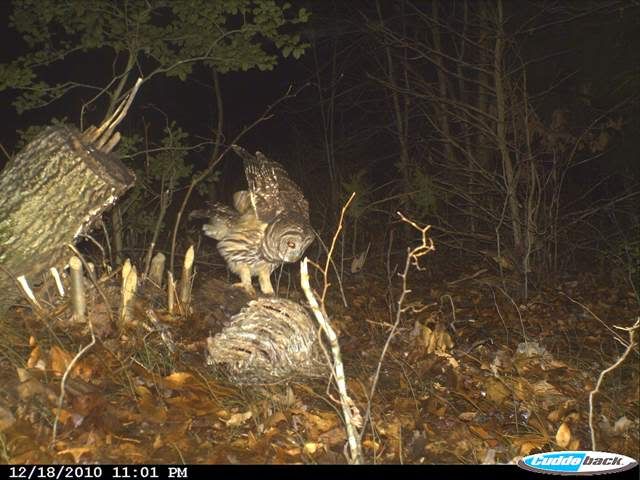
A Barred Owl (Strix varia) also stopped by (more on this later).......


...as did another Gray......


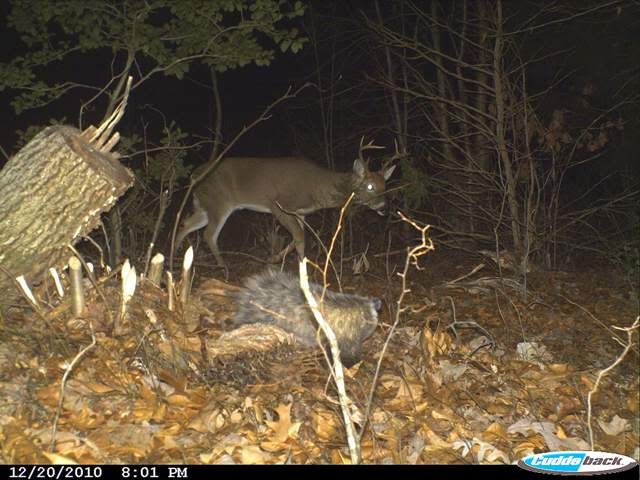
A 'possum AND a white-tailed deer....


A hawk...based on its relative commoness in the area, I'm going to guess Red-Shouldered Hawk (Buteo lineatus), but that's just a guess.


In December I caught something that is amazingly rare in the southeast: SNOW!


The one and only Racoon (Procyon lotor) captured on this camera.  Had I put this deer rib cage out in a setting closer to water....'coons would have raided it on the first night.  As it was, I only got this big old ridge runnin' raccoon to stop off for a gnaw.

A very nice Gray Fox shot in the early parts of the new year (sniffing about where I had sprayed the 'yote urine on the log)........


A deer in mid-leap....


More 'possums.....


Finally, a Gray Fox slinks past the set, but must not stick around long for this is the only picture of him on this night.


And even though I was reluctant to move the camera (I don't know why), a picture in the last batch that I looked through changed my mind.
Look close.  It's exactly what one never wants to see on their camera trap: a picture of some dude possibly checking it out from the seat of his vehicle.

So, the camera had to get moved.