The benign adventures and ponderings of a wildlife ecologist who is interested in old school, down-and-dirty field research. Not cutting edge, but occassionally forced to blaze a trail when in the outdoors.
The number of feral cats round these parts is staggering. Last year, I posted a round of mugshots from individuals skulking around the property (see here). Since that time, our local feral cat population has not appeared to decline much.
This summer we experienced an unusually long period of drought (weeks long, in fact). We don't normally feed the birds because we have a nice variety already without spending the cash on birdseed. Yet, after seeing American Robins hopping around our back porch trying to drink water from the saucers below our potted plants....we caved and put up a makeshift bird bath.
It wasn't long before Sylvester started stalking around the perimeter of the bath, watching the inhabitants. I made sure that every puddy-tat I saw got chased off...hoping to instill in them some negative association of the Pavlovian variety with our house.
Didn't seem to work, though.
A manuscript published several years ago estimated that feral cats and pet cats allowed to roam free kill roughly 1 BILLION wild birds annually in the U.S. (and this is a conservative estimate; Dauphine and Cooper 2009).
Believe it or not, I haven't seen a cat take a bird on our property (although I'm sure it happens). I have, however, obtained evidence that they get other wild prey (see below).
This one had been a constant figure on the property from last fall through early spring. But I haven't seen much of old Joe this summer and fall. He may no longer be around....although the other night as I drove up to the house I saw a kitty that looked very similar dart across the street. Might have been him.
Mr. Marmalade:
He's definitely been around since last year and was the individual I captured a picture of killing a chipmunk a year ago. He must be a wily sort. Others have come and gone since last year, but Mr. Marmalade keeps on showing up. He's the only one that I've consistently gotten pictures over the last year. Probably his coat color helps him blend in.....something useful for hunting and hiding.
Tiger
I first saw this one in early spring 2012, but he has been a permanent figure on my cameras since. I probably have more pictures of Tiger than any other feral puddy tat on-site. Although I don't think he's been around as long as Mr. Marmalade, he has staying power.
Mr. Boots
I only have one picture of Bootsie from this spring. He almost looks like a Siamese, but I haven't gotten a face-shot of him, and he's only been through once.
Misty
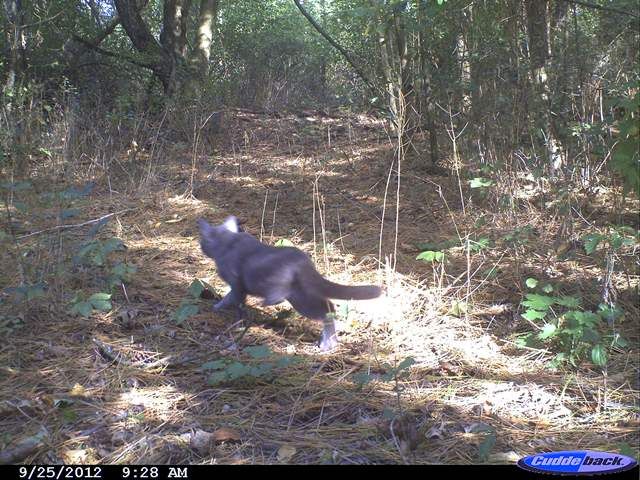
I don't think I'd seen this one until late September of this year. Yet, since that time she/he's been photographed consistently. He/She seems a bit small, so might be a juvenile.
Whiskers
Another new one from late summer 2012. Also looks on the small side, like it might be a juvenile. Since late August, he has shown up on my cameras frequently. (Note; this picture also portrays how dry it was this summer. Compare this picture to the picture taken of Mr. Boots above at the same location in May).
These are just the cats that have passed this one camera location. There are others on-site, and some that appear to have moved on.
For example:
Here Tiger is following a long haired such-n-such that I saw commonly last fall and in the early spring, but has been AWOL since.
There's also El Diablo, whom I've posted about before. He was everywhere this spring, but has been gone for months.
BUT....don't be fooled by the cutesy names. These kitties have claws! And they use them to great effect on native wildlife.
_________________________________________________________________________
What I find the most un-fathomable is that, of the literally tens of thousands of camera trap pictures and video clips generated from projects I've been involved with....I've only ever gotten pictures that definitively show predation being committed by one species:
Felis catus
No fox predation shots, no coyotes, no nothing. But I have a numerous pictures of kitties carrying a meal of native wildlife in their mouth.
There have been more acts of predation captured since that time....
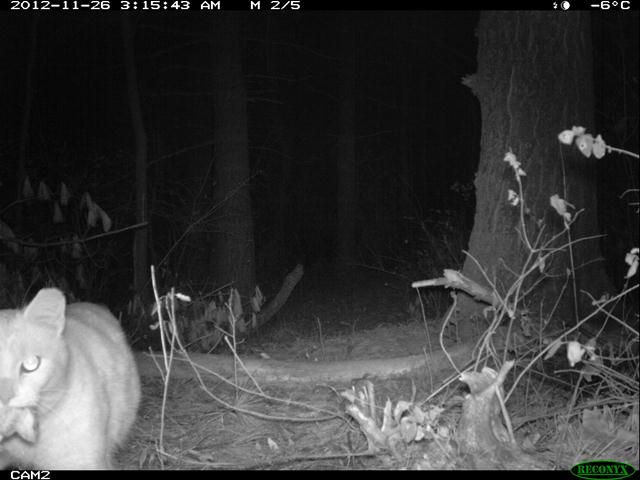
Here is a picture of Calico Joe from last fall, as he saunters by with a bit of din-din.
After zooming in a bit, you can see he's carrying something in its mouth, which is the right size for a rodent (Peromyscus is common on site).
Below is Tiger trotting home with his meal of hapless Eastern Chipmunk.
The new crop of kitties don't want to be left out either. Below is a shot of Whiskers with a mouse in tow (another Peromyscus sp.). Note the set of eyes watching him in the background. I have no idea what they are from.
Of course, we already know that Mr. Marmalade is very effective at catching wildlife. But here's another shot of him in the act again (appears to be another Peromyscus).
Whenever I'm depressed about the impacts of feral cats on native wildlife, I like to watch this clip from the Muppet Show. Rowlf sings The Cat Came Back in a way that makes me smile every time...
Dauphine and Cooper. 2009. Impacts of free-ranging domestic cats (Felis catus) on birds in the United States: a review of recent research with conservation and management recommendations. Proceedings of the Fourth International Partners in Flight Conference: Tundra to Tropics, p 205-219.
Further Reading .
Crooks and Soule, 1999. Mesopredator release and avifauna extinctions in a fragmented system. Nature 400:563-566.
Guttilla, G.A. and P. Stapp. 2010. Effects of sterilization on movements of feral cats at a wildlife-urban interface. Journal of Mammalogy 91:482-489.
Foley, et al. 2005. Analysis of the impact of trap-neuter-return programs on populations of feral cats. Journal of the American Veterinary Medical Association 227:1775-1781.
Hawkins, C.C., et al. 2004. Effects of house cats, being fed in parks, on California birds and rodents. Pgs. 164-170. In Shaw et al. (Eds.) Proceedings of the 4th International Urban Wildlife Symposium.
Lepczyk, C.A. et al. 2003. Landowners and cat predation across rural-to-urban landscapes. Biological Conservation 115:191-201.
Levy, J.K., et al. 2003. Evaluation of the effect of a long-term trap-neuter-return and adoption program on a free-roaming cat population. Journal of the American Veterinary Medical Association. 222:42-46.
Nogales, M. et al. 2004. A review of feral cat eradication on islands. Conservation Biology 18:310-317.
Risbey, D.A. et al. 2005. The impact of cats and foxes on the small vertebrate fauna of Heirisson Prong, Western Australia. II. A field experiment. Wildlife Research 27:223-235.
I was fortunate enough recently to be able to get away to northern Wisconsin for some fishing with high school buddies. The set-up available to us was spectacular: huge house on the lake with a fishing boat and pontoon boat. Also, unlimited dry firewood...a healthy supply of food and drink....and a fair amount of untouched northern forests to play in (when not fishing, of course).
I can't help but bring my cameras when I go on these kinds of trips. In fact, I did it on a different fishing trip with high school buddies at a completely different location this January.
I'm realistic when I put cameras out in these situations. I know the likelihood of actually catching things is pretty low. I typically have one or two nights to work with (assuming we reach the site on Friday with enough daylight). I also don't know the location particularly well, so may not have enough time to find the best place for a camera and have to stay close to our base camp (where I know I'm not tresspassing).
But I'm willing to risk disappointment, because there's always a chance that I'll get some Bob-tailed Cats (Lynx rufus), Fisher Cats (Martes pennanti), or....fingers crossed...Wolves (Canis lupus).
This time, I brought four cameras along. Two of the cameras went in a boggy, sphagnum and fern carpeted forest across the street from our "cabin". One was placed on the grass "driveway" used to back the fishing boats into the lake from the roadside. The fourth camera was placed along the bank of the lake not far from our fishing dock.
The latter two cameras were very close to the house. Just down a short (but steep) slope from the fire pit behind the house.
The first night, we sat up pretty late at the fire (1:30 am, to be exact) and I figured the nearby cameras were going to be complete busts.
The first few critters did little to quell my disappointment.
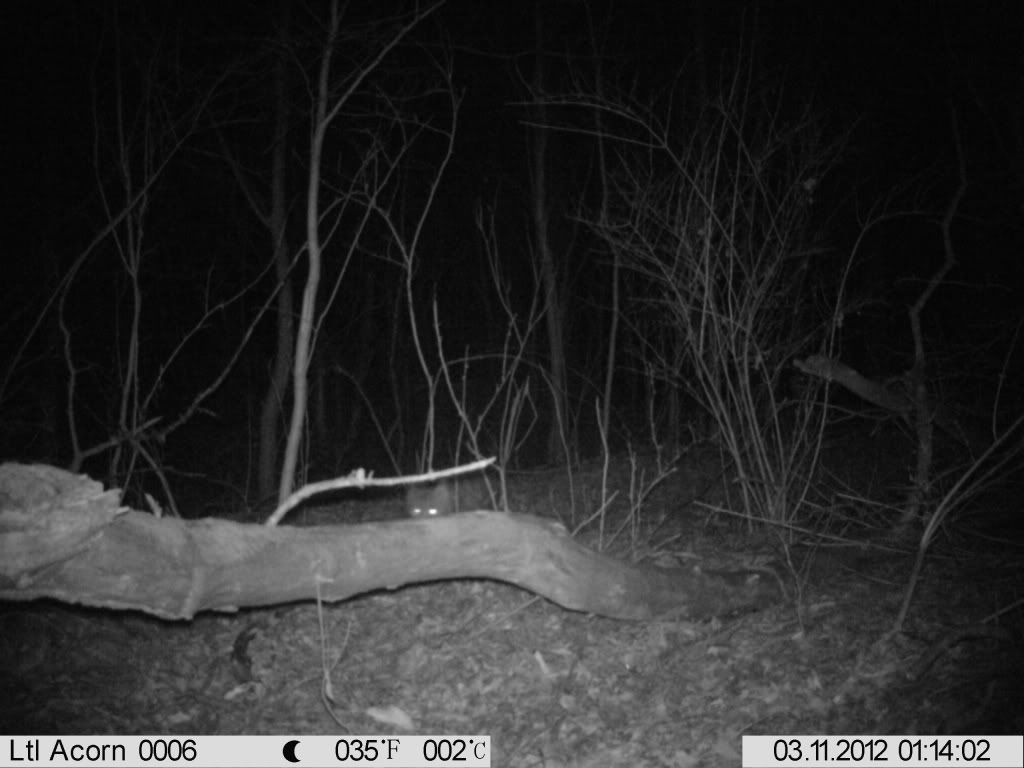
Feral Cat (grrrr...)
Eastern Cottontail (Sylvilagus floridanus)
......and a Mouse (Peromyscus sp.)
So, imagine my surprise when I saw this:
About 20 yards from where we had been making lots of noise just a few hours before!
Only my third camera trapped Bobcat (Lynx rufus)! Needless to say, I was thrilled as I had actually gotten pictures of a species on my "wish-list" for the weekend!
Bobcat densities are generally reported to be on the rise in most of the continental United States, including Wisconsin (see further discussion of this here, and in Roberts and Crimmins, 2010). Thus, I'm not surprised that Bobcats are in the area. However, although their densities are on the rise, this is usually a loner species, that naturally exists in relatively low densities in parts of its range (Anderson and Lovallo, 2003). This is particularly true of the Midwest, where densities as low as 4-6 individuals/km-squared have been reported (Berg, 1979).
The undisturbed plot of boggy woodland across the street from the cabin didn't yield Bobcats, unfortunately.
Numerous game trails.....if only I had more time to trap and more cameras to hang! I decided to help the process along with a few little remnants left-over after cleaning the fish we caught.
The first taker is actually this Blue Jay (Cyanocitta cristata). Neat to see them shredding and swallowing bits of fish flesh.
And the next visitors are what one could refer to as "the usual suspects" (but look at the size of that second one!).
At another nearby camera, baited with more fish, the Bandits again quickly zero-in on the free meal.
What's interesting about this clip is that it really shows how important the combination of scent and tactile sensation (i.e. "touch") is to a Raccoon! Watch how he runs his fore paws over that fish, really trying to get a sense of it.
We have to remember that, out in the remote north woods, there's very little light....and the IR filter is giving us the false-impression that the area is lit-up like a Christmas Tree.
Not so! It's blacker than pitch out there at night (by our standards), and although Raccoons have better low-light vision than us....being able to smell and feel a potential food item is important.
Finally, I'll leave you with a first for me (I think). It's hard to tell from these pictures and video clips....but I'm fairly certain that the cameras are picking up a Shrew. I don't know what species, but given the size....I'm going to guess the Short-tailed Shrew (Blarina brevicauda), although there are Sorex in this part of the state too.
The critter I'm referring to is in the circled location on the picture below.
See a blown up version of this circled area here....
Now, take a look at it moving around in this video clip....which may help....
Interestingly, I tried to place another camera over a bit of fish remnants along the lakeshore. Hoping for a mink, but didn't get any. However, I *think* I got a video clip of a shrew chewing on the carcass. He's close to the camera (so alittle washed out and out of focus).
His backside is facing us, which also makes it difficult to ID him. But, from this vantage we can see there's not an obvious long tail. This would also suggest the Short-tailed Shrew.
Short-tailed shrews are formidable little predators. They eat, not only many invertebrates, but will also take small vertebrates (including smaller shrews, rodents, amphibians, and small snakes; Kurta, 2005). I could find limited information that this species eats carrion, however. They are known to hoard food, so they apparently have no aversion to eating dead stuff. Jackson (1961) also reports recieving a letter from an individual whose property was apparently "overrun" with Short-tailed Shrews. He recounts throwing the carcass of a freshly killed Western Fox Snake (Elaphe vulpina = Pantherophis vulpinus) onto a refuse pile that was "shortly devoured", aside from the skin.
BTW....for those interested....the snake was dispatched for eating a fledgling Rose-breasted Grosbeak. The nerve of that snake!
Anderson, E.M., and M.J. Lovallo. 2003. Bobcat and Lynx (Lynx rufus and Lynx canadensis). Pages 758-786. In: Wild Mammals of North America: biology, management and conservation (second edition). G.A. Feldhammer et al. (editors). Johns Hopkins University Press, Baltimore.
Berg, W.E. 1979. Ecology of bobcats in northern Minnesota. Pages 55-61 In P.C. Escherich and L. Blum (eds.). Proceedings of the 1979. bobcat research conference (Science and Technology Series 6). National Wildlife Federation, Washington, DC.
Jackson, H.H.T. 1961. Mammals of Wisconsin. University of Wisconsin Press, Madison.
Kurta, A., 2005. Mammals of the Great Lakes Region (revised edition). University of Michigan Press, Ann Arbor.
Roberts, N.M. and S.M. Crimmins. 2010. Bobcat population status and management in North America: evidence of large-scale population increase. Journal of Fish and Wildlife Management 1:169-174.
This would be one of my favorite personal camera trap pictures ever, if it weren't so washed out. But...the Cuddeback at close range can't do much better than this....
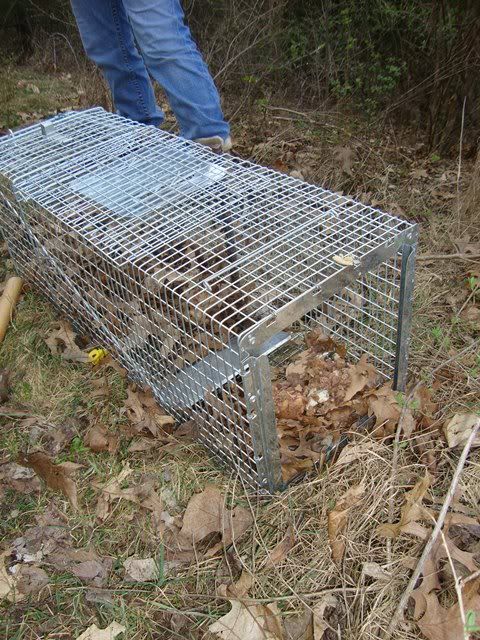
This week was basically a repeat of last week. The goal being to increase the chances of catching critters in the wire cage traps, while allowing the students a chance to further test their skills at setting traps again.... and perform maintenance on other long-term data collection projects.
So, once again the traps went out for two back-to-back days. This time, we sweetened the bait by mixing dog food, sardines, and drippings from St. Patty's Day Corned Beef and Cabbage.....pulling out all the stops.
The feral cats stayed away, which I was happy for...and we actually caught some wildlife, although not a ton.
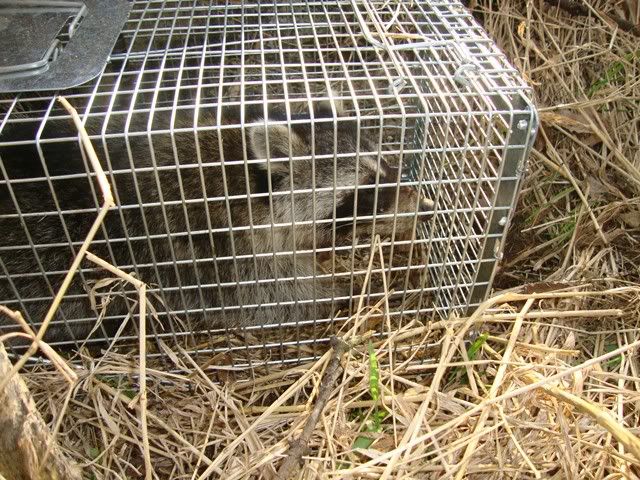
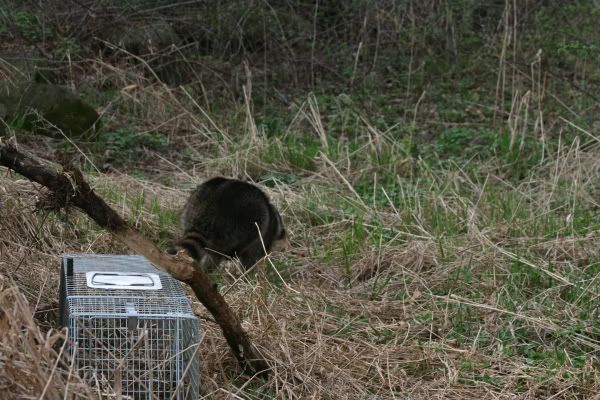
Still, one Raccoon is better than nothing!
Now....a Raccoon in a trap can go either way. Sometimes you'd think a Looney Toon-style Tazmanian Devil was in the trap.
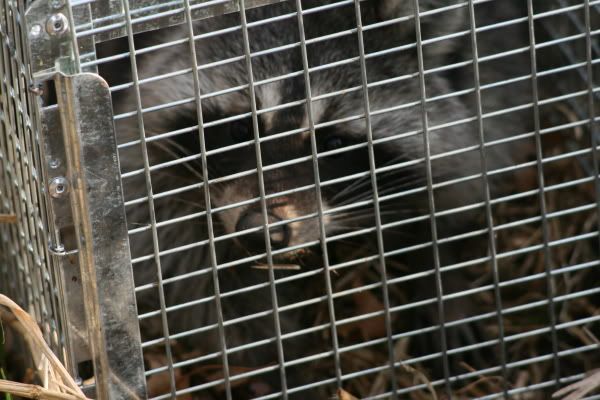
Other times, they are as docile as a kitten.
Photo by J. Scherer
This individual was actually fast asleep when we walked up to the trap in the morning, his belly full of dog food and sardines. I joked with my students that, becuase he was a 'coon living in a suburban/rural mosaic landscape, he probably gets trapped and relocated once a month, so knows the drill.
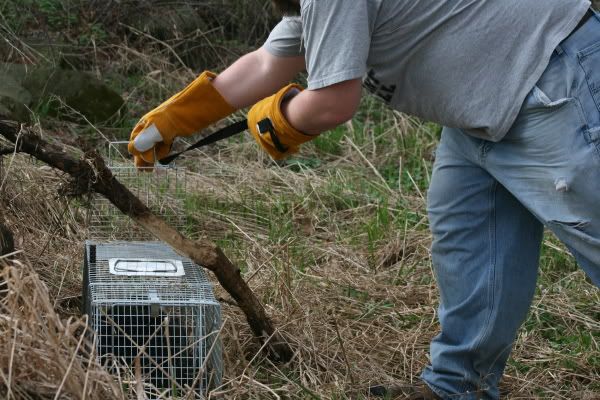
Regardless, approaching with caution is always important (those deft little paws can reach through some pretty tight places). With the threat of rabies (a serious issue with Raccoons), kevlar gloves are warranted.
Photo by J. Scherer
But, if everything goes as planned, the bandit is gone before you have a chance to think about what might happen.....
Photo by J. Scherer
Also, plenty of stuff on the camera traps. A smattering of examples includes....
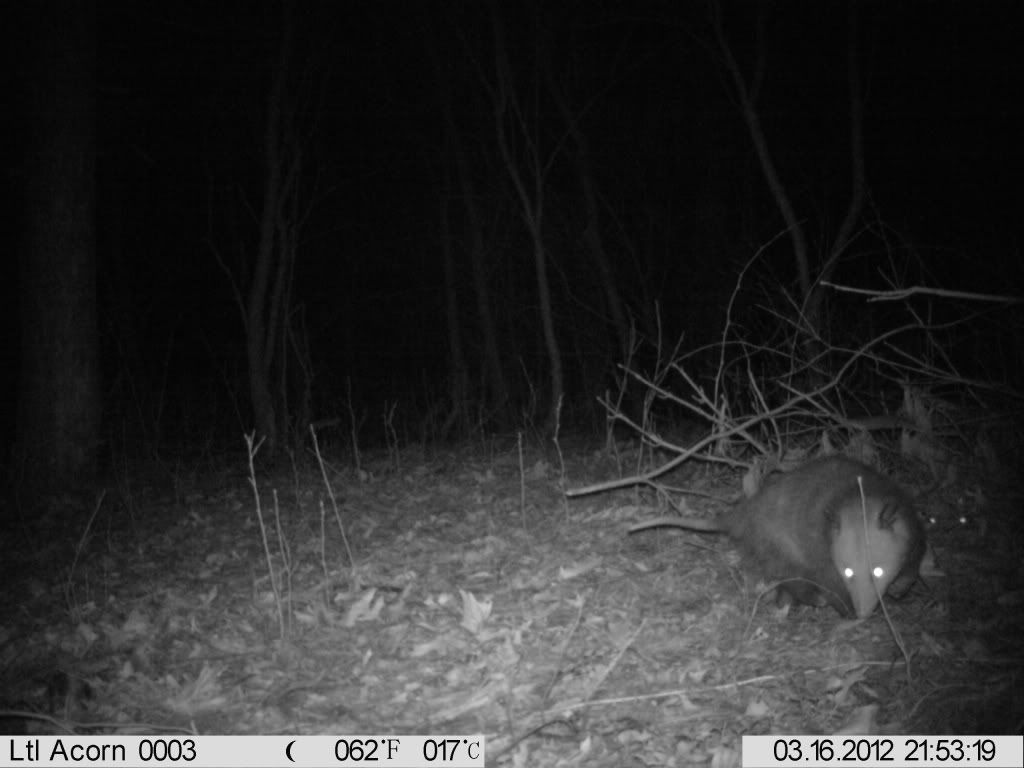
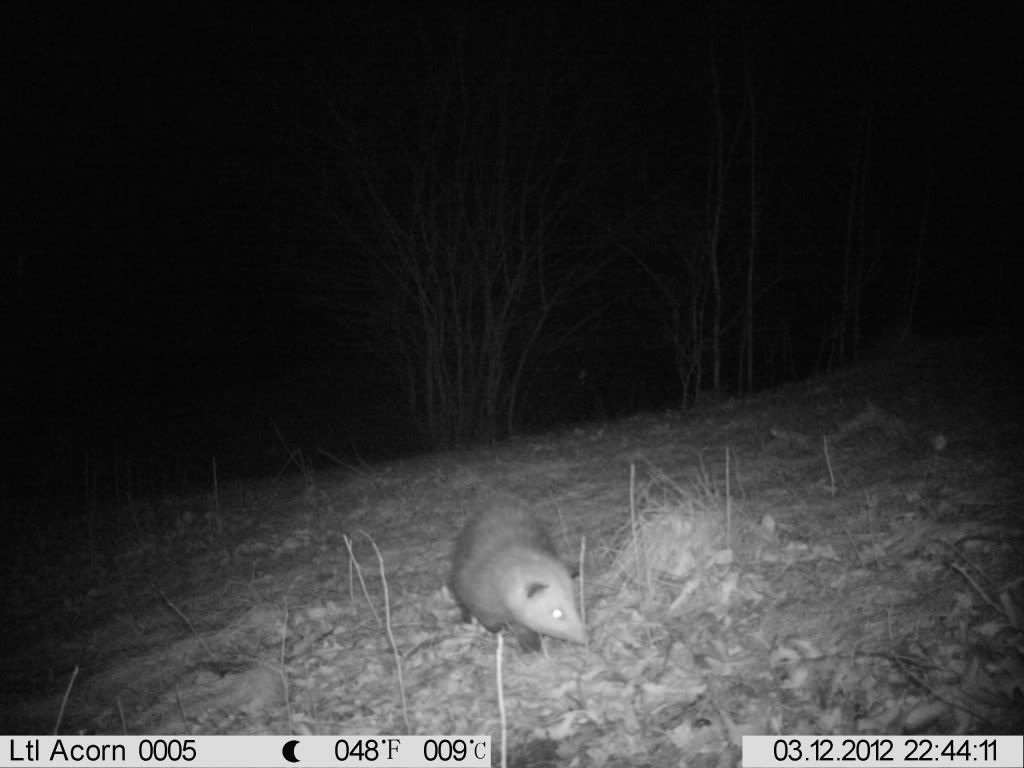
'Possum...
Blue Jay (Cyanocitta cristata)
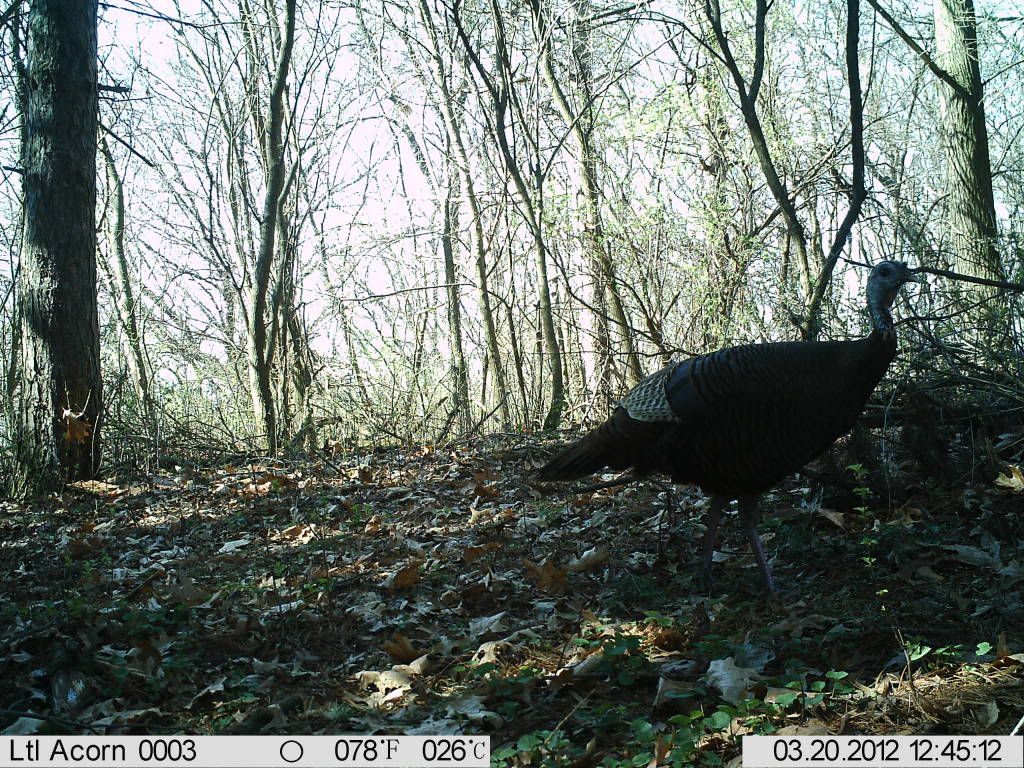
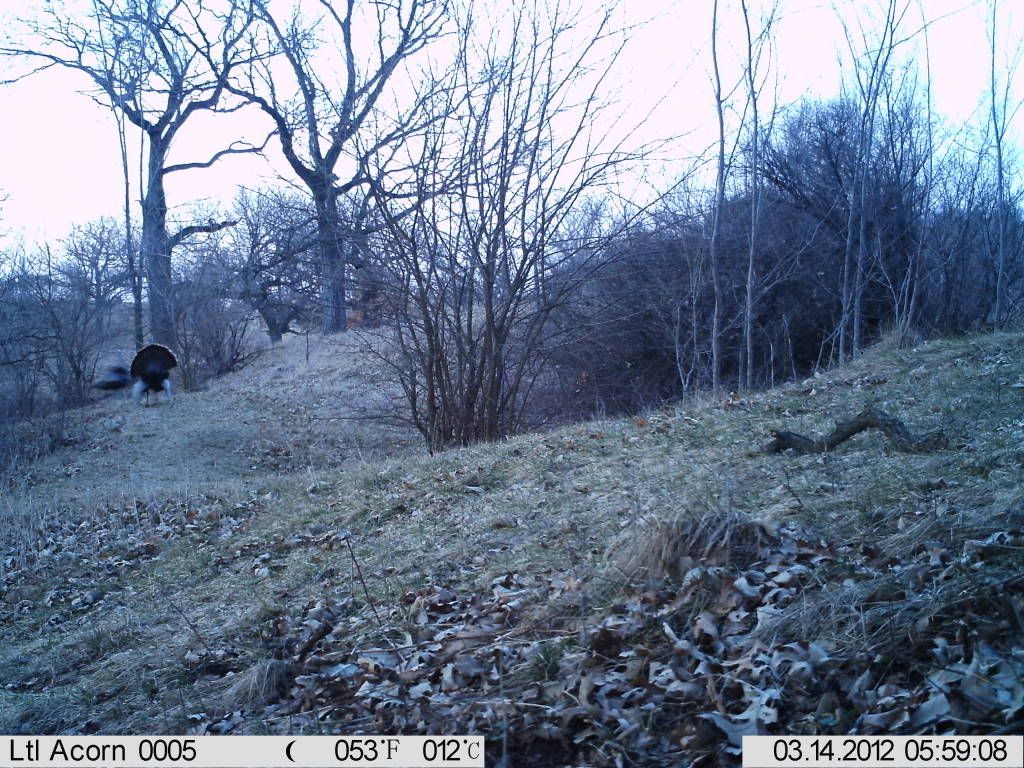
Walkin' Bird (Meleagris gallopavo)
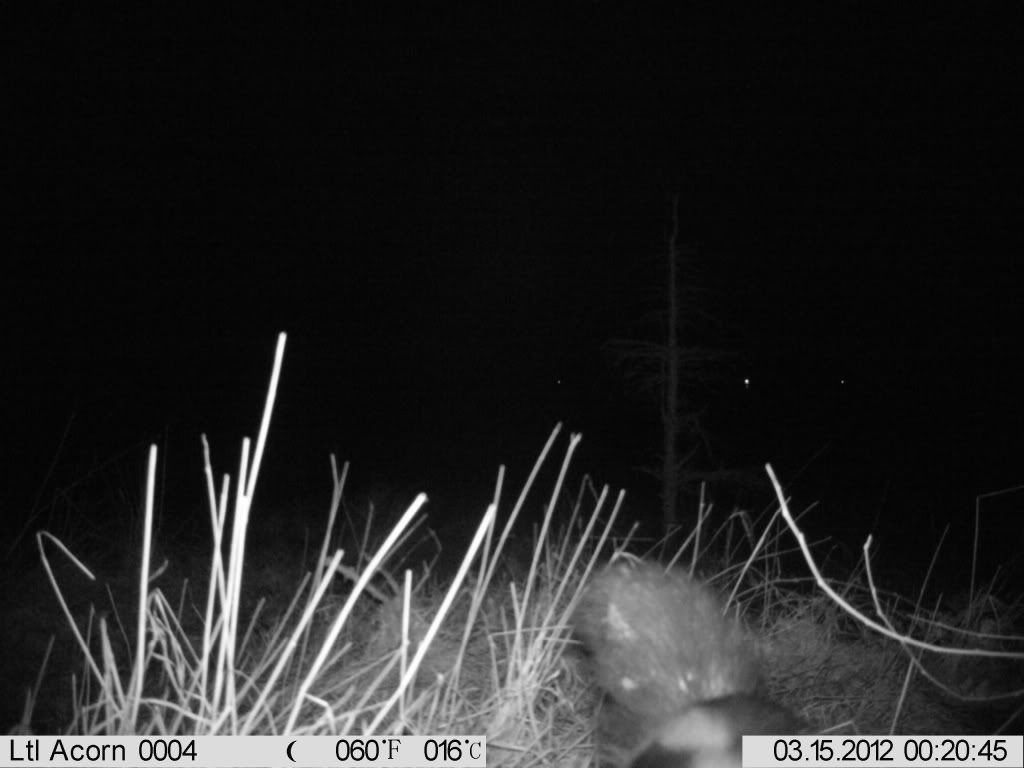
Stinker (Mephitis mephitis)
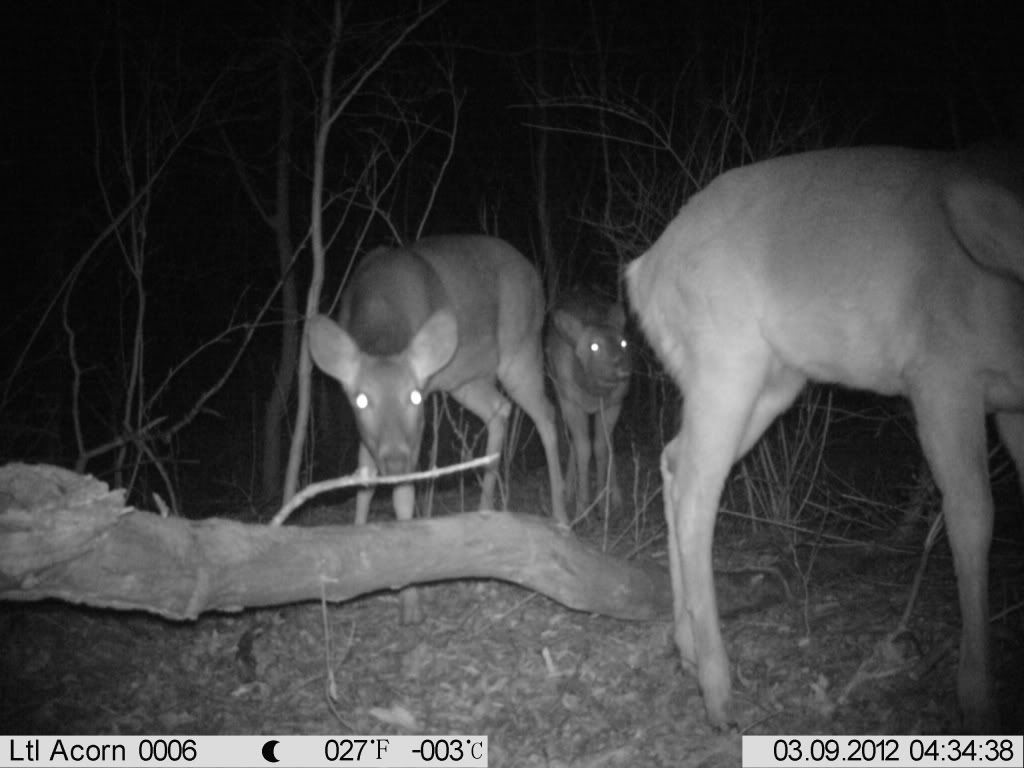
Deer....
One of the minions of El Diablo....
We also had one of our most productive canine weeks on the camera traps.
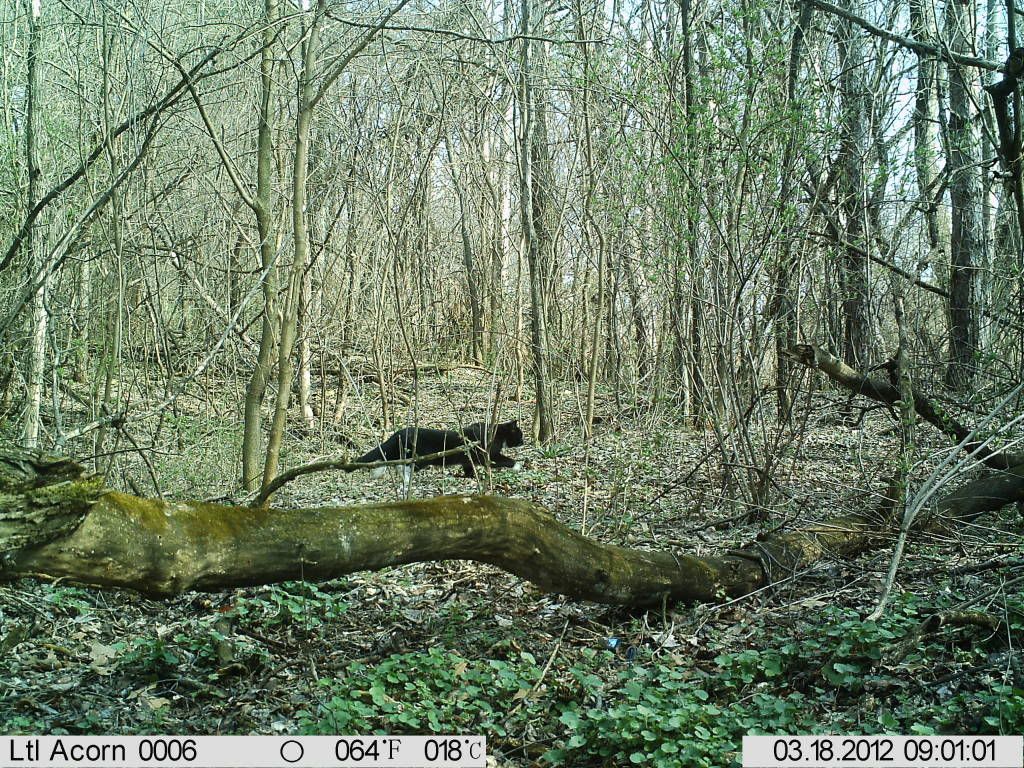
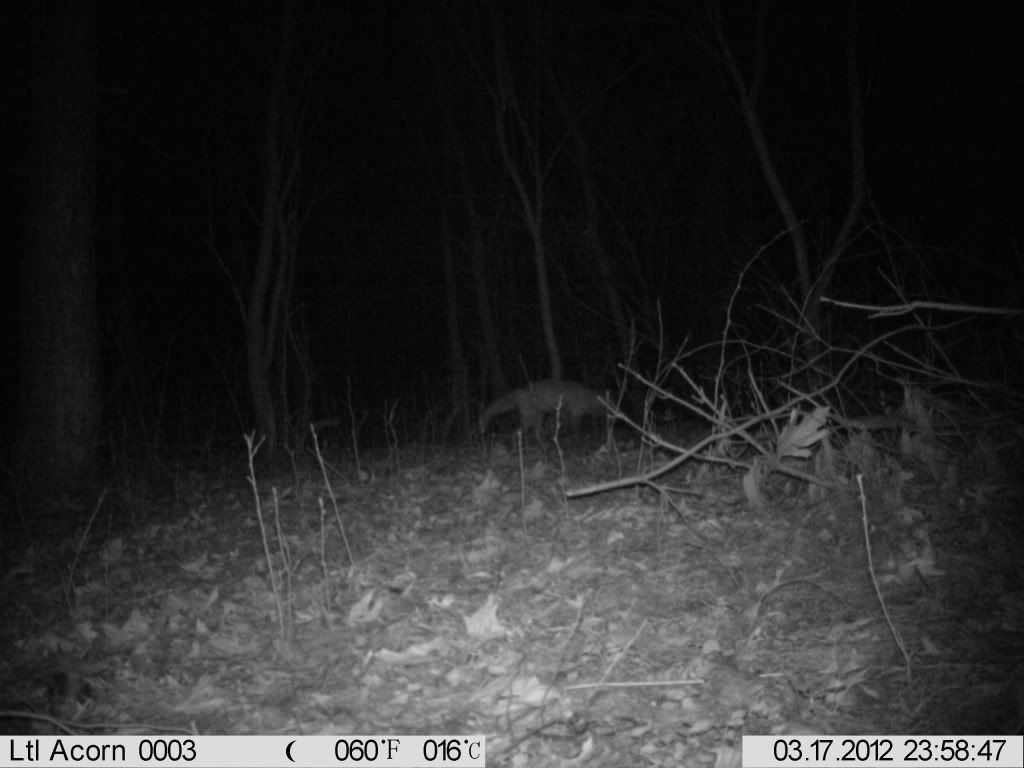
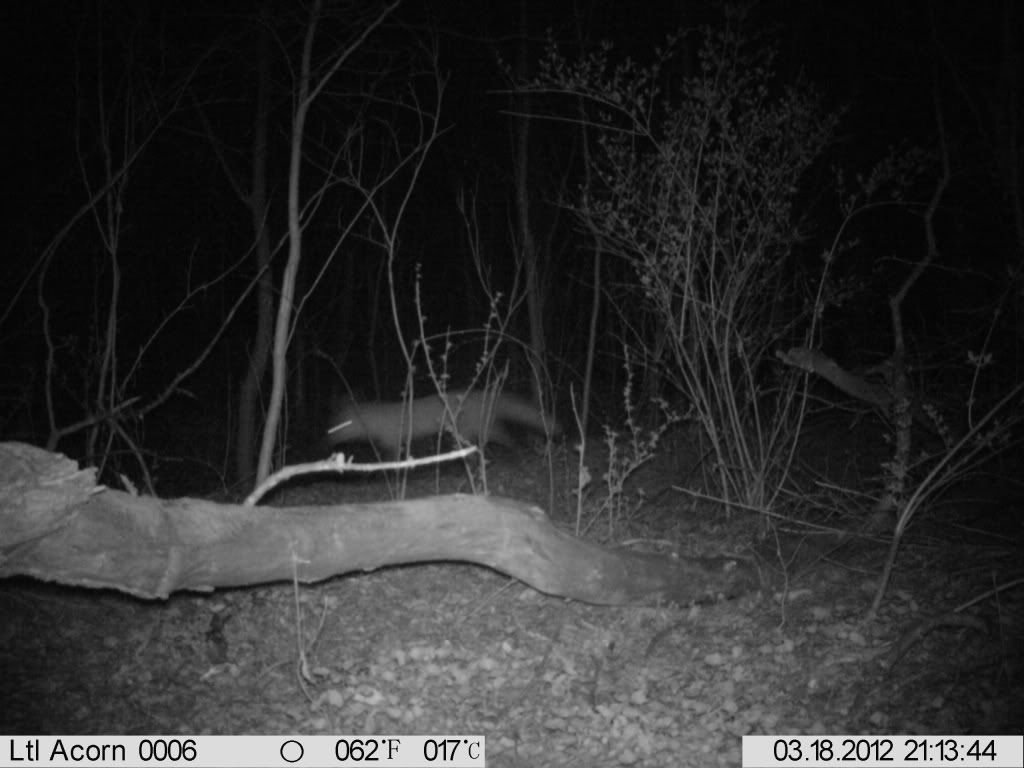
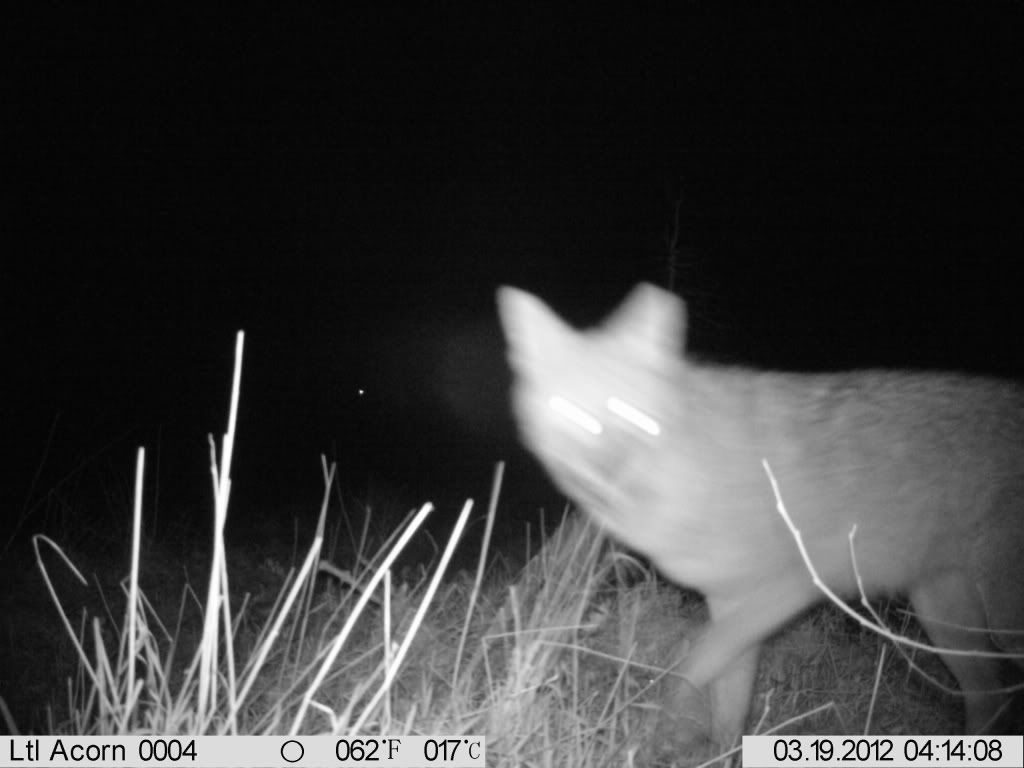
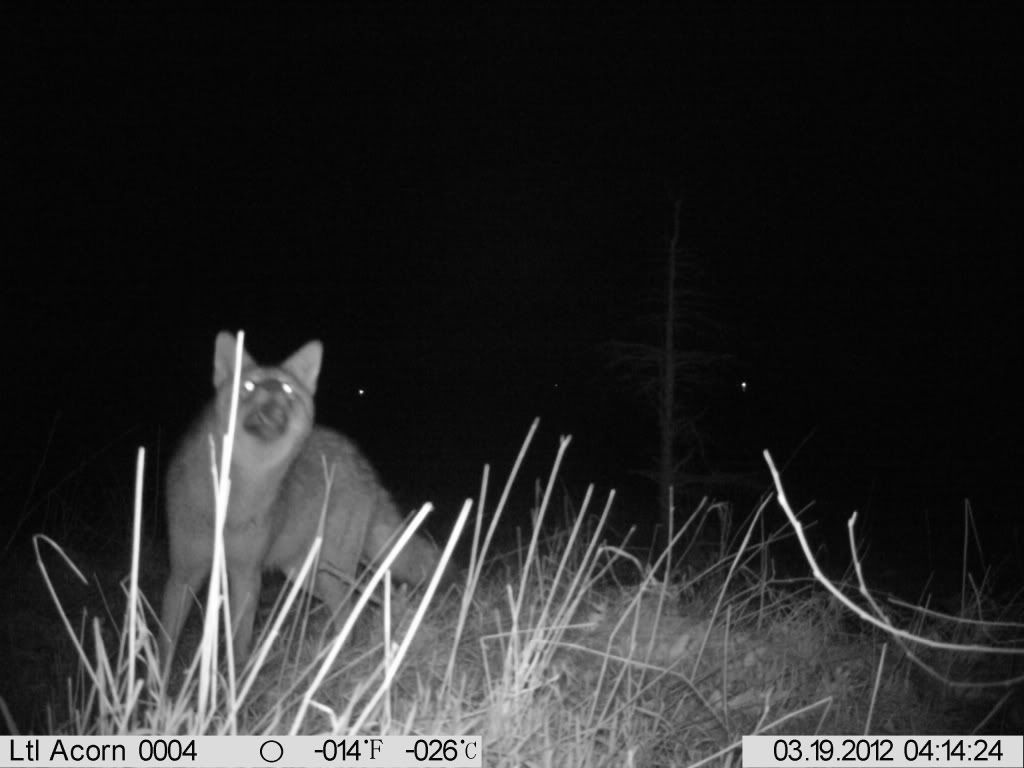
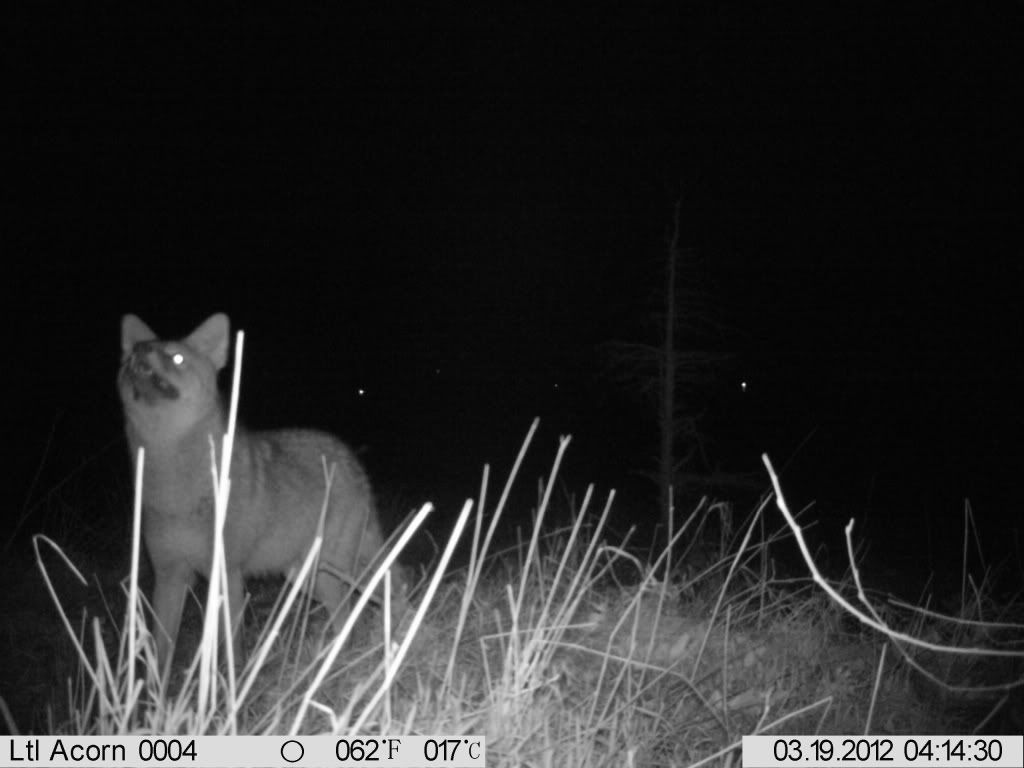
First, The Tod was all over the site (including the picture at the top)....unfortunately, none of these pictures are all that great. The video clip is sort of cool though.......
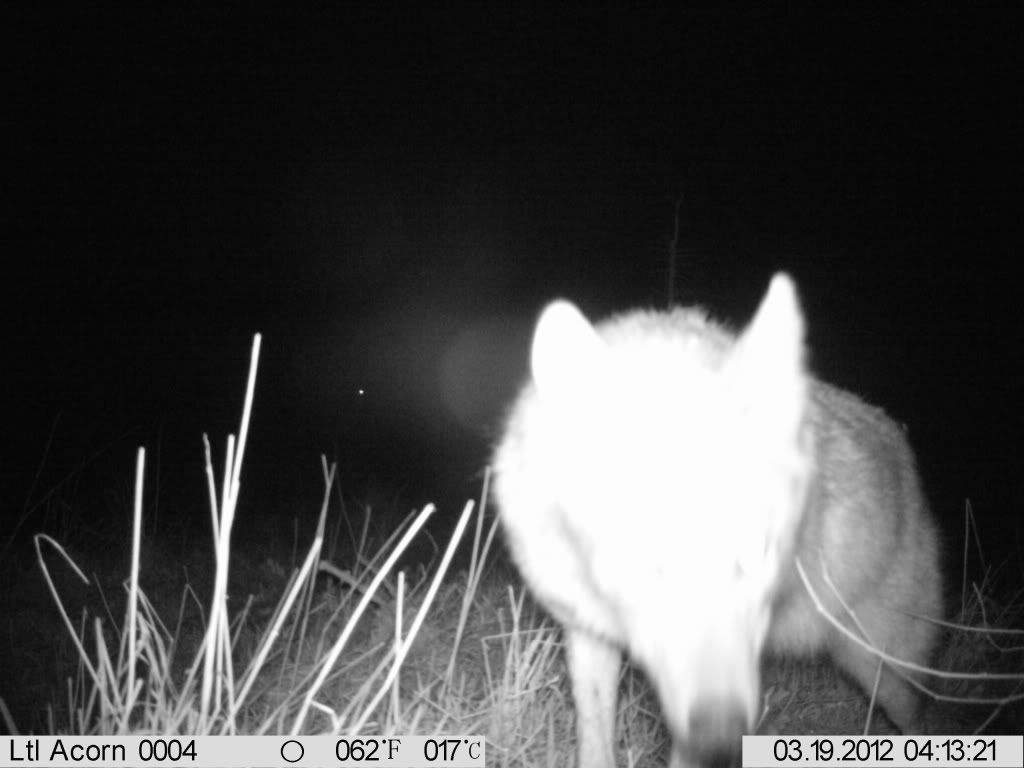
Finally, we got some close up shots of a 'yote on-site. This camera is the one the students mounted on the tree near the location of the rabbit burrow that had been dug up by a canine of some kind (see here). This 'yote is attracted to the spot....but the red LED's must give him a start. As I've posted before, they are incredibly wary of the red LEDs, for some reason.
Then, he puts his nose to work from a slightly safer distance....
The canine pics are often blurry. They are just too skittish to hold still for very long!
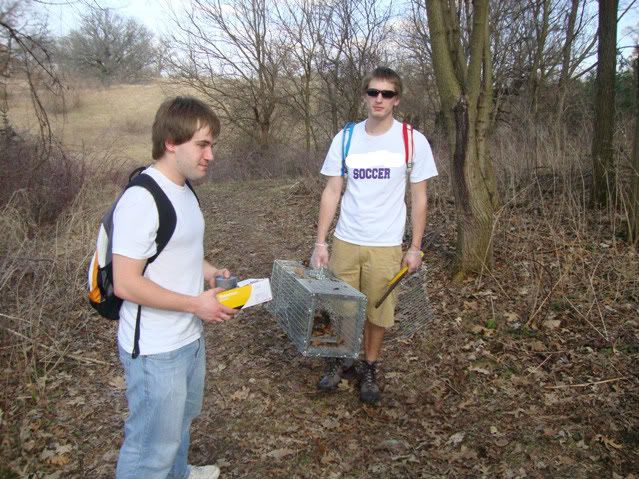
This week in lab, we added another element to our site assessment: mammal trapping with wire cage traps. Admittedly, wire cage traps are very hit-or-miss in their success. You typically have to either (a) riddle a site with many traps or (b) get pretty lucky. Generally speaking, canines are just too dang smart for cage traps. You really need leg-hold traps to have good success there, but leg-holds require a substantial amount of skill (and equipment) that I just don't have. They also put students in too close of contact with potentially dangerous/diseased critters at this point in their careers. As it stands, I had decided I would be the only one releasing animals from the cage traps, despite the fact that this exercise is quite a bit safer than releasing them from leg-holds.
Of course, the success of a cage trap also involves picking good locations. Using the right bait is another important consideration. But, the best bait in the world wont matter if the critters don't happen to walk by (which is the reason why lots of traps helps). Unfortunately, during year 1 of this course, the budget for lots of cage traps was limited by the budget for lots of camera traps. So, we'll have to add more cages in the future.
As it stood this time, we had four.
Not great, but every student group got to test their skills at setting them, and they were active for two trap-nights. With the very high numbers of raccoons, opposums and skunks on-site....I figured we'd get something.
So, we went about setting traps late afternoon on day 1. Personal scent control helps, but can be difficult to achieve with students....who often come to any and every group function (including lab) fully perfumed and cologned, with hair products to-boot. At the very least, I make them wear rubber gloves when handling the gear....I tell them not to let the cages touch their legs as they walk, if possible....and mention they should make an effort not to drip sweat in the vacinity of the trap set (a problem that, in truth, only afflicts their overweight professor). In reality, human scent is probably not a huge deterrent for things like Raccoons and Opossums anyways, but thinking about scent control is a good habit to maintain for trapping.
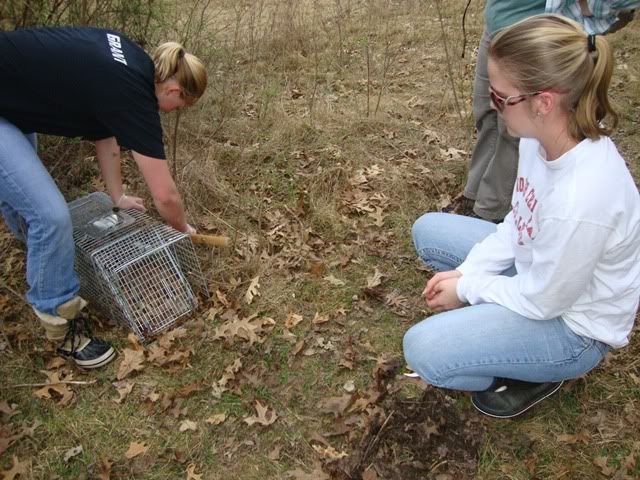
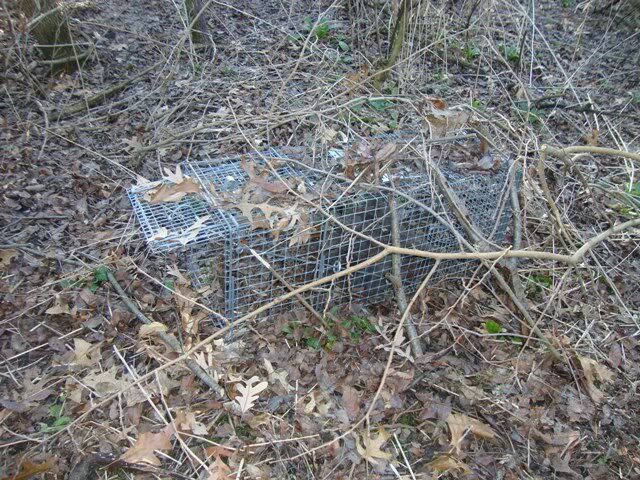
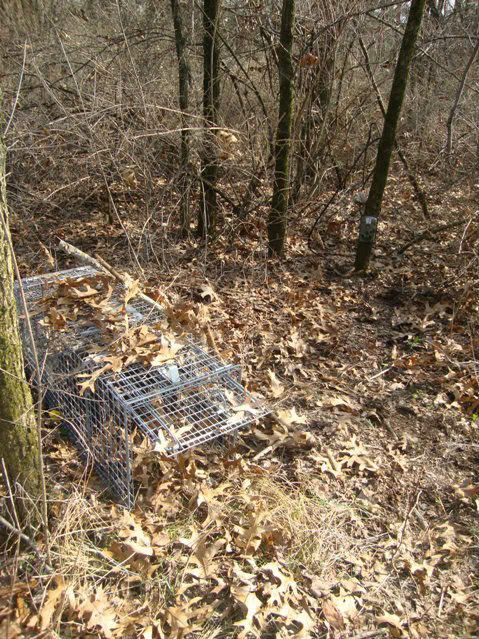
I generally have greater success when I've placed debris along the bottom of the trap, to hide the wire cage. When critters feel that wire, some of them back-off. One has to be careful not to allow debris to get under the trip-plate, so the mechanism continues to work. I'll often place a bit of wool or alpaca fiber on the trip-plate to hide it (and provide insulation for the critter, should it get cold out). I also like to put some debris (logs, sticks, etc.) around the cage to make it feel more secure, and put it near a natural shelter (a tree, thicket, fallen log, etc.). This must be done with caution, however. With all the skunks we've been getting photos of on-site, you have to have a clear path to walk up to the cage with the tarp protecting you. Having to pull a bunch of logs, etc. off of the cage could upset little Pepe, and result in a face-full of glandular odorant.
Bait this time was turkey-flavored cat food. It was cheap and I was in a rush, but that bait may have been a fatal flaw. Next time I'll go with a sardines and bacon grease mix, if I can find the time to make the concotion. We also applied a tiny bit of one of two scent lures (one was a shellfish oil based lure, the other a canine gland lure).
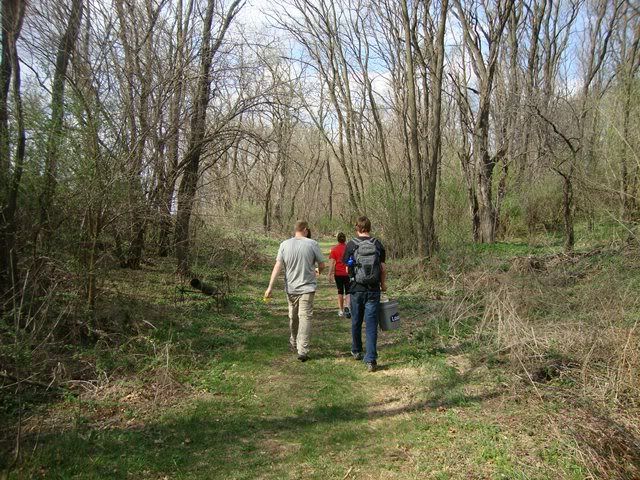
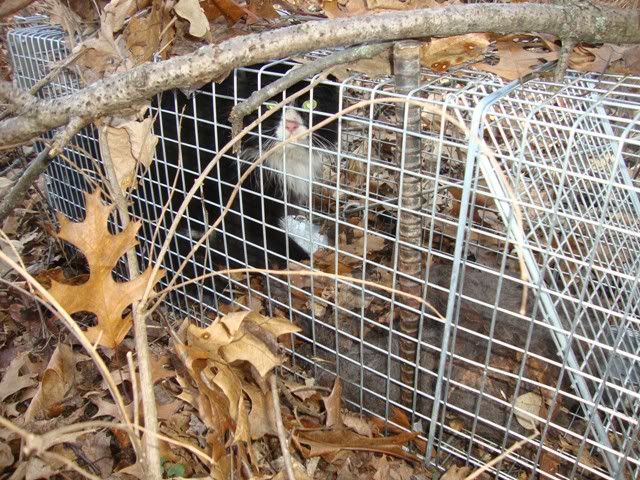
ANYHOO.....the next day, we marched out to the site....kevlar gloves, ketch-all pole and skunk tarp in-hand only to find:
Grrrr..........released with much cursing under my breath at the waste of bait.
The bait in the other traps was undisturbed.
We moved the traps to new locations....but by morning on day 2 we found that not even a feral cat was stirring. This time, however, just to see if it was lack of passersby OR critters being spooked by the cage, I had put a camera over one of the traps (set to video mode). During the 24 period anyways, nothing wandered by.
Above: note camera on the tree in the background.
More evidence that a greater number of traps would increase success rate.
Not as riveting as I would have hoped....but, as Sinatra would say:
Regardless, we did get some cool stuff on our cameras over the past week (you may remember that we moved these about a week ago).
It's the same cast of characters, basically. But that doesn't keep the students (and myself) from being excited that the locations they picked paid off!
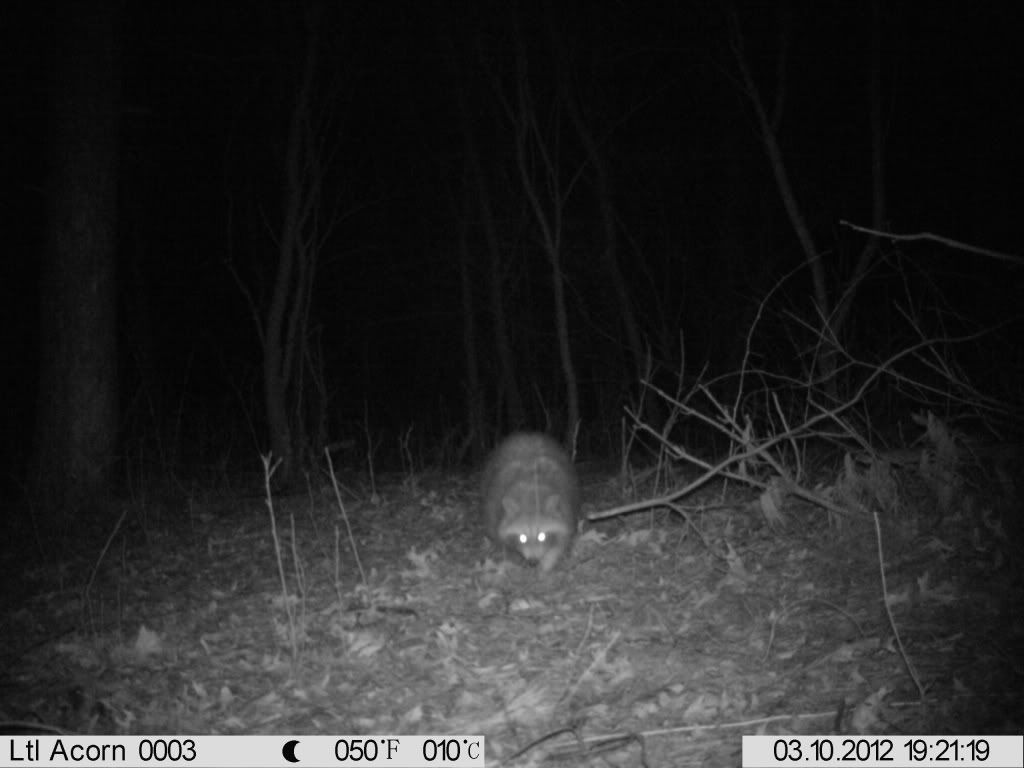
Raccoons are literally everywhere out there now. We caught pics of them on all of the cameras, I think.
'Possums are less common, but still prevalent.....
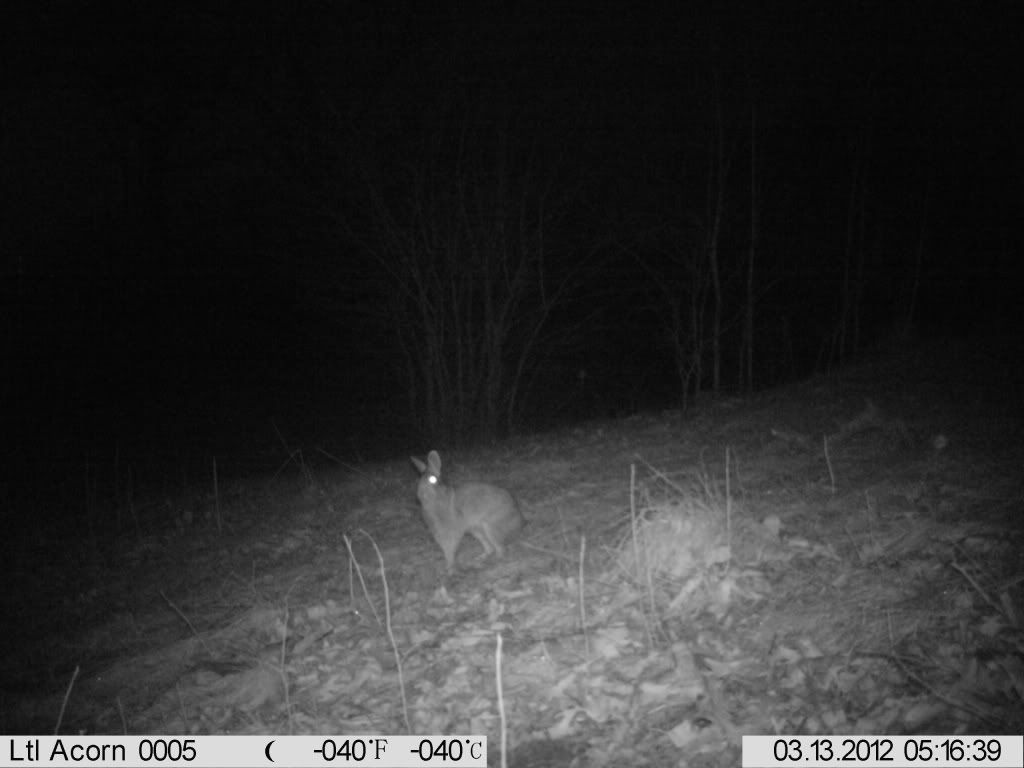
Cottontails, too, have become very active (the rather side-long glance this one is giving the camera made me laugh).
Stinkers are in no short supply....
And, of course, there are deer...deer...deer and more deer. There are now also deer TICKS that have popped out of every crack and crevice in the woods with the warm weather, a minor annoyance during field work.
We also got a neat shot of a male walkin' bird showing off the goods to a nearby hen (left side of the frame).