Showing posts with label Fawns. Show all posts

Wednesday, July 3, 2013

Baby Stinkers, Sibling Rivalries, and a 'Yote in Summer Coat

As with last year, wildlife offspring are starting to show up frequently on the camera traps.

This year, "Skunk" has been the word in baby critters.

Here a momma with a bunch of tag-a-longs shuffle by the camera (I count six baby tails).

Not long after, two baby skunks (Mephitis mephitis) whom are likely siblings start to get after eachother.  There's nothing funnier to me than watching these little puff-balls tumble around in front of the camera.


I've posted similar incidences of sibling rivalries last year, albeit with Raccoons (Procyon lotor)....see here, here and here....

Now that I mention Raccoons.....where are the Raccoon babies this year on my sites?  Last year, there was a momma with at least five offspring all over the same site where I got the skunk babies this year.

We shall see.....


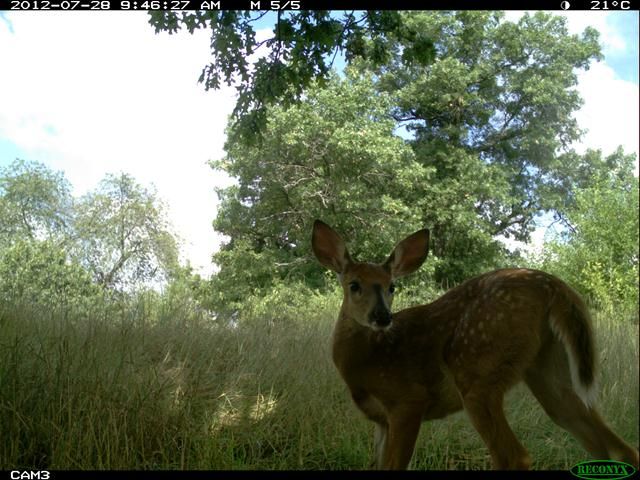
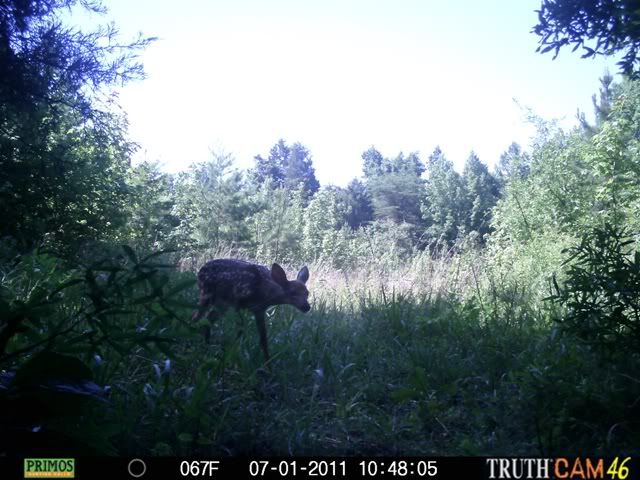
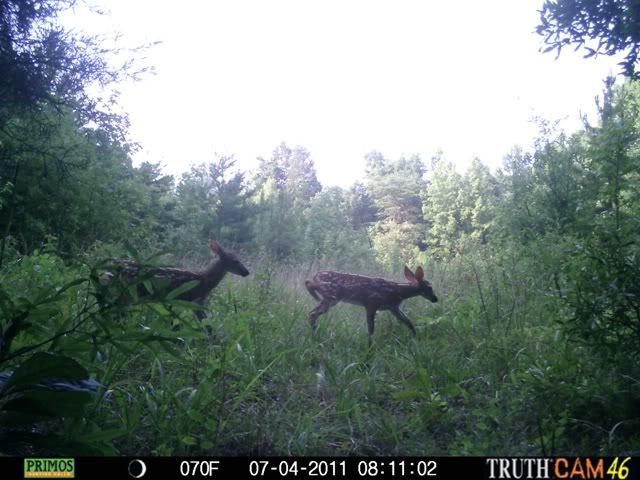
I saw my first fawn of the year back on May 19th....but didn't get my first on a camera trap until recently.

Another random event.....this appears to be a Great Crested Flycatcher (Myiarchus crinitus).  See the tuft of feather on the crown (top of the head), the yellow belly and the brownish tail feathers.  This species is fairly common 'round here....but a first on the camera trap for me.  Interesting tid-bit about this species, their nests apparently almost always contain snake skins (or strips of plastic that might resemble a snake skin).


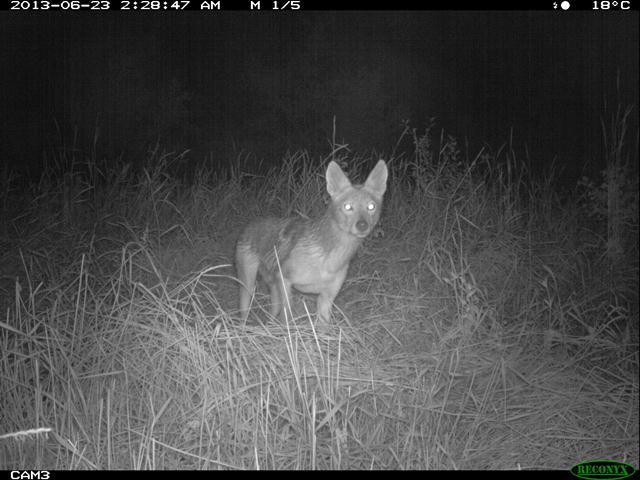
Finally, some very nice shots of a 'Yote (Canis latrans) in summer coat.  They look much different now than they look in the winter (especially considering this one is soaking wet and looks even more scraggly).  But I love those ears! 
 
 
I don't get too many pictures of 'yotes at this site, so I'm always happy when I'm lucky enough to get one coming through.

Saturday, September 8, 2012

What Spooked the White-tails?

Deer tend to mill about in front of my cameras with some complacency.  I typically get video clip after video clip of them wandering in circles and grazing (especially the fawns).

So when I saw this clip, it surprised me a tad.  This fawn is clearly on the alert....head up, looking around, ears swivelling, nose working.

I was even more surprised to see her and momma suddently bolt in a subsequent clip....

Why did they bolt?

About two minutes later, the reason(s) trotted into view. 

But when something just doesn't feel right....even these two are gone in a heartbeat.

Tuesday, August 28, 2012

Your Weekly Fawn: A Late Arrival?

This fawn looks pretty small and/or young for this time of year.


Contrast this with another fawn at this same site almost a month ago...

Friday, August 17, 2012

Your Weekly Fawn AND STILL MORE Wildlife Babies.....

This year's offspring are growing.

First, one of the many fawns active at my research sites......

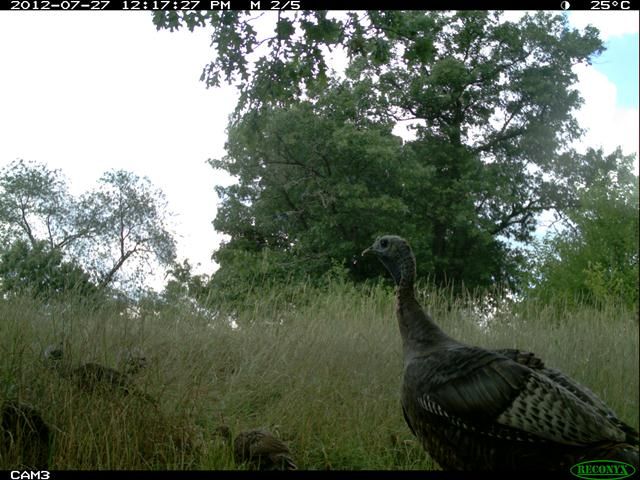
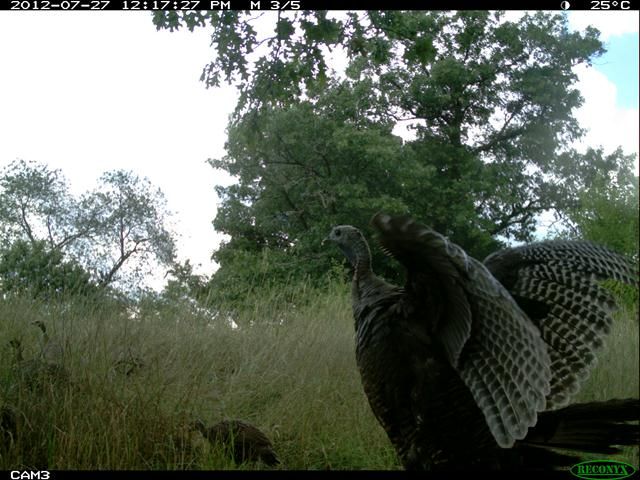
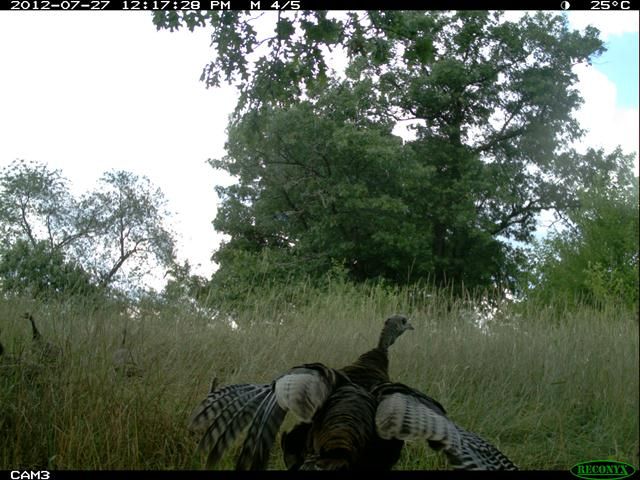
Then, a first for me this year, a picture of a momma walkin' bird with poults....

And...of course....Raccoons.  I know I post alot of clips of Raccoons, but they provide so much entertainment (especially for video footage).  They never sit still, engage in interesting behavior, and are super abundant!

Below, a momma with five juveniles at a completely different site than the one I have posted on before (see here, and here).

....sometimes the youngsters play alittle too rough with momma.....

Saturday, August 4, 2012

Plagued!

The biting flies have been horrendous at several of my study sites this year.  I'm typically mobbed by them every time I go out to check on my camera traps. 

You may imagine that if it's bad for us, it must be worse for resident wildlife that can't just jump in a vehicle to escape the swarms.

It should come as no surprise that they about loose their minds trying to keep these swarms at bay.

So...this is obviously a nuisance for these critters.

Now, imagine how it must impede their ability to sense danger.

Below is a video clip of a fawn at night....when the flies aren't as bad.  He or She is able to be on the alert for danger...ears swivelling....head up....always devoting attention to the search for potential threats.

Now, take a look at a fawn (perhaps the same fawn) at this site during the day.  Note that almost no time is spent scanning for predators, etc., as the flies are taking up most of of the fawn's energy and attention.


It's a rough world out there......

Tuesday, July 17, 2012

Herpin' The Upper Midwest, Day 2: The Prairie

Continuing with my series of posts regarding Dave's visit in May, it's time to tell you all about the second trip we embarked upon.

The Prairie

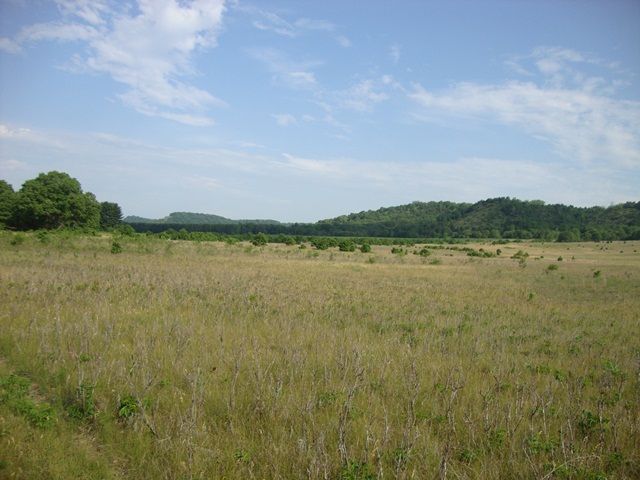
The prairies of the upper Midwest are near and dear to my heart.  I spent a fair amount of time in this type of habitat during graduate school and I remember my time with fondness.  Thus, no herping trip to our area would be complete without checking out the praries.  A group of students taking a herpetology course with a colleague of mine at a nearby university also joined us on this trip.  The more eyes the better, for catching critters....


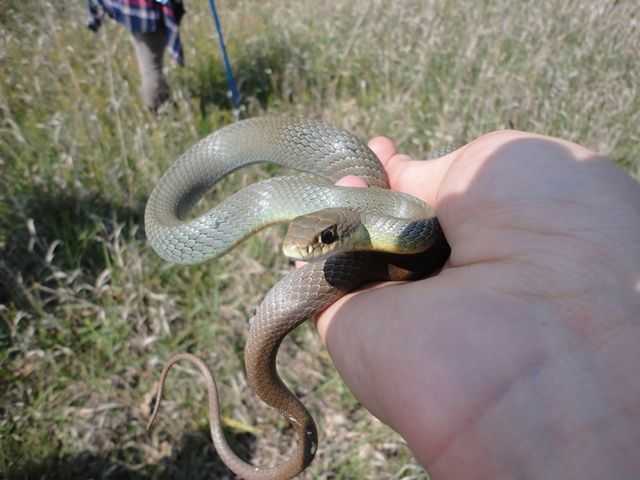
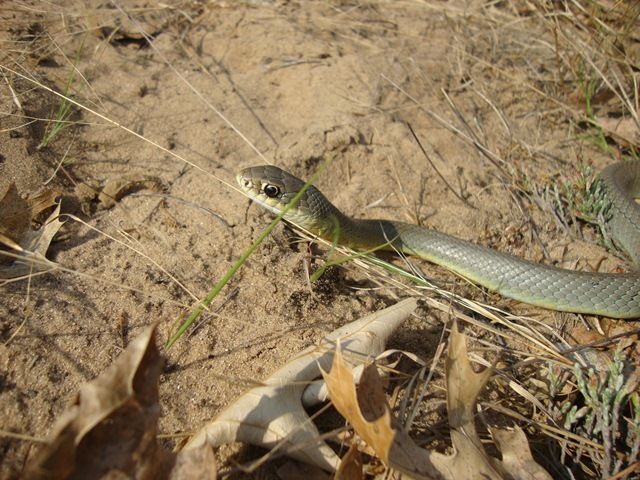
Our first encounter was a rare species in our neck of the woods, but one that is relatively common at this site: the Racer (Coluber constrictor).

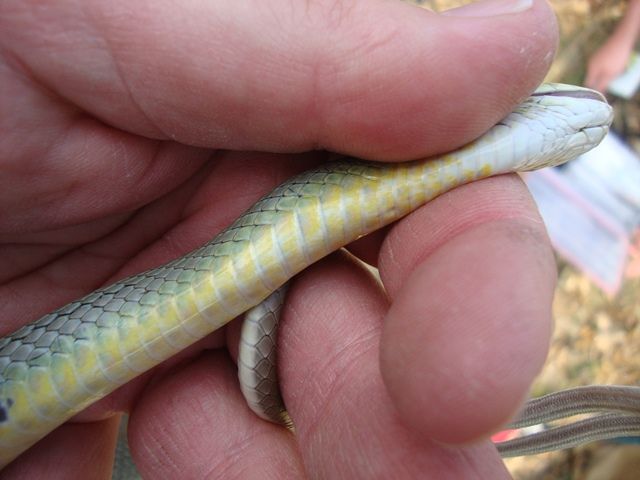
The distribution of this species is broad, ranging from the midwest to the eastern U.S.  Across this geographic area, Coluber constrictor is divided into sub-species that are delineated by location.  For example, back in NC we frequently dealt with the Southern Black Racer (Coluber constrictor priapus), which appears much different than the critter in the upper Midwest (see pics in this post).  Here we get the Eastern Yellow-Bellied Racer (Coluber constrictor flaviventris).

The common name (yellow-bellied) is apt.....

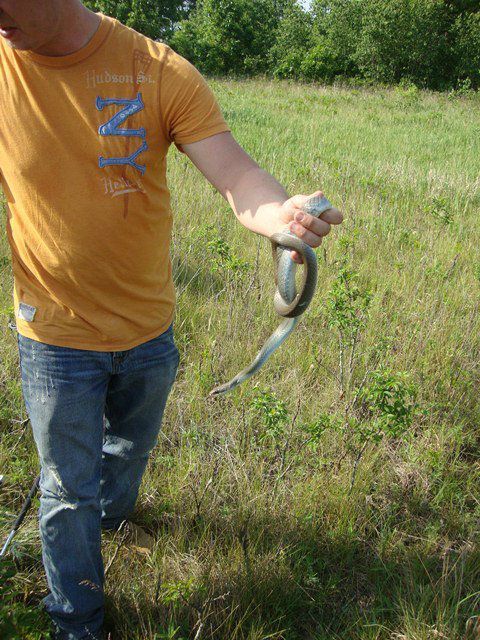
This is a quick-moving, sleek snake that is always a treat to find (and even more fun to try and catch!).

Although they don't get as large, overall, as the Black Racer, these Yellow-Bellied Racers can still get to a respectable size.....
_______________________________________________________________
Another species that we hoped to encounter was the Ornate Box Turtle (Terrapene ornata).  This incredibly rare species is hard to come by.  Collectors decimated their populations in this region during the 70s, 80s and early 90s....which is an absolute shame.  I've made this comment before in other posts, but it staggers me that someone would take a critter like this from the wild (where it rightfully belongs, not only for its own well-being but also so that it is available for others to appreciate) and hide it away in a glass terrarium.

Unfortunately, a combination of collecting, habitat loss and incredibly slow development and low reproductive output have put this species behind the 8-ball.

As such, I didn't know if we'd see one.

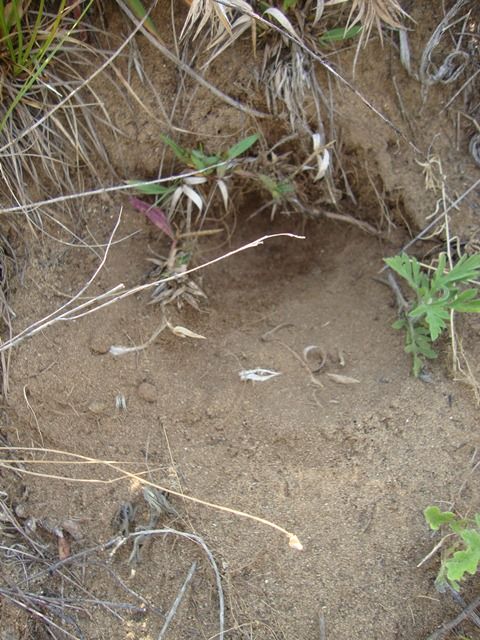
At first we saw only the evidence that box turtles were moving about, including some "divets" or "forms" dug into the soil by box turtles attempting to escape the heat, or hunker down for the night.

However, not far from the "forms".....success!!  A nice adult female resting among the Prickly Pear Cactus.


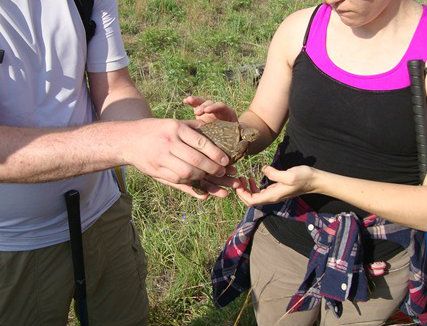
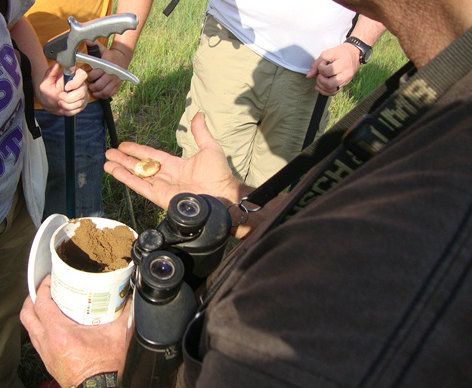
We were also fortunate enough to encounter some of the local box turtle stewards for this site, who were collecting box turtle eggs for a long-term head-starting program.  The goal of this program is to find the nests of wild box turtles....bring their eggs into captivity and incubate them.  This eliminates the potential for mortality due to mesocarnivores, such as Raccoons, Skunks and Oppossums which find turtle eggs to be quite a delicacy.  Once the turtles hatch, they are released on-site at the locaion where their nest was first encountered.

So, we were fortunate enough to get a glimpse of some recently excavated turtle eggs!

______________________________________________________________________
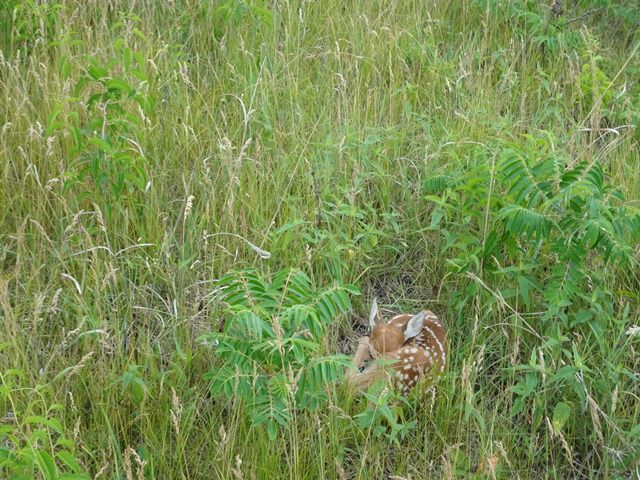
The warm-blooded critters were giving us a show as well.  We happened across this young White-tailed Deer (Odocoileus virginianus) fawn.  The group was within a few meters before noticing it.  Even in this short grass, the tactic of freezing in place is very effective to avoid detection from we visually-oriented primates.

Sometimes they refuse to actually give in and make a break for it........
Photo by D. M.

Prairie plants are another a great reason to get out in May and do some hiking.  Many of my favorite late spring species were in bloom, such as the Spiderwort (Tradescantia sp.).

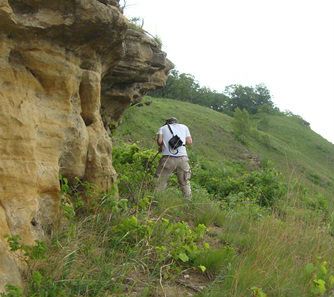
We also checked out a nearby rock formation for one of my favorite herp species in this region....the Bullsnake (Pituophis catenifer sayi). 

While poking around, Dave managed to scare up a nesting pair of birds (his cat-like reflexes saved him from a scalping)....

Unfortunately, of the Bullsnakes, all we saw was this cast-off skin....

_____________________________________________________________________
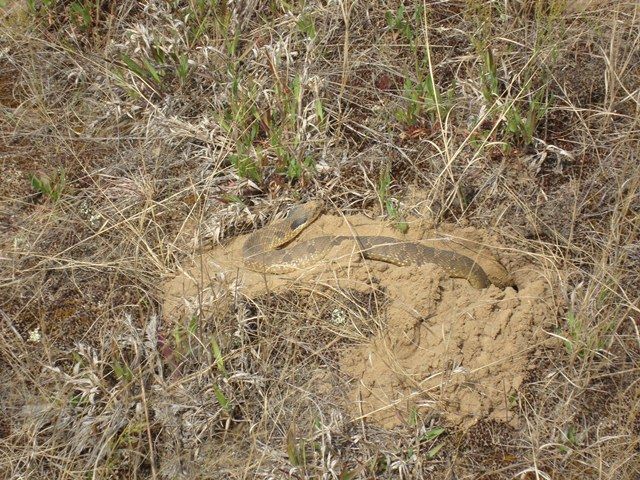
But, Bullsnakes and Racers are not the only snakes present on-site!  We came across this busy little gal as we walked over the sandy terrain: an Eastern Hognose Snake (Heterodon platyrhinos).  She was carefully excavating a burrow to deposit her eggs.

We disturbed her, which wasn't very nice, I suppose...but she forgave us and held still for a photo.

And also allowed us to palp her a bit, to determine if she had deposited her eggs already.  Based on her lack of plumpness and the folds of skin along her sides, I guessed she had.
Photo by D. M.

It's easy to see why they are called Hognose snakes, after you take a close look at them.  That upturned nose (or rostral) scale is unique to this genus in the Midwest.  They use that nose to aid in burrowing through sand or loam.  They are very interesting snakes (both behaviorally and morphologically), which I might get a chance to tell you about in the future, should I see any more......
______________________________________________________________________

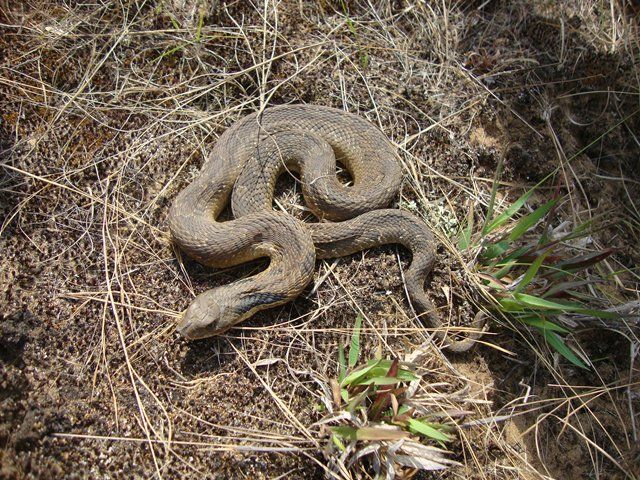
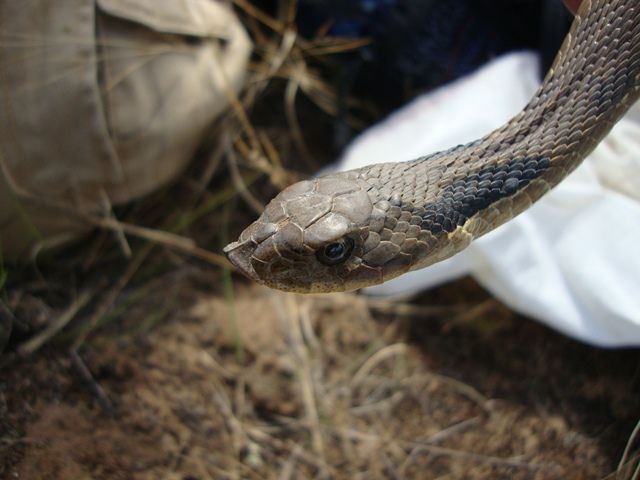
After our successfull day at the first site, we decided to head out to a second site with a specific goal: to find a very rare species in our neck of the woods.

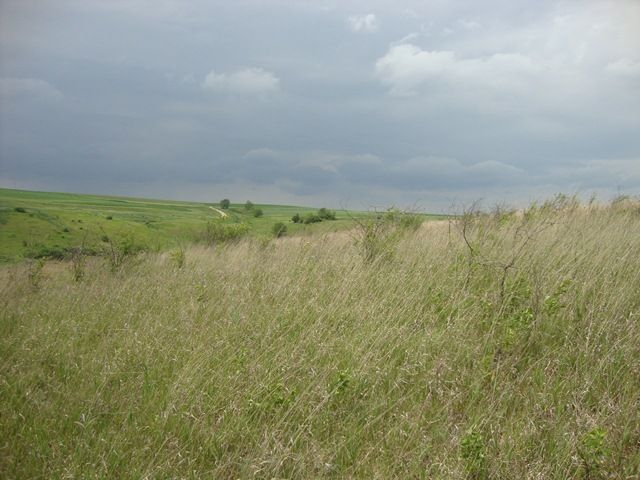
The landscape and sky combined in a very picturesque fashion, as we made are way to this particular location.

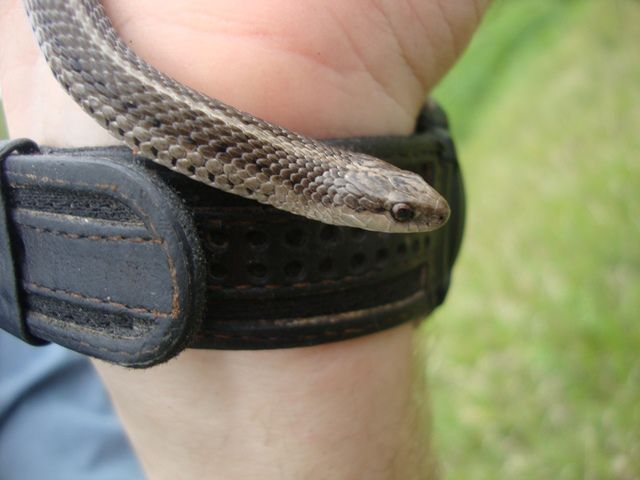
After roughly 30 minutes of searching, we came across the critter we were looking for: the Lined Snake (Tropidoclonion lineatus).  It's a rather small, somewhat drab and non-descript snake, to be honest.  It superficially appears somewhat like a gartersnake.  However, lined snakes are more gray with cream-colored stripes, whereas gartersnakes are black with yellow stripes.

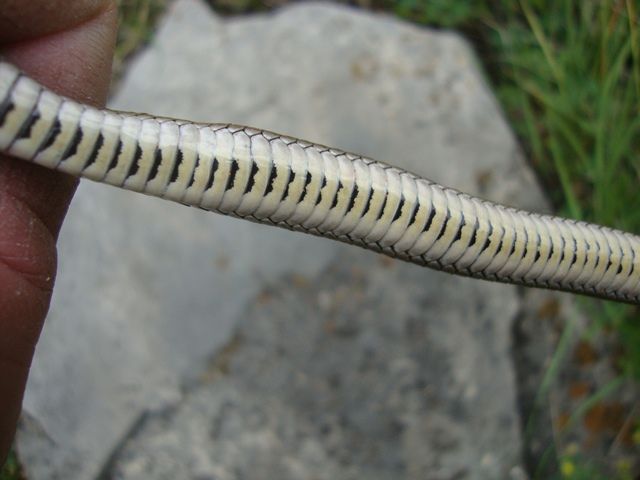
Lined snakes also have markings on each belly scale, that appear similar to two half-circles side-by-side.  Gartersnakes belly scales are mostly without patterns.....

All-in-all it's a very poorly-understood snake.  Small, non-descript, and fossorial (or living below ground most of it's life), it is rarely in the limelight and, thus, rarely attracts the attention of graduate students looking to complete master's theses and doctoral dissertations!

Thus ended our second of three trips during Dave's visit.  Much like the Bog, our trip to the prairie was also a success!

One more trip to share with you all, and it's a doozy!
Friday, June 29, 2012

Your Weekly Fawn AND MORE Wildlife Babies!
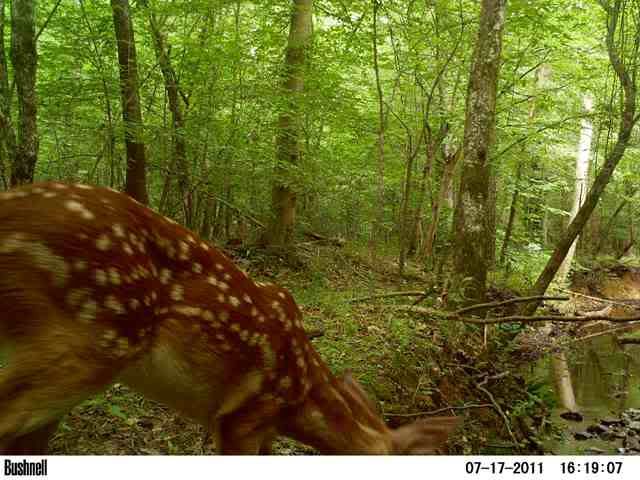
Wildlife babies still abound.  But now they are getting bigger and venturing out on their own a bit.

In addition to the quadruplet Raccoons (Procyon lotor) that I've posted about recently, I've also gotten clips of some other little ones out and about.

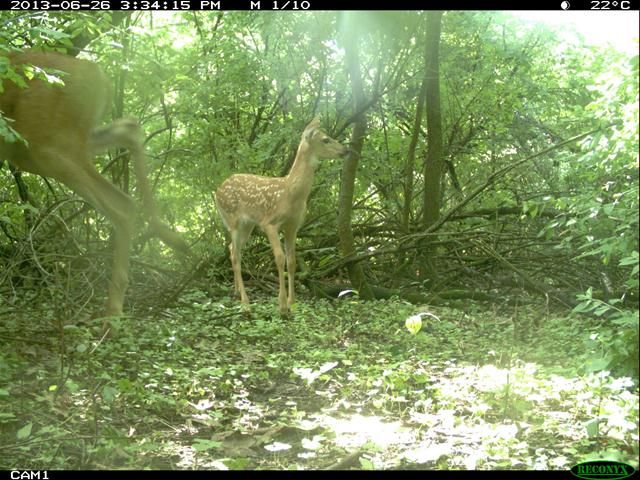
The fawns, in particular, are showing up alot.

So, in an effort to keep up with what I started, here's your weekly fawn (or fawns)!


Here's another, slightly bigger fawn from a different site....

This little fella is part of a two-for-one special!


There's is boldness in numbers, and I ended up with about 20 video clips of these two....until something spooks them (check out that leap!).

Yet ANOTHER set of twins at a different site! 

The females must have had alot of resources available to them in the area this year to produce so many twins!  It's been very hot and dry out there lately, so we'll see how long these babies last....

But for now they look happy.

Plus, there are MORE!

This baby Whistlepig (Marmota monax).

A baby Stiped Skunk (Mephitis mephitis).  This little fella comes back repeatedly and I have many video clips of him (or another one that's the same age).  In every clip he is snuffling about in circles, apparently fascinated by something in front of the camera.  I never see him eating anything, so I am not sure why he keeps returning.  Whatever the reason, he always seems very serious and determined!

There's something I find incredibly endearing about skunks.  Can't place my finger on it....but whatever....the videos of this little critter always give me a chuckle.  He actually could be the ornery little stinker, I've gotten clips of in the past.....

 And finally....a first for me....a Coyote pup!  Don't see many of the pups (even though I knew the adults were on-site).  The parents must keep them well-hidden.

Sunday, June 17, 2012

Your Weekly Fawn Part II: 2012 Edition

I started doing this back in NC (see here, here, and here).  And since I have a fawn at one of my study sites to follow (whom I posted pictures of last week) I'll continue to give you updates as I can.

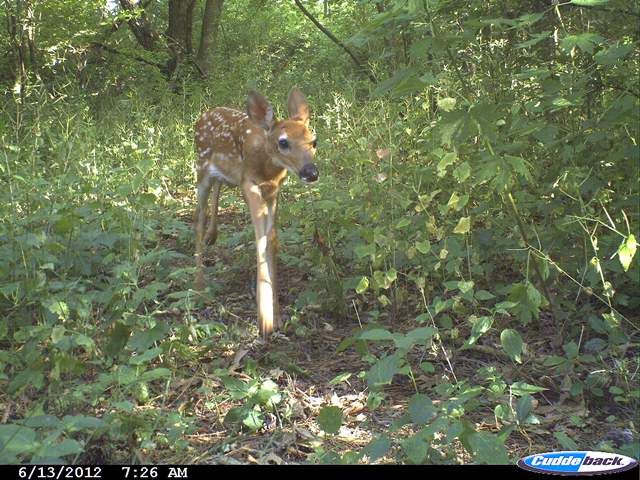
Here's what Junior looked like on 6/13/2012.

Monday, July 18, 2011

Your Weekly Fawn Part II

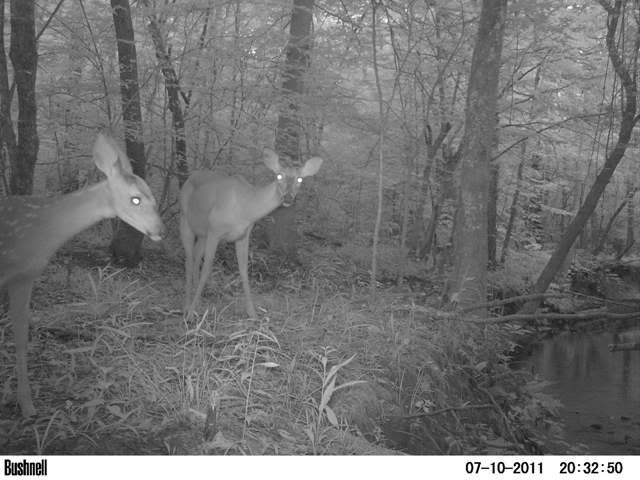
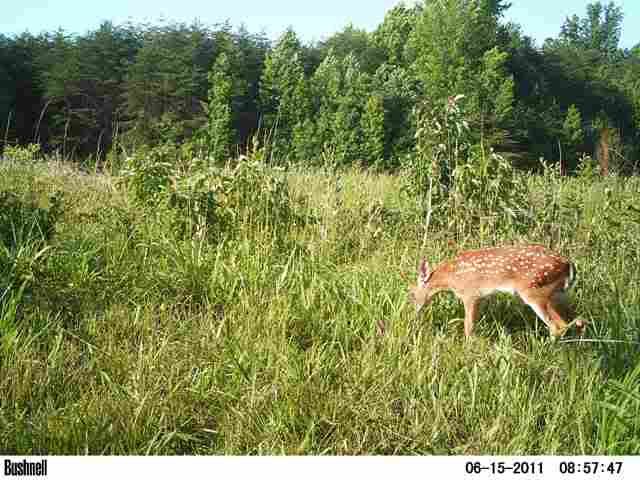
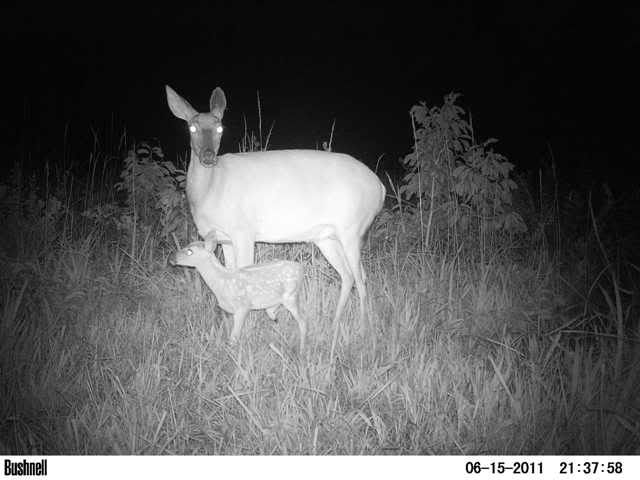
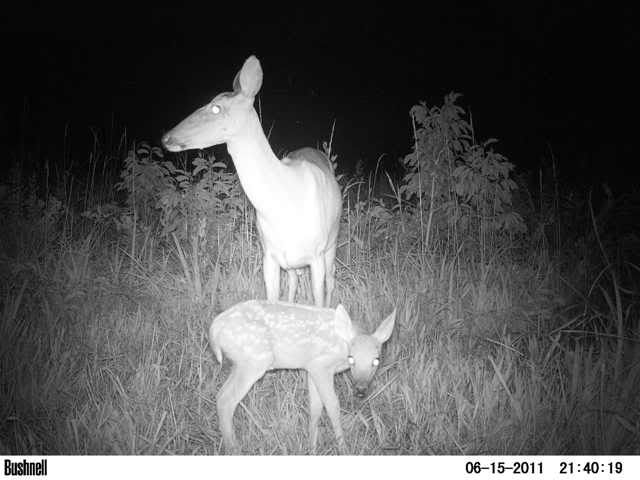
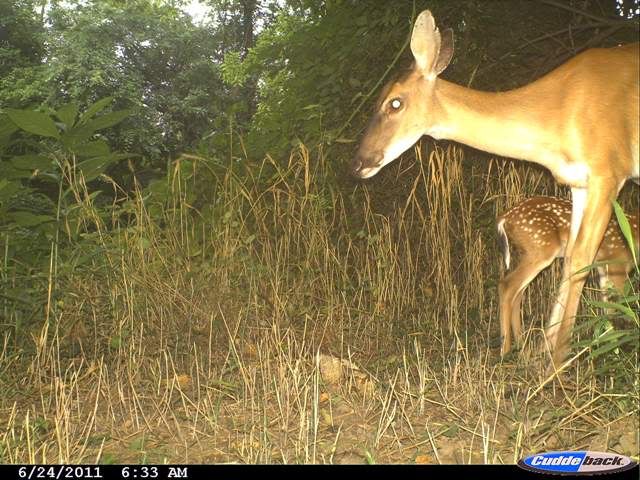
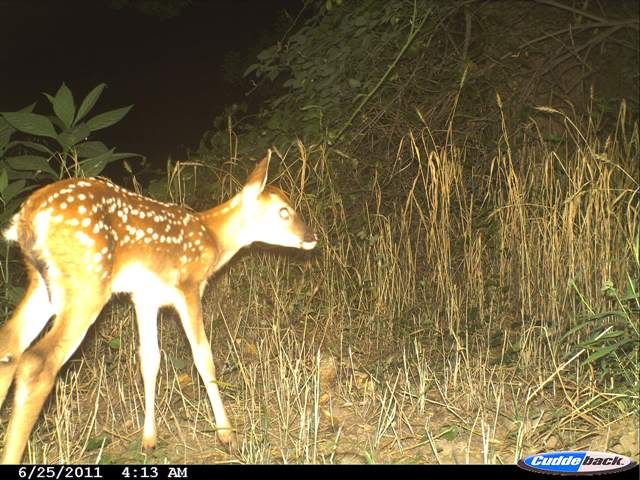
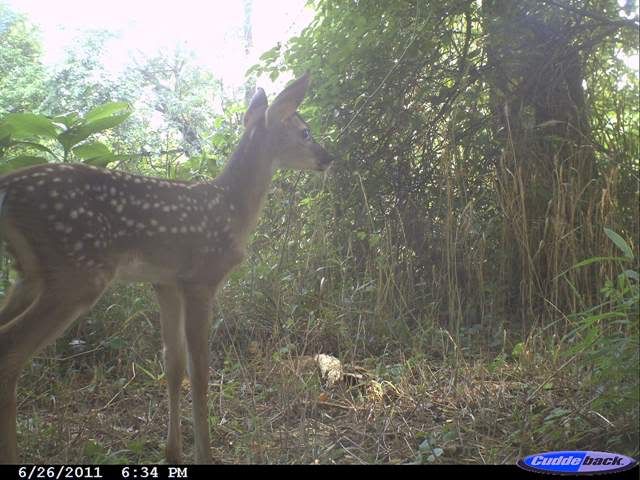
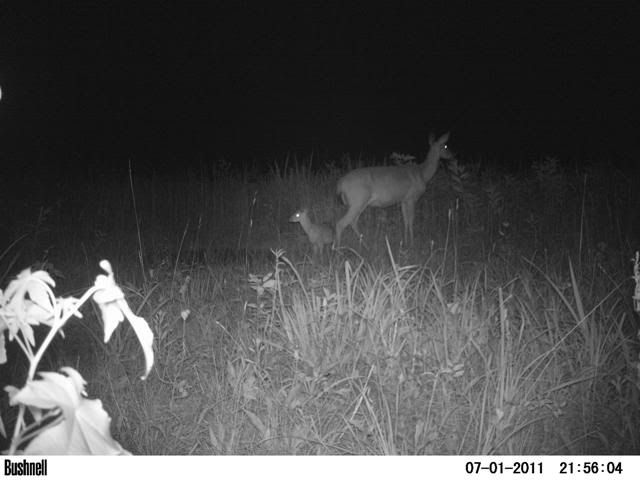
There has been plenty of fawn activity in front of my camera sets over the past few weeks.

Here some most recent pictures.

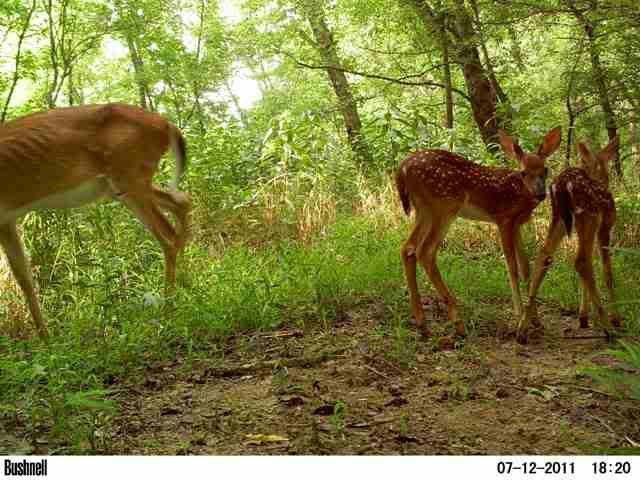
I've got two separate sets of twins at completely different sites.

Here's the first pair.  Momma's looking a wee bit skinny. 

Trying to consume enough calories to feed twins, while also meeting her own metabolic needs must be a herculean task (especially with the brutal heat we've had lately).  Research investigating the energetic demands on female Black-Tailed Deer (Odocoileus hemionus columbianus) that are lactating to feed juveniles illustrates what I'm talking about.  According to Sadlier (1982), female Black-tailed Deer that are lactating and feeding a single fawn consume 135% of the food/energy intake of non-lactating females.  Females lactating to feed twins consumed 170% of the intake of non-lactating does!


Here's the twins from the other site.

This momma looks a bit more heathly.


A couple of does with only one mouth to feed are also hanging around...
I think this is the same fawn as in the picture above.  This fawn and momma pass by this camera at fairly regular intervals.

More fawns in the future, I hope!

Literature Cited:

Sadleir, R.M.F.S. 1982. Energy consumption and subsequent partitioning in lactating black-tailed deer.  Canadian Journal of Zoology 60:382-386.

Wednesday, July 6, 2011

Your Weekly Fawn

I meant to start this two weeks ago...but just didn't get around to it.

With all of the fawn pictures I'm getting, I might as well post some for folks that like cute stuff. :)


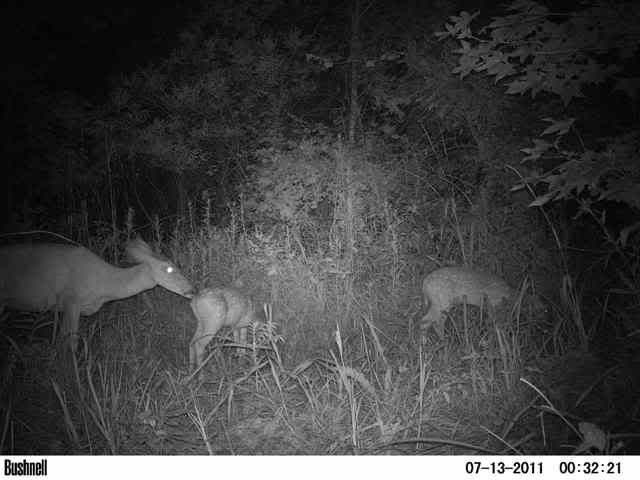
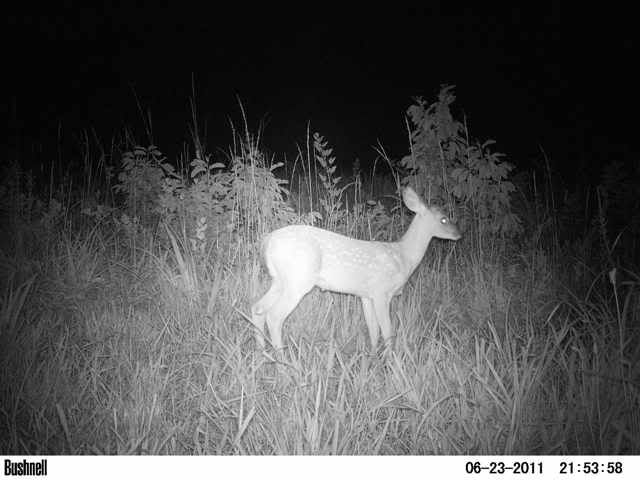
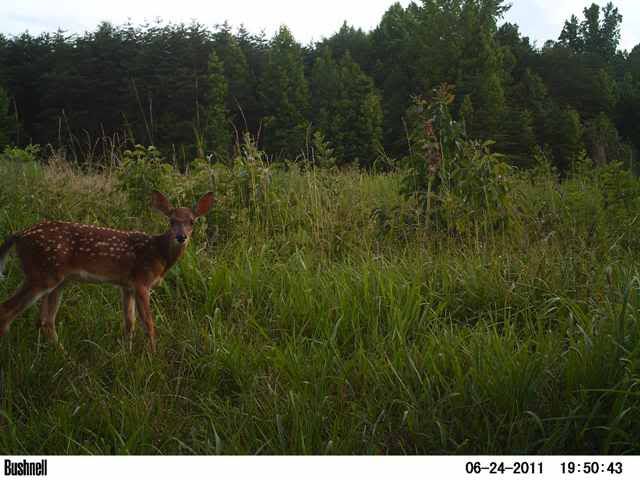
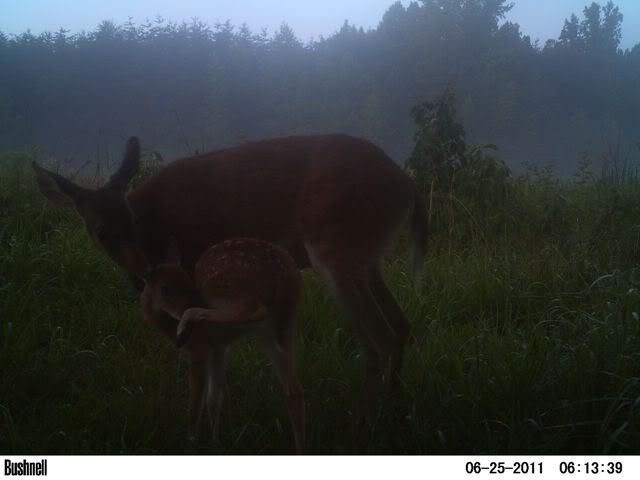
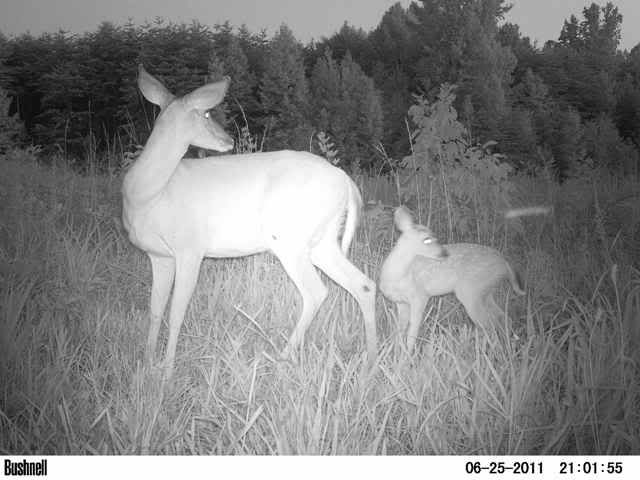
Here are pics of this mother/fawn from two weeks ago (probably some of these are of the same one that I posted pics of earlier).  As usual, the doe is constantly licking the fawn....keeping it clean so its harder for predators to smell it....


These are from last week. I'm particularly fond of the pictures in the mist.


These are some pics of a fawn that showed up last week at one of my cameras at a completely different site.

This week when we checked the pics, it appeared things have slowed down a tad, probably from all of the storms.  But there are a few fawn pics to share....

This was interesting....suddenly a pair of twins showed up at one of my sites.

I'm sure there will be more fawn pics to share in the future!