Well, for anyone who has followed my blog for any length of time knows....I had a research student in NC who was a very enthusiastic (and effective) budding field biologist: Dave. You can actually click on his name in the "Labels" section along the left-hand side of the blog to see some of the stuff he and I were working on down south.....you can also check out his cool blog,
Salameandering.
Anyways, after I moved north Dave and I stayed in contact and continued to work on several of our research projects through correspondence (with Dave doing the field work, and the two of us analyzing data sent via email).
Last fall....during one of our email discussions about some data Dave was collecting....we started to concoct a plan. By the time the plan was solidified, we had decided Dave would come up to our neck of the woods this spring for a week-long visit. I'd show him some of the great natural areas and wildlife our region has to offer. We'd focus on species and habitats that were either absent or not common in NC, so he could see some different stuff. Basically, we decided to have some fun.
So, last month the southern boy found himself in the north and (as we had planned) fun was the result!
BUT....this was not a "sit around and relax" type of trip.
Why?
'Cause there was field work to do!
______________________________________________________________________
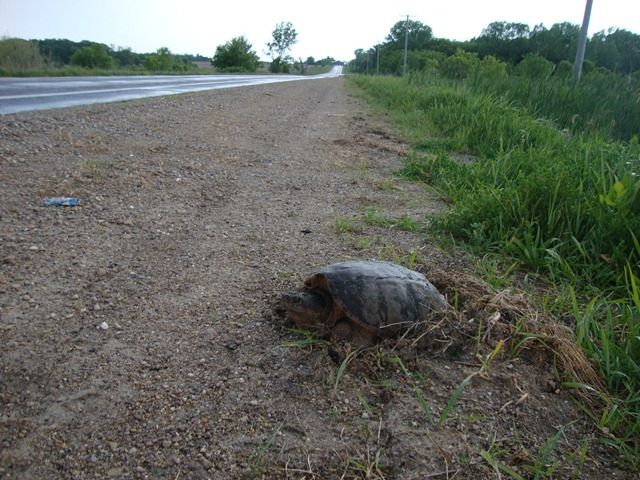
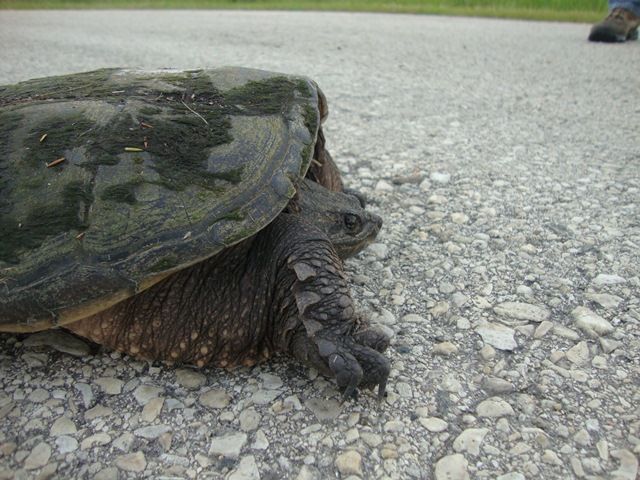
The night he arrived, like a good omen, we found a female snapper (
Chelydra serpentina) nesting along the roadside. Most of the time, turtles along roadsides are of the "pancake" variety. But not this one. She was alive and well and in the act of depositing her eggs. So, we took a picture and moved on, hoping no one would be heartless enough to swerve and hit her. She was an easy target, and I've seen some very ruthless (or completely unattentive) drivers smack turtles that could have been avoided.....so I was a tad nervous.
The next day, however, we passed by this spot and there was no dead turtle. I felt much better.
Occassionally, there are flickers of hope for humanity, I suppose....
Anyways....we visited three habitat types during Dave's trip. I'll talk about each in separate posts, starting with....
The Bog:
I've spent a fair amount of time at this site. I've taught a weekend field herpetology course at the field station on-site for a number of years....which I'll post about later. But I knew we could get some amphibian and reptile species there that don't show up (or are rare) in NC. Plus, Bogs are just neat habitats....with many unique plant species that are found nowhere else. This site doesn't only contain a bog, however. There are nice sedge wetlands, grassy meadows, and a beautiful Beech forest that is heavily managed to control Garlic Mustard (
Alliaria petiolata). For those of you not familiar with this nasty little plant, its a particularly prolific invasive that will blanket the understory of woodlands 'round here if allowed to exist unfettered.
The site also has artificial cover objects (
for surveying snakes) that have been in place for many years. They are all in the grassy meadows and fields adjacent to the open wetland habitat on-site. Thus, they attract snake species prone to using wetlands or grassland or both. So...if you're looking for snakes....flipping cover objects on-site is obviously a good place to start!
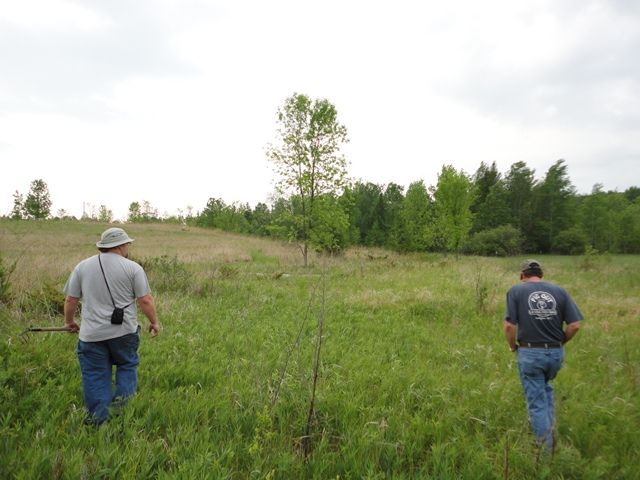
But first, you've gotta walk out and find them in the long grass......
Photo by D. M.
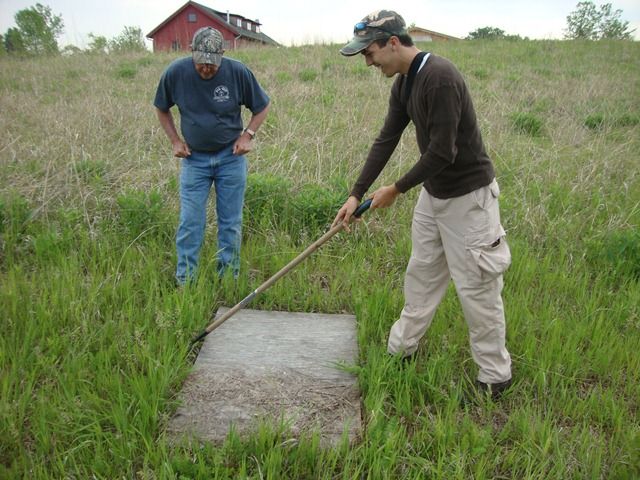
....then you can flip them....
...and reap the rewards of your effort!
Photo by D. M.
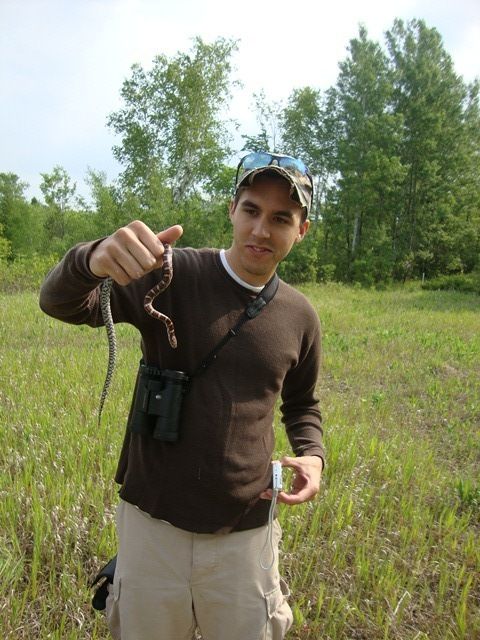
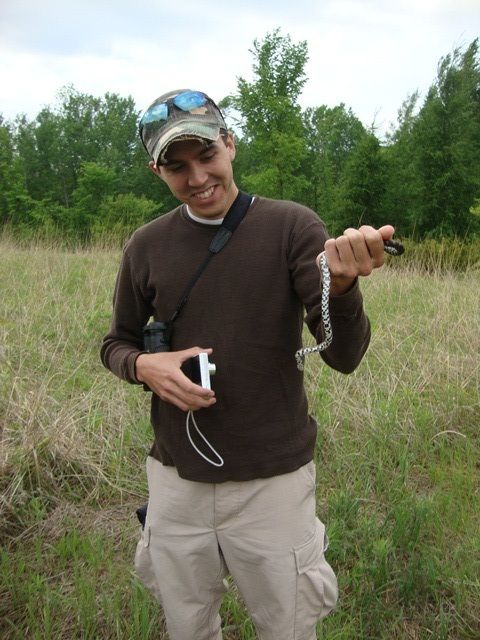
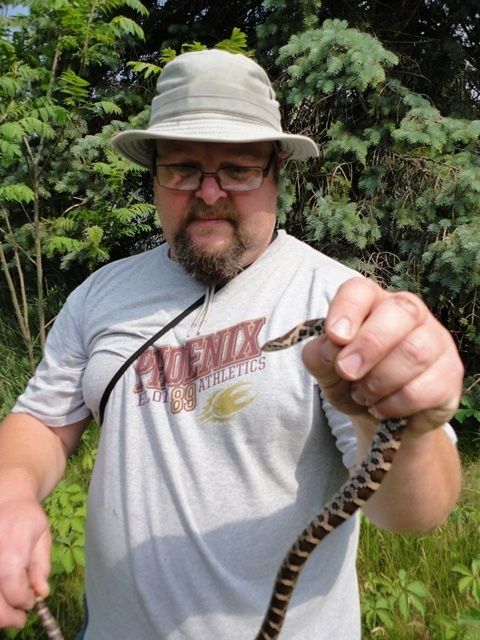
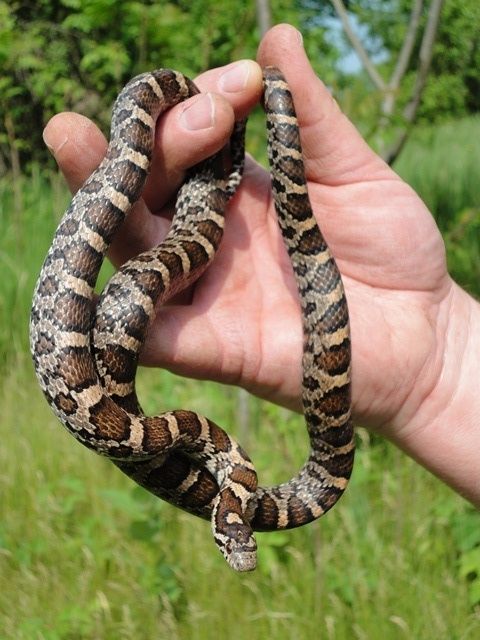
Eastern Milksnakes (Lampropeltis triangulum triangulum) are relatively common on-site, and we found a number of them under the cover objects...
Photo by D. M.
Photo by D. M.
Although eastern Milksnakes were common, also present were a pair of gartersnake species: the Common Gartersnake (Thamnophis sirtalis) and the Butler's Gartersnake (Thamnophis butleri). More on those species in a later post.
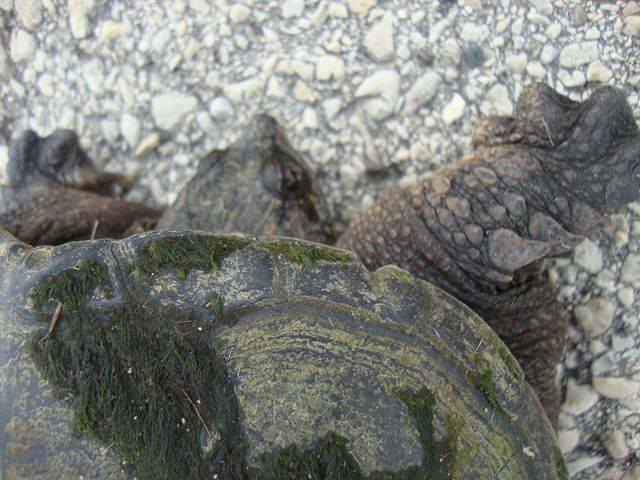
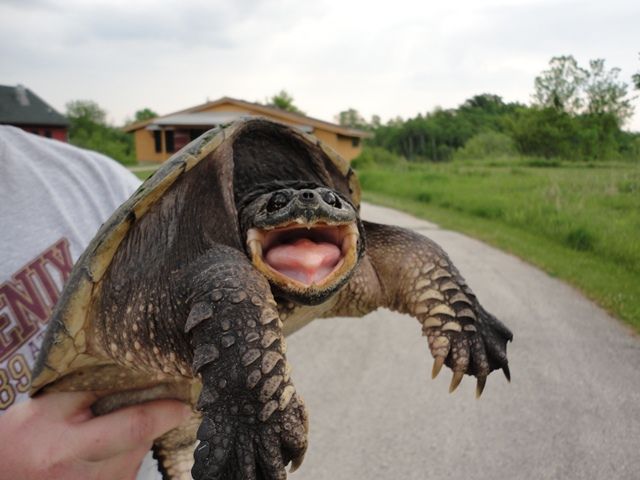
As we conducted a complete circuit of all the coverboards on-site (a few dozen of them), we crossed the driveway into the property. At that time, we came across a Common Snapping turtle (Chelydra serpentina) thumping her way over the concrete....probably looking for a good nesting location.
Upon closer inspection, I realized this was an individual I had marked #3 via marginal scute notch with a file in June of 2008. In 2008, I had also found her crossing a road. Snapping turtles are generall only seen during the nesting season, as the females must come on land to lay eggs. Otherwise, they have no reason to leave the water. In fact, most spend their days buried in the bottom of a mucky pond somewhere sucking down anything that strays too close. While they eat mostly animal material (vertebrates and invertebrates) they are also known to eat a fair amount of vegetation (duckweed, aquatic plant tubers, etc.).
She really didn't appreciate my close inspection, though....
Photo by D. M.
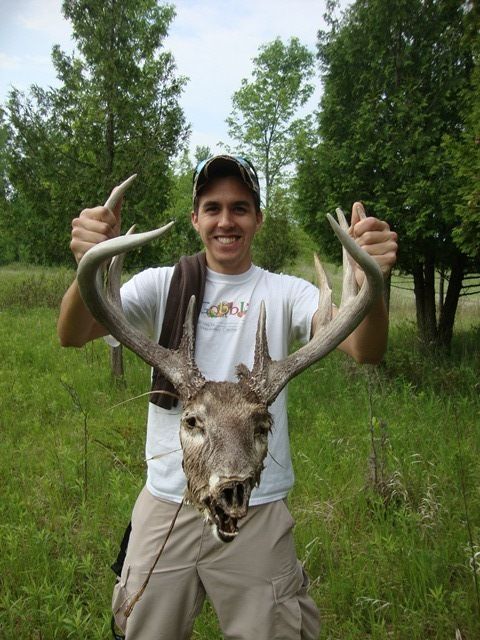
While checking the boards we also came across an incredible carcass, where the board transects bisected a game trail. As anyone who is interested in wildlife knows, finding a good carcass is about as exciting as finding a good pile of poop (both are awesome finds...usually worth photographing.... and both also make most average folks cringe).
This was a White-tailed Deer (Odocoileus virginianus) carcass...which is normally on the lower end of the "cool scale", seeing how common they are.
But this one was better than most.....
This was obviously the carcass of a very nice buck. The base of the antlers were enormous! What it was doing there, I can't say. Our location was very near a little-traveled dirt road.....so it's possible the buck was nicked on the road and managed to get as far as this spot before collapsing. Perhaps it was also winged by a hunter, but was able to make it to this point before it succumbed to its wound. Most of the bones for the rest of the carcass were intact (not cracked, or crunched...and were mostly articulated).
_________________________________________________________________________
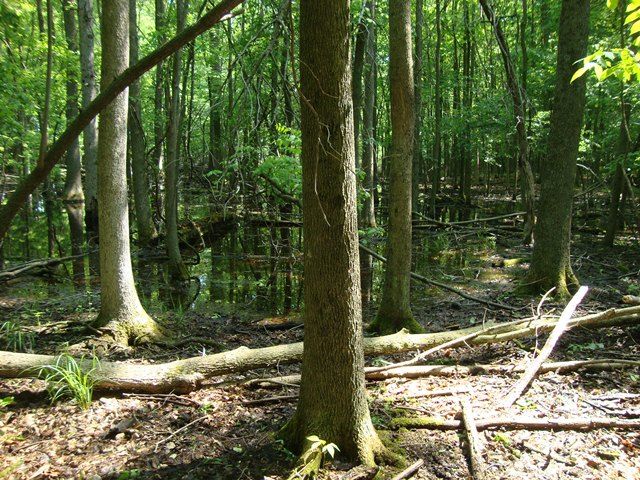
After our success in the meadow, we decided to head deeper into the property to search through the Beech Woods on-site. You may or may not notice from this picture that there is not a sprig of Garlic Mustard to be seen....and that is no accident. The staff on-site exert a huge amount of effort in the hand removal of this nasty invasive plant. The result is obvious, though....and it's a beautiful forest. With little under-story vegetation, several nice ephemeral wetlands.......
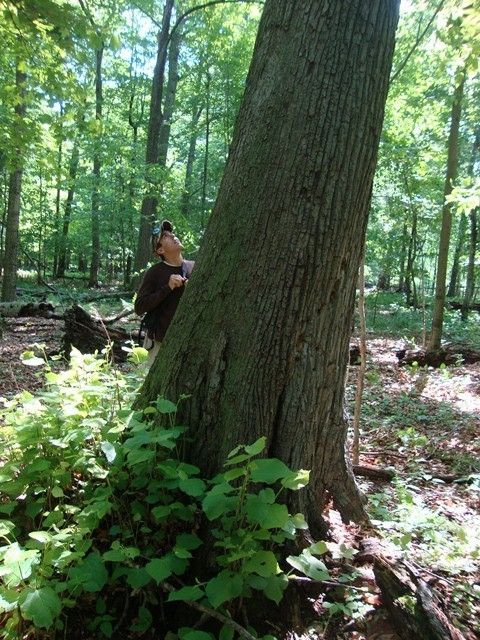
......and some beautiful old trees, such as this giant American Basswood (Tilia americana)!
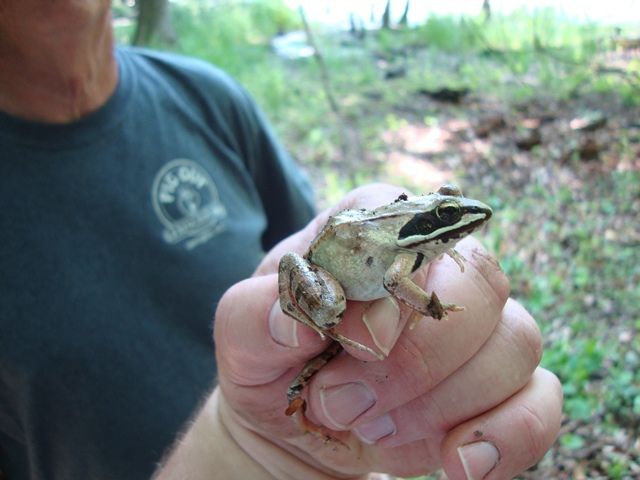
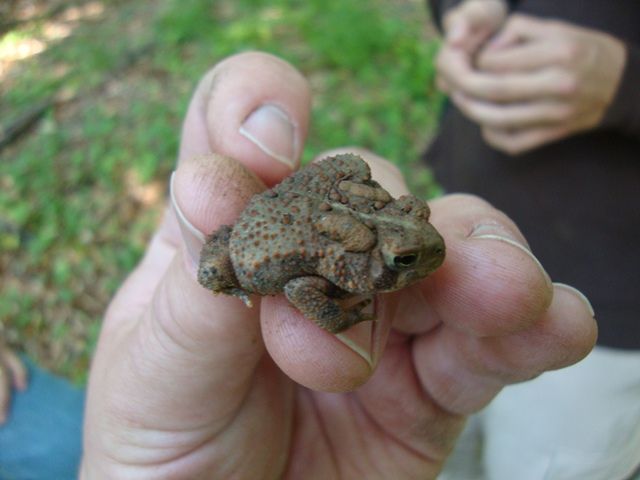
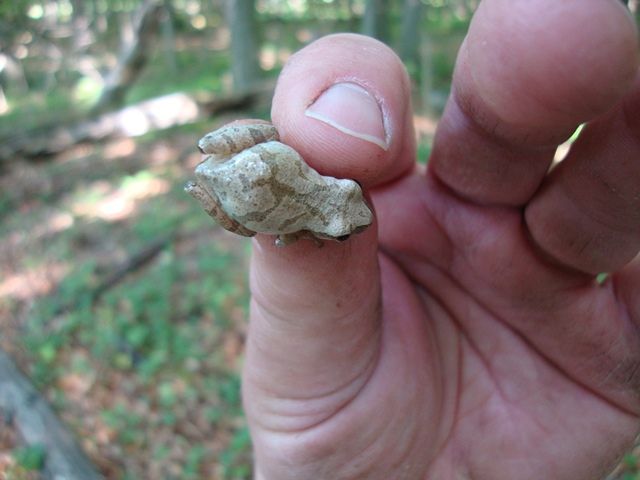
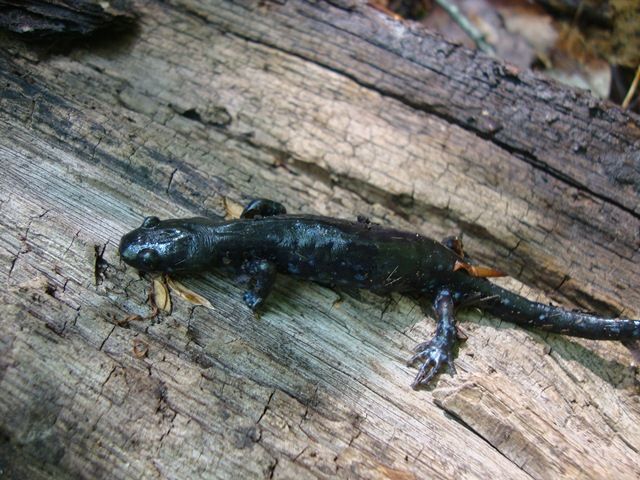
There is also a wealth of amphibians back in the woods. During our brief visit, we found two frog species, a toad species and a salamander....
First, the Wood Frog (Lithobates sylvatica). This is a fairly common species on-site. As the name suggests, it is fond of wooded habitats, and so I frequently find them associated with woodlands that have associated ephemeral wetlands. Most of the year is spent hopping around the leaf-litter and ground debris looking for invertebrates to snack on and they blend in well with the leaf litter in these habitats. Basically, one has to almost accidentally step on them before they'll move.....and THEN you'll be lucky enough to actually see one!
The American Toad (
Anaxyrus americanus) is another frequently encountered amphibian at this site. This is a ubiquitous species 'round here, and is tolerant of landscapes that have been disturbed by humans. They are frequently found in suburban and agricultural settings, so long as there is some available cover and moisture. This species was the one that I most encountered in my back yard as a kid, and is probably largely responsible for my love of amphibians as an adult.
The Spring Peeper (Pseudacris crucifer). A beautiful little member of the family Hylidae (the treefrogs). Very common in woodlands with associated wetlands. This species often shares habitat with the wood frog and I have encountered many sites where these species are sympatric.
The Blue Spotted Salamander (
Ambystoma laterale). This is one of three salamanders on-site that I've seen. It is also a species not found in North Carolina, so was a new one for Dave. The juveniles tend to have much brighter blue spots, and are very pretty. The adults tend to loose the bright blue spots, and often look more black. They are smaller and less chunky than the other "mole salamanders" (or members of the Genus Ambystoma) in this area, such as the Tiger Salamander (
Ambystoma tigrinum) and the Spotted Salamander (
Ambystoma maculatum).
____________________________________________________________________
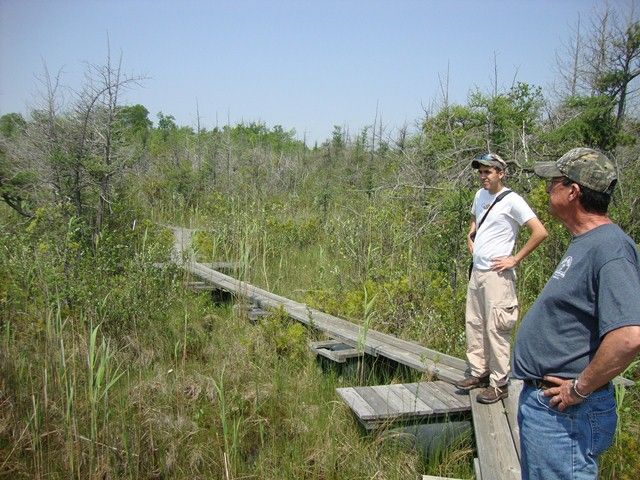
After messing with some amphibians, we decided to take a stroll out on the boardwalk that leads into the actual bog on-site. Being covered in sphagnum, which one easily punches through while slogging around in a bog, these habitats are very difficult to navigate and walk through. Luckily, the folks at the field station associated with this bog created an outstanding boardwalk raised above the sphagnum that allows for easy passage.
The boardwalk really allows naturalists to step back and enjoy this interesting habitat, rather than having to worry about sinking into it......
The board walk also grants those seeking passage through the bog the opportunity to spot some of the cool plants that show up in bog habitats.
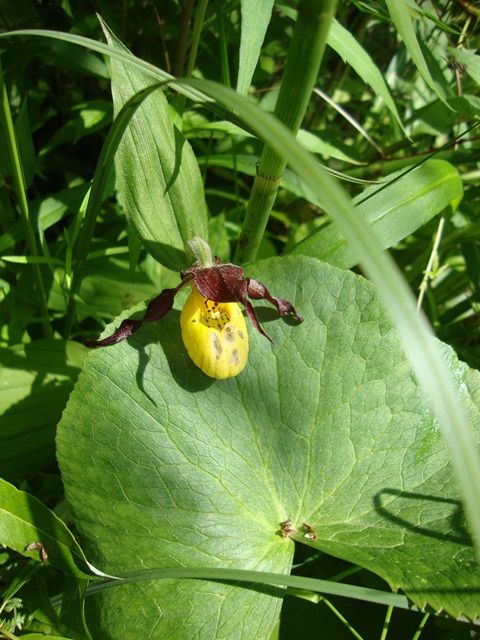
These include the beautiful Yellow Lady's Slipper (Cypripedium parviflorum). Amazingly, there are a handful of "flower-nuts" out there that illegally collect these from the wild to culture in pots! It really doesn't make sense to me. I can see buying a captive-bred orchid variant to keep as a house plant....but I just don't get wild-collecting of stuff like this! Such a shame to remove them from their natural environment.
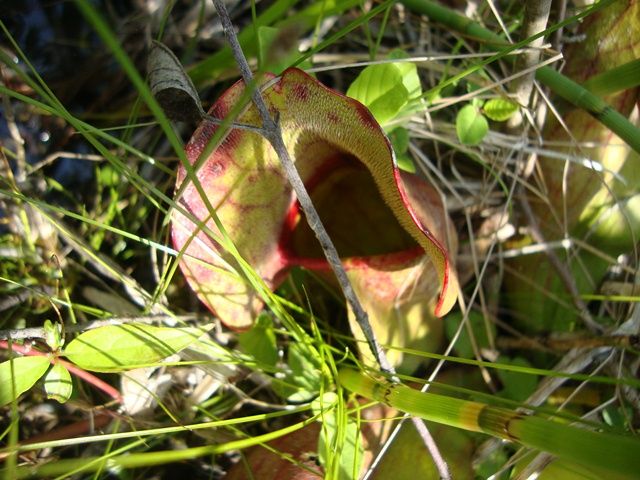
......the carnivorous Pitcher Plant (Sarracenia purpurea).....
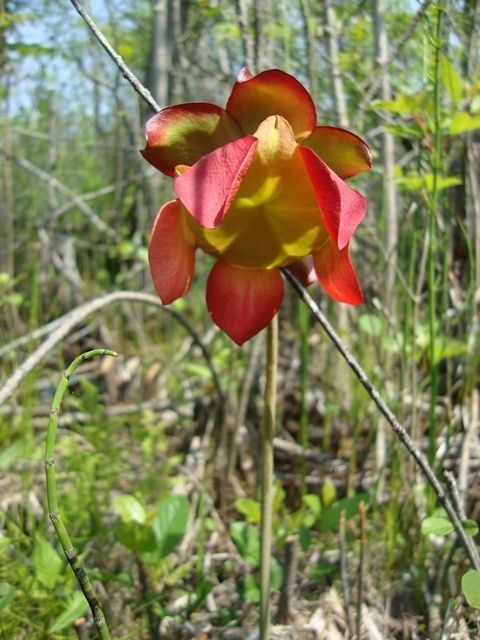
...and its wonderful flowering head.....
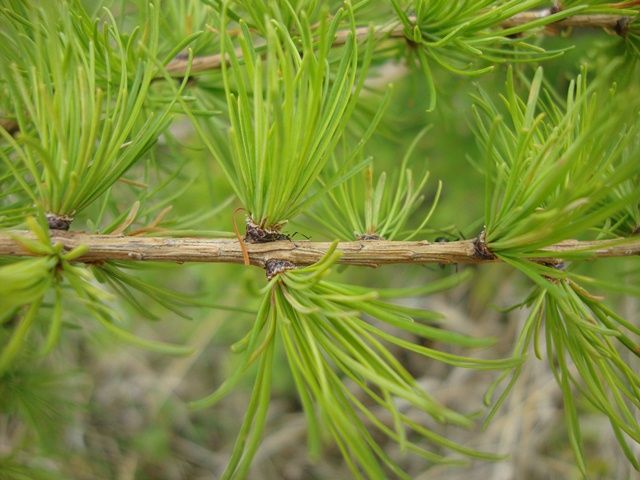
...ALSO...one of my favorites.....the Tamarack (Larix laricina), a deciduous conifer!
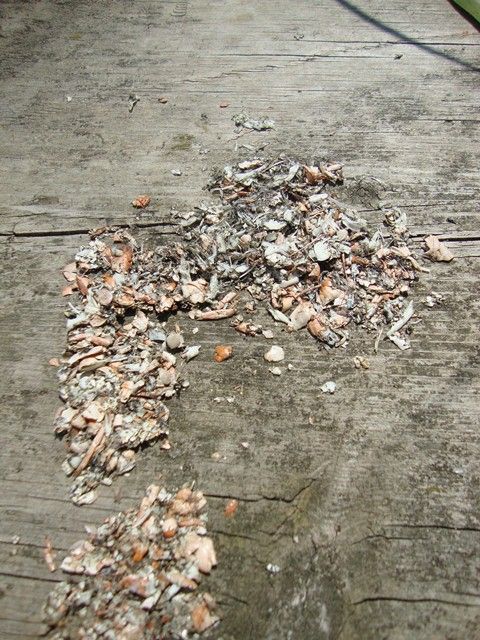
Amphibians and reptiles are very sparse in the bog proper. Birds are plentiful and mammals are common. On our walk out into the boardwalk, we happened upon a location where the bog opens up into a sedge marsh that leads to a nearby lake. Here we saw evidence of Otters (Lontra canadensis). I've seen Otter scat along this stretch of the boardwalk in the past....so I was not surprised to find their scat here again.
______________________________________________________________________
Our first "herping adventure" during Dave's trip was a success!
I'll soon post about the other two big trips we made during his week-long visit.....