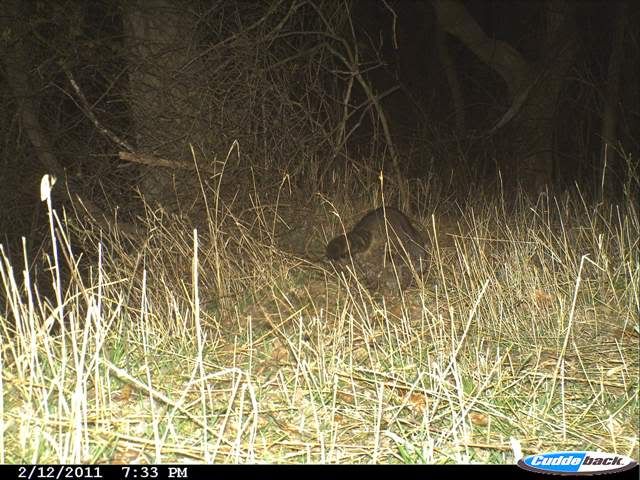
The case of the mystery animal has been solved (see
The Mystery, posted Feb. 23, 2011)!
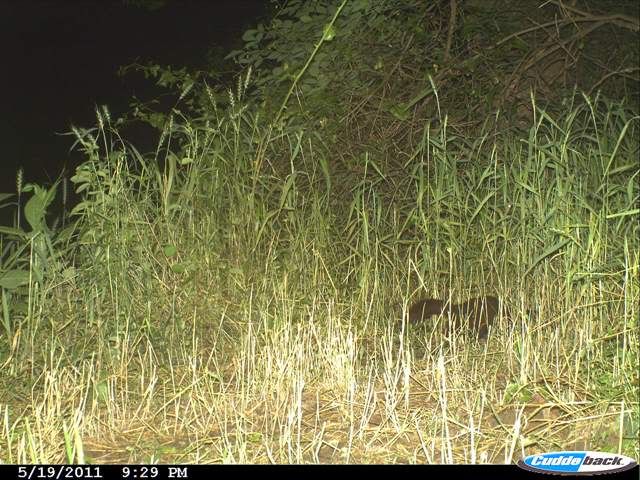
Earlier this month we got the picture below.
Not a very clear shot, but still....had to be a mink.
Also, at about 7:30 am on the morning of May 30th, Dave and I walked down to the main part of the largish river that borders one of our study sites (
not far from where our camera was stolen recently...grrrr). We were setting a turtle trap for the week, and in the process of lugging the equipment down to the water line. The banks there are steep and the County Park and Rec. department has actually installed a set of metal stairs for folks to walk down and launch canoes. We reached the bottom of the stairs and I happened to glance across the river just at the right time.
"Hey, look! There's a mink!"
On the opposite bank we saw the little mustelid bound along some rocks that lined the shore. Then, it ran up the mud bank into some shrubby vegetation. After a second or two it came back down to the water's edge and bounded upstream until we lost sight of it. A quick glance at the muddy banks on our side of the river also revealed mink tracks. So, either it was the same individual, or a number of them had been out and about.
Always cool to see them
in-situ and in real time!
This is only the third live mink I've seen in person.
The first was a very young juvenile (with its eyes still closed) that was crying at a burrow entrance along the banks of a wetland that I was doing amphibian surveys in. This was a while ago...back in spring of 2001, I think, in Houston County, Minnesota. I never saw the parent.
The second was an adult that I saw bounding along the gravel shoulder of a county road that ran parallel to a little stream. This was Jefferson County, Wisconsin. Probably 2007, if memory serves me....
But finally we got a picture that I'm comfortable calling a mink. The pics of this critter came few and far between in recent months. From February 9th through the 20th, one of these passed the camera on 5 different occassions. Since then, there's been only two pictures, including the two associated with this post.
The picture above represents the last (and best) Mink picture we've gotten on-site in a year of camera trapping there.
Not the nice Mink picture I was hoping for, but still a Mink. I even put out shellfish oil as a lure for two weeks, hoping it would come up and smile for the camera, but only raccoons paid any attention to it. The water levels have gotten very low this month and I think it's just become too much work for Minks to climb up the bank at this location now.
So...finally....I pulled the camera. It had been at this spot for over five months. It's given me about everything I need from that particular location, I think. Today, in fact, the Cuddeback got relocated to a brand-spanking new set location for another important purpose.
Hopefully, it will be successful, and I'll share cool results with you in the future.
If not...well...such is the fate of most camera trapping endeavors. ;)
Notes on the Ecology of Mink:
The Mink (
Neovison vison, previously
Mustela vison) has an elongated tubular body, with small ears. The fur is fairly luxurious (the reason it is often farmed for clothing) and dark brown. The Tail is sometimes darker brown or black and there is a white spot on the chin and chest. It is found throughout much of the U.S. and Canada....with the exception of hot and dry locations in the southwestern US. It has also been introduced, or escaped farming operations, to become established in numerous parts of Europe (reviewed by Lariviere, 1999).
Reproduction-. Much like another member of the family Mustelidae that I recently posted about (
the Otter), the mink is an induced ovulator that can undergo delayed implantation (Hansson 1947). Most mating occurs in March, and parturitioni occurs in late June (which coincides with the
DOR individual with enlarged nipples that we found last week).
Habitat and Diet-. This species is almost always associated with aquatic habitats and they are not particularly picky about what type, it seems. I've observed them in wetlands, along large rivers and also associated with small order streams. They often take occupancy of old muskrat dens with multiple entrances that are close to water (reviewed by Lariviere 1999).
The Mink is a carnivore. It will consume a wide variety of foods, such as aquatic invertebrates, fish, amphibians, reptiles, birds and mammals (such as muskrats; reviewed by Lariviere 1999). The main components of the diet often depend on what the locally available prey is (Ben-David et al. 1997). They can be a primary predator of waterfowl and their eggs. This species is not particularly adept at hunting in open water, and usually does its aquatic hunting from shore. This it accomplished by located prey from above the surface of the water, or by focusing their efforts on prey in their refuges (Poole and Dunstone, 1976).
Avoiding Competition-. It would seem that perhaps the mink and the otter could be direct competitors, as they are both aquatic mammals, with overlapping geographic ranges and similar diets. Interestingly, where these two species are sympatric (i.e. found together) they often reduce competitive tension through resource partitioning in regards to habitat and diet (Ben-David et al. 1996). Comparatively, the River Otter (
Lontra canadensis) consumes more invertebrates (like crayfish) and fish than the Mink. The mink then focuses more on mammals and birds....while also being found in slightly drier habitats and having a greater propensity to forage on-land compared to the River Otter (Gilbert and Nancekivel, 1982; Humphrey and Zinn, 1982).
Literature Cited:
Ben-David, M., R.T. Bowyer, and J.B. Faro. 1996. Niche separation by mink and river otters: coexistence in a marine environment. Oikos 75:41-48.
Ben-David, M., T.A. Hanley, D.R. Klein, and D.M. Schell. 1997. Seasonal changes in diets of coast and riverine mink: the role of spawning Pacific salmon. Canadian Journal of Zoology 75:803-811.
Gilbert, F.F., and E.G. Nancekivel. 1982. Food habits of mink (
Mustela vison) and otter (
Lutra canadensis) in northeastern Alberta. Canadian Journal of Zoology 60:1282-1288.
Hansson, A. 1947. The physiology of reproduction in mink (
Mustela vison, Schreb) with special reference
to delayed implantation. Acta Zoologica 28:1-136.
Humphrey, S.R. and T.L. Zinn. 1982. Seasonal habitat use by river otters and Everglads mink in Florida. The Journal of Wildlife Management 46:375-381.
Laviriere, S. 1999.
Mustela vison. Mammalian Species 608:1-9. Published by the American Society of Mammalogists.
Poole, T.B. and N. Dunstone. 1976. Underwater predatory behaviour of the American mink (
Mustela vison). Journal of Zoology 178:395-412.