Showing posts with label Box Turtles. Show all posts

Tuesday, August 16, 2011

The Raccoon Denied of His Prize?

Allow me to take you back in time and also whisk you away from the upper Midwest to the Southeastern USA.

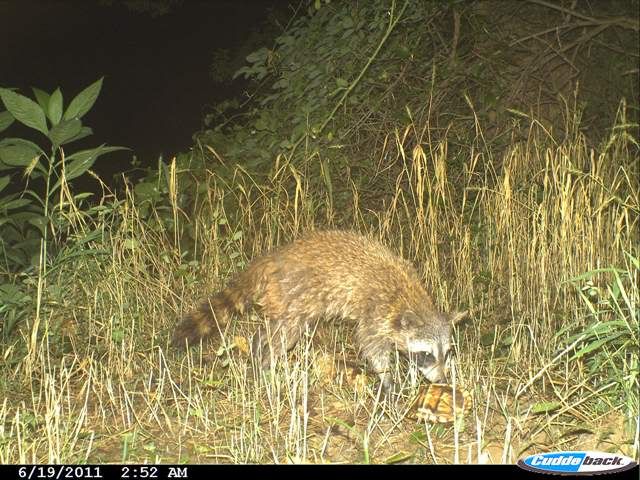
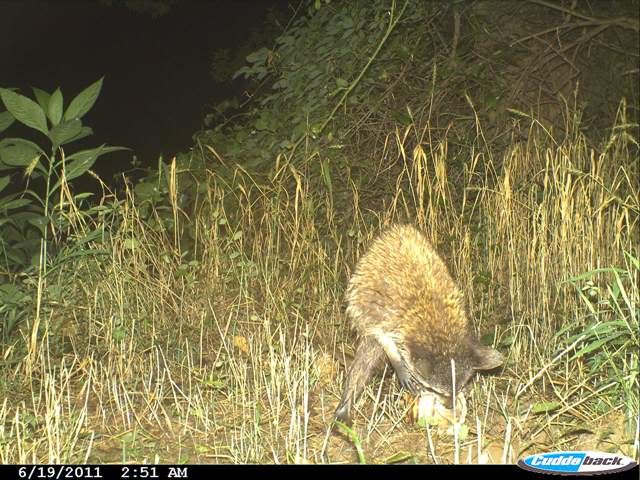
Some great pics I got on the Cuddeback in late June, 2011 in North Carolina.  

Nothing like a little herpetological bycatch on a camera trap.  Especially when the amphibian and/or reptile being photographed isn't ending up as lunch.

At the camera set I had monitoring the whistlepig burrow....we get a lot of Raccoon (Procyon lotor) activity.  Some are big, fat looking boars...but we also see many-a skinny little 'coon running running past the camera.  The critter pictured below looked like the latter to me.

Maybe it was due to lean times, but whatever the reason, the raccoon below tries to have an Eastern Box Turtle (Terrapene carolina) for dinner.


So....is the raccoon denied of his prize in this case?

It would appear so.

I guess those shells with the flexible hinge on the plastron work!

Notes on Box Turtle Predators

According to information summarized by Dodd (2001) a variety of predators threaten box turtles.  Although birds (e.g., herons, crows, etc.) and reptiles (copperheads, cottonmouths, etc.) eat many, medium-sized mammalian carnivores are a common box turtle predator.  Raccoons, Oppossums, Skunks, Minks, Coyotes, and domestic dogs (to name a few) will, apparently, partake of a box turtle snack.  The vast majority of this predation, however, is on eggs... but also juveniles, whose shells are not as hard as adults.  Raccoons and Oppossums, in particular, are known to have devastating effects on turtle eggs in areas where individuals communally nest (i.e. many turtles come together to lay eggs).  I have personally witnessed what can only be described as all out carnage, where aquatic turtles along the Mississippi River in Wisconsin have come up to nest only to have mammalian predators excavate and eat their eggs.  I vividly remember walking a small stretch of sandy bank one day looking for nesting turtles.  I found only destroyed nests.  Then it dawned on me that I should actually count the number of destroyed nests I encountered.  In a half hour, I counted 40 and gave up out of mild depression. 


Yet, it seems that these small carnivores have a tougher time breaching the sealed shell of an adult box turtle....or at least they quickly give up for something easier.  Yet, if the carnivore can catch the turtle before it withdraws its head, it may be able to deliver a fatal bite before the turtle seals itself shut and get a meal.  This happens more than one would think, and box turtles with missing limbs (presumably due to a circumstance such as the one I just described) are a common occurrence.

I don't fault Raccoons or Oppossums for destroying these nests.  Critters need to survive and Raccoons are good at it.  I can't help but respect any species that can thrive in this anthropogenically altered landscape.

I just wish they didn't eat turtle eggs!!

Literature Cited:

Dodd, Jr., C.K., 2001. North American Box Turtles: a natural history.  University of Oklahoma Press, Norman, OK.

Thursday, July 14, 2011

The Turtle Dogs!

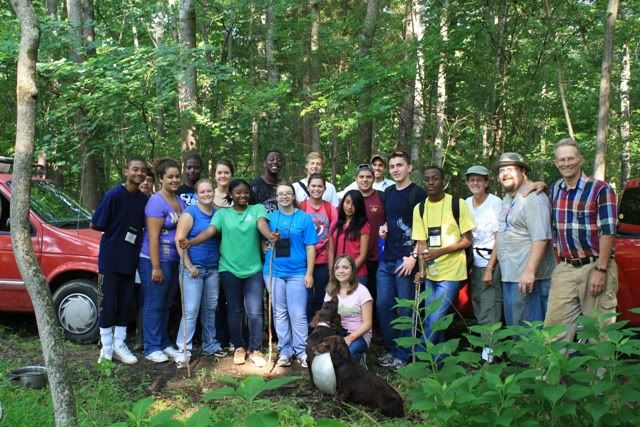
Above: the students, the teachers, the turtle dogs and the turtle dog master!
Photo courtesy of T. Tomasek

_________________________________________________________________________

Well, this week it was hot.  Hot!  Hot!!  And humid.  Sticky, wet, humid.

Heat indices of over 100 on several days....and in the upper 90s every other day.

The worst is that humidity.  Air so thick ya feel like yer swimmin'!  You just can't cool off.  Especially when one is an over-weight male of Germanic/Irish descent (like me :)  )  the humidity is brutal.

Anyhoo, that really did a number on how many critters we caught this week during our normal drift fence and coverboard surveys.  The total captures were down from the last two weeks.

So, that should result in a boring survey round up for this week right?

WRONG!

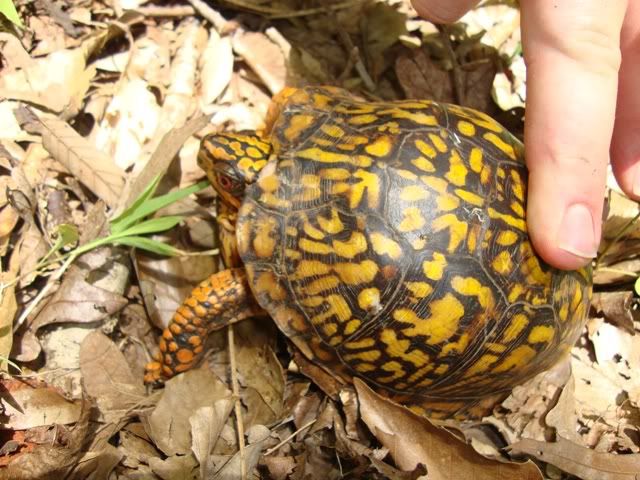
This week we got to take part in one of the coolest things I've been involved with in years.....the use of "turtle dogs" to survey for Eastern Box Turtles (Terrapene carolina) at one of our survey sites.

__________________________________________________________________________

A colleague here at the university has a doctorate in Science Education.  Luckily for me, she also likes amphibians and reptiles!  She created a summer herpetology class for high school students who are interested in going to college. She recently wrote a successful grant to help design and fund this curricula..... and with some of that money she wanted to expose her students to doing surveys with turtle dogs.

Lucky for me, she also wanted to use one of my study sites (which is great, 'cause as much as I wanted to experience turtle-dog surveys....I have not got any money!).

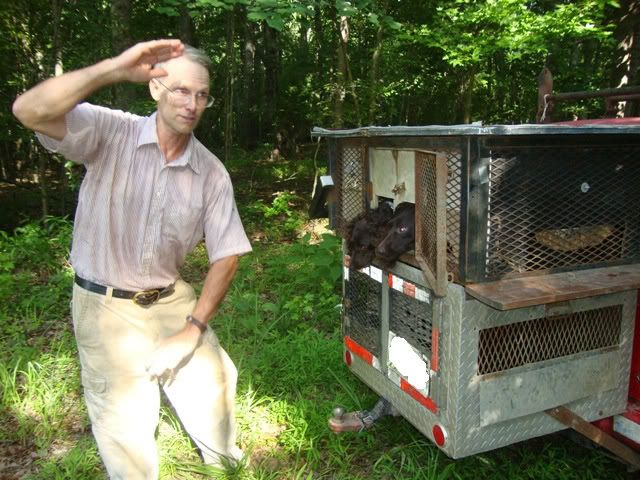
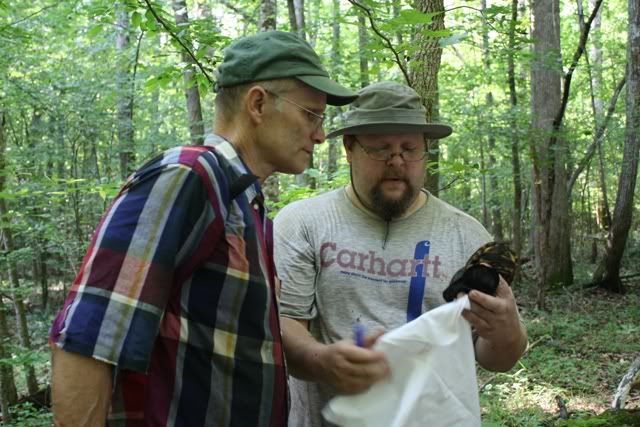
Meet John Rucker (below):  box turtle enthusiast, naturalist, outdoorsman, and turtle dog master!!


Above: John preparing to release the dogs from their holding crates on the back of his van.

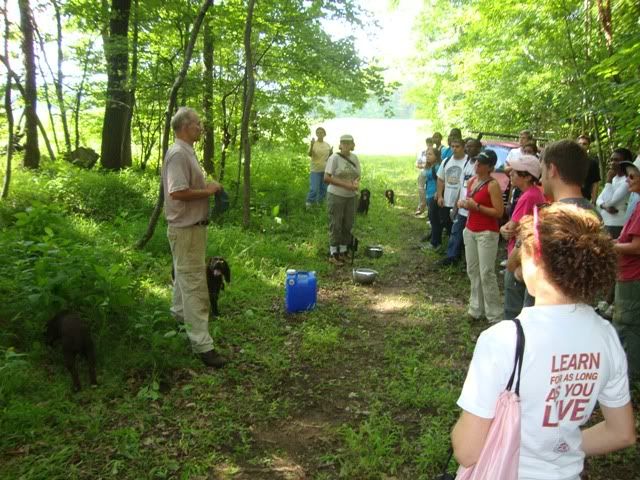
Above: John explaining the process to some students.

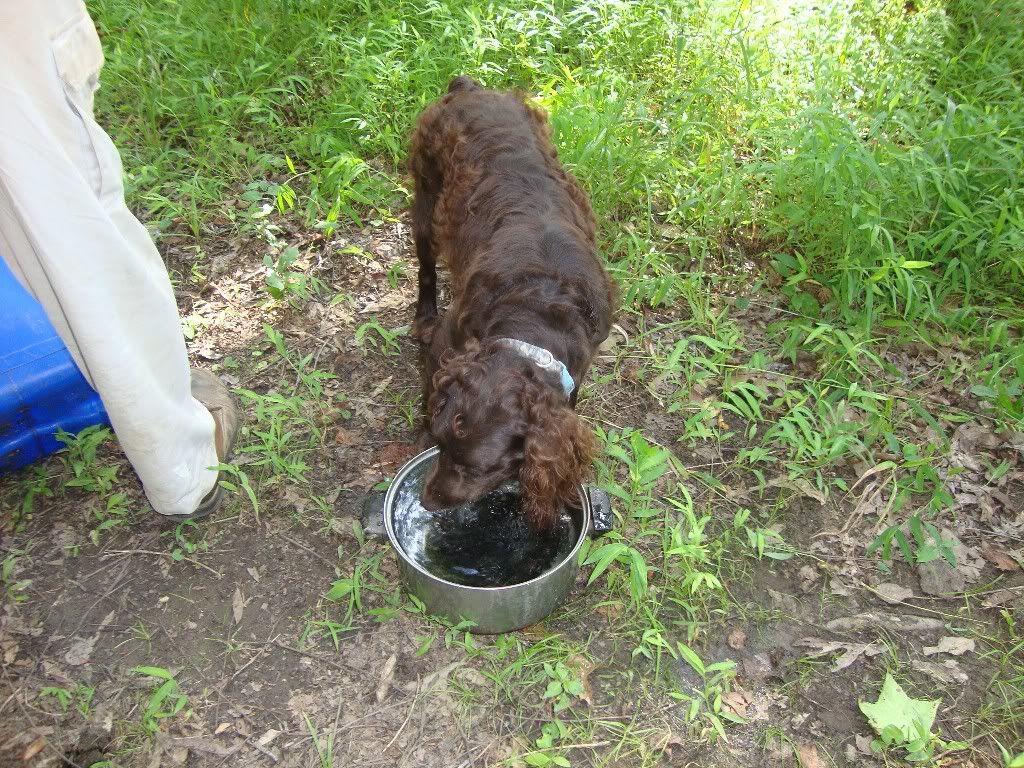
Above: one of the Boykin spaniels who ran turtles for us.  I can't remember this one's name.  Although John brought 8, we worked most closely with three: Mink, Greta, and Ginny Ray.


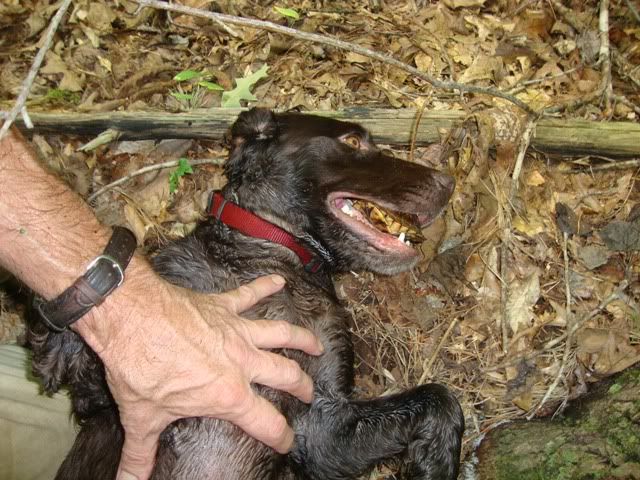
John drove from Tennessee with his fine pack of 8 Boykin Spaniels.  With noses like these canines have...they can sniff out whatever you teach them to find.  Some folks teach their spaniels to retrieve waterfowl they've shot.....some teach theirs to flush quail or pheasant.....John taught his to find turtles!   John charges a very reasonable price for his services, and because of this has done work all over the U.S.

Above: although we only ran a few dogs a day, the others got to be let out of their crates and staked to the ground with a lead to stretch their legs and get some water.


Not only can they find turtles, but they can do it while still thinking for themselves.....and surviving.

John told a story about a little gal of his named Greta that brought this point home brilliantly.  He was in the Badlands of South Dakota...working for a group that was having his dogs look for Ornate Box Turtles (Terrapene ornata).  At one point, Greta caught the scent of a Pronghorn and was gone.....John said they were specks on the horizon before he even realized it.  He waited (his dogs usually come back), and looked for hours....no Greta.  He slept in his van out at the spot he last saw her, hoping she'd return....no Greta.  He figured she had been taken by the land, some Coyotes....or perhaps a Cougar.  But just in case, John had his girlfriend place an ad in the local paper and hoped for the best.

Fourteen days later, he gets a phone call.  The dog had showed up on a rancher's property some 30 miles away.

Now, this work was conducted in an area where a lot of feral dogs run.  The rancher apparently has a policy that any feral dog that comes on his land is shot just as fast as he can get to his pistol.  But serendipity worked in Greta's favor.  The back door of their house happened to be open.  Apparently, the rancher's wife was working at the laundry machine when she felt something nudge the back of her leg.  She turned around and there was sweet little Greta.  Face covered in ticks....ears sticking straight out from all the cockle-burrs....alittle skinny and dehydrated....but alive.

The rancher announced he was going for his gun, but his wife told him to wait.....there was just something different about this dog.  Not a few hours later the rancher's neighbor happened to have seen the ad in the paper about the missing Boykin Spaniel and happened to call the rancher to let him know about it.

And that's how Greta survived her 14 day solo tour of the Badlands.

_______________________________________________________________________

We had John and his dogs come to our study site for two back-to-back days.  During both days, we ran the same number of dogs, through the same area, for the same amount of time and let them catch as many turtles as they could find.

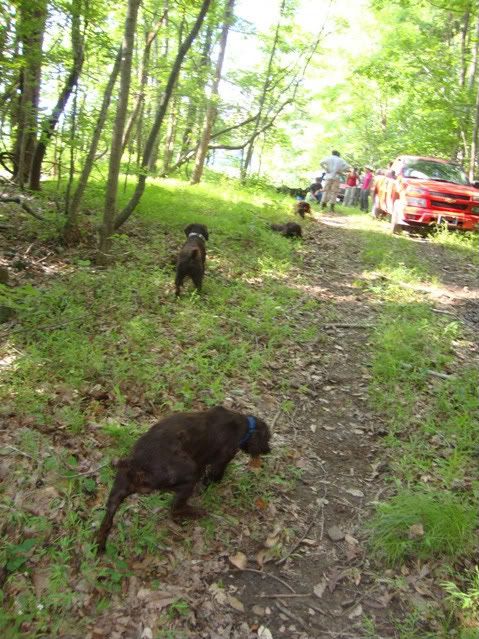
We started each day by taking the dogs to the area we wanted them to search (so they wouldn't become distracted with other scents).  Once we were to the right spot, the dogs went to work...and boy did they work!  The remainder of our time in the morning of both days was spent following and encouraging the dogs....letting them catch stuff...while we followed as fast as we could, flagging the site and bagging the turtles for processing.


Above: walking the dogs down to where the official surveys started.
Photo courtesy of T. Tomasek.

Above: the dogs at work!

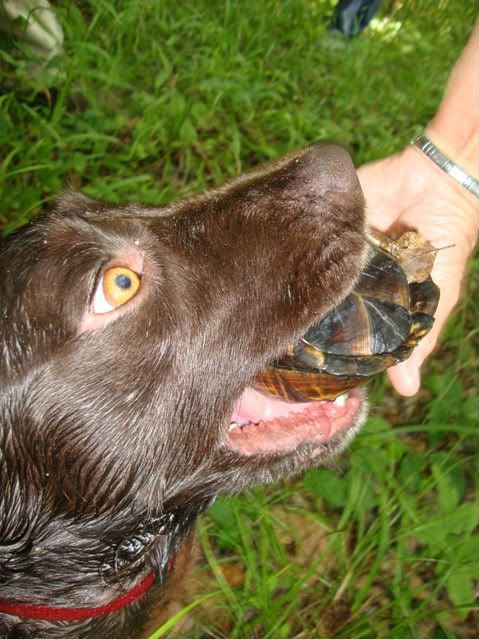
Above: Success!

Above: more success!!

Above: Bagging a breeding pair of turtles that one of the girls found.
Photo courtesy of T. Tomasek
__________________________________________________________________________

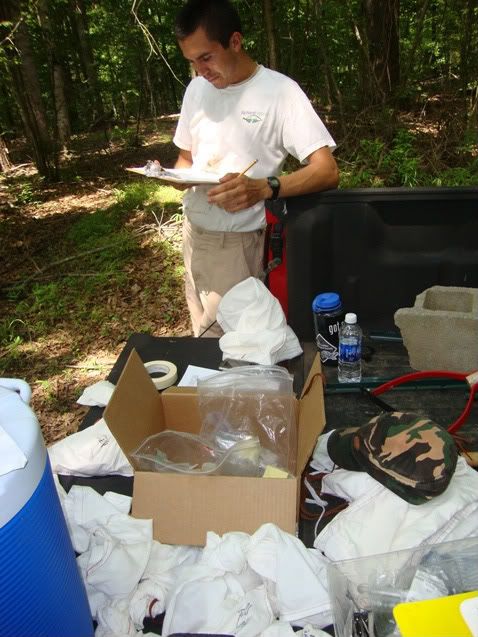
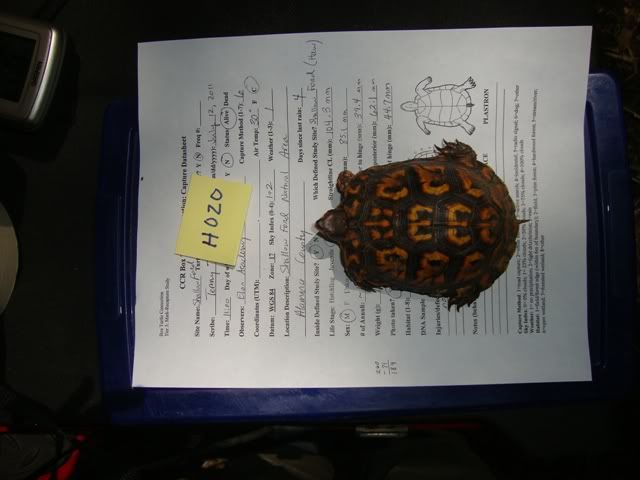
After a few hours of that (in brutal heat, I'll mention again)....the turtles were brought to a central location and important morphological data was recorded.  After the turtles were weight and measured, we gave each a unique mark so they could be identified in the future.  We ended by walking each turtle back to its original capture location using a GPS and looking for the appropriate flagging.

Above: My undergraduate research assistant, Dave, processing the turtles

Above: a turtle with standard data sheet.

By the end of that...usually anywhere from 1:30-2 pm...we were all tired and soaking wet with sweat....but did we ever have fun!

So let me put this into perspective for you:  from last August (2010) until this Monday...between myself, Dave, and all of my Wildlife Ecology students last fall....putting in a total of over 300 person hours on this property....have found about 22 Eastern Box Turtles.

In a total of 3 hrs over two days....these dogs found 25!  This includes 5 juveniles (of which I think I've seen ONE previously).

You know what I say to that?   Who's a good dog!?  Who's a good doggie? 


Above: Turtle number H023.  One of the turtles originally captured on day one, who was recaptured during day two of the surveys.

Saturday, July 9, 2011

Week's End Survey Round Up VII: Copperheads and Cyst-laden Salamanders

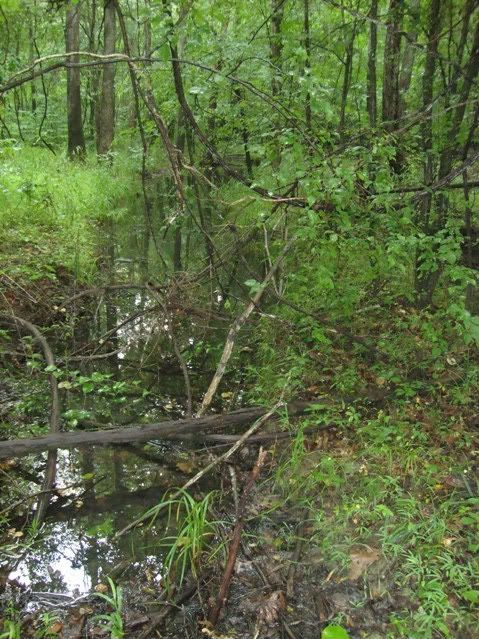
Much like last week, we had a lot of rain and wet to deal with during our surveys.  As you can see from the pictures above, a bunch of standing water and dripping vegetation.

Interestingly, we didn't catch as much this week, as we did last week.  I imagine that because it had been so dry for nearly a month prior to the rains last week....once it got wet, the critters exploded out of hiding and became very active.  Now that the wet conditions are sort of old hat, they aren't quite as active.

Regardless, we still caught some cool stuff....but nothing really new.
____________________________________________________________________________

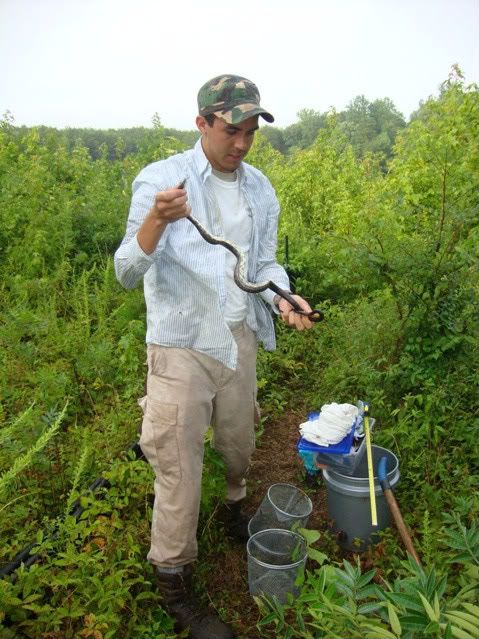
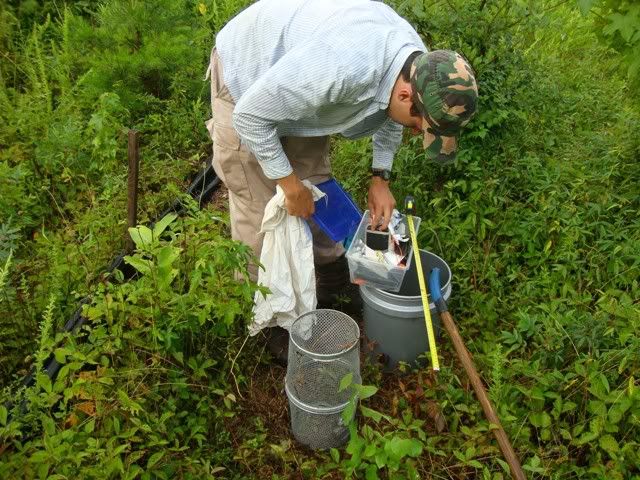
Another nice sub-adult or, perhaps, young adult Eastern Ratsnake (Pantherophis alleghaniensis).  We carry a bucket of our gear with us in the field.  Every time we get a critter to deal with, we set up a little workstation to collect appropriate data.  One person takes measurements and yells out numbers, while the other records.  It works out pretty well.  Often, a back-pack of gear is a good option too...but I sort of like the bucket (I can fit more in it and whatever I put in stays dry).  It can be a bit cumbersome, though.


Above: our bucket O' gear that we carry with us in the field.  Also you can see the handle of the potato rake, which is the most versatile and important tool a field herper can have!  It will flip rocks, turn logs, act as a walking stick, and help balance you when rock-hopping across streams.  It can also be used to carry funnel traps with venomous snakes AND act as a snake hook for venomous snakes, if necessary. 

_______________________________________________________________________

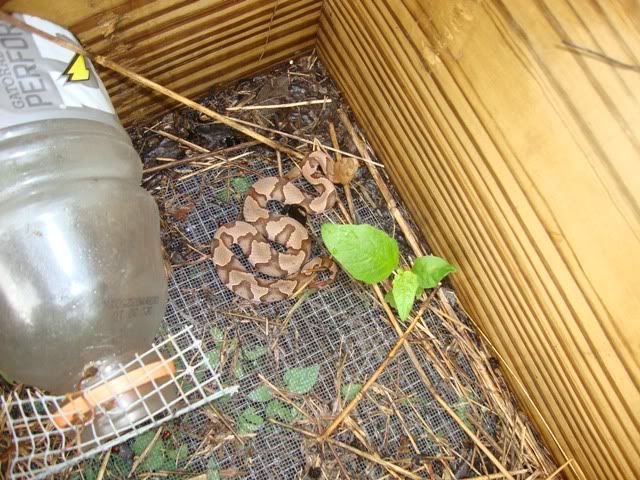
The Copperhead (Agkistrodon contortix).  I just can't get enough of Copperheads.  I'll post pictures of every one I see.  They are absolutely beautiful.  This little juvenile was in our grassland/old field drift fence after a few days of heavy rain.  Could have been after some frogs that crawled in....who knows.

____________________________________________________________________________

The Box Turtle in the funnel trap.  Well, it wasn't quite in the funnel trap, I guess.....  But it sure seemed like it was trying to get caught!  When we found it, the turtle had been meandering along the fence right up to where entrance to the funnel (which it couldn't fit into, as you can see below).

This adult male ended up getting marked number 13 and left to go on about his business.


___________________________________________________________________________

The cyst-laden Two Lined Salamander (Eurycea cirrigera).  This week Dave actually randomly saw two of these guys wriggling around in the leaf litter near our fences and grabbed them.  A consequence of the more moist conditions out there these days is that salamanders hang out closer to the surface of the ground.

After giving one of them a little scrutiny, we noticed these white dots that appeared to be just below the surface of the skin of this little guy's front legs.  I'm fairly positive these are the larval stage of some type of parasitic flatworm.  Either a trematode (a.k.a. fluke) or a cestode (a.k.a. tapeworm)...probably the former.  While I can't be 100% sure of this, because we didn't want to necropsy the animal to be sure, I've worked with two parasitologists in the past.  Both were involved in research on amphibian parasites, and these little critters pick up alot of invertebrate baggage throughout their lives.


The lifecycles of parasitic flatworms are fascinating.  Particularly those considered digenetic trematodes.  These may have two or more larval stages that will exist in as many hosts...and an adult stage that occurs in yet a third host....throughout their lifecycle.

Let us begin with a simple example: a group of adult flukes living in the intestines of a predatory wading bird (like a Great Blue Heron).  The flukes in the intestines reproduce and shed eggs...these eggs then exit the Heron when it defecates.  In this way, thousands of eggs are broadcasted into the environment.  Herons often defecate in or near water...when these eggs hit the water, they hatch into their first larval form, which is a tiny free-swimming stage called a miracidium.  The miracidium is microscopic and ciliated.  It uses these cilia (little hairs) to swim around in the water like a paramecium.   They are on the look-out for an appropriate invertebrate host, which is often an aquatic snail of some kind (the first intermediate host for these critters is usually an invertebrate).  When the find a snail, they burrow into their tissues and start to develop.

After a period of development inside of the snail, the parasite is shed and returns to the water as a form called a cercariae. The cercariae are basically microscopic and look almost like tiny little tadpoles..little tail and all.  Now these little guys also start swimming around the water looking for a host (called a second intermediate host)..but this time they don't look for a snail.  This time they're after a cold-blooded vertebrate (often a fish or larval amphibian).  The cercariae penetrates the skin of the larval amphibian, burrows into its muscle and encysts into a resting stage called a metacercariae. I *believe* it was the metacercarial cysts that we saw on the arms of the salamander pictured above.

A larval parasite can remain as a metacercarial cyst for a fairly long period of time (what this period of time is, on average, I don't know).  Basically, it bides its time until an appropriate terminal host consumes the second intermediate host.  The terminal host is usually a predatory bird or mammal...but may also be a larger fish, snake, turtle, etc..  So...for example...a heron eats an infected fish...or an infected tadpole/frog.  When that infected muscle is consumed, the metacercariae pops out of the cyst in the terminal hosts stomach and becomes an adult fluke.  Once it is an adult, it can reproduce in the intestines and start generating its own eggs that can then be shed in the feces of the heron and the lifecycle starts anew!

Click here for more information on how these parasites may cause malformations in amphibians.  This is the website of Dr. Pieter Johnson at the University of Colorado.  He has studied digenetic trematodes of amphibians for some time.  There is more information on the lifecycles and also a picture depicting a lifecycle at this link.

I've given you only one example.  Certain parasite species may have more or less hosts....these hosts may be of a variety of critters, or specific to one or two.  Depending on species, adult parasites may end up in places aside from the intestines, such as the lungs, the bladder, the stomach, the esophagus and so on.  And any one host can carry many individuals of many different species of parasite at any given time!

Very fascinating and very complicated life cycle for such a small little critter.  I'll say it again, the importance of wildlife diseases cannot be overstated!

Saturday, July 2, 2011

Week's End Survey Round Up VI: Of Marbled Salamanders, Warty Little Critters, and "Woodland" Meadow Jumping Mice.

This week the-powers-that-be decided we needed something alittle different to occur, which would greatly influence our survey results.  After we opened the traps along the drift fences on Monday....we got back-to-back huge rainstorms Monday and Tuesday night. 

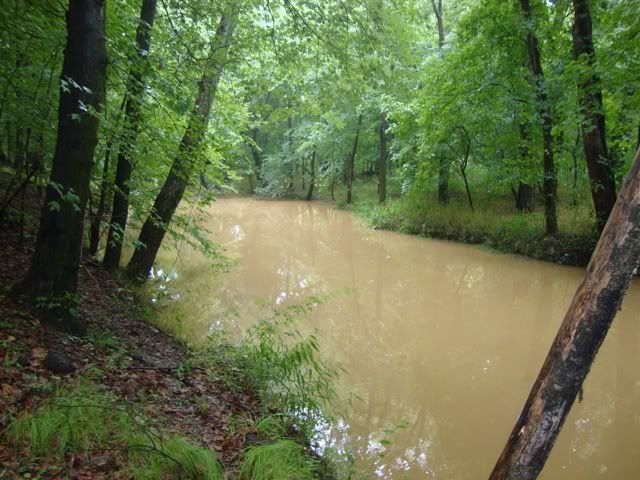
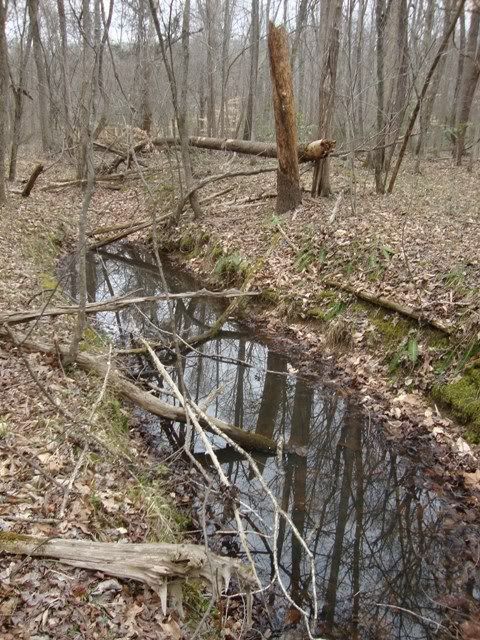
Below is a great before/after comparison of a stream at one of our sites:

A stream before the rains started pictured below.  I was actually standing in the stream bed when I took this picture.

Below is the same stream after the second night of storms.  This time, I obviously couldn't stand in the stream....you'll notice the same leaning trees on the left bank.  But, you may also notice that the fallen log/snag that was in the first picture was apparently washed away by the current!

The wet conditions really brought out the amphibians!

Here are a few of the highlights.

___________________________________________________________________________

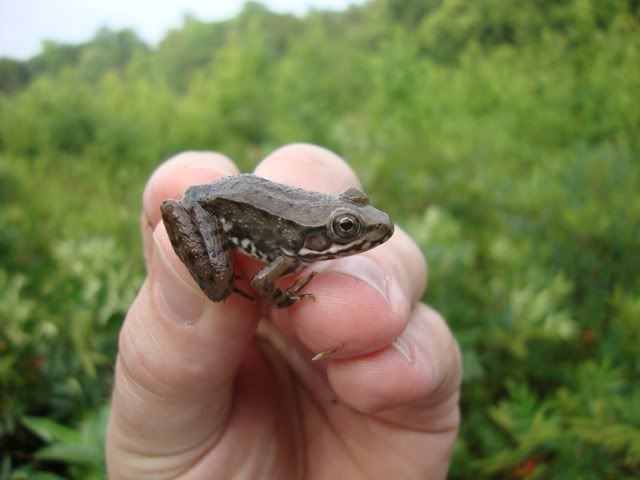
The Green Frog (Rana=Lithobates clamitans): Green frogs are relatively common 'round here.  We'd caught them at this site in minnow traps placed in woodland ephemeral wetlands last year.  We hadn't caught any this year, however.  Unlike many frogs who's tadpoles hatch, develop and turn into froglets in the same year, Green Frog tadpoles usually remain in this larval state over their first winter.  The following spring they metamorphose and become terrestrial.  With the rain, these juvenile green frogs must have decided it was time to migrate away from where they had spent their larval days.....and try to find a new home suitable for froglets!

We caught several in one of our grassland drift fences this week.  All were about as big as the one in the picture.  They can get much bigger than this...and a large adult male can be confused for a bullfrog to the untrained eye!
___________________________________________________________________________

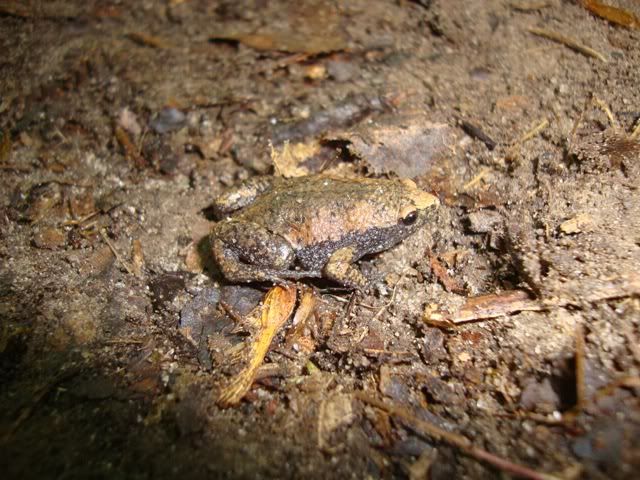
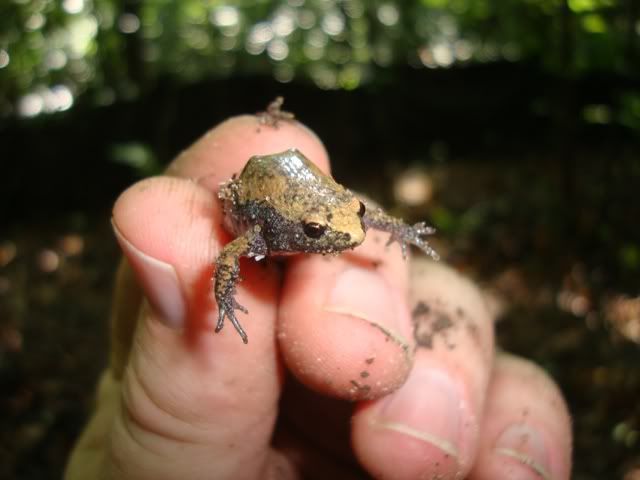
The Eastern Narrowmouth Toad (Gastrophryne carolinensis): The biggest treat for me this week was our Narrowmouth toad captures.  We had gotten one individual last year in a pitfall trap at one of our sites.  We hadn't seen a single narrowmouth toad since.  They remain underground and usually only move around above ground when there are wet conditions.  So this week, we were fortunate enough to catch two in the same pitfall trap of one of our drift fences in a lowland decidous hardwood forest. 

Despite their common name, these aren't really a toad (i.e. they are not a member of the Genus Bufo).  They are, in fact, the only member of the taxonomic Family Microhylidae in our region...so they are not directly related to any of the other amphibians in the state.

Above: these critters spend most of their time below ground and are not very big.  Therefore, they are difficult to find during surveys without the aid of drift fences or coverboards.

Above: The aptly named Narrowmouth Toad.  This roughly adult size for this species.  You may have guessed that this species can't eat big prey with a mouth like that.  In fact, their primary food source is ants and other small insects (Dorcas and Gibbons, 2008).


________________________________________________________________________

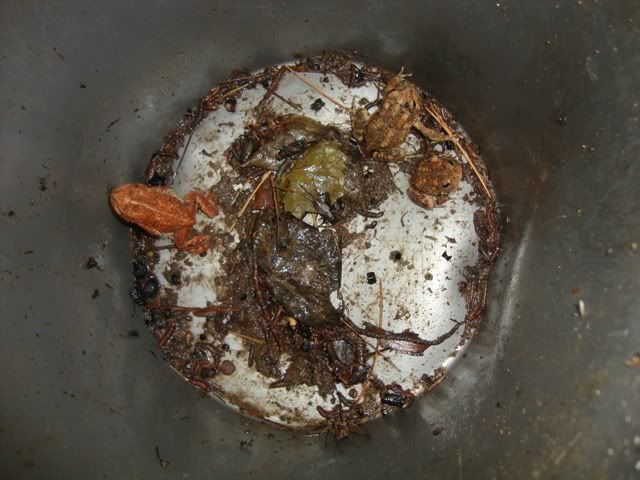
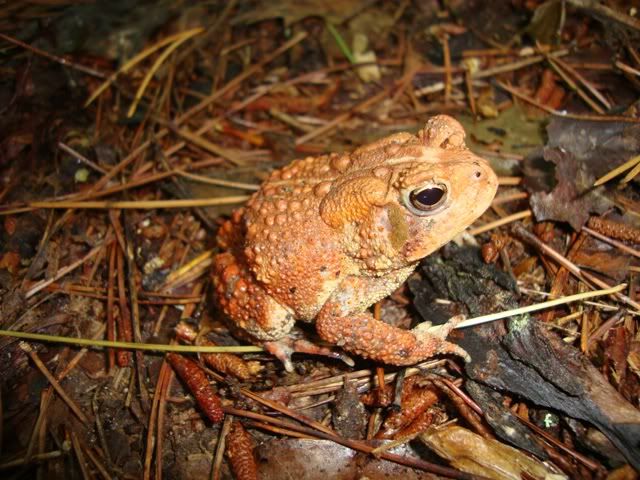
The American Toad (Bufo americanus): I've written about a related species in the past (the Fowler's Toad; Bufo fowleri), but have not said much about these guys.  The American Toad is a very common species at one of our sites....while the Fowler's toad is dominant at the other.  After a rain, the toads really move around and we get them in decent numbers within our drift fences.

Above:  Three American Toads captured in one pitfall trap along a upland deciduous hardwood forest drift fence.

Above: American Toads are usually a bit drab compared to Fowler's Toads, in my opinion. However, this individual was a nice orange/red color....very cute little bugger too.

_________________________________________________________________________

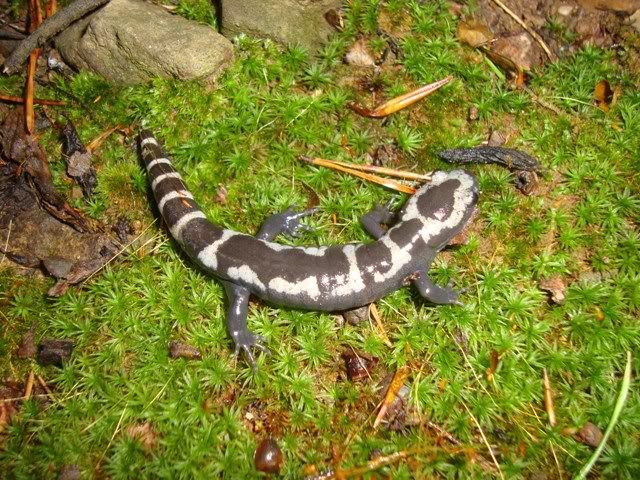
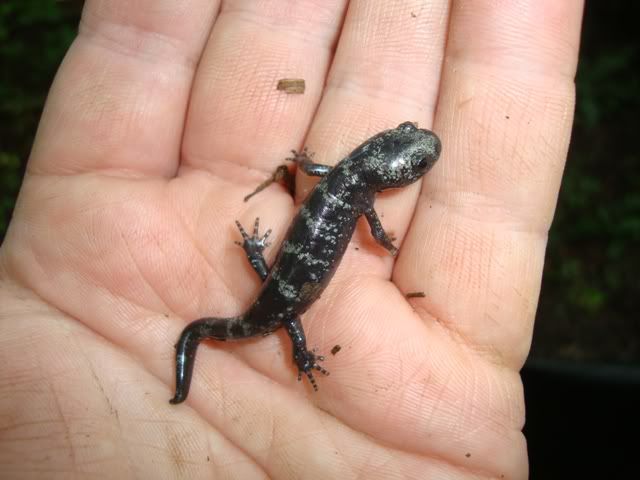
The Marbled Salamanders (Ambystoma opacum): It's been some time since we've caught any of these critters at either of our sites (the last ones were captured in late March, see here).  In fact, we'd never caught them at one of our sites until this week.

The heavy rain that bombarded us drew them out.  We caught numerous individuals in just about every day that the drift fence traps were open, at both of the sites.  So we added them as a resident species to one of our study locations (after nearly a year of surveys without finding them at this spot).  it just goes to show how important random environmental events and conditions are in the activity of wildlife (particularly amphibians and reptiles). Not only did we capture numerous adults, but also juveniles. 

It is interesting to note that not a single individual was found under our woodland cover boards.  In other words, these critters had been patiently waiting for a rain event to get moving.

It's also interesting to note that we didn't see a single individual of any other resident salamander species this week.  I guess it wasn't there time to move around, like it was for the Marbled Sallys.  By why was it their time to move?  This species typically spends its time underground or below debris, when it is outside of the breeding season (and these guys don't breed until the fall around here).  Yet, it had been so very dry for the month of June.  Perhaps after waiting-out the dry spell....they really needed to bust out and find some food after the rain hit.

But, then why didn't we catch other salamader species doing the same thing? 

Above: an adult Ambystoma opacum.  Such a very handsome little salamander.

Above: Two pictures of juvenile Marbled Sallys.  The picture on top shows a slightly younger individual...see the heavy flecking and lack of any resemblance of adult pattern.  The picture on the bottom shows an older juvenile.  You can still see some flecking...but that pattern of adulthood is starting to creep in too.

________________________________________________________________________


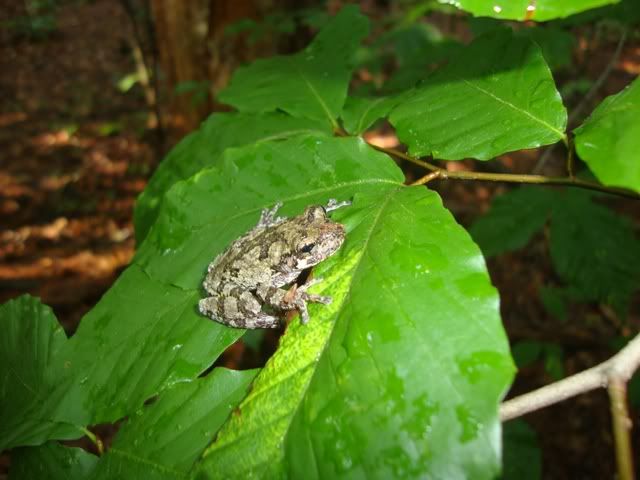
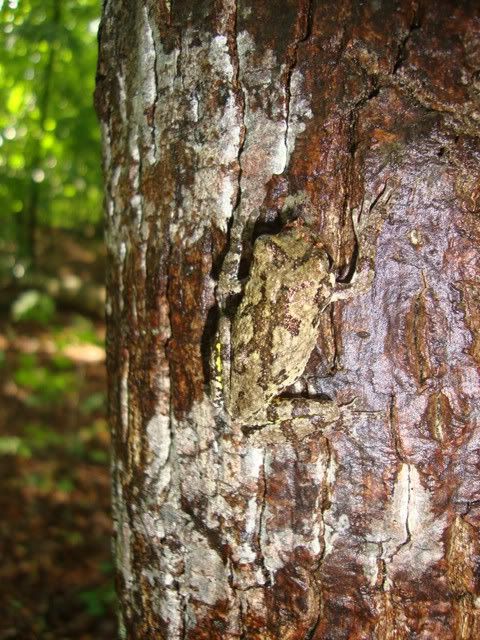
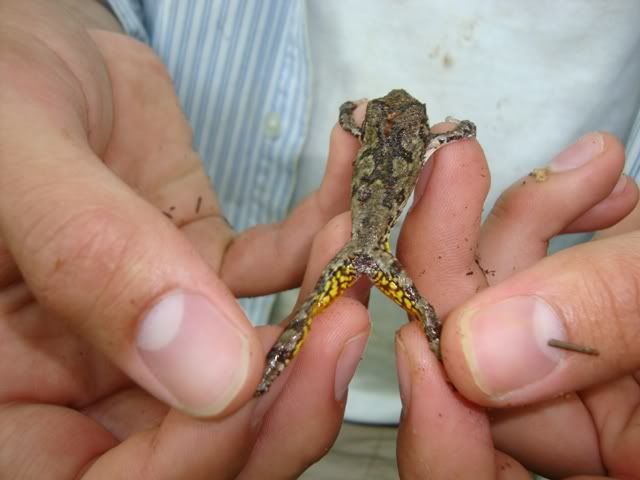
Cope's Gray Treefrog (Hyla chrysoscelis): Another species that we haven't physically seen since late March (see here), although we often hear them calling at both of the sites.  This was a sub-adult, but still looking very much like an adult in coloration.
Above: they show up great against a green background...but put them on the bark of a tree and watch them disappear (below).


Above: the yellow around the inner-thighs and groin is diagnostic for both species of Gray Treefrog in this region (The Gray Treefrog and the Cope's Gray Treefrog).  They are very difficult to tell apart in-hand...but the calls of males differ.  I've only ever heard Cope's Gray Treefrogs calling at this site, so I'm going to assume this is one of those.

_____________________________________________________________________

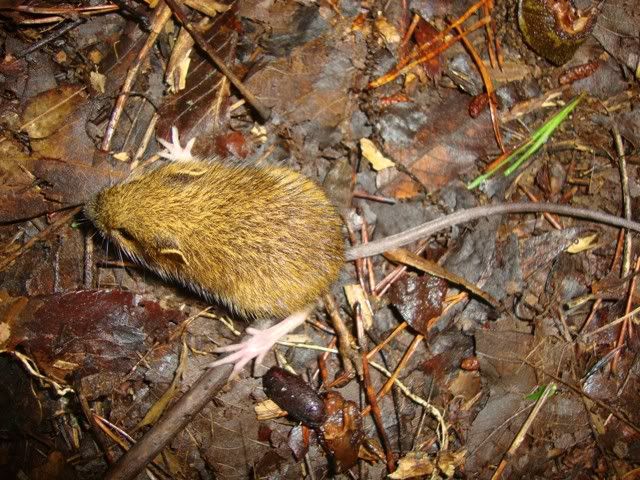
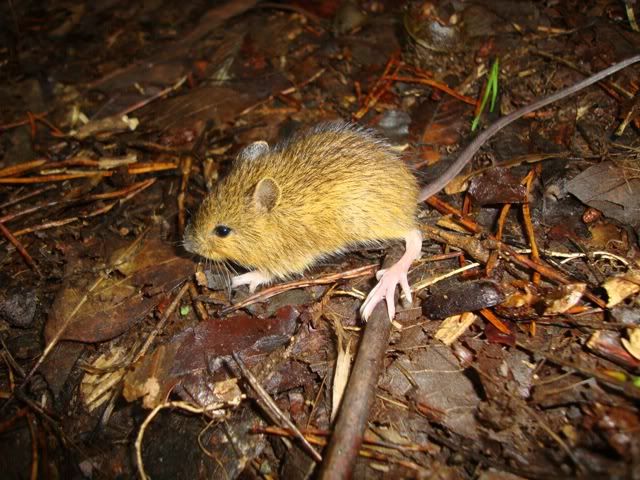
The Meadow Jumper (Zapus hudsonius):  We've now captured three Meadow Jumping Mice at this site.  Given the very spotty distributional information for this species in our state, these are cool findings!  Interestingly, this individual was in one of our upland deciduous forest drift fences....not in the grassland drift fence (like the other ones we've caught).  Not sure what a Meadow Jumping Mouse is doing in the woods, but these things happen.  In fact, I've captured them frequently in woodlands during vertebrate survey work at a site in the U.P. of Michigan back in 2009.

I love the Genus name Zapus.  Feels cool to say...rolls off of the tongue nicely.  It has a Greek origin, with Za meaning "very" and Paus meaning "feet" (Schwartz and Schwarts 2001).  This can be loosely translated into something with big feet, or very large feet (from the pictures below, you should be able to see that this is very descriptive name).

I at first had a glimmer of hope that perhaps we had found a Woodland Jumping Mouse (Napaeozapus insignis).  The genus name translating from latin into "wooded glen" and "big feet".  The Woodland Jumper species is not known from our region of the state at all, according to Webster et al. (2003).  But, so little survey work for small mammals like this has really been conducted throughout the state, so I thought there was always a chance.  Both species look very similar: long feet, a darkish band of pelage down the middle of the back, and strongly bi-colored tail (dark on top, light on the bottom). 

The kicker is in the tuft of hair at the tail tip.  In the Meadow Jumper, this tuft is comprised of dark hair (not whitish hair, as in the Woodland Jumper)  As you can see from the second picture below, this individual had some pretty dark hair on its tail tip.

Above: check out the feet on the Meadow Jumper!

Above: the bi-colored tail, and dark hair at the tail tip are visible in the picture above.  The dark tuft of hair is a giveaway for the Meadow Jumper (rather than the Woodland Jumper).


______________________________________________________________________

The Eastern Box Turtle (Terappene carolina): The rain brought out the box turtles too!  We found three (one along the road, one in a pitfall trap, and one sitting along an upland forest drift fence).  The one we found sitting along the fence was actually turtle E006, which we had a radio transmitter on last fall.  This February, however, we found the transmitter with no turtle attached to it.  We weren't sure what happened to the turtle...we thought it was possible a raccoon or something got it when it was lethargic during the winter.

Not true, it would seem.  It turns out, blame can be laid on the crappy Loctite Epoxy we used to stick the transmitter on the turtle (or perhaps the person applying the epoxy...i.e., me). 

Either way, it's nice to know the turtle is okay!

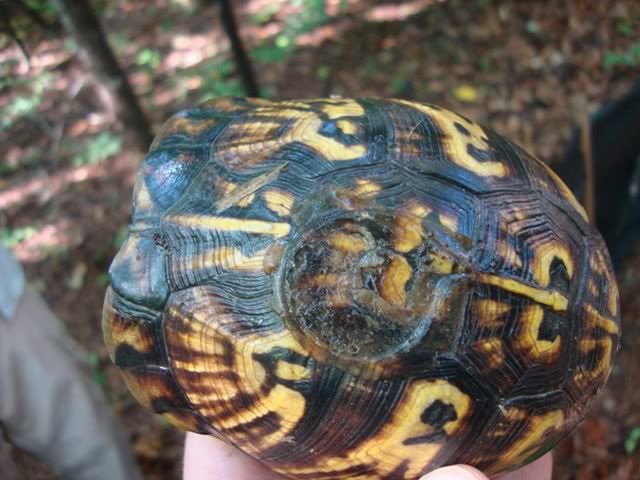
Above: you can see where the transmitter was epoxied to the shell of this individual last year.  We lost it this February when the epoxy failed. 


The individual in the picture below represents only the second box turtle we've captured in drift fences (although we find a fair number through just random visual surveys while walking around in the woods).  It's also the first one we've caught in this grassland drift fence.


Literature Cited:

Dorcas, M., and W. Gibbons. 2008. Frogs and Toads of the Southeast.  University of Georgia Press.

Schwartz, C.W., and E.R. Schwartz. 2001. The wild mammals of Missouri (2nd Edition). The University of Missouri Press, Columbia, Missouri.

Webster, W.D., J.F. Parnell, and W.C. Biggs. 2003.  Mammals of the Carolinas, Virginia and Maryland.  University of North Carolina Press.
Friday, June 10, 2011

Return of the Backyard Denizens

It had been very dry out there for a few weeks.

Then, a huge thunderstorm came through the area yesterday afternoon.  This morning the ground was wet and the air was thick with humidity.

This was apparently what the local Eastern Box Turtles (Terrapene carolina) were waiting for.

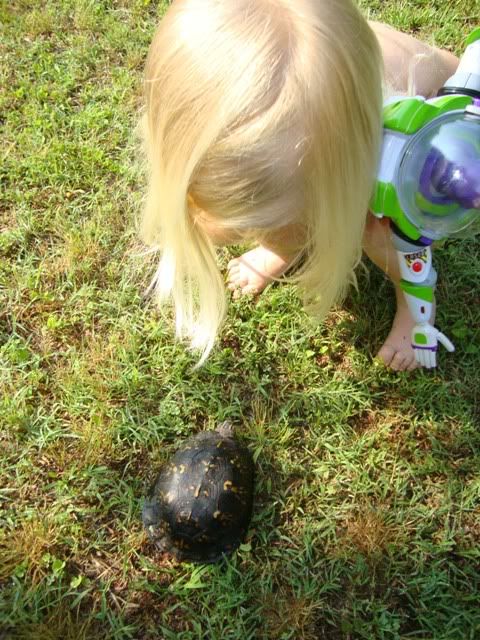
My daughter and I were about to head out back and enjoy the morning cool, when I happened to glance out the window and see this fella wandering across the lawn.

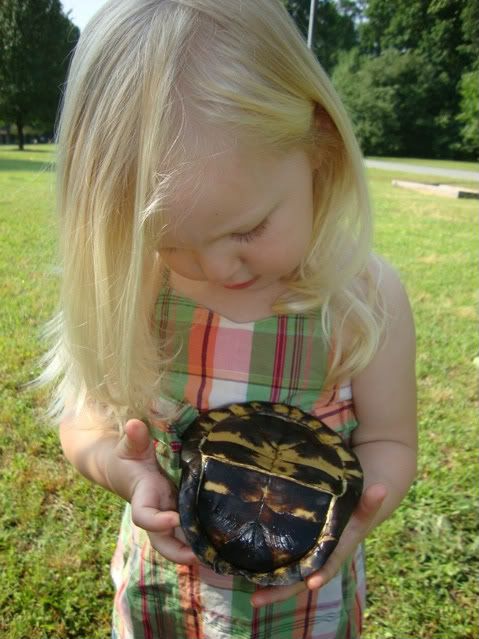
We ran out and, much to my daughter's delight, got to hold the little urban box turtle (a male, as you can see by the concave plastron in the second picture below).


I then took him across the road in the direction he was heading.  There is a somewhat mature wooded buffer between the houses across the street.  I watched him from our side while pushing my daughter in her swing to see which direction he would head.  I figured I'd stop him if he started making his way back to road.  But, as I suspected, within a few minutes he quickly scooted into the woods beyond and out of sight.

For more information on box turtles in suburbia, I've summarized some pertinent information in a previous post.

Happy Friday everyone!

Tuesday, May 10, 2011

Up and About for Spring


You may remember that I posted some information on the box turtle radio telemetry project that I have ongoing (see The Turtle In the Box, posted on February 23, 2011).  We've been monitoring the critters since late February, hoping to nail down their emergence from hibernation.

Since that time, the six turtles* with radio transmitters attached to their shells had remained buried in their winter hiding locations....until about late April.

On April 20th, the one individual (a male named H001) had left his burrow for the first time this spring.  I found him about 8 ft away from the burrow sitting in a sunny patch.  None of the other turtles had moved from their overwintering locations at this time, although two individuals had "semi-emerged" from winter dormancy.  They (both males) were completely buried the week before, but on the 20th they had come close enough to the surface that their heads and upper shells were exposed. 

Above: H005 found on 5/6/2001 in a burrow created when the root of an old tree stump rotted away.


The rest of the turtles were still down at that time.
________________________________________________________________________

By April 30th, all of the turtles had left their winter abodes and moved some distance.  In fact, at that time I couldn't find H001 with the telemetry equipment.  I kept getting a signal, but it was wonky because he had moved so far.  I was in alittle bit of a rush on that particular day, so I had to give up on locating him for the short term.

Above: Undergraduate researcher tracking box turtles with telemetry equipment.

On Friday (May 6, 2011), with the help of some undergraduate researchers, I was finally able to get out and make a full-scale attempt to locate H001.  It took a while, but this time he was found.  Telemetry signals bounce around something terrible when in a woodland (the signal is blocked by and bounces off of trees, rocks etc.).  This is exacerbated if the person holding the telemtry antennae is in a ravine and the turtle being tracked is at the top of an adjacent hill (which is exactly what happened with H001).  The result is that the person who is tracking the turtle may wander around in circles, as the signal leads him/her in many different directions that don't end up at the turtle.  Once I got it through my thick noggin' that this was the score for H001, I finally thought to hike to the top of the ravine slope.  That's when I found him.

There he sat....partially covered with leaves in the middle of the woods.  He looked almost indignant, or at least annoyed, when I walked up to him.  This is probably because no matter how far he travels, this silly pink bipedal mammal seems to find him.

I'd be annoyed too.

Above: the incredibly mobile H001 as I found him on 5/6/2011

Above: Box turtles blend in particularly well.  Pictured above is the same turtle (H001).  This photo was taken at chest height, pointed down at the turtle.  He's in there, if you know where to look!


Anyways, he really had to high-tail it to get that far in such a short time.  In the process, he crossed a rather quick flowing stream with pretty steep banks and a rocky bottom.  How he crossed the stream, I honestly do not know.

Why did he go so far?  It's likely part of what he does every year.  Perhaps he was on the hunt for a female...males tend to move alot for this reason.  In general, however, this is not a very mobile critter.  Most remain within the same small home range (i.e., the area the animal roams in during the active season) throughout their lives.  For example, an individual Eastern Box Turtle tracked in New York was found to remain in the same general home range for 15 years (Nichols, 1939).

We'll see where he goes from here.

Literature Cited:

Nichols, J.T. 1939. Range and homing of individual box turtles. Copeia 1939: 125-127.
_______________________________________________________________________

*At the start of this study, 9 turtles were affixed with radio transmitters...three had the transmitters chewed off by something over the winter.  Although it's plausible that they were eaten by a racoon or oppossum, I never found any turtle corpse....just the transmitter.  I'm hoping the Raccoon, or whatever, simply chewed the transmitter off, but realized the actual turtle, with its tough shell, was too much work and gave up.

Tuesday, March 15, 2011

Backyard Denizens & Cronon's "The Trouble With Wilderness"

The concept of Urban Wildlife Ecology may seem strange to many.

Perhaps environmental historian William Cronon's commentary best highlights the difficulty that some have in grasping the importance of "Urban Wildlife".  As Cronon states in his essay The Trouble With Wildnerness; Or, Getting Back to the Wrong Nature, "For many Americans wilderness stands as the last remaining place where civilization, that all too human disease, has not fully infected the earth.  It is an island in the polluted sea of urban-industrial modernity, the one place we can turn for escape from our own too-muchness." 

However, according to Cronon, the idea that wildnerness can only be found in remote "pristine" and protected lands is fiction.  He believes that we have a misunderstanding of nature and our place within it.  He seems frustrated with the fact that modern environmentalists focus only on pristine landscapes as being wilderness.  Such pristine landscapes, says Cronon, don't exist. 
"The myth of wildnerness", he concludes, "is that we can somehow leave nature untouched by our passage." 

Because protected lands have not avoided humanity's influence, they alone do not represent "wilderness" (according to Cronon).  He also states that by associating wildnerness with only protected, pristine environments we further separate ourselves from the natural world.  Thus, Cronon believes that we should find wilderness anywhere in our surroundings, including your own backyard.  At least....I think this's what he means.  If wildnerness can be found in something we are close to (like our backyards), it helps us better associate with wild things and view them as worth protecting.  By focusing only on protection of pristine lands and only conducting ecological research there, we fail to focus our efforts on an area of equal conservation importance: where the anthropogenic and the natural world frequently collide.  These include urban and suburban landscapes. 

Cronon's notions were met with opposition, but he poses an interesting idea.

Even professional biologists fall victim to the idea that ecological research should only be conducted in pristine, untouched landscapes (myself included).  Recently, however, research focused on urban and suburban landscapes has frequently began to creep into hardcore ecological research.  In past posts, I've mentioned the book Urban Carnivores (edited by Gehrt et al. in 2010).  There are other similar books, also mostly written for biologists and ecologists, including Urban Herpetology (an outstanding volume edited by Mitchell, Jung Brown, and Bartholomew in 2008), and Urban Wildlife Management (written by Adams and Lindsey in 2009).  These are just a few examples of efforts put into understanding how wildlife behaves and survives at the human/natural interface. 

This is a great thing.  The best way to mount animal conservation efforts is to understand how wildlife interacts with humanity.

I'm not saying that I fully embrace Cronon's notion (if I understand it correctly) that we should not place so much emphasis on natural places as the ideal of what "wilderness" is.  Although I agree that it is possible to see "wilderness" all around us, there are many species that cannot handle urban or suburban versions of wilderness.  Without these species, we have an imperfect cast of characters present in our wildnerness.  I don't find this acceptable.  Although conservation in urban areas is important, its still important to conserve places that feel fewer anthropogenic influences.  This is required for the species that don't deal well with humanity....they need somewhere to reside, afterall.
But...as usual....I've gotten off track.  No wonder no one reads my blog; I talk too much!

Anyways, I have become incredibly interested in Urban Ecology since my arrival here.  Mostly because of the observtions I've made of wild animals in my own backyard.  In fact, I've posted on the suburban gray fox that I have frequently seen moving through our lot (see The Gray Ghost, posted on Feb. 20, 2011).

But, this dainty little carnivore is not the only critter I've found meandering through our manicured field of Kentucky Blue Grass, munching on our garden vegetables, or using my pick-up truck as shelter from the sun.

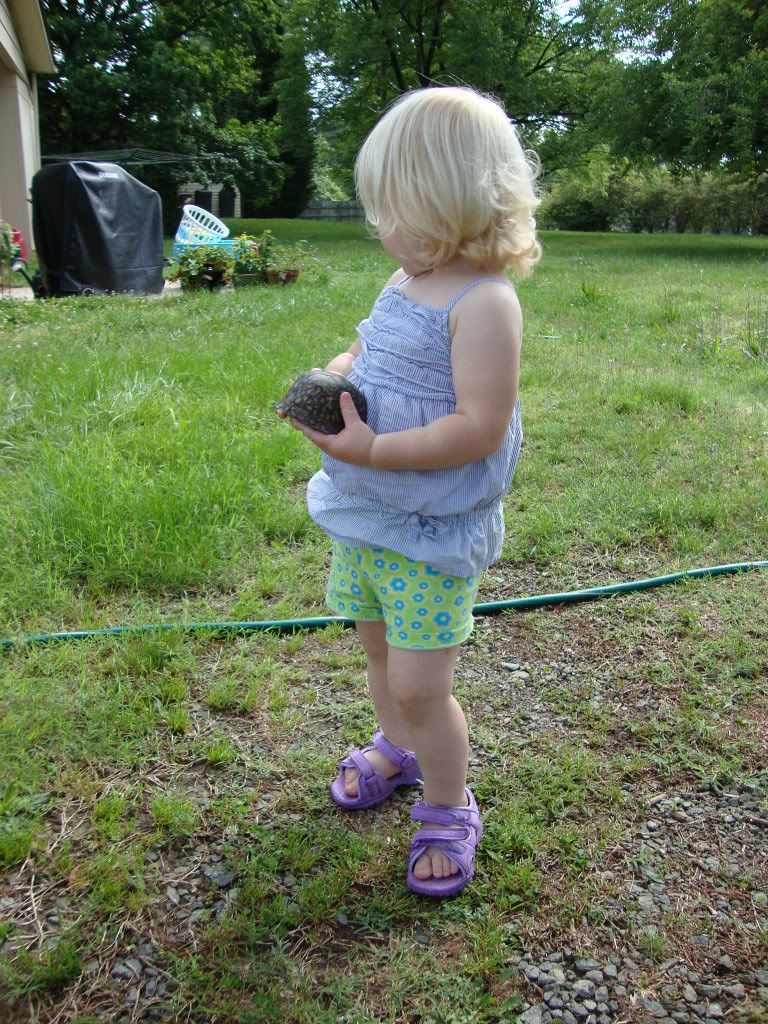
The Eastern Box Turtle (Terrapene carolina). I'll start with one of my favorites: the unassuming little eastern box turtle.  Last May, on a Saturday morning after heavy rains, I hopped in my truck and started backing out of the driveway to run some errands.  Looking over my shoulder, I backed the truck up about 15 ft before glancing forward at the gravel driveway leading up to the house.  At that moment, I noticed a small round lump sitting on the grass between the tracks kept bare by our tires in the driveway.  I stopped the car, got out and walked over to the little gal.  She sat motionless, bunched up in her tightly-sealed shell.  I was glad she hadn't been sitting behind the tires, or I would have accidentally crushed her, not realizing she was there.  I picked her up and called to my daughter and wife.  They came out and...much to my daughter's delight...picked up and looked at the little turtle.  After a few attempts by my daughter to place the timid reptile in her mouth, which mommy and daddy thwarted, I placed the turtle at the base of some shrubs along our back lot line.  She sat there most of the day, and by the next morning was gone.

My daughter holding the eastern box turtle found under my truck


Box turtles are faced with much different challenges in urban/suburban landscapes than are more mobile vertebrates like deer and fox.  Budischak et al. (2006) studied population parameters of box turtles associated with urban landscapes near Davidson College in North Carolina.  They found that adult survivorship in urban landscapes was lower than landscapes with greater tree cover.  They speculated that the reduction in survivorship occurred due to a variety of factors: human-subsidized predators, like raccoons (Procyon lotor), habitat degradation in urban areas, and higher road mortality.  Brisbin et al. (2008) found that although survival rates of adult box turtles in urban landscapes did not differ from those in forested landscapes, there was a tendency for female box turtles to migrate onto open suburban lawns during the nesting season.  Because these nests may be more prone to human-subsidized predators, and females are more likely to be killed during migrations to nest in suburbia, long-term population sustainability seems unlikely.  Furthermore, even if studies find that survival rates do not differ between urban/natural landscapes, recruitment rates for urban populations (i.e. the rate at which young individuals enter the population) are reportedly low.  Ferebee and Henry (2008) studied a population in a Washington, D.C. park and found it to be comprised of mostly older adults, with few sub-adults or juveniles present.  So, little successful reproduction occuring within this population likely meant low potential for the population's persistance.

So, just becuase you find a box turtle in your yard, doesn't mean suburbia is good for them.

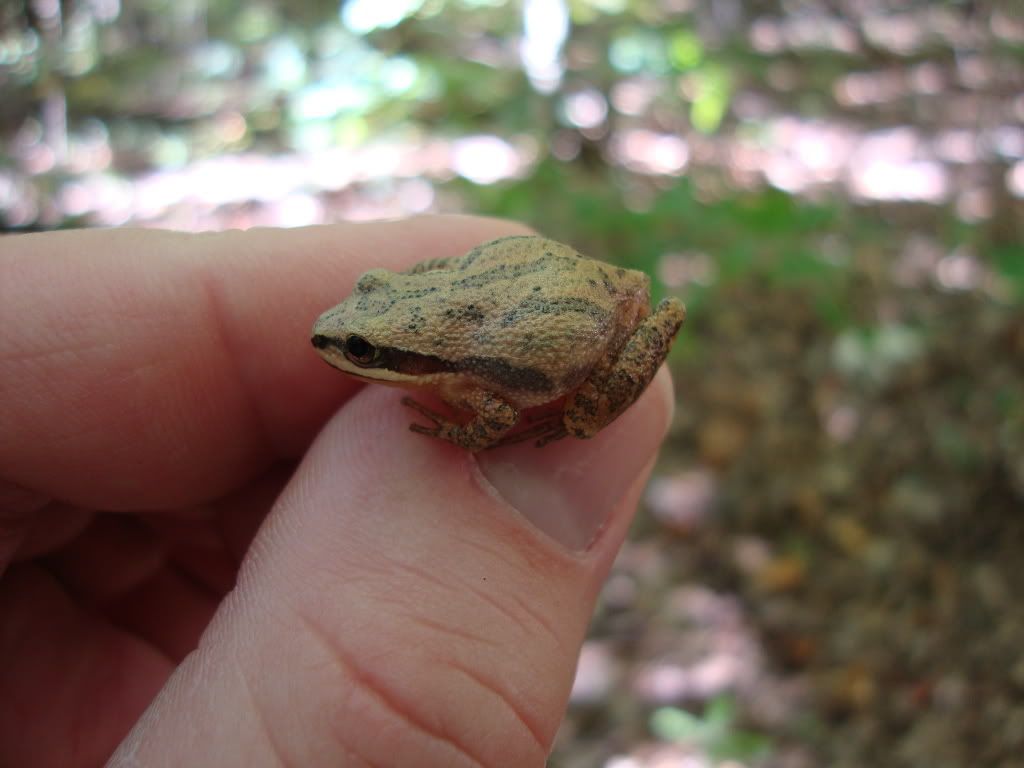
The Upland Chorus Frog (Pseudacris feriarum).  In my first spring here, I noticed immediately the calls of this little amphibian.  One of the first species to call in the spring (and very loudly, I might add), I heard their mating cries from a small wetland nestled between the homes in my neighborhood in February of 2010.  Even now (March 2011), every evening when I take the dog out for his nightly evacuation, I hear them and the spring peepers screaming away, going about their business as best they can in their suburban wetland.  Often, this species breeds in natural ephemeral wetlands within deciduous hardwood forests.  In fact, I heard a chorus of these little frogs in just such a wetland today (see picture below).

A Natural Ephemeral Wetland Where Chorus Frogs Were Heard Calling on 3/15/2011

I've even captured the adults in the fall on the concrete floor of our open car-port....I'm assuming in migration back to some location that they will spend the winter in, although I scarecly imagine where that is in our neighborhood.

An Upland Chorus Frog (Pseudacris feriarum)

Amphibians in urban/suburban habitats face many challenges.  Like the box turtle, they have a limited capacity to move large distances.  Thus, they often become isolated in small "green space" buffers between housing developments, which are likely traps that can result in local population extinction.  If you are interested, I would highly recommend the previously mentioned volume Urban Herpetology for numerous studies and reviews focused on amphibians within such landscapes.

I have more photos to share of urban wildlife.  However, I'll save those for the future.


Literature Cited:

Brisbin, Jr., I.L., J. A. Kennamer, E.L. Peter, and D.J. Karapatakis. 2008. A long-term study of eastern box turtles (Terrapene c. carolina) in a suburban neighborhood: survival characterisitcs and interactions with humans and conspecifics.  In Urban Herpetology (Mitchell, Jung Brown, and Bartholomew; eds). Herpegological Conservation 3:373-385.

Budischak, S.A., J.M. Hester, S.J. Price. and M.E. Dorcas. 2006. Natural history of Terrapene carolina (Box Turtles) in an urbanized landscape.  Southeastern Naturalist 5:191-204.

Ferebee, J.B., and P. F.P. Henry. 2008. Movements and Distributions of Terrapene carolina in a large urban area, Rock Creek National Park, Washington, D.C. In Urban Herpetology (Mitchell, Jung Brown, and Bartholomew; eds). Herpegological Conservation 3:3765-372.