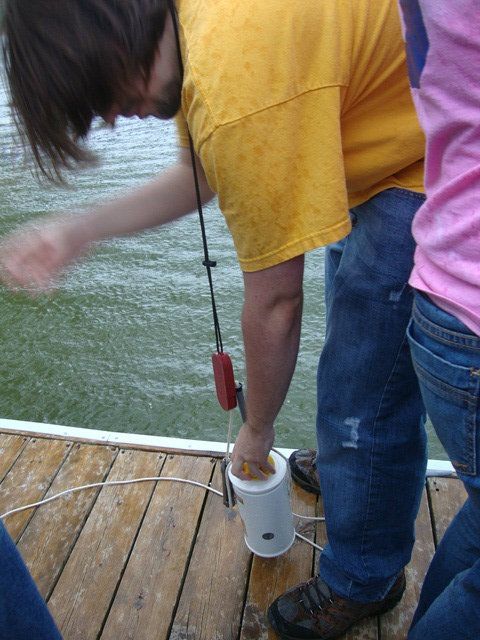
This is Dave.
Dave is an undergraduate student who is particularly good at field work.
Depending on one's point of view, this is unfortunate for him.
Mostly because your humble Trailblazer snatched Dave up and used his own insidious powers to entice Dave into the evil world of Wildlife Ecology! A field full of catching cool critters with traps, and spending alot of time outdoors! It does have it's downsides, though...Lyme disease is a constant threat where we work. The summer heat here is brutal. Often times, the traps you set with such care and effort end up as empty as your pocketbook (should one pursue this field as a career, that is).
Obviously, it's about alot more than money. If it weren't, I wouldn't be here. Yet, I think the fact that you wont make six figures in this field is often somewhat of a shock to students, as well it should be.
As usual...I'm off-track.
ANYWAYS, Dave is involved in a great camera trapping project with me and I thought I'd share some of the initial project set-up with you all. I'm not going to list the full objectives just yet. I figure, I'll wait until we've analyzed some data first.
In late 2010, we acquired a number of Reconyx cameras (no easy feat, considering the cost of those cameras). These are HC600 model, "black flash" cameras, meaning that even the red LEDs which illuminate the area for an infrared photo at night emit almost no visible light. In fact, I have to hold the camera about a foot from my face at eye level to see the red LEDs at night. Pretty cool!
These Reconyx area also picture-taking machines. They will snap off up to 10 pictures in rapid succession when they detect something, and immediately start the process over again if they still detect movement. The trigger time (the time between when the camera sensing an animal and takes a picture) is less than 0.5 seconds!! Compare this to the Bushnell's that I also use, which can only take up to three pictures, have very bright LEDs at night (enough to
scare coyotes), and have a trigger time approaching 2 seconds!
To put it bluntly, these are some bada$$ cameras! Athough the picture clarity may not always be as good as a nice home-brew camera, they never miss a thing. When one needs to identify every single medium to large mammal that may pass within the vacinity of a camera, the Reconyx does the job brilliantly. I'd never buy another camera, if it weren't for the fact that the Reconyx also comes with a price tag to match.
Anyways, this not meant to be a pro-Reconyx post. I'm just excited to have a camera that does what I want it to do after months and months of slogging along with other commercial cams that end up annoying me more times than not.
__________________________________________________
In mid-February of 2011 we began a month-long baseline data collection period for this project (I've actually posted some
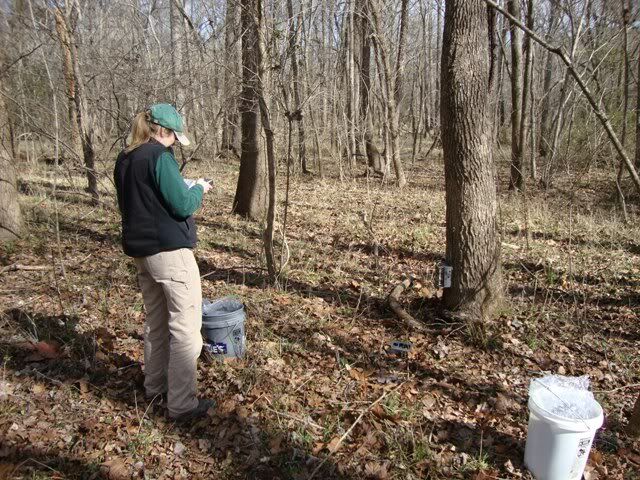
pictures from this period already). We are conducting our project with the state bear and furbearer biologist (pictured below), which is outstanding as she's a great field person and alot of fun to work with.
Above: Camera traps organized and ready for deployment at the beginning of the project!
We used Geographic Information Systems (GIS) to select specific locations for cameras to be deployed within our study site. We then used GPS units find the pre-determined camera locations in the field. Once we arrived at a given set of coordinates, we found a location of high wildlife activity nearest our pre-determined GPS point and mounted a camera. We then recorded new GPS coordinates of the actual location where the camera was deployed.
Above: Recording GPS coordinates for actual camera deployment site in the field.
In total, eight cameras were placed on-site within our available study area. The red dots in the picture blow indicate actual camera locations as of today.
Above: specific camera locations on-site
After a month of baseline data collection, we began application of the treatments we are testing (again, I'll explain more in the future). This required us to use a GPS unit to find the cameras again (becuase the old Trailblazer's mind is frequently muddled with important information that will not allow him to remember the exact locations of cameras in the field).
Next, the cameras were serviced and we went along our merry way. Hopeful of good things to come!
Above: Using a GPS unit to find camera deployment sites after a month
Above: servicing deployed camera prior to application of treatments we are testing.
So, aside from the fact that I used the word "deployed" alot in the above description (because I really like that word), this gives you a general idea of how we started the project.
Like I said, I will likely report results specific to this project in upcoming months, after we start analyzing the data.