Showing posts with label Salmanders. Show all posts

Saturday, June 18, 2011

Week's End Survey Round Up IV: Applied Knowledge.


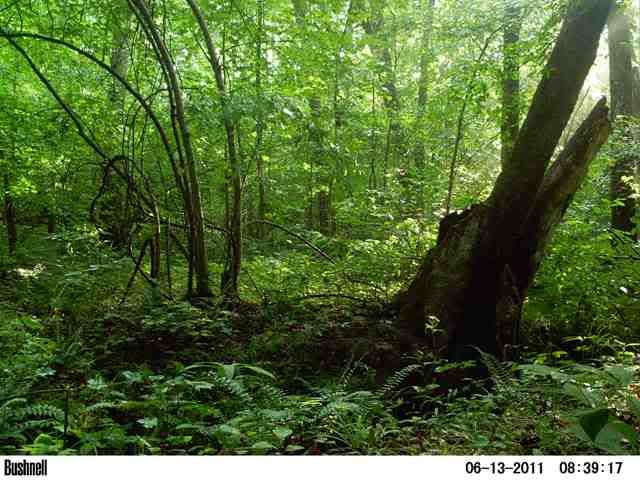
It's rare that a camera trap picks up nice photographs of scenery.  Usually, it requires the camera to take pictures without an animal in-frame...and then it assumes you've chosen a spot for your camera based on it's scenic value (and I never do...I'm choosing based on potential wildlife activity in the area, and the two things never seem to coincide for me).

Anyways, the picture above really struck me for some reason.  The green is so saturated in the picture...everything's lush...the sun barely peeking through in the upper right corner.  It's not a scenic mountain vista or anything, but a simple riparian corridor.

Just looks nice, is all.

___________________________________________________________________________


Well, we've added another stop to our trapping survey circuit every day. 

This one is as much for fun/practice as it is for real data acquisition....you'll see what I mean by this in a second....

Basically, after the Mammal Tracking and Small Vertebrate Survey Workshop that was held at the university (taught by Jim Halfpenny, and myself).....we had left-over Plaster of Paris.  It was technically Jim's.....but he said, rather than trying to ship it home, or lug it on the plane, he'd just give it to us (very nice of him!). 

Dave was a workshop participant.  I co-taught, but focused on surveys with drift fences, coverboards, etc., so I didn't get to do the tracking/casting part of the workshop.  I had done track casting in the past (as a participant in one of Jim's other workshops that the university sponsored last year).  But, I hadn't done it since last year.  So I'm rusty. 

Luckily Dave remembered alot of the rules about mixing the plaster.  It's important to get the plaster to the right consistency, or it wont dry fast enough.
Above: it helps to set up a work station for the mixing, if such a spot is available.  Here, we prep the plaster on a stairway installed for putting canoes into the river.
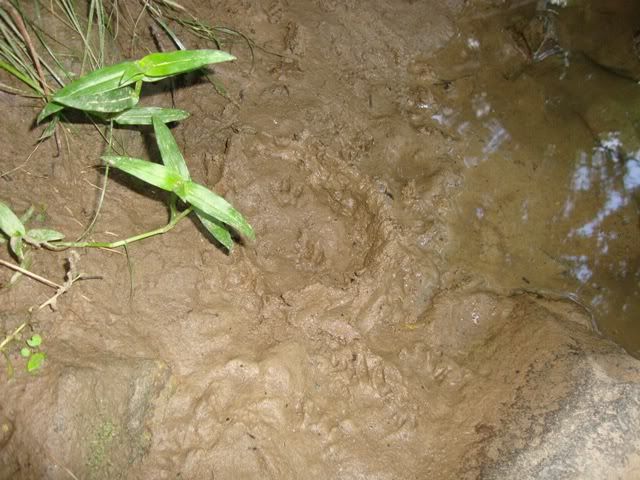

While the plaster is being mixed, someone else builds a wall of dirt around the desired tracks.
Above: prepping the area around a pair of suspected Mink tracks for plaster.
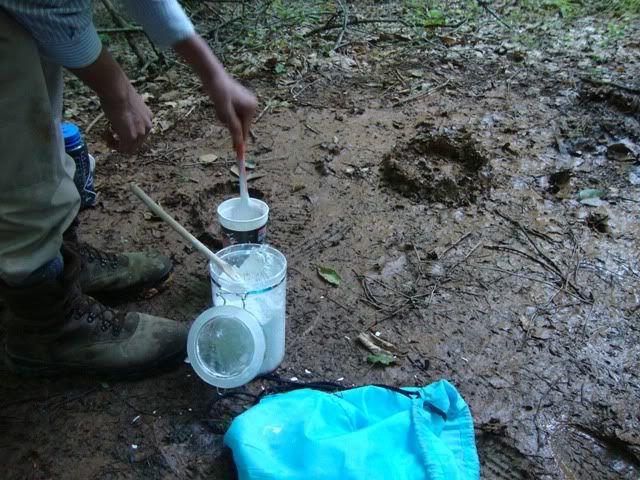
Above:  preparing the mixture for two nice sets of suspected Coyote tracks.  These tracks were not far from the huge pile of 'yote scat I posted about last week.  The location is along an entrance road into a state natural area, where a puddle is often present and the soil is saturated.  Great for tracks!
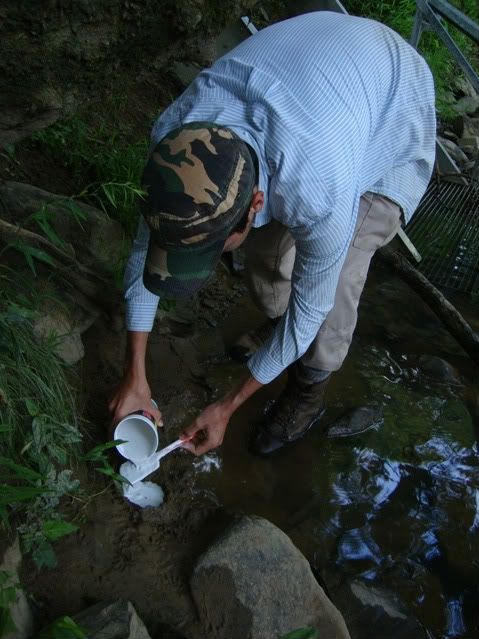

Then, the plaster gets dumped in.
Above: Dave pouring the plaster over some suspected Mink tracks from along the river bank.

And then you wait....
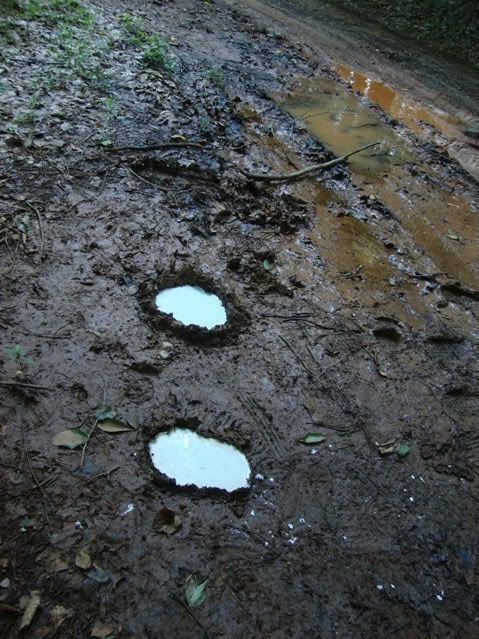
The plaster is such that it dries and solidifies even on saturated soil and mud.  So, after a half hour to 45 minutes.....the plaster is ready to be removed, rinsed and the cast gets dried in the sun for a while....
Above: the pair of suspected coyote tracks with plaster poured on top and waiting to dry.
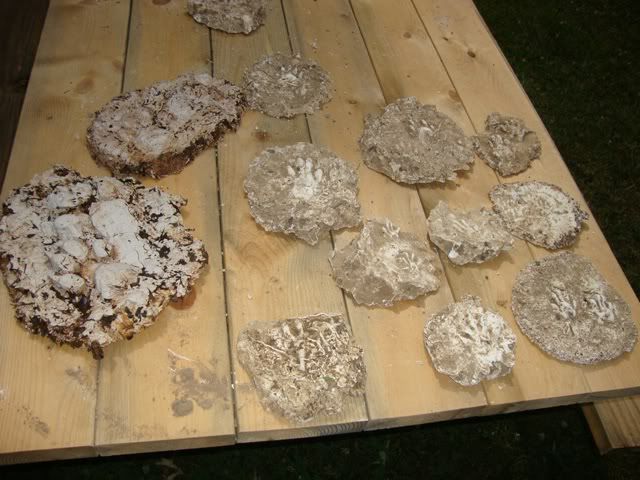
Above: our track-cast library after the first week.

So, to-date we've been making track casts of species we already had evidence of on-site (i.e., Raccoons, Mink, Eastern Gray Squirrel, Coyote).  So, we aren't neccessarily proving anything we didn't already know.

However, being able to cast tracks is a great skill.  You can use it to gain quality evidence of a species' presence on-site, if you don't have camera traps available.  Having the casts on-hand also means that they can be used as a teaching tool in the future.  It's a way for both of us to hone our tracking skills...and apply some knowledge picked up during the worskshop taught by a tracking expert.

It's also fun as hell!  Ironically, Knapperbill over at the Rural Path also had some fun with casting tracks this week.
________________________________________________________________________

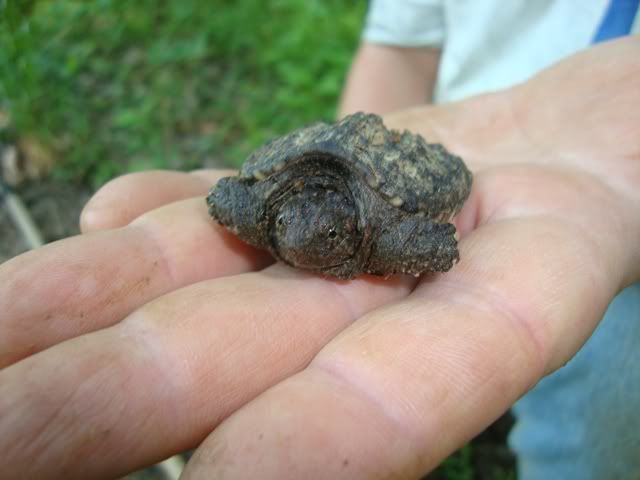
The Common Snapping Turtle (Chelydra serpentina).

This little fella was in the path we were walking along this week.  He was only about 40 yds from the edge of a large old field/grassland, but over 100 yds from the nearest water source (a small feeder stream).

What was a turtle this little doing so far from water?  It's obviously dangerous for a little turtle to leave the water at this age (even a little snapping turtle).  Their shells are pretty soft at this age, and...as you can see...when they are this small, they are completely passive.

One could argue that it's a hatchling, just emerging from the nest...the size is almost correct.  But just a tad big.

It's not completely outside the realm of possibility to assume that this animal was laid in a nest somewhere near the edge of the grassland.  Plenty of sun there to keep the nest warm and the eggs developing.  Female snappers will travel HUGE distances to lay eggs (1.6 km, or nearly one mile, reported for females in Michigan, Congdon et al., 1987).  Thus, travelling over 100 yds from the nearest stream is no problem for a nesting female.

But, most females lay eggs from May 15-June 15 in North America.  The incubation period is 75-95 days...so I wouldn't expect hatchlings to poke out until late August.

Females of some species will "double-clutch" in a year (lay one nest of eggs in the spring/summer and another again in late summer).  These hatchlings may hatch in the nest in fall, but overwinter in the nest and then emerge the following spring.  This phenomena has not been observed often in the Common Snapping Turtle, to my knowledge.

So...I'm alittle stumped on why this little fella was where we found it.

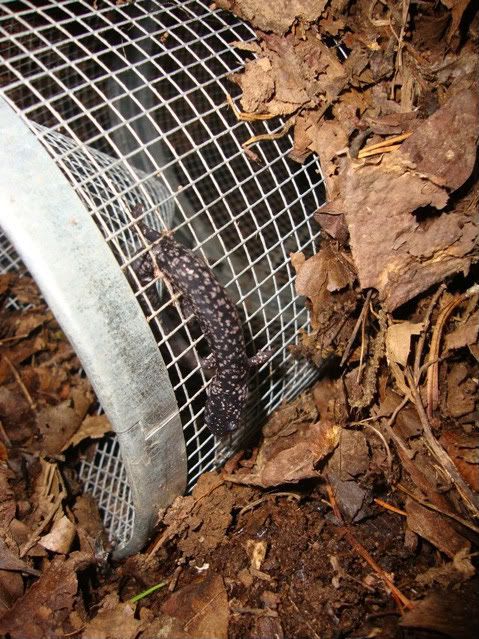
Houdini:  This adult White-spotted Slimy Salamander (Plethodon cylindraceus) caught me by surprise.  I wasn't surprised we caught one (they are our most frequent salamander).  I was surprised by the fact that this one has managed to squeeze itself almost entirely through the mesh of our funnel trap!  How on earth it got its head through is beyond me (the head looks about 20% wider than the mesh apertures to me).  They must be flexible.  Plus, it doesn't hurt to be....well...slimy.

When we came up to the fence, he was caught at the pelvis.  He wasn't stuck too bad, but becuase of the angle I think he just couldn't get enough purchase to pull himself through mesh the rest of the way.

We gently helped him through and he was none-the-worse-for-wear, aside from alittle skin missing from the tail.

The Larval Salamander:  There are several ephemeral wetlands at one of our sites.  "Ephemeral" meaning that they hold water part of the year, but not all year.  Usually, in the summer when it's dry....these wetlands dry up.  In the winter/spring, however, they have water.  This makes them perfect breeding habitat for amphibians.  Primarily due to the fact that, because they are ephemeral, fish cannot live in these wetlands.  Fish eat amphibian larvae and eggs.  So, no fish = good news for amphibians.  The importance of these small ephemeral wetlands cannot be overstated, from a standpoint of biodiversity conservation.

We usually toss a few minnow traps in these little wetlands.  It allows us to see what sort of amphibians are breeding in the ponds.  We've found many tadpoles, mostly Hylids (probably Upland Chorus Frogs and Cope's Gray Treefrogs, as both have been heard breeding around the ponds).

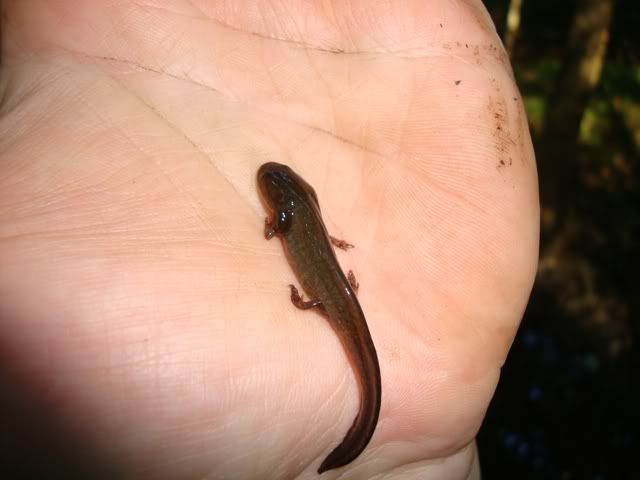
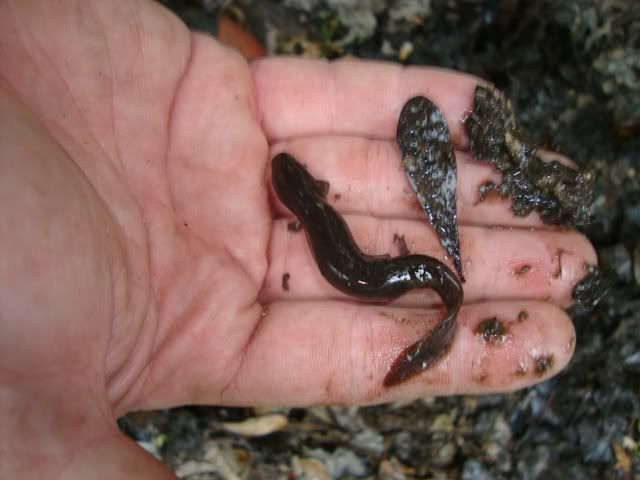
We've also been getting salamander larvae for several months, although the numbers we're catching are smaller these days.  We catch larvae of primarily Ambystomatid salamanders, or salamanders of the Genus Ambystoma.  I'm fairly certain the species is Ambystoma maculatum (the Spotted Salamander).  They are very common in aquatic ecosystems around here, and I captured adults near the ponds this spring (see A Good Day for Herps, posted on March 23, 2011).  It's possible that these are the larvae of Ambystoma opacum (the Marbled Salamander), as we found them hanging around the ponds last fall.

These just sort of look like Spotted Salamander larvae to me.  You can almost see the little dull spots forming on these guys already in the pictures below.

Not very scientific, I know!
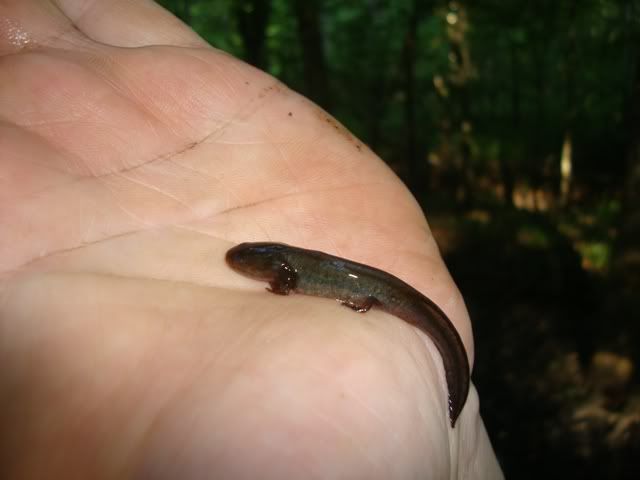

Above: the salamander larvae captured in minnow traps on 6/14/2011.  Note the external gills, which look like fleshy lumps near the neck.  In the water, the gill filaments separate and the gills appear large and bushy.

Literature Cited:

Congdon, et a. 1987. Morphological constraints on egg size: a challenge to optimal egg size theory? Proceedings of the National Academy of Sciences 84:4145-4147.

Tuesday, May 17, 2011

Herpin' In The Sandhills Part III: Amphibians

It dawned on me recently that I still have alot of "stuff" to share with you all from our recent trip to the Sandhills.  I'm falling way behind as it's now been weeks since we were actually there!

So...I've talked about Cottonmouths, and Scarlet Kingsnakes to-date.  Now I'm gonna continue my overview of our herping experience with the amphibians we encountered. 

Our main focus during the trip was snakes (at least mine was :)  ), but we did make sure to take a few stops that were specifically devoted to amphibians.

One of our early stops on this trip was to a slow-moving stream.  The riparian area (i.e. area associated with the stream banks) was mostly wooded.  The stream bottom was silty with lots of organic matter (leaves, sticks, etc.).  Access was easy, as we basically hopped out of the vehicle at a bridge over the stream...walked down to the water and drug a dipnet along the mucky bottom.

Above: habitat where we found the Lesser Siren and Dwarf Mudpuppy

Above: Jeff, Dave and Ed sifting through a dipnet haul for amphibians

It didn't take but one or two net hauls for us to pull up some pretty neat stuff!

Unfortunately, none of these pictures turned out incredibly well.  Salamanders (especially aquatic salamanders) tend to wriggle alot when you take them out of that aqueous medium that they need to effectively breath.

Anyways, one of our grabs was a critter I had really wanted to see since moving here.

The Lesser Siren (Siren intermedia).


A unique little salamander that basically remains fully aquatic for its entire life, unlike many salamander species which have aquatic larvae (juvenile) stages and terrestrial adult stages.  Because they are primarily fully aquatic, adults retain bushy external gills found in most larval salamanders.  Yet, this species also has lungs, and is known to occassionally venture out onto land near the water's edge.  The Lesser Siren is also unique among most native salamanders in that adults have only small front legs and no hind legs. 

Lesser Sirens can be found in many aquatic habitats: slow moving streams, ponds, marshes, ditches, swamps, etc..  These must have plentiful aquatic vegetation and organic matter.

The next net haul revealed yet another species I had really wanted to see.

The Dwarf Mudpuppy or Dwarf Waterdog (Necturus punctatus).


Sorry for the poor picture, but this thing just would not hold still and we didn't want to keep it out of the water for too long.  Anyways, in the state we have the Dwarf Mudpuppy and the Common Mudpuppy (Necturus maculosus).  The Dwarf Mudpuppy is much more common than the Common Mudpuppy (confusing, I know).  It's further confusing for me because back home in Wisconsin, we have Common Mudpuppys....so I'd seen those before.  We don't have the dwarfs back home, however.  So, I was very excited to see the Dwarf.  Whereas the native folks from down here would probably have been more excited to see a Common Mudpuppy.  To each his/her own!

These two species do not have overlapping geographic ranges in the state.  The Common Mudpuppy only being found in a few drainage systems in the north east and the Dwarf found throughout the coastal plain.  This means you can differentiate between these species by the geographic location of capture.

Of further interest is the fact that a third species of mudpuppy or waterdog is found in the state: The Neusse River Waterdog (Nectrurus lewisi).  Although not as common as the Dwarf, the Neusse River Waterdog and the Dwarf overlap in their general geographic distribution.  The Neusse River Waterdog being found in a few drainages within the lower Piedmont and the Sandhills....and its in a few spots in the Sandhills that it overlaps with the Dwarf. 

Where they overlap, they can be distinguished in a few ways.  The Dwarf is comparatively smaller...more slender in general body shape...and has relatively small spots on the body.  The Nuesse River Waterdog has large bluish/black spots.
__________________________________________________________________

Another amphibian location we visited was an old over-flow spillway associated with a resevoir.  We were hoping to find individuals of a currently undescribed species called the "Sandhills eurycea" (Beane 2010).  Ed had seen a few there before and so we decided to check it out.  The spillway, apparently, rarely has running water in it, but seems to remain damp.  Over the years this ditch has also filled with organic debris (leaves, sticks, logs, etc.).  A perfect haunt for amphibians.  They fall into the spillway during migrations and have plenty of good cover and moisture.  This spot usually isn't a "trap", per se.  If they follow the spillway in one direction, or another, they can eventually find an exit out into the woods.

Above: searching through the damp leaf-litter in the spillway for amphibians.

After a few minutes of searching, we found the "sandhills eurycea".  Unfortunately, I didn't get any pictures worth posting.  We also found a frog species that I had previously only seen in books: The Carpenter Frog (Lithobates = Rana virgatipes).  I had heard them calling a few years ago when in Florida, but we hadn't been able to catch any at that time.  So this was a real treat!
Above: a Carpenter Frog (Lithobates=Rana virgatipes) found in the habitat pictured previously

_________________________________________________________________________
In a previous post, I mentioned we visited a fish hatchery during this trip to the sandhills.  We'd found a number of species there, including Cottonmouths (Agkistrodon piscivorus).  The critters below were all found on hatchery grounds as well.  The first one mentioned below was a new species for me: the Southern Cricket Frog (Acris gryllus).  In our area of the Piedmont we have the Northern Cricket Frog (Acris crepitans), not the southern.  Back home in Wisconsin a particular subspecies of the Northern Cricket Frog (the Blanchard's Cricket Frog; Acris crepitans blanchardi) is state Endangered and rarely seen.  Because it is so rare, little is known about its ecology in the Upper Midwest.  Its declining throughout much of the midwest for reasons not entirely known.  In fact, some research manuscripts have actually referred to the decline of this species as "enigmatic"(Lehtinen and Skinner, 2006).  Its even believed that populations of the Southern Cricket Frog have been steadily declining, when compared to reports of their historic abudance.  As summarized by Jensen (2005a) a 1929 report mentioned that Southern Cricket Frogs were amazingly abundant in the southeastern United states.  Jensen's review outlines several recent studies from the late 1990's and early 2000s that have found the number of breeding populations has substantially decreased in areas where they were historically high. 

Still, most folks down here don't really bat an eye at finding them....but being from an area where they are rare....I'm always excited to find one.

Note in the examples below the presence of a "triangle" mark between the eyes.  This is diagnostic for members of the genus Acris.

Above: an adult Southern Cricket Frog (Acris gryllus) found at the hatchery.

Above: for comparison, a Southern Cricket Frog found the next day at a different location.  Note the slightly different color pattern

Above: a Northern Cricket Frog (Acris crepitans) that I captured in the Peidmont in 2010.  It looks indistinguishable from the Southern Cricket Frog (for all practical purposes) and the two species are best differentiated by the breeding calls of the males. 


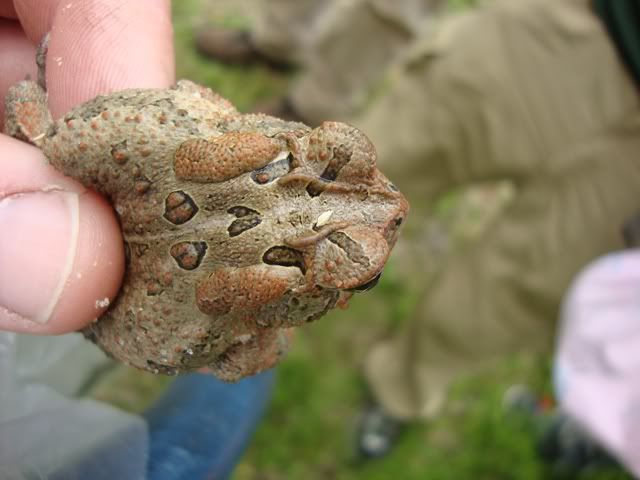
Another hatchery inhabitant was the Southern Toad (Bufo terrestris).  The Southern Toad is apparently common in many types of upland habitats in this region of the state.  According to Jensen (2005) it is even found in agricultural fields.  I'd actually seen this species before in Louisianna, but it was still nice to encounter one again!  Southern Toads are not found in our part of the Piedmont.  Instead we have the ubiquitous American Toad (Bufo americanus) and the less common Fowler's Toad (Bufo fowleri).  Interestingly, the Southern Toad will apparently hybridize with the Fowler's Toad (pertinent literature reviewed by Jensen (2005b).

Above: A Southern Toad (Bufo terrestris) found at the hatchery. 


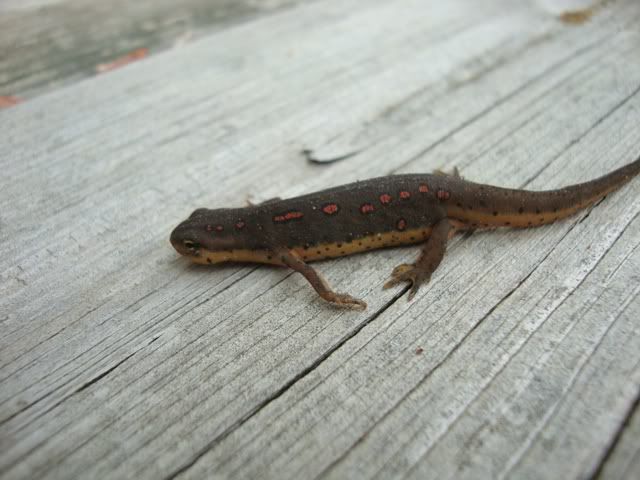
I'll round this out with pictures of an Eastern Red-Spotted Newt (Notophthalmus viridescens).  Another very cool critter.  This appears to be the terrestrial adult phase.  This species has three phases: a fully aquatic adult that hangs out in emphemeral wetlands.  It can remain aquatic indefinately, but should the wetland it calls home start to dry, it can become a terrestrial adult that lives on land. 

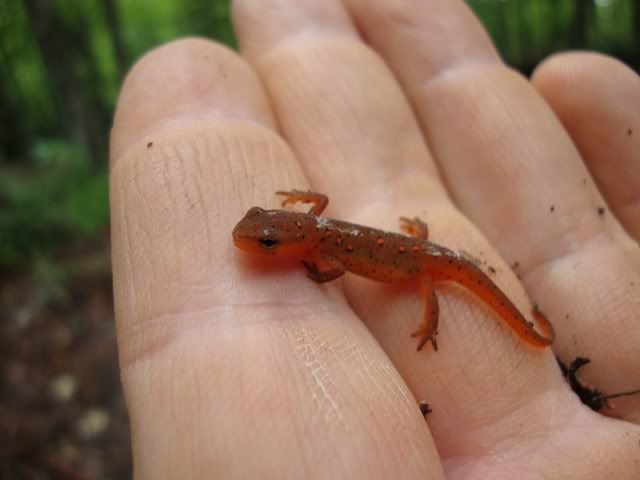
There is also a terrestrial juvenile phase called a "red eft".  Juvenile newts can remain aquatic until they become adults if the pond they live in does not dry.  Should the pond begin to dry when the newt is still a juvenile, it will become a terrestrial "red eft" and live on land like many adult salamanders....and eventually become a terrestrial adult.

Whew! 

This is an amazing survival mechanism and really highlights the plasticity in life history strategies that salamanders are capable of (how many critters can switch between fully aquatic and fully terrestrial lifestyles so willy-nilly?).

This is a species I am very familiar with from Wisconsin.  Still love seeing them, though.

Above: an terestrial phase adult Eastern Red-spot Newt (Notophthalmus viridescens) found at the Hatchery.

Above: a terrestrial juvenile or "red eft" phase of the N. viridescens.  This individual was not caught during our trip to the Sandhills, but in a drift fence at one of my study sites.


I STILL have a fair amount of stuff to share with you from our trip to the Sandhills!   More to come soon.

_______________________________________________________________

Further Literature on the amphibians discussed above, see the following summative resources:

Beane, J.C., A.R. Braswell, J.C. Mitchell, and J.W. Palmer. 2010. Amphibians and Reptiles of the Carolinas and Virginia (second edition).  University of North Carolina Press.

Braswell, A.R. 2005. Neuse River Waterdog, Necturus lewisi, Brimley 1924. In Amphibian Declines: the conservation and status of United States species. M. Lannoo (ed.). University of California Press.

Dundee, H.A. 2005. Dwarf Waterdog, Necturus punctatus, Gibbes, 1850. In Amphibian Declines: the conservation and status of United States species. M. Lannoo (ed.). University of California Press.

Husinger, T.W, and M.J. Lannoo. 2005. Eastern Newt, Notophthalmus viridescens, Rafinsque 1820. In Amphibian Declines: the conservation and status of United States species. M. Lannoo (ed.). University of California Press.

Lehtinen, R.M., and A.A. Skinner. 2006. The enigmatic decline of the Blanchard's Cricket Frog (Acris crepitans blanchardi): a test of the habitat acidification hypothesis. Copeia 2006:159-167.

Leja, W.T. 2005. Lesser Siren, Siren intermedia, Barnes, 1826.  In Amphibian Declines: the conservation and status of United States species. M. Lannoo (ed.). University of California Press.

Jensen, J.B. 2005a. Southern Toad, Acris gryllus, LeConte 1825. In Amphibian Declines: the conservation and status of United States species. M. Lannoo (ed.). University of California Press.

Jensen, J.B. 2005b. Southern Toad, Bufo terrestris, Bonnaterre, 1789. In Amphibian Declines: the conservation and status of United States species. M. Lannoo (ed.). University of California Press.

Matson, T.O. 2005. Mudpuppy, Necturus maculosus, Rafinesque, 1818. In Amphibians Declines: the conservation and status of United States species. M. Lannoo (ed.). University of California Press.

Mitchell, J.C. 2005. Carpenter Frog, Rana virgatipes, Cope 1891. In Amphibians Declines: the conservation and status of United States species. M. Lannoo (ed.). University of California Press.

Petranka, J.W. 1998. Salamanders of the United States and Canada (first edition). Smithsonian Press.