Showing posts with label marbled salamander. Show all posts

Saturday, July 2, 2011

Week's End Survey Round Up VI: Of Marbled Salamanders, Warty Little Critters, and "Woodland" Meadow Jumping Mice.

This week the-powers-that-be decided we needed something alittle different to occur, which would greatly influence our survey results.  After we opened the traps along the drift fences on Monday....we got back-to-back huge rainstorms Monday and Tuesday night. 

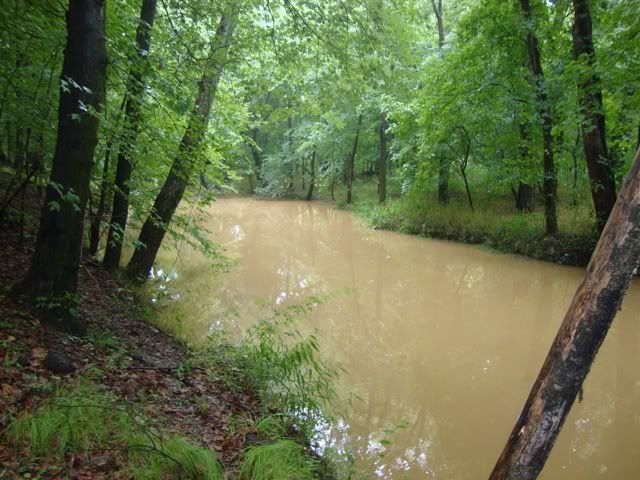
Below is a great before/after comparison of a stream at one of our sites:

A stream before the rains started pictured below.  I was actually standing in the stream bed when I took this picture.

Below is the same stream after the second night of storms.  This time, I obviously couldn't stand in the stream....you'll notice the same leaning trees on the left bank.  But, you may also notice that the fallen log/snag that was in the first picture was apparently washed away by the current!
The wet conditions really brought out the amphibians!

Here are a few of the highlights.

___________________________________________________________________________

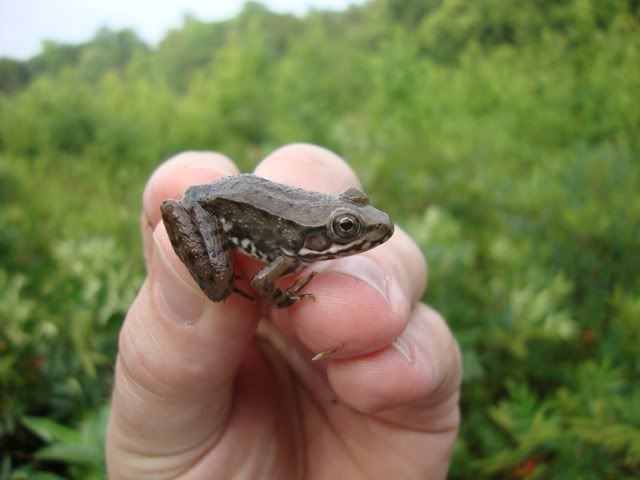
The Green Frog (Rana=Lithobates clamitans): Green frogs are relatively common 'round here.  We'd caught them at this site in minnow traps placed in woodland ephemeral wetlands last year.  We hadn't caught any this year, however.  Unlike many frogs who's tadpoles hatch, develop and turn into froglets in the same year, Green Frog tadpoles usually remain in this larval state over their first winter.  The following spring they metamorphose and become terrestrial.  With the rain, these juvenile green frogs must have decided it was time to migrate away from where they had spent their larval days.....and try to find a new home suitable for froglets!

We caught several in one of our grassland drift fences this week.  All were about as big as the one in the picture.  They can get much bigger than this...and a large adult male can be confused for a bullfrog to the untrained eye!
___________________________________________________________________________

The Eastern Narrowmouth Toad (Gastrophryne carolinensis): The biggest treat for me this week was our Narrowmouth toad captures.  We had gotten one individual last year in a pitfall trap at one of our sites.  We hadn't seen a single narrowmouth toad since.  They remain underground and usually only move around above ground when there are wet conditions.  So this week, we were fortunate enough to catch two in the same pitfall trap of one of our drift fences in a lowland decidous hardwood forest. 

Despite their common name, these aren't really a toad (i.e. they are not a member of the Genus Bufo).  They are, in fact, the only member of the taxonomic Family Microhylidae in our region...so they are not directly related to any of the other amphibians in the state.
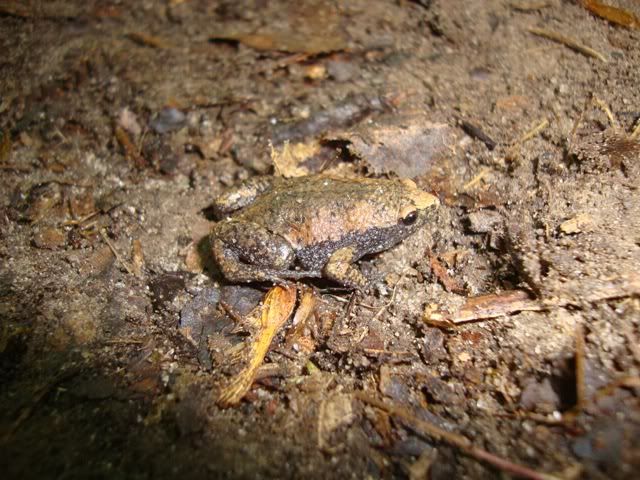
Above: these critters spend most of their time below ground and are not very big.  Therefore, they are difficult to find during surveys without the aid of drift fences or coverboards.
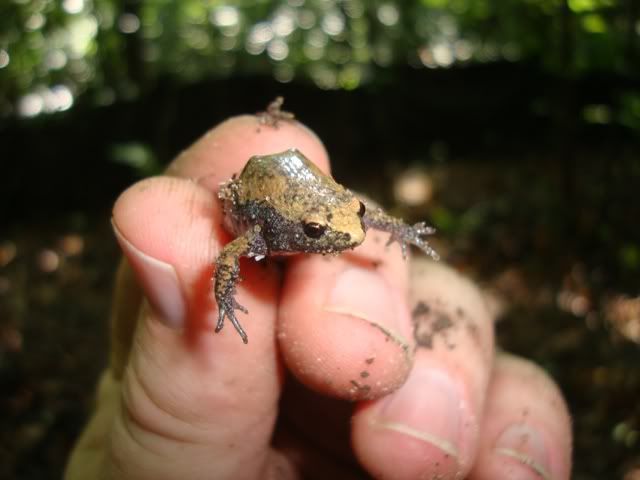
Above: The aptly named Narrowmouth Toad.  This roughly adult size for this species.  You may have guessed that this species can't eat big prey with a mouth like that.  In fact, their primary food source is ants and other small insects (Dorcas and Gibbons, 2008).


________________________________________________________________________

The American Toad (Bufo americanus): I've written about a related species in the past (the Fowler's Toad; Bufo fowleri), but have not said much about these guys.  The American Toad is a very common species at one of our sites....while the Fowler's toad is dominant at the other.  After a rain, the toads really move around and we get them in decent numbers within our drift fences.
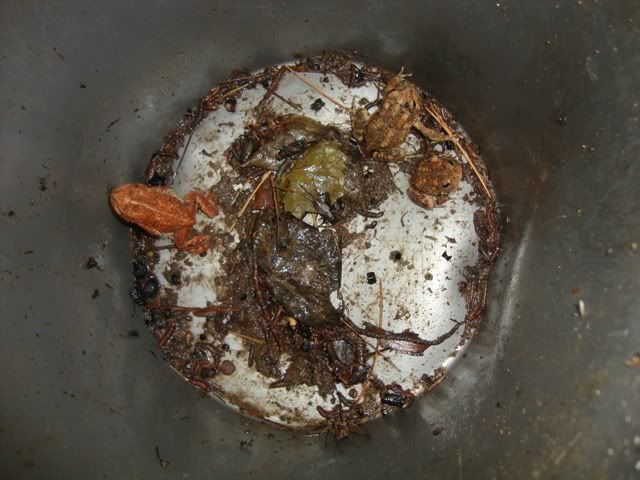
Above:  Three American Toads captured in one pitfall trap along a upland deciduous hardwood forest drift fence.
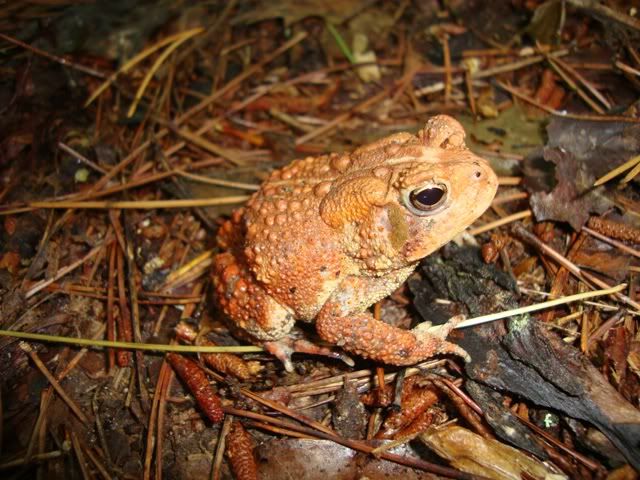
Above: American Toads are usually a bit drab compared to Fowler's Toads, in my opinion. However, this individual was a nice orange/red color....very cute little bugger too.

_________________________________________________________________________

The Marbled Salamanders (Ambystoma opacum): It's been some time since we've caught any of these critters at either of our sites (the last ones were captured in late March, see here).  In fact, we'd never caught them at one of our sites until this week.

The heavy rain that bombarded us drew them out.  We caught numerous individuals in just about every day that the drift fence traps were open, at both of the sites.  So we added them as a resident species to one of our study locations (after nearly a year of surveys without finding them at this spot).  it just goes to show how important random environmental events and conditions are in the activity of wildlife (particularly amphibians and reptiles). Not only did we capture numerous adults, but also juveniles. 

It is interesting to note that not a single individual was found under our woodland cover boards.  In other words, these critters had been patiently waiting for a rain event to get moving.

It's also interesting to note that we didn't see a single individual of any other resident salamander species this week.  I guess it wasn't there time to move around, like it was for the Marbled Sallys.  By why was it their time to move?  This species typically spends its time underground or below debris, when it is outside of the breeding season (and these guys don't breed until the fall around here).  Yet, it had been so very dry for the month of June.  Perhaps after waiting-out the dry spell....they really needed to bust out and find some food after the rain hit.

But, then why didn't we catch other salamader species doing the same thing? 
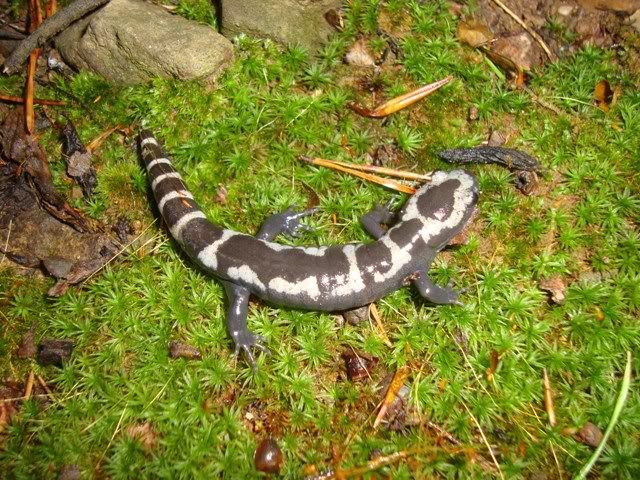
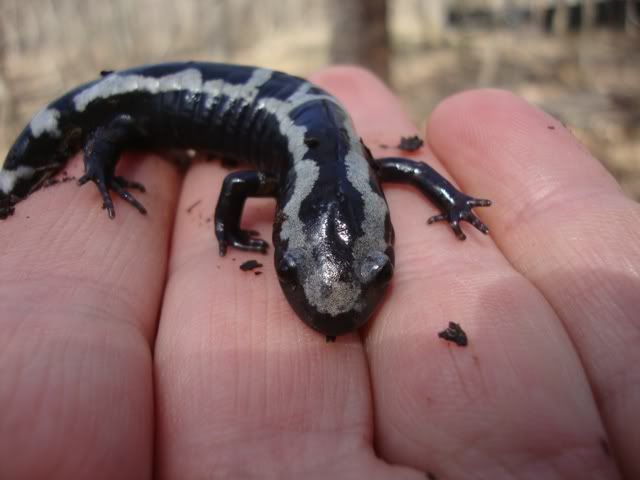
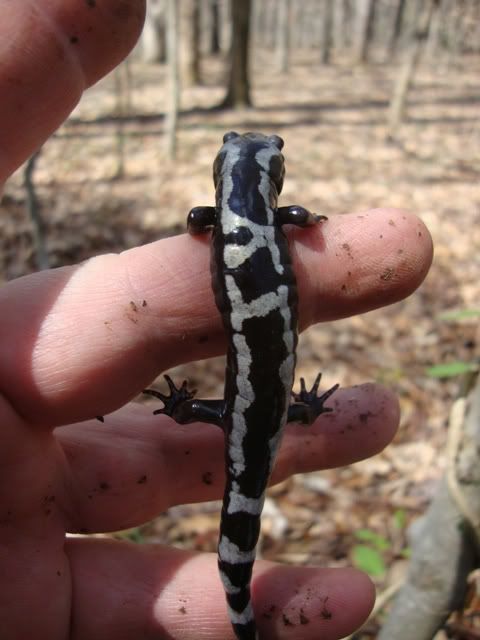
Above: an adult Ambystoma opacum.  Such a very handsome little salamander.

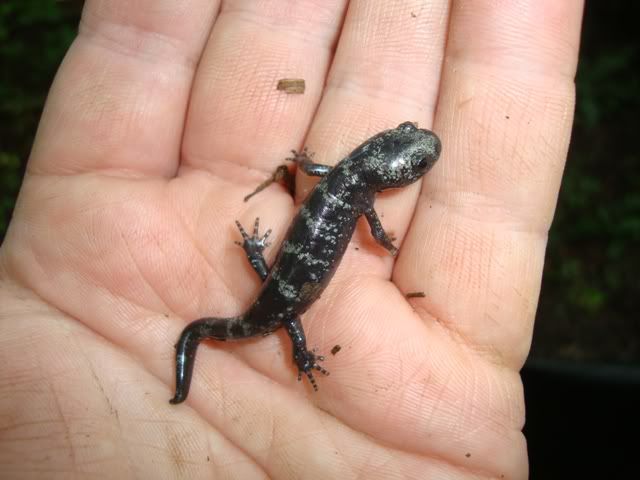
Above: Two pictures of juvenile Marbled Sallys.  The picture on top shows a slightly younger individual...see the heavy flecking and lack of any resemblance of adult pattern.  The picture on the bottom shows an older juvenile.  You can still see some flecking...but that pattern of adulthood is starting to creep in too.

________________________________________________________________________


Cope's Gray Treefrog (Hyla chrysoscelis): Another species that we haven't physically seen since late March (see here), although we often hear them calling at both of the sites.  This was a sub-adult, but still looking very much like an adult in coloration.
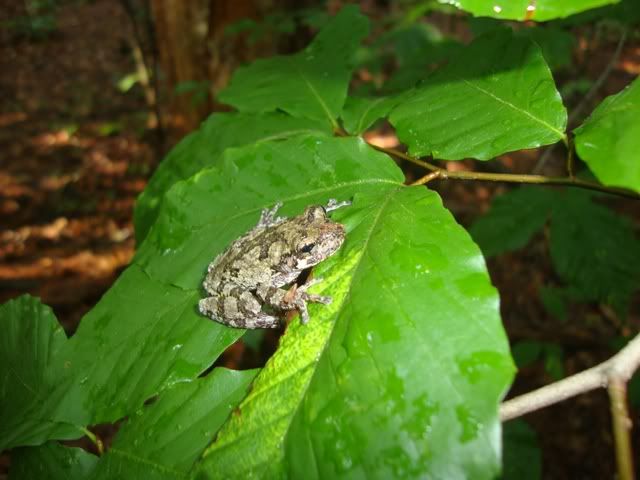
Above: they show up great against a green background...but put them on the bark of a tree and watch them disappear (below).
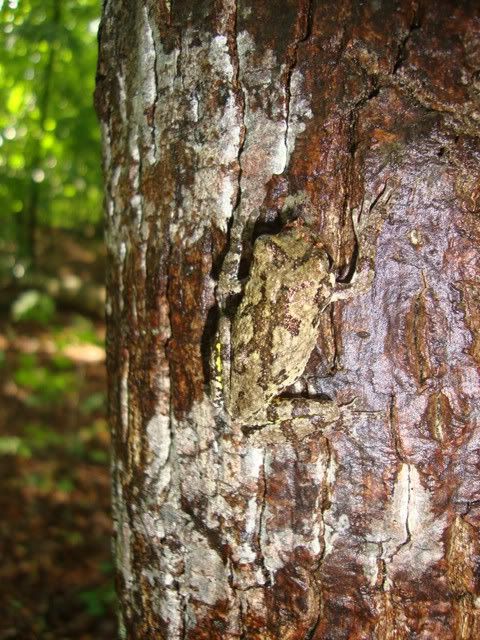
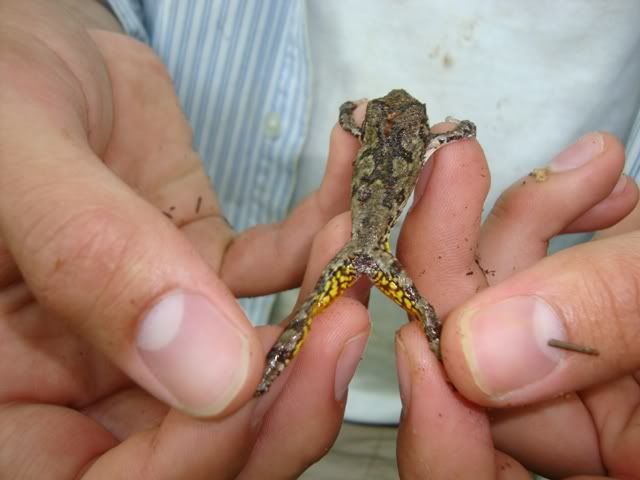
Above: the yellow around the inner-thighs and groin is diagnostic for both species of Gray Treefrog in this region (The Gray Treefrog and the Cope's Gray Treefrog).  They are very difficult to tell apart in-hand...but the calls of males differ.  I've only ever heard Cope's Gray Treefrogs calling at this site, so I'm going to assume this is one of those.

_____________________________________________________________________

The Meadow Jumper (Zapus hudsonius):  We've now captured three Meadow Jumping Mice at this site.  Given the very spotty distributional information for this species in our state, these are cool findings!  Interestingly, this individual was in one of our upland deciduous forest drift fences....not in the grassland drift fence (like the other ones we've caught).  Not sure what a Meadow Jumping Mouse is doing in the woods, but these things happen.  In fact, I've captured them frequently in woodlands during vertebrate survey work at a site in the U.P. of Michigan back in 2009.

I love the Genus name Zapus.  Feels cool to say...rolls off of the tongue nicely.  It has a Greek origin, with Za meaning "very" and Paus meaning "feet" (Schwartz and Schwarts 2001).  This can be loosely translated into something with big feet, or very large feet (from the pictures below, you should be able to see that this is very descriptive name).

I at first had a glimmer of hope that perhaps we had found a Woodland Jumping Mouse (Napaeozapus insignis).  The genus name translating from latin into "wooded glen" and "big feet".  The Woodland Jumper species is not known from our region of the state at all, according to Webster et al. (2003).  But, so little survey work for small mammals like this has really been conducted throughout the state, so I thought there was always a chance.  Both species look very similar: long feet, a darkish band of pelage down the middle of the back, and strongly bi-colored tail (dark on top, light on the bottom). 

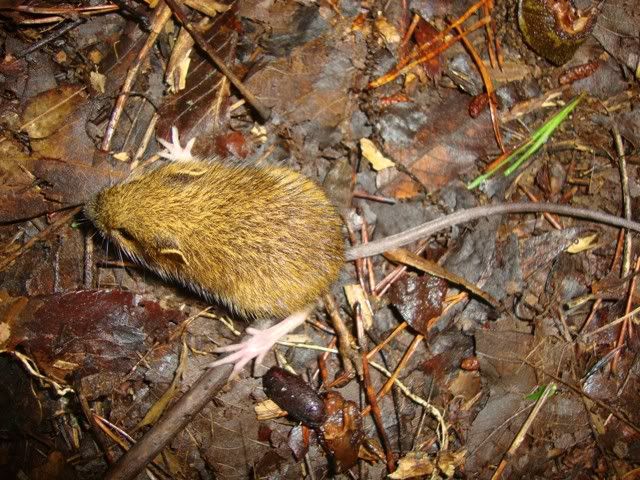
The kicker is in the tuft of hair at the tail tip.  In the Meadow Jumper, this tuft is comprised of dark hair (not whitish hair, as in the Woodland Jumper)  As you can see from the second picture below, this individual had some pretty dark hair on its tail tip.
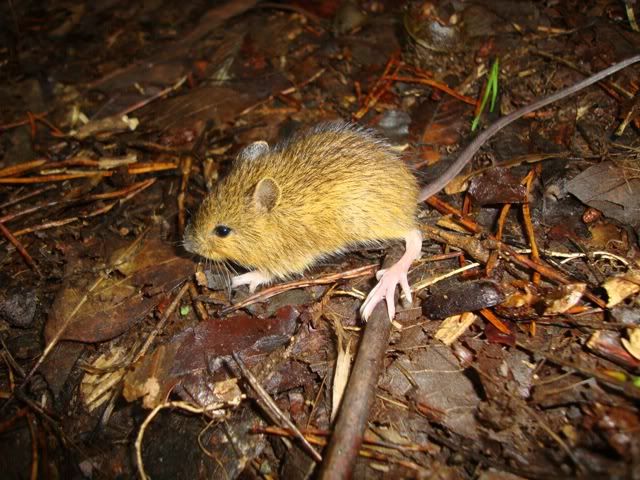
Above: check out the feet on the Meadow Jumper!

Above: the bi-colored tail, and dark hair at the tail tip are visible in the picture above.  The dark tuft of hair is a giveaway for the Meadow Jumper (rather than the Woodland Jumper).

______________________________________________________________________

The Eastern Box Turtle (Terappene carolina): The rain brought out the box turtles too!  We found three (one along the road, one in a pitfall trap, and one sitting along an upland forest drift fence).  The one we found sitting along the fence was actually turtle E006, which we had a radio transmitter on last fall.  This February, however, we found the transmitter with no turtle attached to it.  We weren't sure what happened to the turtle...we thought it was possible a raccoon or something got it when it was lethargic during the winter.

Not true, it would seem.  It turns out, blame can be laid on the crappy Loctite Epoxy we used to stick the transmitter on the turtle (or perhaps the person applying the epoxy...i.e., me). 

Either way, it's nice to know the turtle is okay!
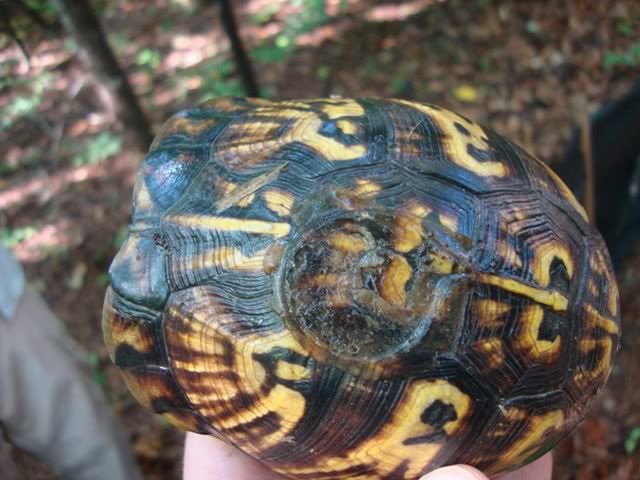
Above: you can see where the transmitter was epoxied to the shell of this individual last year.  We lost it this February when the epoxy failed. 


The individual in the picture below represents only the second box turtle we've captured in drift fences (although we find a fair number through just random visual surveys while walking around in the woods).  It's also the first one we've caught in this grassland drift fence.


Literature Cited:

Dorcas, M., and W. Gibbons. 2008. Frogs and Toads of the Southeast.  University of Georgia Press.

Schwartz, C.W., and E.R. Schwartz. 2001. The wild mammals of Missouri (2nd Edition). The University of Missouri Press, Columbia, Missouri.

Webster, W.D., J.F. Parnell, and W.C. Biggs. 2003.  Mammals of the Carolinas, Virginia and Maryland.  University of North Carolina Press.

Thursday, March 24, 2011

Another Good Day For Herps (i.e., Amphibians and Reptiles)!


I put the clarification in the title as to what a "herp" is....just in case folks not familiar with this word mistakenly thought my post had something to do with an S.T.D.  I thought about this after my post from yesterday (A Good Day for Herps, posted on March 23, 2011).

So...to re-interate....a "herp" is a generic term for amphibians and reptiles (the study of these critters is called Herpetology).  Whereas a "herpe" is something you'll never read about on this blog.

_______________________________________________________________

Yesterday, I posted about my first good haul of captures in my survey equipment this year (drift fences and coverboards).  The scaly and slimy goodness continued today, much to my happiness!

We had several massive thunderstorms blow through the area last night.  I was hoping the rain would stimulate some amphibians to move around alittle...and they did!

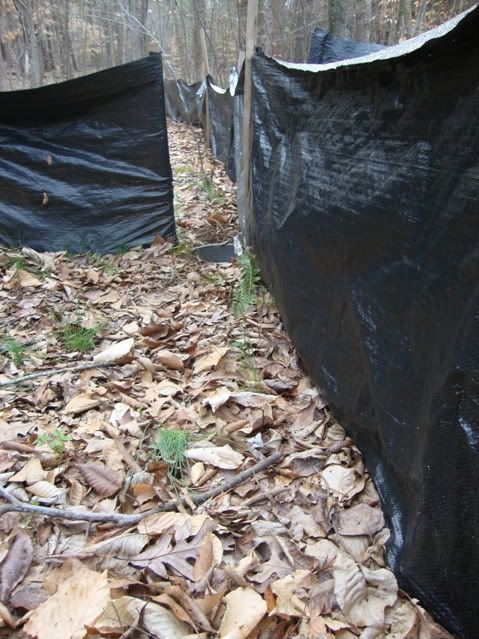
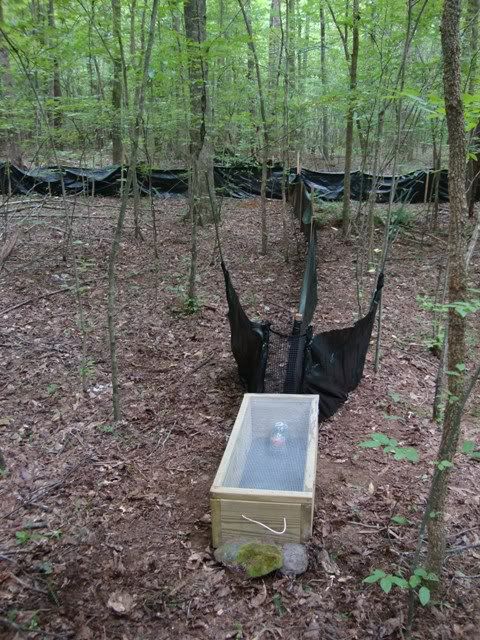
But, let me start with my drift fence capture from yesterday (as promised in my last post).  This one was in the "pitfall" trap along one of the fences I have in an upland deciduous forest.  I have one pitfall trap associated with each drift fence.  It consists of a 5-gallon bucket dug into the ground so the lip of the bucket is flush with the surface of the dirt.  The fence then leads critters to the bucket and they fall in.  It's a live trap.

Above: the drift fence leading up to the pitfall trap

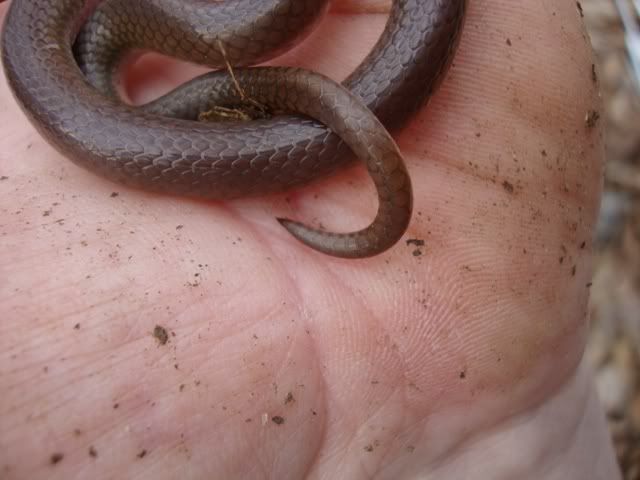
The volunteer yesterday was a nice little wormsnake (Carphophis amoenus).  These critters were a common occurrence in the drift fences last year.  They must exist in large abundances in dry/mesic upland forests in our region.  Despite this, there is relatively little known about these docile little snakes.  In fact, that I know of, there are only five manuscripts that have studied the ecology of these critters in any depth (Aldridge and Metter 1979, Clark 1970, Fitch 1999, Russell and Hanlin 1999, Wilson and Dorcas 2004).  The reason why they have been the subject of so few rigorous ecological research projects is probably becuase they are small, secretive and fossorial (i.e. below ground). They're not easy to find without the use of specific survey equipment.

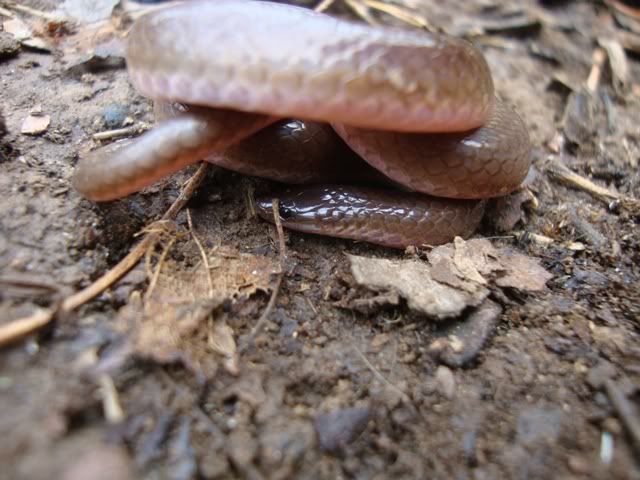
The wormsnake is easy to identify.  Their dorsal (upper) surface is brownish-red, with sleek scales.  Their ventral (lower) surface is often rosy or pinkish in color.  The head is very small (likely becuase they eat primarily soft-bodied invertebrates, such as worms), as are the eyes. 

Above: the small head and eyes of the wormsnake, buried beneath its coils.

The most unique character is the hardened, pointed tail-tip (sometimes called a "tail spine").  They often press this tail tip into the hand of anyone that attempts to restrain them.  This defensive behavior is almost laughable, as it causes no discomfort whatsoever to a human.  However, perhaps it is effective against other smaller predators that may threatened these snakes in the leaf litter of the forest floor.

Above: the hardened "tail spine" of the wormsnake.

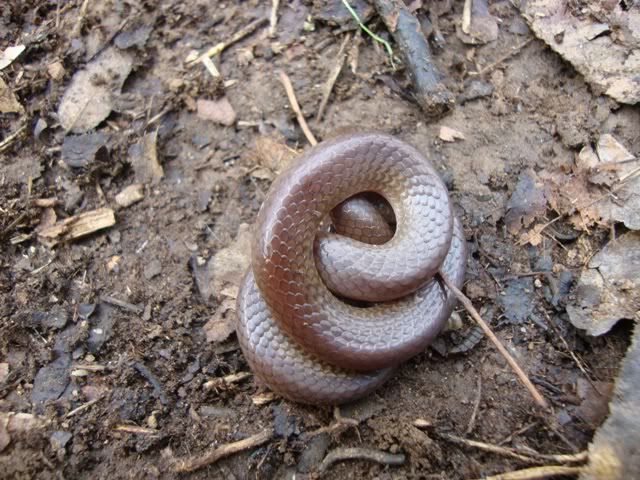
Behavioral observations of this species are uncommon.  However, some unique anecdotal reports exist in the literature regarding their defensive behaviors.  Pressing the "tail spine" into the hand of a would-be captor is the most commonly reported defense.  Kapfer and Slone (In Press) also report a bizzare bit of defensive behavior involving an individual that partially buried the front 3/4 of it's body in leaves, lifted its exposed tail and wagged it's tail in a serpentine fashion.  In addition, Diefenbacher and Pauley (2009) observed an individual hiding its head beneath it's coils, while holding the tip of it's tail vertically.  The assumption is that the head is buried in the coils and the tail is presented to the predator in the hopes that the tail tip is focused on, rather than the head.  In theory, a predator damaging the animal's head is more likely to result in death than if the predator focuses on the tail.  I  don't know how effective this defense mechanism is.....I don't see many wormsnakes with damaged tails.

I had never seen this head-hiding behavior before. 

In any event, while trying to photograph the wormsnake I caught yesterday, it presented me with half of the defensive behavior reported by Diefenbacher and Pauley, it hid its head beneath its coils (it didn't raise its tail in a vertical position, however).  When I would touch the snake in the hopes of repositioning it for a better picture, it would bury its head further into it's coils.  Eventually, I gave up....took a picture of the "headless" snake, buried it under some leaves nearby and went on about my business.

Above: a wormsnake exhibiting the defensive behavior that involves hiding its head beneath its coils.

____________________________________________________________

So the wormsnake was all I got in my drift fences yesterday.  Yesterday was the day for coverboards being effective.

Today, it was just the opposite.  The coverboards yeilded nothing, but the drift fences were crawling (literally).  The massive lightning storm we had last night (and associated rain) may have gave the salamanders under the coverboards the moisture they needed to mosey along to some nice subteranean refuge.

So...I'll go through some of the highlights from the drift fences today.

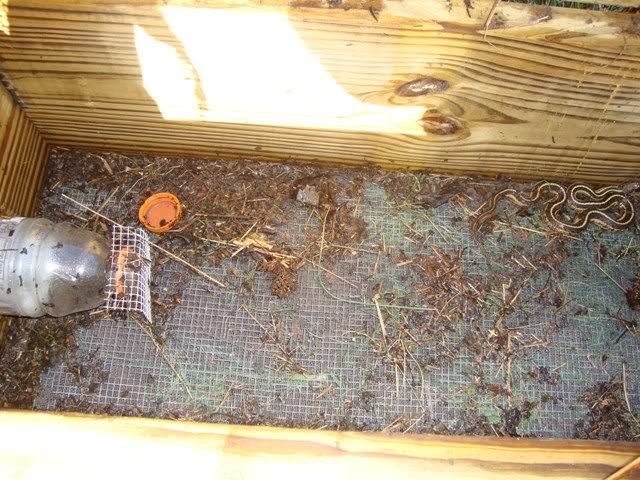
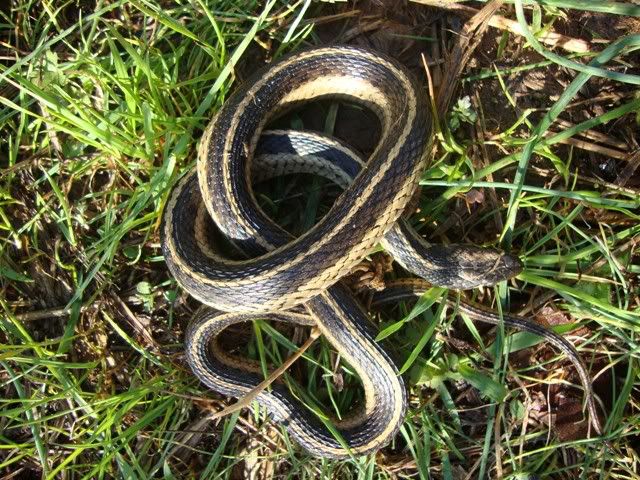
The first captured critter I encountered today was in one of my grassland drift fences: the Common Gartersnake (Thamnophis sirtalis).  I captured two individuals in the same fence.  One in one of my wooden box traps and the other in a funnel trap.

Above: box trap associated with a woodland drift fence

Above: a funnel trap placed along a woodland drift fence

So, the first gartersnake was found in one of the box traps.  The heavy rain had lead to a drop in temperature, and it was cooler this morning.  The snake wasn't moving very fast and I was able to snap a shot of him in the box (normally they are shooting out as soon as its open!).


Above: my first encounter of the day, a common gartersnake (Thamnophis sirtalis) in a box trap


Above: two pictures of a Common Gartersnake (Thamnophis sirtalis) captured in a drift fence.

Common Gartersnakes are....well......common.  They are probably the most commonly encountered snake throughout the eastern and midwestern USA. We even caught them in huge numbers back home in Wisconsin.  They can withstand human disturbance, they are very general in their habitat needs and diet.  So, I'm not shocked to have caught them today. 

But that doesn't mean it isn't always a treat to catch snakes!
________________________________________________________________

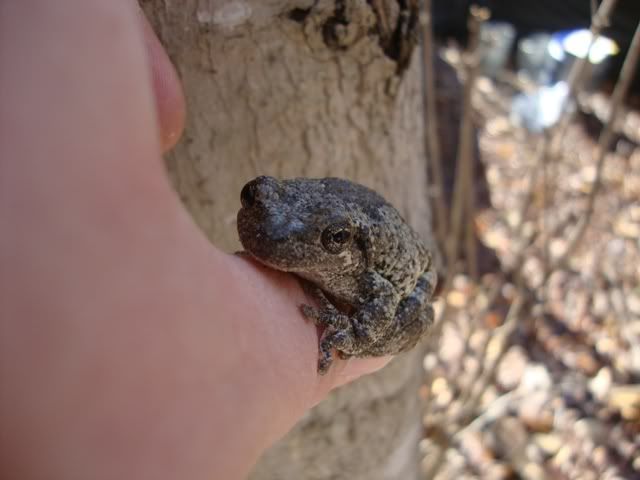
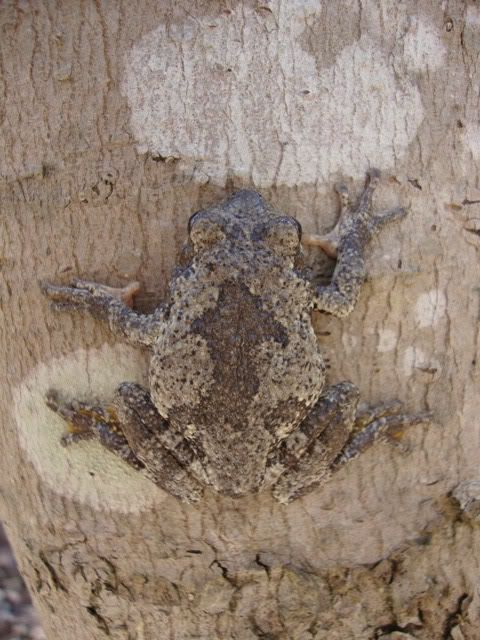
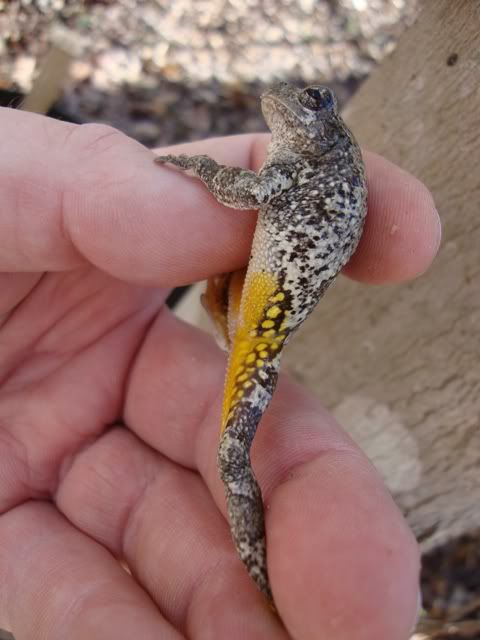
I next moved into check some of my woodland drift fences and was in for a treat.  One of my favorite native frogs was waiting for me in a funnel trap: Cope's Gray Treefrog (Hyla chrososcelis).  Cope's Gray Treefrogs are another species that I was familiar with from my work in Wisconsin (although there it is less common than the related (and very similar) Gray Treefrog (Hyla versicolor).  In fact, these two species are so similar they can only be easily differentiated by hearing the call of the breeding male for each species.  While the call for both is a quick trill, the Gray Treefrog's trill is more bird-like and melodic....whereas the Cope's Gray Treefrog has a trill that sounds more like an insect, almost sounding like a flourished buzz.

There is another definitive way to distinguish these two frogs, but it is much more cumbersome: counting chromosomes.  The Gray Treefrog is a tetraploid, and has double the chromosomes (48) of a Cope's Gray Treefrog, which is a diploid.

Not many people are going to go to this extreme, however!  I've only ever heard Cope's Gray treefrogs calling in our area...so I'm going to assume that's what I caught (I forget my portable chromosome analyzer in the car most of the time, anyways ;) ).

Regardless of all that jazz....one thing is for certain: they are cute as heck!

Above: note the obvious toe pads. They can climb up sheer surfaces and the toes feel sticky to the touch!

Above: Talk about camoflauge!

Above: the yellow in the groin upper thigh region is typical of H. chrososcelis and H. versicolor.

__________________________________________________________________

So after finishing up my work at the first study site, I moved on to site two.  Starting with the grassland drift fence, as I had did at Site 1.  Again, I was in for another treat!

You may recall that yesterday, I found a juvenile Racer under one of the coverboards (which I mentioned was patterned, unlike the adults).

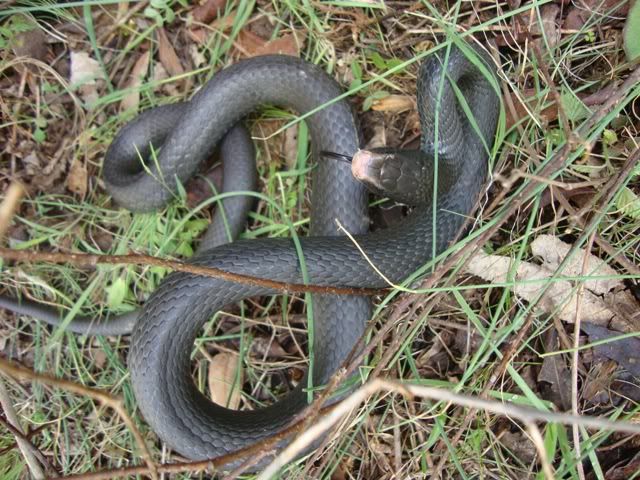
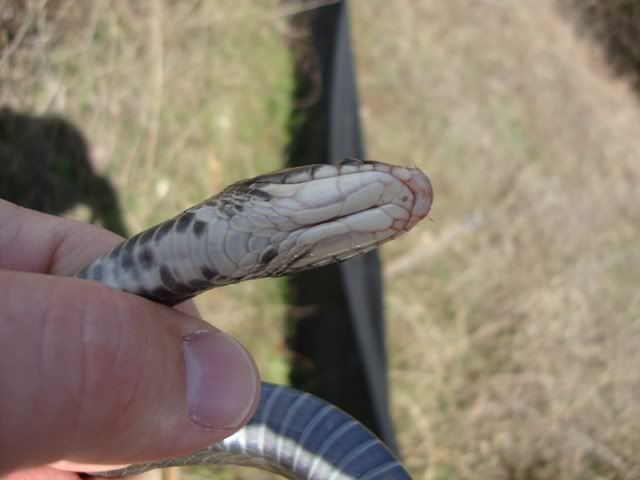
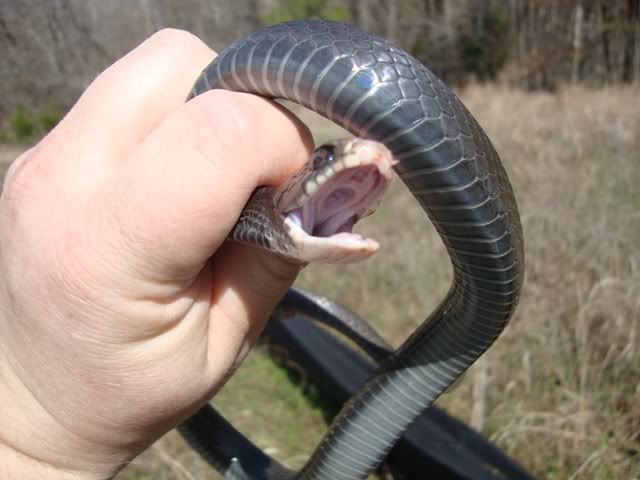
Today I captured a large adult Racer (Coluber constrictor) in a funnel trap.  Now you can see how the juveniles and adults differ in their appearance.  The adults are a beautiful sleek black, with white chins. 


They also can be alittle nippy!


Interestingly, after I set it on the ground and harrassed it for a while (trying to position it for a good picture, while dodging it's angry mouth)....it went through the same head-hiding behavior that the wormsnake did yesterday.  In fact, it was so committed to protecting it's head, that I was able to pick up my gear and prepare to move on for a good three minutes and the snake remained in that pose for the entire time.  I eventually had to move it off into bushes for fear a hawk would nail the snake if I left it where it was.

Above: an adult black racer protecting its head with its coils.

________________________________________________________________________

I'll round this out with some salamanders.  Yesterday, I found two species: the slimy salamander, and the spotted salamander.

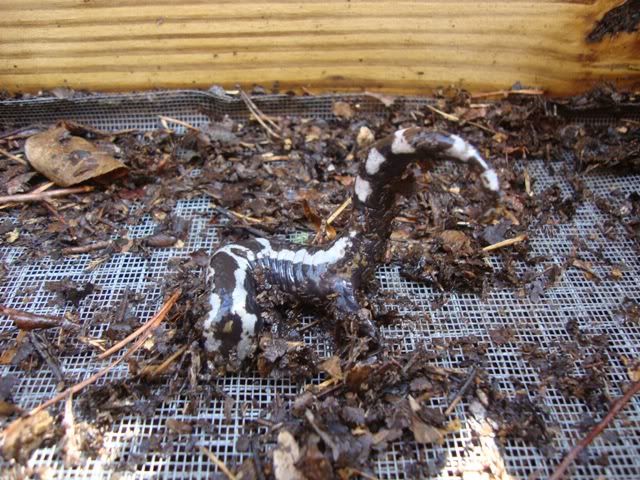
Today, when I checked on my woodland fences at site 2, I found a third species the Marbled Salamander (Ambystoma opacum).  Although I found this species commonly last fall, they are a beautiful little salamander and I always enjoy seeing them.  This one was in a box trap.

So long as I'm on a defensive behavior kick, why not show you some cool salamander defensive behavior.

Above: a Marbled Salamander exhibiting defensive posture.

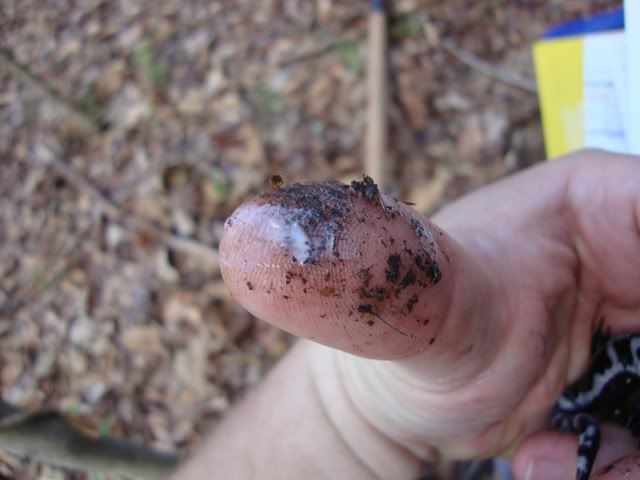
This defensive posturing is cool as heck!  As soon as I touched the salamander, it instinctively rose it's tail and dug its head into the ground (well, as much as it could in this box trap).  What this accomplishes is (1) protecting and hiding the head, making it less of a target and (2) focusing the predator's attention on the tail.  This makes alot more sense for the salamander than it does the wormsnake because, unlike the wormsnake's tail, the salamander's tail would make a particularly undesirable meal.  When harrassed further, the salamander secretes a whitish substance from glands on its tail.  This secretion is incredibly sticky (it will even cause your fingers to stick together for a few seconds).  The secretion is also noxious.  Brodie et al. (1979) found it will deter a common woodland floor predator: the shrew. 

So, the sally protects its head, while presenting a foul, sticky tail.  Brilliant!

Above: whitish secretions from glands on the salamander's tail

Above: the salamander's sticky secretion on my thumb!

Above: a handsome little salamander

I also picked up two more adult slimy salamanders, three white-footed mice (Peromyscus leucopus), and a nice little Carolina Short-tailed shrew (Blarina carolinensis).  Didn't get very good pictures of them, though.


Literature Cited:

Aldridge, R.D., and D.E. Metter. 1973. The reproductive cycle of the western worm snake, Carphophis vermis, in Missouri.  Copeia 1973:472-477.

Brodie, E.D., III and R.T. Nowak and W.R. Harvey. 1979. The effectiveness of antipredator secretions and behavior of selected salamanders against shrews. Copeia 1979:270-274.

Clark, D.R. 1970. Ecological study of the worm snake Carphophis vermis (Kennicott). University of Kansas Publications, Museum of Natural History 19:85-194.

Diefenbacher, and Pauley 2009. Carphophis amoenus defensive behavior.  Herpetological Review 40:94-95.

Fitch, H.S. 1999.  A Kansas Snake Community: composition and changes over 50 years.  Krieger Publishing.  Malabar, FL.

Kapfer, J.M., and C.Slone. In Press. Carphophis ameonus (eastern wormsnake) defensive behavior. Herpetological Review.

Russell, K.R., H.G. Hanlin. 1999. Aspects of the ecology of worm snakes (Carphophis amoenus) associated with small isolated wetlands in South Carolina. Journal of Herpetology 33:330-344.

Wilson, J.D. and M.E. Dorcas. 2004. Aspects of the ecology of small fossorial snakes in the western Piedmont of North Carolina. Southeastern Naturalist 3:1-12.