Showing posts with label Common Gartersnake. Show all posts

Thursday, August 23, 2012

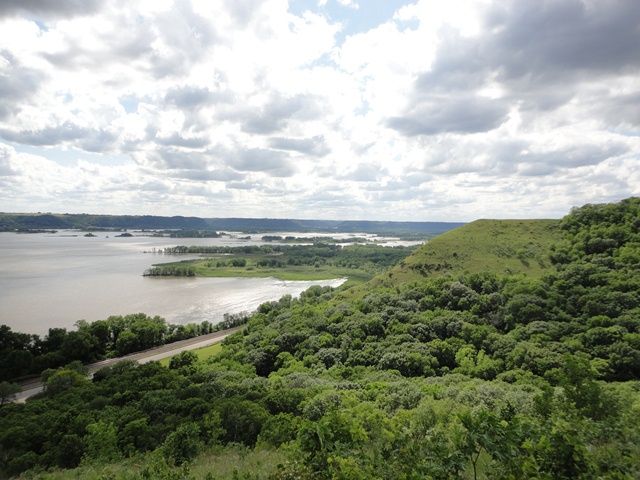
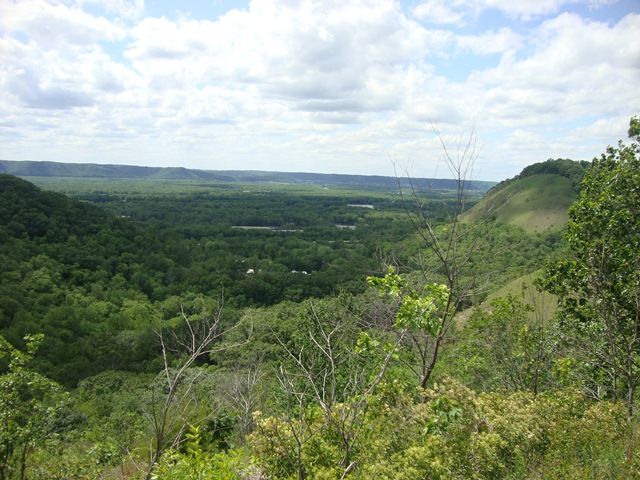
Herpin' The Upper Midwest, Day 3: The Bluffs


I'm finally going to share with you all the last big herping trip we took when Dave visited back in May (seems so long ago now!).  For more, see the previous posts about our trips to the bog and the prairie.

The driftless (or unglaciated) region of the upper Midwest is a unique area, with unique habitats and somewhat unique reptiles.  Unlike the rest of this region, which was scoured nearly flat by glaciers, the driftless area was spared.  The glaciers parted and moved around an area along the Mississippi River on both sides, and includes portions of Minnesota, Wiscsonsin, Iowa and Illinois. 

Due to the lack of recent glacial activity, there is a large topographic relief in this region and deeply carved river valleys and associated hillsides are common.  Such relief gives the driftless area an appearance that is about as close to mountains as one gets in the Upper Midwestern USA.


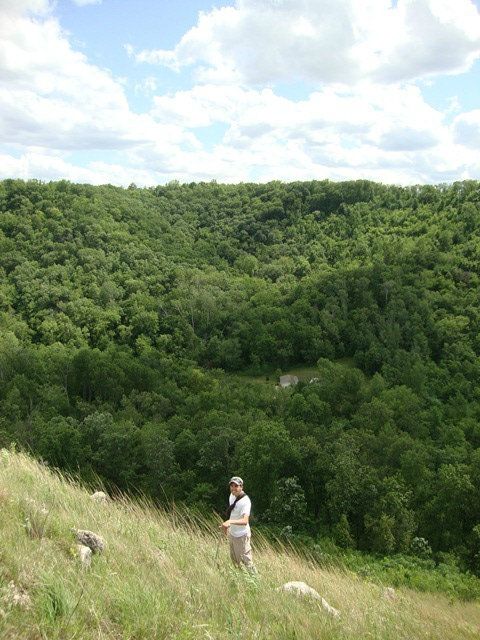
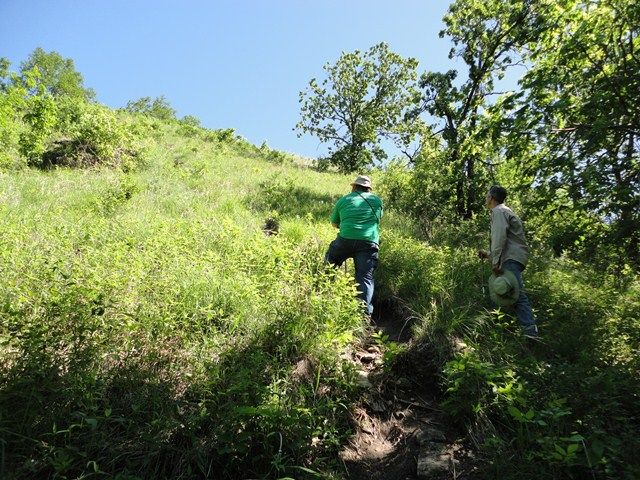
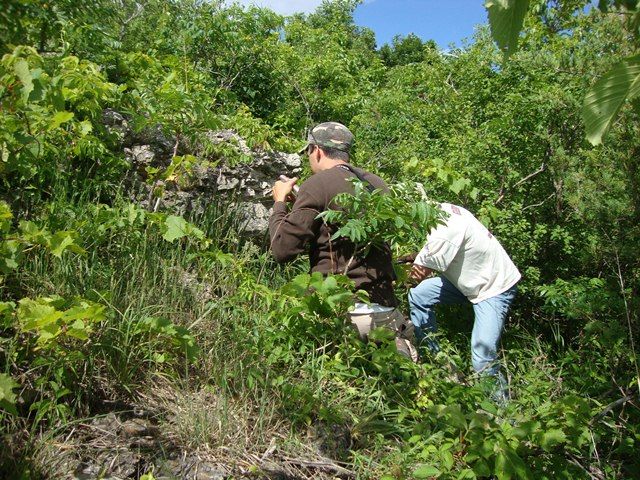
Of course, these are not mountains...but what are called "bluffs".  Regardless, for a flat-lander like myself, hiking in this part of the state involves some pretty serious climbing.  But if you want to see one of the coolest snake species in the region, then climb you must!  Often this requires a schlep of 500 ft or more up a serious incline to get into the preferred habitat for the species in-question.  Now, if I was one of these people that were....how would you say?.....IN SHAPE.....this would be no problem.

But, reality (and gravity, if one slips on the hillside) are a real pain in the neck!
Photo by D.M.
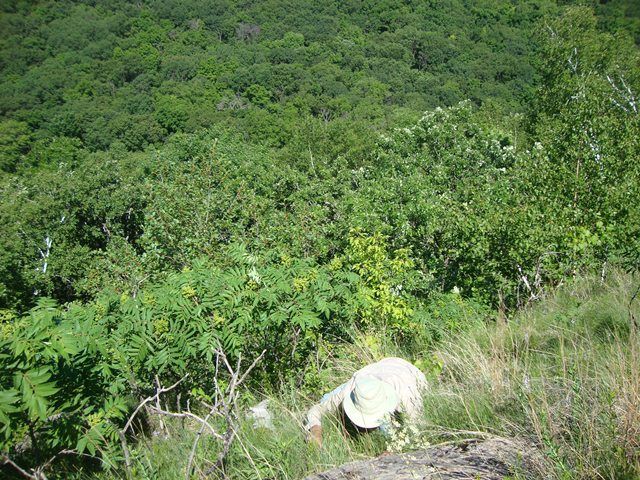
Photo by D.M.

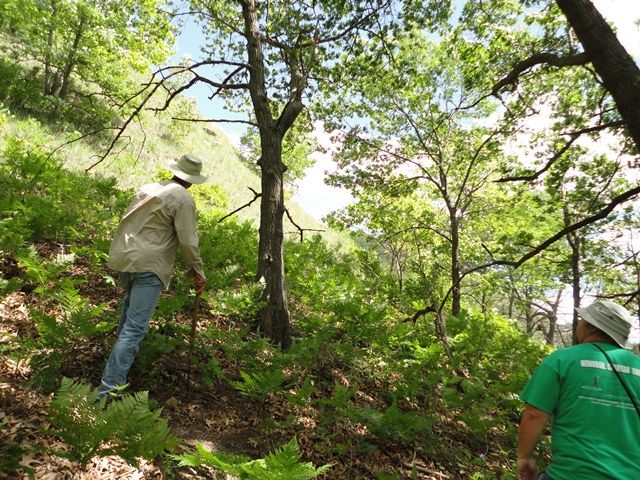
Once you're up there, though, the view is very nice (see pics above).  However, at this elevation a new challenge presents itself: looking for a cryptic venomous snake while walking along an ankle wrenching slope with loose/rocky soil underfoot.  Clearly, many things could go wrong, so care must be excersized!
Photo by D.M.

There is the potential for a variety of rare and common species in this habitat.  For example:

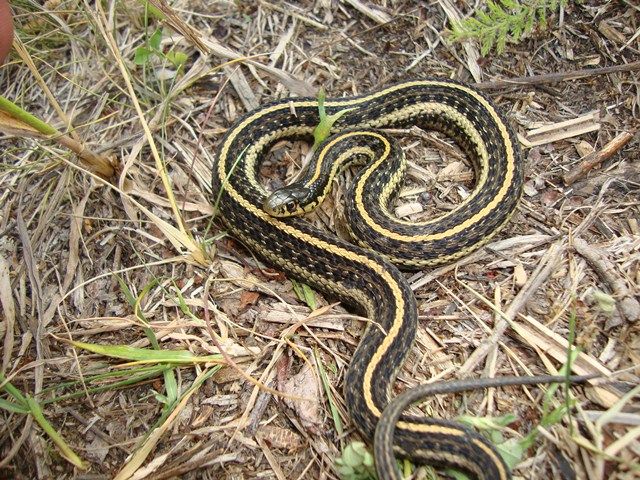
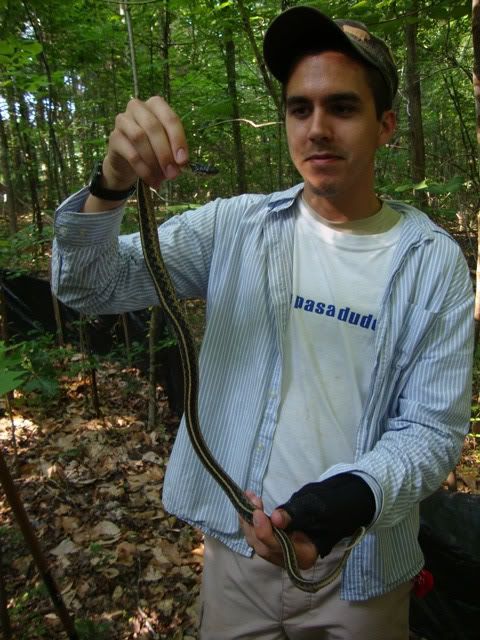
The Common Gartersnake (Thamnophis sirtalis)

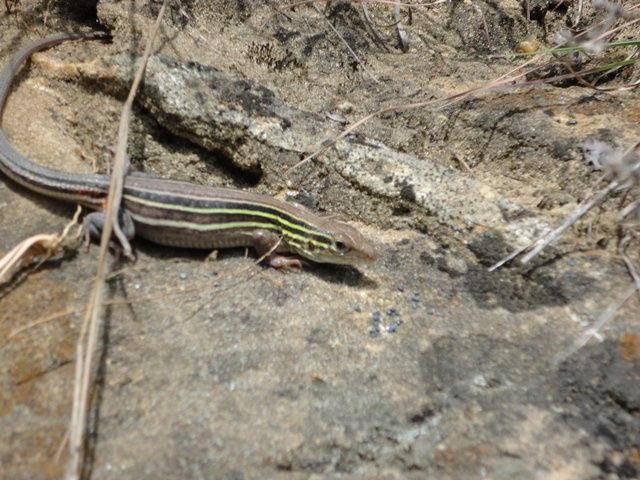
A gravid female Six-lined Racerunner (Aspidoscelis sexlineatus)...note the lumpy sides, which is probably due to her eggs.
Photo by D.M.

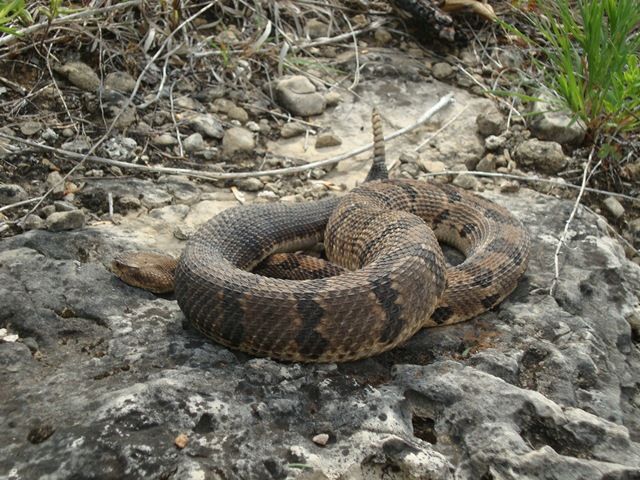
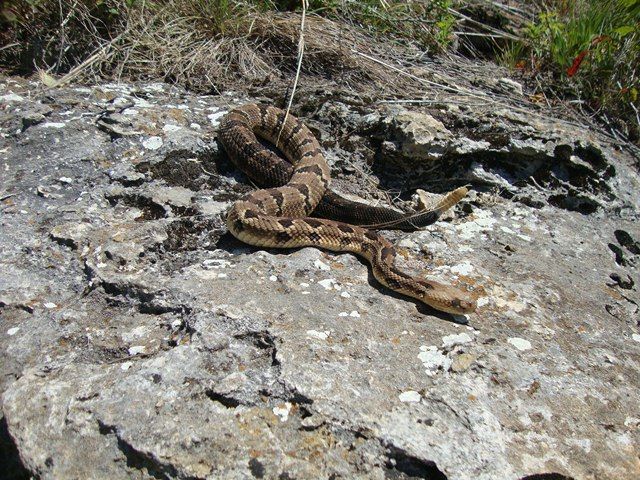
If you're lucky, however, you just might get to see the critter of the hour: Crotalus horridus (the Timber Rattlesnake).
Photo by D.M.


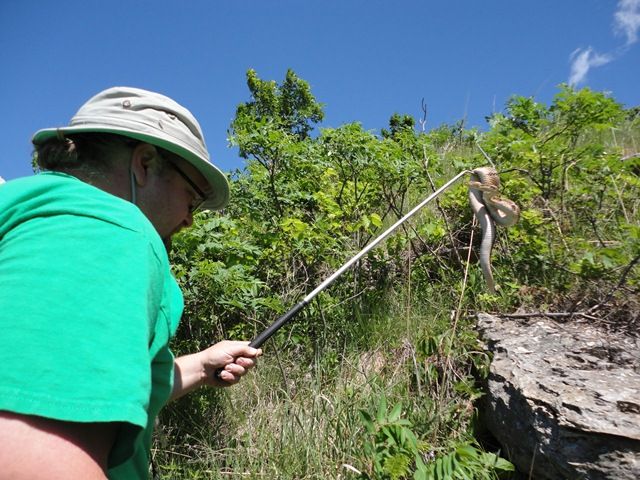
Sometimes, these critters sit out in the open.  As sit-and-wait, or ambush, predators...they rely on remaining still and unseen to surprise their prey (a small rodent, for example).  They employ this tactic to avoid being spotted by humans as well and finding them may require probing around in the grass with a snake hook hoping they will rattle (mostly to avoid stepping on them!). 

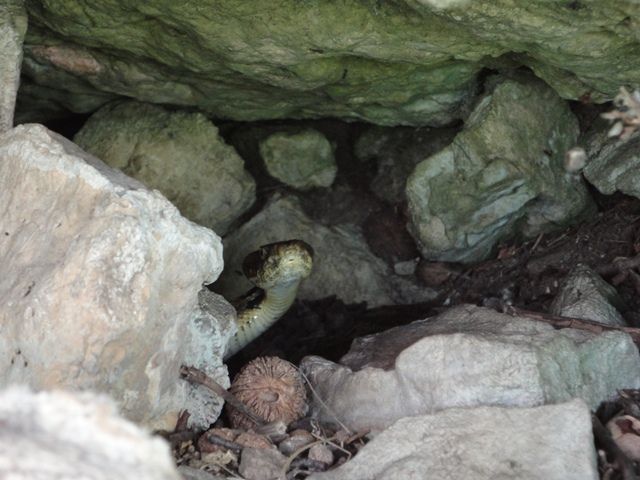
Although they can be found out in the open, often Timber Rattlesnakes hide in rock crevices that require alittle digging.

Some individuals really don't want to be found....
Photo by D.M.

But, if you can coax them out (a dicey process), they are truly a marvelous critter.  My pictures don't do them justice.


Throughout human history, snakes have been treated harshly by we upright-walking apes.  Rattlesnakes (and any venomous species) feel the effects of this disdain to an even greater degree.  Thus, Rattlesnakes throughout the upper Midwest are very rare and often Protected under individual state regulatory statutes/laws.

For more info, see this entry from a neighboring blog Salameandering.

Tuesday, June 19, 2012

Field Ecology, Summer 2012: Herpetological Survey Methods

We offer a semester-long course in field methods for our Ecology majors.  They are exposed to a variety of techniques, ranging from plant identification/collection-making and tree community composition analyses, to aquatic sampling methods, to techniques for surveying vertebrates.  The summer session version of this course offers some unique opportunities for sampling amphibians and reptiles because....well....it's warm out!

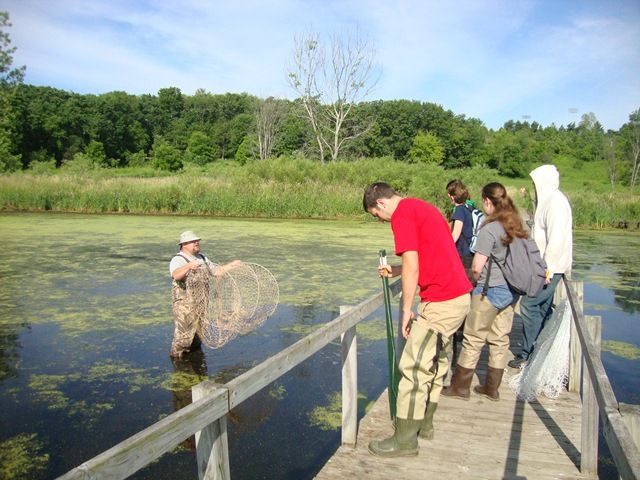
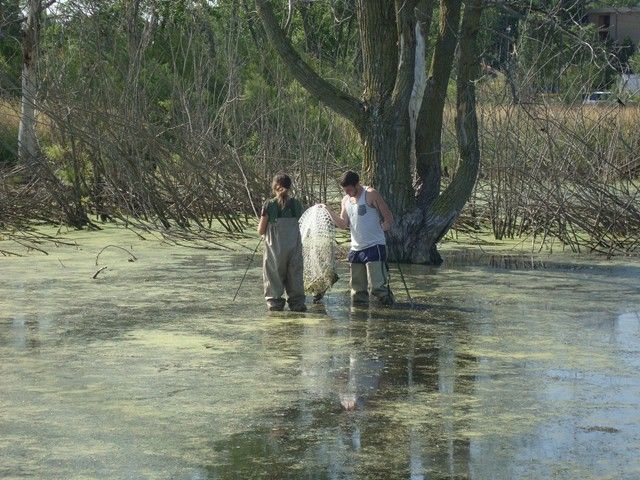
There is a small wetland on campus.  It's shallow and warm.  It's also incredibly productive (teeming with aquatic invertebrates, vegetation, and ampibians)....a great place for turtles.  In fact, turtles in this wetland undergo a fairly treacherous journey every spring and fall.  They leave the shallow wetland and migrate across a road to a nearby stream, where they spend the winter (a journey I've commented on before).  Once they are in the wetland, it's easy street.....assuming some annoying university professor and his students don't screw up your whole morning by setting turtle traps!

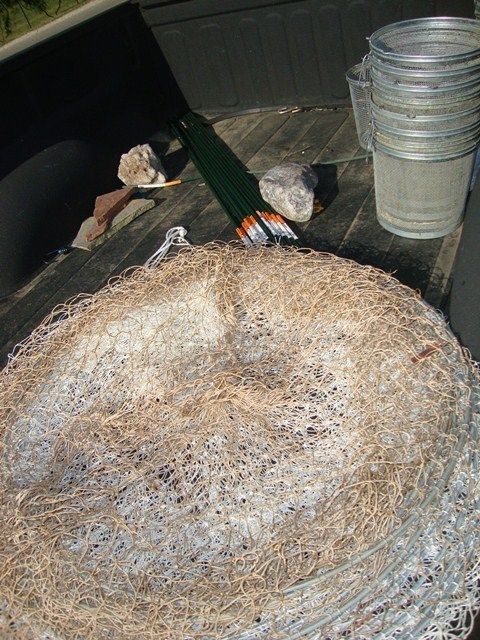
The traps we use are of a size and type that is accepted by our state regulatory agency.  These regulations vary by state (even down to a specific mesh size), so make sure you know these before throwing out turtle traps.  The traps themselves are not particularly difficult, once things have been explained a bit...

Basically, the mechanics of setting the traps is easy.  Finding the best location is one of the most challenging parts of turtle trapping.  Also, finding what type of bait works the best is very important.  I've tried alot of bait in my day (dog food, cat food, tuna, fish guts) and the best all-purpose turtle bait is a cracked tin of sardines! The brand doesn't even really matter.

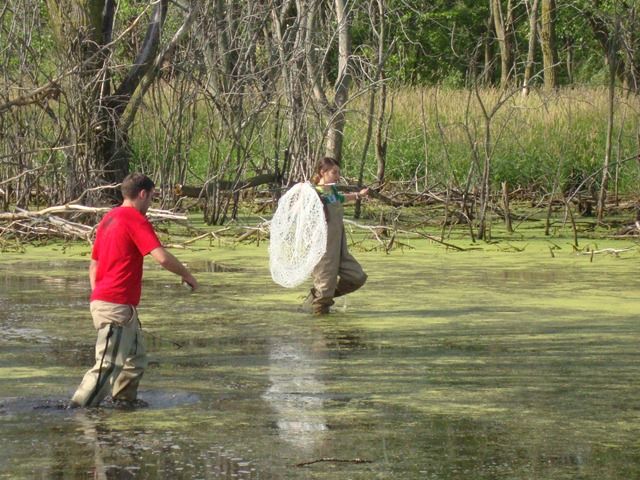
Armed with their knowledge, the students plunged in to set their own traps for an overnight soak....


______________________________________________________________________

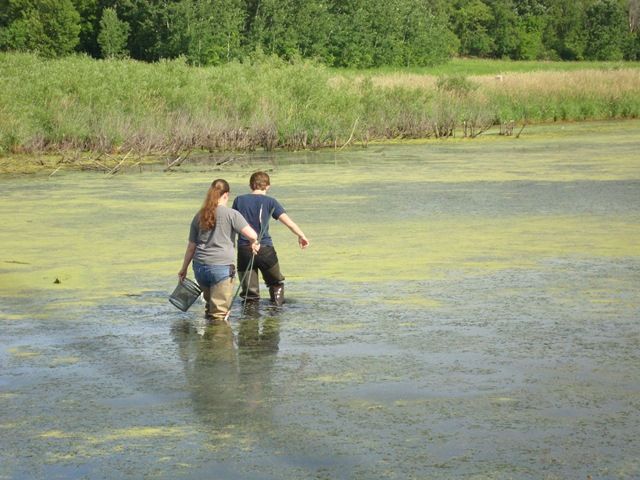
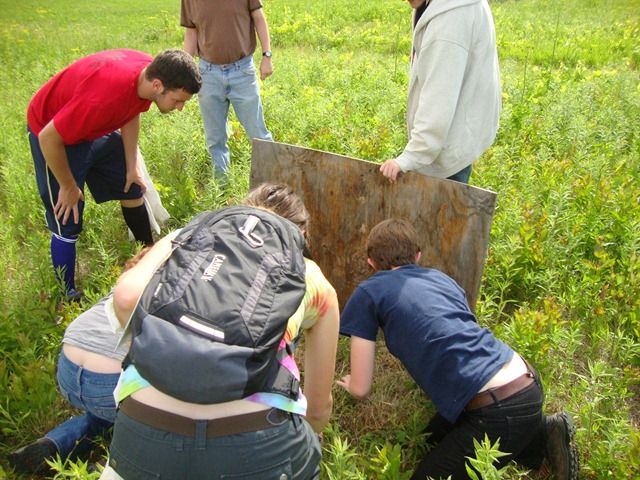
A commonly incorporated technique for sampling snakes involves the use of Artificial Cover Objects (ACOs).  These are essentially a board laid flat on the ground (often CXD plywood in 3 ft x 4 ft sections is ideal.  Once put into place, these boards are warmed by the sun, and also hold moisture, so that the conditions underneath become nice and warm and humid.....perfect for a thermoregulating ectotherm! In early May, the students in the summer session course measured out and deployed a 5 x 5 grid of these boards in a little prairie preserve on campus.  We let the boards age for a few weeks, which gives the snakes some time to find the boards.  So....in the late afternoon on the same day as setting the turtle traps.....we got out there as a group to check what was underneath.

We were not disappointed!  In total we caught 17 snakes in about a half an hour of checking ACOs.

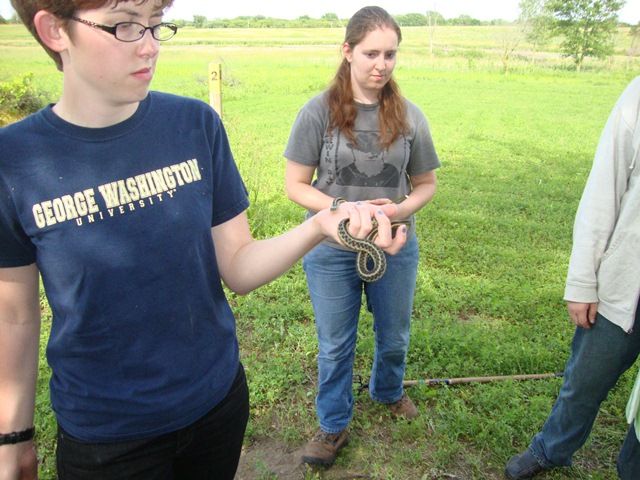
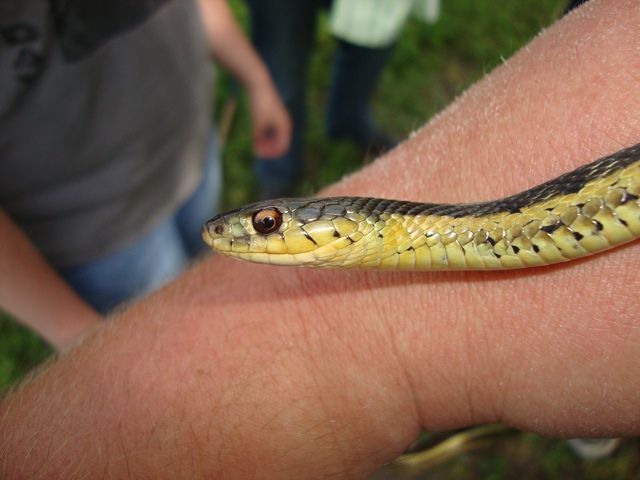
Many of the little live-bearing species that are native 'round these parts will use ACOs.  For example, Brown Snakes (Storeria dekayi), Red-Bellied Snakes (Storeria occipitomaculata) are easy to capture using ACOs.  Gartersnakes (genus Thamnophis) are also commonly captured with this method.  There are several species in this genus that are native to our region, including the Common Gartersnake (Thamnophis sirtalis). 
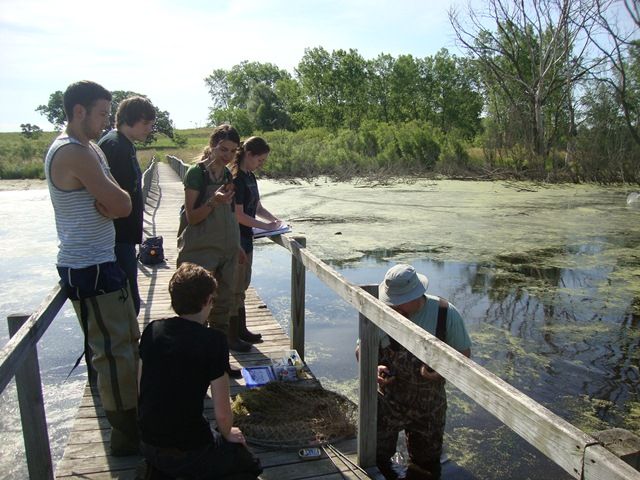
All captured snakes were then processed, which meant learning to sex snakes and learning to record some very basic morphological characters (such as snout-to-vent length, tail length, and weight).

We then let the snakes go along their merry way!
_______________________________________________________________________

The next morning, it was time to check our turtle traps....and again....we were not disappointed!

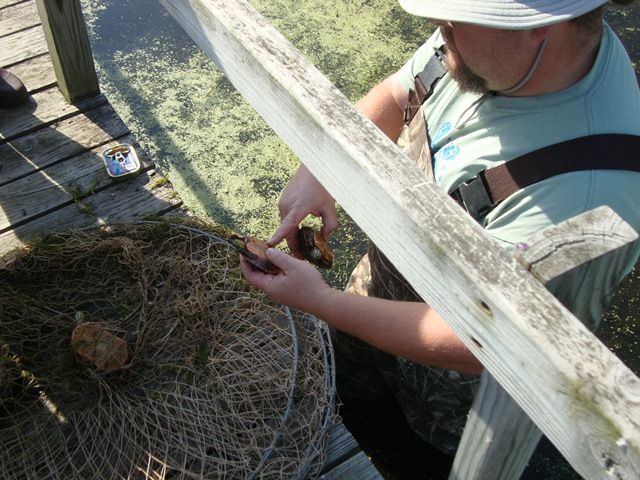
Painted turtles (Chrysemys picta) were the order of the day!  We caught 12 total in our traps...

We then discussed methods for measuring and marking turtles.

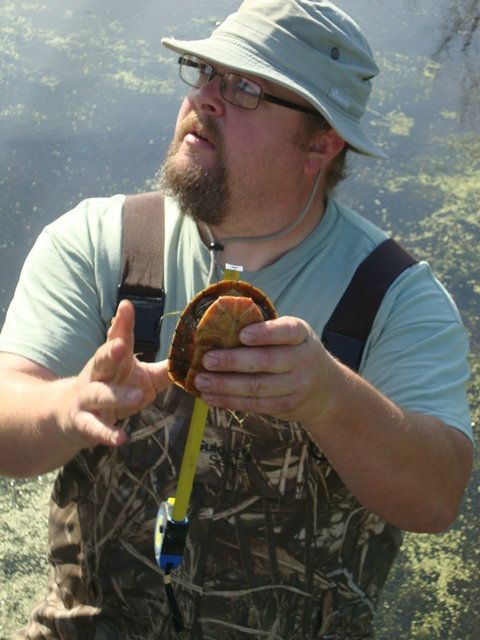
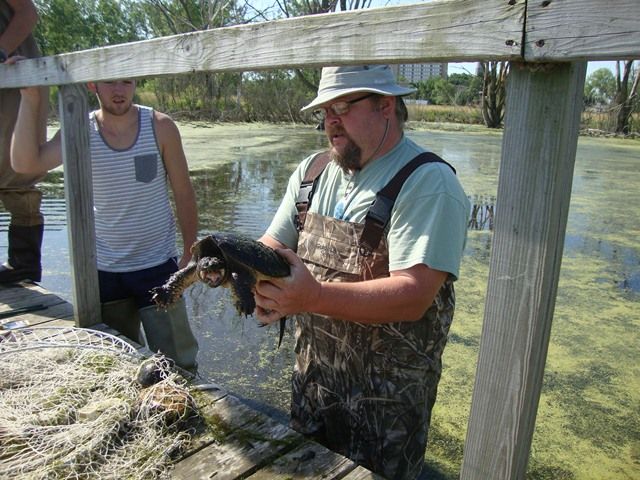
We measured and marked all of our turtles, including a rather small Common Snapping Turtle (Chelydra serpentina) with attitude to burn.

These marked turtles will now be part of an ongoing long-term population monitoring project carried out by students in this little wetland.

Friday, June 3, 2011

Week's End Survey Round Up II: Of Turtle Traps, Sexually Mature Sallys, and Poisonous Mammals

So, I'm going to continue my series of posts regarding our captures during weekly surveys (so long as we actually continue to catch stuff).

Dave (the undergraduate researcher working with me this summer) and I have been busting our back-sides the last two weeks. 

We start at 7 am every day because the heat has gotten brutal.  High of 97 degrees F this wednesday...and let me tell you that is NOT a dry heat.  We should probably start even earlier, but after field days in that brutal heat one just has a helluva time climbing outta bed earlier than 6 am to prepare for the day (I'm glad I don't study birds). 

Mondays are the most work.  We deploy traps along the drift fences.  We do our weekly rounds to all the camera traps.  Finally, we track all our radio tagged box turtles (see The Turtle in the Box posted on February 23, 2011; and Up and About for Spring posted on May 10, 2011 posted here).  The rest of the week involves daily checking of drift fences and cover boards.  Last year we also Sherman trapped the area, but the results became predictable (always White-footed Mice, Peromyscus leucopus).  We catch plenty of Peromyscus in our drift fences, in addition to many other small mammals that we don't catch in Shermans.  This coupled with the tediousness associated with baiting and setting Sherman Traps lead us to discontinue it.

This week...however....we FINALLY got the turtle traps deployed for an official first run.  I'd thrown them in about a month ago and gotten nothing, but hadn't had the time to run them again since.  Now they are part of our circuit and we'll run them the rest of the summer (barring unforseen circumstance).

So, we bust our humps all morning.  On a good day we're done with field work by 10:30 am and beat the worst heat (by 11 am, you're looking at near mid/upper 80s and high humidity).  On bad days, we'll be out until nearly noon.  As an overweight male of germanic/irish descent....I'm usually completely drenched in sweat and stumbling around in fogged-up glasses by about 9 am.

The afternoons are spent inputting data, working on analyses and etc. until about 5 pm....then we call it a day.  This will be our schedule for the rest of the summer. 

Not very glamorous, and a ton of work, but incredibly fun!  Plus, I usually give Dave Fridays off (it is supposed to be his summer break, afterall :)  ).  Although, honestly, I think he'd just as soon do field work on Friday too.
________________________________________________________________________

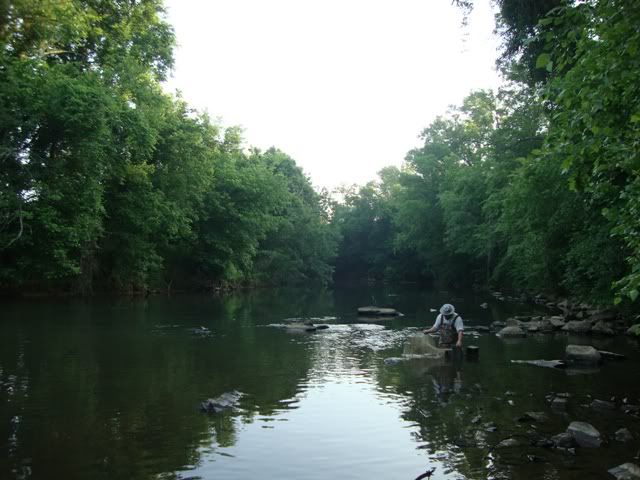
Anyhow, below is a picture of a location we've been trapping for turtles.  The river bed here is hard and rocky...so we've had to anchor the trap by fastening the hoops to cinder blocks with rope.  If we were trapping a pond or lake, we could probably just jam stakes through the hoops and into the soft sediment to secure the traps.  But we ain't so lucky this time.


This trap caught a decent-sized common snapping turtle (Chelydra serpentina) after the first day. 

Unfortunately, we didn't get a picture of it. 

Thought the location was pretty nice, though.

________________________________________________________________________

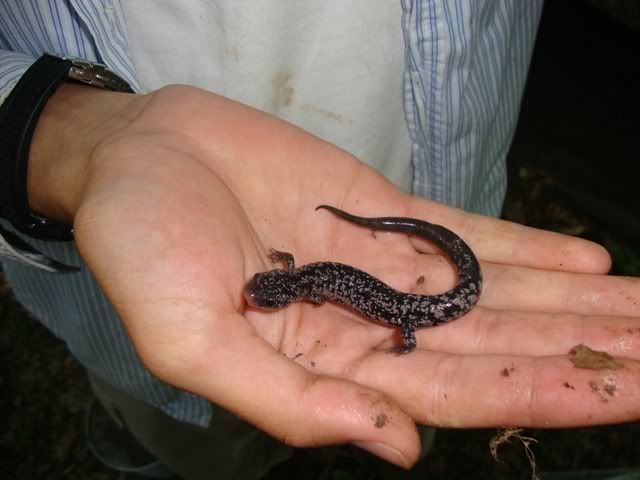
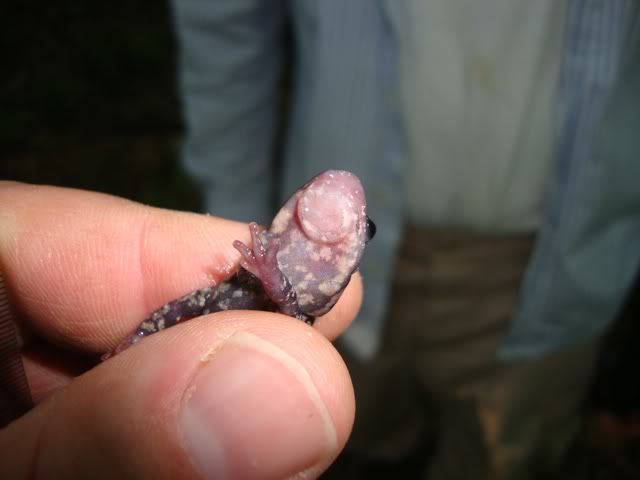
The White-spotted Slimy Salamander (Plethodon cylindraceus).  This isn't a rare find.  In fact, I've reported finding them in the drift fences already.  What makes this a particularly interesting capture was the fact that we caught a fully mature adult male (we usually get juveniles). 


Adult males of many plethodon species have large mental glands under the chin (occassionally referred to as hedonic glands, so you can probably imagine what their function is).  What many may not realize is that salamanders can have very complicated courtship behaviors.  In many species, it's almost like a dance that they play out, where the female follows the male closely, rubbing her chin on the base of his tail, as they move together in circles (this is sometimes called the tail straddling walk).  It is during the tail straddling walk that the mental gland of the male comes into play.  The male will turn around periodically and slap the female on the nose with his mental gland.  Thus, it's believed that important olfactory cues, such as pheromones, are tranferred from male to female in this fashion.  The male then eventually deposits a spermatophore (i.e. packet of sperm) on the ground that the female walks over and picks up with her cloaca....and.....bingo!  Fertilization!
Above Two Pictures: the obvious mental gland on the chin of this adult male white-spotted slimy salamander.

For more information about the courtship behaviors of Plethodon salamanders, see here.  Also check out the bible of amphibian biology/ecology: Duellman and Trueb's (1994) Biology of Amphibians (second edition).  A wealth of information is carried therein.
_______________________________________________________________________

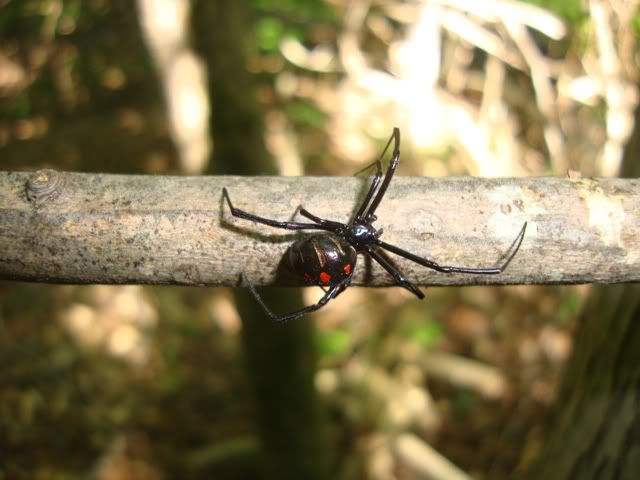
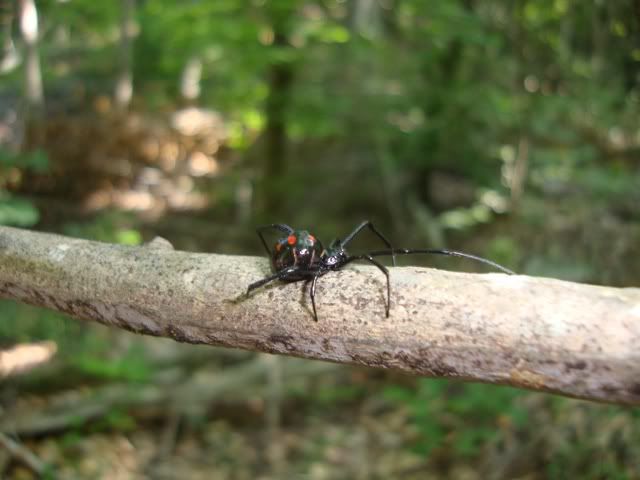
The Black Widow (Latrodectus mactans): We found two large gals in their webs along the same drift fence this week.  Each time, I carefully transfered them on a stick to some location far away from the fence.  I'm sure other widows will move in to take their place.  As usual, they were completely unaggressive during the relocation process.  Yet, they still must be treated with a hefty dose of respect!
Above Two Pictures: one of the Black Widows that had set up shop along one of our drift fences this week.

___________________________________________________________________________
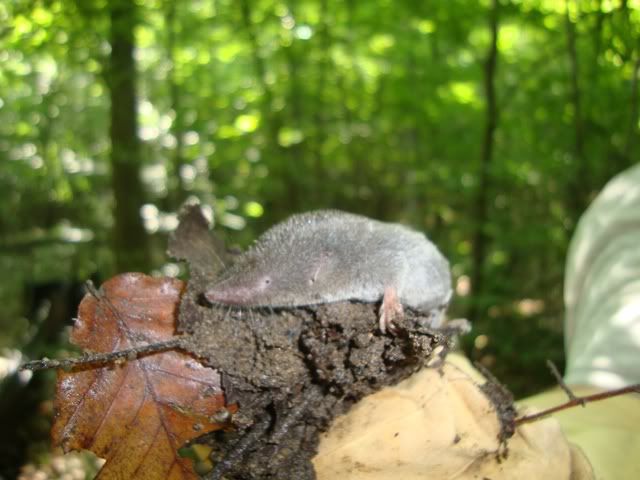
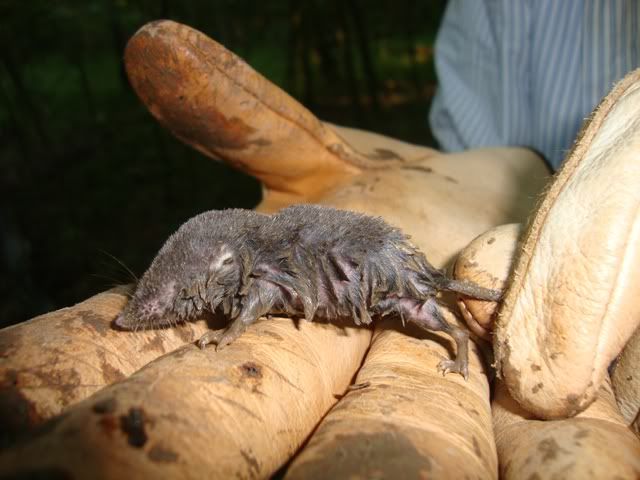
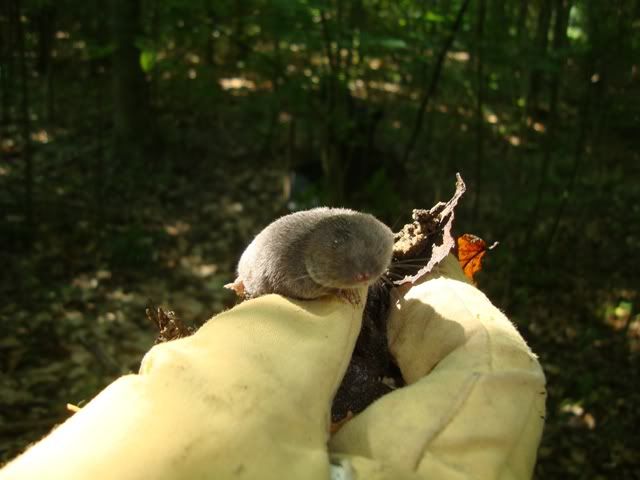
The Southern (or Carolina) Short-Tailed Shrew (Blarina carolinensis).  Although we captured some eastern Harvest Mice again, the most commonly captured small mammal this week was the Short-tailed Shrew.  All ended up in the pitfall traps along the fences.  At our sites, this is the most commonly captured member of the Order Insectivora (which includes primarily shrews and moles in our neck of the woods).  They are often reported from woodland habitats with moist soil and lots of ground debris (which is where the captures pictured below came from).  However, we've also seen them under our coverboards laid out in grasslands/old fields...sometimes with little "nests" of shredded vegetation (often grass) gathered up nearby.

Although we have two species of Short-tail Shrew in the state: The Southern Short-Tail (B. carolinensis) and the Northern Short-Tail (B. brevicauda), their ranges do not overlap (Webster et al. 2003, Mammals of the Carolinas, Virginia and Maryland). 

Above Two Pictures: Note the incredibly small eyes, but large whiskers.  As burrowing mammals, sight is less important than the tactile sensitivity that whiskers can provide when hunting soil invertebrates!

Above: a different individual that we captured.  Note the conical head shape of this species, which (in my opinion) separates them from other shrews, such as the Pygmy Shrew, which have more "elephantine" noses.  The short tail relative to body length is also a helpful clue.


As some of the only poisonous mammals species in the world, members of the Genus Blarina must be handled carefully.  They do not have a sophisticated venom-delivery system as do snakes of the Families Viperidae (vipers and pit-vipers) or Elapidae (cobras, kraits, mambas, etc.).  The toxins are in the saliva (according to George et al. 1986, the account published for the American Society of Mammalogists), and they have grooved teeth that allows it to flow into the bite wound more effectively.  This is somewhat similar to the venom-delivery system of Gila Monsters and Mexican Beaded Lizards, and I'm still up-in-the-air about whether this means they are considered "poisonous" or "venomous".  The toxins are reportedly both hemotoxic (destroys tissue) and neurotoxic (impairs neurological function), and function primarily to aid in prey capture.  It has also been suggested that, becuase they cause paralyses in their prey, these toxins may serve as a means by which Short-tails can cache (or save food) for later.  Their diet includes mostly invertebrates, such as earthworms and millipedes, but they will also eat vertebrates larger than they are, such as mice and voles.  It is believed that their toxic saliva allows for this.

As George et al. (1986) summarize, humans have reported experiencing "serious effects" after being bitten by these shrews.
_______________________________________________________________________


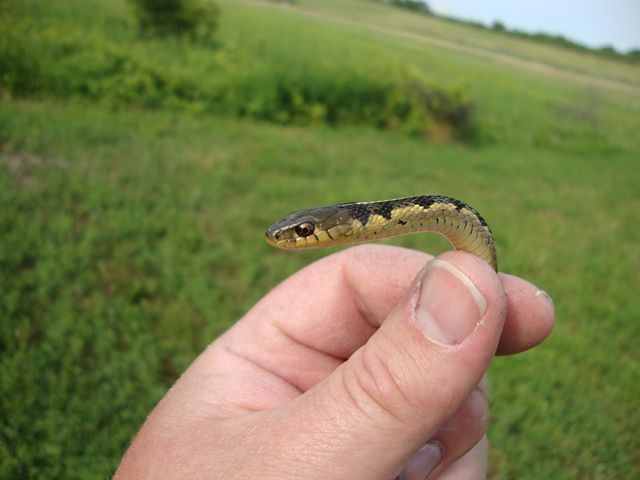
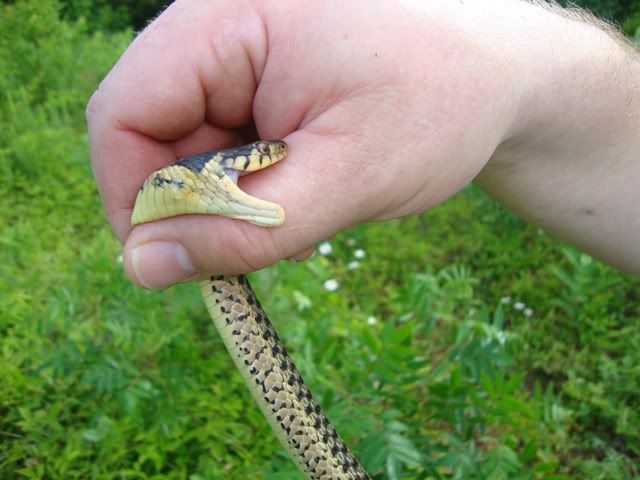
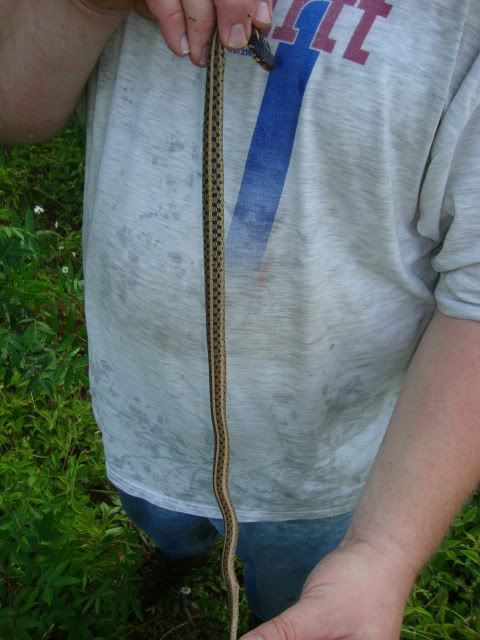
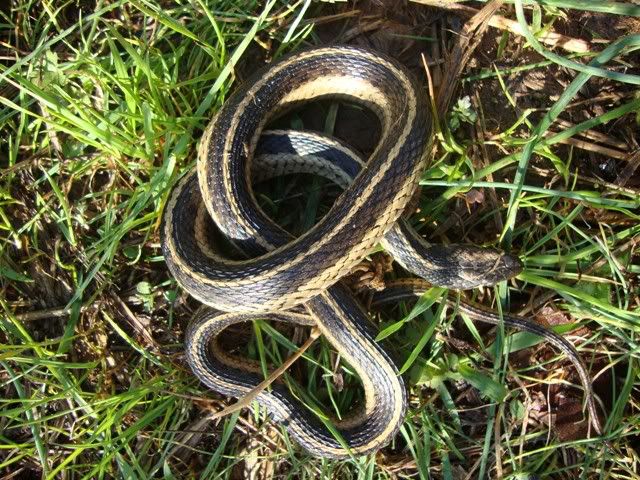
The Common Gartersnake (Thamnophis sirtalis): The Common Gartersnake is probably one of (if not the) most widely distributed snakes in North America (Ernst and Ernst, 2003, Snakes of the United States and Canada).  It's geographic range includes the entire Eastern US, the Entire Midwestern US, a good portion of the Western US....while also reaching far into Canada from coast to coast. Aside from the more northern reaches of Canada, the only regions in North America that the Common Gartersnake is absent from are the hot/dry habitats of the southwestern US, and much of the Rocky Mountains (as far north as Wyoming and the southeastern corner of Montana).

Needless to say, I've spent alot of time with this species (both in WI and in the Southeastern US).  They are ecologically very similar here, as in the upper Midwest: liking damp habitats, but also grassland edges and even disturbed environments.  They are not as abundant down here as up there, but we still catch them often.

One difference I've noticed is that the Southeastern individuals are much quicker to slap a bite down on your finger.  Luckily they don't have much in the way of teeth...and it rarely breaks the skin.

I guess I'd be ornery too if I had to live outside in this hot & humid part of the US 24 hours a day, 7 days a week. 


They also seem to have this very handsome checkerboard pattern more often (at least in my experience).  Nice looking snakes.

The above individual was captured in a grassland drift fence.  The one below, however, came from a lowland deciduous forest drift fence.  It was much bigger than the first snake.

So...that's it for this week.  There will hopefully be more captures to report in the future.

Enjoy the weekend!

Thursday, March 24, 2011

Another Good Day For Herps (i.e., Amphibians and Reptiles)!


I put the clarification in the title as to what a "herp" is....just in case folks not familiar with this word mistakenly thought my post had something to do with an S.T.D.  I thought about this after my post from yesterday (A Good Day for Herps, posted on March 23, 2011).

So...to re-interate....a "herp" is a generic term for amphibians and reptiles (the study of these critters is called Herpetology).  Whereas a "herpe" is something you'll never read about on this blog.

_______________________________________________________________

Yesterday, I posted about my first good haul of captures in my survey equipment this year (drift fences and coverboards).  The scaly and slimy goodness continued today, much to my happiness!

We had several massive thunderstorms blow through the area last night.  I was hoping the rain would stimulate some amphibians to move around alittle...and they did!

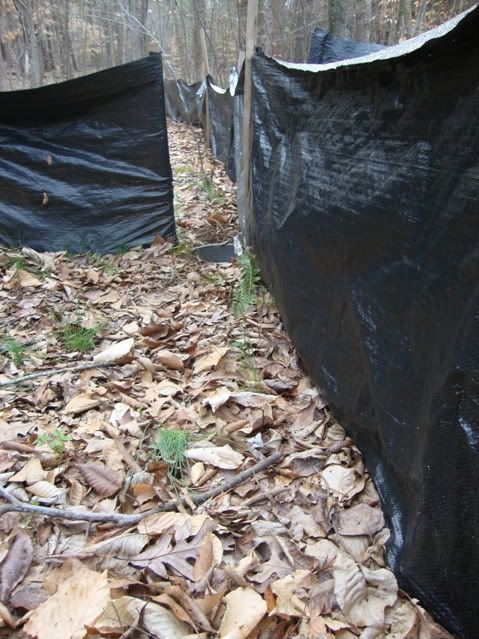
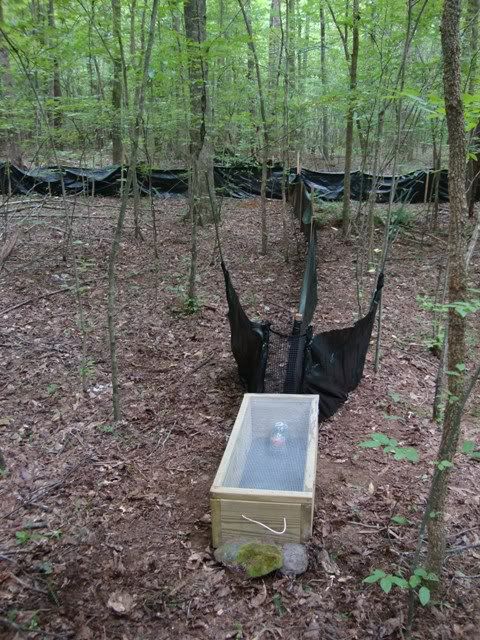
But, let me start with my drift fence capture from yesterday (as promised in my last post).  This one was in the "pitfall" trap along one of the fences I have in an upland deciduous forest.  I have one pitfall trap associated with each drift fence.  It consists of a 5-gallon bucket dug into the ground so the lip of the bucket is flush with the surface of the dirt.  The fence then leads critters to the bucket and they fall in.  It's a live trap.

Above: the drift fence leading up to the pitfall trap

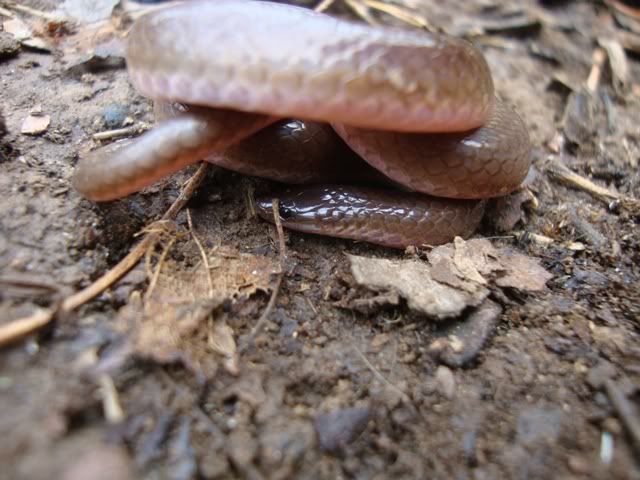
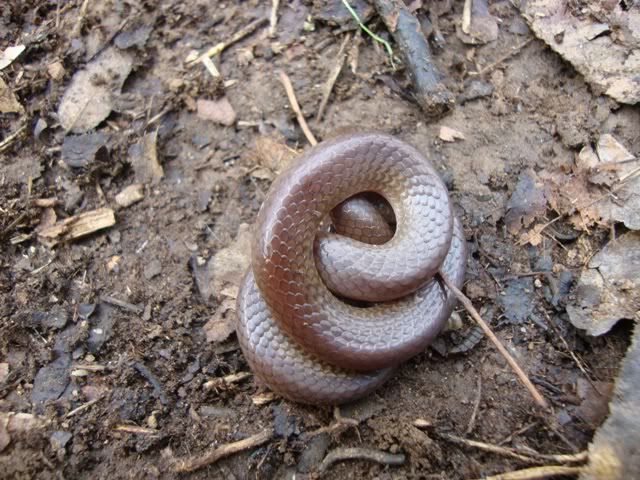
The volunteer yesterday was a nice little wormsnake (Carphophis amoenus).  These critters were a common occurrence in the drift fences last year.  They must exist in large abundances in dry/mesic upland forests in our region.  Despite this, there is relatively little known about these docile little snakes.  In fact, that I know of, there are only five manuscripts that have studied the ecology of these critters in any depth (Aldridge and Metter 1979, Clark 1970, Fitch 1999, Russell and Hanlin 1999, Wilson and Dorcas 2004).  The reason why they have been the subject of so few rigorous ecological research projects is probably becuase they are small, secretive and fossorial (i.e. below ground). They're not easy to find without the use of specific survey equipment.

The wormsnake is easy to identify.  Their dorsal (upper) surface is brownish-red, with sleek scales.  Their ventral (lower) surface is often rosy or pinkish in color.  The head is very small (likely becuase they eat primarily soft-bodied invertebrates, such as worms), as are the eyes. 

Above: the small head and eyes of the wormsnake, buried beneath its coils.

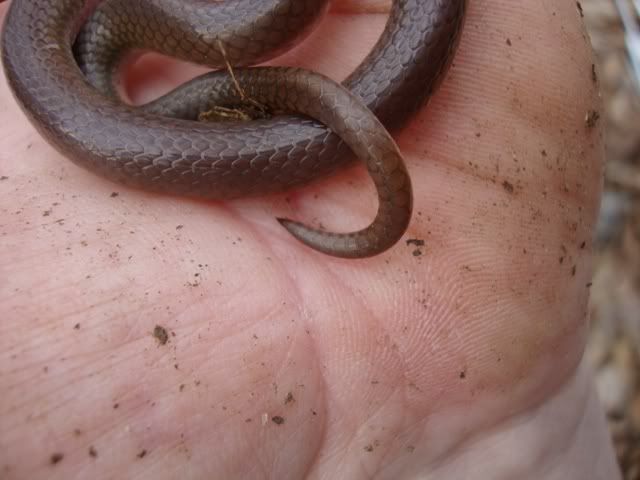
The most unique character is the hardened, pointed tail-tip (sometimes called a "tail spine").  They often press this tail tip into the hand of anyone that attempts to restrain them.  This defensive behavior is almost laughable, as it causes no discomfort whatsoever to a human.  However, perhaps it is effective against other smaller predators that may threatened these snakes in the leaf litter of the forest floor.

Above: the hardened "tail spine" of the wormsnake.

Behavioral observations of this species are uncommon.  However, some unique anecdotal reports exist in the literature regarding their defensive behaviors.  Pressing the "tail spine" into the hand of a would-be captor is the most commonly reported defense.  Kapfer and Slone (In Press) also report a bizzare bit of defensive behavior involving an individual that partially buried the front 3/4 of it's body in leaves, lifted its exposed tail and wagged it's tail in a serpentine fashion.  In addition, Diefenbacher and Pauley (2009) observed an individual hiding its head beneath it's coils, while holding the tip of it's tail vertically.  The assumption is that the head is buried in the coils and the tail is presented to the predator in the hopes that the tail tip is focused on, rather than the head.  In theory, a predator damaging the animal's head is more likely to result in death than if the predator focuses on the tail.  I  don't know how effective this defense mechanism is.....I don't see many wormsnakes with damaged tails.

I had never seen this head-hiding behavior before. 

In any event, while trying to photograph the wormsnake I caught yesterday, it presented me with half of the defensive behavior reported by Diefenbacher and Pauley, it hid its head beneath its coils (it didn't raise its tail in a vertical position, however).  When I would touch the snake in the hopes of repositioning it for a better picture, it would bury its head further into it's coils.  Eventually, I gave up....took a picture of the "headless" snake, buried it under some leaves nearby and went on about my business.

Above: a wormsnake exhibiting the defensive behavior that involves hiding its head beneath its coils.

____________________________________________________________

So the wormsnake was all I got in my drift fences yesterday.  Yesterday was the day for coverboards being effective.

Today, it was just the opposite.  The coverboards yeilded nothing, but the drift fences were crawling (literally).  The massive lightning storm we had last night (and associated rain) may have gave the salamanders under the coverboards the moisture they needed to mosey along to some nice subteranean refuge.

So...I'll go through some of the highlights from the drift fences today.

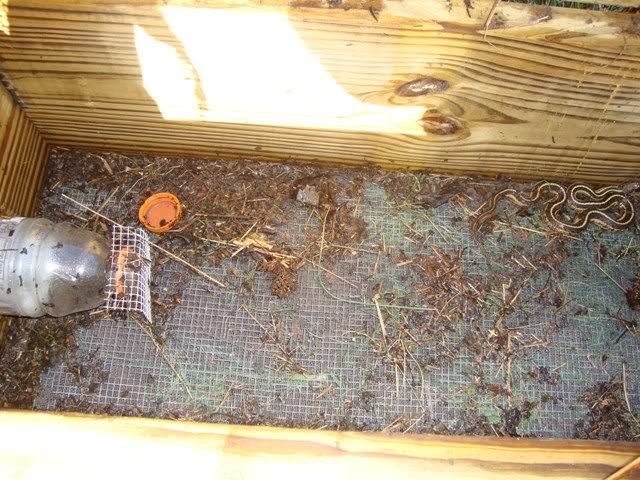
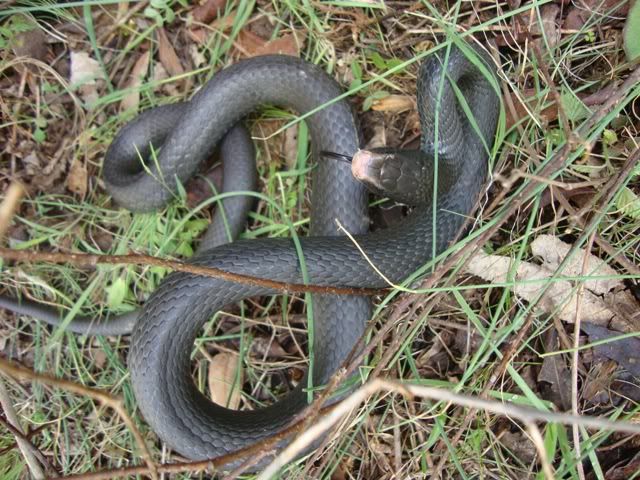
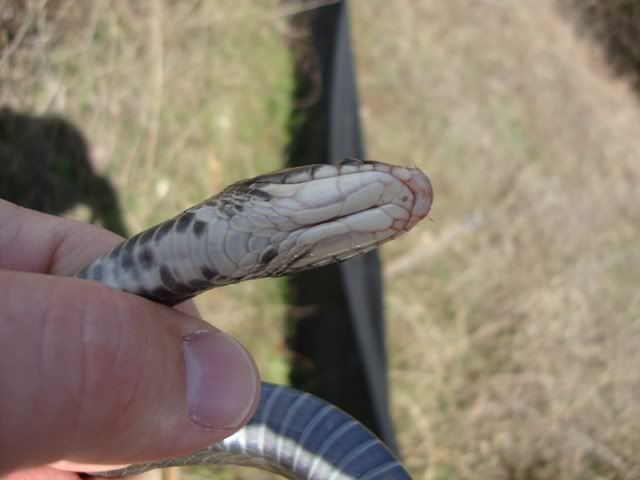
The first captured critter I encountered today was in one of my grassland drift fences: the Common Gartersnake (Thamnophis sirtalis).  I captured two individuals in the same fence.  One in one of my wooden box traps and the other in a funnel trap.

Above: box trap associated with a woodland drift fence

Above: a funnel trap placed along a woodland drift fence

So, the first gartersnake was found in one of the box traps.  The heavy rain had lead to a drop in temperature, and it was cooler this morning.  The snake wasn't moving very fast and I was able to snap a shot of him in the box (normally they are shooting out as soon as its open!).


Above: my first encounter of the day, a common gartersnake (Thamnophis sirtalis) in a box trap


Above: two pictures of a Common Gartersnake (Thamnophis sirtalis) captured in a drift fence.
Common Gartersnakes are....well......common.  They are probably the most commonly encountered snake throughout the eastern and midwestern USA. We even caught them in huge numbers back home in Wisconsin.  They can withstand human disturbance, they are very general in their habitat needs and diet.  So, I'm not shocked to have caught them today. 

But that doesn't mean it isn't always a treat to catch snakes!
________________________________________________________________

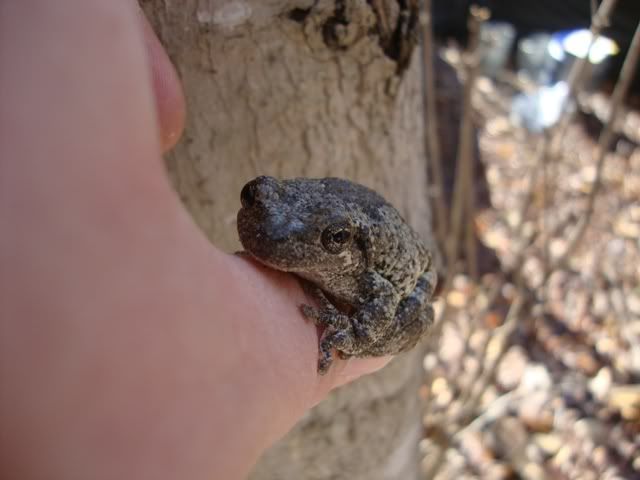
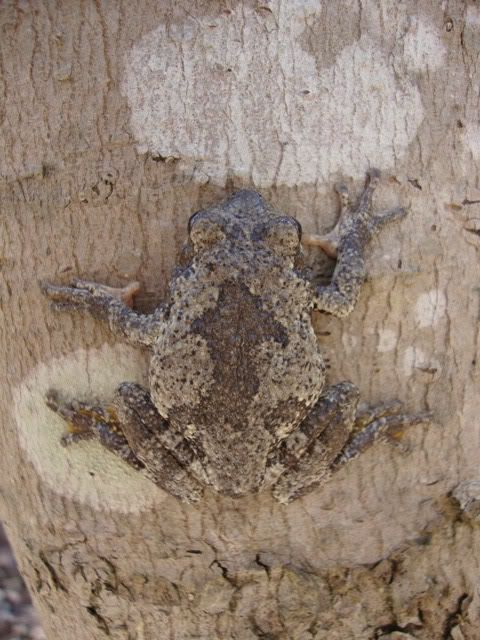
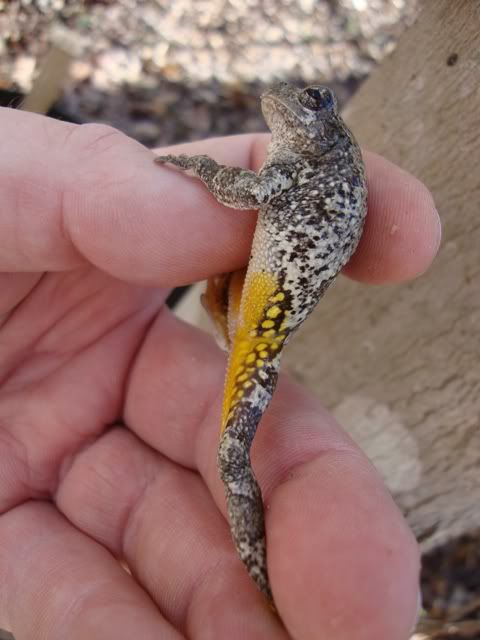
I next moved into check some of my woodland drift fences and was in for a treat.  One of my favorite native frogs was waiting for me in a funnel trap: Cope's Gray Treefrog (Hyla chrososcelis).  Cope's Gray Treefrogs are another species that I was familiar with from my work in Wisconsin (although there it is less common than the related (and very similar) Gray Treefrog (Hyla versicolor).  In fact, these two species are so similar they can only be easily differentiated by hearing the call of the breeding male for each species.  While the call for both is a quick trill, the Gray Treefrog's trill is more bird-like and melodic....whereas the Cope's Gray Treefrog has a trill that sounds more like an insect, almost sounding like a flourished buzz.

There is another definitive way to distinguish these two frogs, but it is much more cumbersome: counting chromosomes.  The Gray Treefrog is a tetraploid, and has double the chromosomes (48) of a Cope's Gray Treefrog, which is a diploid.

Not many people are going to go to this extreme, however!  I've only ever heard Cope's Gray treefrogs calling in our area...so I'm going to assume that's what I caught (I forget my portable chromosome analyzer in the car most of the time, anyways ;) ).

Regardless of all that jazz....one thing is for certain: they are cute as heck!

Above: note the obvious toe pads. They can climb up sheer surfaces and the toes feel sticky to the touch!

Above: Talk about camoflauge!

Above: the yellow in the groin upper thigh region is typical of H. chrososcelis and H. versicolor.

__________________________________________________________________

So after finishing up my work at the first study site, I moved on to site two.  Starting with the grassland drift fence, as I had did at Site 1.  Again, I was in for another treat!

You may recall that yesterday, I found a juvenile Racer under one of the coverboards (which I mentioned was patterned, unlike the adults).

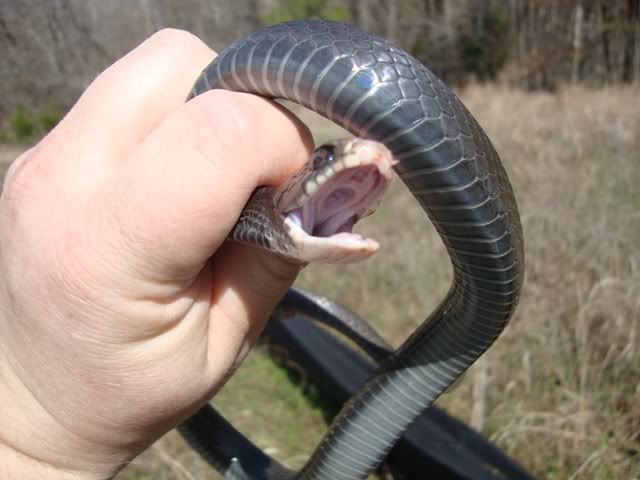
Today I captured a large adult Racer (Coluber constrictor) in a funnel trap.  Now you can see how the juveniles and adults differ in their appearance.  The adults are a beautiful sleek black, with white chins. 


They also can be alittle nippy!


Interestingly, after I set it on the ground and harrassed it for a while (trying to position it for a good picture, while dodging it's angry mouth)....it went through the same head-hiding behavior that the wormsnake did yesterday.  In fact, it was so committed to protecting it's head, that I was able to pick up my gear and prepare to move on for a good three minutes and the snake remained in that pose for the entire time.  I eventually had to move it off into bushes for fear a hawk would nail the snake if I left it where it was.

Above: an adult black racer protecting its head with its coils.

________________________________________________________________________

I'll round this out with some salamanders.  Yesterday, I found two species: the slimy salamander, and the spotted salamander.

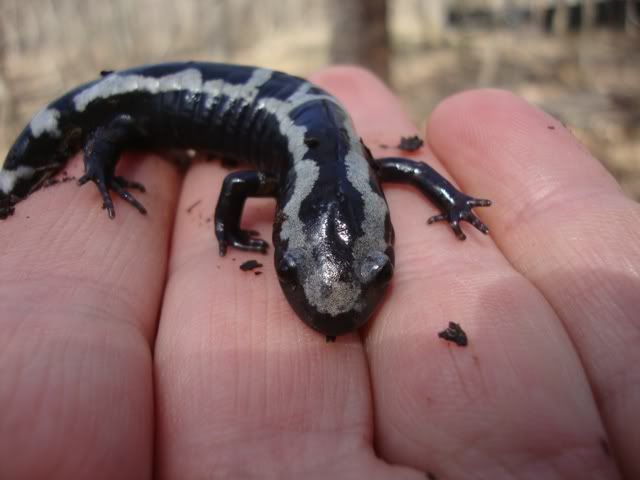
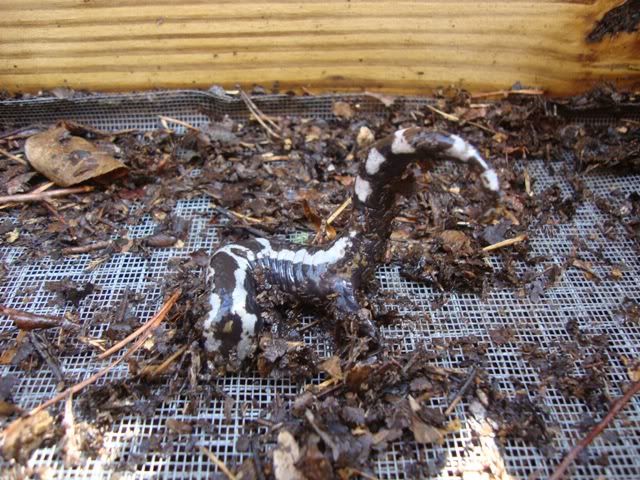
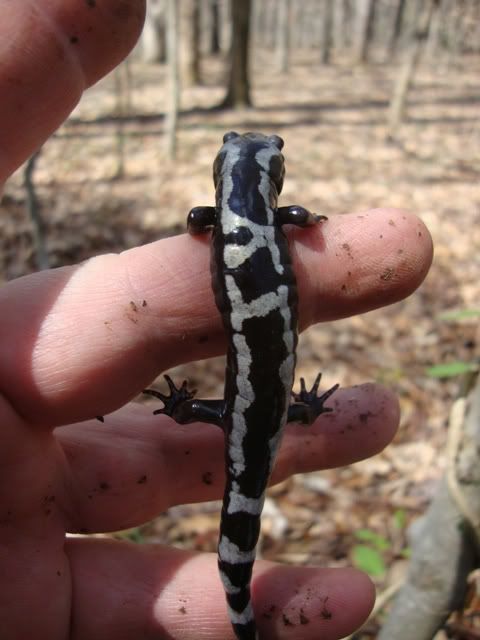
Today, when I checked on my woodland fences at site 2, I found a third species the Marbled Salamander (Ambystoma opacum).  Although I found this species commonly last fall, they are a beautiful little salamander and I always enjoy seeing them.  This one was in a box trap.

So long as I'm on a defensive behavior kick, why not show you some cool salamander defensive behavior.

Above: a Marbled Salamander exhibiting defensive posture.

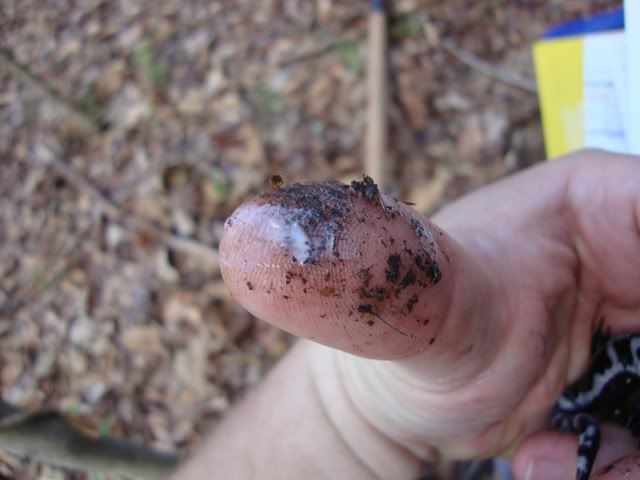
This defensive posturing is cool as heck!  As soon as I touched the salamander, it instinctively rose it's tail and dug its head into the ground (well, as much as it could in this box trap).  What this accomplishes is (1) protecting and hiding the head, making it less of a target and (2) focusing the predator's attention on the tail.  This makes alot more sense for the salamander than it does the wormsnake because, unlike the wormsnake's tail, the salamander's tail would make a particularly undesirable meal.  When harrassed further, the salamander secretes a whitish substance from glands on its tail.  This secretion is incredibly sticky (it will even cause your fingers to stick together for a few seconds).  The secretion is also noxious.  Brodie et al. (1979) found it will deter a common woodland floor predator: the shrew. 

So, the sally protects its head, while presenting a foul, sticky tail.  Brilliant!

Above: whitish secretions from glands on the salamander's tail

Above: the salamander's sticky secretion on my thumb!

Above: a handsome little salamander

I also picked up two more adult slimy salamanders, three white-footed mice (Peromyscus leucopus), and a nice little Carolina Short-tailed shrew (Blarina carolinensis).  Didn't get very good pictures of them, though.


Literature Cited:

Aldridge, R.D., and D.E. Metter. 1973. The reproductive cycle of the western worm snake, Carphophis vermis, in Missouri.  Copeia 1973:472-477.

Brodie, E.D., III and R.T. Nowak and W.R. Harvey. 1979. The effectiveness of antipredator secretions and behavior of selected salamanders against shrews. Copeia 1979:270-274.

Clark, D.R. 1970. Ecological study of the worm snake Carphophis vermis (Kennicott). University of Kansas Publications, Museum of Natural History 19:85-194.

Diefenbacher, and Pauley 2009. Carphophis amoenus defensive behavior.  Herpetological Review 40:94-95.

Fitch, H.S. 1999.  A Kansas Snake Community: composition and changes over 50 years.  Krieger Publishing.  Malabar, FL.

Kapfer, J.M., and C.Slone. In Press. Carphophis ameonus (eastern wormsnake) defensive behavior. Herpetological Review.

Russell, K.R., H.G. Hanlin. 1999. Aspects of the ecology of worm snakes (Carphophis amoenus) associated with small isolated wetlands in South Carolina. Journal of Herpetology 33:330-344.

Wilson, J.D. and M.E. Dorcas. 2004. Aspects of the ecology of small fossorial snakes in the western Piedmont of North Carolina. Southeastern Naturalist 3:1-12.