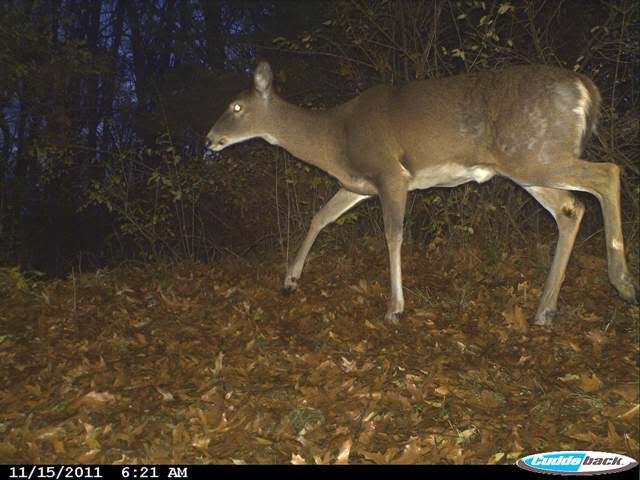
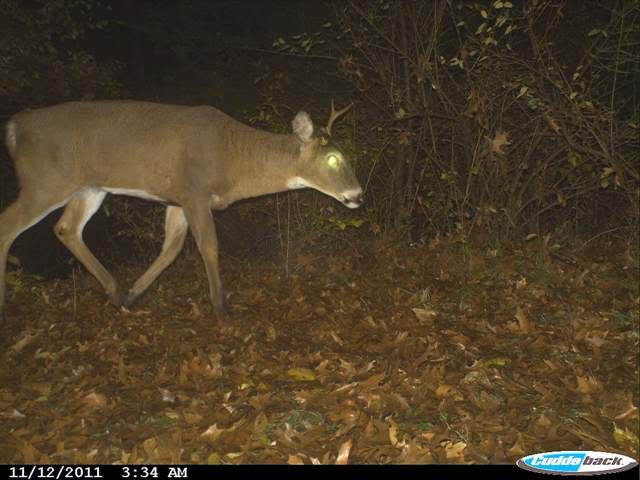
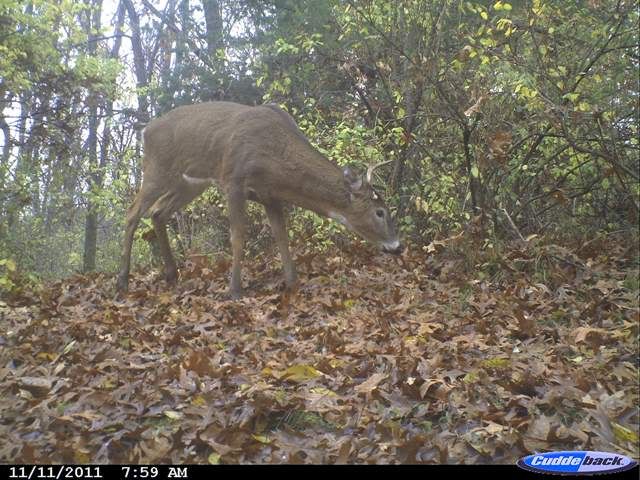
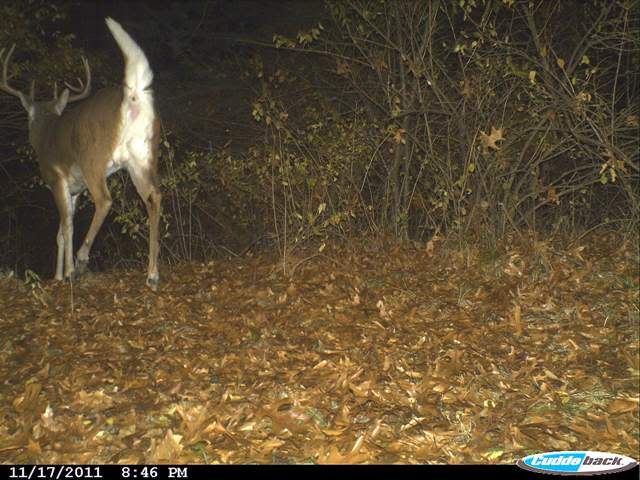
Showing posts with label scrape. Show all posts

Friday, November 16, 2012

White-Tail Chemical Ecology

I accummulate hundreds and hundreds of White-Tail Deer pictures and video clips throughout the year.  I realize that countless pictures of deer get a bit boring and repetitive.  This is evidenced by the fact that my blog entries related to deer consistently have the lowest numbers of views compared to my other entries. 

Therefore, I try to limit the number of entries I write that are focused solely on deer.  I obviously can't help showing you all any large bucks I happen to get (at least once or twice a year)....they are just too impressive when in their prime not to be enamoured with them.  Yet, I try and focus deer-related posts to something specific regarding interesting behavior or phenomena....and I think the interactions below fall into that category.

The video clips below provide a bit of insight into how frequently bucks and does return to investigate a scent location....and also for how long they will return to this spot over time.  Granted, this is a sample size of 1....but it's still neat to see.

You'll also note that there is not a single clip that occurs during the daylight.  Even though the behavior below is occuring outside of the rifle hunting season in our area, most of my pics/videos of deer activity throughout the fall and winter (particularly for the large bucks) happens at night.  There's tons of deer out there....but they're just too dang "smart".  I often wonder if pressure from hunting hasn't acted as a force that drives natural selection to "favor" individuals that more often operate at night....and thus don't get shot! 

But, that's a different topic of discussion.
__________________________________________________________________________

The camera that took these clips is mounted on the trunk of a very young tree.  The trunk is pretty narrow and the branches are low to the ground (in fact, I had to trim some away just to access the tree trunk for camera mounting). 

The camera was deployed to this location on the morning of 9/26/2012.

9/26/2012

9:23 pm:  Doe browsing a bit, but also stopping by to investigate some fox urine that I put out.

11:28 pm: One of The Brutes comes by to investigate....

9/27 to 9/28/2012 (evening to early morning)

7:24 pm: A doe (perhaps the same one from the previous night) once again is sniffing around the same spot...

10:07 pm: The Brute comes by to get a nose-full.....
He then moves towards another low-hanging branch.  He appears to browse a bit, but also deposit scent from his forehead glands....

11:32 pm:  A small buck stops by.  I think he's part of  set of twins that belong to the doe that visits this spot.  He does some browsing, but also appears to investigate the scent from the larger male....

 1:42 am:  The young feller comes back to sniff around a bit.

1:46 am: There's a-doings a-transpirin' off to the right of our field of view!  Something is shaking the limbs of the tree the camera is mounted on, and kicking up the grass.  You can also barely see a pair of eyes watching cautiously in the background (far left).


You can probably guess who's responsible for the ruckus (the little buck also skee-daddles in the background).

......wait for it.....

"Holy .....!  What was that all about?!"
9/28/2012 (evening)

8:59 pm: A doe sniffs the branch that appears to be a despository for scent from the forehead glands of the big male...
For the next two days, the doe and the young bucks come back and sniff around some more.

9/30 to 10/1/2012 (evening to early morning)

11:39 pm: The Brute comes back to invesitage his scent branch...

1:03 am:  There's another ruckus off-screen....and then....

...wait for it....
The Crown!

___________________________________________________________________________

Although the buck meandered by this spot again once or twice, I never saw the back and forth investigation of scent after the first of October.  The camera was moved from this location on November 14, 2012.  So all of that activity was occuring over a period of about 5 days.  An important caveat: almost immediately after I mounted the camera...I was getting clips of this behavior.  Who knows how long it was going on prior to me mounting the camera.

It is worth noting that I started seeing the first actual buck scrapes on the ground in about mid-October at this site.  You may also recall that I first started seeing velvet rubbed off of antlers (at a different site) on September 8, 2012.

It is also fun to go all the way back to the beginning of the year and look at when the antlers first starting showing on these bucks. At the site where the video clips above were taken, antler nubs first became evident on April 17, 2012.

Tuesday, October 9, 2012

Some New Brutes for 2012

I'm not one to go nuts over "big bucks"....however, there are some brutes hanging around the property.

Could be one of the same individuals from last year (see here and here).

Seeing that the "rut" is soon to be upon us....I can't resist posting some clips of these guys.


This one is at a completley different site....almost in the next county.  But he's still a brute.  His antlers are not quite as impressive as the top fella, but check out the neck on this one!  Thick as a mature oak branch!


The clips below were grabbed at a location very near where the video clips at the top of this post came from.  Either it's the same individual (hard to tell from the clips), or another large bruiser in the area.


I've also captured some interesting behavior associated with this last individual. 

But I'll save that for a subsequent post!

Thursday, January 26, 2012

Winter Tracking Opportunities & Mammal Systematics.....

One of the great things about winter is that it provides lots of tracking opportunities.

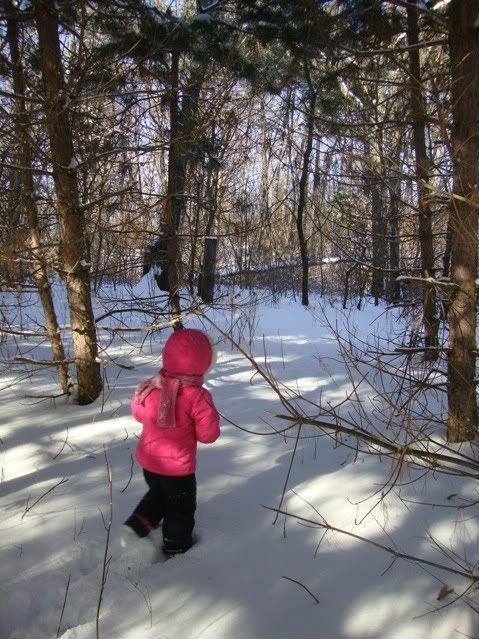
We finally got some snow here this January.  December had been, basically, snow-less....which was sort of a disappointment.  However, the new winter wonderland this month gave me a chance to get outside with my daughter and follow some of the trails in the woods just behind the house.


Basically, all of these tracking opportunities near the house involve the ubiquitous white-tailed deer, but that's alright...especially when your with a three year old that can't walk too far from the back porch in her giant puffy snow suit.

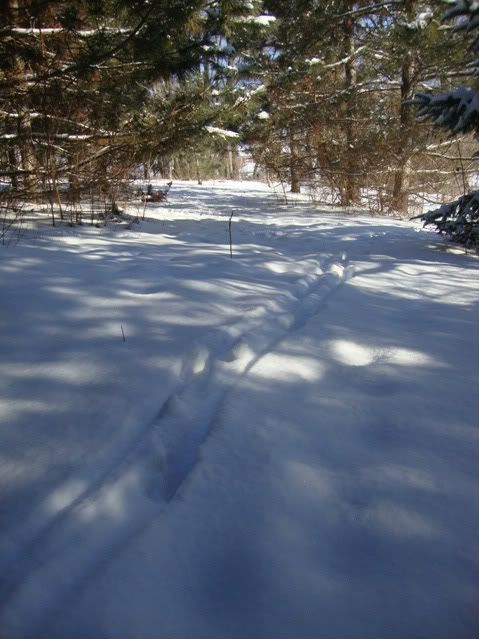
Last week, the snow in the orchard near our house was a criss-cross of deer trails, all varying in their "freshness".  They lead off in several directions, but most followed a specific pathway through the woods behind the house.  One these trails looked is if it had been made recently.  It branched off of the main corridor and moved through the rows of planted pinetrees along the border of the orchard. 
Above: the main deer trail I decided to follow.

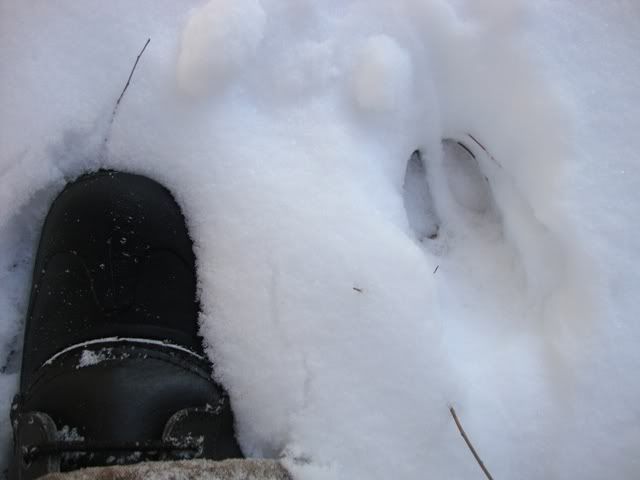
So in the amount of time I had available (dictated by my tracking partner), this easy (and very obvious) trail seemed like a good one to follow.  From what I could tell, the tracks looked like they had been made by a male, but I couldn't be certain.  They were of a decent size with very obvious dew claw imprints on many of the tracks I found.

Above, one of the tracks that actually showed up OK in the deep snow!

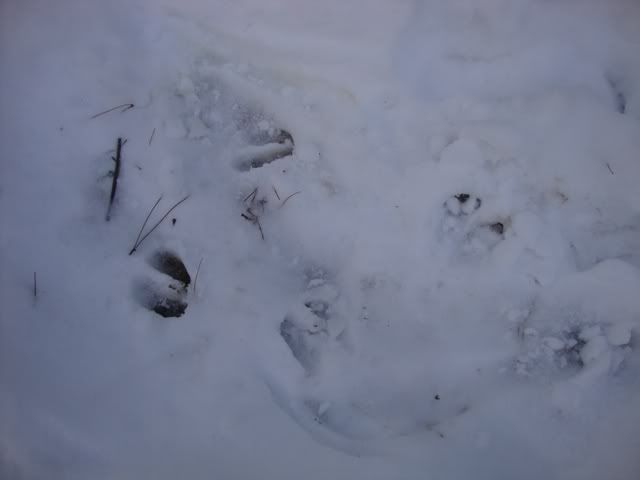
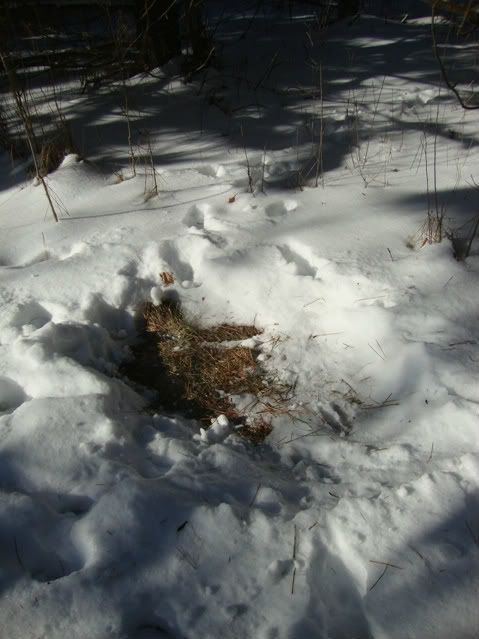
The trail wandered along a lane next to the pine rows and stopped to paw at an area in the snow that I had identified as a buck "scrape" during the rut this last fall.  Here it stopped and stamped around, pawing at the old scrape for a bit, perhaps hoping to catch a whiff of some useful information.  This may have also been another spot where a deer previously laid down for the night and another came along later and pawed at it....hard to know for sure.
Above 2 pics: two shots of the old scrape this deer had cleared off (close up shot below, further back vantage above).

It then took a few steps and deposited a little bit of fresh scat.  A signal to others?  It wasn't left on top of the scrape it had been stomping at, but nearby, so I'm not sure.  It may have just been "time to go", if you know what I mean. 

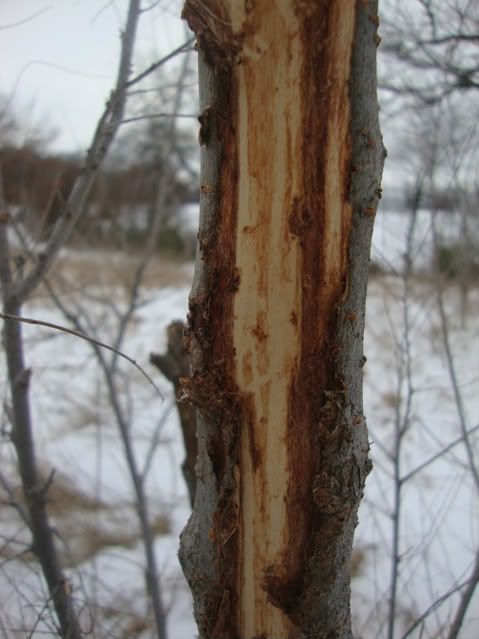
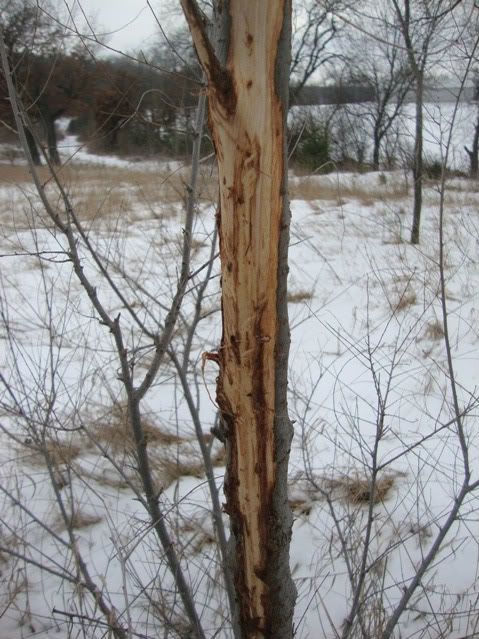
It also took an opportunity to peel some bark off of a few small trees......

Above 2 pics: Two great example of a scrape made by a white-tailed deer's incisors as it stripped bark from this little tree

Most members of the Order Artiodactyla* have no upper incisors.... only lower incisors.  Extant global Families listed by Mathee et al. (2001) within this Order include:
  • Family Camelidae (the camels)
  • Family Suidae (the pigs)
  • Family Tayassuidae (the peccaries)
  • Family Hippopotamidae (hippos)
  • Fmily Tragulidae (the small "mouse deers" or chevrotains)
  • Family Moschidae ("musk deer")
  • Family Cervidae (deer/elk/moose, etc.)
  • Family Bovidae (cattle, buffalo, sheep, etc.)
  • Family Antilocapridae (pronghorns)
  • Family Giraffidae (Giraffes)
Cetaceans (Dolphins, Whales, Porpoises) as a group are also positioned somewhere in the Order Artiodactyla, but listed as a "Clade"....I think.  The Clade Cetacea has its own list of families (such as Family Balaenidae for baleen whales, etc.).  Cetaceans are apparently most closely related to the Hippos among any of the extant Artiodactyls (Gatesy 1997; Price et al. 2005).  There may have been updates to this that have occurred since Price et al. did their work.  Mammalian phylogenetics can be pretty confusing these days.  I'm not as up on my mammal systematics as I should be I suppose.

Regardles of the systematics.......of these Families within Artiodactyla, only the pigs, the peccaries, the hippos, and the Cetaceans have upper incisors.  The rest, such as the deer/elk/moose, etc. (Family Cervidae), Pronghorn (Family Antilocapridae), and the cows/sheep/bison, and so on, all have no upper incisor..but ONLY lower incisors.

Yet, these lower incisors are used to great effect when stripping bark off of trees.  They can take those very sharp teeth on the lower jaw and run them up underneath the bark of a tree (especially a young tree).   They then scrape with an upward movement of their head and strip the bark off for quick meal.  You can actually see the incisor marks in the first picture above.
___________________________________________________________________

After following the trail a short while longer, I came across an area where the deer decided to rest for the night.  It was a perfect spot.  Located below some large pine boughs, so protected from further snowfall and wind.  The location was also positioned on a slight incline, looking down over the orchard to the south.  A great vantage point to see, hear and smell what might be coming up the hill towards him.

Above: the "lay" that this deer made when he decided to bed down below some pine boughs for the night.


And then...finally....my daughter had had enough tromping through the snow, and we started heading towards the back deck.

But, it's nice to have these little opportunities from time to time..........
______________________________________________________________________
* Cetartiodactyla is apparently an alternative Order name that has been proposed for Artiodactyla (Price et al. 2005).  I've seen it a few times....and I'm not fully certain if it's accepted yet or not?  Maybe someone can enlighten me.

Literature Cited

Gatesy, J. 1997. More DNA support for a Cetacea/Hippopotamidae clade: the blood-clotting protein gene gamma-fibrinogen.  Molecular Biology & Evolution. 14:537-543.

Matthee, C.A., J.D. Burzlaff, J.F. Taylor, and S.K. Davis. 2001. Mining the mammalian genome for Artiodactyl systematics.  Systematic Biology 50:367-390.

Price, S.A., O.R.P. Bininda-Emonds, and J.L. Gittleman. 2005. A complete phylogeny of the whales, dolphins and even-toed hoofed mammals (Cetartiodactyla). Biological Reviews 80:445-473.

Saturday, November 19, 2011

The Brute and The Broke-Horn

Well...been alittle while.  Busy, busy with the new job.

However, you may remember I had moved a few cameras over buck scrapes.  I was alittle late in the season for a lot of activity at a scrape, but I had hoped for the best.  I did get a few individuals that came by and checked the scrapes out in the week that I had the cameras over them...but the angle was bad.  Thus, I didn't get the perfect picture of a buck scraping and rubbing an overhead branch.

This doesn't mean that there hasn't been stuff going on.  The rut must be underway and I've finally seen the Brute hanging around after no sign of him for a coupla months.  He's been all over and I've gotten him in two locations on-site.

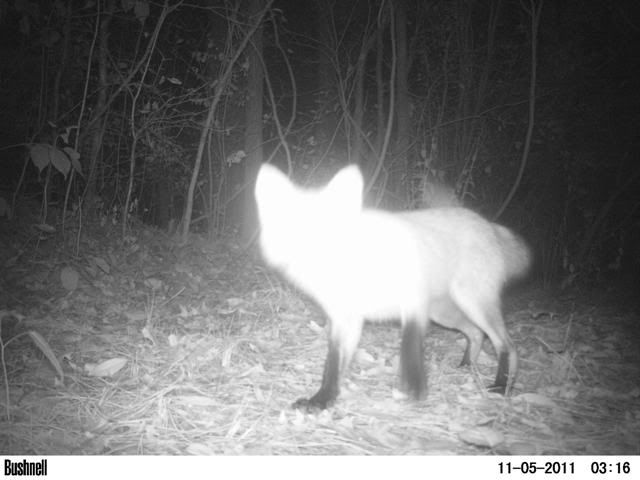
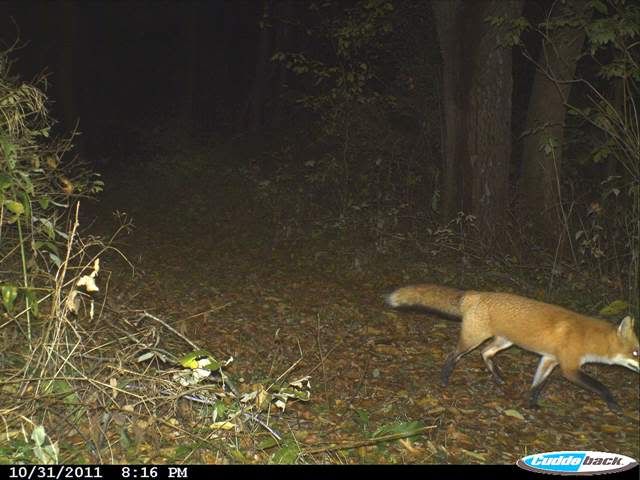
First, a little Red Fox (Vulpes vulpes) stops by.  The pic is washed out becuase he was so close the camera.  Introduced or not....I can't help but smile when I get pics of these little canines....

...and here he is (or at least here's a Red Fox) near the other scrape I was hoping for some activity at....

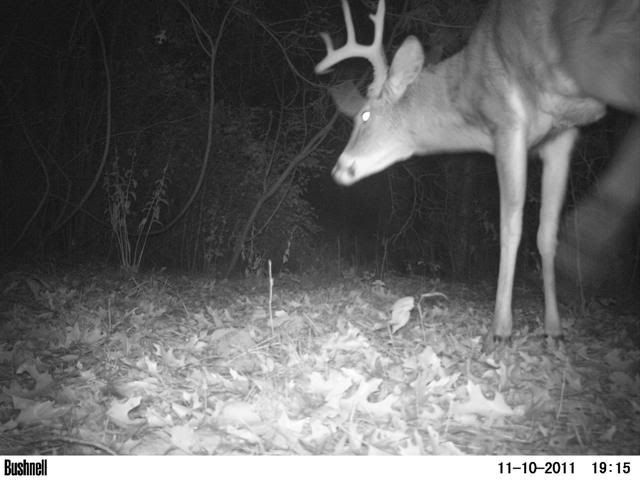
Below...the brute shows up sniffing around the buck scrapes I was monitoring....

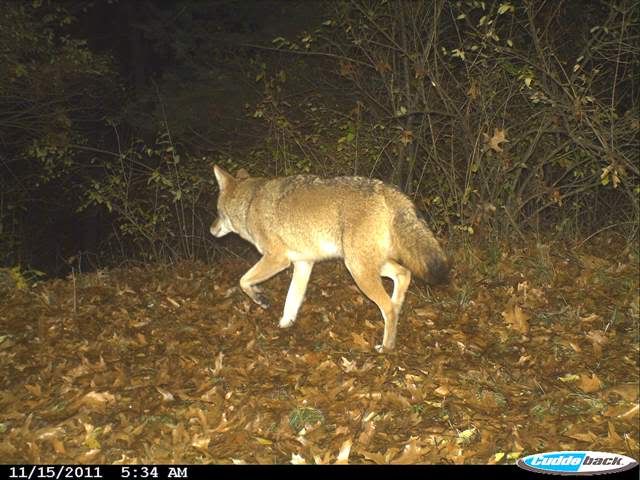
Below is a completely new location I started monitoring two weeks ago.  A woodland path.  Lots of deer activity.  Also a Coyote (Canis latrans).  His coat appears to be thickening nicely in preparation for winter....


This picture of a doe is the one that got me to thinking the rut must be in full swing here.  Her hide looks to be alittle roughed up at the back end.  Perhaps it's from brush she's pushed through, but I wonder if this isn't due to the advances of resident males.......

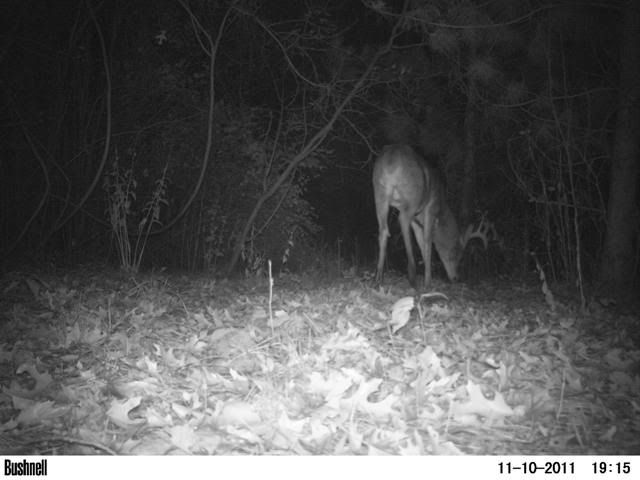
The "broke-horn" (more correctly, the "broke-antler") male also passes by here.  Not sure if he lost his right antler in a bout of some kind (perhaps with the Brute?)...or if perhaps this is a developmental abnormality.

But the Brute is clearly the "Big Deer on Campus".  Here is a picture of his backside.  Head high, tail up...  In this picture, I imagine him chasing a female or investigating a rival male that must be ousted....

...and again this morning, not long before the dog, the kid and I came up to the camera.....

Lots of deer activity out behind the house.  Very interesting because we have a relatively small woodland fragment....surrounded by a sea of agriculture and occasional wooded strips along riparian corridors or between rural houses within a five mile radius.  I guess this little fragment is about the best thing around and the critters congregate here.  It would be interesting to compare species diversity within fragments of different sizes on the landscape to see if they support MacArther and Wilson's theory of Island Biogeography.

-sigh-

If only there was unlimited time and money.......

Further Reading:
MacArthur and Wilson, 1967. The Theory of Island Biogeography. Princeton University Press.  Princeton, NJ.

Sunday, October 30, 2011

Proper Etiquette at a Buck Scrape

Well, it's been awhile since I've posted anything.  Life, unfortunately, intervened.  About a month ago, a nasty case of the flu kept me bed-ridden for three straight days (and left me with after-effects that I felt for two weeks).  Just three days put me woefully behind at work. 

So the blog had to wait.

However, yesterday as I wandered the woods and grassland behind the house, I saw numerous buck scrapes.  This reminded me: 'tis the season for the rut!  I'm not a hunter, but the rut is still an exciting time of the year.  Knowing the males are out there attempting to strut their stuff...some in the prime of their lives, some too young to matter, and some too old to be a threat....is very cool from a behavioral standpoint!  Needless to say, I moved two cameras over some scrapes that appeared to be very active locations. 

We'll see who comes knocking.  I just hope I didn't miss the main activity periods of bucks over their scrapes, as we're getting alittle late in October now.

In the meantime, I'll tease you with a great series of pictures I picked up last year in North Carolina during the period just before the rut.

________________________________________________________________________

Our story begins in mid September 2010 on an old logging road through the middle of a dry upland forest...a site dominanted by deer. 

The first players are a pair of, what appear to be, subordinant males.  The male to our right in the picture below is standing directly over an existing scrape.  It's hard to tell if he's doing anything over the scrape....but I assume he might be.


In no time, the two are moseying along the old logging trail.

It doesn't take long (less than a minute) for the Big Dog in the area to come stalking up after these two smaller males.  He gives them a long hard look.

While watching the others meander on, the big male moves over his scrape and gets to work.  You can see the dust he's raising while kicking debris off of his scrape with his hooves.  Also notice that he seems very interested in the little branch directly above his head.

Finally, he finishes off his handiwork by depositing alittle more urine on the scrape (notice the wide stance with the back legs, a typical urination posture).
___________________________________________________________________________

What is the rut?
The rut is the period of time when male white-tailed deer seek out females for breeding.  In the upper Midwest, the "rut" typically occurs from late October through early/mid November.  Typically they follow pheromones (scents) produced by female deer who are in estrous.


Why do bucks make "scrapes" in the woods?
Male white-tailed deer use a variety of methods to "mark" their territories prior to the breeding season.  They will rub their antlers on trees (depositing dominant male scent in the process), and they will make a "scrape" in the woods.  This scrape is usually an area selected by the buck to leave his mark and signal to other potential rival bucks in the area that this is his turf for chasing females, and also tells females of his presence.  The buck making the scrape will kick away the leaves from a patch of ground, exposing the dirt beneath.  The male will then urinate on the scrape, allowing the urine to flow over a tarsal gland on the legs (depositing pheromones which are meant to be a signal of his status).  Scrapes will be revisited by the creator to "freshen" them with new scent and to see if any other males or females have passed by. 

Often times the scrape is located below a low-hanging tree limb or branch, where the male will rub his forehead, and lick/mouth the branch.  This is because white-tailed deer also have scent producing glands on their foreheads (called preorbital glands).  Between the preorbital glands and the scent in their saliva, they are depositing more cues of their status to other deer in the area.

Please excuse my ham-fisted attempts at photo editing, but here are two scrapes I found behind the house yesterday.  I've circled the scraped up dirt and the over-hanging branch for both of the scrapes.


Creation of scrapes usually occurs most frequently just prior to the peak of the rutting season.  This is because the dominant male wants to make sure he's told the other suitors to take a hike and informed resident females that he's around BEFORE the rut starts.  Although, I suppose it's probably likely that some activity over scrapes occurs after the peak rut is underway.  Scrape activity is apparently instigated by the decreases hours of sunlight in the fall, which causes a change in hormones being produced.

If scrapes and rubs don't work, and there's still more than one male in the area hoping to get in on some action, it may result in direct male-male combat.  During these bouts, males will spar with their antlers to determine who is actually the big dog on the block.

Scrapes are not only created by mature bucks, however....and mature bucks do not prevent sub-dominant males from scraping (although their scent on scrapes may cause sub-dominant bucks to seek greener pastures).  Yet, less mature bucks will create scrapes near those of mature bucks and will even mark with urine on-top of the mature buck scrape.  Females will also visit already made scrapes and rub their forehead glands on over-hanging branches or urinate on the scrape.  This is presumeably to advertise their presence/receptivity to the resident males when they return to check their scrape.

Also, to identify a deer scrape (as opposed to turkey activity...seeing that turkeys will scrape back leaf litter to peck at bugs, etc. while feeding), look for the drag marks in the scrape left by the cloven hooves of the deer.....a branch hanging over the scrape is another clue that it's a deer, as is the time of year when the scrape was found (turkeys feed year round...but bucks *mostly* scrape in the fall).

For more general information on scrapes, see this article from Quality Deer Management magazine.  Becuase deer are a favored game species alot of research has been conducted on their ecology and behavior.  That's good news, even for people who don't hunt, but are interested in ecology.  I just wish all critters could garner the type of research attention and money that game species do!

Addendum:  after posting this, I started getting caught up on past posts I missed from the blogs I read, and noticed that JVN at Backyard Beasts also posted recently about scrape activity.  Check it out here!