Showing posts with label Wary. Show all posts

Monday, January 27, 2014

Wil E. Returns

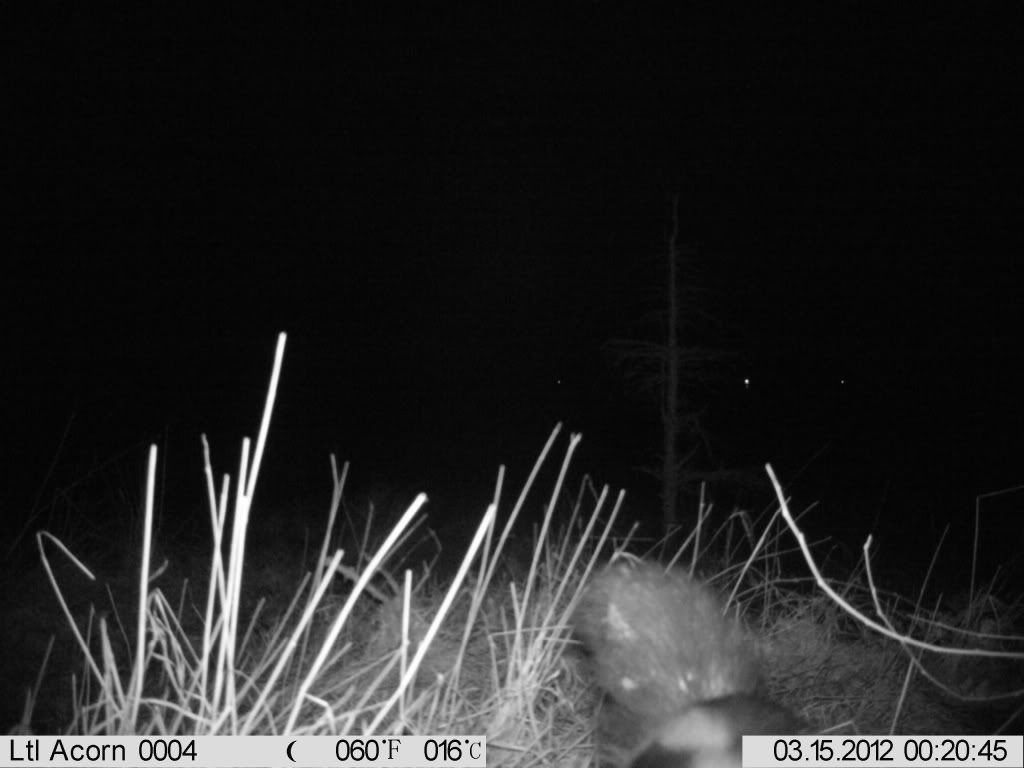
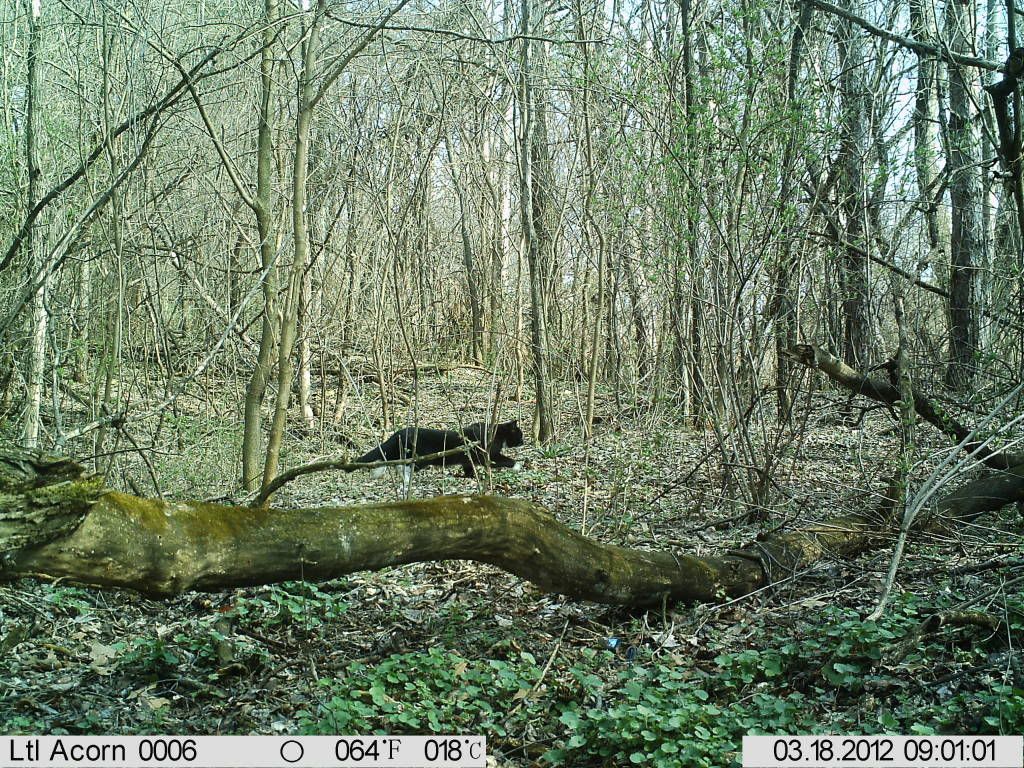
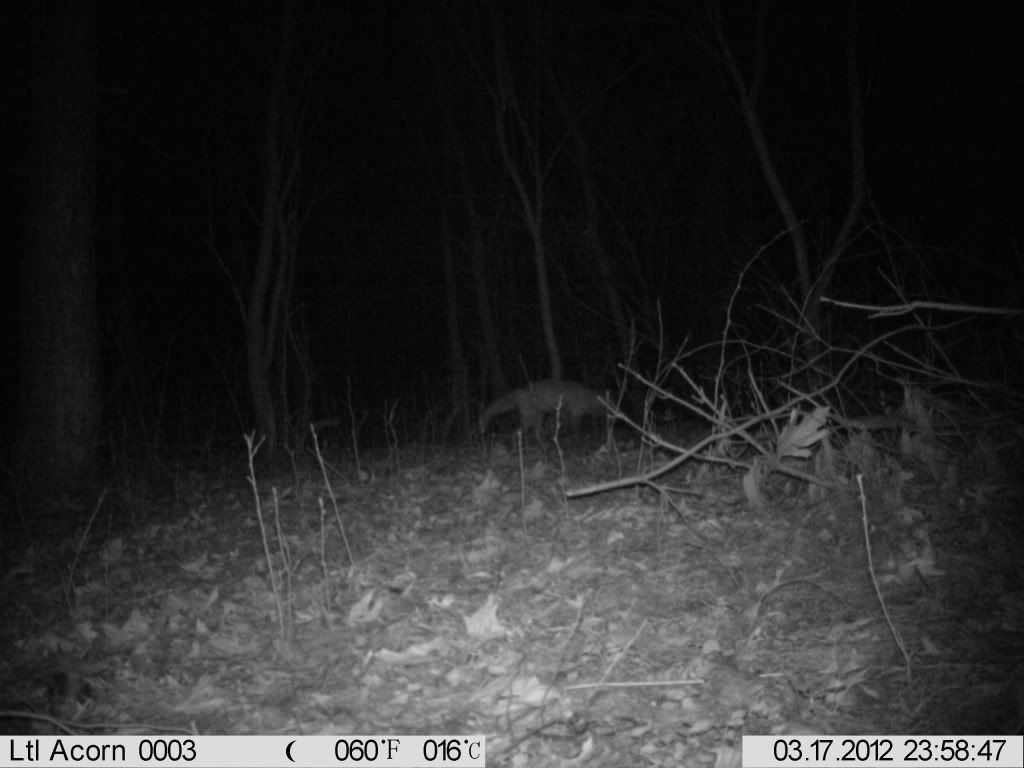
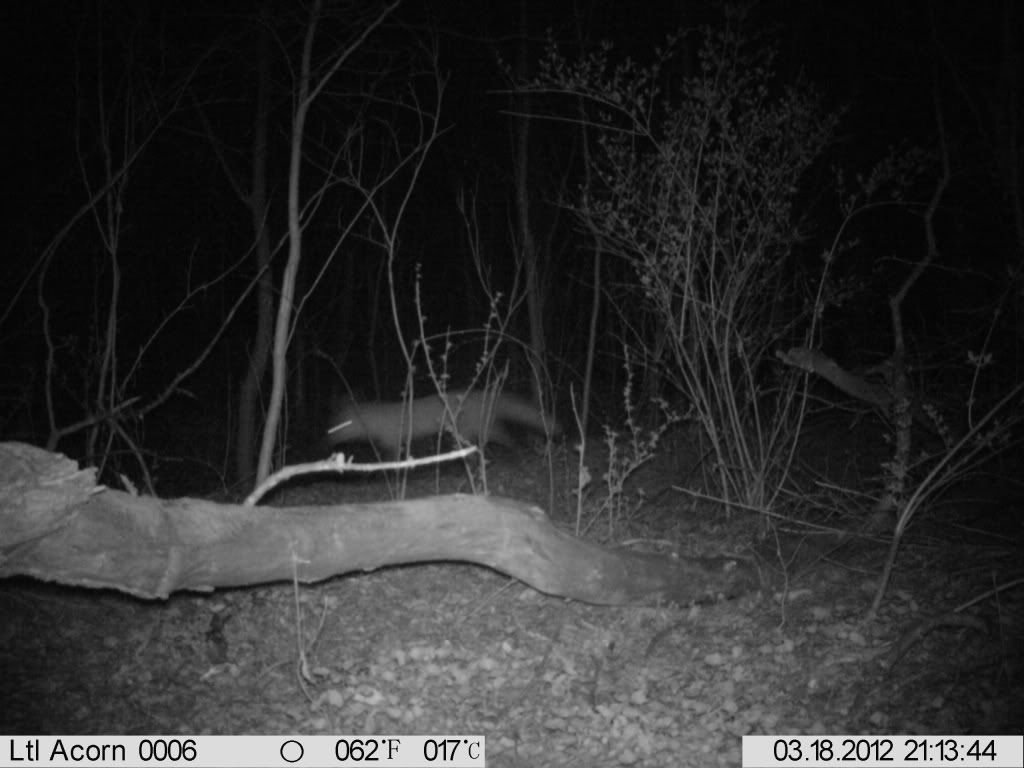
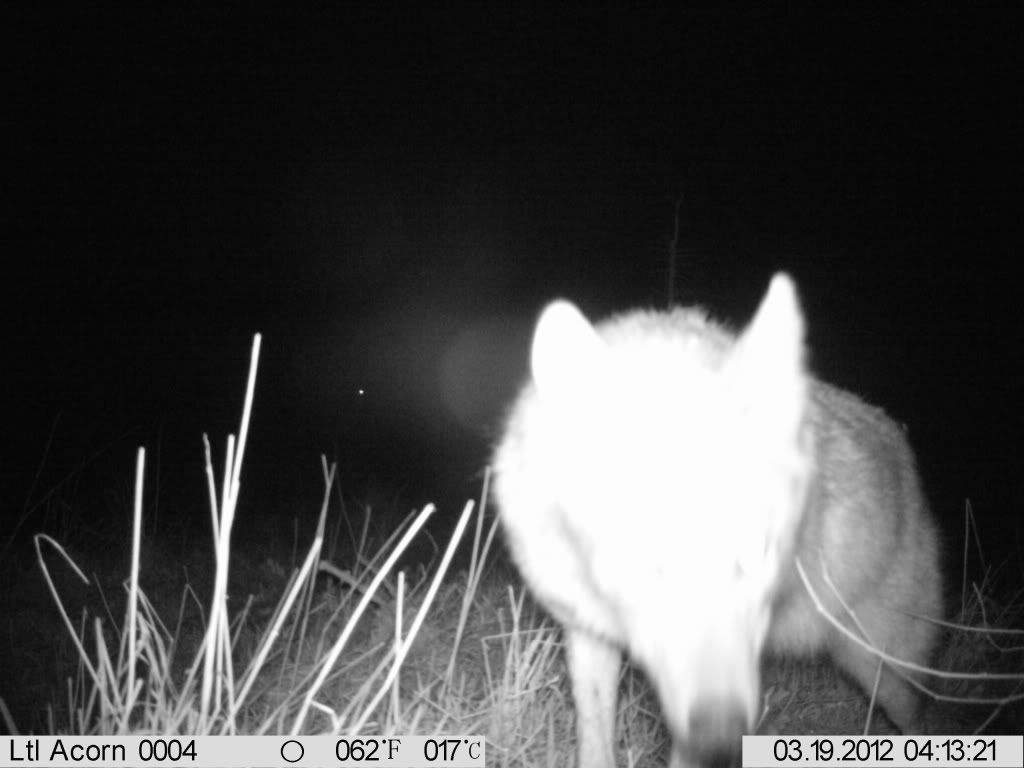
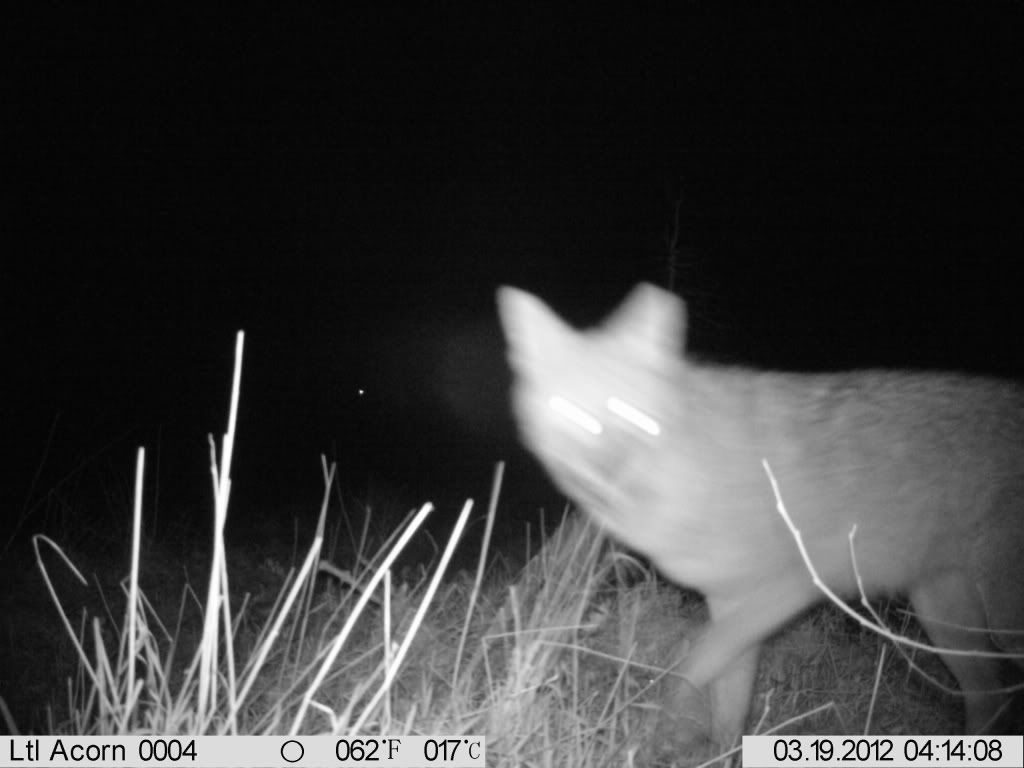
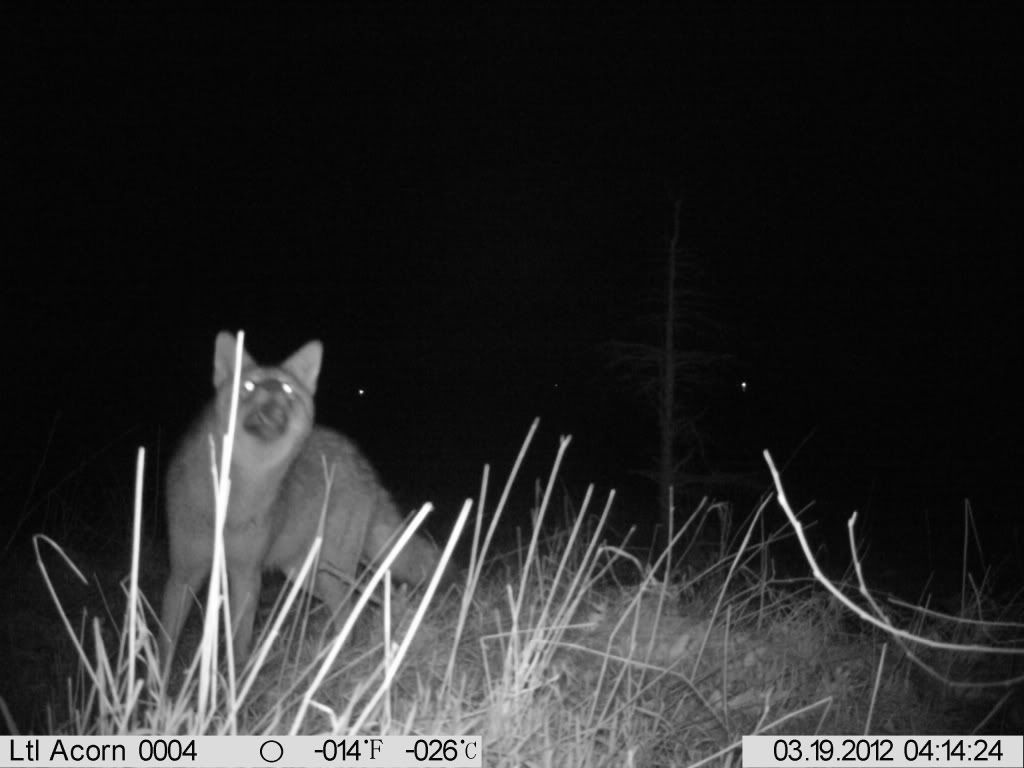
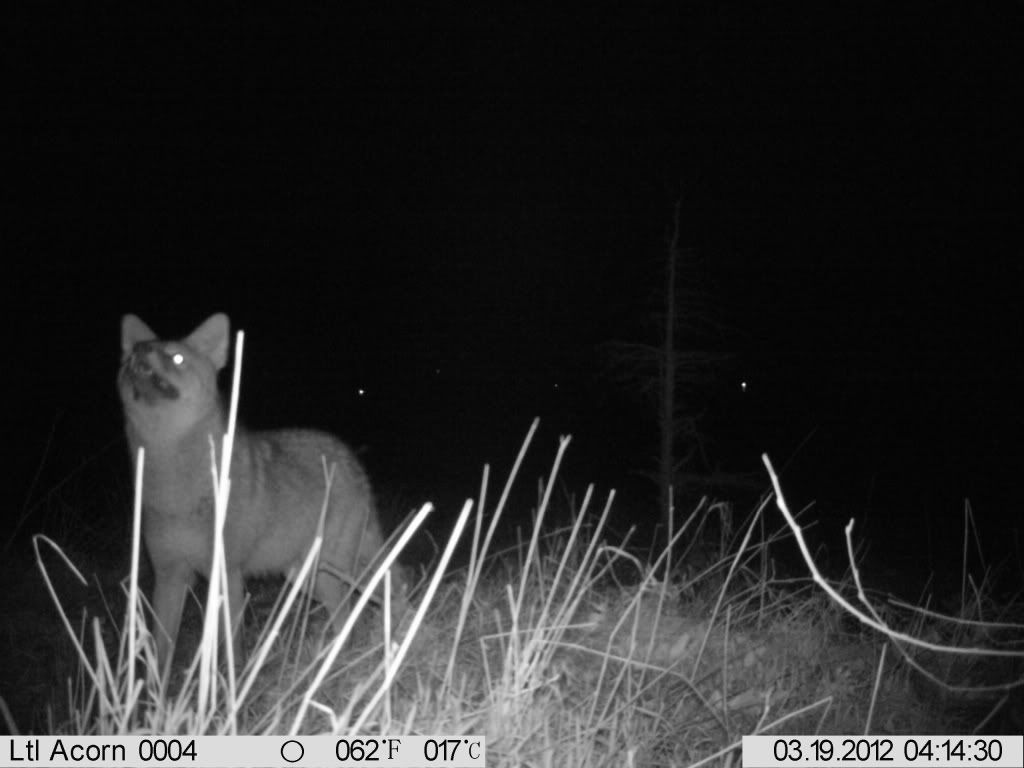
The Coyotes at one of my study sites grew sparse after some heavy ATV use began in the summer.

However, the snow seems to have curtailed the ATV activity, which gave the canines a chance to sneak back onto the site.  In fact, the beginning of the calendar year seemed to really bring out the 'yotes....

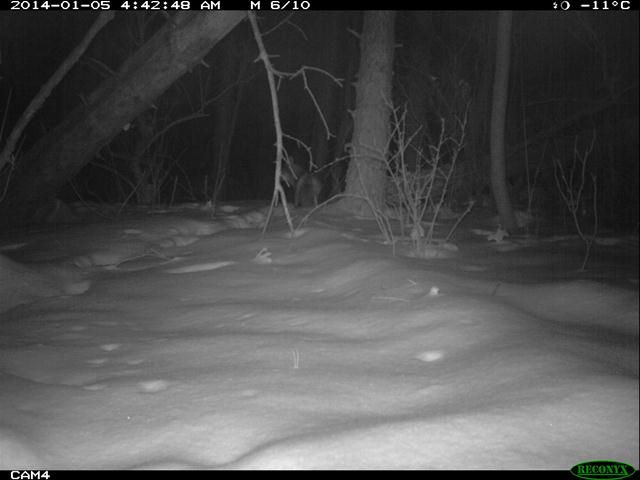
Although glimpses of them were as fleeting as you might expect at first....
The 'yote is in the far background in this picture, partially obscured by a dead branch


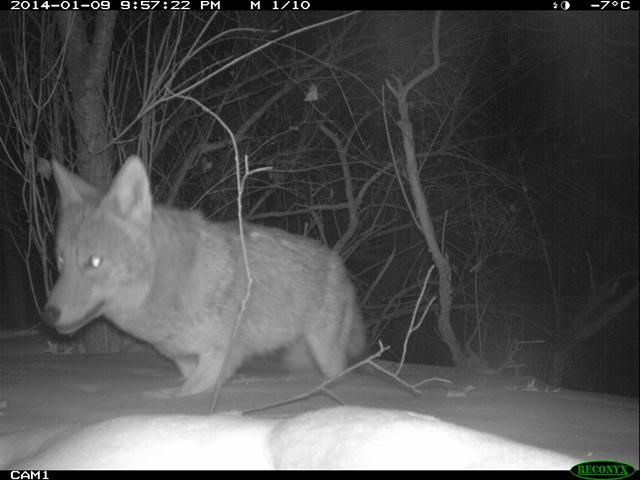
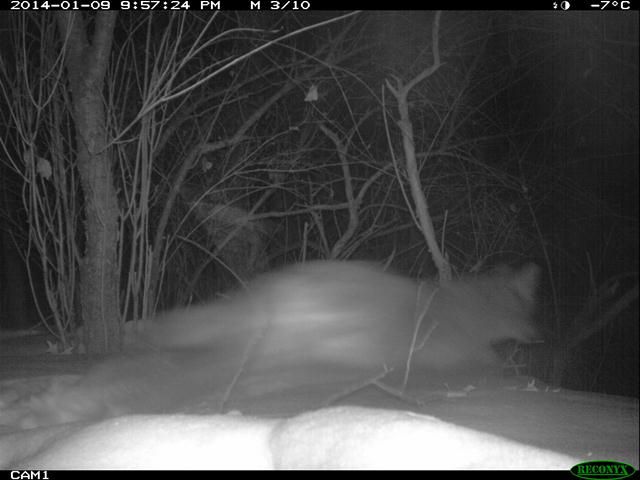
They also appeared to be appropriately skittish.  The IR flash of the camera caused this individual to turn-tail and run.  This is a response to IR cameras that I've observed from Coyotes several times in the past (see here , here and here).
 

Skittishness is probably one of their greatest survival mechanisms.  It might even be a reason why (despite the best efforts of humanity) the Coyote has avoided eradication throughout recent history.

Yet, sometimes, skittishness is over-powered by the desire to check out what the neihbors are up to.

This individual (on January 10th, perhaps the same one from the 5th and the 9th?) is very interested in the canine urine we deposited in front of the camera. 

Considering we are in the general time period of the breeding season, it's not too surprising to see the canines doing some territorial investigations.

I imagine "curiosity" treats the canine, much like it does the cat .....if said canines don't learn quickly.  Canine urine is a common tool in the trapper's toolkit.

Another quick capture on January 15th....

I've also seen a large number of tracks and trails throughout the site since the first of the year.  One of my research students even found an interesting trail in the snow two weeks ago.  It appeared to tell a story of ol' Wil E. catching a Cottontail (complete with blood and tufts of rabbit fur).  I'm pretty happy to see them return after their long absence this summer and very sparse appearances in the fall.

I can't imagine our resident forest ghost is particularly thrilled (seeing that Coyotes will exclude Red Fox)...but it hasn't scared him/her off completely. 

Although he does appear a bit more on-edge than before....
 

Thursday, November 8, 2012

Hedonist Coyote

These are probably some of my favorite Coyote (Canis latrans) video clips that I've been lucky enough to get with a camera trap.

The majority of the pictures and video clips that I have of Coyotes are fleeting....mostly I have quick shots, or blurry shots of an individual before it was spooked and ran off.

Not the case here.  In fact, this Coyote appears to be luxuriating in the fact that he can roll around in a bit of urine.  Red Fox (Vulpes vulpes) urine to be precise.

I'm obviously anthropomorphizing, but he almost appears to dive in with great relish.....and expresses little obvious concern for any potential threats.  This is not at all what I'm used to from Coyotes on my cameras....

He also gets alittle mouthy on one of the stakes that I use to hold scent....

Now.....in the past, I've gotten pictures that appear to indicate Coyotes show some hefty aversion to the red LEDs on the camera traps (see here and here).

This individual shows none of that (particularly in the second clip below, where he must be getting a face-full of red LED).  I've been camera trapping this site for over a year now.  Perhaps that's enough time for them to fully acclimate.  Also...the fact that we are not too ridiculously far out of the mating season (January/February) may have something to do with it.

Also of interest:  there is a similar scent stake on the left of our field of view that is holding Coyote urine.

Untouched.

Once satisfied, Wil E. decides to move along in search of other opportunities.

I've posted on this type of "scent rolling" behavior in the past (involving a Gray Fox, Urocyon cinereoargenteus) from North Carolina.  I also included a brief review of existing literature that I could find on the topic, which I'll re-post at the bottom.

Roughly half an hour later, a trio of rather concerned White-tails cautiously come along to check things out.
 
If they are the group I've seen most of the summer/fall, it's a doe and her twin boys.....


The reason why canines roll in scented-stuff is not fully understood or agreed upon.  Although a plethora of anecdotal and pseudo-scientific explanations for this behavior can be found on many websites (usually associated with training domestic dogs), I have not found one that backs their claims up with hard data, or references to scientific literature.

Mech and Boitani (Wolves: Behavior, Ecology & Conservation, 2003) summarize research that has been done on wolves to help better understand this phenomenon.  But even the work they cite, although giving good information about what type of scent-stimuli wolves will choose to roll in, does not clearly indicate why they do it! 

The general possibilities proposed to explain this behaior include: (1) "familiarization with novel odors or change in odors", (2) "strong attraction or aversion to particular odors", (3) "concealing one's own scent with something more pungent" (an obvious advantage for a hunting carnivor), and (4) "making oneself more attractive by applying novel odor".  An interesting study on African wild dogs found that females will roll in the urine of the lead male in a pack they are trying to join.  This may increase their chances of acceptance becuase they are coated in a scent familiar to the pack they are hoping to get in with (Frame et al. 1979).  It has also been proposed that individuals roll in specific scents to bring back information to others in their packs.  For example, bringing back information about the age of a carcass found to others in the pack.....

Literature Cited and Further Readings on Scent-Rubbing in Carnivores:

Frame, L.H., J.R. Malcolm, G.W. Frame, and H. van Lawick. 1979. Social organization of African Wild Dogs (Lycaon pictus) on the Serengeti Plains, Tanzania 1967-1978. Zoological Tierpsychology 50:225-249. (note: I could not find the above article, and was not able to read it....so my comments on this study are based on what Mech and Boitani report)
Reiger, I. 1979. Scent rubbing in carnivores. Carnivores 2:17-25.

Friday, March 23, 2012

Advanced Ecology Lab Week 9: The Tod and The Bandit


This would be one of my favorite personal camera trap pictures ever, if it weren't so washed out.  But...the Cuddeback at close range can't do much better than this....

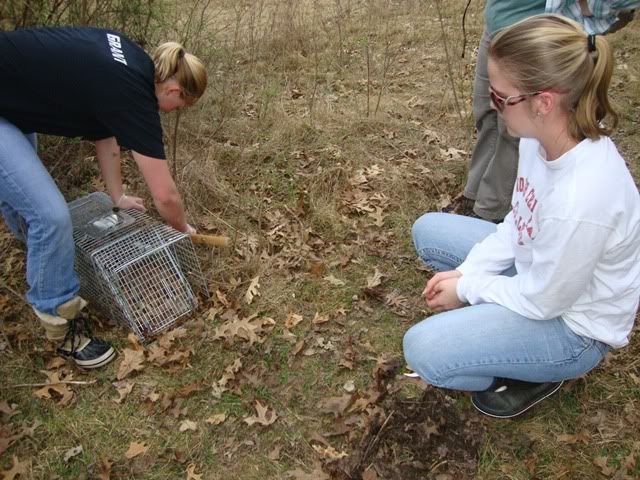
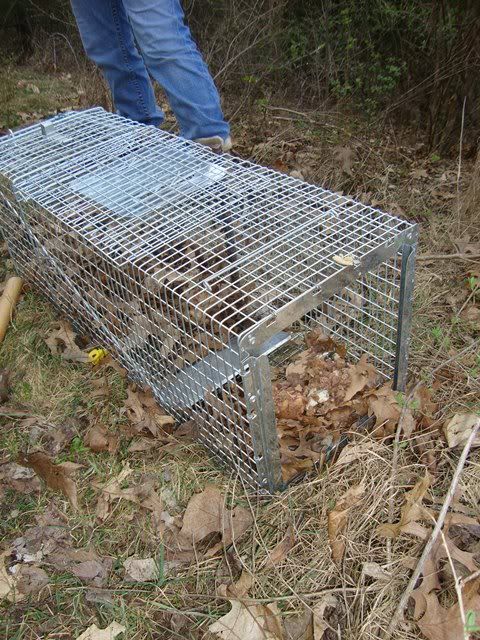
This week was basically a repeat of last week.  The goal being to increase the chances of catching critters in the wire cage traps, while allowing the students a chance to further test their skills at setting traps again.... and perform maintenance on other long-term data collection projects.


So, once again the traps went out for two back-to-back days.  This time, we sweetened the bait by mixing dog food, sardines, and drippings from St. Patty's Day Corned Beef and Cabbage.....pulling out all the stops.


The feral cats stayed away, which I was happy for...and we actually caught some wildlife, although not a ton.

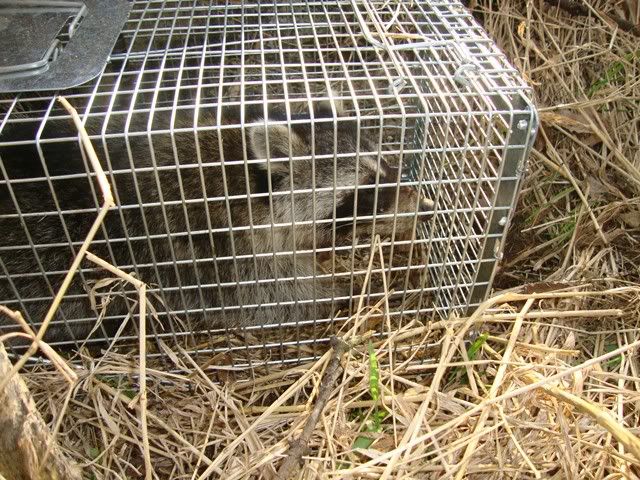
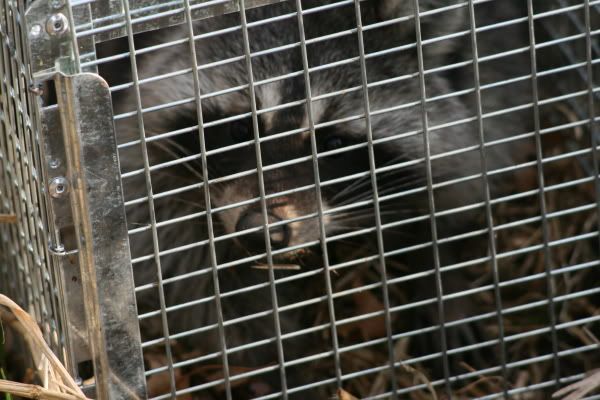
Still, one Raccoon is better than nothing!


Now....a Raccoon in a trap can go either way.  Sometimes you'd think a Looney Toon-style Tazmanian Devil was in the trap. 

Other times, they are as docile as a kitten.
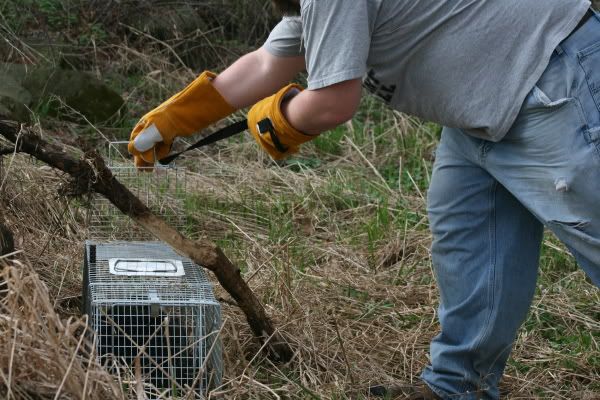
Photo by J. Scherer

This individual was actually fast asleep when we walked up to the trap in the morning, his belly full of dog food and sardines.  I joked with my students that, becuase he was a 'coon living in a suburban/rural mosaic landscape, he probably gets trapped and relocated once a month, so knows the drill.

Regardless, approaching with caution is always important (those deft little paws can reach through some pretty tight places).  With the threat of rabies (a serious issue with Raccoons), kevlar gloves are warranted.
Photo by J. Scherer

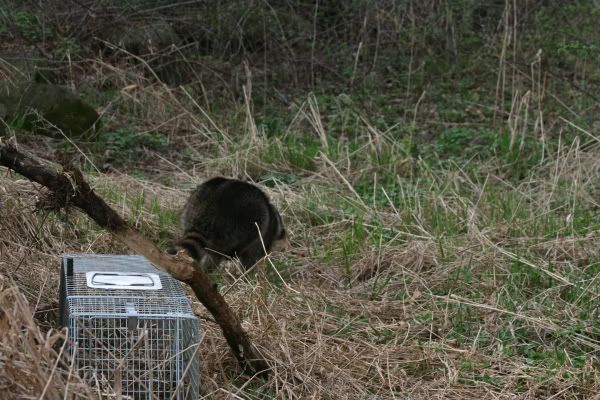
But, if everything goes as planned, the bandit is gone before you have a chance to think about what might happen.....
Photo by J. Scherer


Also, plenty of stuff on the camera traps.  A smattering of examples includes....
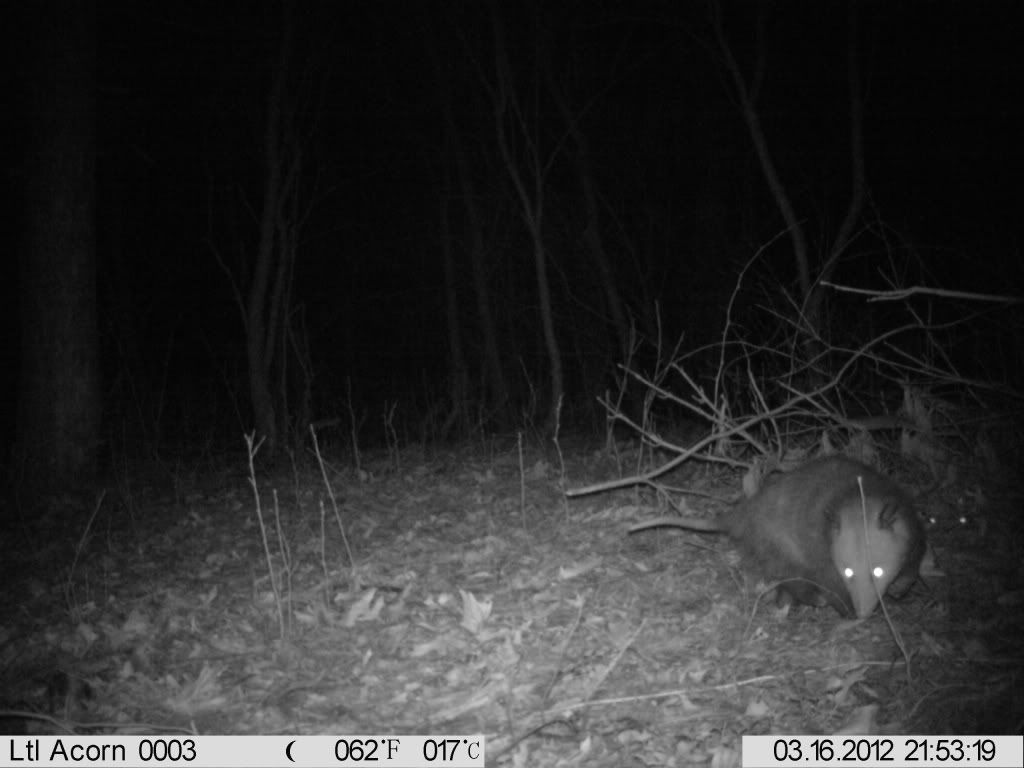
'Possum...


Blue Jay (Cyanocitta cristata)

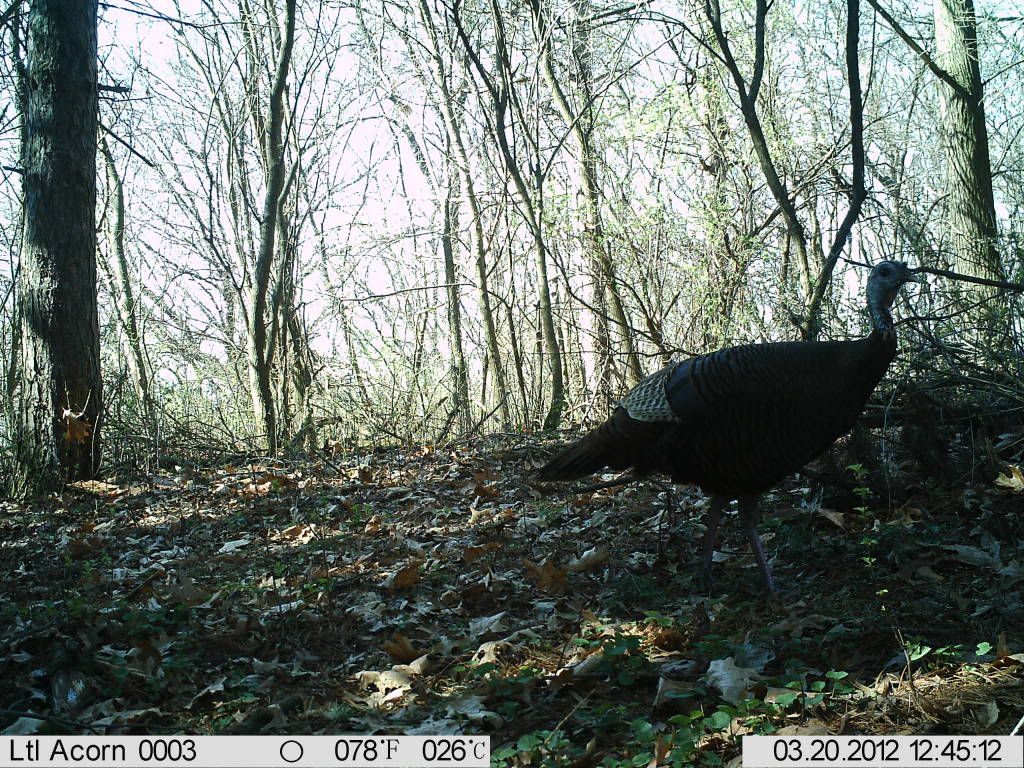
Walkin' Bird (Meleagris gallopavo)

Stinker (Mephitis mephitis)

Deer....

One of the minions of El Diablo....


We also had one of our most productive canine weeks on the camera traps.

First, The Tod was all over the site (including the picture at the top)....unfortunately, none of these pictures are all that great.  The video clip is sort of cool though.......


Finally, we got some close up shots of a 'yote on-site.  This camera is the one the students mounted on the tree near the location of the rabbit burrow that had been dug up by a canine of some kind (see here).  This 'yote is attracted to the spot....but the red LED's must give him a start.  As I've posted before, they are incredibly wary of the red LEDs, for some reason.


Then, he puts his nose to work from a slightly safer distance....


The canine pics are often blurry.  They are just too skittish to hold still for very long!


Monday, July 4, 2011

Who Skirts the Whistlepig Burrow?

There's nothing like a good river corridor if you want to get pictures on a camera trap.

Especially if that river corridor experiences reduced human disturbance.

I've posted pictures from this camera set before.  Originally, I was hoping to identify a mystery animal (which I determined was a mink; Neovison vison), and then the goal became to monitor Whistlepig (Marmota monax) activity near their burrow entrance, and I've also reported a nice Coyote picture (Canis latrans).

However, lots of critters skirt the Whistlepig burrow while following the river corridor.

Here are a few more shots from this location, and a summary of everything that passed by.

The Opossum (Didelphis virginiana): Early on in the spring, a 'possum passed the camera just this once.  The picture below was before I repositioned the camera. 

On the day I deployed this cam...as I walked along the river perusing potential camera set locations, I remember having a strange feeling of being watched.  I glanced to my right, and sitting not far away was a 'possum, watching me pass by.  I stopped and looked at him for a second, which prompted him to slowly turn and amble back into the woods. 

I wonder if this picture is of that same 'possum?


Gray Fox (Urocyon cinereoargenteus): A Gray Fox has only wandered by once.  It was about this time that I also had one pass near my Otter Latrine set, which isn't too far away. 

White-tailed Deer (Odocoileus virginianus):  


One of the reasons commercial cameras with white-flash have been slowly taken over by infra-red flash cameras is because it's been promoted that perhaps the white-flash deter deer.  I find this incredibly difficult to believe in alot of situations.  Canines and cats, I'll perhaps buy (although see the recent post over at Camera Trapping Campus).....but even they're smart enough to acclimate to flash.  Regardless, I still don't buy that the white flash really deters many deer.   I suppose that big trophy buck might be wary and not come around as often with a white-flash camera (and this is what many camera owners are most interested in photographing), but I'll bet deer in general couldn't care less.  I have no hard data to back this up.....just some anecdotal observations like the one below. 

The individual in the lower two pictures lays down in front of this camera, and takes that bright flash directly in the face repeatedly for an entire HOUR AND A HALF!  This resulted in 57 pictures of this one deer, and on the Cuddeback (which doesn't take multiple pictures per wildlife pass) this is alot of pics of one individual.

This is just one of at least five similar incidents.  Although during the other such incidents a deer catches the flash right in the face and continues to graze right in front of the camera...they don't hang around as long as this individual (and don't lay down in front of the camera).


Eastern Cottontail (Sylvilagus floridanus): Another common critter at this location. Almost all of the pics from this spot are like the one below (i.e., of a rabbit in mid-leap).  The Cuddeback does have a lightening fast trigger time!

Coyote (Canis latrans): the "talking dog" has floated past more than once (three times, in fact).  I would think the flash would deter them.  It's possible these are all different individuals.  If the same individual...they may have acclimated to the flash, which I've seen them do with Infra Red flash cameras (See Coyote Cams, posted on Feb. 19th, 2011). 


Beaver (Castor canadensis): A Flat-tail ambled by only this once.

Racoons (Procyon lotor): By far the most commonly captured critter by this camera trap.  Since February 8, 2011, I've had Racoons pass by over 160 times!  See summary below.

Whistlepig (Marmota monax):  Of course the whistlers are still about!  Check out the claws on the individual in the second picture.  No wonder they are such great diggers! 


Summary of results:

Camera deployed on February 8, 2011 and retrieved on June 27, 2011.

I summarized the number of animal "passes" to-date.  To apply some sort of general criteria to what was considered an individual "pass", if two pictures of the same species appeared on the camera close together in time, I considered them separate "passes" if they were at least two minutes apart.  Within two minutes, it's feasible that the same individual just turned around and came back...but this time criteria is arbitrary.  Obviously, I can't identify individual animals that well, so I may be counting the same individual more than once (as I'm sure I am with the Whistlepigs).  If there were unique marks to identify individuals back-to-back within within 2 minutes of eachother, I only counted it as one "pass".

I wish I wasn't such a dunce and could figure out how to imbed a graph from Excel on my blog, as I think that would be more informative than what I have below.  Unfortunately, I haven't been able to figure it out (without having to get some additional piece of software), so you'll just have to view the results as is.

What I find most interesting is the shift in the number of Racoon, Rabbit and Whistlepig passes as the months advance.

February Totals: A fairly low number of captures, overall.  But, this was the only month of the "mystery animal".  The number of Racoon passes is also respectable.
  • Coyote= 1
  • Beaver= 0
  • Deer = 13
  • Gray Fox= 0
  • Mystery Animal/Mink= 6
  • Opossum = 1
  • Rabbit (eastern cottontail)= 5
  • Racoon= 40
  • Squirrel (eastern gray squirrel)=2
  • Whistlepig = 0
March Totals:  March is the Month of the Racoon and the Rabbit!  Also, the Whistlepig starts to show (but not until late in the month).
  • Coyote= 0
  • Beaver= 1
  • Deer = 14
  • Gray Fox= 1
  • Mystery Animal/Mink= 0
  • Opossum = 0
  • Rabbit (eastern cottontail)= 46
  • Racoon= 94
  • Squirrel (eastern gray squirrel)=3
  • Whistlepig = 14
April Totals:  A month of low activity.  Look at how far the Racoon total has dropped!
  • Coyote= 2
  • Beaver= 0
  • Deer = 2
  • Gray Fox= 0
  • Mystery Animal/Mink= 0
  • Opossum = 0
  • Rabbit (eastern cottontail)= 10
  • Racoon= 13
  • Squirrel (eastern gray squirrel)= 0
  • Whistlepig = 3
May Totals:  May is the Month of the Whistlepig...and the Rabbit is all but a memory.
  • Coyote= 0
  • Beaver= 0
  • Deer = 3
  • Gray Fox= 0
  • Mystery Animal/Mink= 1
  • Opossum = 0
  • Rabbit (eastern cottontail)= 3
  • Racoon= 29
  • Squirrel (eastern gray squirrel)= 3
  • Whistlepig = 48
June Totals:  The Raccoon is now the most abundant again, and the number of Whistlepig passes has decreased substantially.
  • Coyote= 0
  • Beaver= 0
  • Deer = 8
  • Gray Fox= 0
  • Mystery Animal/Mink= 1
  • Opossum = 0
  • Rabbit (eastern cottontail)= 6
  • Racoon= 18
  • Squirrel (eastern gray squirrel)= 0
  • Whistlepig = 10
Overall Totals for this location:
  • Coyote= 3
  • Beaver= 1
  • Deer = 40
  • Gray Fox= 1
  • Mystery Animal/Mink= 8
  • Opossum = 1
  • Rabbit (eastern cottontail)= 76
  • Racoon= 194
  • Squirrel (eastern gray squirrel)= 8
  • Whistlepig = 75

The camera was pulled from this location on June 27, 2011.

It was a fun spot.

Sunday, May 29, 2011

Wary Coyote

I wanted to title this post "War E. Coyote"...a delicious pun on the full name of the well-known Loony Tunes character.  Unfortunately...no matter how I tried to tweak it...the blog post title kept coming off like a coyote that wanted to go to war.

So I gave up.
______________________________________________________________________

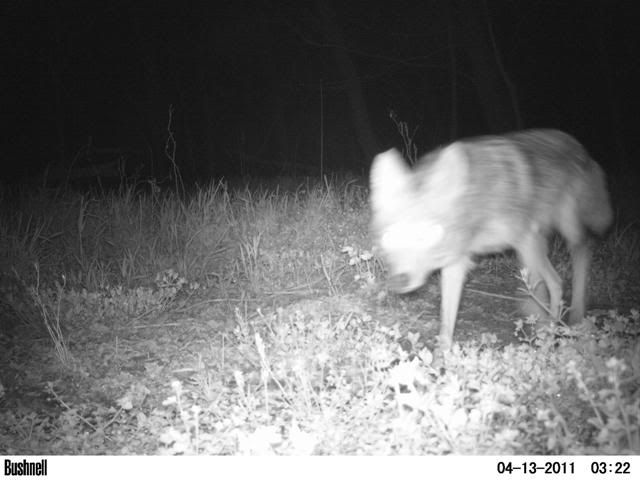
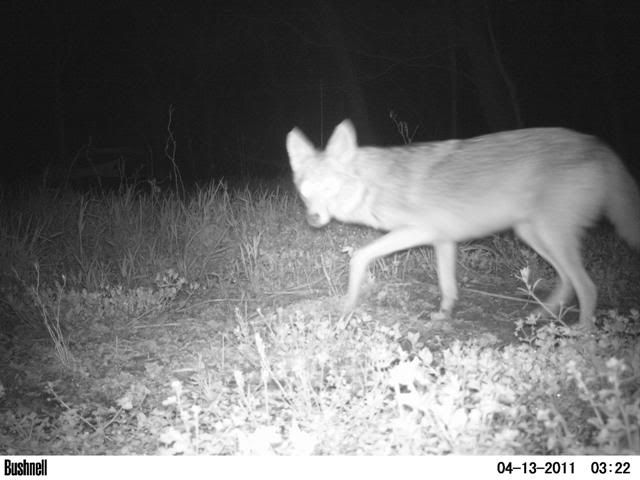
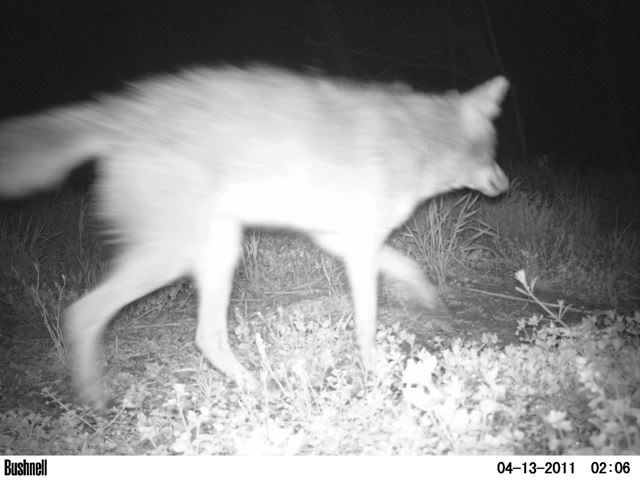
Anyhoo, the camera at my Otter Latrine set caught another example of coyote aversion to the red LEDs of an infrared camera trap.  On April 13, a 'yote comes past from behind the camera.  This is the direction most of them are heading when I get pictures of them at this camera trap set.  What this means is that they probably don't notice the red glow from the infrared LEDs. 


If they are looking at the camera, they'll see the red glow.  As I've reported elsewhere, 'yotes seem to show alot of aversion to this red glow (although they apparently acclimate, see Coyote Cams posted on February Feb. 19th, 2011). 

The individual (or an individual) comes back alittle while later, but is facing into the camera.  I think this might be a different 'yote actually, as it appears alittle smaller than the first (although this could just be the camera angle).

Everything seems fine and then....you can almost hear the comedic exaggerated automobile braking noise.
Above: Whoa!  What the hell is that?!

And then he's gone.  No 'yotes have passed by this camera since.


Saturday, February 19, 2011

Coyote Cams

The winter is when canines seem to become most active.  Probably this is due to the fact that late winter/early spring is the breeding season for the species in this area. 

Take, for example, the Coyote (Canis latrans).  The so-called "singing dog", or "talking dog", as its greek name translates to (in reference to their vocal nature).  The coyote is a wary animal.  Let's face it, you'd be wary too if folks felt about you the way they feel about coyotes.  It's impossible to deny that humans have waged a nation-wide all-out war against predators throughout our history.  I'm not saying it's right or wrong (well, at least I'm not saying one way or the other right now).  It's just a fact.  Let's focus on coyotes, for now.  The Colorado Division of Wildlife claims on their website that between 1915 and 1947 some 1,884,897 coyotes were brought in dead and had bounties paid on them (Armstrong, 2010).  This is reported to be largely due to reports of livestock depredation.  It is interesting to note that coyotes "thrive despite widespread attempts to control or eradicate them" in Colorado (Armstrong, 2010).  This is only one of countless examples. 

Regardless, this form of predator control is not only something that occured in the past.  It also is not something that occurs solely at the behest of upset cattle-ranchers.  Sometimes attempts to control 'yotes are made becuase they threaten other species of wildlife that we deem more desirable, are a greater conservation concern, or are things WE like to hunt and really don't want coyotes cutting in on our action.  For example, the Nevada Department of Wildlife has a number of "Predator Management Plans" that involved removal of coyotes (and other carnivores) to help conserve deer, big horn sheep, elk in 2006 (http://www.ndow.org/wild/conservation/predator/index.shtm).  I don't mean to pick on this particular agency, as others have done the same. 

Many (not all) recreational hunters loath coyotes because they'll occassionally take white-tailed deer as part of their incredibly varied diet.  I'm sure this will draw the ire of folks, but some would not consider a reduction of the white-tailed deer herd a bad thing (ask a person who's had Lyme Disease recently, or is interested in the conservation of native plant communities).

Even your humble Trailblazer...when working on a research project that involved radio tracking Bullsnakes (Pituophis catenifer sayi) in Wisconsin.... had coyotes that gave him a wee bit O' trouble.  It seems 'yotes will also eat snakes (even big snakes with expensive radio transmitters implanted into their body cavities; Kapfer et al. 2008).  In fairness, I didn't propose removal of coyotes to conserve snakes (although I may have felt a small twinge of maliciousness towards them at that time :)  ).

Now...remember....I'm not saying coyote removal for these reasons is right or wrong.  But, this persecution has resulted in some pretty wary (and savy) coyotes!  That hapless canine that is perpetually (and with futility) attempting to catch a tongue-plugging, "meeping" bird on Saturday morning cartoons isn't named "Wil E. Coyote" for nuthing!  Coyotes, it seems, can easily adjust to negotiate the current urban/suburban/rural matrix that we've created on the landscape (for reference, see reports of coyotes in Chicago and New York City; Illinois Department of Natural Resources;  New York State Department of Environmental Conservation).  *I must also here recommend DeStefano's recent book Coyote At the Kitchen Door. A very nice book that focuses on living with wildilfe in suburbia.* 

But ...back to wary coyotes.  Street-wise or otherwise, 'yotes are flat-out wary as heck!  So, to get pictures of them on a camera trap requires extra effort and alot of patience!

Back in June (2010), I placed a number of cameras on my study sites.  I was expecting anything and everything.  However, what I was quickly struck with was the absolute lack of carnivores captured by cameras. Many thoughts came to mind about how to rectify the situation.  I was certain coyote and fox were around (I had seen their tracks earlier in the project).  So,  I decided it was time to try some commercial trapper scent, and l settled on applying a scent lure of animal glands, musks and/or urines.  I also figured I'd try some food lures of some kind.  This eventually drew in some grey fox (Urocyon cinereoargenteus), but still no 'yotes!

I started reading up on what traditional coyote trappers do to catch their quarry...and it can be very extensive and requires meticulous scent control on the part of the trapper.  Well, that's just not feasible for me.  I'm doing more in the field than just messing with my cameras and all the other work gets me good and sweaty.  So, there's no way I have the time to spend on the personal scent control that many report I need.

But...turns out patience is as important as anything.  Also, time of year may play a factor.

My first capture (out of 8 cameras deployed across two sites!) comes in October of last year.  A fleeting shot as one crosses in front of my camera along a wooded stream that runs adjacent to a power line Right of Way.  This picture occured on a camera that I do not put scent or food lures in front of.


It takes several weeks for the next ones to show up.  This picture of an individual from a completely different site.  No scent lure was applied in front of this camera.  Interestingly, there was another camera placed roughly 80 yds away from this location....and I tried alot of different scent lures in front of that camera 80 yds from this one, with no avail.  Yet, at that distance, the coyotes must have smelled the scent at that other camera, but their spidey senses must have been tingling becuase I never got a picture of them there.


The individual below was captured on a different camera, but still at the same study site where the first picture was taken.  No scent lures used in front of this camera either.  This individual is obviously high-tailing it outta there.


An important point about camera traps.  This particular brand is considered "Infra-red", or IR.  So, at night a series of red LEDs glow slightly, which causes just enough illumination for the special IR filter over the camera lens to take night pictures without a bright white flash.  The bright white flash (presumably) scares animals away, although this is debatable.  However, although less obvious at night than a white flash camera, the IR flash is still visible.  It doesn't visibly illuminate an area, but if the animal is looking directly at the camera, they will see the red LEDs flash.  It's those glowing red LEDs that must have scared the coyote in that last picture.

After that, things get pretty quiet on the 'yote front, and it's not until mid-December of 2010 that they start showing up again.  But when they show...boy do they show!

First crossing the stream multiple times in the same location as the first picture in this blog entry.


Then, crossing in front of a camera located down stream from the location pictured immediately above

Here a Christmas Coyote following a stream corridor at a completely different camera location at another site.

And...the trend continues on into the new year.  This first picture is my personal favorite.  Mostly becuase this coyote is looking right at the camera.  Given the fact that it's day, there shouldn't be any red LED glow to cue the 'yote into the camera's presence.  But...the camera just doesn't look right, I guess.  The 'yote gives the camera one glance and is nowhere to be found later!

Another interesting note: this last picture is at the same camera as the picture I posted above with the coyote obviously being scared by something (taken on 11/12/2010).  But...in the night time picture captured immediately above (taken on 1/23/2011), the coyote pictured clearly gets the red LEDs straight in the face and casually walks past. 

I'm guessing a period of acclimation had to occur.  And coyotes, being as smart as they are, learn that if something isn't a threat...don't waste your energy running from it!

I'm a coyote fan.  For some, that apparently means I'm a hippie, pinko, commie, environmentalist, tree-hugger.  I'm not.  I'm a realist and I know that the coyote can be problematic.  I'm also not an animal rights activist (although I ain't crazy about unneccessary animal testing), but that means I understand that in some instances 'yotes may have to be removed.  I am, however, a conservation biologist, which means I'm interested in practical and objective approaches to conserve biodiversity.  The coyote, it would seem, has thwarted all of humanity's efforts to eradicate it for many years.  Despite being one of the most loathed and reviled critters in America (behind, perhaps, the wolf and the rattlesnake), it has learned to get around every trap we set and every gun barrel we point.  It also has been shown to be a very useful predator, based on the work of Kevin Crooks and Michael Soule, who coined the term mesopredator release as a result of their research.  I'd summarize what mesopredator release is for you, but you have to figure out something for yourself, right?  :)  It's a must-read for anyone serious about wildlife conservation (particularly those interested in birds)!

So, I suppose we could ask the questions:

Are coyotes an important part of the ecological communities in which they naturally exist? 

Absolutely. 

Do coyotes need to be removed sometimes? 

Absolutely. 

Are there probably much bigger concerns to human, livestock or other wildlife's safety than coyotes? 

I'll bet a large sum of money there are!  Feral pigs, feral dogs, feral cats, mosquitoes, cars and Homo sapiens (to name a few) pose a bigger threat to the three categories listed above than coyotes ever will.

References
Armstrong, D.M. 2010. Coyote (Canis latrans). Colorado Division of Wildlife. http://wildlife.state.co.us/WildlifeSpecies/Profiles/Mammals/Coyote.htm  Accessed on Feb. 19, 2011.

Kapfer, J.M., J.R. Coggins, and R. Hay. 2008. Estimates of population size, measurements of sex ratios, and reported mortality rates for Bullsnakes (Pituophis catenifer sayi) at a site in the upper Midwestern United States.  Journal of Herpetology 42:265-269.