Showing posts with label Cottontail. Show all posts

Friday, April 5, 2013

Phenology 2013: Faltering Frogs and Wary Leapers....

Today I heard the first calling Anurans (Frogs/Toads) of the season.  Chorus Frogs (Pseudacris triseriata) are generally the earliest frogs to call in the spring 'round these parts.  I've been listening intently at various wetlands nearby for the last week.....but these tiny amphibians have been extremely hesitant (and rightfully so, given our very cold spring this year).  Despite this, I've been anticipating their calls for several days now seeing that it has started to sneak above 50 deg F more frequently over the last week.

Today I finally heard them.....

In some parts of the region they are rivaled for first position by the Wood Frog (Lithobates sylvatica).  But we do not have Wood Frogs in the immediate area....so I always consider the arrival of spring to be heralded by the Chorus Frog.

Interestingly, this is much different than their date of first call last year (which was a much warmer spring)....but on par with past dates I've recorded.

2012: March 14th
2009: April 14th
2008: April 8th
2007: April 27th
2006: April 12th
2005: April 7th
2004: March 28th
2002: April 6th
2001: April 14th

Beyond that....sometimes all that's needed are a few cool camera trap pictures.

First, an Eastern Cottontail (Sylvilagus floridanus).....


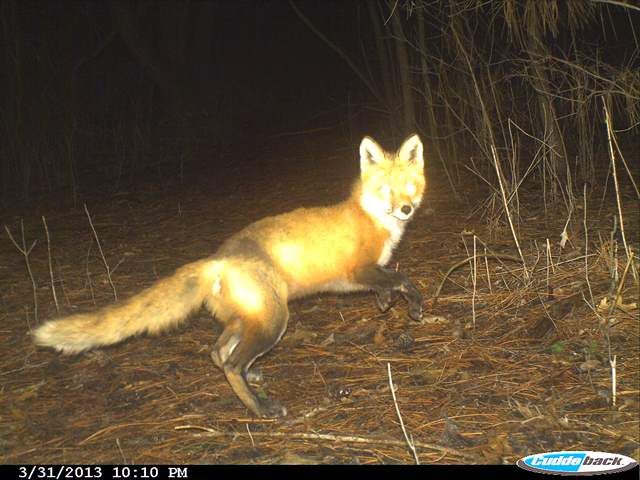
Then, what might be one of my favorite Red Fox (Vulpes vulpes) pictures to-date.......

Foxes are so amazingly cognizant of their surroundings.  The Cuddeback has a lightning-fast trigger speed (< 1 sec.), which is the primary strength of this make and model of camera trap.  Thus, it almost appears as if this fox started to leap, sensed the flash, and faced the camera.....all as it was springing into action.

That is what I'd call complete situational awareness!

Wednesday, October 3, 2012

A Lucky Shot in the Dark!

I was fortunate enough recently to be able to get away to northern Wisconsin for some fishing with high school buddies.  The set-up available to us was spectacular: huge house on the lake with a fishing boat and pontoon boat.  Also, unlimited dry firewood...a healthy supply of food and drink....and a fair amount of untouched northern forests to play in (when not fishing, of course).

I can't help but bring my cameras when I go on these kinds of trips.  In fact, I did it on a different fishing trip with high school buddies at a completely different location this January.

I'm realistic when I put cameras out in these situations.  I know the likelihood of actually catching things is pretty low.  I typically have one or two nights to work with (assuming we reach the site on Friday with enough daylight).  I also don't know the location particularly well, so may not have enough time to find the best place for a camera and have to stay close to our base camp (where I know I'm not tresspassing).

But I'm willing to risk disappointment, because there's always a chance that I'll get some Bob-tailed Cats (Lynx rufus), Fisher Cats (Martes pennanti), or....fingers crossed...Wolves (Canis lupus).

This time, I brought four cameras along.  Two of the cameras went in a boggy, sphagnum and fern carpeted forest across the street from our "cabin".  One was placed on the grass "driveway" used to back the fishing boats into the lake from the roadside.  The fourth camera was placed along the bank of the lake not far from our fishing dock. 

The latter two cameras were very close to the house.  Just down a short (but steep) slope from the fire pit behind the house. 

The first night, we sat up pretty late at the fire (1:30 am, to be exact) and I figured the nearby cameras were going to be complete busts.

The first few critters did little to quell my disappointment.

Feral Cat (grrrr...)

Eastern Cottontail (Sylvilagus floridanus)

......and a Mouse (Peromyscus sp.)

So, imagine my surprise when I saw this:


About 20 yards from where we had been making lots of noise just a few hours before!

Only my third camera trapped Bobcat (Lynx rufus)!  Needless to say, I was thrilled as I had actually gotten pictures of a species on my "wish-list" for the weekend!

Bobcat densities are generally reported to be on the rise in most of the continental United States, including Wisconsin (see further discussion of this here, and in Roberts and Crimmins, 2010).  Thus, I'm not surprised that Bobcats are in the area.  However, although their densities are on the rise, this is usually a loner species, that naturally exists in relatively low densities in parts of its range (Anderson and Lovallo, 2003).  This is particularly true of the Midwest, where densities as low as 4-6 individuals/km-squared have been reported (Berg, 1979).

____________________________________________________________________________

The undisturbed plot of boggy woodland across the street from the cabin didn't yield Bobcats, unfortunately.

Numerous game trails.....if only I had more time to trap and more cameras to hang!  I decided to help the process along with a few little remnants left-over after cleaning the fish we caught.

The first taker is actually this Blue Jay (Cyanocitta cristata).  Neat to see them shredding and swallowing bits of fish flesh.

And the next visitors are what one could refer to as "the usual suspects" (but look at the size of that second one!).

At another nearby camera, baited with more fish, the Bandits again quickly zero-in on the free meal.

What's interesting about this clip is that it really shows how important the combination of scent and tactile sensation (i.e. "touch") is to a Raccoon!  Watch how he runs his fore paws over that fish, really trying to get a sense of it.

We have to remember that, out in the remote north woods, there's very little light....and the IR filter is giving us the false-impression that the area is lit-up like a Christmas Tree. 

Not so!  It's blacker than pitch out there at night (by our standards), and although Raccoons have better low-light vision than us....being able to smell and feel a potential food item is important.

___________________________________________________________________________

Finally, I'll leave you with a first for me (I think).  It's hard to tell from these pictures and video clips....but I'm fairly certain that the cameras are picking up a Shrew.  I don't know what species, but given the size....I'm going to guess the Short-tailed Shrew (Blarina brevicauda), although there are Sorex in this part of the state too.

The critter I'm referring to is in the circled location on the picture below.

See a blown up version of this circled area here....

Now, take a look at it moving around in this video clip....which may help....


Interestingly, I tried to place another camera over a bit of fish remnants along the lakeshore.  Hoping for a mink, but didn't get any.  However, I *think* I got a video clip of a shrew chewing on the carcass.  He's close to the camera (so alittle washed out and out of focus). 

His backside is facing us, which also makes it difficult to ID him.  But, from this vantage we can see there's not an obvious long tail.  This would also suggest the Short-tailed Shrew. 

Short-tailed shrews are formidable little predators.  They eat, not only many invertebrates, but will also take small vertebrates (including smaller shrews, rodents, amphibians, and small snakes; Kurta, 2005).  I could find limited information that this species eats carrion, however.  They are known to hoard food, so they apparently have no aversion to eating dead stuff.  Jackson (1961) also reports recieving a letter from an individual whose property was apparently "overrun" with Short-tailed Shrews.  He recounts throwing the carcass of a freshly killed Western Fox Snake (Elaphe vulpina = Pantherophis vulpinus) onto a refuse pile that was "shortly devoured", aside from the skin.  

BTW....for those interested....the snake was dispatched for eating a fledgling Rose-breasted Grosbeak.  The nerve of that snake!
____________________________________________________________________________

Literature Cited

Anderson, E.M., and M.J. Lovallo. 2003.  Bobcat and Lynx (Lynx rufus and Lynx canadensis). Pages 758-786. In: Wild Mammals of North America: biology, management and conservation (second edition). G.A. Feldhammer et al. (editors). Johns Hopkins University Press, Baltimore.

Berg, W.E. 1979. Ecology of bobcats in northern Minnesota.  Pages 55-61 In P.C. Escherich and L. Blum (eds.). Proceedings of the 1979. bobcat research conference (Science and Technology Series 6). National Wildlife Federation, Washington, DC.

Jackson, H.H.T. 1961. Mammals of Wisconsin. University of Wisconsin Press, Madison.

Kurta, A., 2005. Mammals of the Great Lakes Region (revised edition). University of Michigan Press, Ann Arbor.

Roberts, N.M. and S.M. Crimmins. 2010. Bobcat population status and management in North America: evidence of large-scale population increase. Journal of Fish and Wildlife Management 1:169-174.

Friday, March 16, 2012

Advanced Ecology Lab Week 8: Medium-Sized Mammal Trapping & More Camera Photos


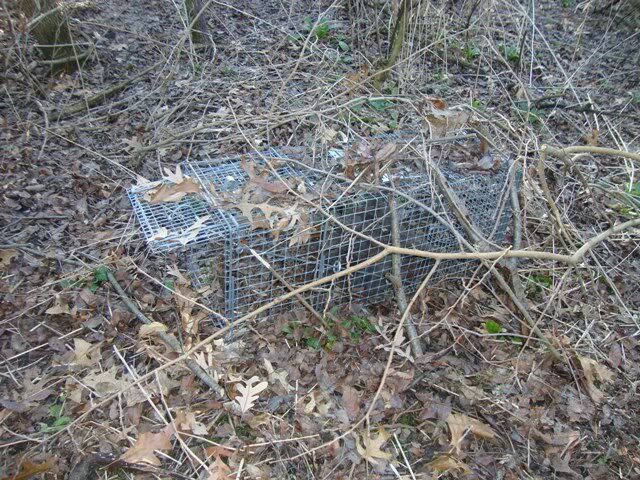
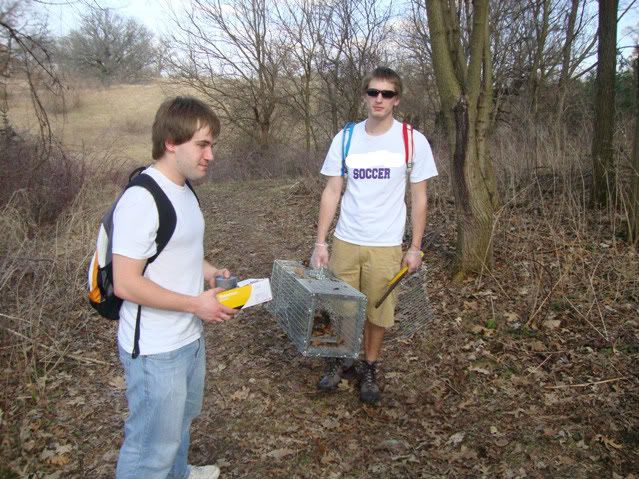
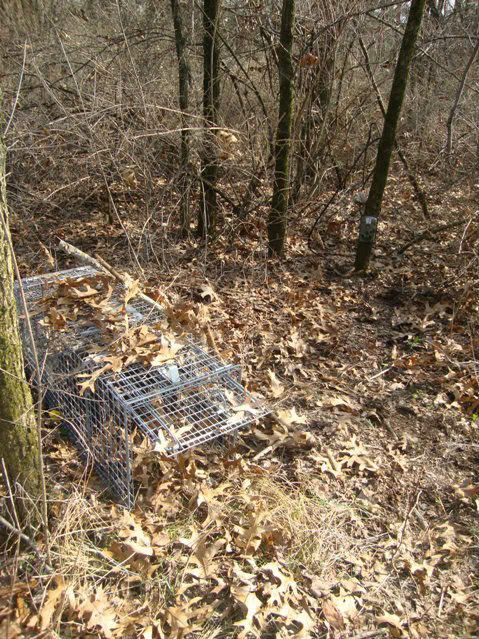
This week in lab, we added another element to our site assessment: mammal trapping with wire cage traps.  Admittedly, wire cage traps are very hit-or-miss in their success.  You typically have to either (a) riddle a site with many traps or (b) get pretty lucky.  Generally speaking, canines are just too dang smart for cage traps.  You really need leg-hold traps to have good success there, but leg-holds require a substantial amount of skill (and equipment) that I just don't have.  They also put students in too close of contact with potentially dangerous/diseased critters at this point in their careers.  As it stands, I had decided I would be the only one releasing animals from the cage traps, despite the fact that this exercise is quite a bit safer than releasing them from leg-holds.

Of course, the success of a cage trap also involves picking good locations.  Using the right bait is another important consideration.  But, the best bait in the world wont matter if the critters don't happen to walk by (which is the reason why lots of traps helps).  Unfortunately, during year 1 of this course, the budget for lots of cage traps was limited by the budget for lots of camera traps.  So, we'll have to add more cages in the future.

As it stood this time, we had four. 

Not great, but every student group got to test their skills at setting them, and they were active for two trap-nights.  With the very high numbers of raccoons, opposums and skunks on-site....I figured we'd get something.

So, we went about setting traps late afternoon on day 1.  Personal scent control helps, but can be difficult to achieve with students....who often come to any and every group function (including lab) fully perfumed and cologned, with hair products to-boot.  At the very least, I make them wear rubber gloves when handling the gear....I tell them not to let the cages touch their legs as they walk, if possible....and mention they should make an effort not to drip sweat in the vacinity of the trap set (a problem that, in truth, only afflicts their overweight professor).  In reality, human scent is probably not a huge deterrent for things like Raccoons and Opossums anyways, but thinking about scent control is a good habit to maintain for trapping.


I generally have greater success when I've placed debris along the bottom of the trap, to hide the wire cage.  When critters feel that wire, some of them back-off.  One has to be careful not to allow debris to get under the trip-plate, so the mechanism continues to work.  I'll often place a bit of wool or alpaca fiber on the trip-plate to hide it (and provide insulation for the critter, should it get cold out).  I also like to put some debris (logs, sticks, etc.) around the cage to make it feel more secure, and put it near a natural shelter (a tree, thicket, fallen log, etc.).  This must be done with caution, however.  With all the skunks we've been getting photos of on-site, you have to have a clear path to walk up to the cage with the tarp protecting you.  Having to pull a bunch of logs, etc. off of the cage could upset little Pepe, and result in a face-full of glandular odorant. 

Bait this time was turkey-flavored cat food.  It was cheap and I was in a rush, but that bait may have been a fatal flaw.  Next time I'll go with a sardines and bacon grease mix, if I can find the time to make the concotion.  We also applied a tiny bit of one of two scent lures (one was a shellfish oil based lure, the other a canine gland lure).

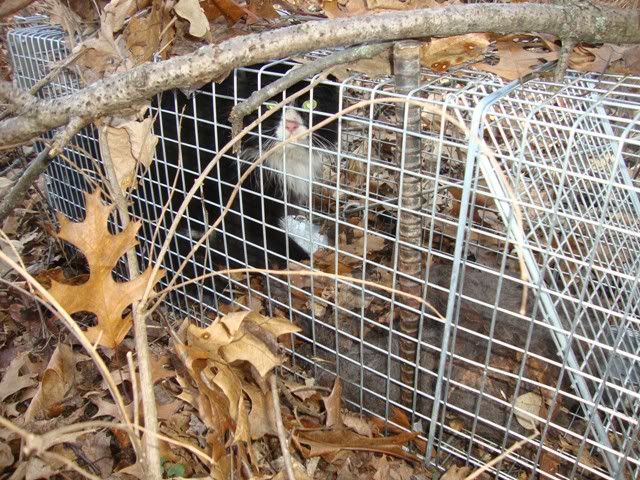
ANYHOO.....the next day, we marched out to the site....kevlar gloves, ketch-all pole and skunk tarp in-hand only to find:

Grrrr..........released with much cursing under my breath at the waste of bait.

The bait in the other traps was undisturbed.

We moved the traps to new locations....but by morning on day 2 we found that not even a feral cat was stirring.  This time, however, just to see if it was lack of passersby OR critters being spooked by the cage, I had put a camera over one of the traps (set to video mode).  During the 24 period anyways, nothing wandered by.

Above: note camera on the tree in the background.

More evidence that a greater number of traps would increase success rate.

Not as riveting as I would have hoped....but, as Sinatra would say:

 "That's life!"
_________________________________________________________________________

Regardless, we did get some cool stuff on our cameras over the past week (you may remember that we moved these about a week ago).

It's the same cast of characters, basically.  But that doesn't keep the students (and myself) from being excited that the locations they picked paid off!

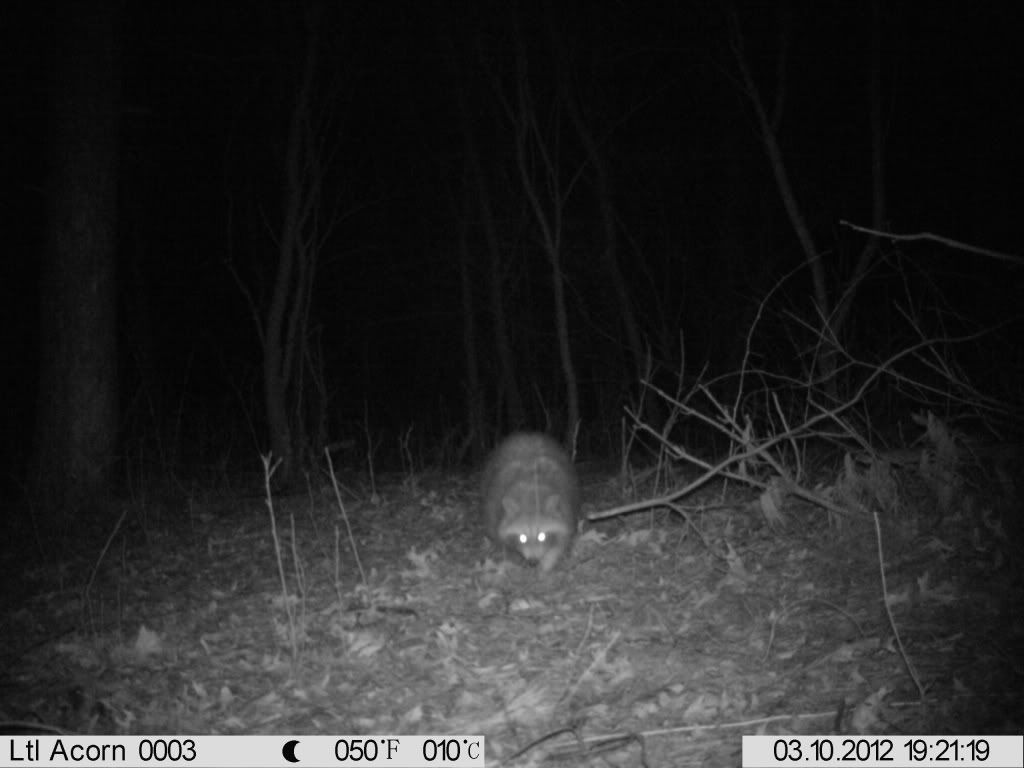
Raccoons are literally everywhere out there now.  We caught pics of them on all of the cameras, I think.

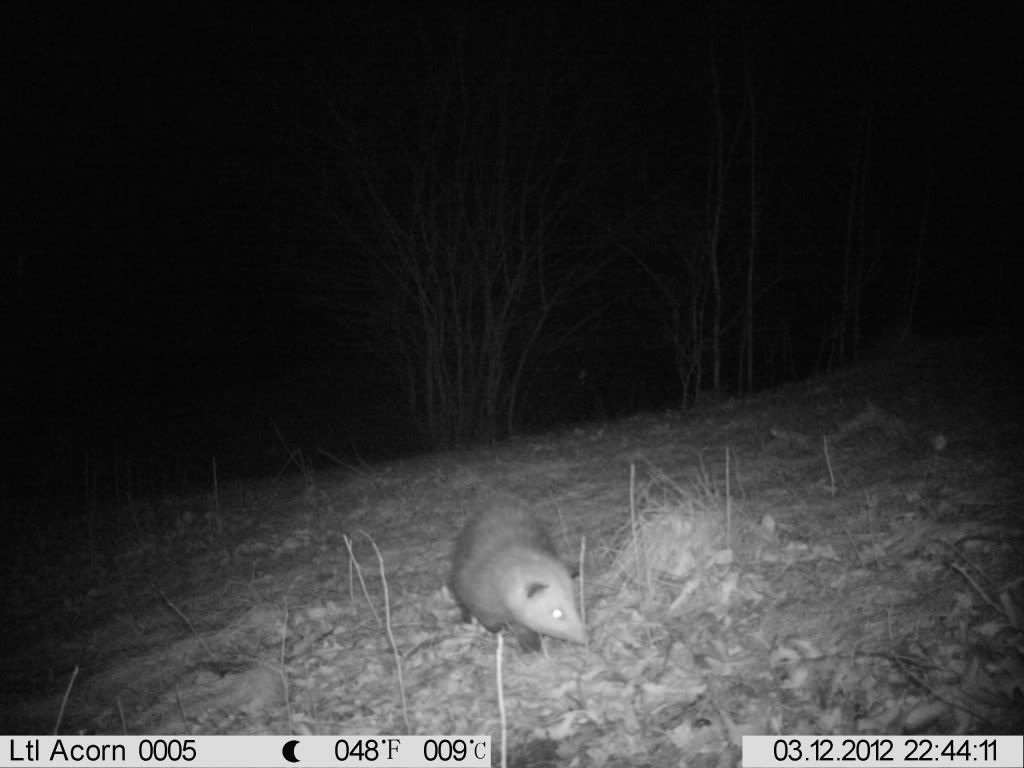
'Possums are less common, but still prevalent.....

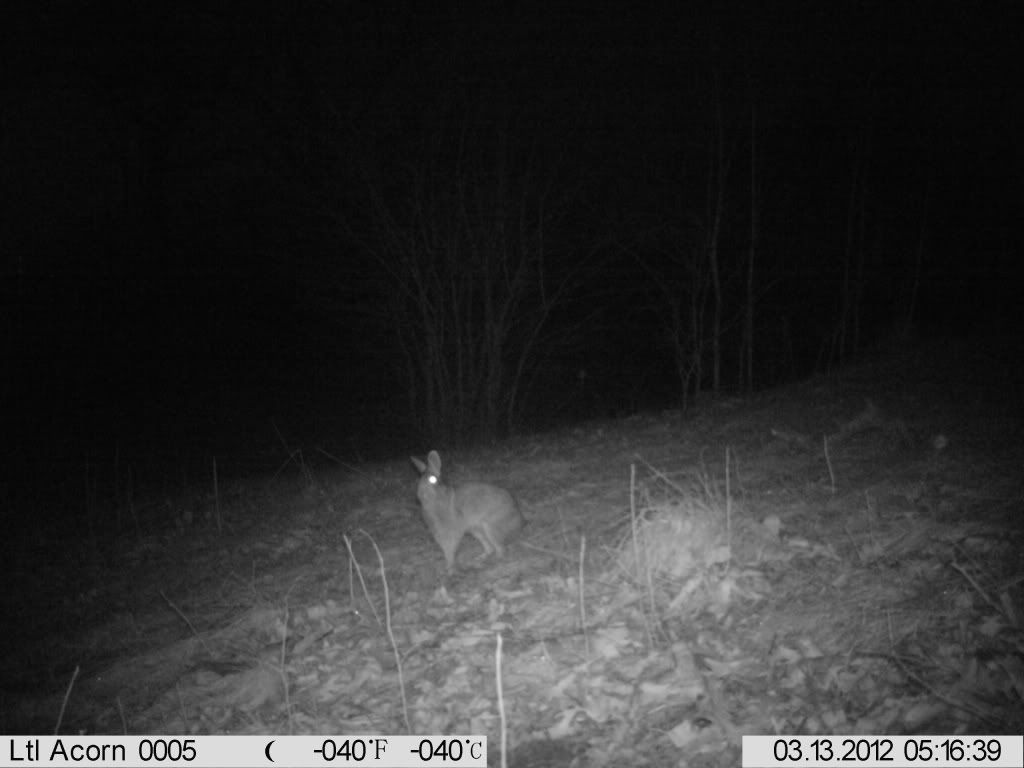
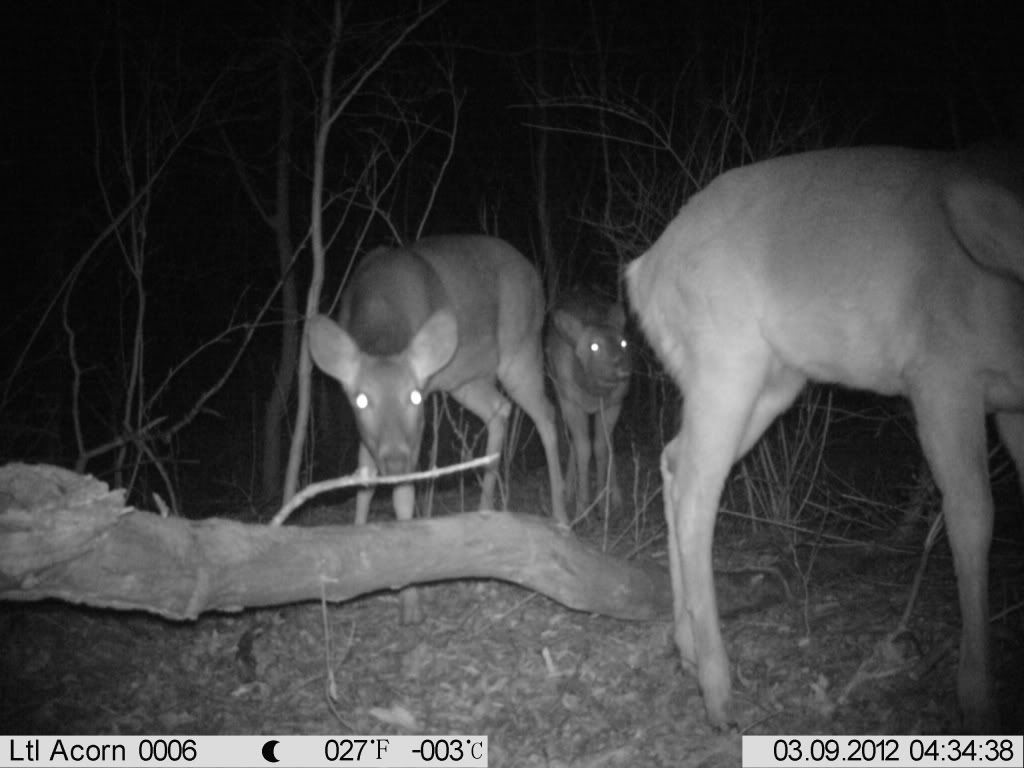
Cottontails, too, have become very active (the rather side-long glance this one is giving the camera made me laugh).

Stinkers are in no short supply....

And, of course, there are deer...deer...deer and more deer.  There are now also deer TICKS that have popped out of every crack and crevice in the woods with the warm weather, a minor annoyance during field work.

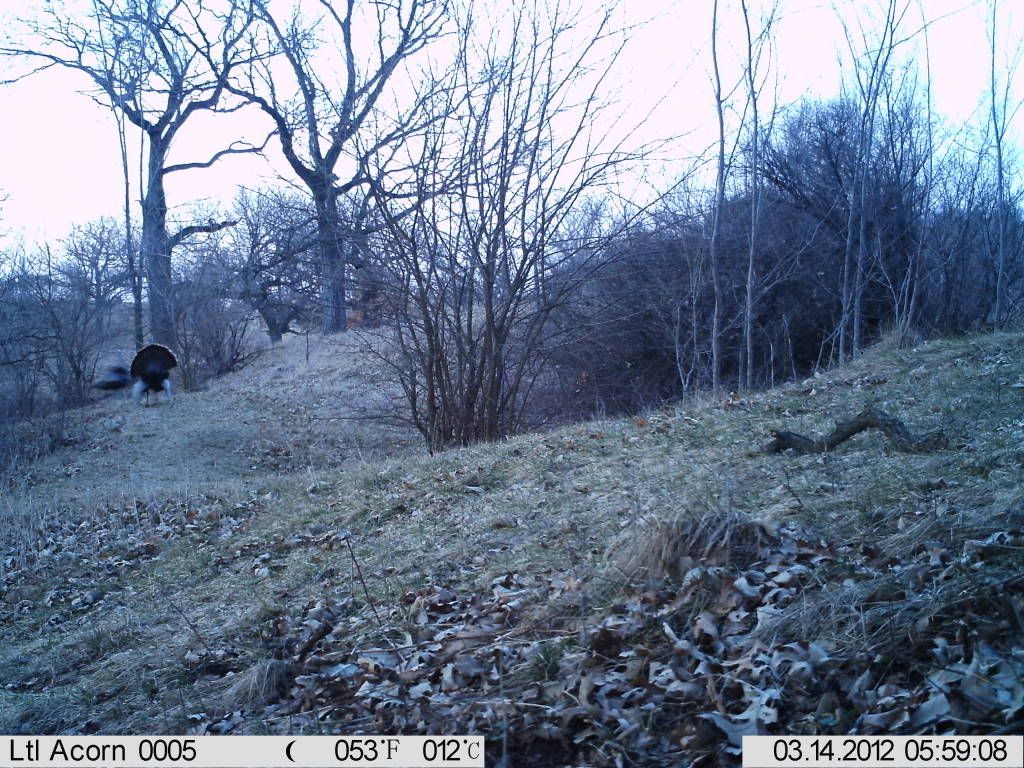
We also got a neat shot of a male walkin' bird showing off the goods to a nearby hen (left side of the frame).

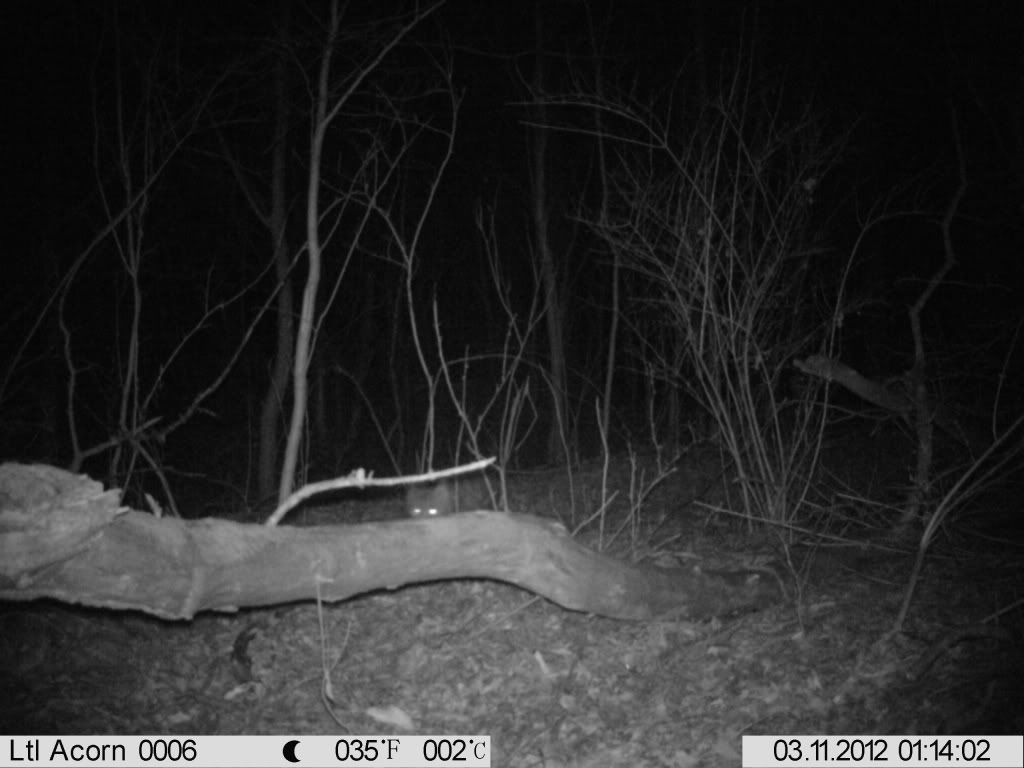
This one puzzled me for a second or two.....

That is, of course, until I saw this picture....

I'll say it again.....Grrrr!

Friday, January 20, 2012

Getting Rid of the Winter Blues


The key, in this case, is to have an annual ice-fishing trip with high school buddies in northern Wisconsin.

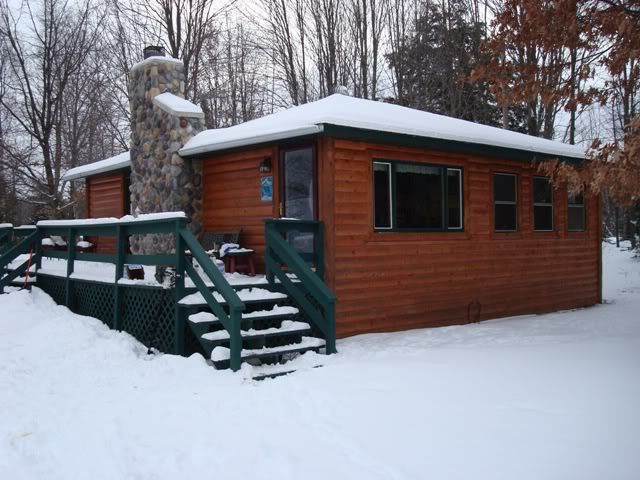
We've been taking this ice fishing trip since 2004 and it always falls on the same weekend (the weekend of Martin Luther King, Jr. Day).  Fortunately for us, we have access to a cabin owned by the father of a friend of ours (Nate). 

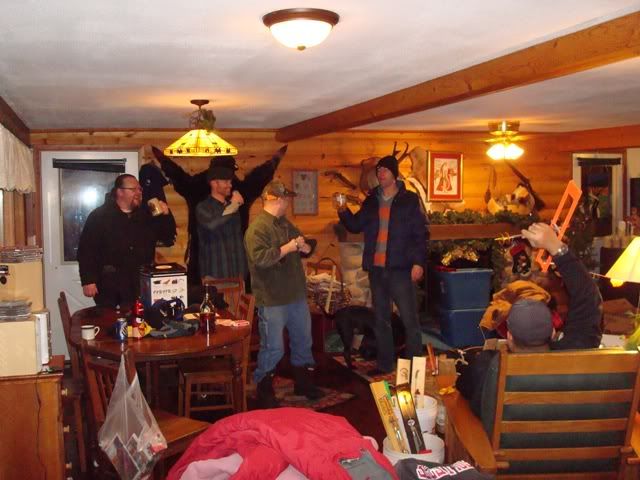
Usually a smallish group of individuals go along, and we exert alot of effort putting out and checking tip-ups (for those of you not familiar with a tip-up, stay tuned and I will explain).  It's not all hard work, though.  We also try to put forth considerable effort sitting in the cabin playing cards and reminiscing.  Or maybe just enjoying the incredible crisp, cold weather that is normal of a January in Wisconsin. 

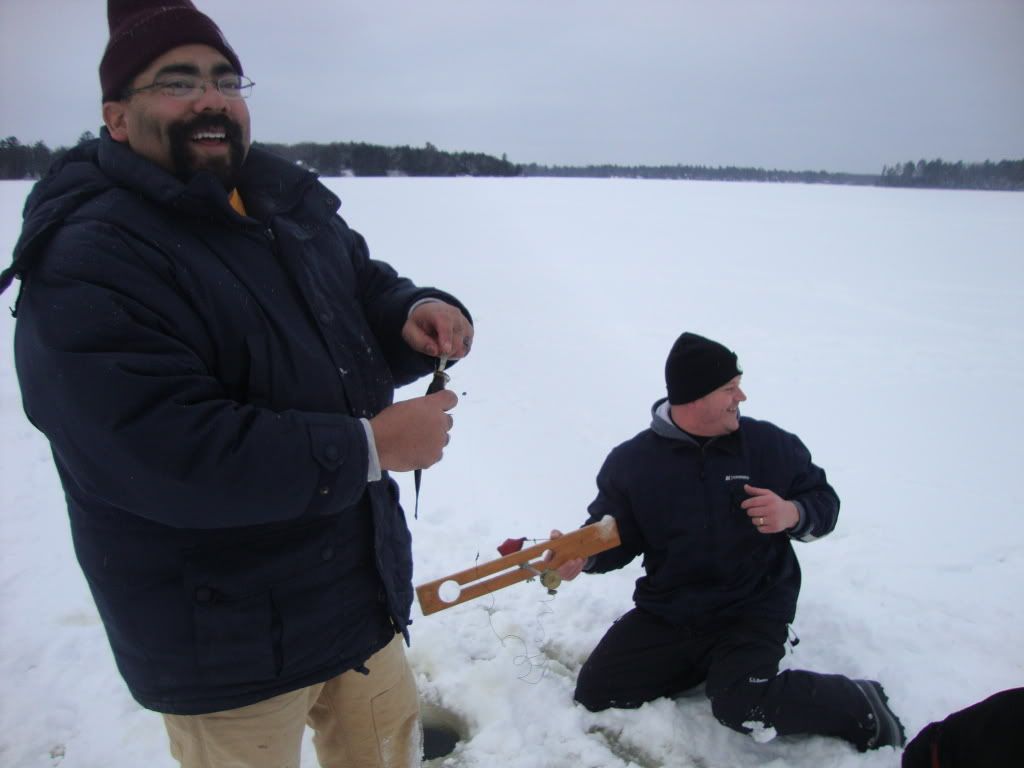
So, anyways....we arrived on Friday evening and unloaded the gear, including the tip-ups.  These are a fishing apparatus designed so that a spool of fishing line and a hook can be placed below the ice (see pics below).  Bait is attached to the hook and when something strikes the bait, the spool moves, which causes a flag to pop up. Thus, a flag that has popped means you may have a fish.

The prep-work for ice fishing is substantial.  First, you have to give all of your tip-ups a good once over (new line, hooks, sinkers, etc.).  The evening that we arrived, Nate began the tedious process of preparing all of the tip-ups for deployment the next morning on the ice. 
Above: Nate preparing the gear for early-morning deployment

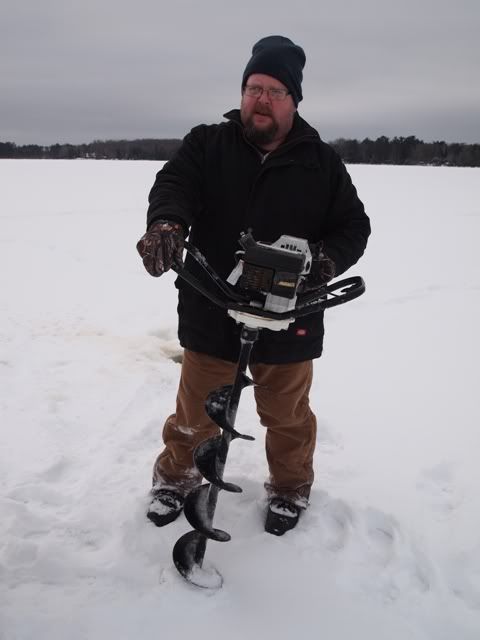
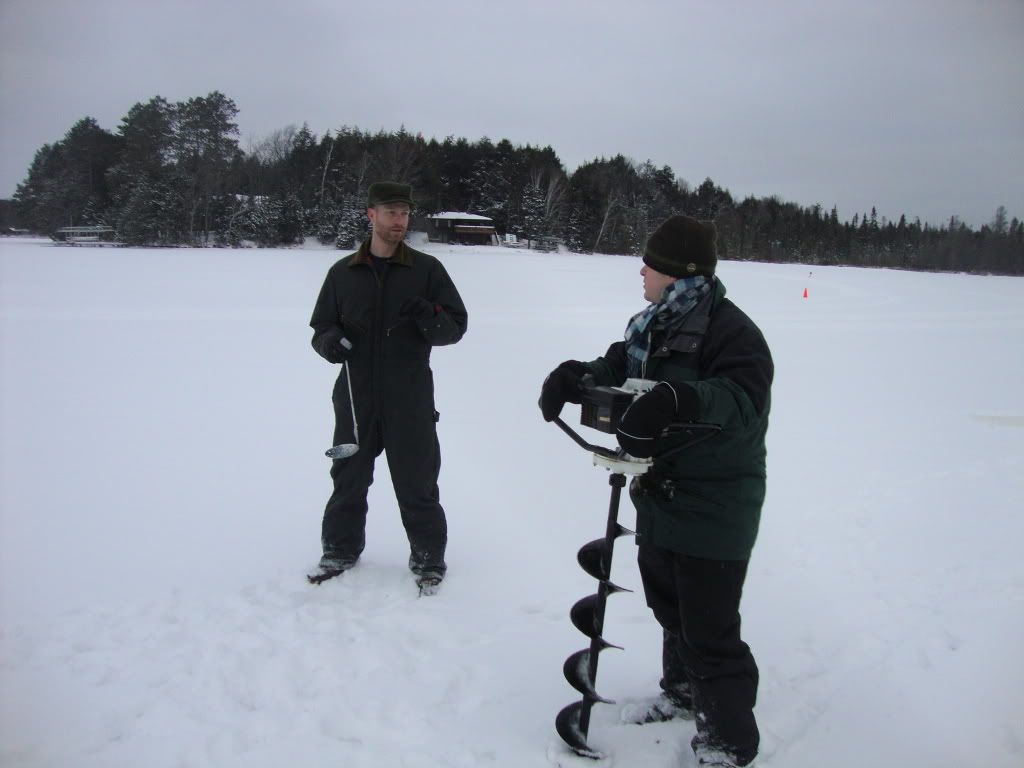
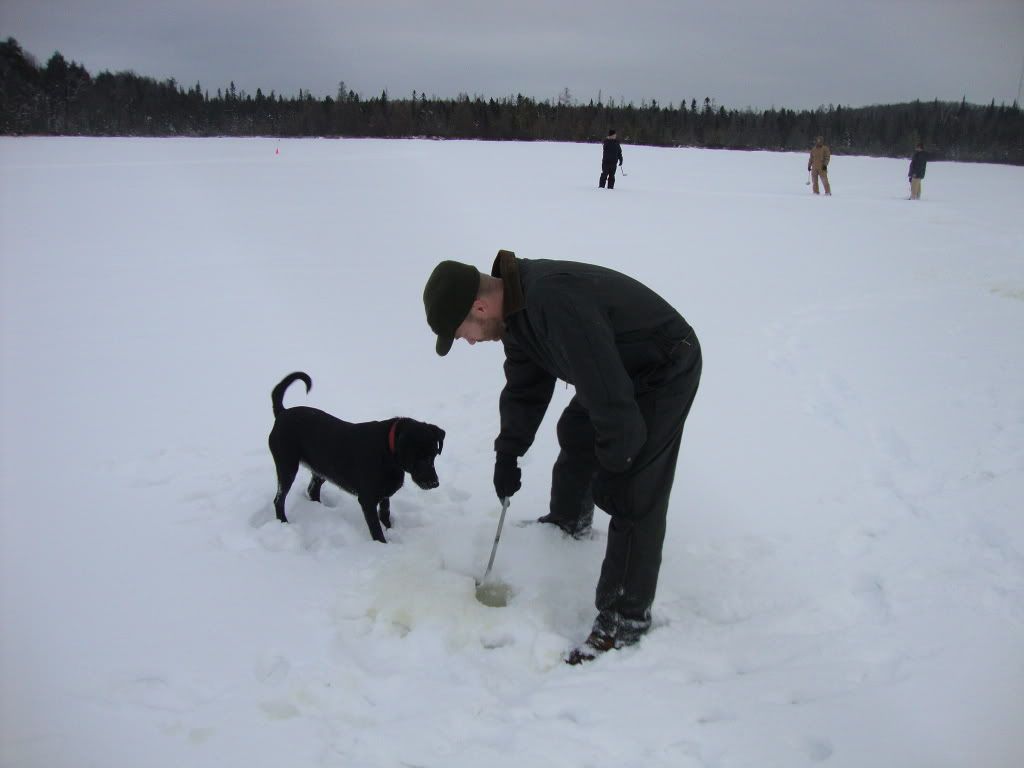
Early the next morning, we got dressed and trudged our mountains of gear out onto the ice.  To fish through the ice, one obviously needs to make a hole.  This is done with an auger and we were fortunate enough to have a gas-powered auger available to speed up the process (there was roughly a foot of ice to contend with in most cases).

Because of all the hard-work required, it's okay to take a break from time to time.  It's supposed to be an enjoyable experience, afterall!
Above: Justin and Chad show us how to relax on the ice while deploying tip-ups.

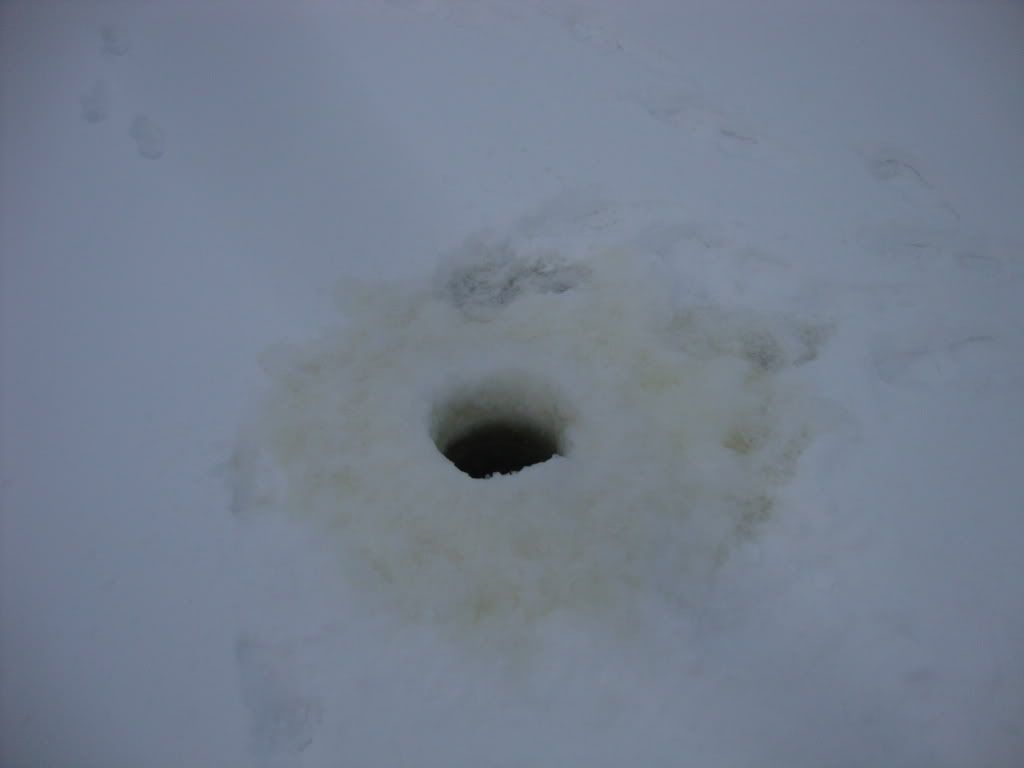
The result is a nice hole for your tip-up to rest on.

Once the holes are popped, any ice/snow that falls in must be scooped out.


Next, the tip-up gets carefully placed over the hole in the ice.....

Of course, it's always helpful to have a nice fire nearby to warm your chilled bones......

...or perhaps a cabin to step into for lunch and a drink....

If you're lucky, all of the hard work pays off and you get to have fresh fish for dinner....
Above: Nate and Andy give a lesson in how to haul in the big one through the ice.


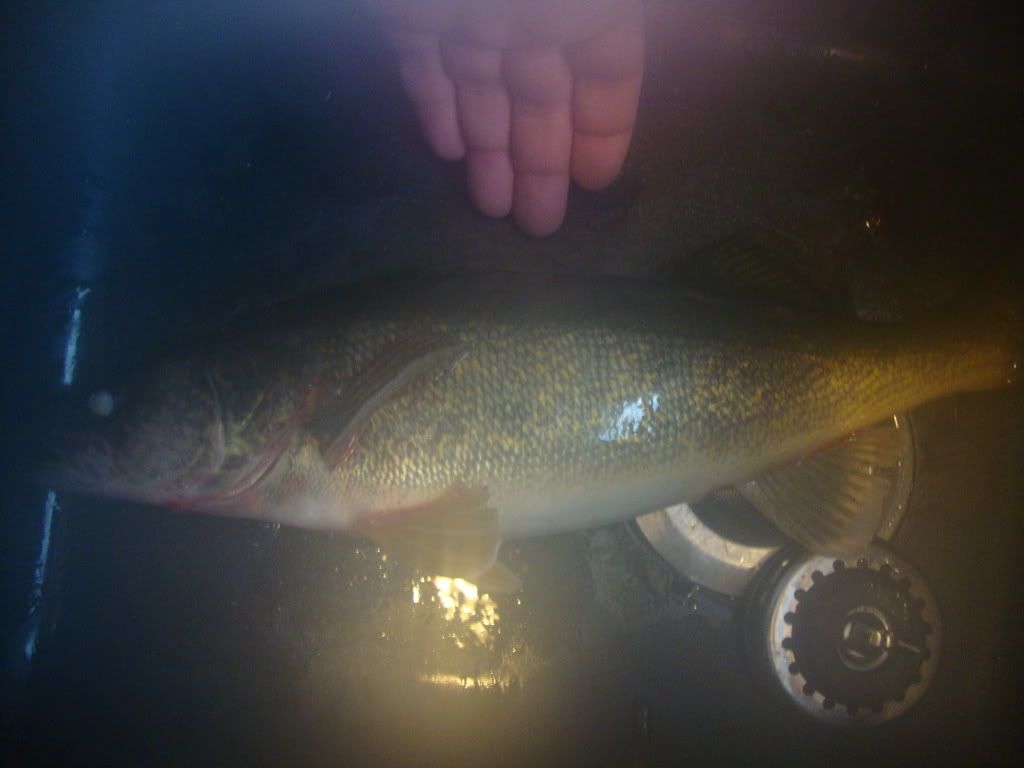
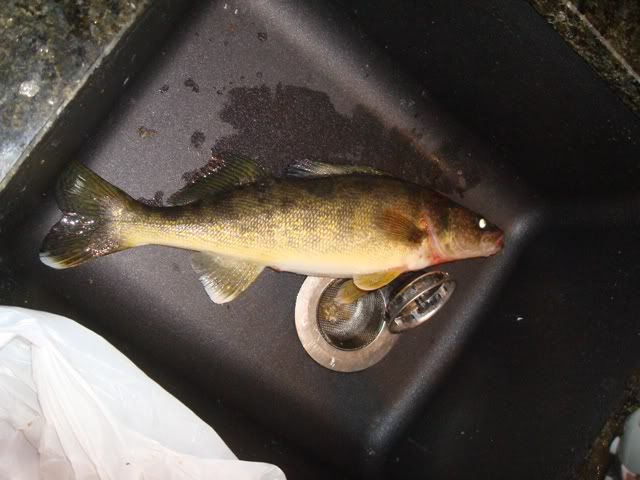
Above two pictures:  A pair of Walley (Sander=Stizostedion vitreum) caught on tip-ups 

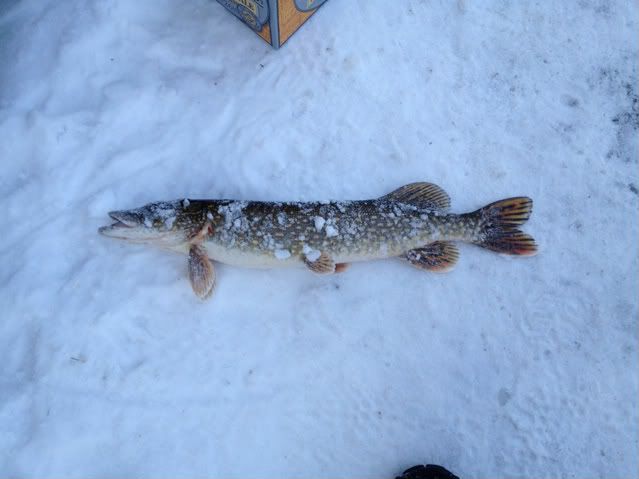
Above: Northern Pike (Esox lucius) is another species we commonly catch on this lake

______________________________________________________________________

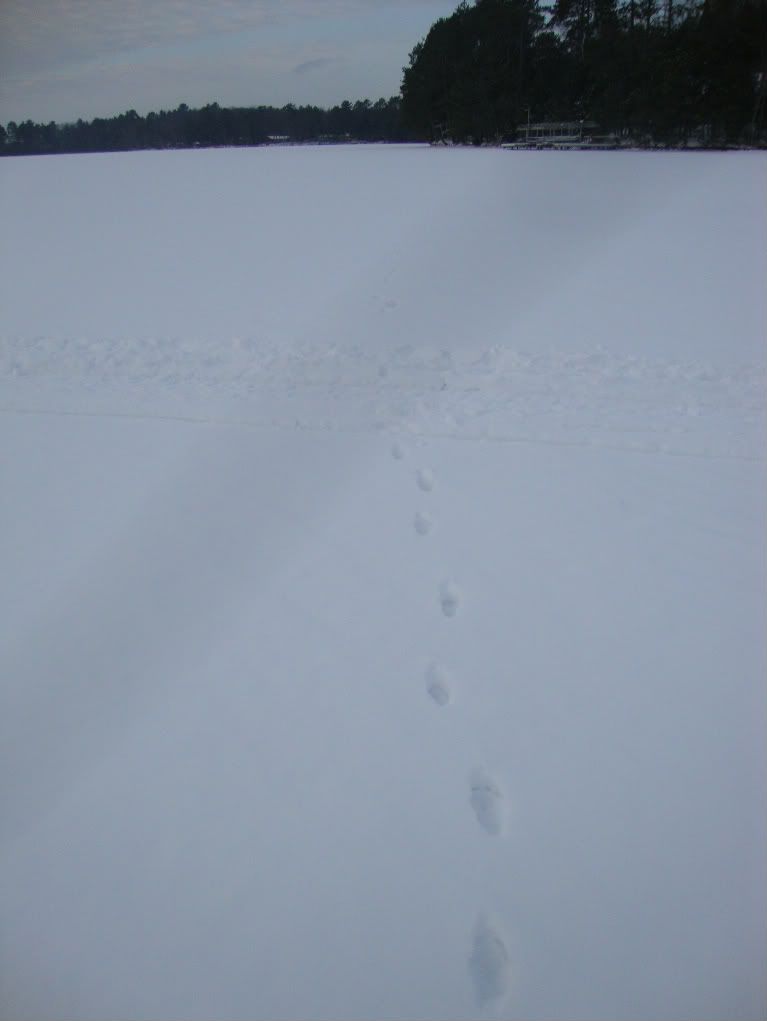
There's also usually a treasure-chest of tracking opportunities thanks to the snow.  There had been a nice snow-fall the night before we arrived, so I found a number of fresh tracks and trails to follow.  The snow was alittle deep, however, and good photos were hard to come by.  In the past, I've seen gray wolf (Canis lupus) tracks near the cabin.  None this time, however.  Yet, the usual cast of characters could be found: White-tailed Deer (Odocoileus virginianus), Squirrel (based on size, I'm assuming eastern Gray Squirrel; Sciurus carolinensis), and Eastern Cottontail (Sylvilagus floridanus).

Fox (I'm assuming Red Fox; Vulpes vulpes) were also present and always fun to track.  On more than one occasion, we crossed the trail of an individual who wandered across the ice on both sides of the peninsula.  This one moved with a purpose and took advantage of trails in the snow left by folks on snow-mobiles. 

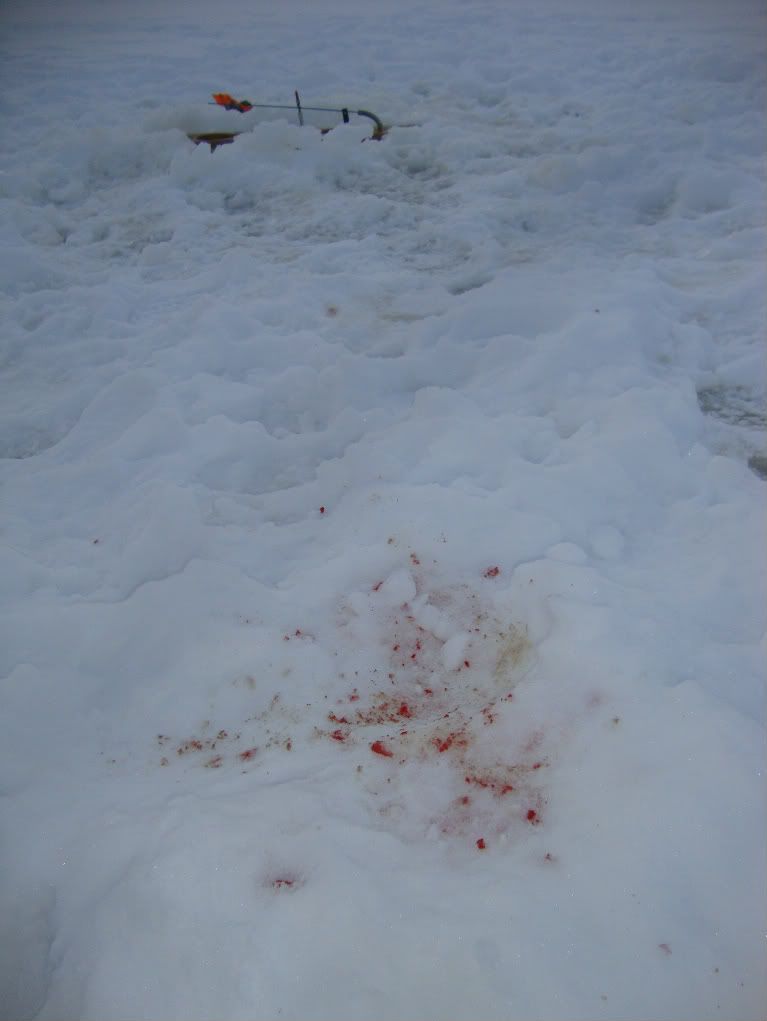
Something also stopped by and made a meal of a bait minnow someone dropped on the ice. 
This could have been done by a bird, such as a crow.  The spattering of frozen blood almost seems unlikely for a fox, which I would assume would chew this up and swallow quickly.  A crow would hack away at a frozen minnow, making the scene above.  However, we never noticed any crows on the ice near our tip-ups.  It's possible that a fox chomping a frozen minnow would have spattered a bit of blood on the snow.....especially if that minnow was frozen to the snow and the fox and to work to get it out.

Just not 100% positive....At any length, the remains of the macerated minnow were right next to the fox trail I found.

More evidence of wildlife activity below.  The drillings of a woodpecker and based on the size, I'd say it was a Pileated Woodpecker (Dryocopus pileatus).  We saw them fly overhead on two separate mornings and they are incredible critters.

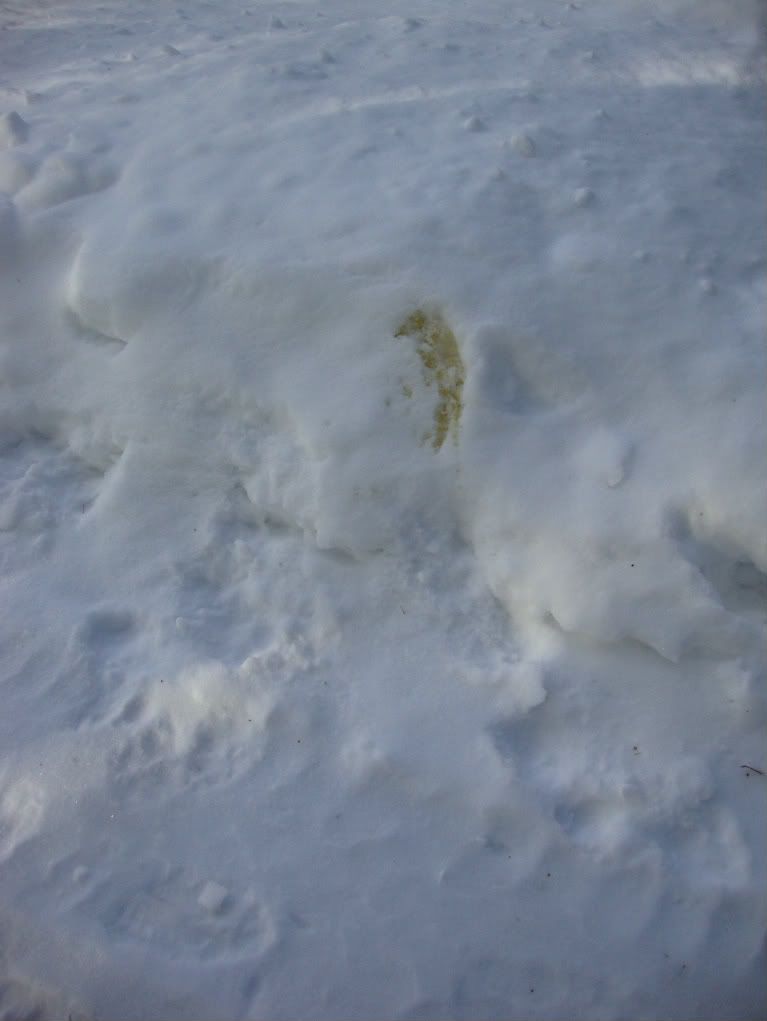
Another one I'm not 100% positive on.....an example of a raised-leg urination (or RLU) from a canid.  This was along the road near the cabin.  The tracks associated with this were fairly large and looked like a domestic dog, but I couldn't be certain.  Unfortunately, this individual didn't make it past our road-side camera trap (see below).

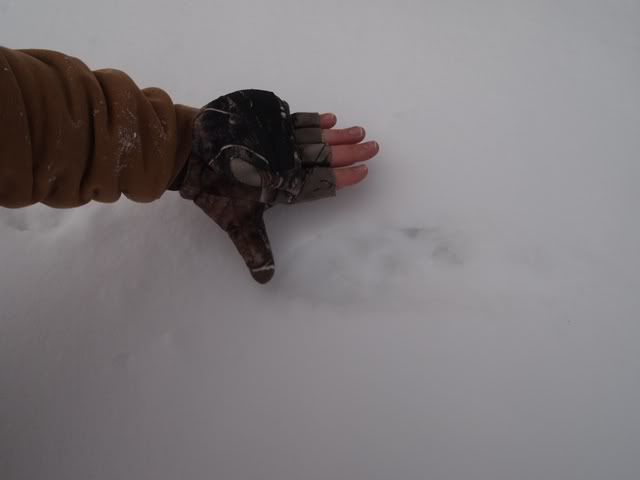
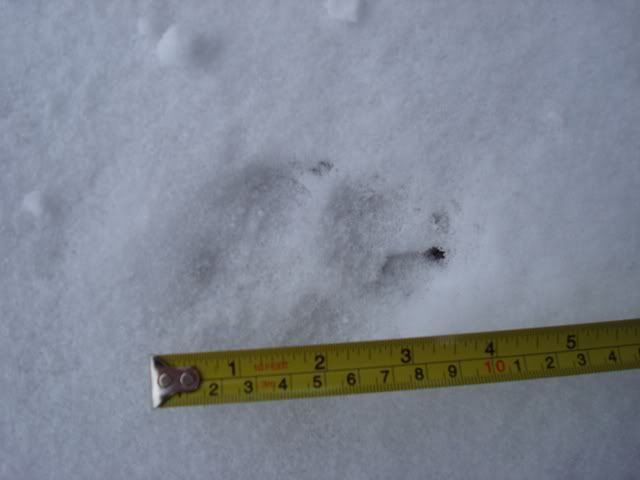
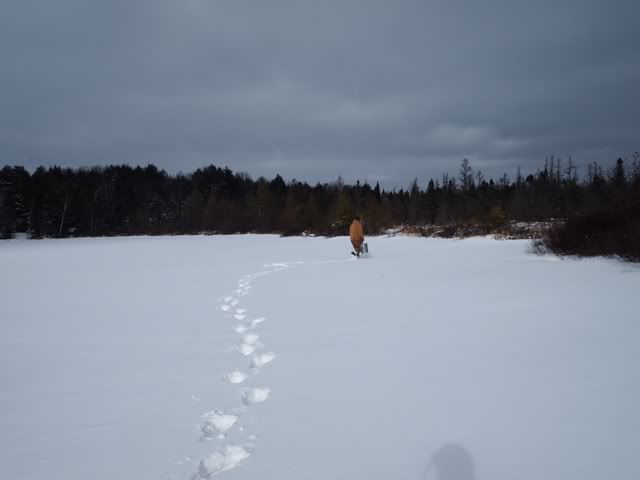
There were also a few large Canid tracks on the ice.  They measured around 3.5 inches from tip of the nails to the back of the inter-digital pad.  They followed the edge of the lake, investigating the shoreline, and at first I was excited that they might be wolf tracks.  It was hard to see the details of the print in the deep fluffy snow, but they didn't jump out as domestic dog. The top pictture below doesn't show details well, but you can at least see the general size of the tracks.  It's almost a double-register (i.e., the hind foot just about registers directly on top of the front foot).  Yet, it's not quite a double-register so the track looks a tad longer in the picture than it really is.  The bottom picture (with the tape measure) gives a better relation to size and detail. 

We followed the trail for a while, but eventually ran into some fresh human tracks running parallel to the Canid tracks......probably a domestic dog and it's owner.  Big dog, though!
________________________________________________________________________

Of course, while I was there...I decided to throw out some camera traps and have alittle fun.  The cabin we were using was on a peninsula, so there was limited human activity in the surrounding area, and the threat of theft was reduced.  I figured it would be easy to put a few cams out with less rigid security measures in place.  I also knew from the wildlife activity I had observed in the past, there was the possibility for some neat pictures.  However, time was working against me....... the cameras could only be out for 2-3 nights.  I was hopeful, but also realistic.  I also decided to help the process along, if possible.  I'm not one to put alot of bait out in front of my cameras, but in this case I pulled out all of the stops due to the short time-frame.
Above: a bog that borders the lake we fished on is a great place to find evidence of wildlife

We had found several trails that appeared very much like that of a weasel.  They made the classic "dumbell"-shaped 2-2 pattern that Rezendez and Halfpenny talk about in their tracking books.  They also appeared to wander back and forth, checking every possible nook and cranny for food.  For some reason, I never took a picture of the trails....but they prompted me to set up a baited camera trap.

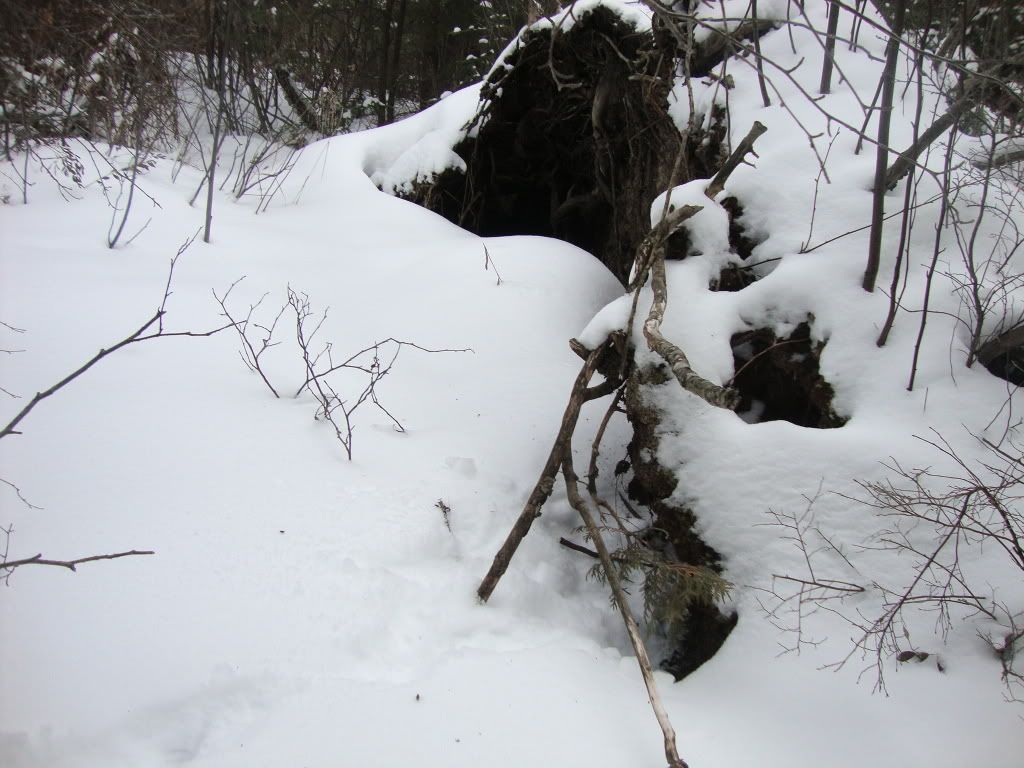
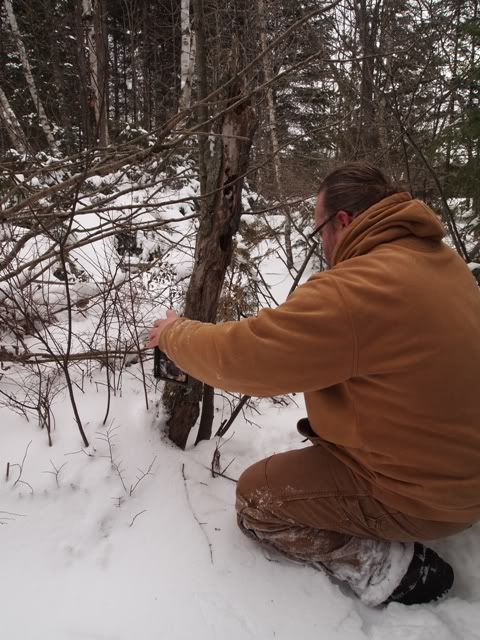
The trail lead to the root system of a blown-over tree, and it came in and out of this root system several times.  Looked like a good place to put up a camera to me.

Above: the root system burrow that I saw the apparent weasel tracks enter.

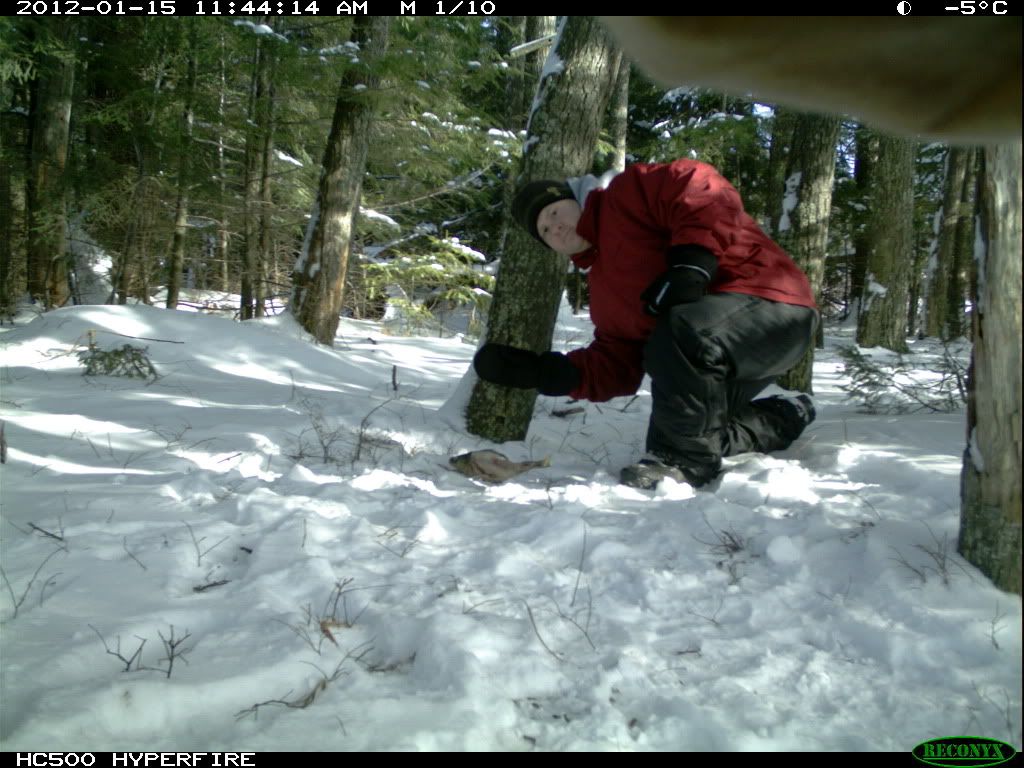
Above: hanging the camera next to the root system.

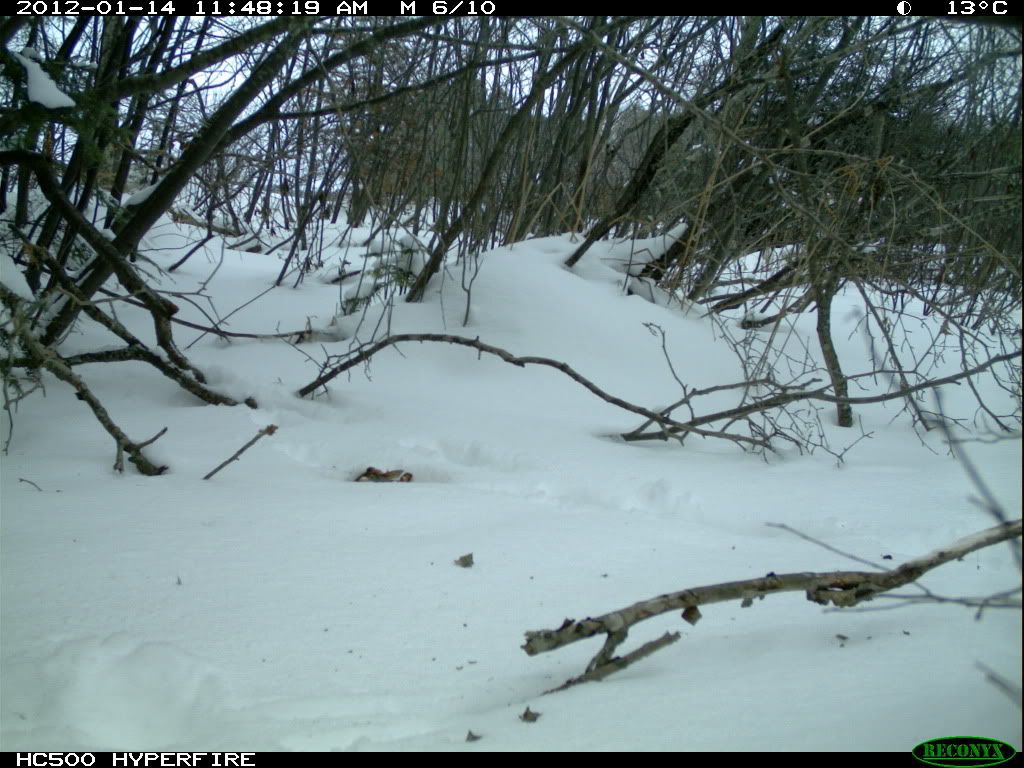
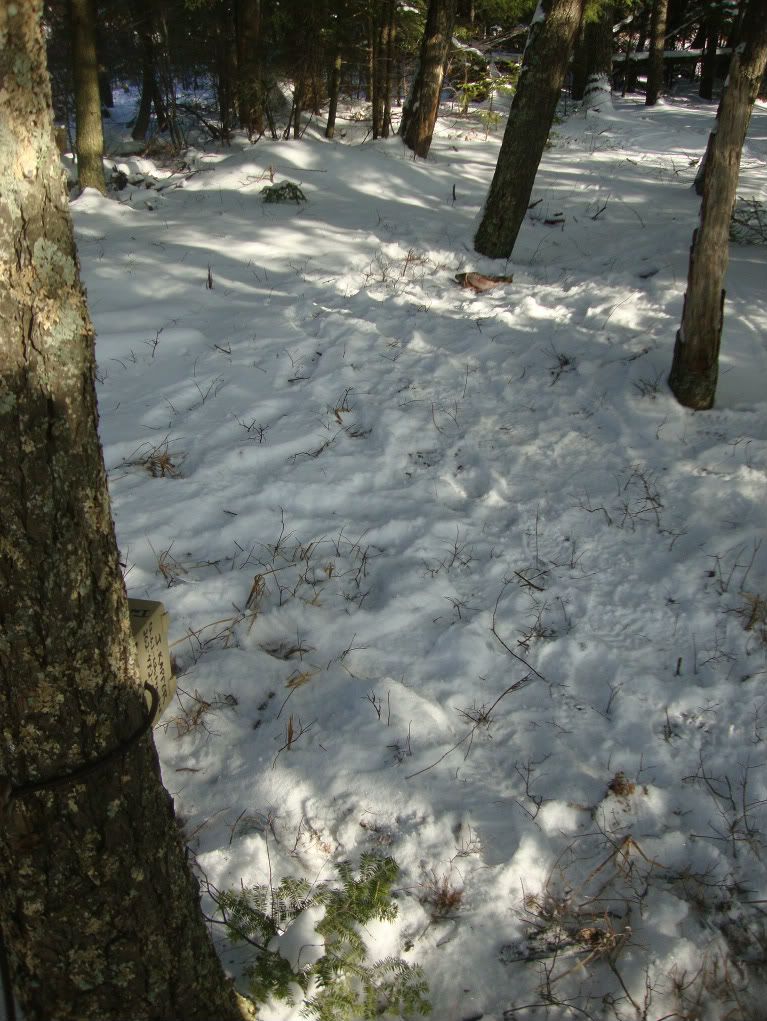
The view from the camera is below...the blown over tree is to the right just out of view.  You can see the small pile of bait minnows......  I also put a dab of commercial trapper lure for weasels on a stick poking out of the snow just left of the bait pile.

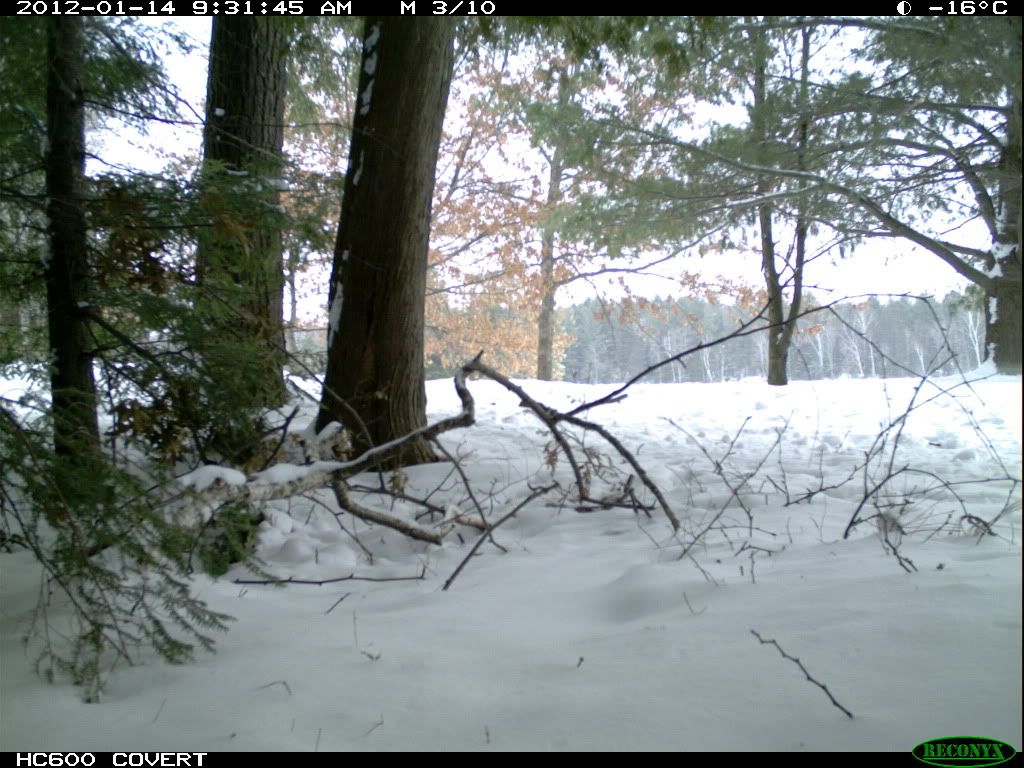
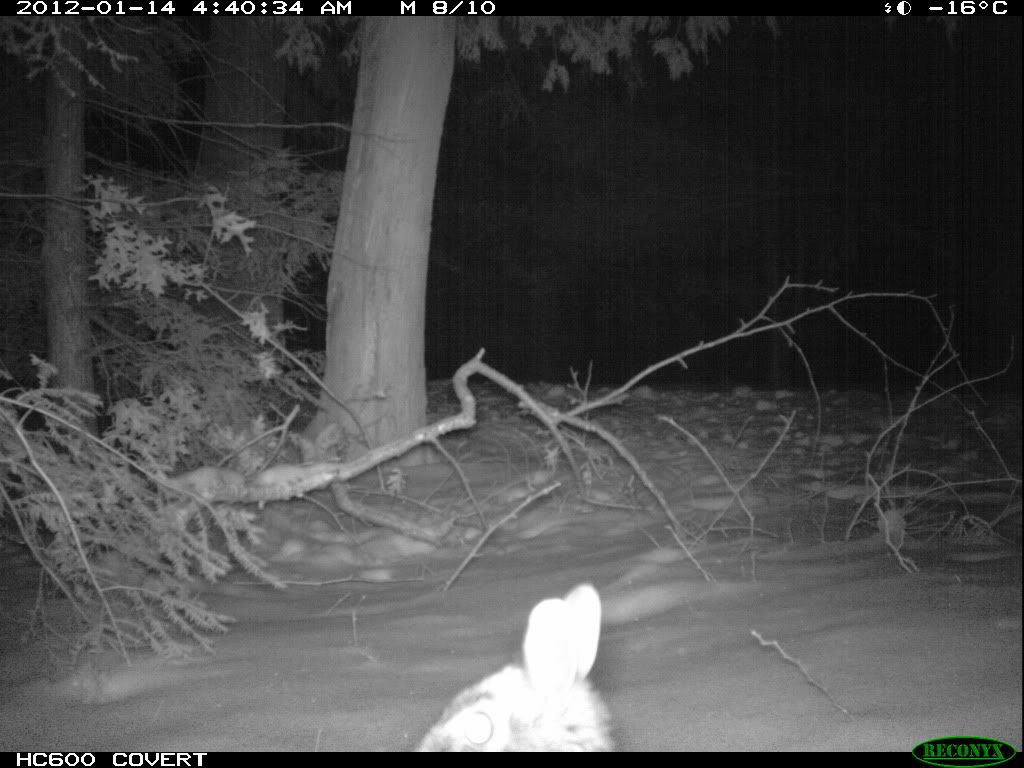
The weasel I was hoping for never showed, unfortunately.  Instead, I got pictures of an Eastern Cottontail......

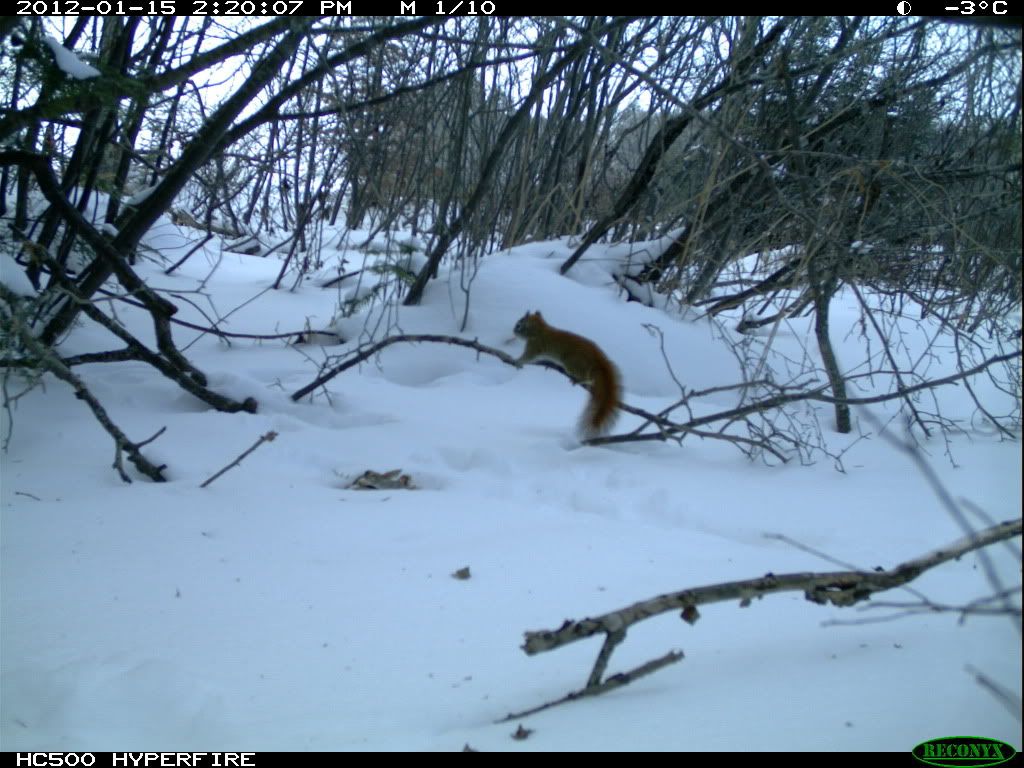
....and two visits by a Red Squirrel (Tamiasciurus hudsonicus).

Although it wasn't a weasel....the Red Squirrel is a species I've never camera trapped before.  It's more of a northern species, preferring coniferous and mixed forests and isn't found in the more southern locale I currently live in.  It is one of five tree squirrels in the area.  The others being the Eastern Gray Squirrel (Sciurus carolinensis), the Fox Squirrel (Sciurus niger), the Northern Flying Squirrel (Glaucomys sabrinus) and the Southern Flying Squirrel (Glaucomys volans).

The Red is a cute little critter, coming in at only 11-14 inches long (including it's 4-6 inch tail) and weighing 7-10 oz..

Our second camera location (below) was selected based on evidence of past activity, and it's protected nature.  It was on an island we hiked out over the ice to reach.  A series of deer trails passed right through the middle of the island, which was covered by a small grove of evergreens and no understory vegetation.  It was obvious that critters used the spot as a little oasis when crossing the large area of open ice, where they were very exposed.  In past years, I had also seen weasel tracks on this island, and was again hoping for pictures of one of the little mustelids (which always seem to elude my cameras!).

So, we put down some more bait (minnows and some fish guts)...and I put a few drops of liquid smoke on the tree that the camera faced.

I've had good luck with liquid smoke in the past, and I hoped it would draw something in.

Above: having help in the field makes all the difference!  You can see Justin above helping me make my camera adjustments before securing it to the tree.

Unfortunately, open ice is also good for something else....snowmobiles.  On at least two nights I heard them zipping around on the ice and it sounded like they were very near the island.  Not much of a chance that any critters would venture out there on a night when the snow mobiles were cruising nearby. 

As a result, this camera produced nothing. 


The last camera was a road-side camera (below).  I had noticed the roads were the highest areas of wildlife activity during our past ice fishing trips (easier than pushing through the deep snow). This is a dirt road that is little traveled, since the cabin is on a peninsula.  So....hoping for wolf photos....I used alittle commercial wolf urine in front of this camera as an attractant.   I knew this might actually scare off anything else, but I REALLY wanted some wolf photos.


But...alas....no wolves showed themselves.

Apparently, however, fresh wolf urine isn't a big deterrent for Eastern Cottontails :)

And, thus, ended our 2012 ice fishing trip.  Although the camera traps were a disappointment, a great time was had by all and I can't wait to get back next year!