Showing posts with label Beaver. Show all posts

Friday, March 15, 2013

The Fisher-Cat and More Phenology 2013

The student Wolf project finally generated a clip of a Fisher (Martes pennanti) that was worth posting.

This was taken at 7 am on February 18th, 2013.

Given the soft-spot I have for Mustelids.....I thought it was pretty neat to get a Fisher clip, and the students were excited as well.  Fishers are particularly interesting because they are a carnivore that has figured out how to get around that battery of quills protecting the North American Porcupine (Erethizon dorsatum).  The Fisher apparently achieves this by focusing its efforts on the Porcupine's face, where there are no quills, with repeated attacks until the prickly rodent is worn down by blood loss and/or shock.

The history of the Fisher, the Porcupine and overharvesting is particularly interesting, as it starts way back in 19th and early 20th centuries (reviewed by Nowak 2005).  Fishers were heavily harvested by early trappers in North America during this time, which also happened to other furbearing species, such as the Beaver (Castor canadensis, a story I've recounted for you all before).  As a result, the Fisher-Cat was nearly extirpated from the U.S., and with numbers dramatically lowered in Canada.  At this point, it is probably important to appreciate the effect that Fishers can apparently have on Porcupine populations.  An interesting study was published by Earle and Kramm (1982) that compared porcupine populations in two locations:  one with Fishers (due to a re-introduction) and one without.  They estimated Porky population densities of 40 / 100 km-squared in the area with Fishers, and densities of 350 / km-squared in areas without Fishers!  According to Nowak (op. cit.) the loss of the Fisher to excessive trapping lead to a concomitant rise in Porcupine numbers, who proceeded to do "considerable forest damage".  This made the Porcupine unpopular within the timber industry (Roze 2009).  Thus, efforts were made to protect the Fisher in order to control the number of Porcupines.  Such efforts included more stringent laws and closed trapping seasons to help conserve the Fisher.....which were coupled with several successful re-introductions....has lead to the re-bound of Martes pennanti in the U.S.
________________________________________________________________________

Phenology:

The last week (March 10th through the 15th) has also yielded a host of new phenological events for 2013.

On Sunday (March 10th) I saw the first Sandhill Cranes (Grus canadensis) of the year.
Photo source: Wikipedia

On March 10th I also saw the first American Robin (Turdus migratorius) of the season.
Photo source: Wikipedia

Today (March 15th) I observed two other "firsts" for the year: I heard the first Red-winged Blackbirds (Agelaius phoeniceus) calling of 2013, and the first strutting/displaying Tom walkin' birds (Meleagris gallopavo) of the year (THREE Toms displaying amongst a group of 15 birdds near campus).  As an aside, the first Red-winged Blackbird call I heard last year was March 1st.
Photo source: Wikipedia

Things have been chaotic busy!  Hopefully more to post soon!
_______________________________________________________________________

Literature Cited:

Earle, R.D., and K.R. Kramm. 1982. Correlation between fisher and porcupine abundance in upper Michigan. The American Midland Naturalist 107:244-249.

Nowak, R.M. 2005. Walker's Carnivores of the World. Johns Hopkins University Press, Baltimore.

Roze, U. 2009. The North American Porcupine (second edition). Comstock Publishing, Ithaca.

Friday, February 8, 2013

Skulls and Skull Cleaning: Part I

I find skulls fascinating.

First of all, so much can be learned from their close inspection.  This includes the likely diet of the organism in-question (at least in a general sense)...prominant muscle attachment areas, which provide information on life history....and important information about sensory function and brain-size (just to name a few).

I'm obviously not alone in this.  Just about anyone I know who is interested in vertebrate ecology (and obviously morphology) is also a "skull-o-phile".

Anyhoo....figured the best way to share my love of skulls with you all was to dig into the university's specimen collection and show you some examples.

We can start with one of my favorite groups, the reptiles.....

Reptiles:

Look at the teeth of a crocodilian (in this case, a small Black Caiman; Melanosuchus niger).

Very impressive chompers!  Incredibly sharp...well-suited for grabbing prey and holding it fast.  This is perfect for an ambush predator that lunges out of the water to grab a critter that's come down for a sip.

BUT...as impressive as these teeth are...they are alittle "one-dimensional".  In other words, they are mostly the same in shape (large, sharp and conical), because they all serve a similar purpose: grabbing, holding, tearing prey.

Here's another interesting example....the turtle.  Although also a reptile, the turtle's mouth is not filled with teeth.  Rather than teeth, turtles have flat, sharp, cutting plates....that resemble a sort of "beak".  These cutting plates have are sheath made of keratin (which is protein-based and similar to our fingernails) that is over the bones of the jaw.  The example below is the skull of a Snapping Turtle (Chelydra serpentina; previously known as the Common Snapping Turtle).


This lack of teeth (among other features) differentiates turtles from the rest of the reptiles.  In fact, they are in their own Order (Testudines).  Note: other well-known reptiles belong to the Orders Squamata (lizards & snakes), and Crocodilia (crocodilians).

Also, check out the large projection of bone coming off the back of the skull (appearing similar to a crest).  This bone, called a supraoccipital bone, creates a large area for muscle attachment....these muscles are involved in bringing those jaws closed with the force that snapping turtles are renowned for.  The muscles also play an important role in pulling the head into the shell and keeping it there, where it is protected.

Mammals:

Now let's move on to some mammals....

Mammal teeth, unlike reptile teeth, are "differentiated".  In other words, they are not all uniform in shape, size and general purpose.  Think of your own teeth.....feel around in your mouth with your tongue...it's fun!.  As mammals, we have incisors, pre-molars and molars that all differ in their shape and general use.

These teeth are also modified among the different groups of mammals and reflect their various feeding styles/preferences.

Herbivores:

First, a herbivore.....the White-tailed Deer (Odocoileus virginianus)
Artiodactyl skulls are easy to identify, as most  lack upper incisors.  They also have teeth that are very well designed for thoroughly masticating (chewing) tough food: vegetation.

Check out these grinders!  They are broad and sharply ridged so that when used appropriately can grind the heck out of even very tough vegetation....in an effort to break it down as much as possible before passing it to the digestive system.

Now compare the WTD to a herbivore specialized for chewing: a rodent.  In this case, one of my favorite rodents: the North American Beaver (Castor canadensis). Rodents have large incisors, immediately followed by a large gap, or arch with no teeth, called a diastema.

Rodents have the broad, flat and ridged pre-molars/molars, for grinding vegetation, that one would expect of a herbivore....

But, as you can see in the top picture of the Beaver above.....they also have those large incisors shaped like chisels.....which is exactly what they are used for.  Rodents can use those large chisels to chew with great effect.  In the case of the Beaver...as you all know.....they can even chew through tree trunks!  Other groups (such as Lagomorphs like rabbits) also have a large gap between chisel-like incisors and molars...but Rodent incisors are different than those of bunnies.  The action of chewing actually helps sharpen rodent incisors, due to the thick layer of enamel on the front relative to the back of these teeth.  As they rub together....this actually results in the incisors sharpening, which is not the same for lagomorph teeth.

Carnivores:
Compare the teeth of herbivores to that of a strict carnivore: the domestic cat (Felis catus).
Felids have teeth that are very effective at slicing through meat.  See the narrow molars and premolars above.  These are very sharp and come perfectly together with similarly narrow/sharp molars on the lower jaw to create teeth that behave like meat scissors, called the carnassials. 

Note also the large round/bulbous structures at the back of the head (the left one is broken on this specimen)....these are the auditory bullae, and they house the inner ear, including the tiny ear bones (or ossicles): incus, malleus, stapes.  Large auditory bullae are often found in mammals with acute hearing.

Canids have carnassials as well.  However, many Canids will eat more than just the soft bits of flesh from their prey....and some frequently crack into larger bones, etc.  As a result, the molars behind the carnassials on a Canid are more broad and flat for crushing. 

We can see this must be put to good use by wolves (Canis lupus; below), as their molars behind the carnassials have fairly broad surfaces for really crunching up bone.  Interestingly, according to Paquet and Carbyn (2003), wolf molars are broad...but less broad than the Coyote (Canis latrans), which eats more vegetation that requirs broader molars for mastication.

This is even more interesting when we compare the Wolf's teeth to those of the dainty little Gray Fox (Urocyon cinereoargenteus). According to Cypher (2003), these are often used for "crushing flesh and vegetable foods", which are less difficult to mash-up than bone.
It's also pretty cool to compare the areas for muscle attachment associated with the jaws of these two species.  The Wolf has a broad zygomatic arch (cheekbone)....see view from the bottom, looking up through the Wolf's zygomatic arches.  Also...note again the large bulbous auditory bullae....

The zygomatic arch helps protect the animal's eyes, but also makes room for large, strong jaw muscles.  These muscles attach to the mandible (lower jaw)....run underneath the zygomatic arch...and attach to the sagittal crest.  This is a bony projection that runs along the mid-line of the top of the cranium.  The large sagittal crest on the wolf represents a big surface area for the attachment of large muscles that power the jaw...and help generate the force to use those molars for crunching through bone.
We can again compare the wolf to the rather diminutive Gray Fox and see that the fox has obvious temporal ridges for muscle attachment, but the sagittal crest is (proportionally) much smaller than in the wolf. 
The Gray fox is not so much of a bone cracker.....or at least not to the extent of the Wolf.
________________________________________________________________________
I also can't resist but to compare some of these structures to extinct critters....in this case, Felids.  There are a pair of outstanding books that I recommend to anyone interested in skeletal morphology.  Wang and Tedford's Dogs: their fossil relatives and evolutionary history, and Turner and Anton's The Big Cats and Their Fossil Relatives.  Fun to read and full of great drawings of the extinct critters.  I wish I had the rights to include some of the illustrations from these books in my blog, because they perfectly detail what I'm about the describe.

Anyways, if we compare the width of a modern African Lion's (Panthera leo) skull to that of an extinct sabertooth cat, the concepts of large jaw muscles, the zygomatic arch, and feeding strategies can be brought together.

Modern lions have wide skulls due to wide zygomatic arches, and relatively short snouts compared to sabertoothed cats, such as Smilodon sp..  The wide arches accommodate large muscles that produce considerable bite force and strength.  This bite force is employed when lions kill their prey.  Lions can bring down large prey by clamping their jaws around the throat of the animal...or around the end of their muzzle....and suffocating them.  The captured animal will surely struggle when in the lion's jaws, and holding them requires the lions have considerable jaw strength (i.e. large jaw muscles and, thus, wide zygomatic arches to allow the jaw muscles to pass underneath).

The sabertooth cats...however....probably did not use such a hunting/killing strategy.  Rather, it's speculated that they held their prey down with their strong fore limbs....and once the prey was immobilized.....unleashed their famous teeth to sever the major veins/arteries and trachea in the throat to quickly kill the animal.  Thus, sabertooth cats did not require jaw muscles that were as strong as modern lions, because they used a different strategy to kill their prey.  Hence the reason why they have relatively narrow skulls and long muzzles compared to modern lions.  Sabertooth cats did, however, need strong fore limbs to immobilize their prey, which are proportionally larger than modern lions.


Wow!

Skulls are fun to talk about!  But....all of this has distracted me from the fact that I STILL haven't talked about how to clean them. 

Well....we'll get to that next time!


Literature Cited:

Cypher, B.L. 2003. Foxes (Vulpes species, Urocyon species, and Alopex lagopus). In Wild Mammals of North America: biology, management and conservation (second edition). Feldhamer, Thompson, Chapman (eds.).  Johns Hopkins University Press.

Paquet, P.C., and L. N. Carbyn. 2003. Gray Wolf (Canis lupus and allies). In Wild Mammals of North America: biology, management and conservation (second edition). Feldhamer, Thompson, Chapman (eds.).  Johns Hopkins University Press.

Monday, July 4, 2011

Who Skirts the Whistlepig Burrow?

There's nothing like a good river corridor if you want to get pictures on a camera trap.

Especially if that river corridor experiences reduced human disturbance.

I've posted pictures from this camera set before.  Originally, I was hoping to identify a mystery animal (which I determined was a mink; Neovison vison), and then the goal became to monitor Whistlepig (Marmota monax) activity near their burrow entrance, and I've also reported a nice Coyote picture (Canis latrans).

However, lots of critters skirt the Whistlepig burrow while following the river corridor.

Here are a few more shots from this location, and a summary of everything that passed by.

The Opossum (Didelphis virginiana): Early on in the spring, a 'possum passed the camera just this once.  The picture below was before I repositioned the camera. 

On the day I deployed this cam...as I walked along the river perusing potential camera set locations, I remember having a strange feeling of being watched.  I glanced to my right, and sitting not far away was a 'possum, watching me pass by.  I stopped and looked at him for a second, which prompted him to slowly turn and amble back into the woods. 

I wonder if this picture is of that same 'possum?


Gray Fox (Urocyon cinereoargenteus): A Gray Fox has only wandered by once.  It was about this time that I also had one pass near my Otter Latrine set, which isn't too far away. 

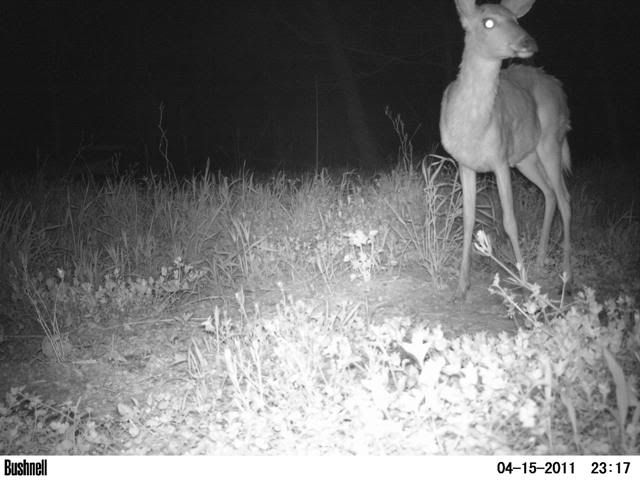
White-tailed Deer (Odocoileus virginianus):  


One of the reasons commercial cameras with white-flash have been slowly taken over by infra-red flash cameras is because it's been promoted that perhaps the white-flash deter deer.  I find this incredibly difficult to believe in alot of situations.  Canines and cats, I'll perhaps buy (although see the recent post over at Camera Trapping Campus).....but even they're smart enough to acclimate to flash.  Regardless, I still don't buy that the white flash really deters many deer.   I suppose that big trophy buck might be wary and not come around as often with a white-flash camera (and this is what many camera owners are most interested in photographing), but I'll bet deer in general couldn't care less.  I have no hard data to back this up.....just some anecdotal observations like the one below. 

The individual in the lower two pictures lays down in front of this camera, and takes that bright flash directly in the face repeatedly for an entire HOUR AND A HALF!  This resulted in 57 pictures of this one deer, and on the Cuddeback (which doesn't take multiple pictures per wildlife pass) this is alot of pics of one individual.

This is just one of at least five similar incidents.  Although during the other such incidents a deer catches the flash right in the face and continues to graze right in front of the camera...they don't hang around as long as this individual (and don't lay down in front of the camera).

Eastern Cottontail (Sylvilagus floridanus): Another common critter at this location. Almost all of the pics from this spot are like the one below (i.e., of a rabbit in mid-leap).  The Cuddeback does have a lightening fast trigger time!

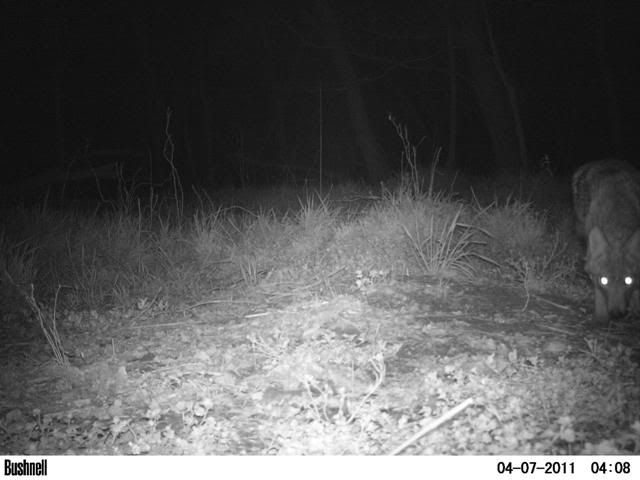
Coyote (Canis latrans): the "talking dog" has floated past more than once (three times, in fact).  I would think the flash would deter them.  It's possible these are all different individuals.  If the same individual...they may have acclimated to the flash, which I've seen them do with Infra Red flash cameras (See Coyote Cams, posted on Feb. 19th, 2011). 


Beaver (Castor canadensis): A Flat-tail ambled by only this once.

Racoons (Procyon lotor): By far the most commonly captured critter by this camera trap.  Since February 8, 2011, I've had Racoons pass by over 160 times!  See summary below.

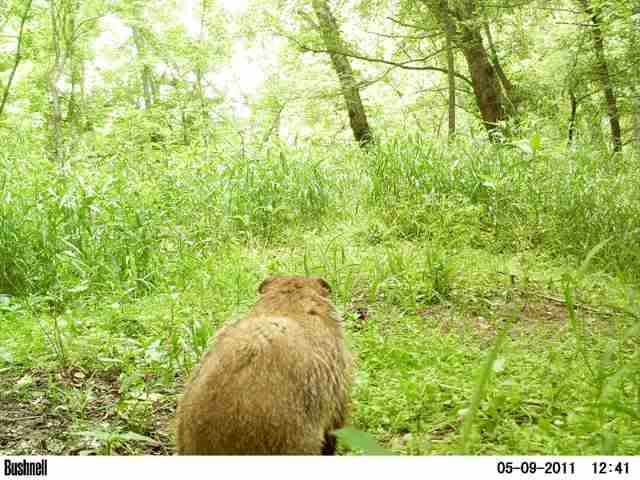
Whistlepig (Marmota monax):  Of course the whistlers are still about!  Check out the claws on the individual in the second picture.  No wonder they are such great diggers! 


Summary of results:

Camera deployed on February 8, 2011 and retrieved on June 27, 2011.

I summarized the number of animal "passes" to-date.  To apply some sort of general criteria to what was considered an individual "pass", if two pictures of the same species appeared on the camera close together in time, I considered them separate "passes" if they were at least two minutes apart.  Within two minutes, it's feasible that the same individual just turned around and came back...but this time criteria is arbitrary.  Obviously, I can't identify individual animals that well, so I may be counting the same individual more than once (as I'm sure I am with the Whistlepigs).  If there were unique marks to identify individuals back-to-back within within 2 minutes of eachother, I only counted it as one "pass".

I wish I wasn't such a dunce and could figure out how to imbed a graph from Excel on my blog, as I think that would be more informative than what I have below.  Unfortunately, I haven't been able to figure it out (without having to get some additional piece of software), so you'll just have to view the results as is.

What I find most interesting is the shift in the number of Racoon, Rabbit and Whistlepig passes as the months advance.

February Totals: A fairly low number of captures, overall.  But, this was the only month of the "mystery animal".  The number of Racoon passes is also respectable.
  • Coyote= 1
  • Beaver= 0
  • Deer = 13
  • Gray Fox= 0
  • Mystery Animal/Mink= 6
  • Opossum = 1
  • Rabbit (eastern cottontail)= 5
  • Racoon= 40
  • Squirrel (eastern gray squirrel)=2
  • Whistlepig = 0
March Totals:  March is the Month of the Racoon and the Rabbit!  Also, the Whistlepig starts to show (but not until late in the month).
  • Coyote= 0
  • Beaver= 1
  • Deer = 14
  • Gray Fox= 1
  • Mystery Animal/Mink= 0
  • Opossum = 0
  • Rabbit (eastern cottontail)= 46
  • Racoon= 94
  • Squirrel (eastern gray squirrel)=3
  • Whistlepig = 14
April Totals:  A month of low activity.  Look at how far the Racoon total has dropped!
  • Coyote= 2
  • Beaver= 0
  • Deer = 2
  • Gray Fox= 0
  • Mystery Animal/Mink= 0
  • Opossum = 0
  • Rabbit (eastern cottontail)= 10
  • Racoon= 13
  • Squirrel (eastern gray squirrel)= 0
  • Whistlepig = 3
May Totals:  May is the Month of the Whistlepig...and the Rabbit is all but a memory.
  • Coyote= 0
  • Beaver= 0
  • Deer = 3
  • Gray Fox= 0
  • Mystery Animal/Mink= 1
  • Opossum = 0
  • Rabbit (eastern cottontail)= 3
  • Racoon= 29
  • Squirrel (eastern gray squirrel)= 3
  • Whistlepig = 48
June Totals:  The Raccoon is now the most abundant again, and the number of Whistlepig passes has decreased substantially.
  • Coyote= 0
  • Beaver= 0
  • Deer = 8
  • Gray Fox= 0
  • Mystery Animal/Mink= 1
  • Opossum = 0
  • Rabbit (eastern cottontail)= 6
  • Racoon= 18
  • Squirrel (eastern gray squirrel)= 0
  • Whistlepig = 10
Overall Totals for this location:
  • Coyote= 3
  • Beaver= 1
  • Deer = 40
  • Gray Fox= 1
  • Mystery Animal/Mink= 8
  • Opossum = 1
  • Rabbit (eastern cottontail)= 76
  • Racoon= 194
  • Squirrel (eastern gray squirrel)= 8
  • Whistlepig = 75

The camera was pulled from this location on June 27, 2011.

It was a fun spot.

Wednesday, June 15, 2011

The Otter Latrine Redux

The Otter latrine site continues to be monitored.  Since I last posted any of my findings from this camera trap set on April 10th, 2011 (see Back to the Otter Latrine), alot has has happened. 

Of course, as I've shown you before, Otters aren't the only critters that like this spot.

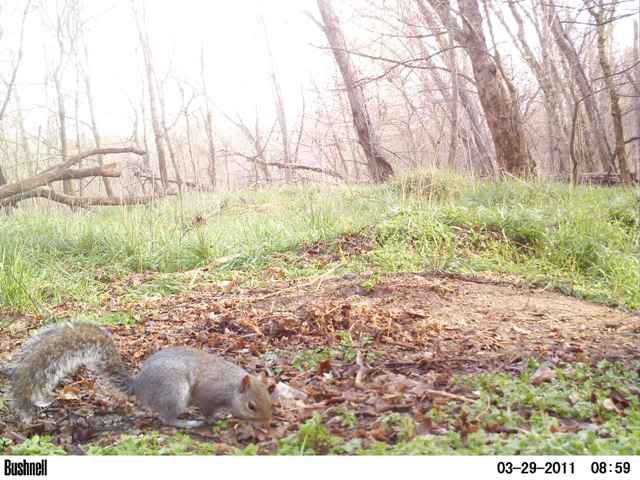
There are eastern gray squirrels (Sciurus carolinensis)....


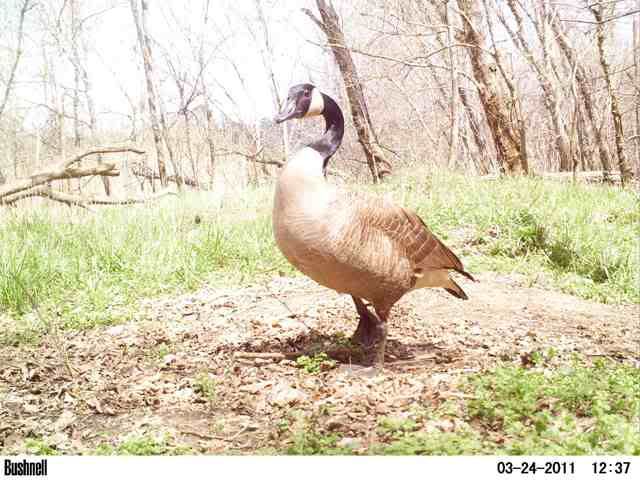
Once, and only once, some Canada Geese (Branta canadensis) waddled by.....


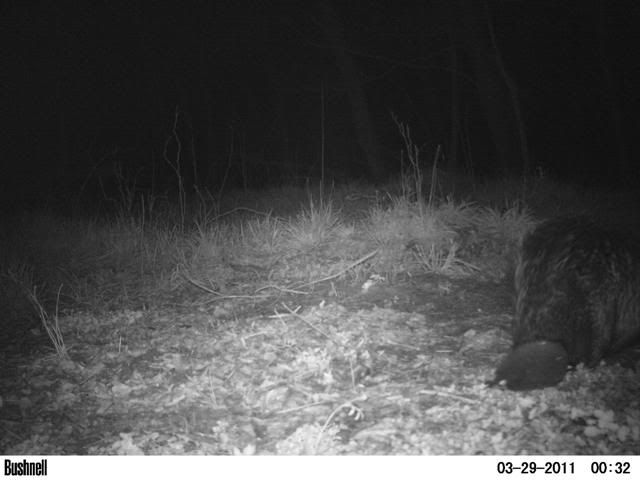
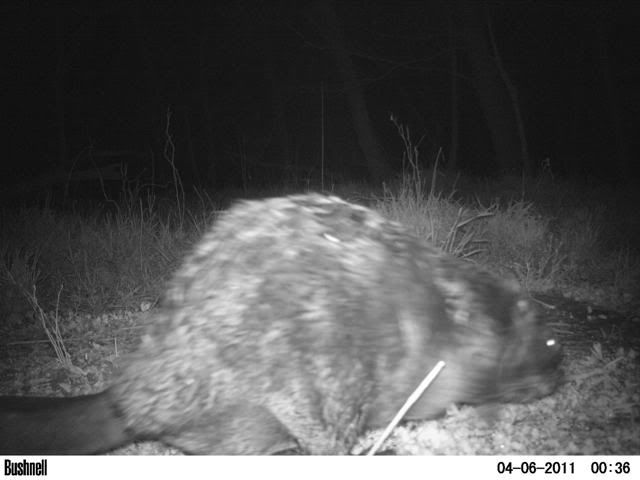
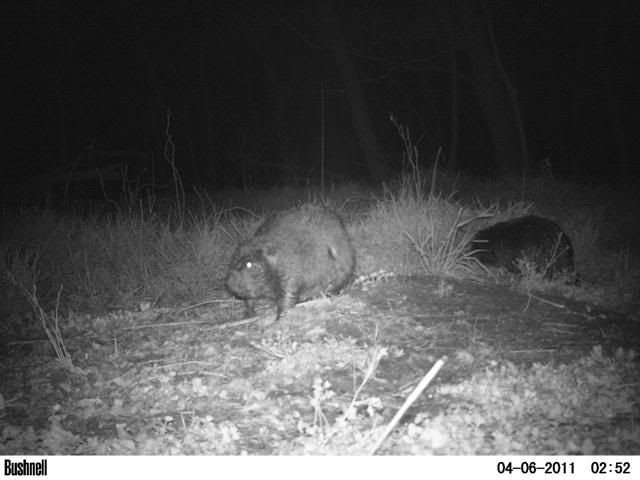
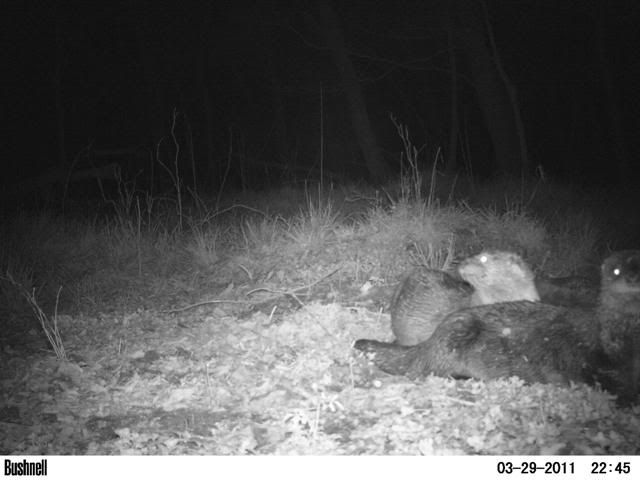
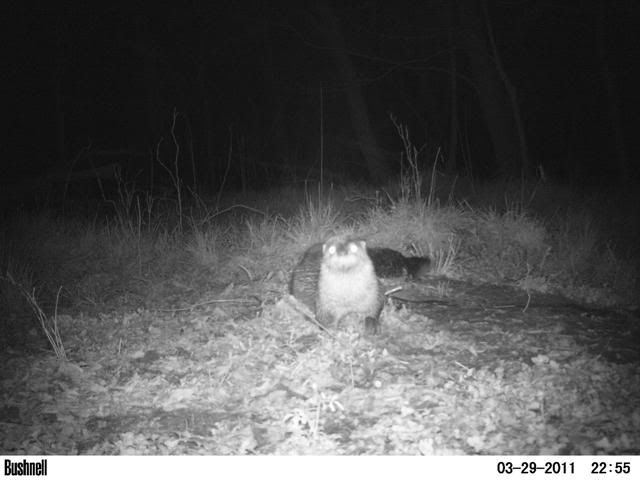
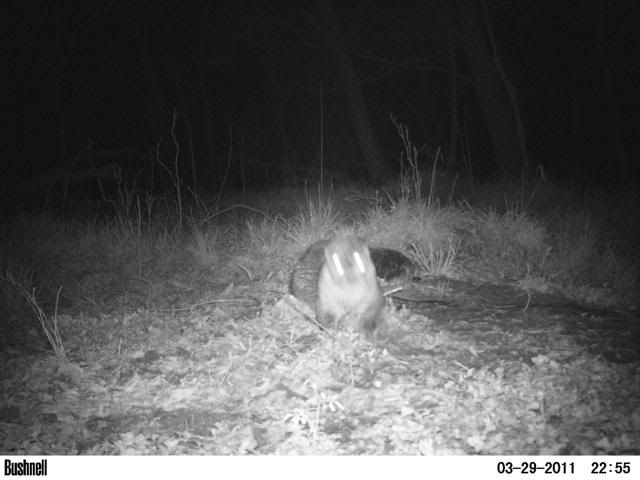
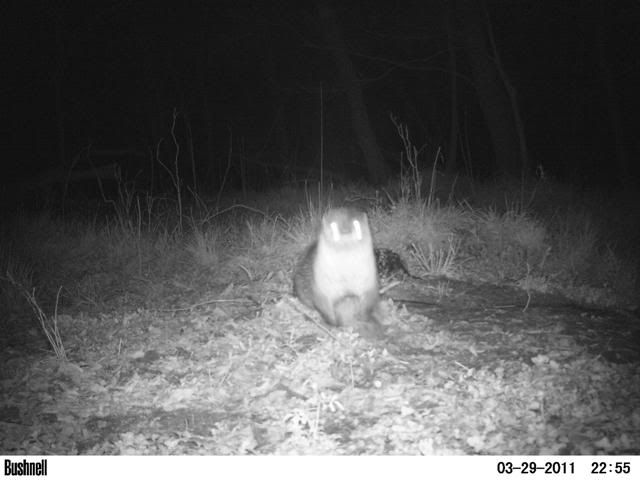
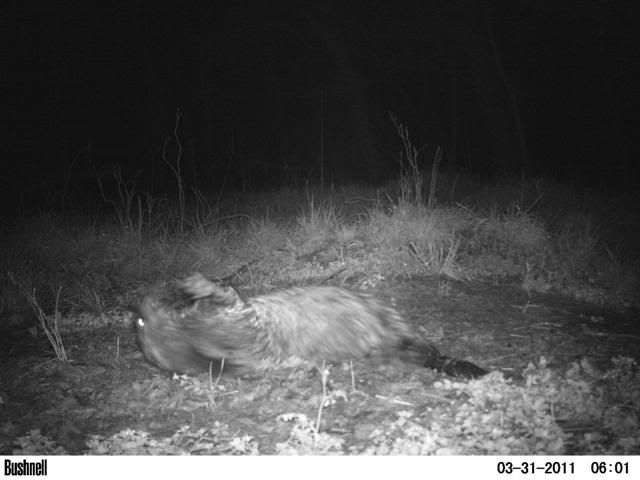
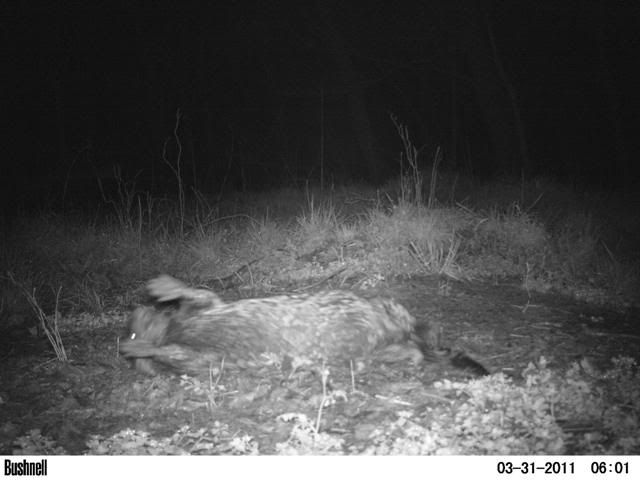
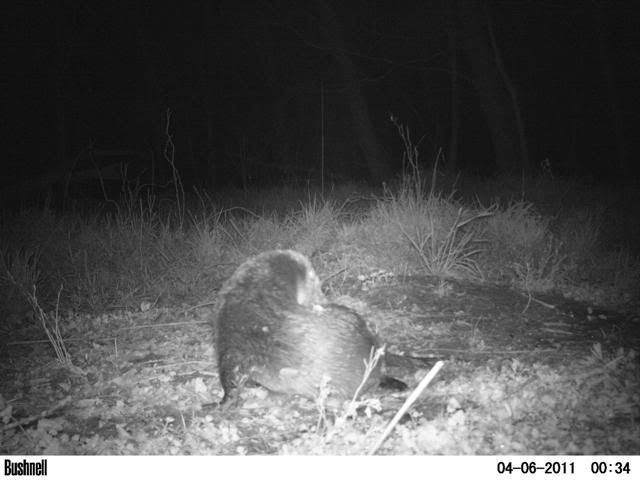
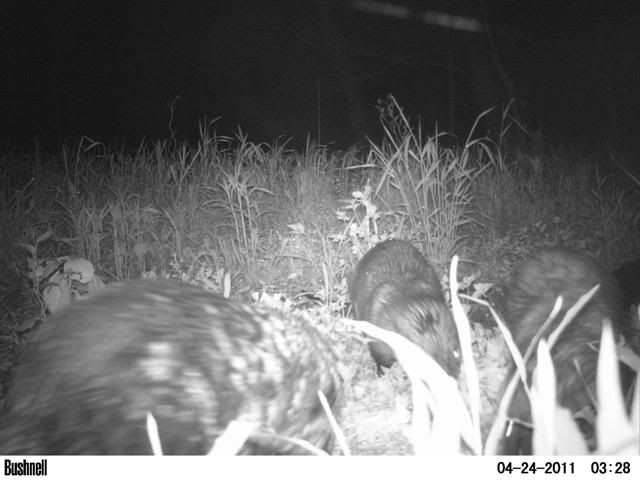
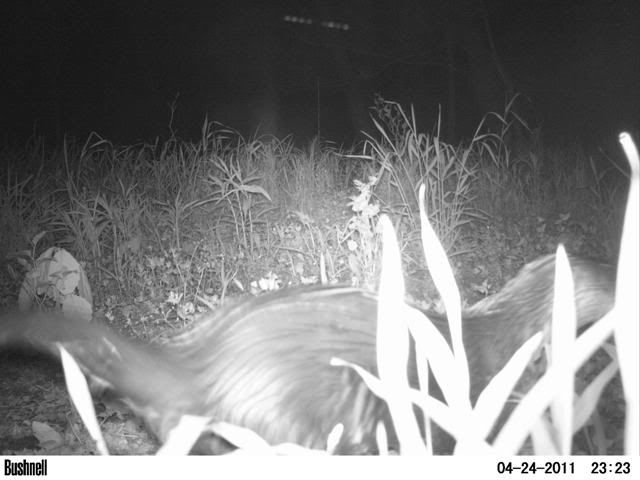
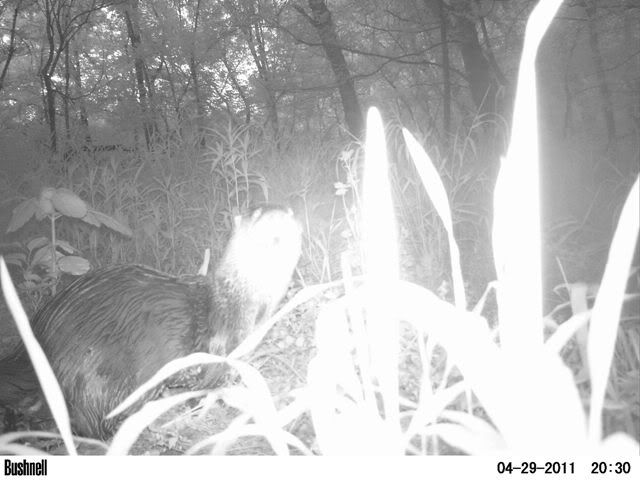
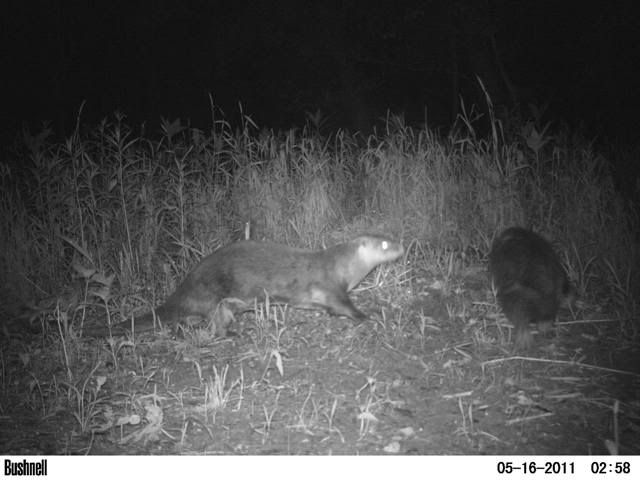
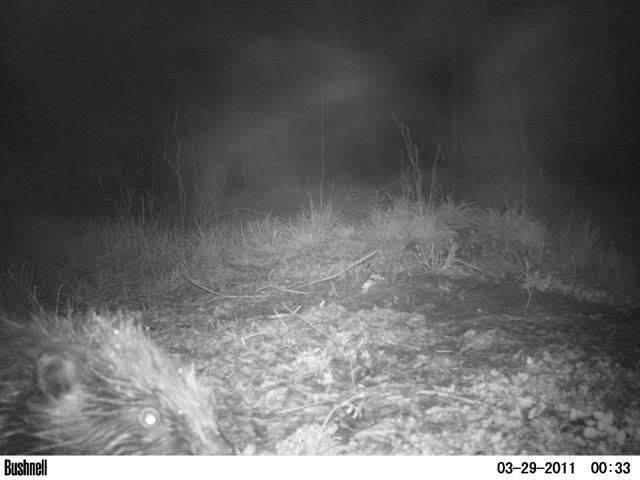
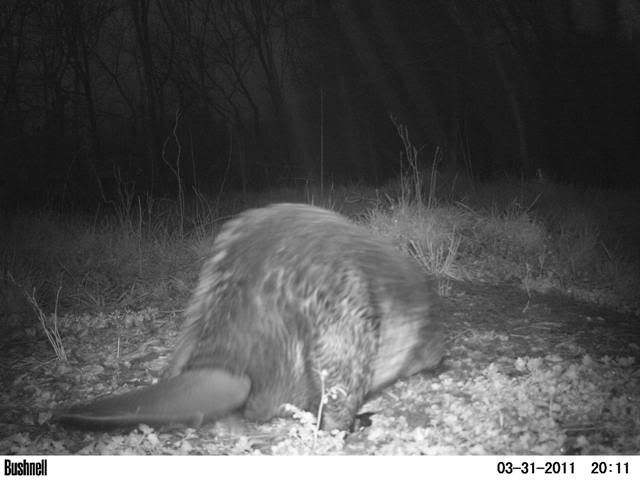
Also, for a few weeks....Beavers abound!  A pair of flat-tails (Castor canadensis) work the area pretty heavily....this is not far from two other locations where I've camera trapped them at roughly the same time (see Busy Little Beasts posted on March 28, 2011).  They haven't been back since.  Because I like Beavers, I can't help but post one picture from every time they passed.


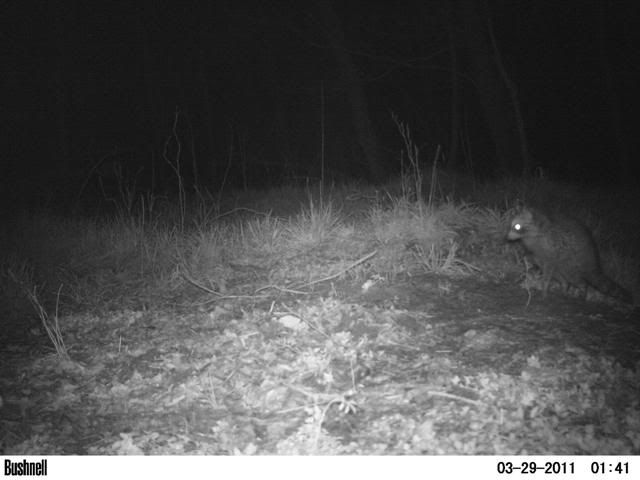
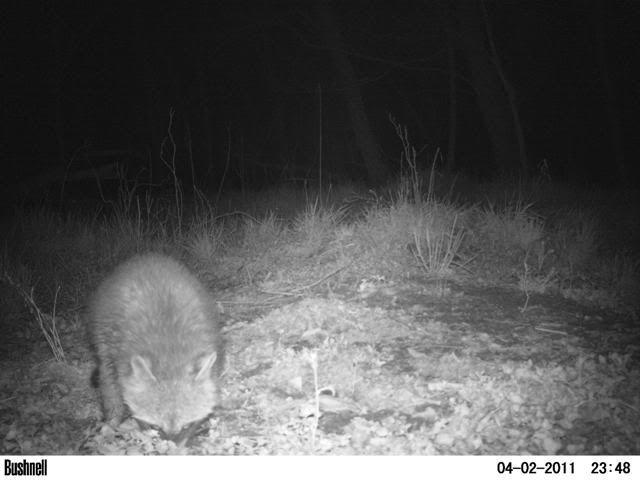
But, really...Raccoon is the word!  I have hundreds of pictures of these guys from this set.

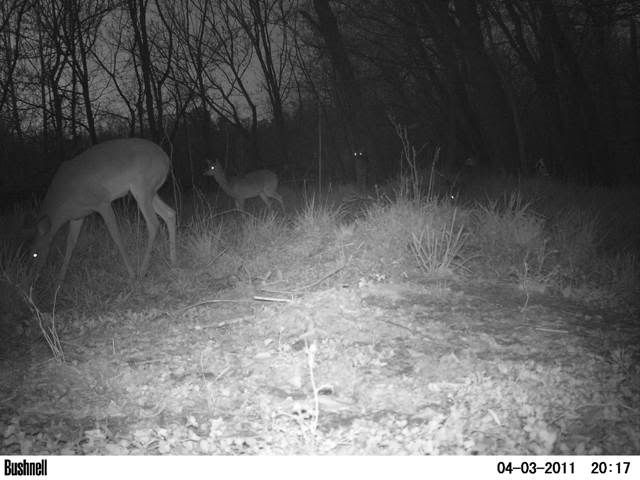
If Raccoon is the word, then deer is the punctuation....ever present and in no short supply.

Even the Whistlepig (Marmota monax) wants in on the action....his camera set is not far away from here either.

Of course, a batch of pictures from this set wouldn't be complete without one of my favorites....Canis latrans.  I really like this picture.

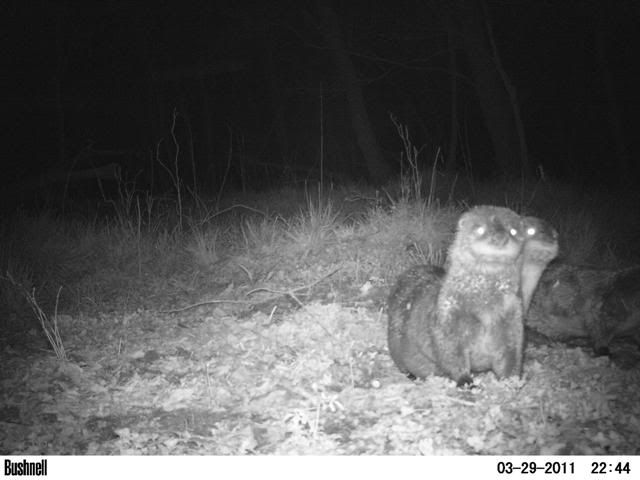
But the critter of the hour is our buddy the Otter (Lontra canadensis).

Below is a great series of three pictures that shows an otter scraping together a mound of debris to deposit scent on....


...a few hours later....someone stops by to inspect the scent mound....

...and the next day something very interesting happens....an otter "scent rolls" in the leavings!  See other posts regarding animals doing a scent-roll in smelly stuff in Gray Fox at the Stink Pole (posted on March 4, 2011).

...then no Otters for a week...until....

Another long period between visits.  This time the family group is back.

...a solo otter laying down alittle scent about a day later....

Another solo Otter swings by.....

...then again....nothing for weeks.  But these critters will not give up on their favorite dumping spot!

It has now been almost a month since any otters have visited this latrine spot.
___________________________________________________________________________
Upon arriving at the latrine site in early May, I noticed a real lack of fresh scat.  This puzzled me, as it would have been the first time this spring that the otters hadn't used this latrine site in between my visits. 

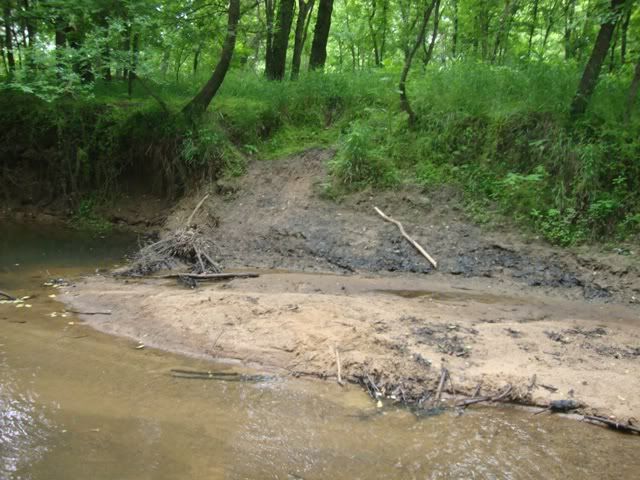
As I was preparing to leave, I happened to glance down the sloping bank towards the stream.  The water was fairly low at that time (and still is today) and an exposed sand bar, as well as several large flat rocks in the streambed, were near the base of the "slide" associated with the latrine I have the camera over.  Even from high up on the bank, where I have the camera, I could clearly see otter scat and tracks on one of the sand bars below.  The otters had abandoned the bank latrine for one in the sand bar/rocks in the streambed.

Above: a photo of the otter slide and sandbar latrine from across the stream.  Note the normal latrine site that the camera is monitoring is up on the bank at roughly the top of the slide in this picture.  This picture and the picture below were taken during the "low-water" period within the last month.


Above: For this picture, I stood parallel to the latrine, pointing the camera down-stream.  That way you can see the relationship the latrine site has to the larger river.  You can also see the exposed flat rock and muddy/sandy bars in the water.

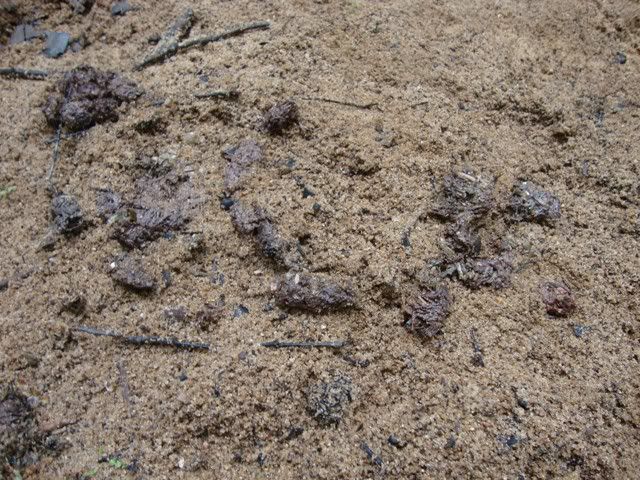
And what post about an otter latrine would be complete without more scat pictures!!
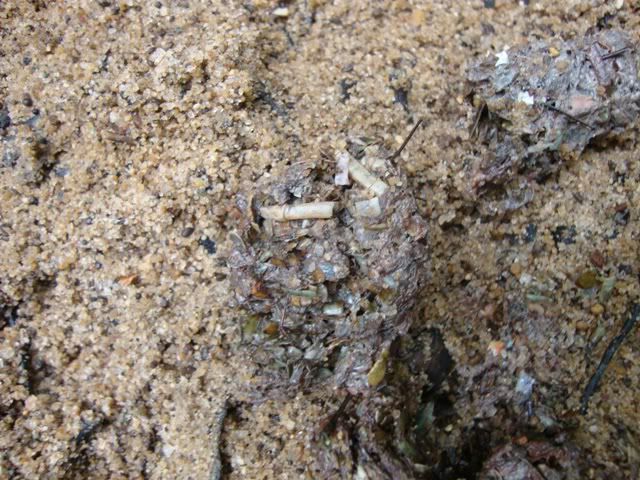
Above three pictures: Example scats deposited on the sandbar below the bank from the normal latrine site (5/12/2011).

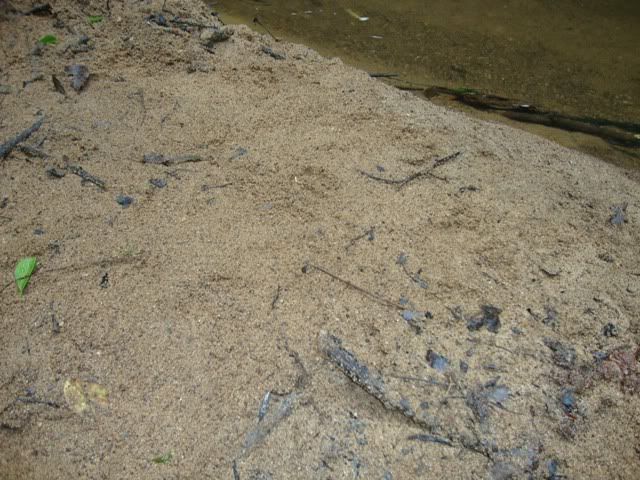
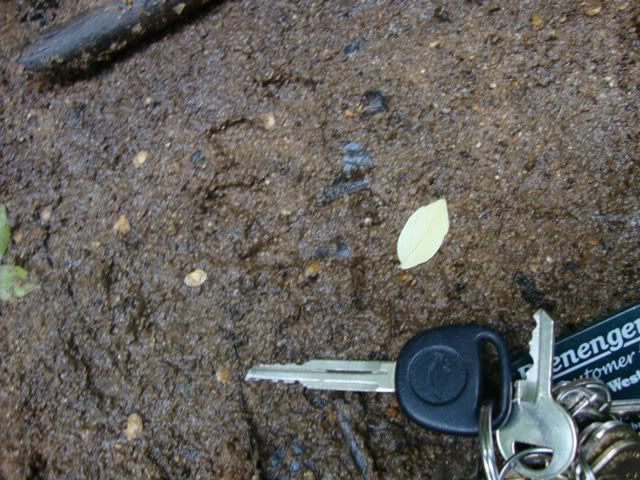
Above: tracks around the sandbar where the "temporary" latrine site had been set up (5/12/2011).
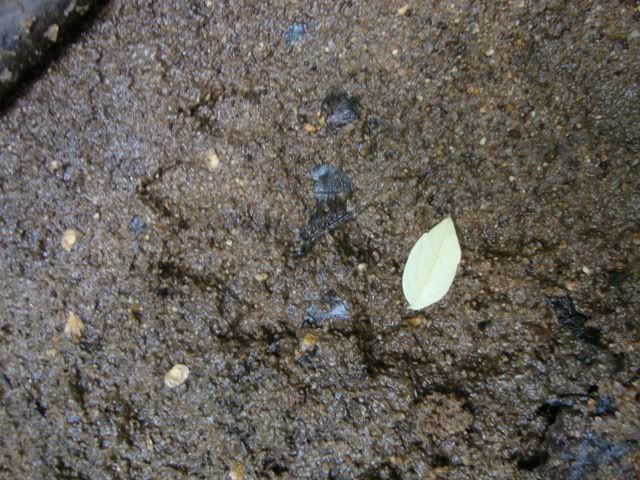
Above Two Pictures: Close ups of the otter tracks (5/12/2011).  Not great pictures.  I had to turn the flash off, as it was washing the tracks out completely in that sand...but any camera shake and the pic ends up blurry without the flash. 

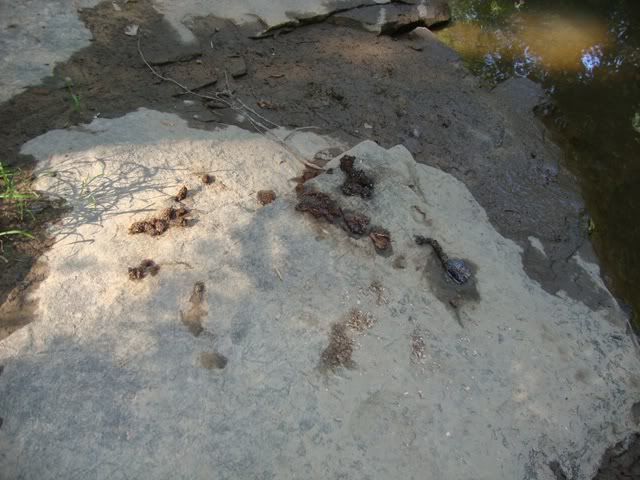
Above Two Pictures: Otter latrine located on flat rocks in the stream just below the camera set on 6/14/2011.  This was very near the latrine location found on 5/12/2011.


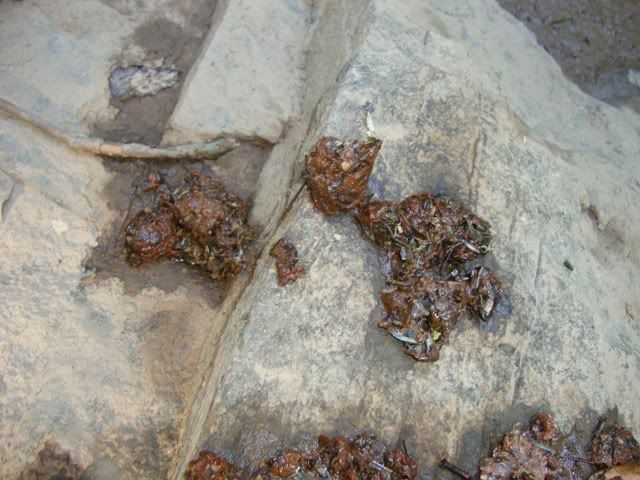
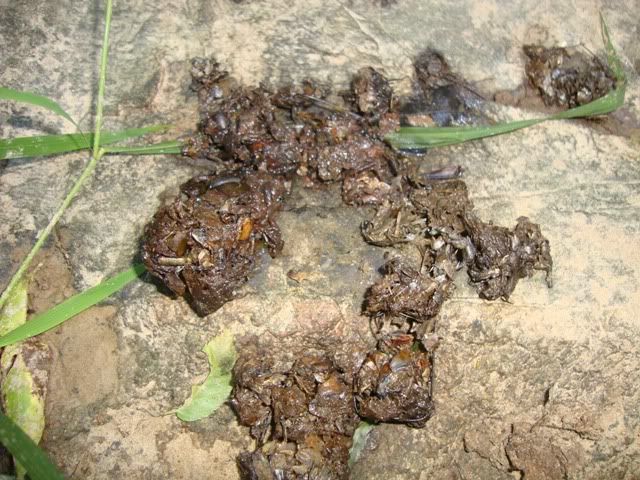
Above Two Pictures: Close-ups of the scat on the latrine found on 6/14/2011.  As usual, full of crayfish.

__________________________________________________________________________

So...what does this minute altitudinal shift in an otter's latrine mean?  All I can think of is that the water's lower....it's more work to climb up the side of the bank than it's worth because the water's so low and so they simply leave their message in the most accessible spot near their normal latrine.

Might be time to move a camera next week!