Showing posts with label prairie. Show all posts

Sunday, July 28, 2013

More Box Turtle Stories? Not Quite!

I had mentioned at the end of my recent Turtle Dog post, that there would be more box turtle stories to share.  Figured it was about time!

Earlier in the summer my students and I had another opportunity to work with our state regulatory agency to conduct some rare reptile surveys.

This time, however, we would not be fortunate enough to have Turtle Dogs along to help.  Instead we had a lot of humans, which we got together in a coordinated fashion to "pound the ground" looking for turtles. 

Thus, we all met at a completely different site than the ones we had worked previously.

After a brief organizational meeting and a run-through of our objectives (find as many turtles as possible), we set to our task.  The habitats we would be working in were very cool...including some beautifully well-managed oak savanna....
 
 
High-quality oak savanna habitat is something of a rarity these days.  The primary reason for the loss of such habitat is its conversion to agriculture and urban/suburban development.  But, there's still more that threatens oak savanna and prairie habitat: uncontrolled vegetative succession. 
 
What is succession, you ask?
 
I'll have to keep this somewhat simple, to avoid making this post too long.  So, I'll briefly define succession as the directional change of a plant community from an early community of species that establish immediately after disturbance to a final community of species that are superior competitors. 
 
The community that establishes immediately after a disturbance (such as a fire, or heavy grazing) is called a Pioneer Community.  Pioneer communities usually consist of colonizing species that have specific characteristics. 
  • They are often small annual species, and ones we might consider "weedy"
  • They can generally handle harsh conditions (high light intensity, high heat, low moisture)
  • Their seeds are often dispersed by wind
  • They are easily out-competed by later successional species.
  • They reach sexual maturity quickly.  In this way they can quickly reproduce and disseminate their seeds to adjacent disturbed habitats before the later successional species (which are theoretically superior competitors) move in and push them out.
Eventually, other species, that perhaps grow taller (e.g., shrubs) enter the area....shade out the pioneers and change the species structure within the community.  An example would be a mowed field that is left untouched for years eventually growing in with shrubby vegetation.
 
In theory, successional change will continue to occur (i.e., the plant communities will progress from pioneer to climax) if no further disturbance happens.  Thus, over time this community will eventually change from a pioneer to a Climax Community.  The climax community is the final community an area can achieve post-disturbance....in other words, these species are the best competitors and will not allow new species to come in, out-compete them and replace them. The plant species in Climax Communities have the following characteristics:
  • They are usually larger as adults and shade-out competitors (e.g., trees)
  • They are often slow to mature
  • They have shade-tolerant seedlings
  • Their seeds are dispersed by gravity or seed-dispersers, such as birds 
Image Source: http://faculty.ycp.edu
 
One last important point: Although successional change is directional (i.e., moving from Pioneer to Climax Community) if a new disturbance happens, the community undergoing succession can be knocked back to its pioneer community (or some earlier successional state).
 
So, how does the concept of succession relate to the previously mentioned oak savanna?  Well, although too much disturbance is obviously a bad thing, not enough natural disturbance can be bad as well.  Habitats like prairies and savannas typically have a vegetation community that is in an earlier successional state when compared to woodland.  Thus, these habitats are dependent upon natural disturbance to persist.  Usually this disturbance comes in the form of natural fire or moderate levels of grazing/browsing by herbivores.  What this means is that even if a prairie or savanna parcel is protected from development, it must be properly managed or succession will occur until the parcel is no longer comprised of savanna.  So, legally protecting land is only half of the battle.  It is necessary to have the means and resources to effectively manage the prairie and savanna to keep it in an earlier successional state.  The typical management practices used on savanna and prairie include mowing, hand removal of vegetation (chainsaws, etc.), herbicide applications, and purposely starting (controlled) fires.
 
WHEW!  Sorry about the wordiness of this post!
 
Anyhoo...back to the story.....
 
The site we were surveying in had received appropriate management to maintain savannas.  For example, you can see the limited understory vegetation, yet mature trees, in the picture below.  This occurs because a controlled fire was used to kill back much of the small vegetation.  The large trees, however, are resilient to low-intensity fire and so they persist.  Management of this habitat is designed to keep the community in an earlier successional state in a way that specifically promotes oak savanna.


Interestingly.......this post about "Box Turtle Stories" doesn't have much ado about Box Turtles!

Not for lack of trying, however.

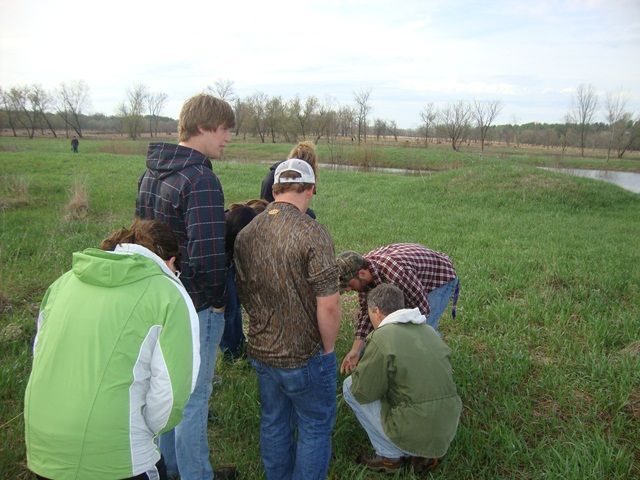
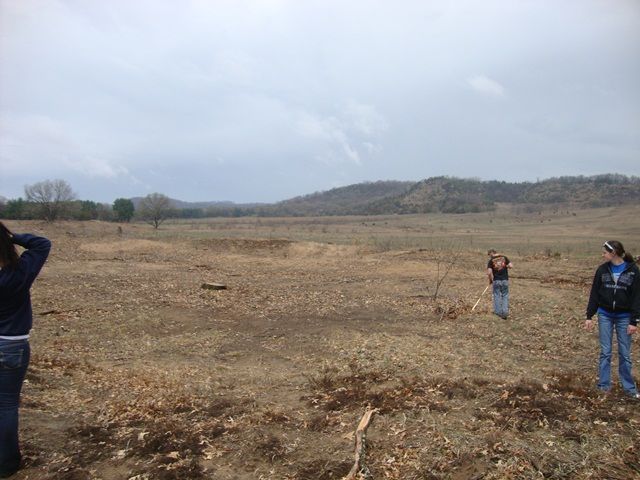
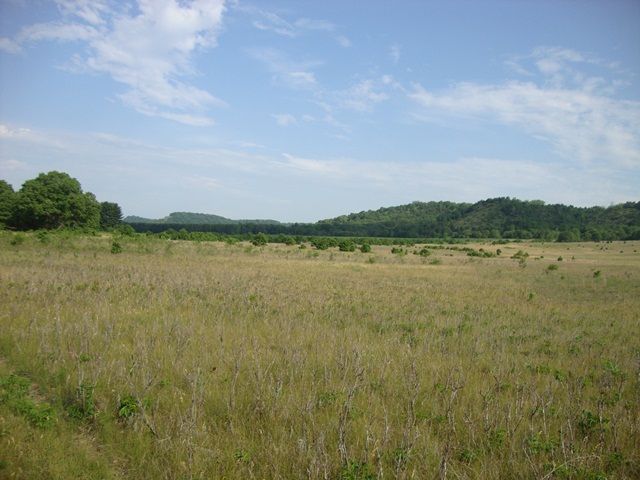
There were at least 18 individuals surveying at one point during the day.  We went over and back over locations on-site that exhibited evidence of box turtles.  The oak savanna habitats were surveyed intensively, as were the more open grassland/prairie type habitats (note the prairie below is starting to grow in with more woody vegetation, i.e., succession is occurring!).

Some of the strongest evidence to suggest box turtles are around is the presence of fresh "forms" in the ground.  These are shallow burrows that the turtles dig in the ground for short-term respite from unfavorable conditions, or to sleep in at night. These forms usually don't go back very far, and they are shaped sort of like the profile of a box turtle shell.  We found plenty of fresh forms on-site during our surveys (see below), so we knew box turtles were active in the area.

One would think that 18 competent surveyors vs. a slow-moving innocuous reptile would be a contest stacked heavily in favor of the humans.

You'd be wrong!

Despite the fact that we knew there were box turtles in the area, and found fresh evidence of them when we arrived, not a single box turtle did we see!!

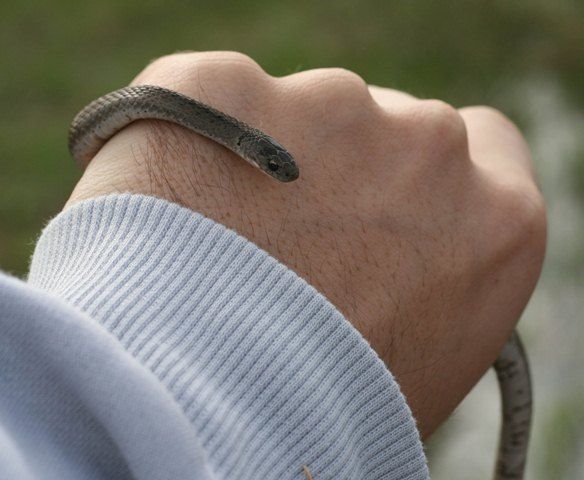
We DID find other reptiles (one of which was possibly even better than finding a box turtle.....more to come).  For example, we found several beautiful Smooth Greensnakes (Opheodrys vernalis).

This species is mostly insectivorous (eats insects) and prefers the shrubby edges adjacent to grassland/prairie, as in the picture below.

Let me tell you, there are few species that are harder to find than a green-colored snake that hangs out in the grass!


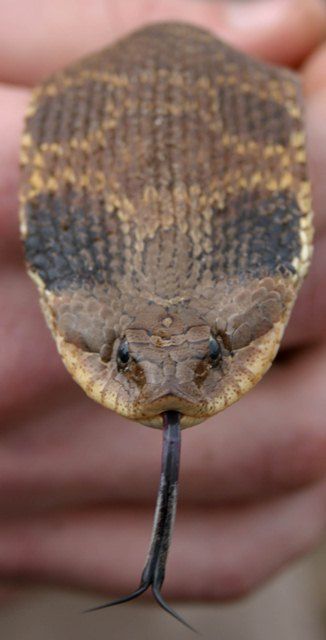
We also found a nice little juvenile Eastern Hognose Snake (Heterodon platirhinos).  Note the upturned scale on the tip of the rostrum (or "nose").  This gives them the appearance of having a "nose" similar to a hog....or that's how it appeared to the person that named them!
 

But those weren't even the best finds that day!

Looks like a snake, doesn't it?

It's not a snake, although it is a reptile....and it is in a closely related group: the lizards.  Snakes and lizards are both in the taxonomic Order Squamata, while snakes are in the Sub-Order Serpentes.....the lizards are in the Sub-Order Lacertilia.

What we have here is a leg-less lizard....the Western Slender Glass Lizard (Ophisaurus attenuatus attenuatus).  An incredibly rare find in our neck o' the woods!

So, how can we tell this is a lizard?  Superficially, it looks just like a snake.  Yet, there are certain clues that belie this critter's ancestry....

First, all lizards have a hole on each side of the head, which is essentially an ear opening.  Snakes have no external ear-opening.

See the hole circled in red below?  You have to look carefully!

Lizards also have movable eyelids, something that snakes don't possess.  In other words: lizards can blink.  Obviously, I can't show you moving eyelids in still photos, so you'll have to trust me that these lizards can blink!

There are other differences too, but this is good enough for the current blog post.

These interesting little critters are not only hard to find, they are hard to catch.  At certain times of year (such as late spring) they have a tendency to sit concealed in the thatch of short grasses.  This provides them with cover and allows them to still soak up the sun.  It also makes them incredibly difficult to find.  Usually one only sees these lizards if they are almost stepped on, which prompts them to make a quick break for it.  The motion gives them away and they can be located.

In addition to their cryptic nature, there are two other difficulties a glass lizard surveyor must deal with: (1) they are incredibly fast, (2) they have the ability to perform caudal autotomy (i.e., break off their own tails when captured).  Why?  The tail, after separated from the body, continues to thrash and twitch....presumably to distract the predator and allow the lizard to escape.  The ability to break off pieces of their body is also apparently the origin of the name "glass" lizard.

We don't want them to loose their tails if they don't have to.  The tail takes a while to regenerate.  Better if they use that strategy when it really counts (i.e., avoiding a real predator).  Yet, if one is incredibly gentle when capturing and handling the lizard, they are much less-likely to drop their tails.

So, capturing glass lizards requires a quick, but careful, response.

We actually found a fair number of glass lizards, which was even better!

I tried to explain to my students that I had seen less than five of these lizards in my entire life up to that point.  On that day, we found 10!!!

On at least one occasion, there were two right next to each other......

...and so ended our second effort at finding box turtles.  Although not a box turtle was found, we still got some great wildlife captures!

There's still one more small box turtle story to tell, but I'll save that for a later date.

Saturday, May 25, 2013

Winter is for mammals....but summer is for HERPS!!!!

So much going on....

I guess I should start at the beginning of the real herp field season this year....and it began with a field trip that I took my advanced ecology class on.  This is the same trip we took last year, although back then we didn't have much luck finding the cold-blooded crawly critters.

The conditions were alot better this year, so we pulled out of the parking lot with feelings of hopefullness a few weeks ago.

After nearly 2 hours in the car, we reached the first of our destinations: a sand prairie/savanna located immediately adjacent to a large river.  The part of the property where we were given access to is primarily used by a retriever club.  As a result, there was alot of more typical "grasses" that one might fing in a homeowner lawn.  As we moved further away from where the club operates, we ran into the results of recent habitat management.  These activities involved removal of some un-desirable/exotics: common buckthorn (Rhamnus cathartica) and Honeysuckle (Locinera sp.).  While it's good to get rid of these troublesome species of vegetation, it didn't provide great "herping" habitat.....

Yet, there were several pot-hole wetlands on site and lots of downed debris that the critters we wanted could be hiding in.  The morning was still a tad cool, but the sun was quickly warming things.  I felt confident we'd find something....

It wasn't long before....success!  One of my students called out that they found a snake...

A small species, the Northern Brown (or Dekay's) Snake (Storeria dekayi).

Photo by K. Kron
Brownsnakes are highly fossorial (living below ground or ground debris) and rarely seen for that reason.  They are relatively common, however....but still a great find!

We also found several other species at this site: a Common Gartersnake (Thamnophis sirtalis), a Northern Leopard Frog (Lithobates pipiens), various birds, and some interesting plants (although this site was a tad disturbed for any really cool plants).

We ended our time there with only a handful of captures.   BUT...it was still early and there were several more sites to check.
_______________________________________________________________

Next we headed towards a floodplain forest habitat along a major river in the state.  The primary objective here was salamanders and frogs, which require a bit of log-rolling (and "log-returning" after checking underneath).
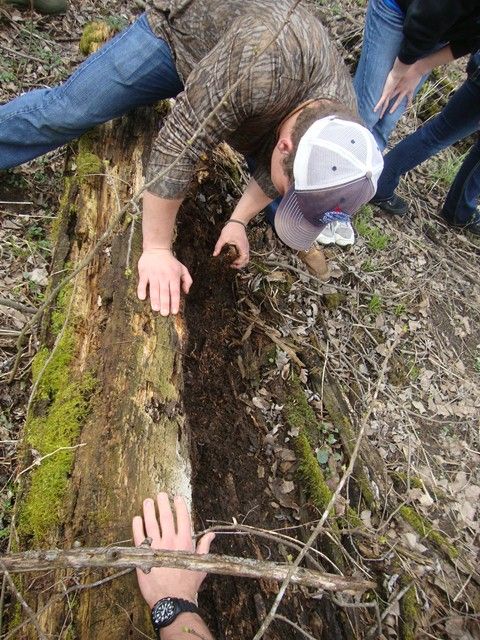
So it was that we hopped out of the vehicles and plunged into the deer tick infested forest in search of sallies....

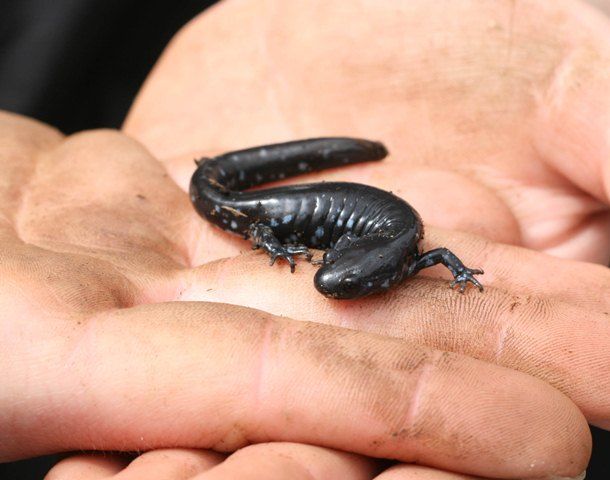
With 19 plus sets of boots on the ground, our chances of finding something were high.  It wasn't long before calls started going up that critters had been found.  The most commonly encountered was the cute little Blue-Spotted Salamander (Ambystoma laterale).
Photo by K. Kron
Another commonly captured critter was the terrestrial phase of the Eastern Newt (Notophthalmus viridescens).  The one pictured below is employing an interesting anti-predation behavior.  I believe the goal is to make themselves too awkard for certain predators to swallow whole.

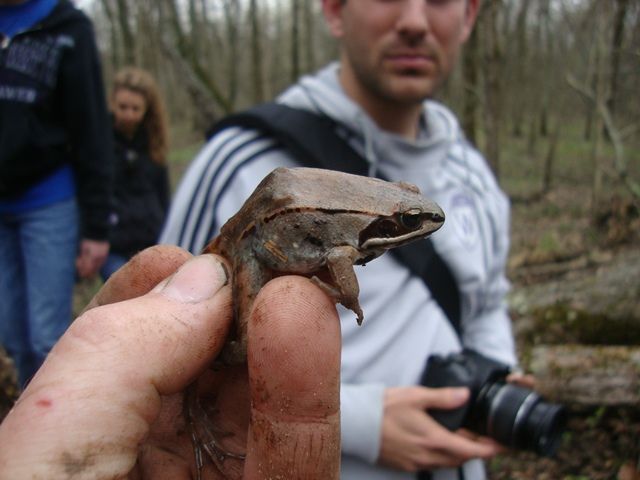
A variety of frogs were also hopping around in the forest.  This included the Wood Frog (Lithobates sylvatica), easily identifiable by it's coppery color and black mask.....

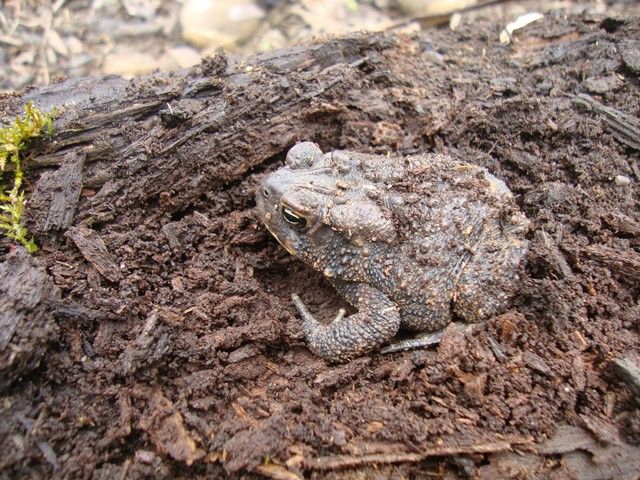
We also found Spring Peepers (Pseudacris crucifer) and a few American Toads (Anaxyrus americanus)....

So....the flood plain forest was mostly successful.  Thus, we moved on, hoping to grab some lunch and get to the next site: a sand prairie.
__________________________________________________________________
Then....the equivalent of a herpetological distaster occurred!  On an already almost too cold day, clouds rolled in.  Next came the water-works, and the rain began to pour!  As we drove to the new location we were bombarded with a deluge.  Thus, we ate lunch and I watched through the windows glumly as the rain came down. 

We hadn't seen many snakes so far.  If the rain kept up this way, we were sunk.

But...then...as we were finishing our meals and throwing away our trash...things changed.  The sun suddenly poked through, the clouds started to break....and I got excited as the air temperature began to climb.

So it was that our boots hit the ground at the next location....
 
Although it was still a bit cloudy, the sun was peeking through occassionally and it became noticeably warmer.  Due to this positive change in the weather, it didn't take long for us to start catching things.

Within 20 minutes of arriving...one of the students yelled out: 

"Doc, there's a snake over here!" 

"Well, grab it!" I replied.

"There's actually two snakes!"

"Well, grab THEM!" 

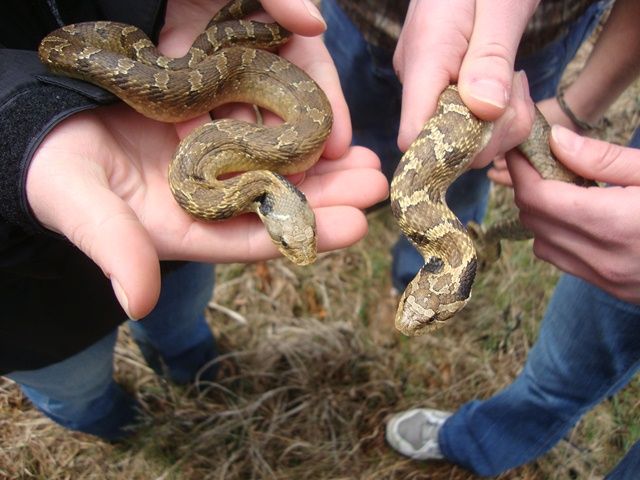
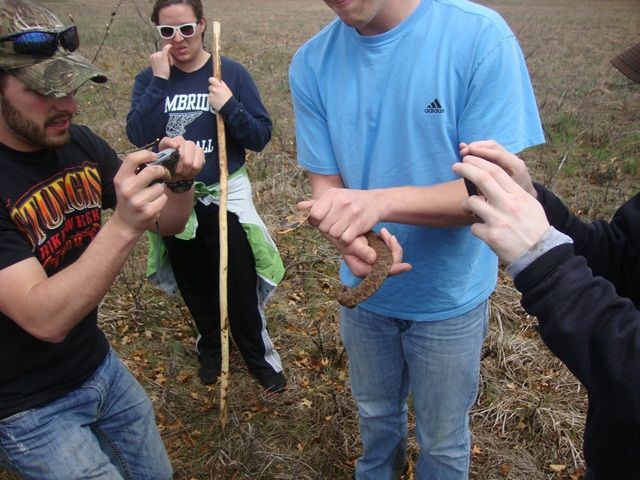
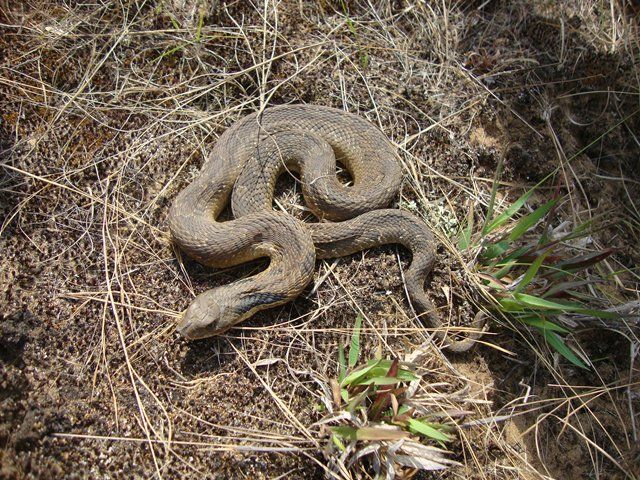
I don't know if they heard me or not over the commotion, but when I got there, we had two nice Eastern Hognose Snakes (Heterodon platyrhinos) to admire!
 
One was a very pretty orange-brown......
Photo by K. Kron
Photo by K. Kron
In total, we found four (or maybe even five?) Hognose Snakes in a matter of an hour.  Presumably, they were congregated in such a tight area for breeding....although we didn't actually see them doing so.

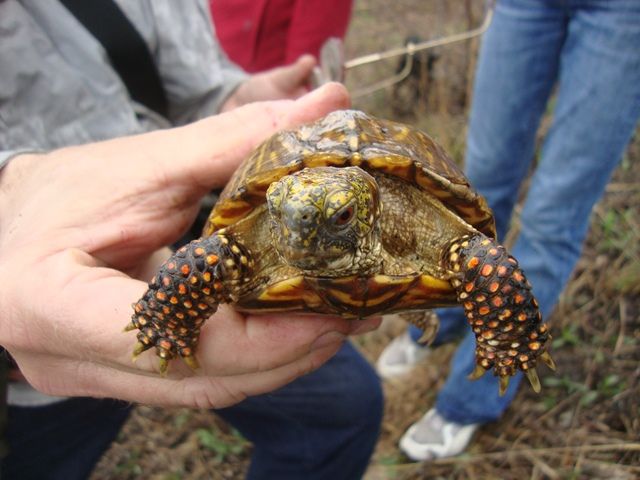
Next we moved to the north a bit, searching for some of the other critters that I knew were on-site. It was not long before we found one: the incredibly rare Ornate Box Turtle (Terrapene ornata).  The Ornate is the only fully-terrestrial turtle in the upper Midwest.  It generally requires deep, sandy soils to burrow below the frost-line in the winter.  Because such habitats have mostly been converted to agriculture or housing developments around here, this species has been nearly extirpated from the region.  In addition to habitat loss, herp-enthusiasts who collect them to keep as pets have severely impacted their populations.  Luckily, our fine state protects this species, and large fines can be incured for removing them from the wild.

Given how rare they are, it was encouraging to find a juvenile individual.....

Also...a very nice looking adult male.  Males have bright-red eyes and reddish orange on their front-legs.
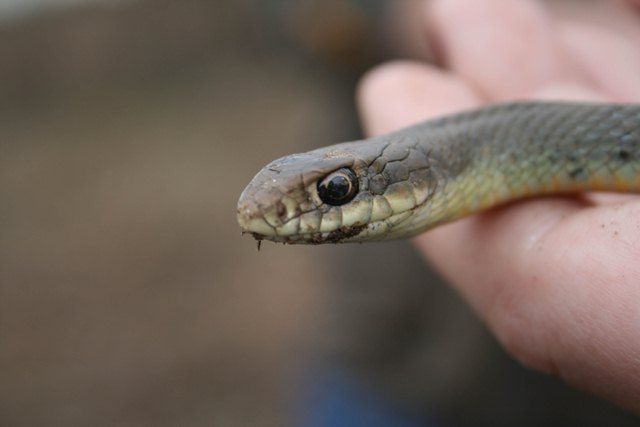
As we moved along, we found another rare species: the Racer (Coluber constrictor).

Photo by K. Kron
.....but we weren't done there!

A rare snake and a rare turtle....not to mention a few Hognose Snakes.  I was feeling pretty good about our trip, but not completely satisfied.  There were two other species that I knew were present, but we hadn't seen yet.  If we found only one of these, I decided that I would consider the day a success.

Luckily, the Herp-Gods smiled on us, and it was not long before we found one of the two sought-after species. 

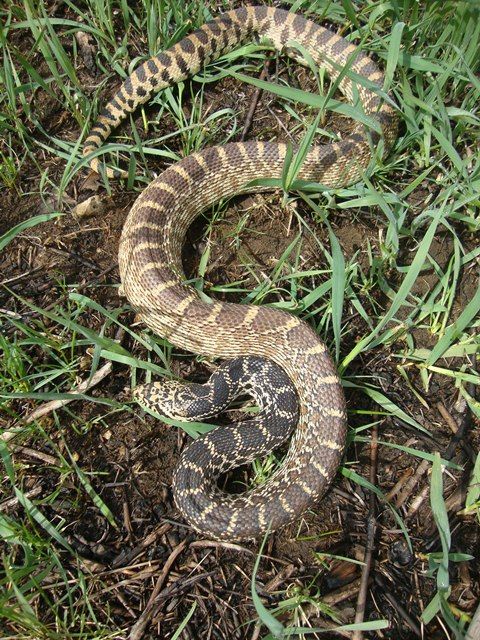
Someone found a Bullsnake (Pituophis catenifer sayi)....my favorite snake in North America....

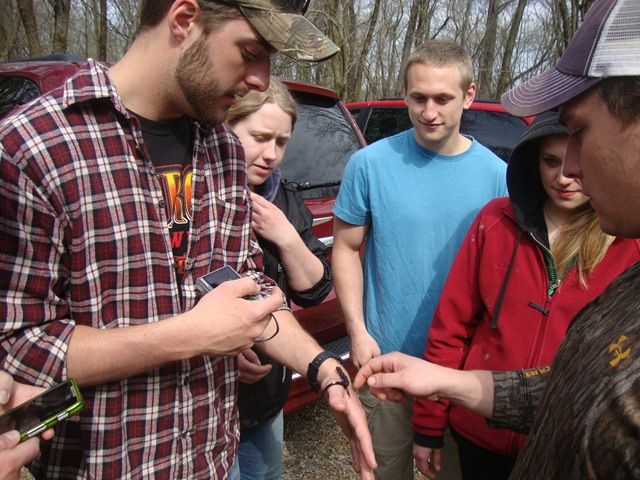
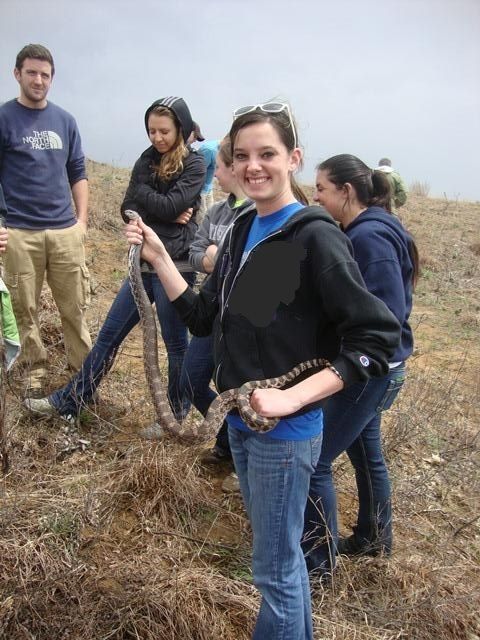
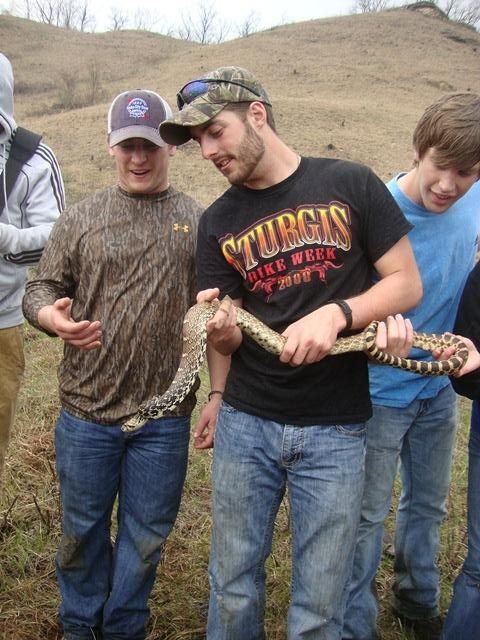
This one was polite enough for several of the students to get a chance at holding it.  Many of them were shocked that a snake species of this size lives in our region.  Unfortunately, this is another species that has been significantly (and negatively) impacted by the activities of humans.  The reasons run the gamut:  habitat loss is a key factor again....direct killing/persecution by folks afraid of snakes is another (to have such an unreasonable fear of something that you would kill it outright has never made much sense to me).  And...as with the poor Ornate Box Turtle....the Bullsnake has suffered greatly at the hands of collectors.  Unscrupulous "herp-enthusiasts" just can't resist bringing these back to keep in an aquarium....a damn shame, if you ask me.

It was not long after that when I heard more yelling "Doc! There's another big snake over here!".  Again, I yelled "grab it!", while running up towards the student waving his hands in the air. 

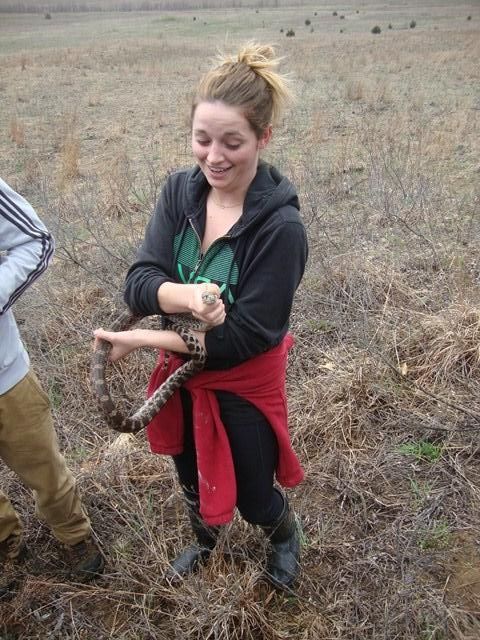
Another Bullsnake!

In total, we found five Bullsnakes! 

Even the students that were alittle uncomfortable with snakes, at least sucked it up and held one (even without any chiding from me! :)  ).

With every capture and encounter, they became more confident and several even grabbed the snakes without help.

All-in-all, I'd say it was a very successfull trip!  Probably one of the most important achievements of this trip is that those who are afraid of snakes (hopefully) see them in a more positive light.  Snakes really aren't scary....heck, they aren't even aggressive, if you leave them be.  Every snake we encountered on this trip first made a mad-dash for escape...it was only after we started to "mess" with them that any took a defensive posture.   Some never even did that. 

It also exposes younger folks to rare herps, and helps them understand the importance of conserving all components of an ecosystem....not just the furry/feathery charismatic ones....

I look forward to bringing a new crop of students on the trip again next year!

Tuesday, July 17, 2012

Herpin' The Upper Midwest, Day 2: The Prairie

Continuing with my series of posts regarding Dave's visit in May, it's time to tell you all about the second trip we embarked upon.

The Prairie

The prairies of the upper Midwest are near and dear to my heart.  I spent a fair amount of time in this type of habitat during graduate school and I remember my time with fondness.  Thus, no herping trip to our area would be complete without checking out the praries.  A group of students taking a herpetology course with a colleague of mine at a nearby university also joined us on this trip.  The more eyes the better, for catching critters....


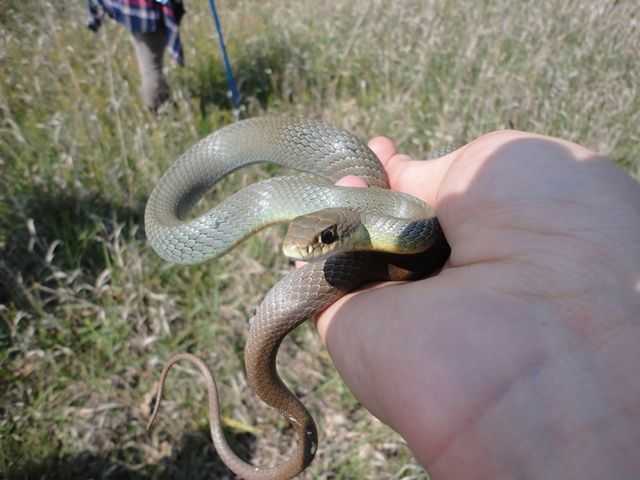
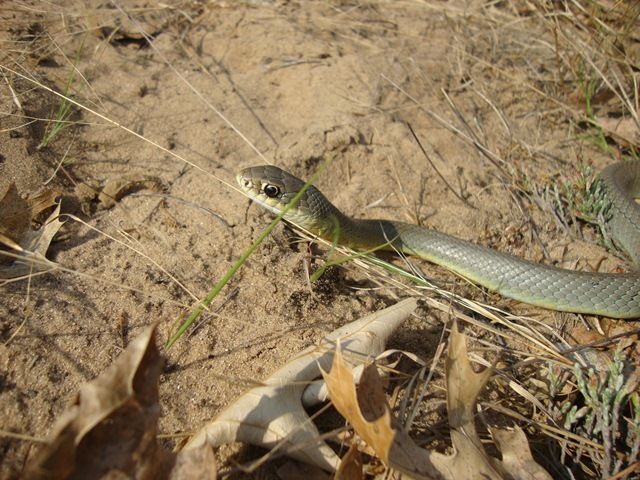
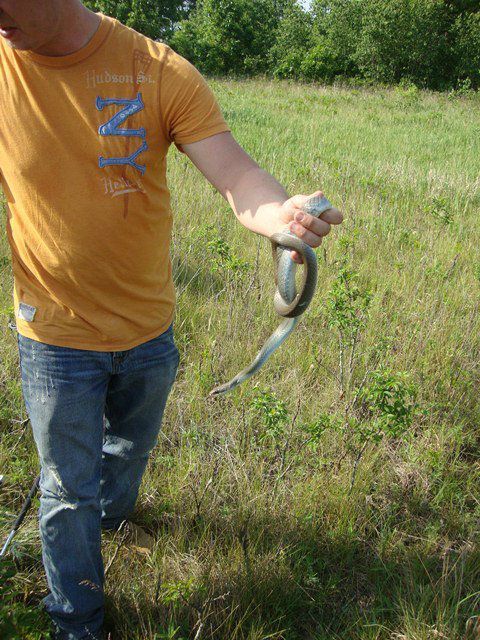
Our first encounter was a rare species in our neck of the woods, but one that is relatively common at this site: the Racer (Coluber constrictor).

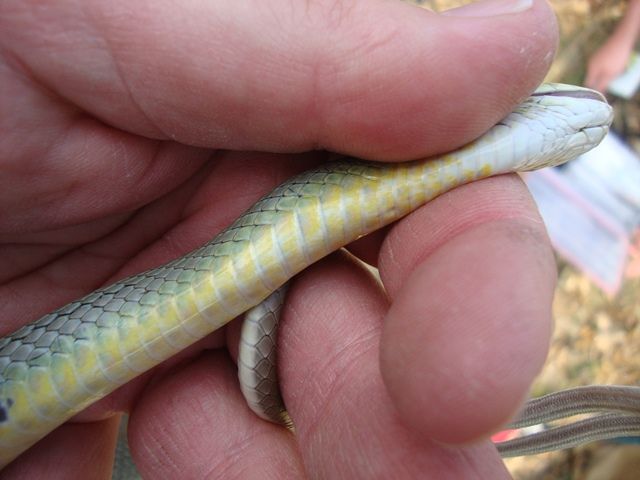
The distribution of this species is broad, ranging from the midwest to the eastern U.S.  Across this geographic area, Coluber constrictor is divided into sub-species that are delineated by location.  For example, back in NC we frequently dealt with the Southern Black Racer (Coluber constrictor priapus), which appears much different than the critter in the upper Midwest (see pics in this post).  Here we get the Eastern Yellow-Bellied Racer (Coluber constrictor flaviventris).

The common name (yellow-bellied) is apt.....

This is a quick-moving, sleek snake that is always a treat to find (and even more fun to try and catch!).

Although they don't get as large, overall, as the Black Racer, these Yellow-Bellied Racers can still get to a respectable size.....
_______________________________________________________________
Another species that we hoped to encounter was the Ornate Box Turtle (Terrapene ornata).  This incredibly rare species is hard to come by.  Collectors decimated their populations in this region during the 70s, 80s and early 90s....which is an absolute shame.  I've made this comment before in other posts, but it staggers me that someone would take a critter like this from the wild (where it rightfully belongs, not only for its own well-being but also so that it is available for others to appreciate) and hide it away in a glass terrarium.

Unfortunately, a combination of collecting, habitat loss and incredibly slow development and low reproductive output have put this species behind the 8-ball.

As such, I didn't know if we'd see one.

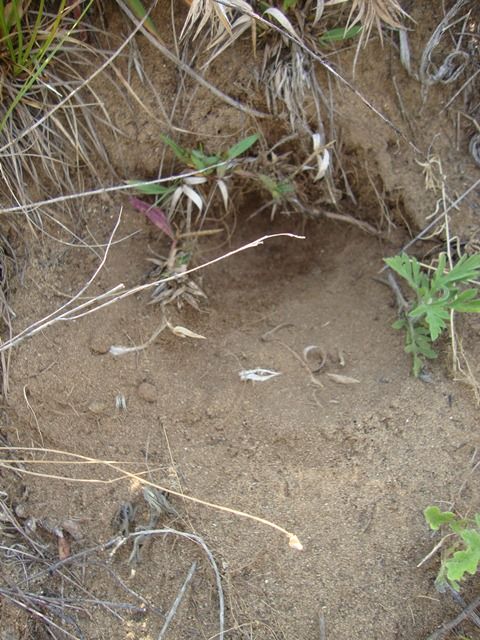
At first we saw only the evidence that box turtles were moving about, including some "divets" or "forms" dug into the soil by box turtles attempting to escape the heat, or hunker down for the night.

However, not far from the "forms".....success!!  A nice adult female resting among the Prickly Pear Cactus.


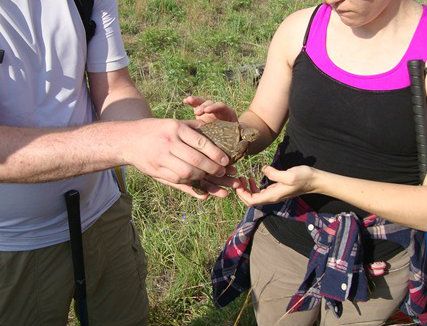
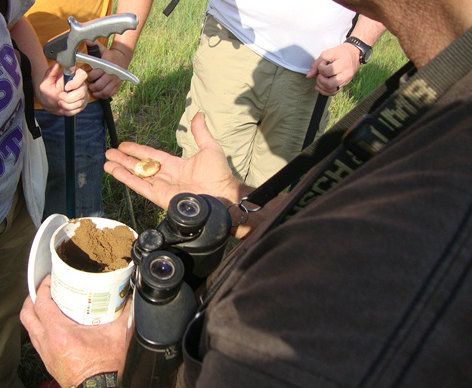
We were also fortunate enough to encounter some of the local box turtle stewards for this site, who were collecting box turtle eggs for a long-term head-starting program.  The goal of this program is to find the nests of wild box turtles....bring their eggs into captivity and incubate them.  This eliminates the potential for mortality due to mesocarnivores, such as Raccoons, Skunks and Oppossums which find turtle eggs to be quite a delicacy.  Once the turtles hatch, they are released on-site at the locaion where their nest was first encountered.

So, we were fortunate enough to get a glimpse of some recently excavated turtle eggs!

______________________________________________________________________
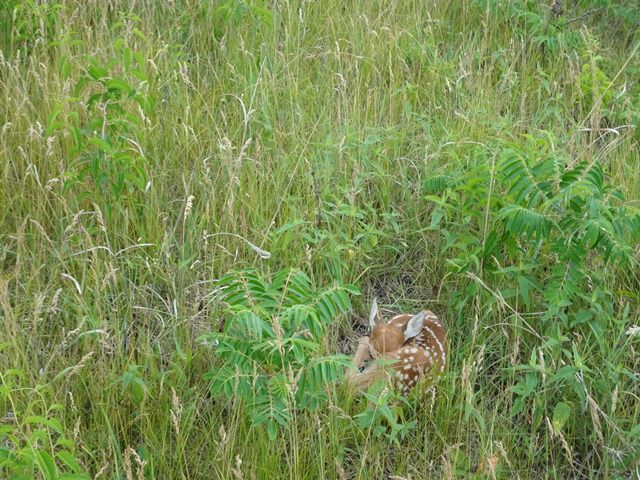
The warm-blooded critters were giving us a show as well.  We happened across this young White-tailed Deer (Odocoileus virginianus) fawn.  The group was within a few meters before noticing it.  Even in this short grass, the tactic of freezing in place is very effective to avoid detection from we visually-oriented primates.

Sometimes they refuse to actually give in and make a break for it........
Photo by D. M.

Prairie plants are another a great reason to get out in May and do some hiking.  Many of my favorite late spring species were in bloom, such as the Spiderwort (Tradescantia sp.).

We also checked out a nearby rock formation for one of my favorite herp species in this region....the Bullsnake (Pituophis catenifer sayi). 

While poking around, Dave managed to scare up a nesting pair of birds (his cat-like reflexes saved him from a scalping)....

Unfortunately, of the Bullsnakes, all we saw was this cast-off skin....

_____________________________________________________________________
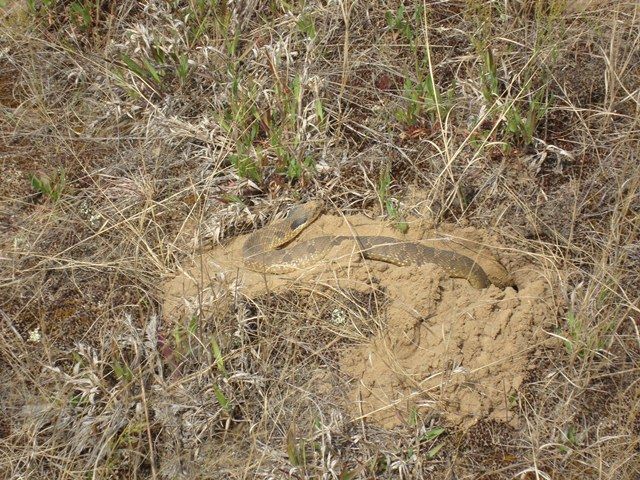
But, Bullsnakes and Racers are not the only snakes present on-site!  We came across this busy little gal as we walked over the sandy terrain: an Eastern Hognose Snake (Heterodon platyrhinos).  She was carefully excavating a burrow to deposit her eggs.

We disturbed her, which wasn't very nice, I suppose...but she forgave us and held still for a photo.

And also allowed us to palp her a bit, to determine if she had deposited her eggs already.  Based on her lack of plumpness and the folds of skin along her sides, I guessed she had.
Photo by D. M.

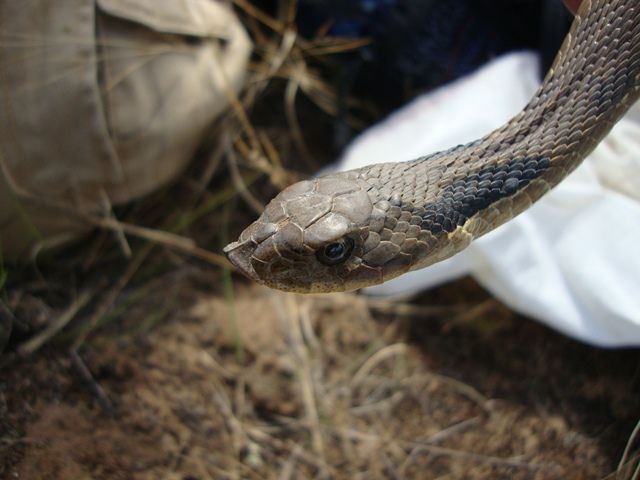
It's easy to see why they are called Hognose snakes, after you take a close look at them.  That upturned nose (or rostral) scale is unique to this genus in the Midwest.  They use that nose to aid in burrowing through sand or loam.  They are very interesting snakes (both behaviorally and morphologically), which I might get a chance to tell you about in the future, should I see any more......
______________________________________________________________________

After our successfull day at the first site, we decided to head out to a second site with a specific goal: to find a very rare species in our neck of the woods.

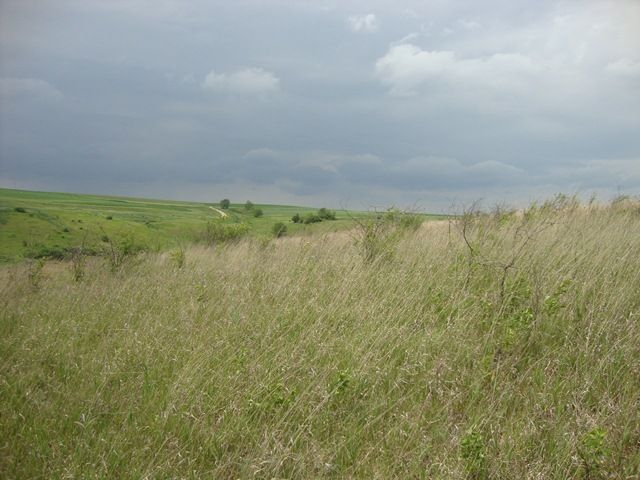
The landscape and sky combined in a very picturesque fashion, as we made are way to this particular location.

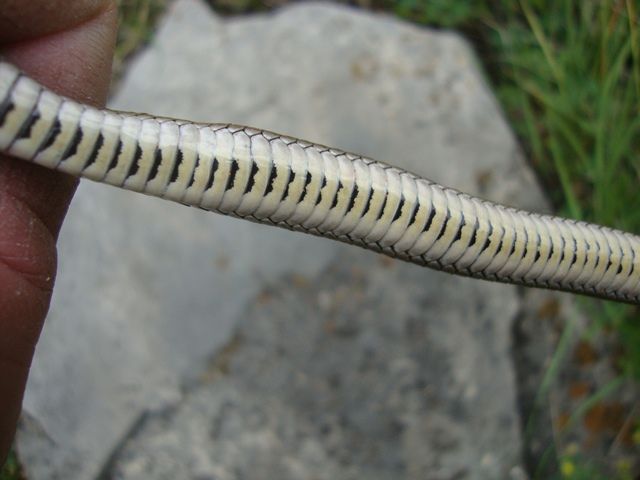
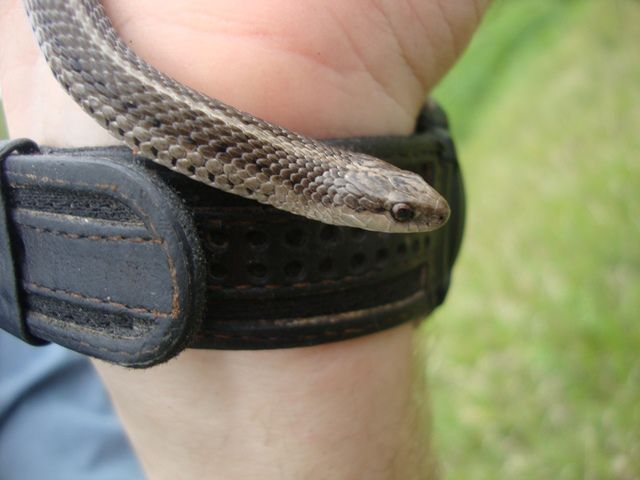
After roughly 30 minutes of searching, we came across the critter we were looking for: the Lined Snake (Tropidoclonion lineatus).  It's a rather small, somewhat drab and non-descript snake, to be honest.  It superficially appears somewhat like a gartersnake.  However, lined snakes are more gray with cream-colored stripes, whereas gartersnakes are black with yellow stripes.

Lined snakes also have markings on each belly scale, that appear similar to two half-circles side-by-side.  Gartersnakes belly scales are mostly without patterns.....

All-in-all it's a very poorly-understood snake.  Small, non-descript, and fossorial (or living below ground most of it's life), it is rarely in the limelight and, thus, rarely attracts the attention of graduate students looking to complete master's theses and doctoral dissertations!

Thus ended our second of three trips during Dave's visit.  Much like the Bog, our trip to the prairie was also a success!

One more trip to share with you all, and it's a doozy!