The benign adventures and ponderings of a wildlife ecologist who is interested in old school, down-and-dirty field research. Not cutting edge, but occassionally forced to blaze a trail when in the outdoors.
Bobcats (Lynx rufus) are a somewhat tricky lot to camera trap around here.
They aren't really found in the southern part of our fine state, which is where I spend most of my time. Further north the ol' Bob-tailed Cat becomes more common, but still doesn't exist in very high densities (at least compared to other frequently cam-trapped critters).
Much like many Felines, they are also very secretive and sneaky. Slinking quietly through an area, leaving little evidence of their passing, unless one is lucky enough to find some tracks.
But we finally caught up with this Sneaky Bob!
Earlier in the Spring, the students on the wolf project had a few quick glimpses.
You have to watch this first video clip in its entirety....he/she doesn't show up until the very end....off to the far right.
In this second video clip, which is several minutes after the one above, we basically get a second. The 'cat is now on the far left and appears to be spraying a stump before moseying on.
In late July, however, we got a better clip of Sneaky Bob.
I haven't put alot of thought into it, but I do wonder why this species doesn't take to the more populated areas in the southern part of our state? Especially considering that out west they have acclimated to urban edges in parts of California (e.g., Santa Monica), Colorado, Arizona, and Texas.
I suspect these urban 'cats have access to some pretty rugged habitat immediately adjacent to the edge of Santa Monica (for example), which makes crossing over into the urban sphere pretty easy. At the same time, we have lots of rural and sparsely populated areas 'round here. Lots of "green space" and public natural areas....seems like there would be plenty access to the more southern parts of the state.
Perhaps it has to do with the fact that some of the states listed above have more arid environments. Thus, the 'cats are drawn into the well-watered greenspaces/lawns (and associated rodents) in urban areas. We aren't as dry here, but neither is Dallas/Fort Worth, and Bobcats apparently end up there.
I often put a camera out in the backyard when we lived there. This began as an intermittent, when I remembered it, sort of thing.
After a while it became interesting to the point where every night, with few exceptions, I'd set a camera out and pull it in the morning.
Why did it become interesting, you ask?
Thanks to the little critter with the big scientific name: Urocyon cinereoargenteus.
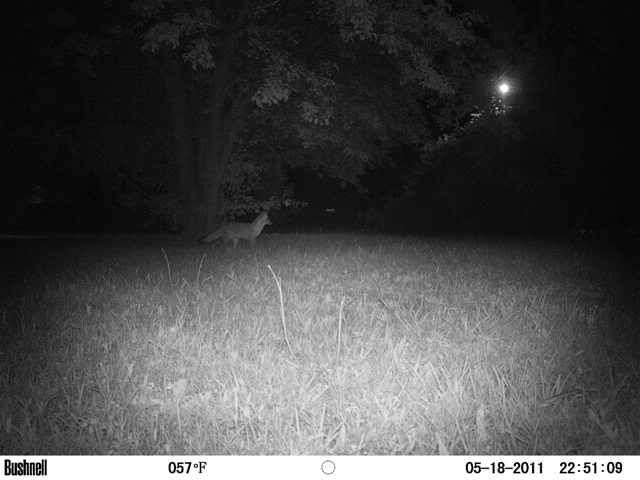
But....let me back up a bit. As I mention in the Gray Ghost post referenced above, I first started seeing Gray Fox first-hand in our neighborhood back in Spring of 2010. Their sightings became frequent enough that I was prompted to actually put a camera back there some time in early 2011 and started getting serious about recording my camera trapping records and visual sightings.
My first pictures of Gray Fox in the back yard occurred in January of 2011 (see the Gray Ghost post referenced above). Around this time, our family also saw a Gray Fox trotting along the back lot line at dusk as we played outside. This led to a brief string of photographs, which ultimately dried up some time in February. This short dry spell snapped a few weeks later, and March yielded two pictures: one on March 9...the other on March 21 (see above picture).
Then the observations ground to a halt until about mid-May.
On 5/11/2011, I took the dog out with me while programming the camera for the evening's deployment. We walked slowly, and my attention was focused on the little plastic box in my hand. Suddenly there was a tug on the leash, and I turned around to see the dog squatting in the middle of the yard.
Dang it, Sampson!, I said....knowing I'd have to go inside and get a bag to remove the pile o' shite, lest our daughter find it interesting the next day.
But...then the wheels started turning. How could I both (a) avoid having to go all the way inside for a bag and (b) use this steaming pile to my advantage?
The answer was clear! I placed the camera on one of my daughter's kiddie chairs directly overlooking the dog's evacuation. If anything was moving about that night, perhaps they'd come to investigate. I'd used Sampson's "leavings" in this manner at my study sites with good results. I'd even had success placing my cameras over an area where he had emptied his bladder in the yard (see pic at the top of this post).
However, the first night (post-fecal evacuation) was eventless!
Bummer, I thought.
But..still...why go all the way inside and get a bag to clean up this fine pile of animal attractant?
I'll just keep an eye on my daughter when in the yard and make sure she doesn't step on it (-I know...I know...your minds are racing wildly...coming up with a million terrible father things to put in a comment on this post). If I'm going to be lazy...then I better also be right about being lazy. As such...failure was not an option!
On the afternoon of 5/13/2011, I even upped the ante. We cooked burgers on the grill. HUGE patties of succelent grass-fed beef acquired from a local farmer. They were...to put it mildly...an absolute delight. As an aside, let me just say: for those of you squandering your taste buds on hamburger from a giant corporate beef producer that you've picked up from your big box grocery store....you are missing out! Seriously. There is NOTHING like hamburger from a grass-fed cow that you buy at your farmer's market.
Anyways...that beautiful aroma wafted out for hundreds of yards from my grill, I'm sure. Spreading the news that something good to eat might be here.
That night, a storm blew through the area.......one of many storms that plagued us that spring. Seemed like we'd had one a week from the beginning of April to the end of May! I put the camera out because I forgot we were supposed to get storms and I was excited about the new olfactory cues I had introduced into the backyard. I didn't usually leave the backyard camera out during a lightning storm. But when the thunder and lightning started, I shrugged and figured the camera wouldn't catch any critters.
Perhaps it was the unintentional lures...perhaps it was the storm...who knows. But...low and behold....I had a surprise on the camera the next morning.
Above: The offending pile can be seen at the right in the field of view. In the background is an Eastern Cottontail that triggered the camera before the storm hit. Note: I don't, and never will, seriously attempt to draw carnivores into the yard with food or scent lures....but scent remains from Sampson's crap were all over out there anyways, so I figured I'd make it work to my advantage.
Above: My first backyard Coyote (Canis latrans) sniffing at my dog's home-brewed scent lure. I'm not shocked by the fact that Coyotes were in this suburban neighborhood. I'm more shocked that I hadn't gotten pictures of them before. Too bad the camera lense was covered with moisture from the recent rain!
Above: The Gray Ghost (Urocyon cinereoargenteus) investigates things. I've obviously seen these in the yard before. What's strange is that it came by not long AFTER the coyote did. I figured any evidence of the Coyote might scare them off.
Above: either a different, or the same, Gray Fox noses around near the camera again alittle later.
A few nights after this, Sampson and I went through our usual routine for deploying the backyard camera. This time, the cam quickly captured activity after our departure.
Above: Sampson and I leaving....
Above: Note the difference in time-stamps. This little fella slinks through less than 10 minutes after my dog and I passed the camera
Unfortunately, about three days before the pictures above were taken (on May 15th) a rabid Gray Fox bit two people not less than a mile from where we live. In one case, the fox first tangled with the person's dog while they were out on an evening walk. When the owner tried to intervene with his foot, the fox moved on to him. The second rabid fox incident did not involve a domestic dog. This one occurred in the morning (8:30 am) rather than at night.
On May 25th, someone in a neighboring county (about 25 minutes away) was attacked by a rabid Gray Fox while walking his dog. He actually grabbed the fox by the neck after it bit him and threw it as far as he could. The fox, however, did not give up so easily. It apparently ran all the way back up the hill and attacked him again. The man grabbed it once more, but this time was was able to secure it in a garbage can for animal control officers.
Rabies was relatively common in that part of North Carolina. For example, from January 1 to June 1, 2011 there had been four confirmed cases in our county alone. Incidence of rabies may increase when potential carriers reach high densities, as the fox currently are in this general area. HOWEVER, as Gehrt and Riley (2010) point out, there is not much information known on how living in urban areas alters wildlife disease dynamics for canids.
Don't take the wrong message from this post. The risk of rabies from wild animals is low (see other posts regarding Wildlife Disease, including rabies here). You're more likely to contract it from an unvaccinated domestic dog bite, according to many sources.
Yet, given the number of fox we'd been seing around, I figured I'd start carrying a bit of personal protection when I took the dog out at night.
Not that a bat would really help....especially considering I'm also dumb enough to wear shorts and sandals. Even a small nip from a rabid animal can expose one to the virus and result in having to get the very unpleasant treatment. Thus, to really protect yourself, you'd have to kill the rabid critter in one quick swing of the bat, before it's actually on you. Even if we assume I'm deft enough to swing a bat so perfectly that it kills the rabid critter (a huge assumption), I almost certainly couldn't do it in one quick shot and without a scratch.
But it at least made me feel a tad better.
Also, as an aside, my dog wouldn't have been much help to me. Despite his intimidating size and bark, he's not much of a brawler....but at least he's vaccinated.
Thankfully, the Gray Fox in our neighborhood didn't exhibit any signs of strange behavior.
They kept right on coming through the yard.
Above: our last Gray Fox picture on the camera trap for the month of May.
In fact, the sightings continued even without the aid of a camera trap!
At 5 pm on May 26th, my wife called me at work and told me she had witnessed a Gray Fox crossing the road into neighbor's yard with something hanging out of its mouth (a prey item, although she couldn't tell what). The area that our two yards made up was large...and wide open (no trees). So the Fox was very exposed when he crossed here. My wife asked if she should be concerned, given the recent rabies cases not far away. I said that if the fox was out during the day and appeared to be wandering aimlessly, acting unafraid of people, or acting aggressive, then there should be concern. If it was moving with a purpose, and away from human activity.....that was probably normal fox behavior. Especially considering there were likely pups in the picture this time of year. Perhaps this was the male bringing some food to the female while she nursed. My wife then saw ANOTHER fox at about 8:30 pm that evening heading the same direction.
At 11 am on May 29th we saw the Gray running across the street and adjacent yards again. We were all outside (including my dog), which didn't deter the little fox. He moved with a purpose and was gone before the dog even got wind of him. That night at about 10 pm, I took Sampson out and saw the fox's outline in the glow from a lone street lamp about 50 yds away. He actually crossed through the area illuminated by the street lamp twice as I watched. I say "he", because I'm still assuming it was a male who had a gal nursing pups nearby. As such, he was on the move constantly to forage for himself and her.
Interestingly, despite the camera being in the yard every night....I didn't catch any more fox activity until the early morning of June 6th at about 2:14 am.
Back then, I rarely used the video function on my cameras. Mostly becuase it took up too much memory card space. But, for a while, I felt like trying it with the backyard camera for a while...and got a nice clip of the gray.
The clip below was taken just off of the cement slab of my backporch (the camera is sitting on my daughter's little play picnic table). So, this one came all the way up to the house, rather than skirting the back lot line.
He takes sniff, wanders off in one direction and then cuts back across the yard a few seconds later.
In the early morning of June 14, 2011, the camera grabbed another video clip of a Gray Fox in our yard. However, it wasn't a very good clip (about 1 second of fox, and 19 seconds of nothing) so I didn't post it.
June 16, 2011 (in the early morning), the camera took two pictures. I had set the camera on a chair on the edge of the concrete slab of our back porch, facing out into the yard.
This is the second Coyote (that we know of) that passed through our yard. He was on a mission, apparently, and the camera only recorded one blurry photo of him.
A few hours later, the little Gray Fox carefully sniffs his way through....following the same path as the 'yote.
On June 24 at about 12:51 am, a Gray Fox also meanders through the yard....but the picture isn't particularly good.
On June 27 at 10:00 am, I was out at my study sites when my phone rang. It was my wife, and she was calling to report seeing fox pups for the first time! She first saw an adult run across the road with four pups in-tow, as she pushed my daughter in the swing not 50 yds away.
On July 7, again at 10:00 am, I stopped home after field work to get some things together before heading out. My daughter (not even three years old at the time) was standing by the window as I milled about next to her in the kitchen.
Suddenly, I heard her say:
"Look Daddy! A Fox!"
Now, my daughter said stuff like this often (she had quite an imagination for a nearly 3 yr old). I often heard things like "Look Daddy! Creatures!" or "Woody and Buzz want to talk to you!" and so on. Because of that, I almost ignored her comment about the fox. But couldn't help but take a look (I was impressed she remembered the word Fox at all, so I had to at least look).
To my amazement, there was an adult Gray Fox running across the adjacent road and lawn! On the opposite side of the road from the adult, I also saw one of the pups. It ran part-way across the road, but turned abruptly and retreated back into the brush. The adult sat completely exposed for a good thirty seconds looking back at the juvenile. Eventually, a car came along and the adult casually trotted off in the opposite direction.
A half hour later, Dave had come by. We were all going somewhere as a group (Dave, me, my daughter and wife). Just before we left, my daughter saw the fox again with the juvenile. She turned to Dave and said "Look a Fox, Dave! The big fox is looking for the little one!"
Now, I can't help but brag a little about my daughter.
Prior to that day, she'd only gotten one fleeting glimpse of a fox in the backyard...and maybe a few black and white IR pictures from my cameras. Not only did she see the fox (which was more than 50 yds away), but she remembered it was a fox AND told me and Dave! This on top of the fact that she was not even three years old at the time.
Interestingly, the pictures of them at my more "natural" study sites had ceased as of March. They must have been tending to young some where on-site that didn't happen to be close to the cameras.
There were also no more accounts of rabies in the area to my knowledge during that spring/summer.....
I miss those little canines. They are much more rare up here in the midwest and I don't get the pleasure of seeing them anymore.
Further Notes on Urban Gray Fox and Coyotes:
Coyotes (I cite a variety of sources below, but have taken liberally from the outstanding review by Gehrt and Riley, 2010):
According to Bekoff and Gese (2003) Coyotes are one of the most-studied canids in North America. Despite this, as Gehrt and Riley (2010) point out, relatively little of this work has focused on Coyotes in urban or suburban settings. The most detailed work on this subject probably comes from Stanley Gehrt and his colleagues, who have focused on Coyotes in very urban areas in or around Chicago, Illinois. Furthermore, Seth Riley has worked on urban Coyotes in southern California, and Jonathan Way has done considerable research in Cape Code, Massachussets.
Population Density and Survival-. Densities of Coyotes in urban/suburban landscapes have generally been found to be higher than in rural settings. As Gehrt and Riley (2010) review, urban density estimates in a site from southern California (a site considered "urban-adjacent") were 2.4-3.0 per square kilometer. Increased food sources (i,e, trash and domestic fruit) may be contributing factors, as "anthropogenic food items" were 14-24% of the diet of these coyotes. In the greater Chicago area, density estimates of 2 to 6 coyotes per square kilometer were calculated. On the other hand, Bekoff and Gese (2003) review density estimates in a variety of more natural settings and report numbers of 0.1-0.9 coyotes per square kilometer and one fall estimate of 1.5-2.3 / square kilometer. Survivorship is generally high in urban areas...with survival estimates being comparable to un-hunted or un-trapped populations in natural settings. Yet despite high survivorship, threats to survival of urban coyotes still exist. For example, vehicle collisions represented 62% of all Coyote mortality in the greater Chicago area. In southern California, over a nine year period, 27% of coyote mortalities were the result of anticoagulant rodenticide poisoning (perhaps picked up by eating dead or dying rodents that have consumed the rodenticide). In the same study, vehicles were found to be the cause of 51% of the coyote mortalities (Riley et al. 2003).
Activity and Habitat-. Several studies have confirmed that Coyotes in urban areas shift their activity to be mostly nocturnal (rather than crepuscular or diurnal). This is largely believed to be because it allows urban Coyotes the opportunity to avoid humans during the day, while also making it possible to move around when the volume of traffic is lower. This would explain the fact that the pictures I have collected of them both in my yard and at my study sites are all in the evening or very early morning. Furthermore, studies that have occurred in a variety of geographic locations have found that the habitats selected by urban coyotes usually involve a small natural island or natural buffer, which is used as the core of the home range (Riley et al. 2003, Gehrt et al. 2009). Their territories then include forays into the adjacent fragmented urban landscape from this central natural location.
Urban Diet and Threats to Pets or People-. Urban Coyotes have slightly different diets than their counterparts living in more rural landscapes. In the Chicago area, for example, an important dietary stable were the eggs and hatchlings of Canada Geese (Branta canadensis). These have become very abundant around a variety of water sources, including man-made stormwater retention ponds, making them an easy food source. Coyotes are also an important predator of urban white-tailed deer fawns. As Gehrt and Riley point out, this may be a useful means by which urban deer are managed, given the fact that hunting may not be allowed within city limits. Domestic cats that allowed to roam freely and feral cats also fall victim to Coyotes, a phenomenon that increases in frequency in residential areas. This has been correlated with higher songbird densities by Crooks and Soule (1999). Urban coyotes may also attack domestic dogs. According to Gehrt and Riley, most attacks are on smaller breeds (e.g., Jack Russel Terriers, Shih Tzus), but a group of coyotes may attack larger domestic dogs, as well (Gehrt and Riley 2010). Attacks appear to peak during the mating season (December-February) and in April when pups are born.
Attacks on humans are known to occur. White and Gehrt (2009) reviewed 142 coyote attacks on humans and place them in the following categories.
Predatory (37%), primarily involving children
investigative (22%), including a a minor bite, or nip, usually directed towards adults
pet-related (6%)
defensive (4%), usually directed towards adults
due to rabies (7%), usually directed towards adults
Attacks on people possibily involve some level of habituation, but this is poorly understood in urban coyotes (Gehrt and Riley 2010). Coyotes are known to actively avoid humans most of the time, and the context surrounding habituation of urban coyoes has not been rigorously investigated. Yet, habituation (much like attacks on humans) are not common. For example, of 150 coyotes followed with radio telemetry in the Chicago area, only five adopted problematic behaviors (Gehrt and Riley, 2010). This included taking frequent advantage of food sources in residential yards, such as birds at bird feeders. Yet, as Gehrt and Riley point out, seeing Coyotes near residential homes eating trash, fruit, pets, or being active during the day should not be automatically considered a sequeway to attacking humans. Instead this is equally indicative of the behavior exhibited by a "flexible" generalist predator. Instead, concern should be raised when certain types of aggression are shown, such as failing to run from humans, or growling and barking in the presence of humans.
Gray Foxes:
Surprisingly little research has been conducted on urban/suburban Gray Fox. According to Riley and White (2010), the most detailed studies come from California (Riley 2001, Riley 2006 and Riley et al. 2004), and New Mexico (Harrison 1997, but also see Kapfer and Kirk 2012). Farias et al. (2005) also radio tracked Gray Fox near Los Angeles, but the tracked animals did not use urban or suburban areas. Riley and White (2010) indicate that Gray Fox cannot stand landscapes inhabited by humans as well as other carnivores. In fact, Harrison (1997) suggested that they would only withstand a housing density of 1 house/3.1 acres (or 50-125 residence per km-squared). Geographical Information System (GIS) analysis of our neighborhood in NC revealed a much greater density of buildings (237-347 buildings/km squared) then Harrison suggested Gray Fox would tolerate (Kapfer & Kirk 2012). However, we also have some pretty sizeable woodland buffers in our area, which may explain why our Gray Fox withstand heavier development than in Harrison's (1997) study (Kapfer & Kirk 2012).
Use of Urban Areas and Periods of Activity -. The work in California found that most of the radio-tracked Gray fox (which were associated with a national park north of San Francisco) used urban areas only sparingly. This use included forays into developed areas during the evening. Harrison's work in New Mexico found that, although Gray Fox avoided urban areas during the day, they actually selected for them at night. This seems similar to what I've seen this species doing in NC, with the exception of the time period when the males were bringing food for nursing females. In California, vehicles are a known source of mortality for urban Gray Fox...and I'd seen at least three dead on the roads near our home from 2010 to 2011.
Diet and Threats-. Interestingly, food associated with people was not a major portion of fox diets in the previously mentioned studies. We don't leave dog food outside, and there's really no other food for them to get into around our house, aside from maybe the trash....but I'd never noticed any problems there. I had found a dried up roadkilled squirrel husk in the backyard the morning after witnessing two Gray Fox run along the lot line one evening. The most commonly consumed food in the diet of urban Gray Fox are small rodents (Riley and White 2010). Attacks on pets and people are apparently rare. Probably the biggest threat in this regard is possible attacks by rabid individuals.
I'm glad that I finally came back to this topic of urban wildlife (even though it was after we had moved from our suburban home). A few of my "ongoing" post topics have been in need of revisitation for some time. I have other Backyard Denizens from NC that I will report on in the future.
Literature Cited:
Bekoff, M. and E.M. Gese. 2003. Coyote (Canis latrans). In G.A. Feldhammer, B.C. Thompson, and J.A. Chapman. (eds.). Wild Mammals of North America: biology, managment and conservation. 2nd Edition. Johns Hopkins University Press.
Farias, V, T.K. Fuller, R.K. Wayne, and R.M. Sauvajot. 2005. Survival and cause-specific mortality of grey foxes (Urocyon cinereoargenteus) in Southern California. Journal of Zoology 266:249-254.
Gehrt, S.D., C. Anchor, and L.A. White. 2009. Home range and landscape use of coyotes in a major metropolitan landscape: coexistence or conflict? Journal of Mammalogy 90:1045-1057.
Gehrt, S.D, and S.P.D Riley. 2010. Coyotes (Canis latrans). In S.D. Gehrt, S.P.D. Riley and B.L. Cypher (eds.). Urban Carnivores: ecology, conflict and conservation. Johns Hopkins Press.
Harrison, R.L. 1997. A comparison of gray fox ecology between residential and undeveloped rural landscapes. Journal of Wildlife Management 61:112-122.
Kapfer, J.M., and R.W. Kirk. 2012. Observations of gray foxes (Urocyon cinereoargenteus) in a suburban landscape in the Piedmont of North Carolina. Southeastern Naturalist 11:507-516.
Riley, S.P.D. 2001. Spatial and resource overlap of bobcats and gray foxes in urban and rural zones of a national park. In A. Woolf, and C.K. Nielsen (eds.). Proceedings of a Symposium on the Ecology and Management of Bobcats. Illinois Department of Natural Resources, Champaign. (NOTE: I could not find a copy of this report and cited the interpretation of it given by Riley and White, 2010).
Riley, S.P.D. 2006. Spatial ecology of bobcats and gray foxes in urban and rural zones of a national park. Journal of Wildlife Management 70:1425-1435.
Riley, S.P.D., R.M. Sauvajot, T.K. Fuller, E.C. York, D.A. Kamradt, C. Bromley, and R.K. Wayne. 2003. Effects of urbanization and habitat fragmentation on bobcats and coyotes in Southern California. Conservation Biology 17:566-576.
Riley, S.P.D., J. Foley, and B. Chomel. 2004. Exposure to feline and canine pathogens in bobcats and gray foxes in urban and rural zones of a national park in California. Journal of Wildlife Diseases 40:11-22.
Riley, S.P.D., and P.A. White. 2010. Gray Fox (Urocyon cinereoargenteus) in Urban Areas. In S.D. Gehrt, S.P.D. Riley and B.L. Cypher (eds.). Urban Carnivores: ecology, conflict and conservation. Johns Hopkins Press.
Been months since I posted in my Suburban/Urban Wildlife "series" (see here, here, and here) .....and now that we don't live in North Carolina, we don't live in suburbia. Although that is to my un-ending joy (that we no longer live in suburbia), it makes it difficult to get new Urban Wildlife tales to tell.
However, I have a few stories that I've saved ........from back during the time when we lived in a suburban environment.....that I can share with you all.
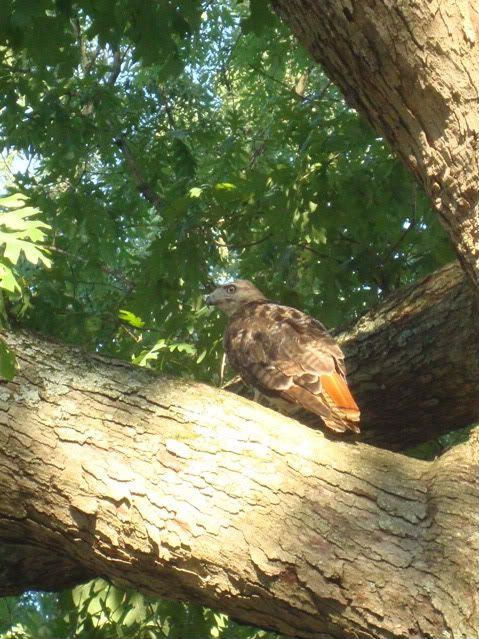
This one is from late July and it involves a Red-tailed Hawk (Buteo jamaicensis).
I would almost go so far as to call red-tailed hawks commonplace these days. I would be willing to guess that 80% of the times I'm in the car for more than 20 minutes driving through an agricultural landscape, I see red-tails. Just two weeks ago, I was driving somewhere and actually saw one sitting on a street sign at an intersection, not 10 feet off of the ground. If I had a camera with me, I would have pulled over to try and get a picture.
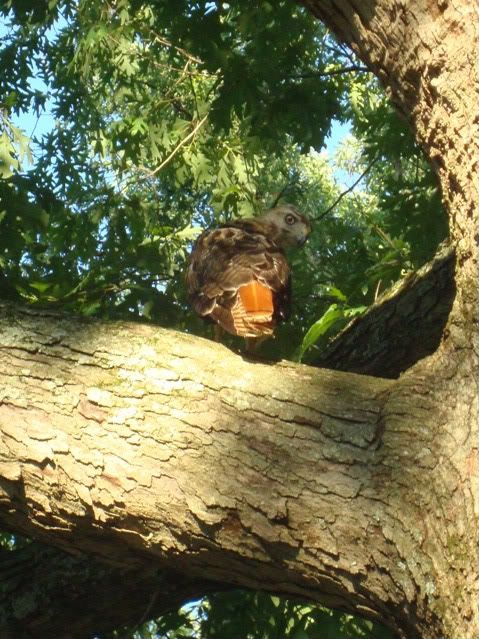
I'm not sure exactly what was going through the mind of the individual pictured below. He was perched in a tree roughly 20 ft off of the ground.....which was the lowest I had ever encountered one perching, until I saw the individual on the street sign not long ago!
I had been having a conversation with a colleague in the parking lot near our offices at the University. We had been talking for 10 minutes, at least, when I happened to look up at the trees to see this Red-tail staring back at me. Shocked, I alerted my colleague to the bird and the two of us stared in amazement.
As you can see, I was able to get pretty close. The hawk seemed more annoyed with us than scared of us. There was a community garden near our building, which I imagine was great for hunting rodents.
The Red-Tailed Hawk has one of the largest distrubtions of any raptor in the New World (found from Alaska and the Yukon to Central America). It's a species that can apparently handle anthropogenic disturbance. It enjoys woodland edges and may have benefited from clearing of woodlands to create suburban and agricultural landscapes (probably also the reason why they are so frequently seen along roads). It can handle the city life as well, and has even been found to breed in very urban environments such as New York City and Philadelphia.
But I don't think red-tails were always so common.
Back when I was a kid....hawks and eagles always seemed pretty rare...at least I think they were rare. I can vividly remember the excitement associated with actually seeing one. For example, I recall a handful of occassions from my youth when dad saw a hawk (probably a red-tail) soaring overhead as we were driving in the car. I remember that the rest of us family passengers were just happy to get a brief glimpse of it before it soared out of view.
I don't know if red-tailed hawk populations have made a massive comeback in the upper Midwest, or if I'm just better at looking for them now? Maybe they were never as rare as I remember them being.
Interestingly, a fella named Gordon Orians published a paper in volume 17 of the Passenger Pigeon (the publication of the Wisconsin Society of Ornithologits) that gives an intriguing historical perspective on the attitudes of people toward this species. Orians recounted the results of a questionnaire survey that was given to rural residents in the state of Wisconsin in 1955. The results indicated that not one of the individuals who took the survey "were able to or cared to distinguish one species of hawk from another. All were unanimous in saying that hawks are shot whenever possible in their area. The attitude that the only good hawk is a dead hawk still prevails".
These previous attitudes towards birds of prey give some indication as to why even the red-tail (a common species that benefits from the increased amount of habitat created by agriculture), could be in a precarious situation based on the prevailing mind-set of people. I would also be willing to bet that this anti-hawk sentiment is in stark contrast to the general attitude towards hawks today. Although I suppose folks that keep poultry aren't fond of red-tails swooping down on the chicken coop....most people are probably ok with hawks.
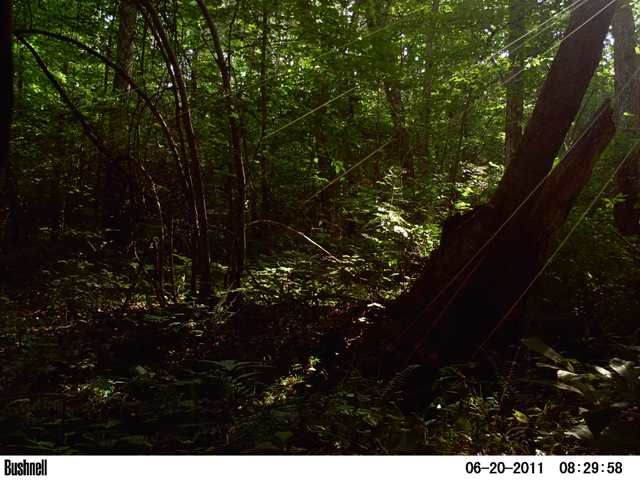
Surprinsingly, the location above resulted in another interesting scenic photograph (see last week's post).
This one, however, is interesting because of the pronounced rays of light coming from the upper right. I also find it interesting because if one compares this picture to the one taken at the same location only a week ago, you can get a feeling for how much variation there is in the appearance of photos on these cameras.
The Juvenile Copperhead (Agkistrodon contortix). We captured this little guy in one of our grassland drift fences. He was in a funnel trap. This is the fourth Copperhead captured in this particular drift fence since last August. So, not very common. I've posted about finding Copperheads before, and catching a venomous snake never really looses its thrill. Plus, these snakes are gorgeous! Juveniles have an additional dimension to their beauty: the tail The tails of juvenile copperheads are a bright yellow-white (see below).
This is because juvenile Copperheads hunt using a strategy called caudal luring. Copperheads are ambush predators, so they sit in one spot and wait for prey to come by.....then they strike. Juvenile Copperheads increase their chances of ambushing prey with the aid of caudal luring. This is accomplished by moving their yellow-white tail-tip in a serpentine fashion so that it resembles a worm....or some other bit of prey. This tail movement then attracts frogs and lizards (which are a staple food item for young Copperheads). Once the frog or lizard is close enough, the baby Copperhead strikes.
For a great document that summarizes and investigates information on the ecology of the Copperhead, see Fitch (1960).
Above: the juvenile Copperhead captured in our drift fence this week. Note the yellow-white tail tip.
Above: a nice head shot of the little Copperhead. I'll say it again, they are a handsome-looking snake!
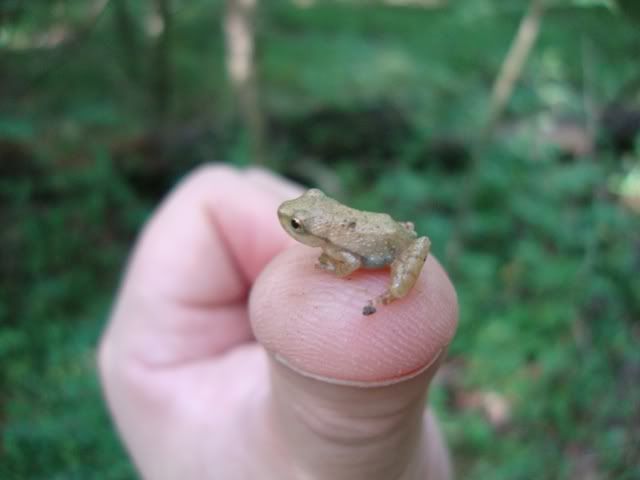
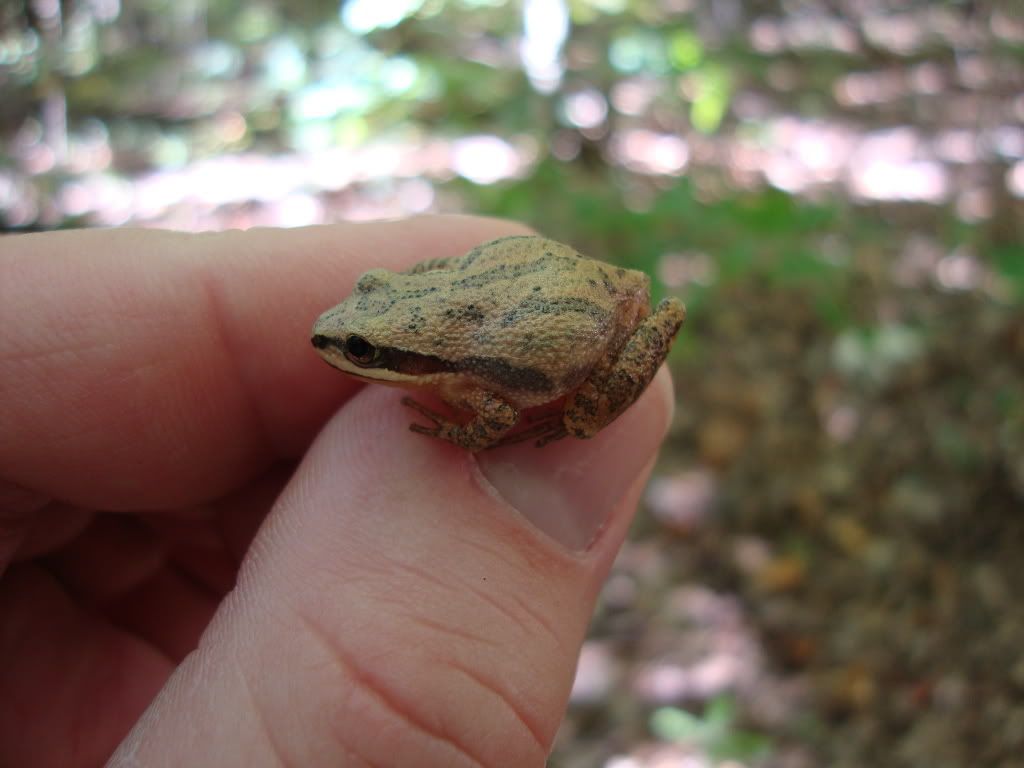
The metamorphosed Spring Peeper (Pseudacris crucifer): It's the time of year when the amphibians species who laid eggs in the early spring are now having larvae metamorphose into tiny juveniles. This week, for the first time, we started seeing froglets and tiny terrestrial salamanders.
One example was this tiny Spring Peeper froglet that I captured while tracking Box Turtles with radio telemetry equipment. I happened to look down just as the little critter hopped out of my way. It took alittle effort to catch such a minute (and delicate) amphibian while not injuring it, but I managed.
These frogs are some of the earliest breeders in the state, along with the Upland Chorus Frog (Pseudacris feriarum). I heard both species calling in the ephemeral wetlands on-site as early as February of this year. This is only the second individual of this species that we've captured at this site. The individual captured previously was an adult....so click on the link to see the difference in size from the juvenile pictured below.
Above: newly metamorphosed frogs are usually small, but they are even smaller for members of the Genus Pseudacris. These frogs are diminutive as adults, and as juveniles....well you can see the size compared to my thumb in this picture.
The D.O.R. Mink (Neovison vison). A Dead-On-Road, or DOR, animal is something one never wants to come across. It really puts a downer on the day. So...if I'm not at risk of putting myself or others in danger...I try and at least get something useful out of the carcass. I don't have the facilities to make mammals into suitable museum specimens, but if it is an uncommon species and the carcass is still in good shape...I try to at least snap photos, get location information, note associated habitat, and take some measurements. I then send this to the appropriate regulatory and/or museum folks.
For herps....it's alittle easier (no skinning involved, you just need access to a chemical fixative and preservative and some jars). I always try to make specimens out of the DOR herps I find, if possible.
Anyways, we saw this poor mink dead in the middle of the road as we drove to the sites this Monday. It was killed near a stream-crossing....with a fairly dense wooded riparian (i.e., stream-associated) buffer. The carcass was fresh and in good shape. We got some photos of the feet, head and etc..
Also turns out, it was a female with enlarged nipples, which meant that she was nursing young nearby. Those young may not have very good odds of survival anymore.
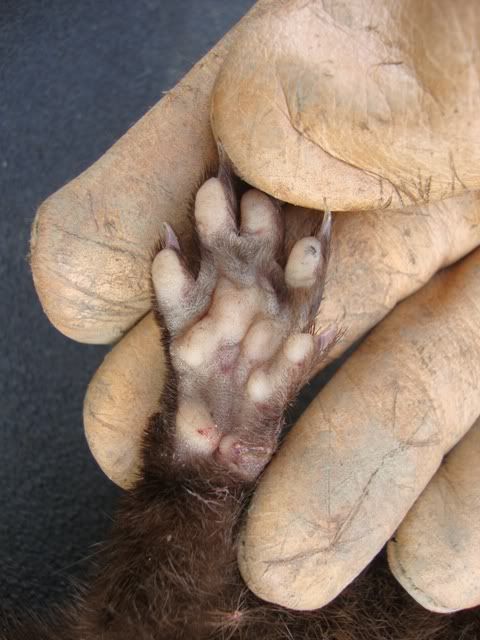
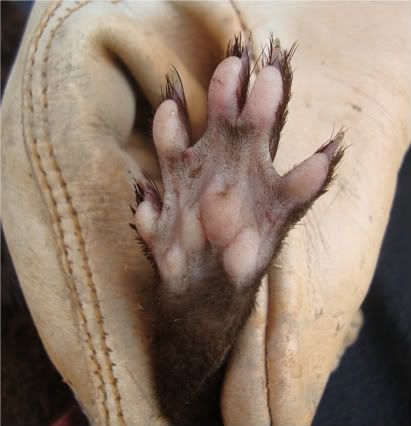
While taking pictures, I attempted to snap some of the critters feet (with Dave's help). Having pictures of the feet really helps one see what they should be looking for when identifying tracks in the mud.
Thought I'd share the feet/paw pictures.
I'll post more information about Mink in the future....
Above: the right front paw of the road-killed mink. Check out the slight webbing between the toes. Also important to note is the shape of the inter-digital pad (i.e., pad between the toes). It's that pad which gives mink tracks that crescent-shaped imprint directly below where the toes register in their tracks.
Above: The rear left paw of the road-killed mink. Again, note the webbing and crescent-shaped inter-digital pad. Also, five toes...but you may be able to see why one of those toes doesn't always make an impression.
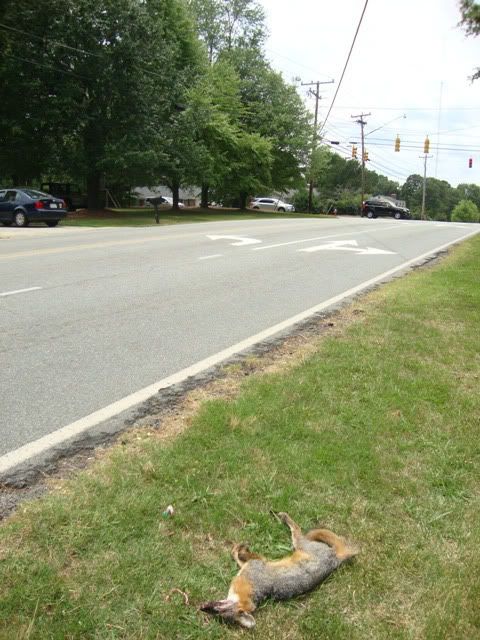
The D.O.R. Gray Fox (Urocyon cinereoargenteus). The downside of being a wild animal in suburbia, is that you face mortality from a variety of sources that you otherwise wouldn't face in a more natural setting. A great example of which is mortality due to vehicular traffic (see also Temple et al. 2010). I'll post more specifics about carnivores in suburban lanscapes at a later date...but for now....I'll tell you about the road-killed Gray Fox we had the opportunity to see this week.
Above: the road-killed Gray Fox that we were told about on 6/23/2011.
This individual was not encountered at our normal study sites (nor on the road as we drove to our study sites). Dave and I were working in the office one afternoon...data entry...data analysis....etc., when a colleague stopped by.
He told us of a freshly dead fox on the road not far from campus. He said it had not been there in the morning, but was there now (several hours later). He said it looked mostly intact.
Dave and I jumped up and hopped in my truck to check it out.
Within about 30 seconds we found him......laying stiff in the road just about at the middle of a busy suburban intersection. So busy, in fact, it had a stop light. On one side of the road was suburbia...densely packed with houses. On the other side was a large wooded buffer associated with a corporate headquarters of some kind.
We drug the little fella off of the road with garden rake and donned some gloves. Took some measurements, got a GPS reading, and snapped some photos. The body was pretty stiff with rigor mortis, but I was able to pry the legs apart enough to see that it was a male. It was in perfect condition....the skull appeared intact...the pelt in good shape aside from being split along the shoulder and part of the front leg. Would have made a fantastic museum specimen. Unfortunately, I don't have a good facility to deal with a dead critter this large.
So we had to leave him there. Seems like a massive waste, but we submitted our data to the state wildlife commission.
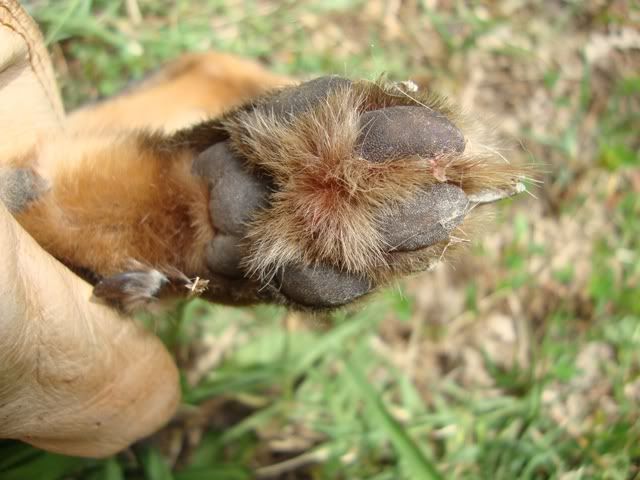
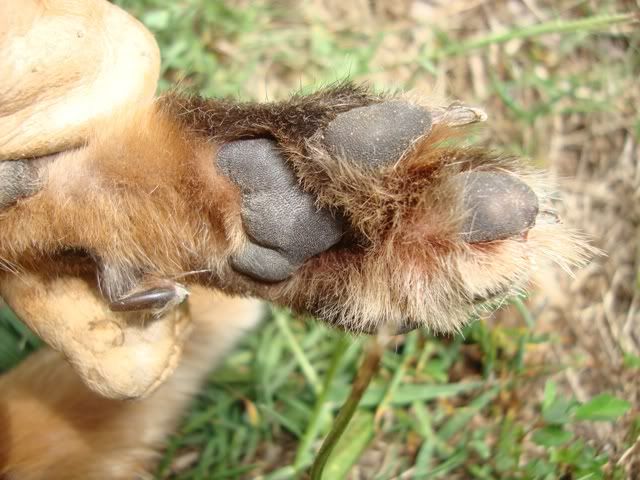
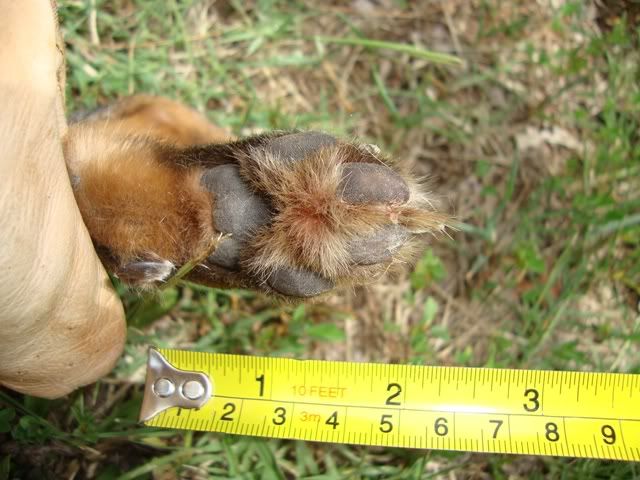
Among the photos we took were some good shots of the paws. As with the mink, I think seeing the actual paws of an animal can be very helpful in learning to identify tracks in the wild.
The pictures below are all of the front right paw. Due to rigor mortis, I couldn't get a very good shot of the back paws (and we were trying to do this along a busy roadway...so we were working quickly).
Above: in this picture, the pads of the digits (i.e. toes) are in focus. You can really see the details of these pads, including the dermal pappillae (i.e. which essentially are the "finger prints" of this individual fox).
Above: in this picture, the interdigital pad (closer to the heel) is in better focus and you can also see the dewclaw (near the thumb of my glove). The dewclaws don't usually register in the track the animal makes.
Above: the same paw with a ruler for scale. The Gray Fox really is a pretty small critter.
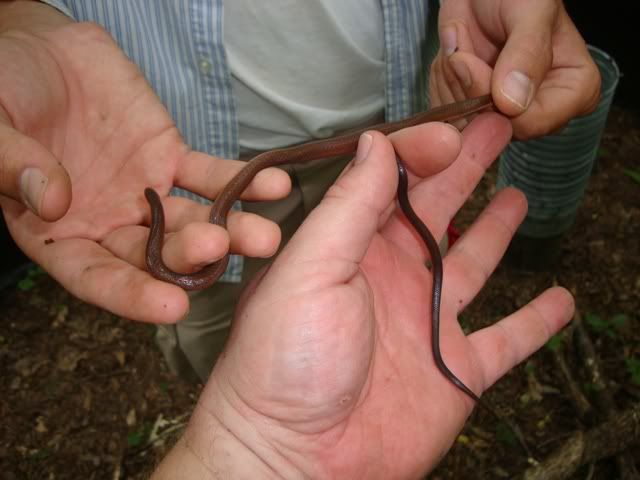
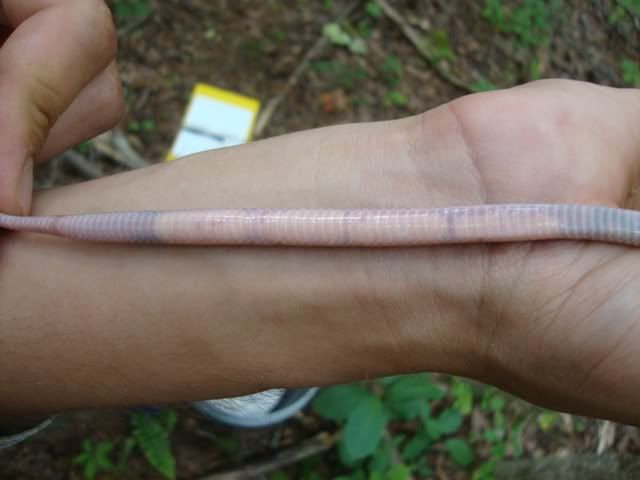
The Gravid Wormsnake (Carphophis amoenus): This is a very commonly captured species at our sites, and I've reported capturing them in the past. However, on Thursday we first noticed definitive evidence that the females at one of our sites are gravid (i.e. carrying eggs). I had thought previous females looked as if they might have eggs....but the one we caught this Thursday has eggs that are clearly visible in the second picture below.
It's that time of year for the egg-laying snakes and turtles!
Above: the gravid female and juvenile wormsnakes captured in an upland forest drift fence this week. They were found in one of the pitfall traps.
Above: the whitish blobs in her belly (visible through her ventral scales) are individual eggs. It appears she has four eggs ready to be laid.
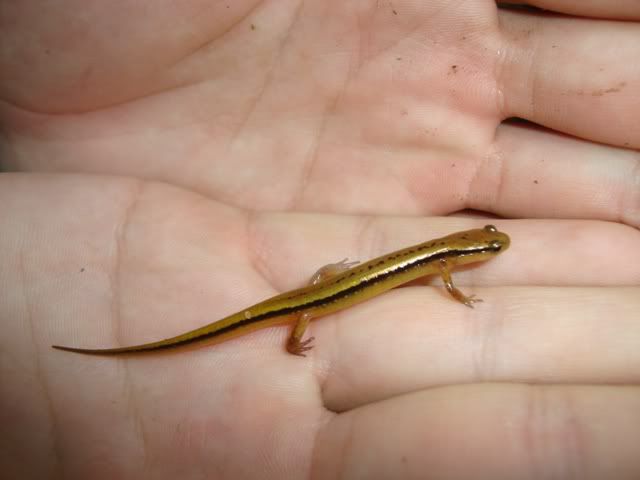
The Southern Two-lined Salamander (Eurycea cirrigera). We captured this juvenile in a pitfall trap along one of our lowland forest drift fences. It is the first time we've captured Two-Lined Sallys in the drift fences at this site (although we'd found them flipping rocks in the stream edge nearby). We hadn't seen any this year at this site. At our other site, we captured an adult in an upland drift fence back in May.
There's not much to add.....the pictures are just cool.
In addition, it's just another example of the juvenile amphibians we're seeing this week.
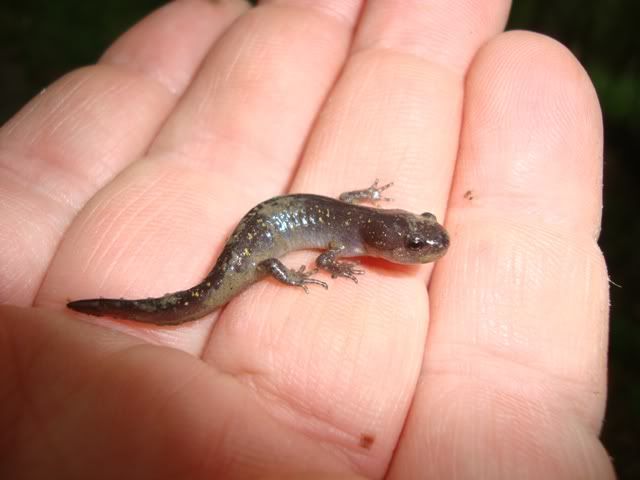
The metamorphosed Spotted Salamander (Ambystoma maculatum). You may recall that last week we were still seeing larval Spotted Salamanders (note: as larvae most salamanders are fully aquatic, breathing with gills and spending all of their time in water). Last month we found many larvae in the ephemeral wetlands on-site, but slowly the numbers we captured began to dwindle, which meant they were metamorphosing (i.e. transforming from aquatic larvae to land-dwelling adults and leaving the water). But until this week, we hadn't captured any juveniles that had metamorphosed and began living terrestrially (i.e. on land).
Finally, we captured a pair of them in the pitfall trap of a lowland forest drift fence.
Above: a small juvenile Spotted Salamander, just beginning his new life as a land-dwelling organism.
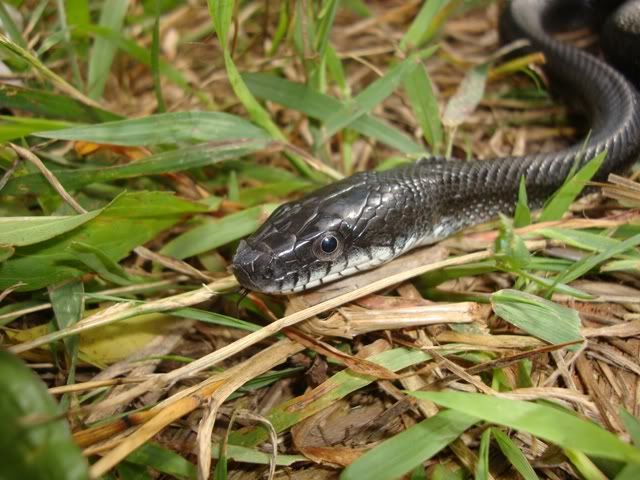
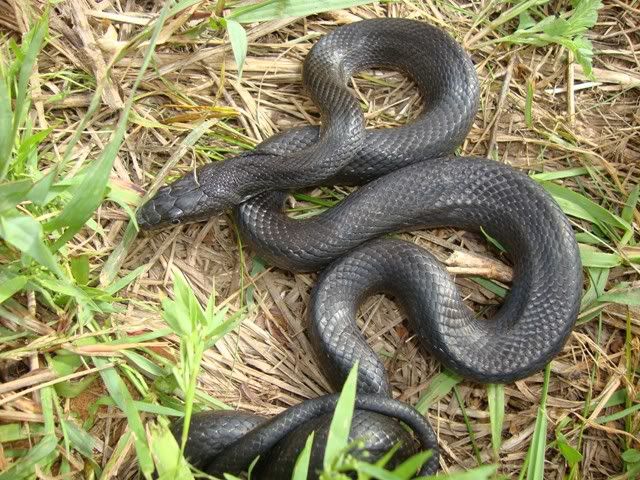
The Adult Eastern Ratsnake (Pantherophis alleghaniensis). You may recall that we captured a juvenile Eastern Ratsnake a few weeks back in a lowland forest drift fence. In that post, I made mention of how different adult individuals look compared to juveniles. Well, here's another chance to see what I mean!
This adult female was captured in a funnel trap along a grassland drift fence at the same site that we caught the juvenile.
You can see, she's very black....no real discernible pattern.
A very cool snake! Back home, these are very rare (listed as "Special Concern" by the Wisconsin Department of Natural Resources). Here, they are one of the most common large constrictors encountered (I've even caught them in the university's "community garden" just outside my office door).
Funny what a difference geography makes.
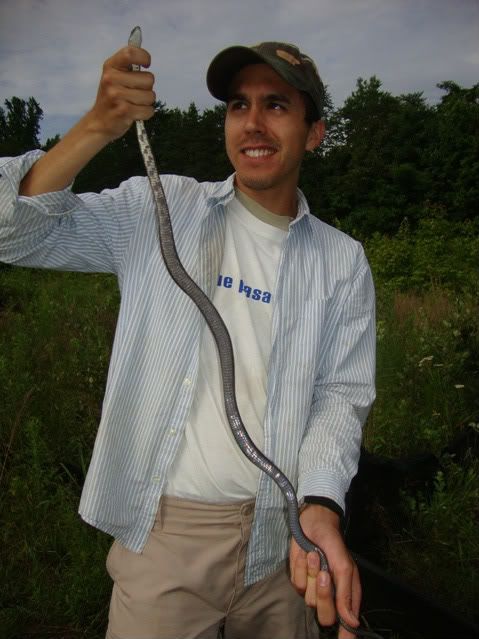
Above: although it may be possible to confuse the Eastern Ratsnake with the Black Racer (Coluber constrictor), there are two basic differences that most folks can figure out. (1) if its warm out, the Racer will be gone almost immediately after you see it....they are FAST....while the Ratsnake is a bit more pokey. (2) if you can capture the snake (and you will probably get bitten in the process...trust me) look at the underside. The Racer's belly is basically solid-black with the exception of the area around the chin. Although it also has a white chin, the Ratsnake often has a "checkerboard" pattern along parts of the belly....not the solid-black scales of the Racer.
Hopefully, we'll have more to report from our surveys next week. And hopefully we wont have any more camera thefts!
____________________________________________________________________________
Literature Cited:
Fitch, H.S. 1960. Autecology of the copperhead. University of Kansas Publications of the Museum of Natural History 13:85-288.
Temple, D.L. et al. 2010. Spatial ecology, survival and cause-specific mortality of gray foxes (Urocyon cinereoargenteus) in a longleaf pine ecosystem. American Midland Naturalist 163:413-422.
Then, a huge thunderstorm came through the area yesterday afternoon. This morning the ground was wet and the air was thick with humidity.
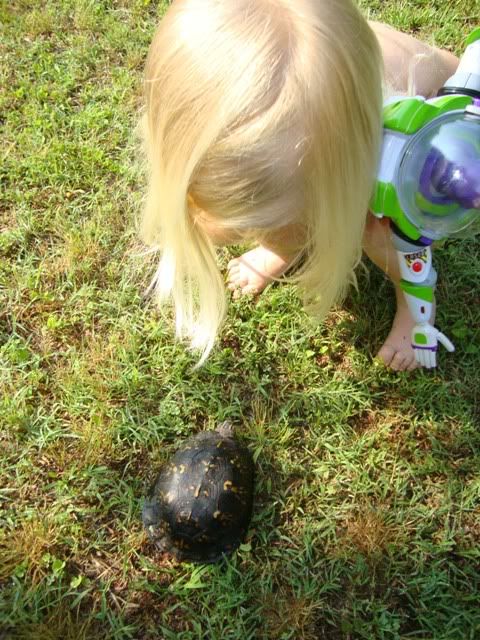
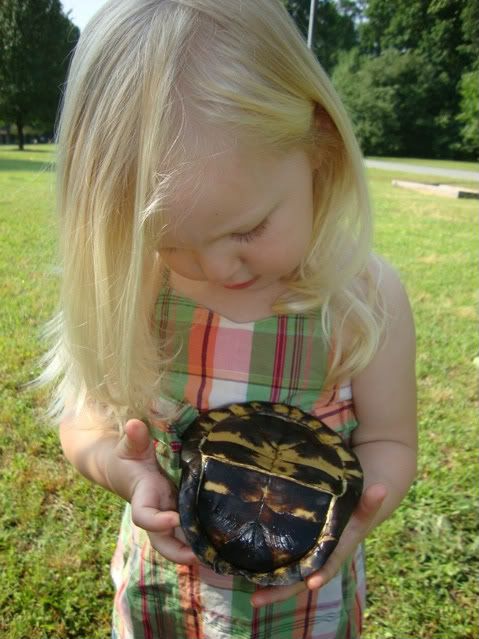
This was apparently what the local Eastern Box Turtles (Terrapene carolina) were waiting for.
My daughter and I were about to head out back and enjoy the morning cool, when I happened to glance out the window and see this fella wandering across the lawn.
We ran out and, much to my daughter's delight, got to hold the little urban box turtle (a male, as you can see by the concave plastron in the second picture below).
I then took him across the road in the direction he was heading. There is a somewhat mature wooded buffer between the houses across the street. I watched him from our side while pushing my daughter in her swing to see which direction he would head. I figured I'd stop him if he started making his way back to road. But, as I suspected, within a few minutes he quickly scooted into the woods beyond and out of sight.
For more information on box turtles in suburbia, I've summarized some pertinent information in a previous post.
Checked the drift fences with two of my students on Friday, May 13th.
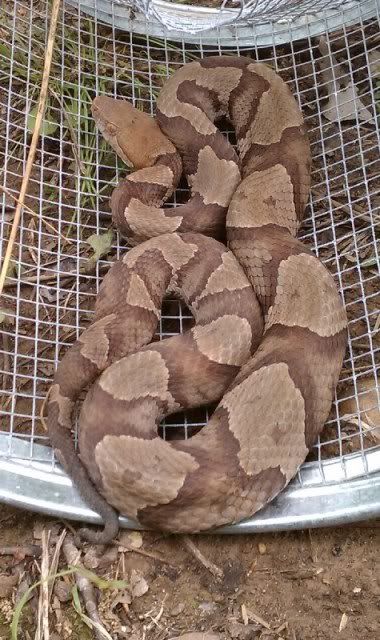
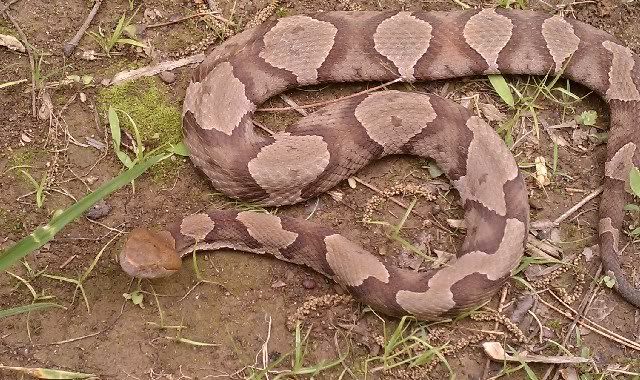
We were all excited to find a Copperhead (Agkistrodon contortix) in one of the funnel traps.
The individual was a sub-adult female.
In our neck of the woods, it's a relatively common species and may even end up in suburban/urban areas.
As a venomous snake, Copperheads are often treated harshly by humans. Even by folks that claim to like "wildlife". I can understand the fear venomous critters promote and, as a father, I can understand the concern folks have about them in suburban/urban landscapes. I wish there was a good solution for this problem....but there doesn't seem to be. This is mostly due to the fact that there's not many places to go in the eastern US if you're a snake that aren't frequented by...or at least visted by.....people.
This means there is lots of potential for interaction between humans and things that may accidentally do humans harm. I say 'accidentally' because, let's face it, venomous snakes don't seek out humans to bite. Bites occur when the snake is threatened. Unfortunately, the snake may feel threatened even if you don't know it's there. The Copperhead blends in so well, that it's not suprising folks unknowingly step on them, or place their hands near them.
But, to put this in perspective, I've spent literally hundreds of hours at my study sites near campus, which are confirmed Copperhead locations. These sites are comprised mostly of good Copperhead habitat (better habitat than found in many urban/suburban backyards). Despite this, I have yet to just walk up on one in the field, and all of the individuals I've seen were captured in drift fences. I imagine I've walked by oodles of them without knowing.
Regardless, dealing with a Copperhead in your backyard is a much different issue than killing a Copperhead that you happen to come upon while hiking in the woods.
But, I'm a strange person and I empathize with the critters that folks fear or dislike. Especially the critters that, despite being loathed by humanity, are able to hang on.
Regardless....if one can separate themselves from the fact that it's a venomous snake, its an incredibly handsome critter.
The concept of Urban Wildlife Ecology may seem strange to many.
Perhaps environmental historian William Cronon's commentary best highlights the difficulty that some have in grasping the importance of "Urban Wildlife". As Cronon states in his essay The Trouble With Wildnerness; Or, Getting Back to the Wrong Nature,"For many Americans wilderness stands as the last remaining place where civilization, that all too human disease, has not fully infected the earth. It is an island in the polluted sea of urban-industrial modernity, the one place we can turn for escape from our own too-muchness."
However, according to Cronon, the idea that wildnerness can only be found in remote "pristine" and protected lands is fiction. He believes that we have a misunderstanding of nature and our place within it. He seems frustrated with the fact that modern environmentalists focus only on pristine landscapes as being wilderness. Such pristine landscapes, says Cronon, don't exist.
"The myth of wildnerness", he concludes, "is that we can somehow leave nature untouched by our passage."
Because protected lands have not avoided humanity's influence, they alone do not represent "wilderness" (according to Cronon). He also states that by associating wildnerness with only protected, pristine environments we further separate ourselves from the natural world. Thus, Cronon believes that we should find wilderness anywhere in our surroundings, including your own backyard. At least....I think this's what he means. If wildnerness can be found in something we are close to (like our backyards), it helps us better associate with wild things and view them as worth protecting. By focusing only on protection of pristine lands and only conducting ecological research there, we fail to focus our efforts on an area of equal conservation importance: where the anthropogenic and the natural world frequently collide. These include urban and suburban landscapes.
Cronon's notions were met with opposition, but he poses an interesting idea.
Even professional biologists fall victim to the idea that ecological research should only be conducted in pristine, untouched landscapes (myself included). Recently, however, research focused on urban and suburban landscapes has frequently began to creep into hardcore ecological research. In past posts, I've mentioned the book Urban Carnivores (edited by Gehrt et al. in 2010). There are other similar books, also mostly written for biologists and ecologists, including Urban Herpetology (an outstanding volume edited by Mitchell, Jung Brown, and Bartholomew in 2008), and Urban Wildlife Management (written by Adams and Lindsey in 2009). These are just a few examples of efforts put into understanding how wildlife behaves and survives at the human/natural interface.
This is a great thing. The best way to mount animal conservation efforts is to understand how wildlife interacts with humanity.
I'm not saying that I fully embrace Cronon's notion (if I understand it correctly) that we should not place so much emphasis on natural places as the ideal of what "wilderness" is. Although I agree that it is possible to see "wilderness" all around us, there are many species that cannot handle urban or suburban versions of wilderness. Without these species, we have an imperfect cast of characters present in our wildnerness. I don't find this acceptable. Although conservation in urban areas is important, its still important to conserve places that feel fewer anthropogenic influences. This is required for the species that don't deal well with humanity....they need somewhere to reside, afterall.
But...as usual....I've gotten off track. No wonder no one reads my blog; I talk too much!
Anyways, I have become incredibly interested in Urban Ecology since my arrival here. Mostly because of the observtions I've made of wild animals in my own backyard. In fact, I've posted on the suburban gray fox that I have frequently seen moving through our lot (see The Gray Ghost, posted on Feb. 20, 2011).
But, this dainty little carnivore is not the only critter I've found meandering through our manicured field of Kentucky Blue Grass, munching on our garden vegetables, or using my pick-up truck as shelter from the sun.
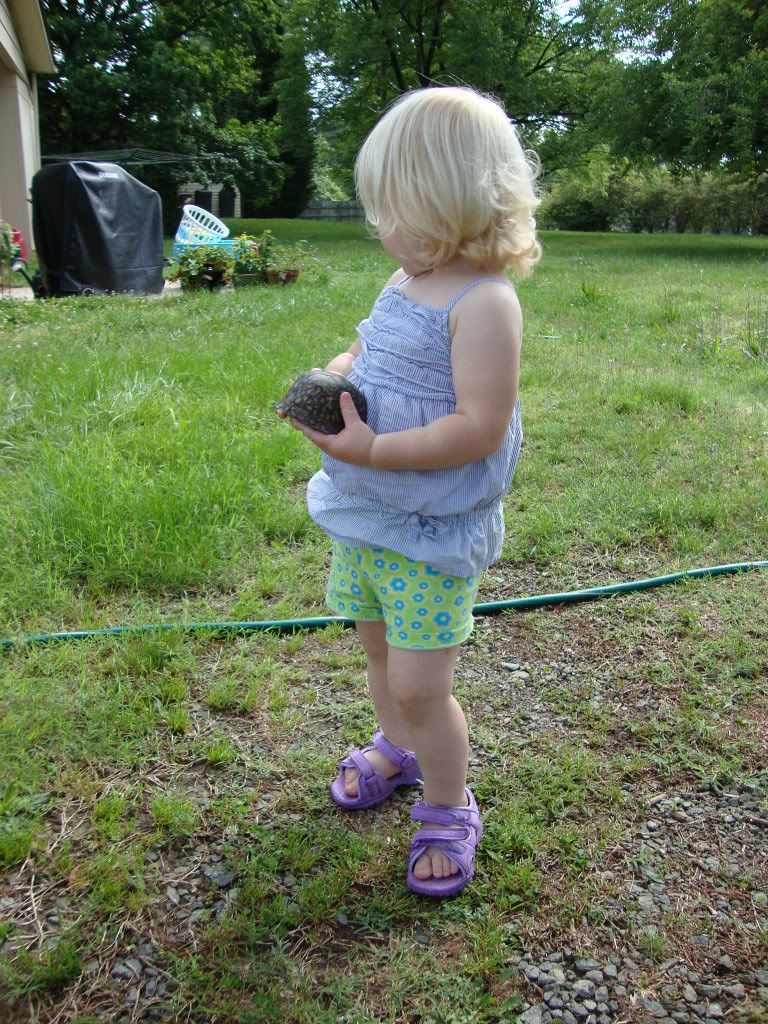
The Eastern Box Turtle (Terrapene carolina). I'll start with one of my favorites: the unassuming little eastern box turtle. Last May, on a Saturday morning after heavy rains, I hopped in my truck and started backing out of the driveway to run some errands. Looking over my shoulder, I backed the truck up about 15 ft before glancing forward at the gravel driveway leading up to the house. At that moment, I noticed a small round lump sitting on the grass between the tracks kept bare by our tires in the driveway. I stopped the car, got out and walked over to the little gal. She sat motionless, bunched up in her tightly-sealed shell. I was glad she hadn't been sitting behind the tires, or I would have accidentally crushed her, not realizing she was there. I picked her up and called to my daughter and wife. They came out and...much to my daughter's delight...picked up and looked at the little turtle. After a few attempts by my daughter to place the timid reptile in her mouth, which mommy and daddy thwarted, I placed the turtle at the base of some shrubs along our back lot line. She sat there most of the day, and by the next morning was gone.
My daughter holding the eastern box turtle found under my truck
Box turtles are faced with much different challenges in urban/suburban landscapes than are more mobile vertebrates like deer and fox. Budischak et al. (2006) studied population parameters of box turtles associated with urban landscapes near Davidson College in North Carolina. They found that adult survivorship in urban landscapes was lower than landscapes with greater tree cover. They speculated that the reduction in survivorship occurred due to a variety of factors: human-subsidized predators, like raccoons (Procyon lotor), habitat degradation in urban areas, and higher road mortality. Brisbin et al. (2008) found that although survival rates of adult box turtles in urban landscapes did not differ from those in forested landscapes, there was a tendency for female box turtles to migrate onto open suburban lawns during the nesting season. Because these nests may be more prone to human-subsidized predators, and females are more likely to be killed during migrations to nest in suburbia, long-term population sustainability seems unlikely. Furthermore, even if studies find that survival rates do not differ between urban/natural landscapes, recruitment rates for urban populations (i.e. the rate at which young individuals enter the population) are reportedly low. Ferebee and Henry (2008) studied a population in a Washington, D.C. park and found it to be comprised of mostly older adults, with few sub-adults or juveniles present. So, little successful reproduction occuring within this population likely meant low potential for the population's persistance.
So, just becuase you find a box turtle in your yard, doesn't mean suburbia is good for them.
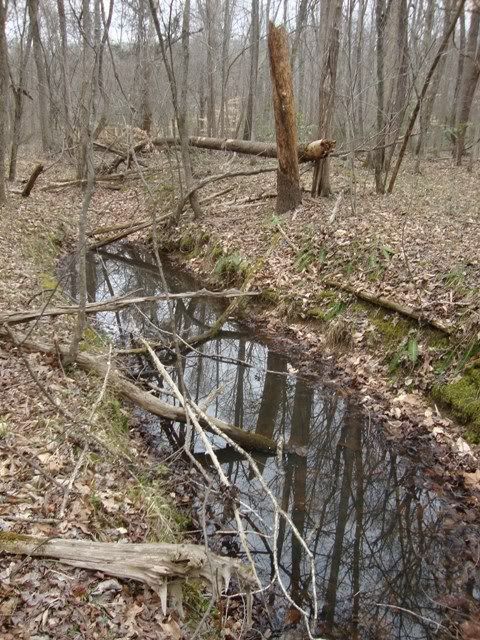
The Upland Chorus Frog (Pseudacris feriarum). In my first spring here, I noticed immediately the calls of this little amphibian. One of the first species to call in the spring (and very loudly, I might add), I heard their mating cries from a small wetland nestled between the homes in my neighborhood in February of 2010. Even now (March 2011), every evening when I take the dog out for his nightly evacuation, I hear them and the spring peepers screaming away, going about their business as best they can in their suburban wetland. Often, this species breeds in natural ephemeral wetlands within deciduous hardwood forests. In fact, I heard a chorus of these little frogs in just such a wetland today (see picture below).
A Natural Ephemeral Wetland Where Chorus Frogs Were Heard Calling on 3/15/2011
I've even captured the adults in the fall on the concrete floor of our open car-port....I'm assuming in migration back to some location that they will spend the winter in, although I scarecly imagine where that is in our neighborhood.
An Upland Chorus Frog (Pseudacris feriarum)
Amphibians in urban/suburban habitats face many challenges. Like the box turtle, they have a limited capacity to move large distances. Thus, they often become isolated in small "green space" buffers between housing developments, which are likely traps that can result in local population extinction. If you are interested, I would highly recommend the previously mentioned volume Urban Herpetology for numerous studies and reviews focused on amphibians within such landscapes.
I have more photos to share of urban wildlife. However, I'll save those for the future.
Literature Cited:
Brisbin, Jr., I.L., J. A. Kennamer, E.L. Peter, and D.J. Karapatakis. 2008. A long-term study of eastern box turtles (Terrapene c. carolina) in a suburban neighborhood: survival characterisitcs and interactions with humans and conspecifics. In Urban Herpetology (Mitchell, Jung Brown, and Bartholomew; eds). Herpegological Conservation 3:373-385.
Budischak, S.A., J.M. Hester, S.J. Price. and M.E. Dorcas. 2006. Natural history of Terrapene carolina (Box Turtles) in an urbanized landscape. Southeastern Naturalist 5:191-204.
Ferebee, J.B., and P. F.P. Henry. 2008. Movements and Distributions of Terrapene carolina in a large urban area, Rock Creek National Park, Washington, D.C. In Urban Herpetology (Mitchell, Jung Brown, and Bartholomew; eds). Herpegological Conservation 3:3765-372.