Showing posts with label lizards. Show all posts

Tuesday, June 21, 2011

Herpin' In the Sandhills Part V: Filling in the Gaps

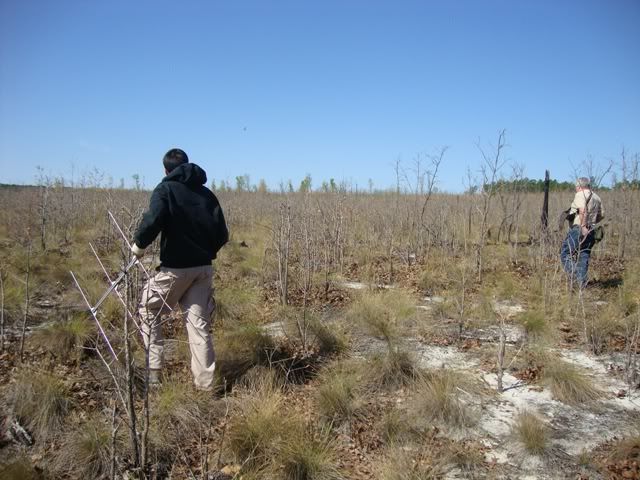
Above: habitat typical of the southern Hognose snake (Heterodon simus).  Jeff allowed us to help him track an individual that he had tagged with a radio transmitter (see Dave above with the antennae).  Unfortunately, the individual was underground and we didn't get to see it.  Cool habitat, though!

____________________________________________________________________________

I'm going to take you both back to the Sandhills and back in time (to April of 2011).  I'm nearing the end of my series about our trip to the sandhills, which has already covered the Cottonmouth, the Scarlet Kingsnake, some cool amphibians, and the Cornsnake and Bullsnake.

Before I end with possibly my favorite encounter of the trip  -I must really stress the word possibly in this sentence- , I'm going to fill in the gaps with a few more reptile encounters that aren't really long enough to justify their own post at this point.  This is especially true considering that this trip is already going to result in SIX blog posts!
___________________________________________________________________________

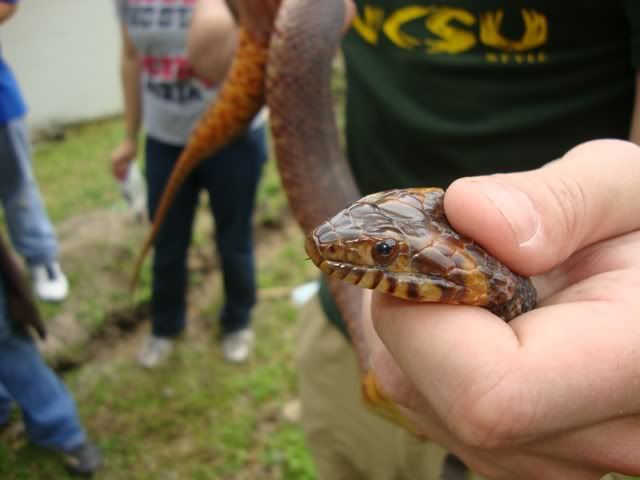
The Banded Watersnake (Nerodia fasciata).  Up in our neck of the woods we have the Northern Watersnake (Nerodia sipedon), which I've posted about before.  In the Sandhills, for some reason, the Northern Watersnake is replaced with the Banded Watersnake.  Both have similar ecological needs (habitat, food, etc.).  Why one likes the Sandhills and one likes the Piedmont...who knows?  Maybe the Banded Watersnake can better handle the drier conditions in the Sandhills?  The two species are found sympatrically (together) in the areas where the Piedmont and the Sandhills meet, and will apparently hybridize (reviewed by Gibbons and Dorcas in their 2004 book: North American Watersnakes: a natural history, University of Oklahoma Press). 

Regardlesss, this species was fairly common around the hatchery.  I saw more than one dive into the water from the rip-rap along the banks before I could hope to get a hand on them (and I have to admit being more hesitant here, because I knew there were Cottonmouths around). 

I've found very similar scenarios in the upper Midwest with fish hatcheries and watersnakes (although up there we only have the Northern Watersnake).  These hatcheries attract amphibians, which are a primary food source for most watersnake species.  In fact, I recall catching a few Northern Watersnakes in Wisconsin at a hatchery, only to have one vomit up three freshly eaten Bullfrog tadpoles.

The biggest issue with watersnakes is that they are stinky!  If you grab one be prepared to get musked with some of the most unpleasant-smelling fluid that comes from an animal, this side of a skunk.

Oh....and they're also biters...but that's as much a badge of honor as anything.  I actually prefer the biting to the musking.   ;)
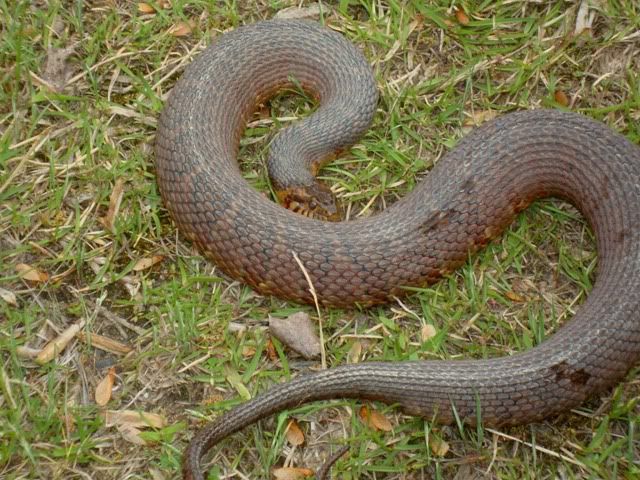
Above: three pictures of a Banded Watersnake that was captured at the hatchery during our trip to the Sandhills.  If you ask me, it's quite a pretty individual. The pattern on the head is very nice.
________________________________________________________________________
Yellow-Bellied Sliders (Trachemys scripta scripta):  There is a drainage ditch that runs through a portion of the fish hatchery property.  There is a point where this ditch runs into a cement pit....and the water is apparently then directed back to a natural stream...or maybe the sewer...I'm not sure.  Anyways, it's a trap for alot of herps...they fall in and can't get out.  I'm told that folks who visit the hatcher and are in-the-know always check the pit.

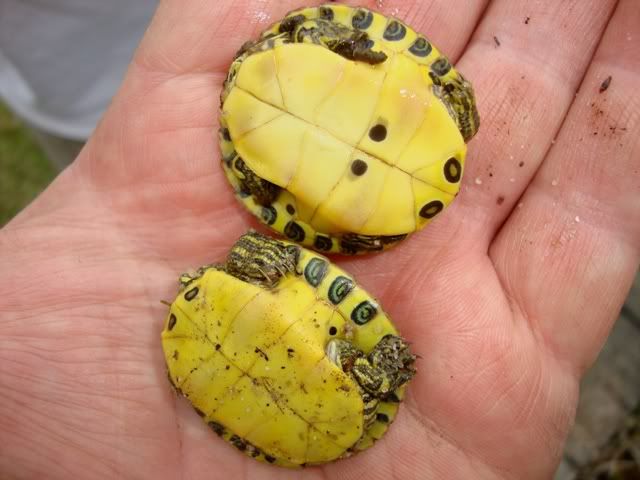
This time, the pit contained a handful of hatchling Yellow-Bellied Sliders.
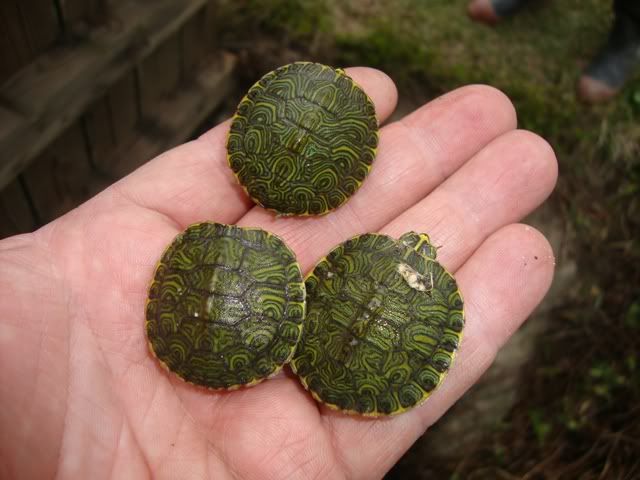
Above: two pictures of hatchling Yellow-Bellied Sliders found in the cement trap at the hatchery.  Note the black dots on the humeral scutes of the plastron.  These distinguishes this species from the River Cooter.


Yellow-bellied sliders can be difficult to distinguish from the River Cooter (Pseudemys concinna concinna).  Both are dark with yellow lines around their heads and arms....both have yellow plastrons (lower shells).  But most of the time the Yellow-bellied Slider has characteristic dark circles or dots on the humeral scutes near the head (see pictures above).

These turtles are related to the Red-eared Slider (Trachemys scripta elegans), which is often sold in pet stores.  The Red-eared Slider is also an invasive species in many areas around the world, as pets are often released in water bodies outside of their natural geographic range.
__________________________________________________________________________

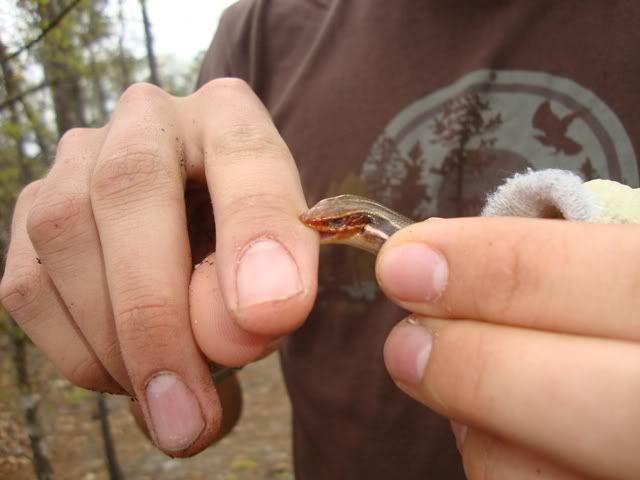
Southestern Five-lined Skink (Plestiodon inexpectatus):  I've posted about finding the plain-old Five-Lined Skink (Plestiodon fasciatus) back up in the Piedmont.  The Southeastern Five-Lined Skink is very similar....and basically can be distinguised by counting the number of labial, or mouth, scales between the eye and the nostril, or looking at the size of the scales that line the underside of the tail.  Either way, it requires you to catch them and scrutinize them pretty closely. 

We found oodles of these guys flipping boards and pieces of tin....pretty much everywhere we went.  

Members of this genus (Plestiodon, which used to be Eumeces) are very common in our fine state.  Usually associated with fallen woody debris (bark, logs, leaf-litter) in woodlands or semi-open woodlands.  They root around for invertebrates.  The picture of the male, sporting the red-head, is one I've posted before.  This was an individual that we found on our Sandhills trip.
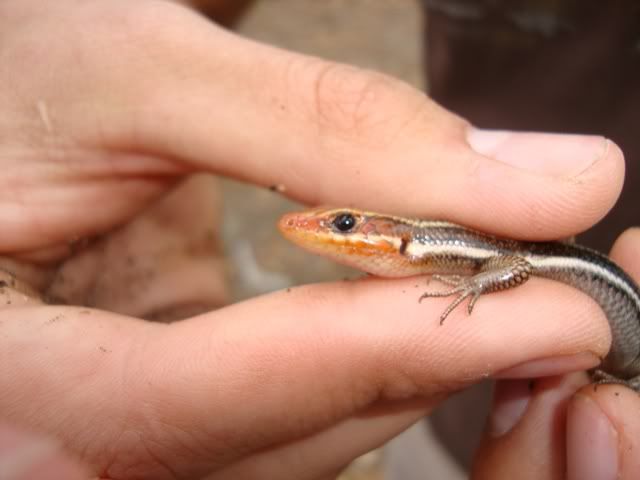
Above:  Skinks like to bite!  It's a last ditch effort to escape predation.  They will also undergo what is technically referred to as caudal autotomy.  This is where an individual purposefully separates its tail from its body.  The animal usually does this when captured by a predator.....the tail keeps wiggling after it has been separated, and apparently distracts the predator enough for the skink to make a hasty escape.
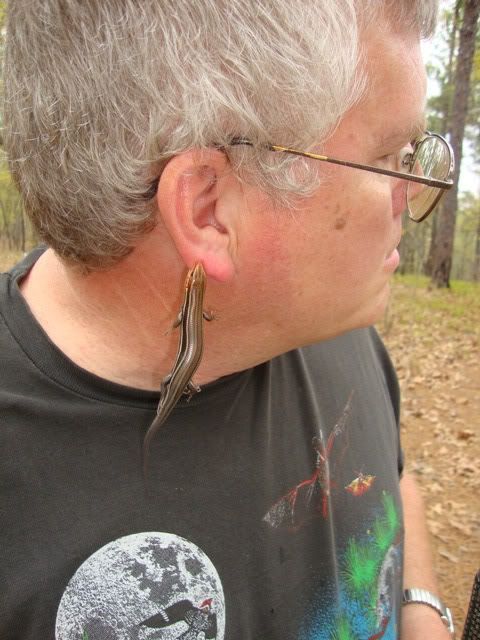
Above: Skinks even make good living jewelry for the fashion-savy individual on a budget.

_____________________________________________________________________

Only one more post focused on what we found during our trip to the sandhills is forthcoming. 

Stay tuned!

Saturday, June 11, 2011

Week's End Survey Round Up III: Meadow Jumpers, Toothy Skinks and the like....


Things were hot, muggy and active in the woods this week.  Surprisingly, the turtle traps resulted in a big fat goose egg, which was disappointing.  There's still time left for turtles to show up, though.

The drift fences, on the other hand, caught some critters to keep us busy!
_________________________________________________________________________

The Eastern Ratsnake (Pantherophis alleghaniensis).  

The individual pictured above is a juvenile.  As adults, this species mostly loses the pattern found in juveniles.  In fact, I've posted some pictures not long ago where you can sort of see what this species looks like as an adult (see The Snake Hole posted on April 22, 2011).   They are basically black on the top (or dorsal) surface as adults.  We caught him in a funnel trap along one of our lowland forest drift fences.  After recording the appropriate morphological data, I let him go on a low-growing tree branch nearby.  Within 40 seconds he climbed to an adjacent tree with no lateral branches and scaled it, up to 40 feet (just by gaining purchase on the tree's bark somehow).  Then we lost sight of him. 

The taxonomy of this group of snakes (i.e., the ratsnakes) has been somewhat in flux over the last 10 years.  For decades, ratsnakes were considered members of the genus Elaphe.  At that time, the Eastern Ratsnake was part of a group that was sort of generically referred to as the Black Ratsnakes (Elaphe obsoleta), with various sub-specific designations depending on location.  Around 2002, new analyses revealed that the genus name of the New World Ratsnakes (those in North America and South America) should be changed to Pantherophis (Utinger 2002).  While this change took awhile to catch on, it is now...basically...accepted by most professional herpetologists. Other taxonomic research (focused mostly on mitochondrial DNA and physical characters) resulted in the elimination of all subspecies for this genus.  Instead of having a variety of subspecies of Pantherophis obsoleta, three distinct species were classified based on region: the Eastern Ratsnake (P. alleghaniensis) in the east, the Gray Ratsnakes (P. spiloides) in the midwest, and the Texas Ratsnake (P. obsoletus) in the west (Burbrink et al. 2000, Burbrink 2001).  Honestly, there may have been more changes since then.  It's hard to keep up with it since the advent of molecular techniques, which can allow for questions of this nature to be investigated much faster than in the days of analyzing hundreds of museum specimens.
___________________________________________________________________________

The Five-Lined Skink (Plestiodon fasciatus).  Although this is a Five-lined Skink, there is also the potential for Southeastern Five-lined Skinks (Plestiodon inexpectatus) around here.  These two species are pretty hard to distinguish.  Basically one can look at the size of the scales on the lower surface of the tail, or count the number of labial (mouth) scales between the eye and the nostril on the side of the head to identify them.  I wish I had good pictures of what I'm talking about!  Didn't think about it when we were snapping photos of the animal.

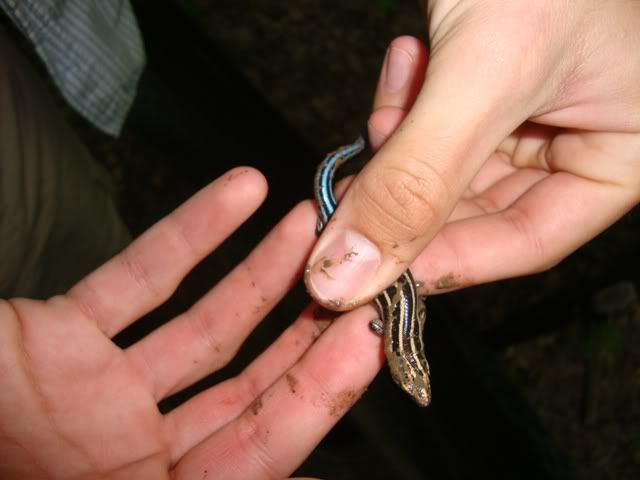
These are a fairly common woodland lizard.  Relatively small, and usually found rooting through ground debris, and beneath logs for invertebrates....there is a pronounced sexual dimorphism (differerence in how males and females appear) in the breeding season.  Adult males have reddish heads and often lack the bright blue tail of the female and juvenile (see reference picture below).  The individual we captured (pictured below) was probably an adult female, and we found her in a pitfall trap along one of our lowland deciduous forest drift fences.  

Skinks within the genus Plestiodon were not so long ago considered members of the genus Eumeces.  But, based on new molecular analyses, their taxonomy has been re-evaluated (see review in Crother 2008).  

As a side note, skinks in the Genus Plestiodon are generally referred to as the "Toothy Skinks".  I don't know why....but that name always makes me chuckle.

The above two pictures show the female Five-Lined Skink that we encountered during surveys this week.  Note the bright blue tail and lack of reddish color on the head.

A picture of a similar species, the Southeastern Five-lined Skink, found elsewhere in the state.  This is a male (note the red tinge on the head), and the male Five-lined Skink appears similar.

____________________________________________________________________________

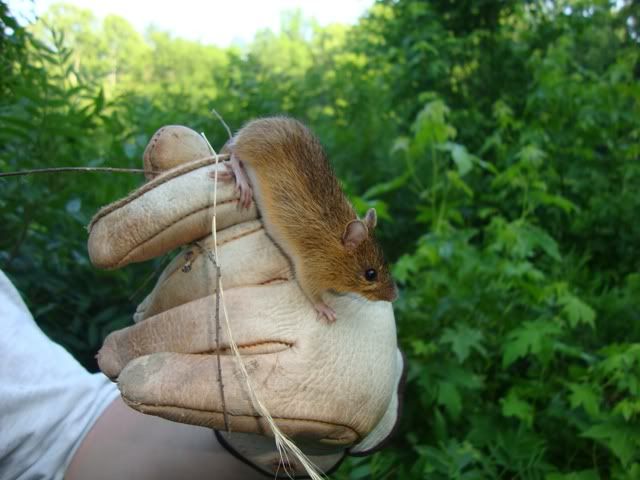
The Meadow Jumping Mouse (Zapus hudsonius).  An apparently rare species in our fine state (which may be the result of no one really looking).  Only a handful of records exist (one in the far western part of the state, and a handful of other recrods to our east).  Observations and confirmed presence of this species in the central part of the state (where we live) are rare, so it turns out our finding was very valuable!  We found him in one of the box traps along a grassland drift fence.

This is an aptly named critter, with the ability to jump or bound up to three feet, according to (Webster et al., 1985).  It can be identified by its large feet, wide band of darker pelage (i.e., fur) down the back, and its long distinctly bi-colored tail (dark on top and light on the bottom),

Interestingly, this is apparently the only mouse in our region that actually hibernates (Webster et al. 1985).  They also do not store food for the winter, but lay down a layer of fat to sustain them in their torpor and pop back up sometime in March or April (Webster et al. 1985).

For those interested in more pictures of these guys, John Van Niel recently posted a story about capturing some during Sherman Trap surveys on his cool blog, Backyard Beasts. 

Check out the long feet and dark mid-dorsal pelage (i.e. fur) down the center of the back.
Note the bi-colored tail of the individual in the picture above. 

The Black Racer (Coluber constrictor) has become the snake species we most commonly encounter at our sites.  This individual was captured in a funnel trap placed along one of our grassland drift fences on the same day we found the Meadow Jumper above.  We also happen across them while walking through the woods with some frequency.  As the name suggests, they are quick! There can't be a moment of hesitation if one hopes to catch an individual randomly encountered while out and about in the woods.  

To top it off, they're usually biters.  I've been tagged more by racers than any other snake here in the Southeastern US.  It doesn't hurt, and barely draws blood.  

The individual in the picture below nailed Dave on the hand a few times.

It builds character, if you ask me.

He looks none-the-worse-for-wear after the experience, anyhow! 


I've summarized some pertinent ecological information (such as dietary preferences) for Racers in a past post (see A Good Day for Herps posted March 23, 2011).
Literature Cited:

Burbrink, F.T. et al. 2000.  Mitochondrial DNA phylogeography of the polytypic North American Rat Snake (Elaphe obsoleta): a critique of the subspecies concept. Evolution 54: 2107-2118.

Burbrink, F.T. 2001.  Systematics of the Eastern Ratsnake complex (Elaphe obsoleta). Herpetological Monographs 15:1-53.

Crother, B.I. (ed) 2008.  Scientific and Standard English Names of Amphibians and Reptiles North of Mexico.  pp 1-84. SSAR Herpetological Circular 37. 

Utinger, U. et al. 2002.  Molecular systematics and phylogeny of Old and New World ratsnakes, Elaphe auct., and related genera (Reptilia, Squamata, Colubridae). Russian Journal of Herpetology 9:105-124. 

Webster et al. 1985. Mammals of the Carolinas, Virginia and Maryland (1st edition).  University of North Carolina Press.