Showing posts with label habitat destruction. Show all posts

Wednesday, March 16, 2011

What Makes The Otter Crap Red?

Anyone know?  I do....maybe (-he said hoping know one realized how unsure he was  :)  -).

Last week, I investigated the river otter latrine (Lontra canadensis) that I have been monitoring for a month.

As has been the case every week, I found fresh otter scat carefully deposited on pile of debris.

This otter scat looked alittle different than it did in previous weeks.  How did it differ, you ask?

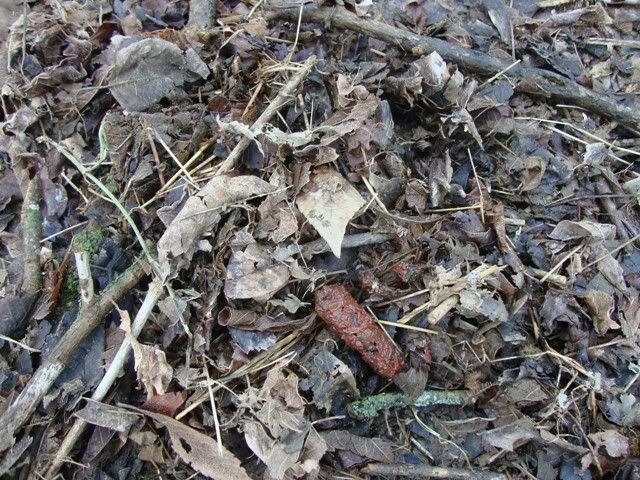
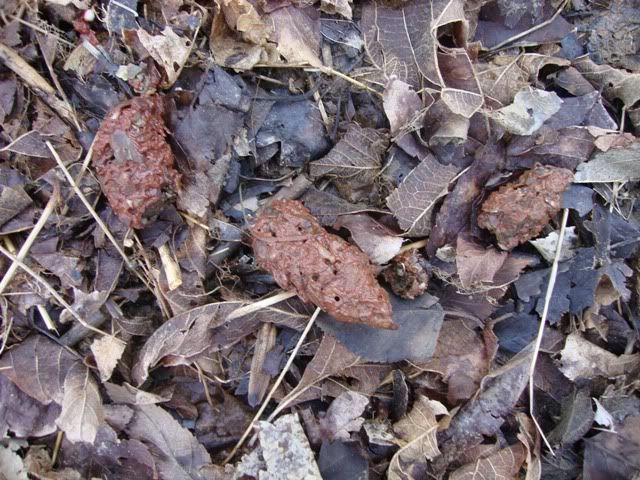
It was red.


Above: Two examples of red otter scat found on March 11, 2011


Although it is tempting to think the crimson hue of this poop is the result of blood....I think another culprit is more likely: soil erosion.

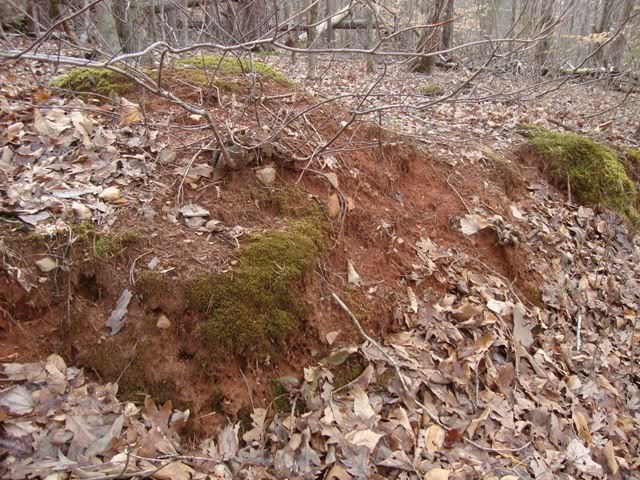
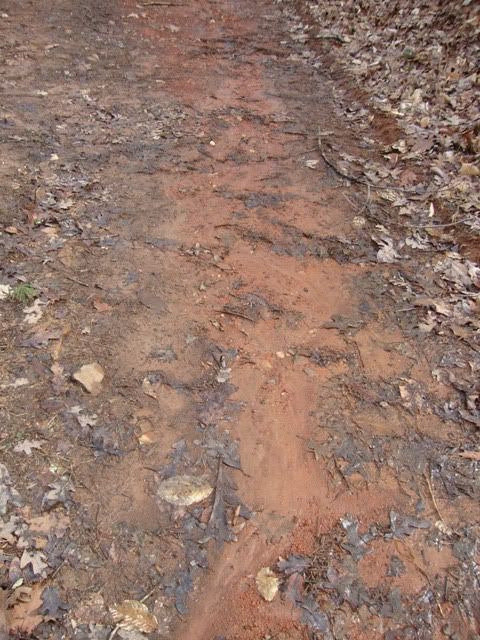
We had heavy rains for nearly a full day and night immediately prior to me visiting the otter latrine and finding the red scat.  You'll see from the pictures below that the soil in our region is dominated by reddish clay (see below).  This clay erodes into waterways during heavy rain events.  This sediment is then picked up by the otters when they feed on crayfish or shellfish (which hang out on the stream bed).

Above: examples of the red clay soil in our region

Above: red clay being washed down a trail near the stream after heavy rains

What impact does this have on river otters?  I dunno.  I couldn't really find any information on how sedimentation affects otters.  I found a few sources that comment on how erosion isn't a good thing for otters(for example Illinois DNR, 2006).  Yet, these comments seem more to do with associated fertilizer/pesticide run-off than sediment deposition in streams.  Furthermore, from what I've found, comments on how erosion and sedimentaiton affects otters is mostly anecdotal.  There is some work done on how contaiminants (such as PCBs) can affect European otters (Lutra lutra), and these contaiminants can get bound in sediments (Traas, et al., 2001).  But other than that, I couldn't find much.  Perhaps someone else knows of research that I've missed.

But, anyways....what makes the otter crap red?  Soil erosion (I think).

More otter-related posts to come in the future!

Literature Cited

Traas, T. P., et al. 2001. Congener-specific model for polychlorinated biphenyl effects on otter (Lutra lutra) and associated sediment quality criteria.  Environmental Toxicology and Chemistry 20:205-212.

Tuesday, March 15, 2011

Backyard Denizens & Cronon's "The Trouble With Wilderness"

The concept of Urban Wildlife Ecology may seem strange to many.

Perhaps environmental historian William Cronon's commentary best highlights the difficulty that some have in grasping the importance of "Urban Wildlife".  As Cronon states in his essay The Trouble With Wildnerness; Or, Getting Back to the Wrong Nature, "For many Americans wilderness stands as the last remaining place where civilization, that all too human disease, has not fully infected the earth.  It is an island in the polluted sea of urban-industrial modernity, the one place we can turn for escape from our own too-muchness." 

However, according to Cronon, the idea that wildnerness can only be found in remote "pristine" and protected lands is fiction.  He believes that we have a misunderstanding of nature and our place within it.  He seems frustrated with the fact that modern environmentalists focus only on pristine landscapes as being wilderness.  Such pristine landscapes, says Cronon, don't exist. 

"The myth of wildnerness", he concludes, "is that we can somehow leave nature untouched by our passage." 

Because protected lands have not avoided humanity's influence, they alone do not represent "wilderness" (according to Cronon).  He also states that by associating wildnerness with only protected, pristine environments we further separate ourselves from the natural world.  Thus, Cronon believes that we should find wilderness anywhere in our surroundings, including your own backyard.  At least....I think this's what he means.  If wildnerness can be found in something we are close to (like our backyards), it helps us better associate with wild things and view them as worth protecting.  By focusing only on protection of pristine lands and only conducting ecological research there, we fail to focus our efforts on an area of equal conservation importance: where the anthropogenic and the natural world frequently collide.  These include urban and suburban landscapes. 

Cronon's notions were met with opposition, but he poses an interesting idea.

Even professional biologists fall victim to the idea that ecological research should only be conducted in pristine, untouched landscapes (myself included).  Recently, however, research focused on urban and suburban landscapes has frequently began to creep into hardcore ecological research.  In past posts, I've mentioned the book Urban Carnivores (edited by Gehrt et al. in 2010).  There are other similar books, also mostly written for biologists and ecologists, including Urban Herpetology (an outstanding volume edited by Mitchell, Jung Brown, and Bartholomew in 2008), and Urban Wildlife Management (written by Adams and Lindsey in 2009).  These are just a few examples of efforts put into understanding how wildlife behaves and survives at the human/natural interface. 

This is a great thing.  The best way to mount animal conservation efforts is to understand how wildlife interacts with humanity.

I'm not saying that I fully embrace Cronon's notion (if I understand it correctly) that we should not place so much emphasis on natural places as the ideal of what "wilderness" is.  Although I agree that it is possible to see "wilderness" all around us, there are many species that cannot handle urban or suburban versions of wilderness.  Without these species, we have an imperfect cast of characters present in our wildnerness.  I don't find this acceptable.  Although conservation in urban areas is important, its still important to conserve places that feel fewer anthropogenic influences.  This is required for the species that don't deal well with humanity....they need somewhere to reside, afterall.

But...as usual....I've gotten off track.  No wonder no one reads my blog; I talk too much!

Anyways, I have become incredibly interested in Urban Ecology since my arrival here.  Mostly because of the observtions I've made of wild animals in my own backyard.  In fact, I've posted on the suburban gray fox that I have frequently seen moving through our lot (see The Gray Ghost, posted on Feb. 20, 2011).

But, this dainty little carnivore is not the only critter I've found meandering through our manicured field of Kentucky Blue Grass, munching on our garden vegetables, or using my pick-up truck as shelter from the sun.

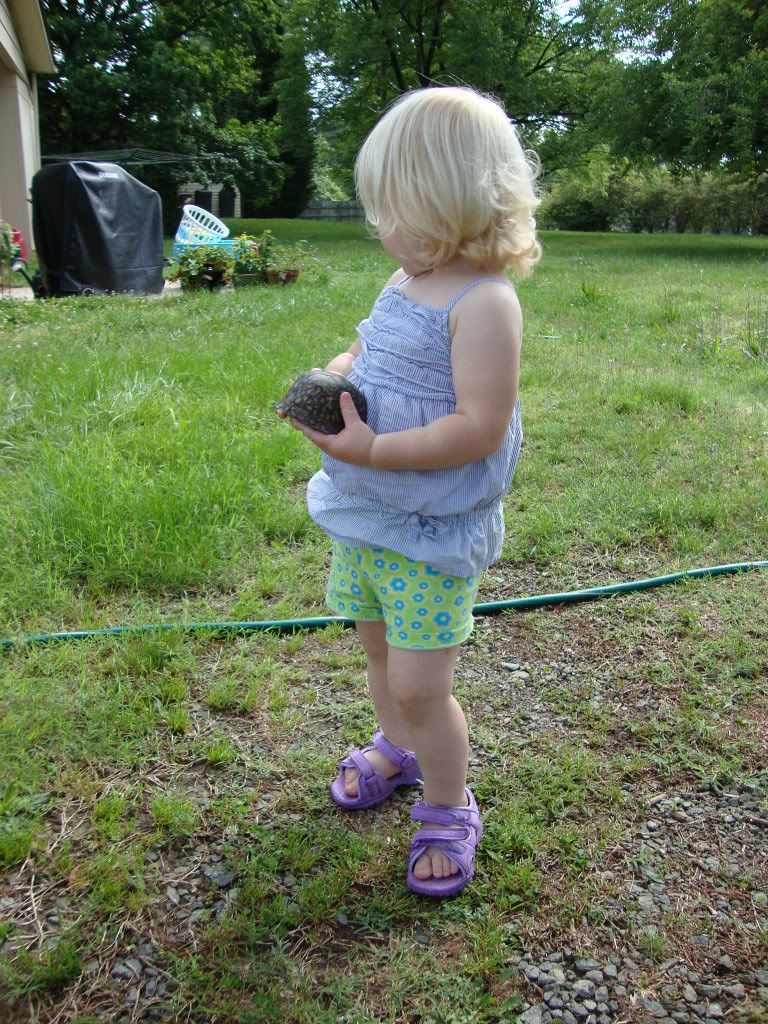
The Eastern Box Turtle (Terrapene carolina). I'll start with one of my favorites: the unassuming little eastern box turtle.  Last May, on a Saturday morning after heavy rains, I hopped in my truck and started backing out of the driveway to run some errands.  Looking over my shoulder, I backed the truck up about 15 ft before glancing forward at the gravel driveway leading up to the house.  At that moment, I noticed a small round lump sitting on the grass between the tracks kept bare by our tires in the driveway.  I stopped the car, got out and walked over to the little gal.  She sat motionless, bunched up in her tightly-sealed shell.  I was glad she hadn't been sitting behind the tires, or I would have accidentally crushed her, not realizing she was there.  I picked her up and called to my daughter and wife.  They came out and...much to my daughter's delight...picked up and looked at the little turtle.  After a few attempts by my daughter to place the timid reptile in her mouth, which mommy and daddy thwarted, I placed the turtle at the base of some shrubs along our back lot line.  She sat there most of the day, and by the next morning was gone.

My daughter holding the eastern box turtle found under my truck


Box turtles are faced with much different challenges in urban/suburban landscapes than are more mobile vertebrates like deer and fox.  Budischak et al. (2006) studied population parameters of box turtles associated with urban landscapes near Davidson College in North Carolina.  They found that adult survivorship in urban landscapes was lower than landscapes with greater tree cover.  They speculated that the reduction in survivorship occurred due to a variety of factors: human-subsidized predators, like raccoons (Procyon lotor), habitat degradation in urban areas, and higher road mortality.  Brisbin et al. (2008) found that although survival rates of adult box turtles in urban landscapes did not differ from those in forested landscapes, there was a tendency for female box turtles to migrate onto open suburban lawns during the nesting season.  Because these nests may be more prone to human-subsidized predators, and females are more likely to be killed during migrations to nest in suburbia, long-term population sustainability seems unlikely.  Furthermore, even if studies find that survival rates do not differ between urban/natural landscapes, recruitment rates for urban populations (i.e. the rate at which young individuals enter the population) are reportedly low.  Ferebee and Henry (2008) studied a population in a Washington, D.C. park and found it to be comprised of mostly older adults, with few sub-adults or juveniles present.  So, little successful reproduction occuring within this population likely meant low potential for the population's persistance.

So, just becuase you find a box turtle in your yard, doesn't mean suburbia is good for them.

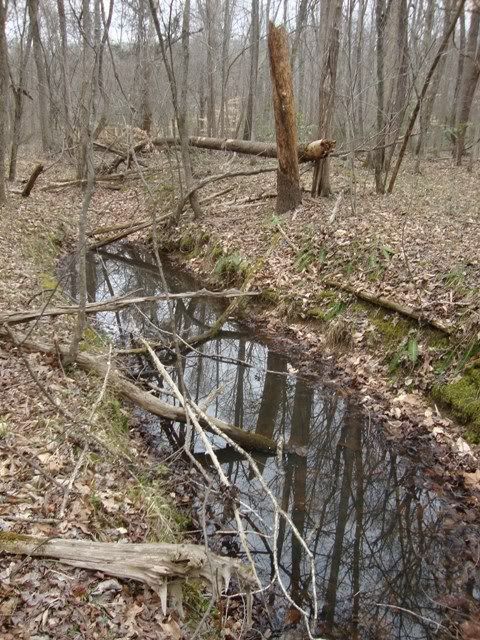
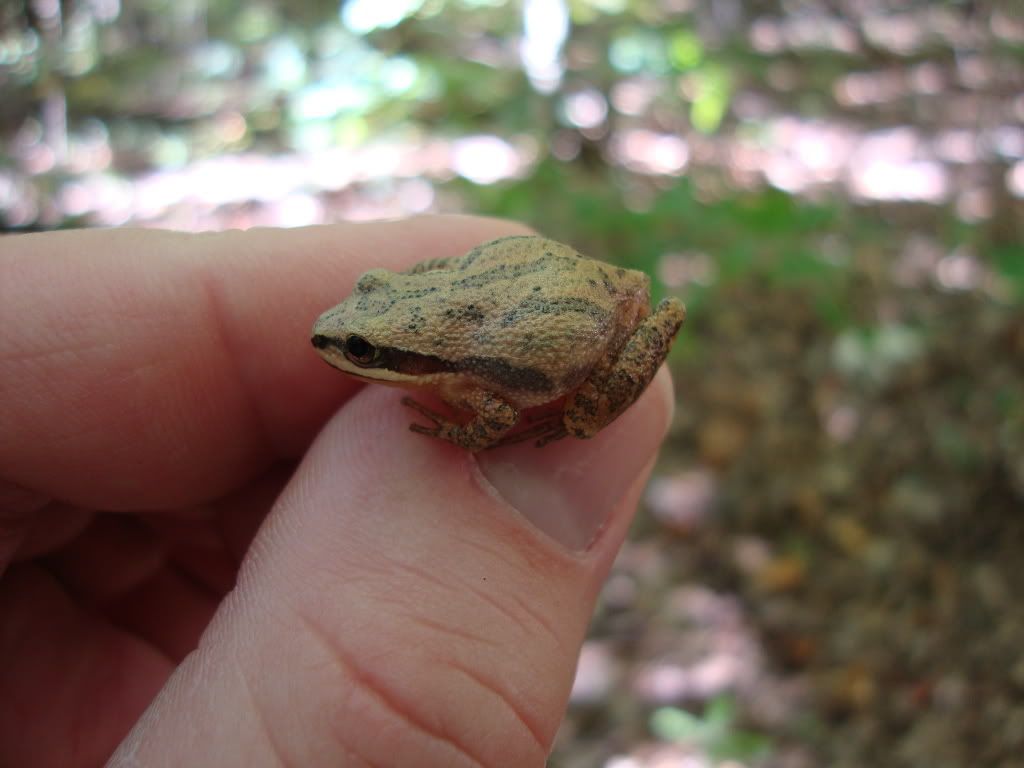
The Upland Chorus Frog (Pseudacris feriarum).  In my first spring here, I noticed immediately the calls of this little amphibian.  One of the first species to call in the spring (and very loudly, I might add), I heard their mating cries from a small wetland nestled between the homes in my neighborhood in February of 2010.  Even now (March 2011), every evening when I take the dog out for his nightly evacuation, I hear them and the spring peepers screaming away, going about their business as best they can in their suburban wetland.  Often, this species breeds in natural ephemeral wetlands within deciduous hardwood forests.  In fact, I heard a chorus of these little frogs in just such a wetland today (see picture below).

A Natural Ephemeral Wetland Where Chorus Frogs Were Heard Calling on 3/15/2011

I've even captured the adults in the fall on the concrete floor of our open car-port....I'm assuming in migration back to some location that they will spend the winter in, although I scarecly imagine where that is in our neighborhood.

An Upland Chorus Frog (Pseudacris feriarum)

Amphibians in urban/suburban habitats face many challenges.  Like the box turtle, they have a limited capacity to move large distances.  Thus, they often become isolated in small "green space" buffers between housing developments, which are likely traps that can result in local population extinction.  If you are interested, I would highly recommend the previously mentioned volume Urban Herpetology for numerous studies and reviews focused on amphibians within such landscapes.

I have more photos to share of urban wildlife.  However, I'll save those for the future.


Literature Cited:

Brisbin, Jr., I.L., J. A. Kennamer, E.L. Peter, and D.J. Karapatakis. 2008. A long-term study of eastern box turtles (Terrapene c. carolina) in a suburban neighborhood: survival characterisitcs and interactions with humans and conspecifics.  In Urban Herpetology (Mitchell, Jung Brown, and Bartholomew; eds). Herpegological Conservation 3:373-385.

Budischak, S.A., J.M. Hester, S.J. Price. and M.E. Dorcas. 2006. Natural history of Terrapene carolina (Box Turtles) in an urbanized landscape.  Southeastern Naturalist 5:191-204.

Ferebee, J.B., and P. F.P. Henry. 2008. Movements and Distributions of Terrapene carolina in a large urban area, Rock Creek National Park, Washington, D.C. In Urban Herpetology (Mitchell, Jung Brown, and Bartholomew; eds). Herpegological Conservation 3:3765-372.

Sunday, February 20, 2011

The Gray Ghost

Gray Fox (Urocyon cinereoargenteus) are pretty common here.  They are one of the species that has seemed to do incredibly well in the suburban/rural landscape that is found throughout the region where we live.  Although the urban environment poses some significant challenges to certain species (particularly small vertebrates with little mobility, like amphibians and reptiles), other species seem to adapt and take advantage of what surburbia has to offer.  According to Gehrt's Urban Carnivores (2010) when a carnivore, like a gray fox, travels through the rural/urban landscape they are likely to experience a variety of biotic (living) and abiotic (nonliving) factors, and althought these factors are present in more "natural" ecosystems, they are substantially different in a urban/rural matrix.

(1) Climate: temperatures within "urban cores" are typically warmer than the surrounding non-urban landscape.  All of that black top, concrete, and etc. absorbs heat and retains it for longer than vegetation and soil.  Obviously for ectothermic (cold-blooded) species, this may be more problematic.  But it poses challenges to endotherms as well.

(2) Water: Hydrology may be significantly altered in urban areas.  In cities surrounded by arid landscapes (such as deserts), water may be more plentiful in town than out-of-town (due to garden ponds, sprinklers, fountains, golf courses, etc.). Urban/suburban areas in any part of the U.S. also usually have storm-water retention ponds.  These collect rain run-off, which occurs in excess when lots of concrete is present, that blocks rain from being absorbed by the ground.  That rain must go somewhere.  Often natural wetlands act as a catchment area for rain-runnoff.  But, as we fill in wetlands for a variety of purposes related to development, that water is more likely to end up in basements, etc..  So artificial retention ponds are often built in urban/suburban areas to act as an artificial catchment for excess rain water.  These are not natural, but may attract wildlife just the same.  Amphibians breed in them, fish are introduced into them, while mammals and birds find them for drinking purposes.  Some semi-aquatic mammals and birds (i.e., mink and herons) may actually take up more permanent residency in artificial retention ponds.  In some cases hydrology is massively altered in the form of stream corridors, river corridors and lakeshores being rearranged and re-directed to suit the needs of the people living within a given area.

(3) Light:  We often do not think of light pollution.  Street lights, billboards, neon signs all create artificial light that illuminates urband/surburban areas, making them much brighter at night than in more rural areas.  Many mammal species likely learn to avoid areas that are lit up at night, or at least skirt around in the shadows.  Although for carnivores like fox and coyotes, their major prey (small mammals) may become less active on bright nights, which can cause them problems.  For some species, particularly certain reptiles and amphibians, artificial light sources can be a more serious problem.  They have been known to artificially attract adults during the breeding season, or juveniles recently hatching from eggs.

(4) Noise: Something else we take for granted.  We're used to constant traffic, lawn mowers, leaf-blowers, and car stereos.  The inlfuence of this is not well-studied, but animals that rely heavily on hearing must be affected.  See Gehrt (2010) for some examples.

(5) Habitat Fragmentation:  Loss of habitat is the number one cause for the global reduction of biodiversity that we are experiencing.  Habitats become fragmented into smaller isolated "islands" due to a variety of reasons.  Conversion of previously "undisturbed" habitat into agriculture or housing/commercial land is one cause of fragmentation.  Also, construction of roads through previously undisturbed habitat is another cause of fragmentation (for a good general overview of fragmentation see Franklin et al., 2002, What is Habitat Fragmentation? in Studies in Avian Biology).  Obviously, some animals are more heavily affected by it than others.  Small vertebrates are particularly susceptible to mortality when a large undisturbed plot of woodland gets bisected by a road (for example).  They tend not to be quick enough getting across and will either not attempt to cross the road (and become stranded in a habitat island of inadequate size) or get smacked when trying to cross.  Some species may remain in habitat fragments (or islands of "undisturbed" habitat surrounded by development) for some period of time.  But the retention rate of species within these fragments depends on the size of the fragment and the avialble resources within that fragment.  So, if food becomes scarce, animals will be required to make forays into the disturbed suburban or urban landscape to meet this need.  Larger, more mobile vertebrates can likely get across these boundaries with greater ease than small mammals, reptiles and amphibians.  Some species do well in fragmented landscapes, so long as there are still small buffers and "green spaces" for them to move along and hide in among the homes and businesses associated with suburbia. 

(6) Biota: Native wildlife species in urban/suburban landscapes also likely come into contact with many types of flora and fauna that are unfamiliar.  Exotic pets, exotic ornamental plants, domestic dogs & cats, etc. all pose the potential for interactions with wildlife that live in such a landscape that don't exist in "natural" areas.  Ornamental plants, shrubs, bushes, may provide cover for certain species.  On the other hand, large manicured lawns reduce cover.  Newer developed areas may lack any type of vegetation that has grown enough to provide real cover for many medium and large vertebrates, while older suburbs and city parks (with older trees, shrubs, etc.) may be adequate.

Alright...so...I was talking about gray fox, right?  Gray fox seem to be a very adaptable little critter. 

Take a look at their traditional geographic range, extending from Canada to Panama.  It is often reported to prefer wooded habitats, or areas of dense cover (thickets, woodlands, wooded wetlands, etc.).  It is also a very adept climber, which means it can eat birds and their eggs, as well as any arboreal or ground-residing mammals, birds, insects, and etc (they'll also eat a fair amount of berries, and other vegetable matter throughout the year).  They are great mousers, which makes them beneficial in natural ecosystems (and may control rodent populations in towns and cities, although I could find little information on this.  Their generalist's attitude towards diet, range and habitat features means it can be a frequent inhabitant of surburan and urban areas.  Plenty of food is provided in the form of vegetable gardens, backyard birds, squirrels, dog food that's been left outside, and perhaps scraps of meat in a trashcan. 

Although they can handle disturbed habitats, it may not be good for them.  They are more likely to come into contact with domestic dogs and either contract, or spread, diseases such as canine distemper (which is fatal in wild canines that can't visit the vet) and rabies.  They also often run afoul of folks that keep poultry in rural and suburban settings.  Them chickens are easy pickins! 

Yet, despite all of this, the International Union for Conservation of Nature (IUCN) lists them as being of "Least Concern".  Globally, this is accurrate, as in many areas they are relatively common.  IUCN also lists the major threat to this species as loss of habitat (which probably affects just about all species).  Becuase it apparently does not have a desirable coat for trappers/hunters, it is not often a target species in those areas.  It is worth noting, however, that this species may be considered rare regionally.  For example, although common where I live now....in my home state of Wisconsin, this is a more rare species that is legally protected by the state.

------------------------------------------------

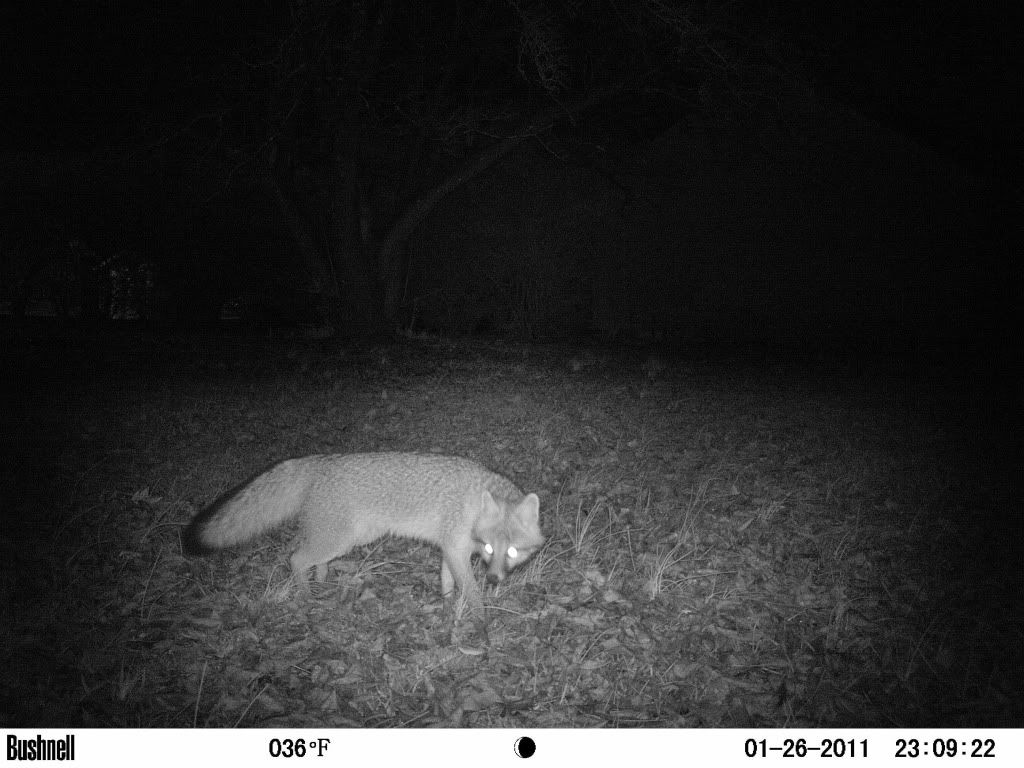
I have captured so many pictures of gray fox on my camera traps over the last year that I hardly know how to start posting them all!  So..I'll post some of my more recent pics that I've obtained.  These are, appropriately, from my own back yard.  We live in a suburban environment, but one with alot of "green space" in between the houses (mostly in the form of small wooded corridors).  Also, some of the development in our area is relatively old and the Shrubs and trees larger for more cover.

My first experience with a gray fox near our home came in the car with the wife and kid.  One day last spring, as we drove home form somewhere in the middle of the day, I was shocked to see a grey streak shoot in front of the car, followed by a gang of angry ravens.  Not sure what happened, but I can only imagine the fox was after young or eggs (because they can climb...a nest in a tree is no problem!).  That night, I took the dog out for his nightly evacuation and I happened to see one run along our lot line (just in the shadows of an area illuminated by our street lamp) before bolting off between the houses.  Not a week later, I saw two running in the neighbor's yard one night (and the next morning found a dried husk of a squirrel roadkill they had probably drug into our yard, which I had to quickly dispose of before it got into my young daughter's curious line-of-sight).  Then, activity in the yard stopped.  At one point last July, I half-heartedly tried putting a camera trap in the yard to see if they were around, but after two weeeks of brutal heat realized they weren't going to be very active and pulled the cam.

This spring, however, I started testing out new cameras in the back yard and guess who decided to show?

In this first picture below, I was still testing which direction the camera should face for the best pics.  So, I caught only a glimpse of the fox, off to the left of the field of view.   In the second picture, I had figured out which angle was better.  With the help of Sampson (my dog), who emptied his bladder in front of the cam, I was able to get some of these urban fox to come in for a close up.


Not two days ago, we (my wife, the kid, the dog and I) were enjoying a very mild spring afternoon.  It was nearing evening, and the sun was going down, but our daughter was enjoying alittle play time outside before bed.  Suddenly, I noticed movement along our back lot line and without any hesitation, a gray fox silently trotted out, walking along the neighbor's driveway.  He moved with a purpose, but didn't seem to pay us much heed, and didn't run as I said "hey, look...a gray fox!" to my wife and kid.  In a matter of seconds, and before the dog had even noticed, the fox had quickly moved across the street and into the wooded green space between the houses on the other side.

I have many, many more gray fox pictures that I will share with you.  Most from more natural settings.  But these are some of my favorites.

Further Reading on Gray Fox:

Chapman and Feldhammer (editors). 1982.  Wild Mammals of the World. Johns Hopkins University Press.

Macdonald and Sullero-Zibiri (editors). 2004. The Biology and Conservation of Wild Canines.  Oxford Uuniversity Press.