Showing posts with label Spring Peeper. Show all posts

Monday, April 15, 2013

More Phenology 2013: Tiny Peepers and Other Little Ditties


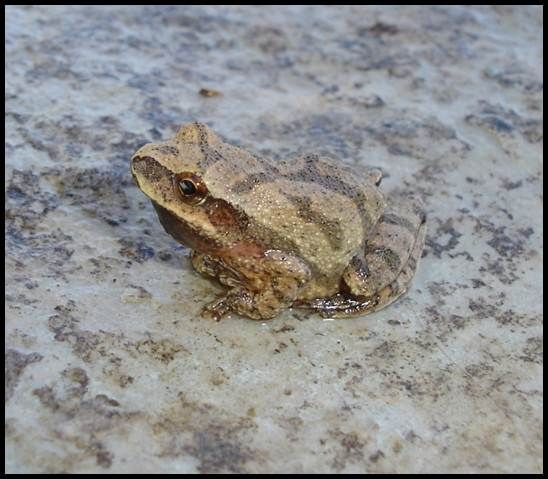
Today (April 15th) marked the first time I've heard Spring Peepers (Pseudacris crucifer) this year.  Much like their congener the Chorus Frog (Pseudacris triseriata), Peepers are one of the earlier frogs to call in our region.

The species name "crucifer" is in reference to the X-shaped mark (or cross) on their backs.

Like most amphibians, the Peeper must lay its eggs in water, which is the reason why the males call around wetlands this time of year (i.e., to attract females for reproduction).  Although many larger frog species around here lay their eggs in large gelatinous "masses", the Peeper is alittle different.  They lay their eggs singly, or in small clumps, attached to vegetation in the water.
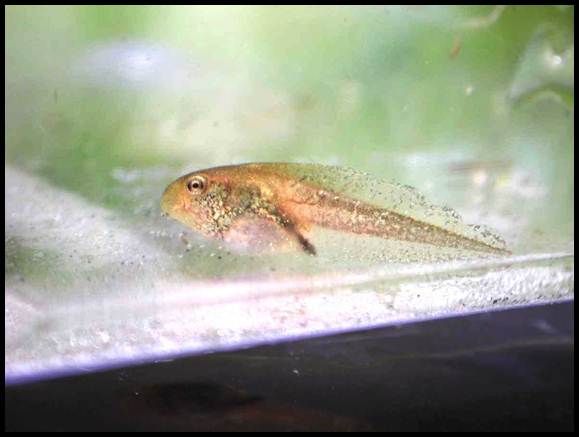
The tadpoles are also small and mostly non-descript to the unfamiliar eye.  In general, tadpoles of frogs in the "Treefrog" group (Family Hylidae), which includes the Gray Treefrog, Cope's Gray Treefrog, Chorus Frog and Spring Peeper in our fine state, have a deep tail.  Peeper tadpoles don't get as large as the Treefrog tads....but are similar in size to the Chorus Frog tads....which makes them hard to ID as tadpoles.

Otherwise, it's been for the birds.....

A Pair O' Canada Geese (Branta canadensis)

Goosey, Goosey Gander laying down the law.....

....and Fido turning the tables on Goosey......

Also, a confused Sandhill Crane....


Some other firsts for the year:
April 3: Yellow-bellied Sapsucker (yard)
April 7: Eastern bluebird (prairie on campus)
April 7: Goldfinch (yard)
April 15: Tree Swallow (prairie on campus)

I should also point out that recently I attended the National Council of Undergraduate Research to support some of my students that were presenting data from our research projects (where I also saw Alyssa doing a very nice job of presenting some of her research).  This conference is the reason why I took a week off of the blog.  There were about 11 total ecology students from my institution attending the conference and as a group we took a small field trip to a neighboring marsh (~2 hr hike).  While there, we saw a variety of birds, despite the short time frame.

Here's a hasty species list, based on what I can recall:

The aquatic birds were particularly obvious:
American Coot
Pied-Billed Grebe
Great Blue Heron
Scaup (couldn't tell if it was Lesser or Greater)
Ringneck Duck
Blue-Winged Teal
Bufflehead
Mallard
American Black Duck
American Wood Duck
Northern Shoveler

There were a few Raptors
American Kestrel
Bald Eagle (Juvenile)

A few odds 'n' ends, and I'm sure we heard more that I couldn't identify (my bird call ID is rusty!)....
Red-bellied Woodpecker
Downy Woodpecker
Belted Kingfisher

Then there were the common ones....the Red-winged Blackbirds, the Common Grackles, the European Starlings, the North American Robins, and such.....

Overall, it was a good experience for the students and an enjoyable for me to watch them mature as professionals.

Sunday, July 1, 2012

Herpin' the Upper Midwest, Day 1: The Bog

Well, for anyone who has followed my blog for any length of time knows....I had a research student in NC who was a very enthusiastic (and effective) budding field biologist: Dave.  You can actually click on his name in the "Labels" section along the left-hand side of the blog to see some of the stuff he and I were working on down south.....you can also check out his cool blog, Salameandering. 

Anyways, after I moved north Dave and I stayed in contact and continued to work on several of our research projects through correspondence (with Dave doing the field work, and the two of us analyzing data sent via email).

Last fall....during one of our email discussions about some data Dave was collecting....we started to concoct a plan.  By the time the plan was solidified, we had decided Dave would come up to our neck of the woods this spring for a week-long visit.  I'd show him some of the great natural areas and wildlife our region has to offer.  We'd focus on species and habitats that were either absent or not common in NC, so he could see some different stuff.  Basically, we decided to have some fun.

So, last month the southern boy found himself in the north and (as we had planned) fun was the result! 

BUT....this was not a "sit around and relax" type of trip.

Why?

'Cause there was field work to do!
______________________________________________________________________

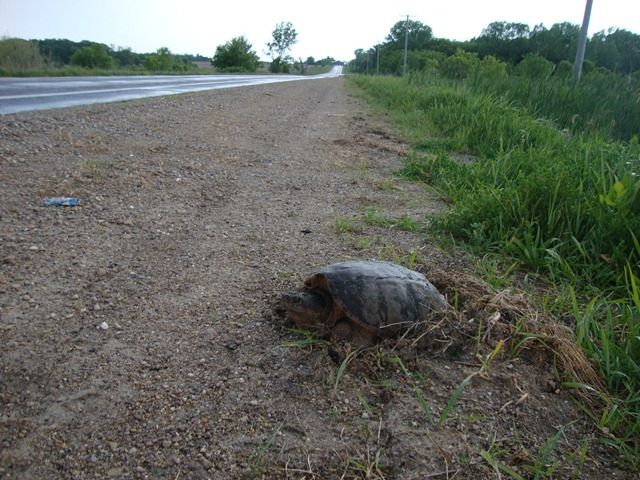
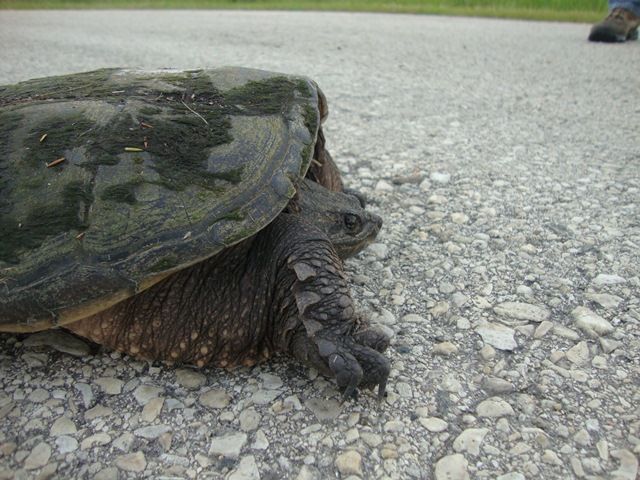
The night he arrived, like a good omen, we found a female snapper (Chelydra serpentina) nesting along the roadside.  Most of the time, turtles along roadsides are of the "pancake" variety.  But not this one.  She was alive and well and in the act of depositing her eggs.  So, we took a picture and moved on, hoping no one would be heartless enough to swerve and hit her.  She was an easy target, and I've seen some very ruthless (or completely unattentive) drivers smack turtles that could have been avoided.....so I was a tad nervous.


The next day, however, we passed by this spot and there was no dead turtle.  I felt much better.

Occassionally, there are flickers of hope for humanity, I suppose....

Anyways....we visited three habitat types during Dave's trip.  I'll talk about each in separate posts, starting with....

The Bog:

I've spent a fair amount of time at this site.  I've taught a weekend field herpetology course at the field station on-site for a number of years....which I'll post about later.  But I knew we could get some amphibian and reptile species there that don't show up (or are rare) in NC.  Plus, Bogs are just neat habitats....with many unique plant species that are found nowhere else.  This site doesn't only contain a bog, however.  There are nice sedge wetlands, grassy meadows, and a beautiful Beech forest that is heavily managed to control Garlic Mustard (Alliaria petiolata).  For those of you not familiar with this nasty little plant, its a particularly prolific invasive that will blanket the understory of woodlands 'round here if allowed to exist unfettered.

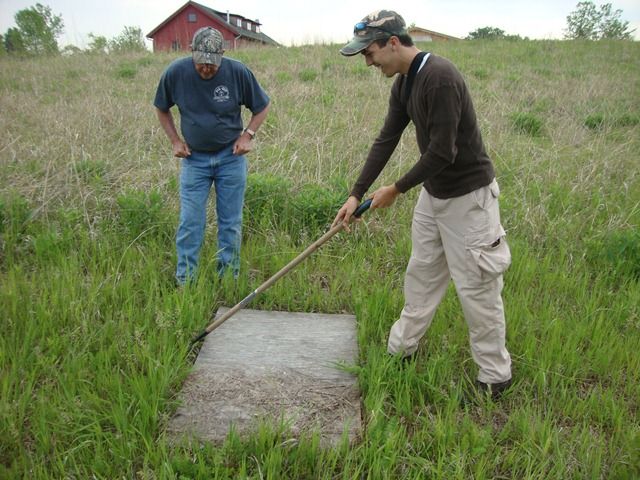
The site also has artificial cover objects (for surveying snakes) that have been in place for many years.  They are all in the grassy meadows and fields adjacent to the open wetland habitat on-site.  Thus, they attract snake species prone to using wetlands or grassland or both.  So...if you're looking for snakes....flipping cover objects on-site is obviously a good place to start!

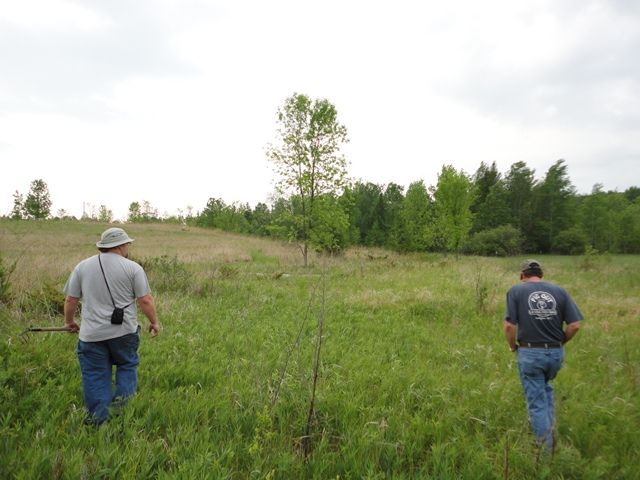
But first, you've gotta walk out and find them in the long grass......
Photo by D. M.

....then you can flip them....


...and reap the rewards of your effort!
Photo by D. M.

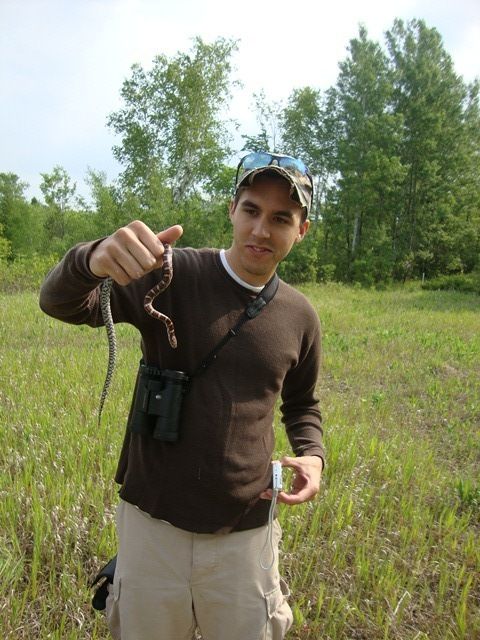
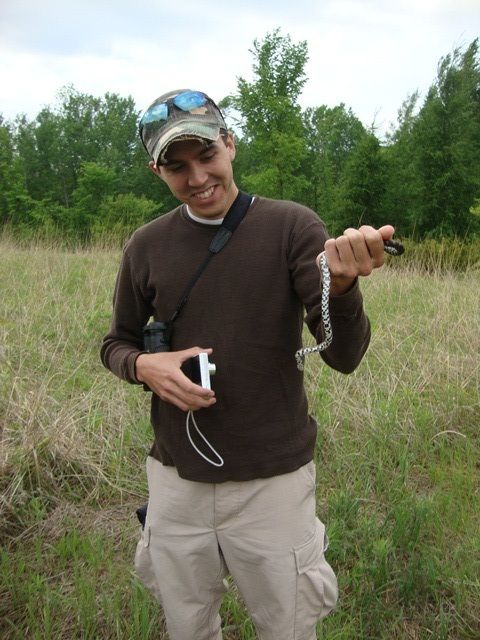
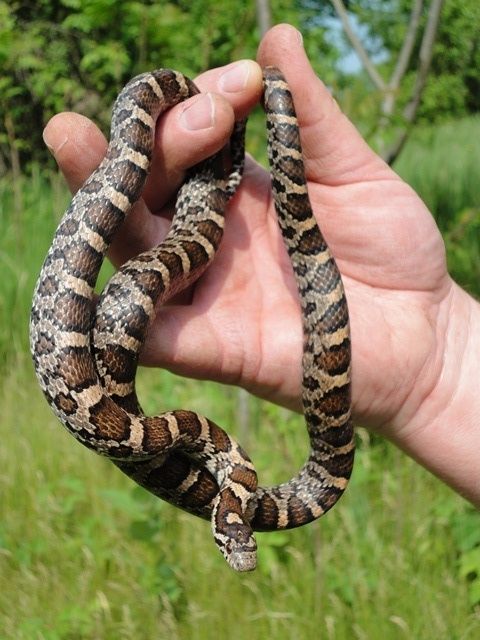
Eastern Milksnakes (Lampropeltis triangulum triangulum) are relatively common on-site, and we found a number of them under the cover objects...
Photo by D. M.

Photo by D. M.

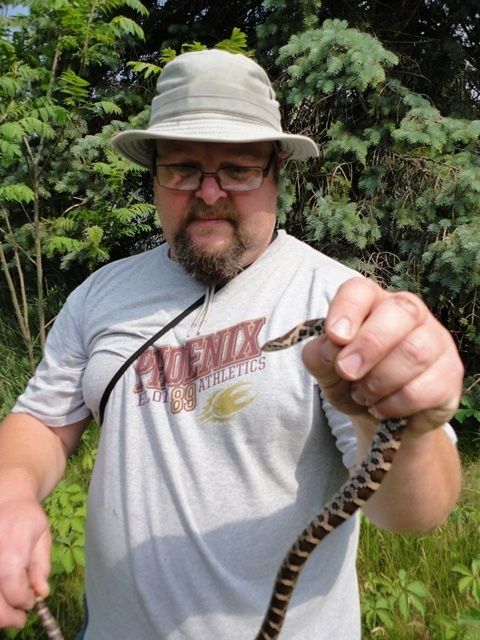
Although eastern Milksnakes were common, also present were a pair of gartersnake species: the Common Gartersnake (Thamnophis sirtalis) and the Butler's Gartersnake (Thamnophis butleri).  More on those species in a later post.

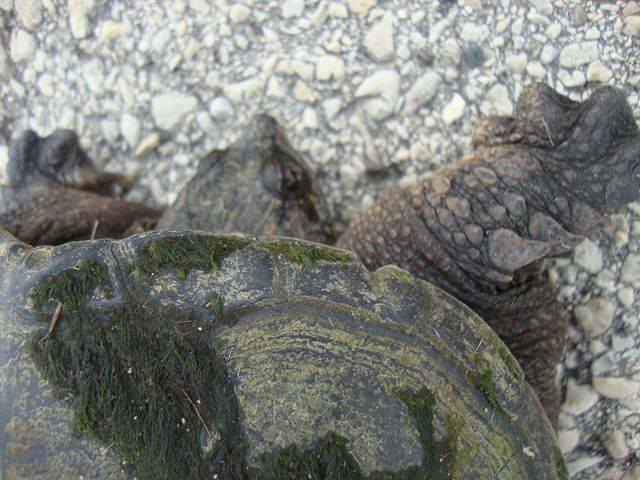
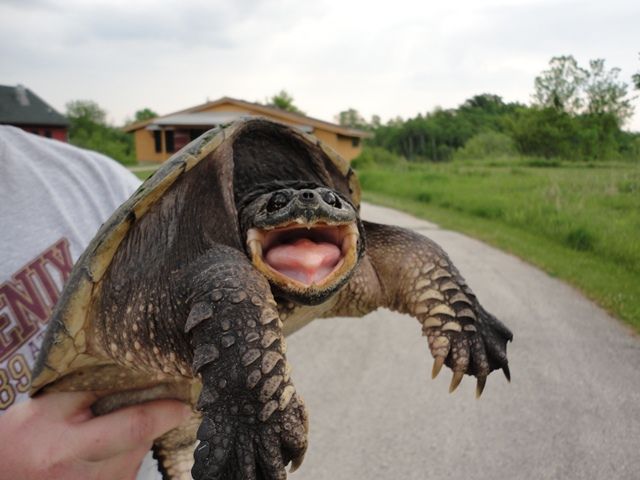
As we conducted a complete circuit of all the coverboards on-site (a few dozen of them), we crossed the driveway into the property.  At that time, we came across a Common Snapping turtle (Chelydra serpentina) thumping her way over the concrete....probably looking for a good nesting location.

Upon closer inspection, I realized this was an individual I had marked #3 via marginal scute notch with a file in June of 2008.  In 2008, I had also found her crossing a road.  Snapping turtles are generall only seen during the nesting season, as the females must come on land to lay eggs.  Otherwise, they have no reason to leave the water.  In fact, most spend their days buried in the bottom of a mucky pond somewhere sucking down anything that strays too close.  While they eat mostly animal material (vertebrates and invertebrates) they are also known to eat a fair amount of vegetation (duckweed, aquatic plant tubers, etc.).

She really didn't appreciate my close inspection, though....
Photo by D. M.

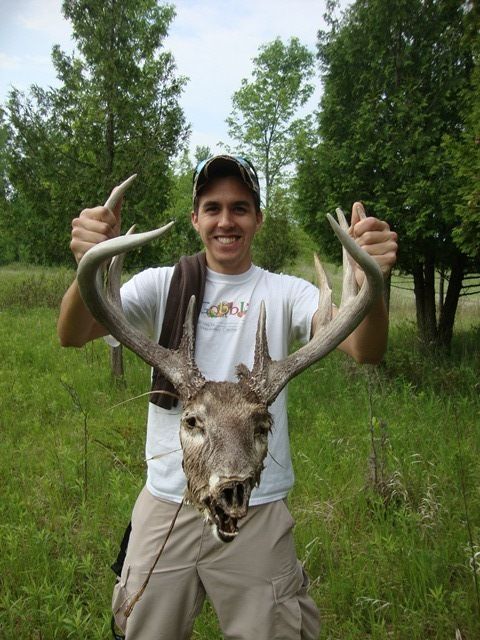
While checking the boards we also came across an incredible carcass, where the board transects bisected a game trail.  As anyone who is interested in wildlife knows, finding a good carcass is about as exciting as finding a good pile of poop (both are awesome finds...usually worth photographing.... and both also make most average folks cringe).

This was a White-tailed Deer (Odocoileus virginianus) carcass...which is normally on the lower end of the "cool scale", seeing how common they are. 

But this one was better than most.....

This was obviously the carcass of a very nice buck.  The base of the antlers were enormous!  What it was doing there, I can't say.   Our location was very near a little-traveled dirt road.....so it's possible the buck was nicked on the road and managed to get as far as this spot before collapsing.  Perhaps it was also winged by a hunter, but was able to make it to this point before it succumbed to its wound.  Most of the bones for the rest of the carcass were intact (not cracked, or crunched...and were mostly articulated).
_________________________________________________________________________

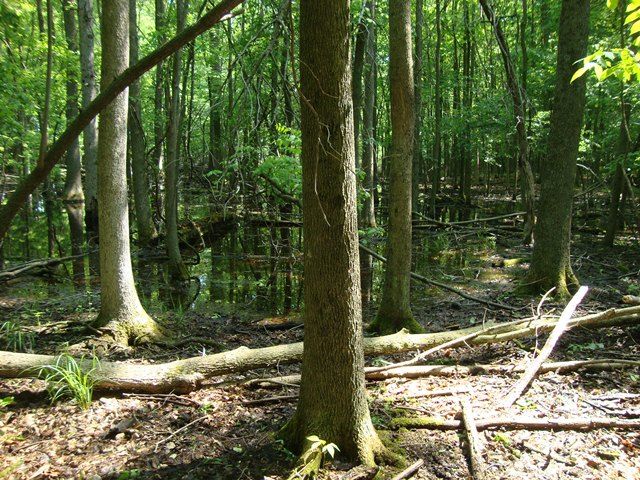
After our success in the meadow, we decided to head deeper into the property to search through the Beech Woods on-site.  You may or may not notice from this picture that there is not a sprig of Garlic Mustard to be seen....and that is no accident.  The staff on-site exert a huge amount of effort in the hand removal of this nasty invasive plant.  The result is obvious, though....and it's a beautiful forest.  With little under-story vegetation, several nice ephemeral wetlands.......

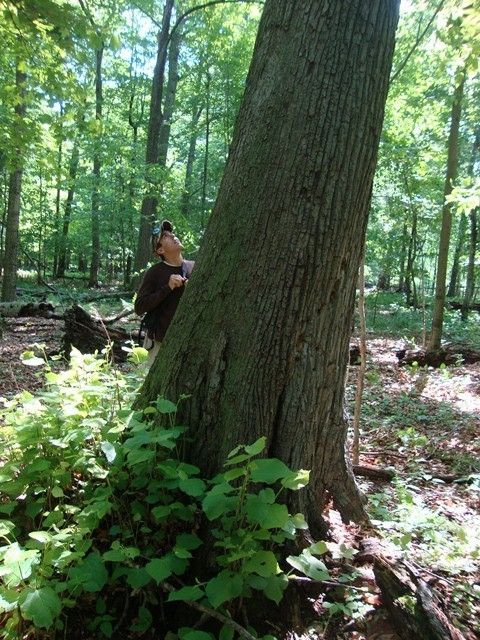
......and some beautiful old trees, such as this giant American Basswood (Tilia americana)!

There is also a wealth of amphibians back in the woods.  During our brief visit, we found two frog species, a toad species and a salamander....

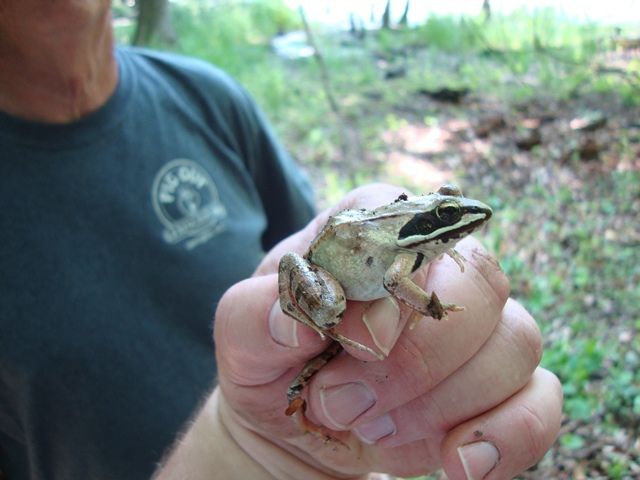
First, the Wood Frog (Lithobates sylvatica).  This is a fairly common species on-site.  As the name suggests, it is fond of wooded habitats, and so I frequently find them associated with woodlands that have associated ephemeral wetlands.  Most of the year is spent hopping around the leaf-litter and ground debris looking for invertebrates to snack on and they blend in well with the leaf litter in these habitats.  Basically, one has to almost accidentally step on them before they'll move.....and THEN you'll be lucky enough to actually see one!

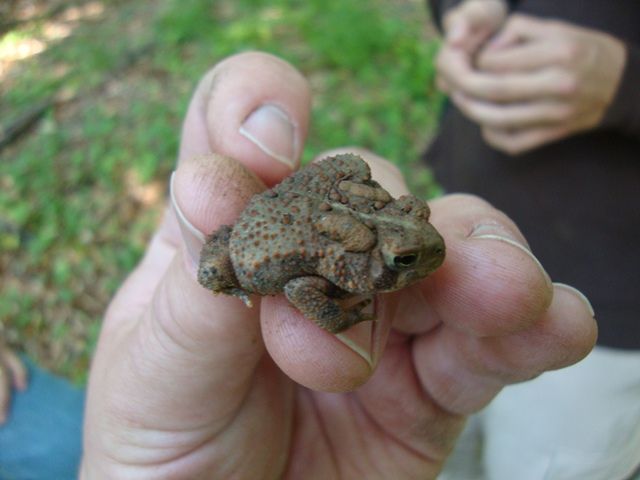
The American Toad (Anaxyrus americanus) is another frequently encountered amphibian at this site.  This is a ubiquitous species 'round here, and is tolerant of landscapes that have been disturbed by humans.  They are frequently found in suburban and agricultural settings, so long as there is some available cover and moisture.  This species was the one that I most encountered in my back yard as a kid, and is probably largely responsible for my love of amphibians as an adult.

The Spring Peeper (Pseudacris crucifer).  A beautiful little member of the family Hylidae (the treefrogs).  Very common in woodlands with associated wetlands.  This species often shares habitat with the wood frog and I have encountered many sites where these species are sympatric.

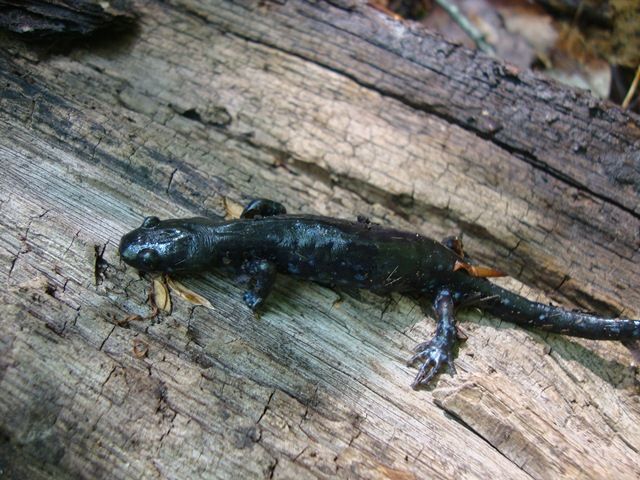
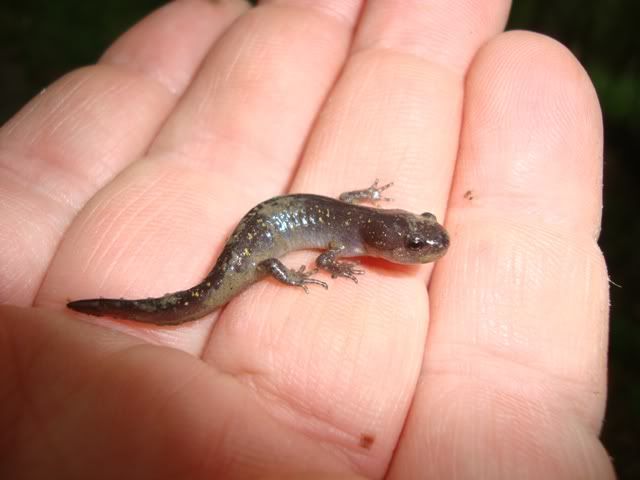
The Blue Spotted Salamander (Ambystoma laterale).  This is one of three salamanders on-site that I've seen.  It is also a species not found in North Carolina, so was a new one for Dave.  The juveniles tend to have much brighter blue spots, and are very pretty.  The adults tend to loose the bright blue spots, and often look more black.  They are smaller and less chunky than the other "mole salamanders" (or members of the Genus Ambystoma) in this area, such as the Tiger Salamander (Ambystoma tigrinum) and the Spotted Salamander (Ambystoma maculatum).
____________________________________________________________________


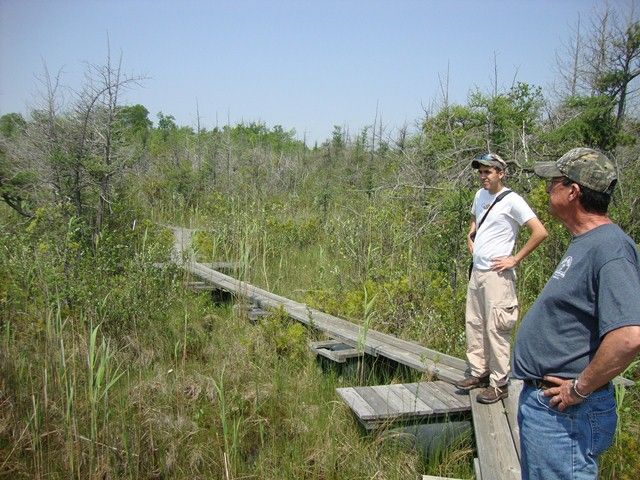
After messing with some amphibians, we decided to take a stroll out on the boardwalk that leads into the actual bog on-site.  Being covered in sphagnum, which one easily punches through while slogging around in a bog, these habitats are very difficult to navigate and walk through.  Luckily, the folks at the field station associated with this bog created an outstanding boardwalk raised above the sphagnum that allows for easy passage.

The boardwalk really allows naturalists to step back and enjoy this interesting habitat, rather than having to worry about sinking into it......
The board walk also grants those seeking passage through the bog the opportunity to spot some of the cool plants that show up in bog habitats.

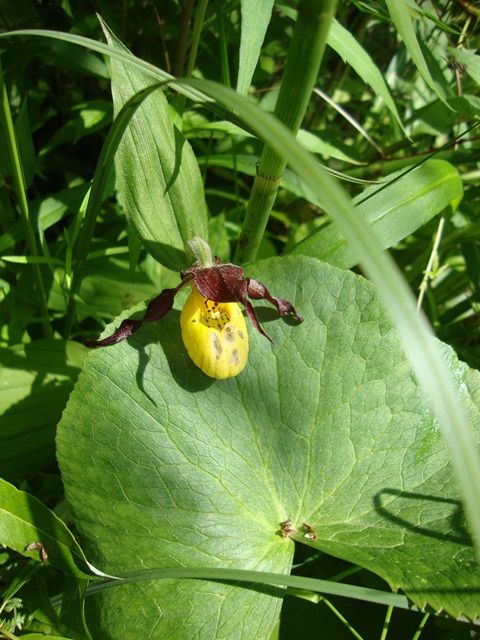
These include the beautiful Yellow Lady's Slipper (Cypripedium parviflorum).  Amazingly, there are a handful of "flower-nuts" out there that illegally collect these from the wild to culture in pots!  It really doesn't make sense to me.  I can see buying a captive-bred orchid variant to keep as a house plant....but I just don't get wild-collecting of stuff like this!  Such a shame to remove them from their natural environment.

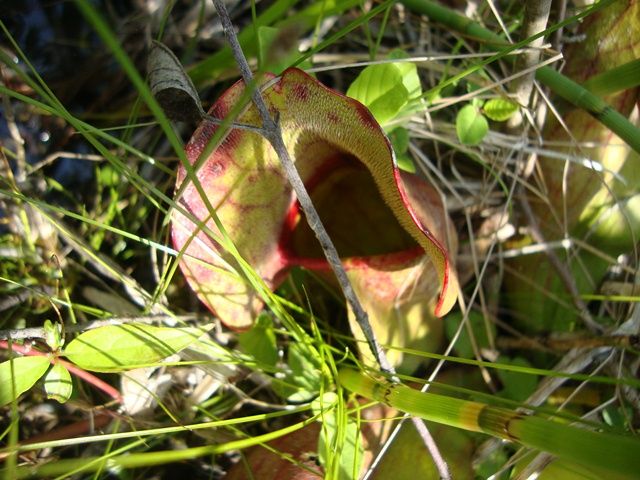
......the carnivorous Pitcher Plant (Sarracenia purpurea).....
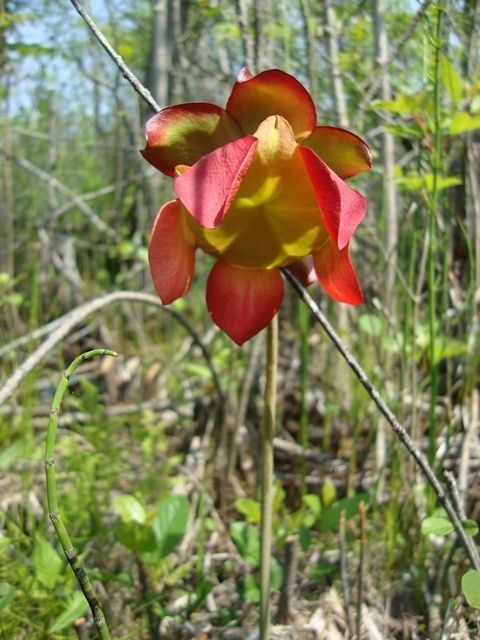
...and its wonderful flowering head.....

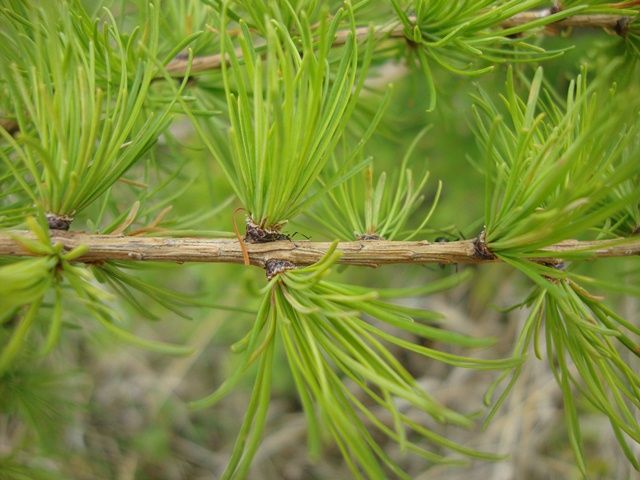
...ALSO...one of my favorites.....the Tamarack (Larix laricina), a deciduous conifer!

Amphibians and reptiles are very sparse in the bog proper.  Birds are plentiful and mammals are common.  On our walk out into the boardwalk, we happened upon a location where the bog opens up into a sedge marsh that leads to a nearby lake.  Here we saw evidence of Otters (Lontra canadensis).  I've seen Otter scat along this stretch of the boardwalk in the past....so I was not surprised to find their scat here again.
______________________________________________________________________

Our first "herping adventure" during Dave's trip was a success!

I'll soon post about the other two big trips we made during his week-long visit.....

Tuesday, March 27, 2012

Of Newts, Turtles and Timber Wolves...


....alright....I suppose there is debate about whether or not the Timber Wolf (Canis lupus lycaon) is a valid subspecies....and regardless, the US Fish & Wildlife Service has deemed that we can only have the Gray Wolf (Canis lupus) in our part of the U.S.......but "Timber Wolf" fit into the title so well!


Anyways, with the nice weather (unseasonably warm...in the 80s in March, which here doesn't happen until May) hiking is a viable daytime activity.

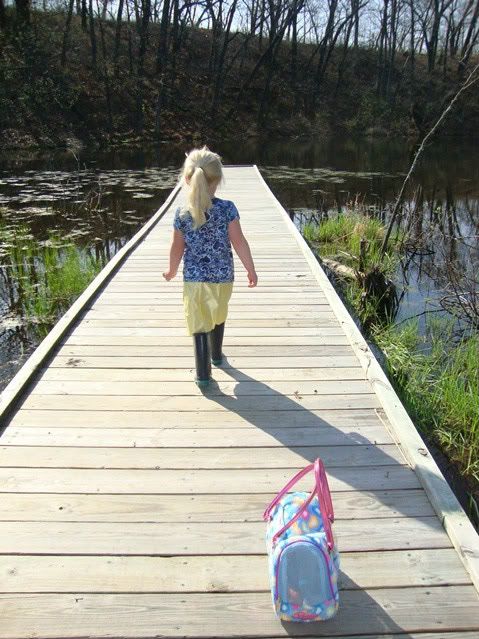
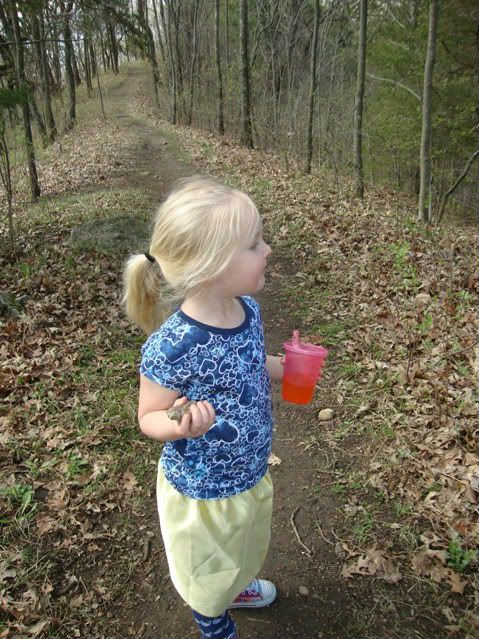
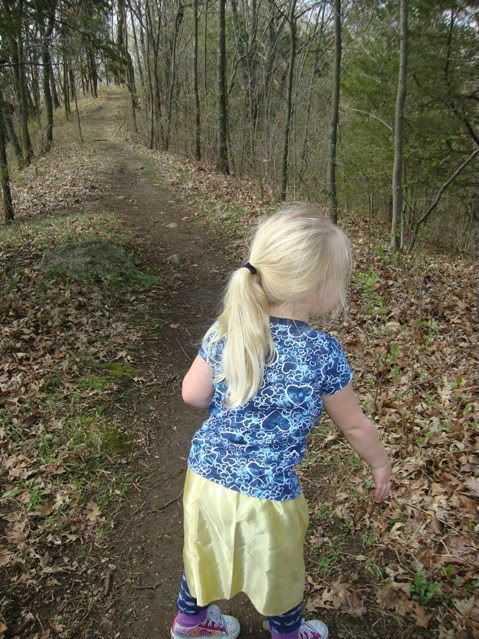
So, the kid and I went to a nearby state forest for a little hike.  She's sort of a paradox, this daughter of mine.  A nearly perfect mix of myself and her mother, as evidenced by the outfit she selected for a day of getting dirty (which she has no problem doing...nor picking up anything that she finds interesting, including a nugget of Canada Goose turd, which she threw into the water, before I could stop her...).

So...the chosen get-up included a shirt with colorful print, the skirt from her Snow White dress-up outfit, a pair of leggings with whales on it, and her La Crosse brand rubber boots.  This was drawn together with a plush purse, in which she carried countless treasures...including an orange (which I had not seen her grab) that she proudly produced later after exclaiming she was hungry.

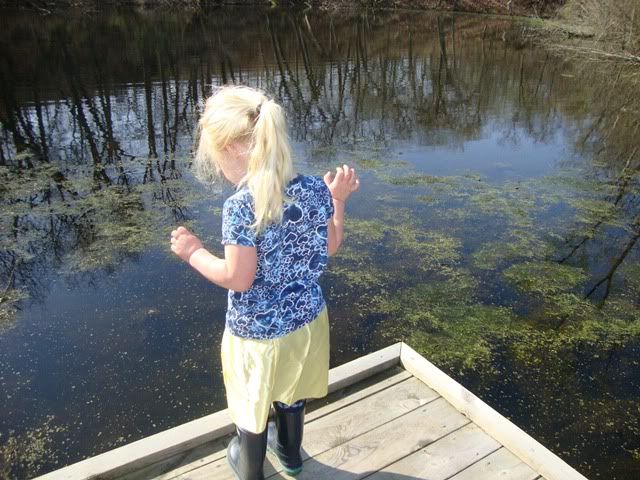
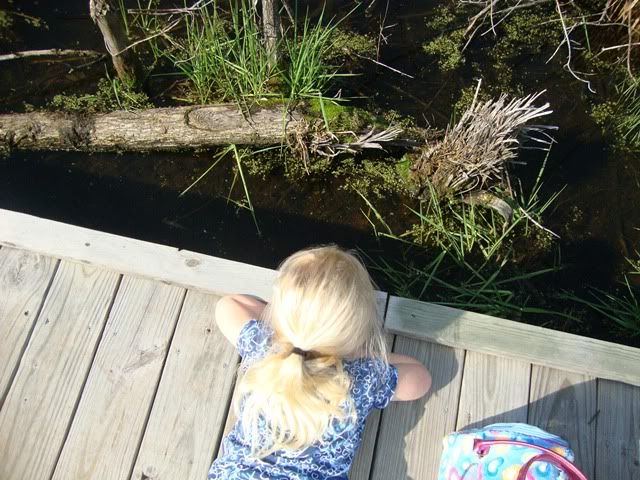
One of the first things we found along the trail was a pond with a boardwalk that allowed us to walk out over the water.
The Spring Peepers (Pseudacris crucifer) were screaming around the pond peripheries....which possessed a nice buffer of flooded woodlands.  These were the first Peepers I've heard this spring, although I've recieved reports of them calling for the past several weeks by colleagues (which is very early, by the way). 

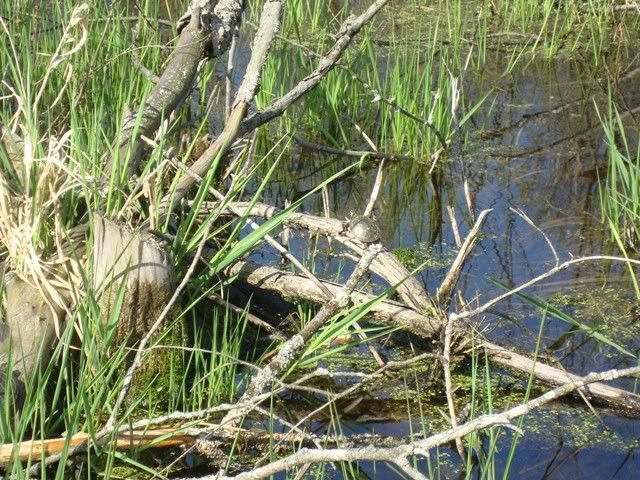
There were also Painted Turtles (Chrysemys picta) to burn in this little pothole scoured out by the glaciers.  It seemed that every available space above the water line, be it log, stick or clump of mud, had a turtle basking on top of it.  Some were even close enough to snap a picture of with a camera that has little zooming ability.

The best part, however, was peering down into the clear wetland water.  It teemed with activity, and we were obliged to get down and take a closer look.

 Water striders and other aquatic invertebrates were plentiful.  I even watched a leech swimming sinuously through the substrate.  But what drew our attention most were the amphibians.  It seemed that every square foot of real-estate was occuppied by large a tadpole.  Based on the fact that they were already sizeable this early in the spring, it's a no-brainer to assume they were a member of the Family Ranidae, and almost certainly Green Frogs (Rana=Lithobates clamitans).  Green frogs lay their eggs late in the summer and the tadpoles remain as tadpoles through winter, only to metamorphose in the following summer.  With the exception of the Bullfrog (Rana=Lithobates catesbeiana), all other frogs in our region have tadpoles that hatch and develop into froglets during the same season.  It's possible these were Bullfrog tadpoles, but they just didn't seem big enough to me.

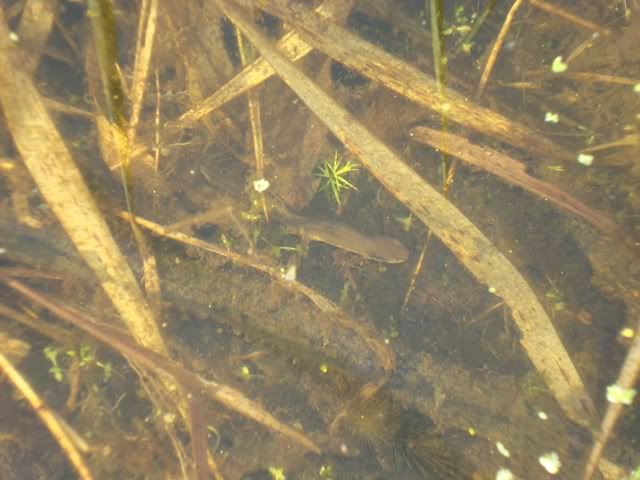
Anyways, the tadpoles were neat...but they dont' really move much.  They basically sat in one place, soaking up some of the rays penetrating through the water's surface.  Much more interesting to watch were the Eastern Newts (Notophthalmus viridiscens).  These little guys were fairly numerous as well, we could see them pushing through the leaf litter at the bottom of the pond, and occassionally swimming up to the surface.  As I've mentioned before, the newt is a most amazing amphibian.  It has several possible "phases" in which it can exist: an aquatic adult, a terrestrial adult, an aquatic juvenile and a terrestrial juvenile.  Basically, these phases are adopted depending on environmental conditions.  If the newt grows up in a wetland that doesn't dry out, they will go from an aquatic juvenile to an aquatic adult.  But, should the water levels receed, they are capable of transforming into a terrestrial adult, or a terrestrial juvenile.  The terrestrial juvenile is beautiful, and is often referred to as a Red Eft.

The individuals my daughter and I saw were adults, and clearly in the aquatic phase.

All of this information: the basking turtles, the tadpoles that need to over-winter, and the newts in their aquatic phase tells us something important (albeit not unusual) about this wetland: it rarely goes dry....or is not ephemeral.  If it went dry by the end of the summer, there would be nowhere for the turtles and tadpoles to overwinter....and the adult newts would have transformed from their aquatic phase to their terrestrial phase.
__________________________________________________________________________
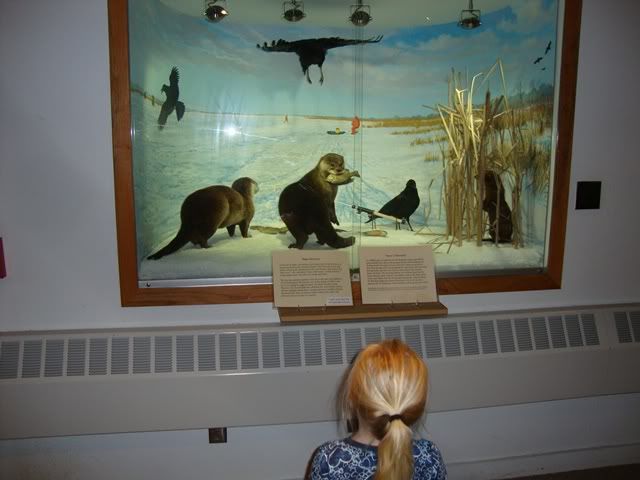
We passed the State Park's headquarters during our adventure.  They had a neat little museum, which we made use of, seeing that the kid loves to look at stuffed dead things (the reason she likes museums so much, I suppose).

A number of cool dioramas, including this rather comical scene of a pair of River Otters cleaning up the leavings of an ice fisherman (as a Mink watches from the cattails).

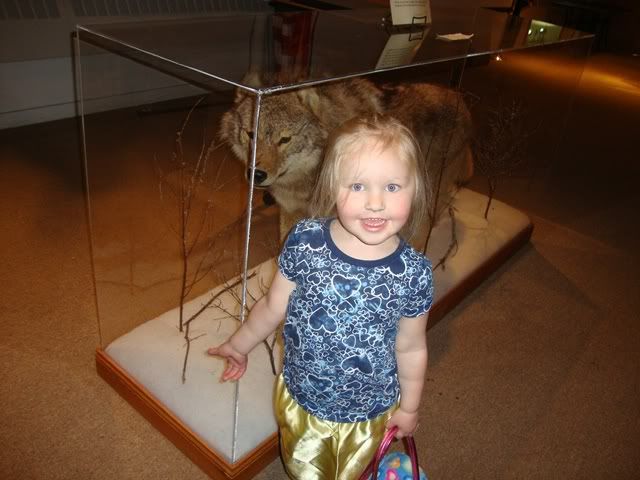
There was also a nice mount of a Gray Wolf (Canis lupus), which made for a perfect photo-op.

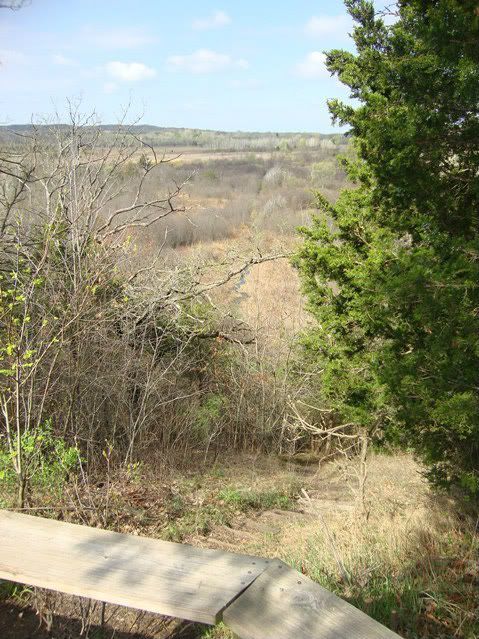
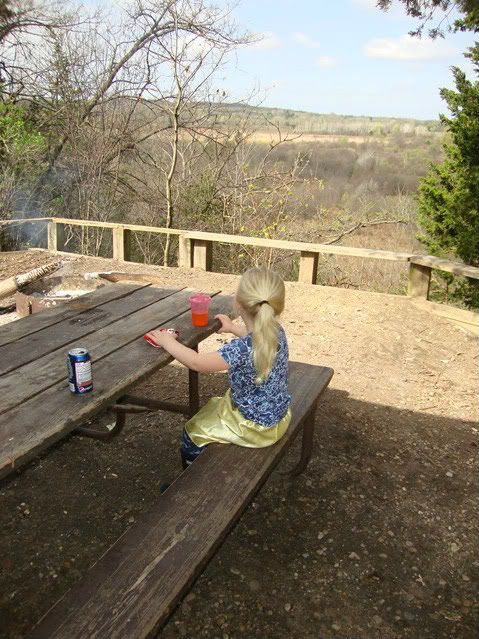
We walked on, and continued to follow the trail until we found a scenic overlook.  A decent-enough spot to stop for some juice and crackers.

...and of course...the rocky path provided many opportunities to lob some geologic protectiles down the hillside.

I guess it's hard to turn down an opportunity to throw a good rock.....

Saturday, June 25, 2011

Week's End Survey Round Up V: The Copperhead, the Peeper of Spring, and the Misfortuned Furbearers


Well, despite the theft of our survey equipment, this week wasn't all bad!

Let me start with another bit of scenery.

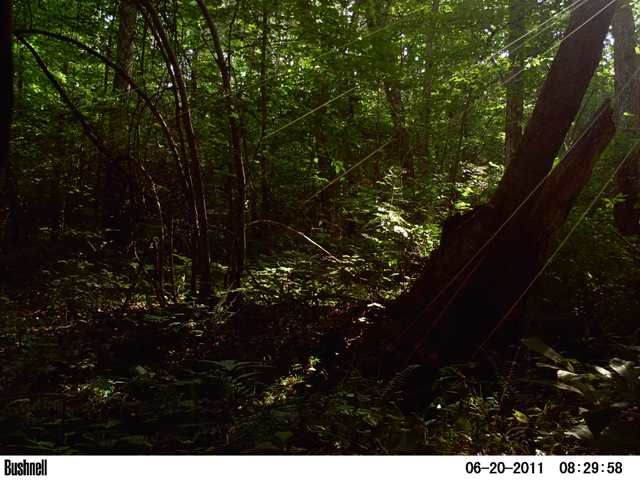
Surprinsingly, the location above resulted in another interesting scenic photograph (see last week's post). 

This one, however, is interesting because of the pronounced rays of light coming from the upper right.  I also find it interesting because if one compares this picture to the one taken at the same location only a week ago, you can get a feeling for how much variation there is in the appearance of photos on these cameras.

__________________________________________________________________________
The Juvenile Copperhead (Agkistrodon contortix).  We captured this little guy in one of our grassland drift fences.  He was in a funnel trap.  This is the fourth Copperhead captured in this particular drift fence since last August.  So, not very common.  I've posted about finding Copperheads before, and catching a venomous snake never really looses its thrill.  Plus, these snakes are gorgeous!  Juveniles have an additional dimension to their beauty: the tail   The tails of juvenile copperheads are a bright yellow-white (see below).

This is because juvenile Copperheads hunt using a strategy called caudal luring. Copperheads are ambush predators, so they sit in one spot and wait for prey to come by.....then they strike.  Juvenile Copperheads increase their chances of ambushing prey with the aid of caudal luring.  This is accomplished by moving their yellow-white tail-tip in a serpentine fashion so that it resembles a worm....or some other bit of prey.  This tail movement then attracts frogs and lizards (which are a staple food item for young Copperheads).  Once the frog or lizard is close enough, the baby Copperhead strikes.

For a great document that summarizes and investigates information on the ecology of the Copperhead, see Fitch (1960).

Above: the juvenile Copperhead captured in our drift fence this week.  Note the yellow-white tail tip.

Above: a nice head shot of the little Copperhead.  I'll say it again, they are a handsome-looking snake!
_________________________________________________________________________

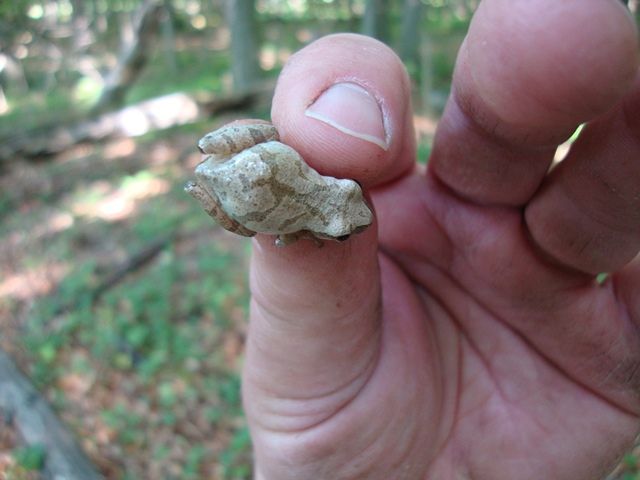
The metamorphosed Spring Peeper (Pseudacris crucifer):  It's the time of year when the amphibians species who laid eggs in the early spring are now having larvae metamorphose into tiny juveniles.  This week, for the first time, we started seeing froglets and tiny terrestrial salamanders.

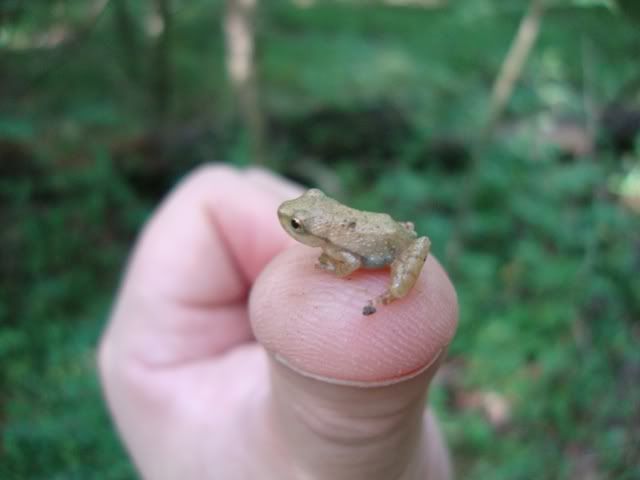
One example was this tiny Spring Peeper froglet that I captured while tracking Box Turtles with radio telemetry equipment.  I happened to look down just as the little critter hopped out of my way.  It took alittle effort to catch such a minute (and delicate) amphibian while not injuring it, but I managed.

These frogs are some of the earliest breeders in the state, along with the Upland Chorus Frog (Pseudacris feriarum).  I heard both species calling in the ephemeral wetlands on-site as early as February of this year.  This is only the second individual of this species that we've captured at this site.  The individual captured previously was an adult....so click on the link to see the difference in size from the juvenile pictured below.

Above: newly metamorphosed frogs are usually small, but they are even smaller for members of the Genus Pseudacris.  These frogs are diminutive as adults, and as juveniles....well you can see the size compared to my thumb in this picture.

___________________________________________________________________________

The D.O.R. Mink (Neovison vison).  A Dead-On-Road, or DOR, animal is something one never wants to come across.  It really puts a downer on the day.  So...if I'm not at risk of putting myself or others in danger...I try and at least get something useful out of the carcass.  I don't have the facilities to make mammals into suitable museum specimens, but if it is an uncommon species and the carcass is still in good shape...I try to at least snap photos, get location information, note associated habitat, and take some measurements.  I then send this to the appropriate regulatory and/or museum folks.

For herps....it's alittle easier (no skinning involved, you just need access to a chemical fixative and preservative and some jars).  I always try to make specimens out of the DOR herps I find, if possible.

Anyways, we saw this poor mink dead in the middle of the road as we drove to the sites this Monday.  It was killed near a stream-crossing....with a fairly dense wooded riparian (i.e., stream-associated) buffer.  The carcass was fresh and in good shape.  We got some photos of the feet, head and etc..

Also turns out, it was a female with enlarged nipples, which meant that she was nursing young nearby.  Those young may not have very good odds of survival anymore.

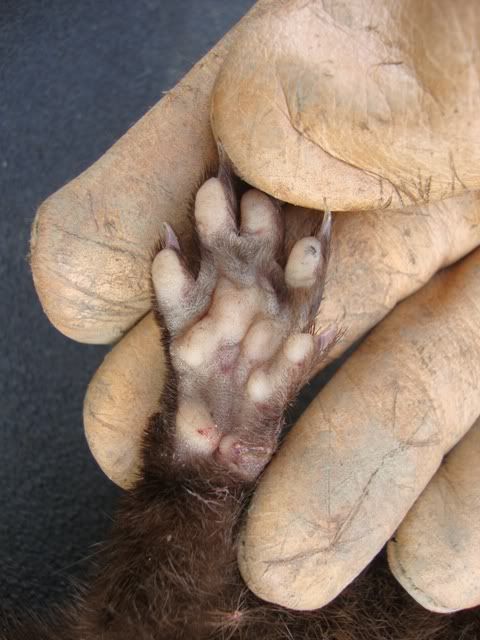
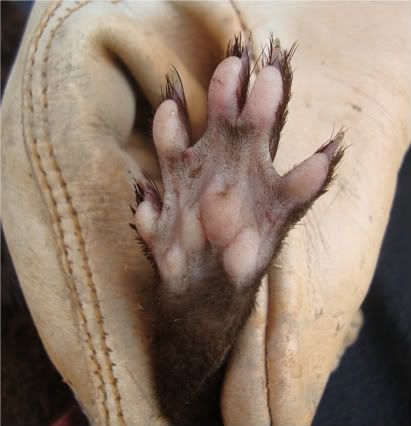
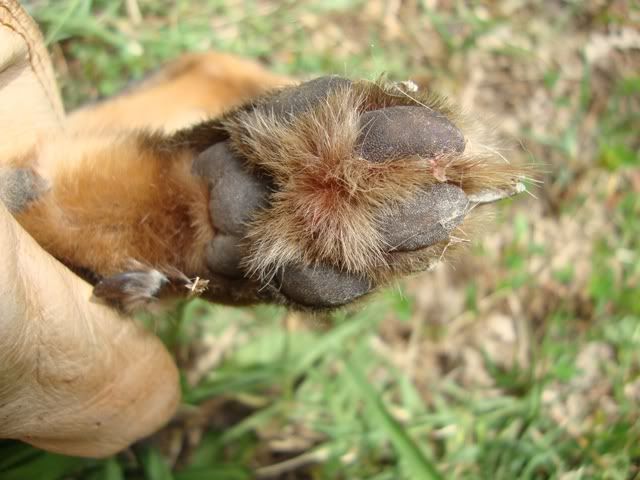
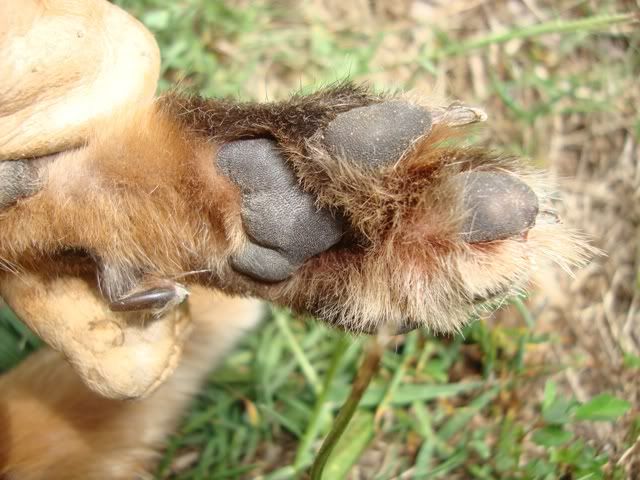
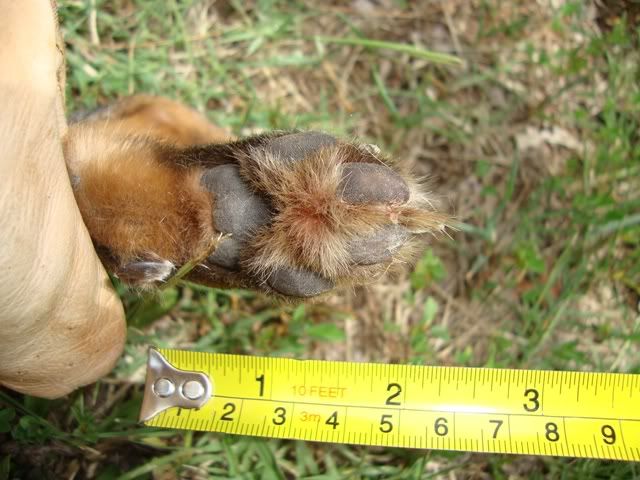
While taking pictures, I attempted to snap some of the critters feet (with Dave's help).  Having pictures of the feet really helps one see what they should be looking for when identifying tracks in the mud.

Thought I'd share the feet/paw pictures.

I'll post more information about Mink in the future....
Above: the right front paw of the road-killed mink.  Check out the slight webbing between the toes.  Also important to note is the shape of the inter-digital pad (i.e., pad between the toes).  It's that pad which gives mink tracks that crescent-shaped imprint directly below where the toes register in their tracks.

Above: The rear left paw of the road-killed mink.  Again, note the webbing and crescent-shaped inter-digital pad.  Also, five toes...but you may be able to see why one of those toes doesn't always make an impression.

_______________________________________________________________________

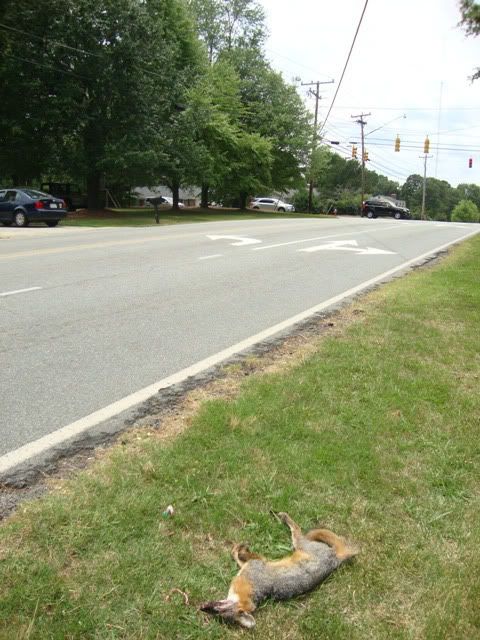
The D.O.R. Gray Fox (Urocyon cinereoargenteus).  The downside of being a wild animal in suburbia, is that you face mortality from a variety of sources that you otherwise wouldn't face in a more natural setting.  A great example of which is mortality due to vehicular traffic (see also Temple et al. 2010).  I'll post more specifics about carnivores in suburban lanscapes at a later date...but for now....I'll tell you about the road-killed Gray Fox we had the opportunity to see this week.

Above: the road-killed Gray Fox that we were told about on 6/23/2011.

This individual was not encountered at our normal study sites (nor on the road as we drove to our study sites).  Dave and I were working in the office one afternoon...data entry...data analysis....etc., when a colleague stopped by.

He told us of a freshly dead fox on the road not far from campus.  He said it had not been there in the morning, but was there now (several hours later).  He said it looked mostly intact.

Dave and I jumped up and hopped in my truck to check it out. 

Within about 30 seconds we found him......laying stiff in the road just about at the middle of a busy suburban intersection.  So busy, in fact, it had a stop light.  On one side of the road was suburbia...densely packed with houses.  On the other side was a large wooded buffer associated with a corporate headquarters of some kind.

We drug the little fella off of the road with garden rake and donned some gloves.  Took some measurements, got a GPS reading, and snapped some photos.  The body was pretty stiff with rigor mortis, but I was able to pry the legs apart enough to see that it was a male.  It was in perfect condition....the skull appeared intact...the pelt in good shape aside from being split along the shoulder and part of the front leg.  Would have made a fantastic museum specimen.  Unfortunately, I don't have a good facility to deal with a dead critter this large.

So we had to leave him there.  Seems like a massive waste, but we submitted our data to the state wildlife commission.

Among the photos we took were some good shots of the paws.  As with the mink, I think seeing the actual paws of an animal can be very helpful in learning to identify tracks in the wild.

The pictures below are all of the front right paw.  Due to rigor mortis, I couldn't get a very good shot of the back paws (and we were trying to do this along a busy roadway...so we were working quickly).

Above: in this picture, the pads of the digits (i.e. toes) are in focus.  You can really see the details of these pads, including the dermal pappillae (i.e. which essentially are the "finger prints" of this individual fox). 


Above: in this picture, the interdigital pad (closer to the heel) is in better focus and you can also see the dewclaw (near the thumb of my glove).  The dewclaws don't usually register in the track the animal makes.


Above: the same paw with a ruler for scale.  The Gray Fox really is a pretty small critter.
__________________________________________________________________________

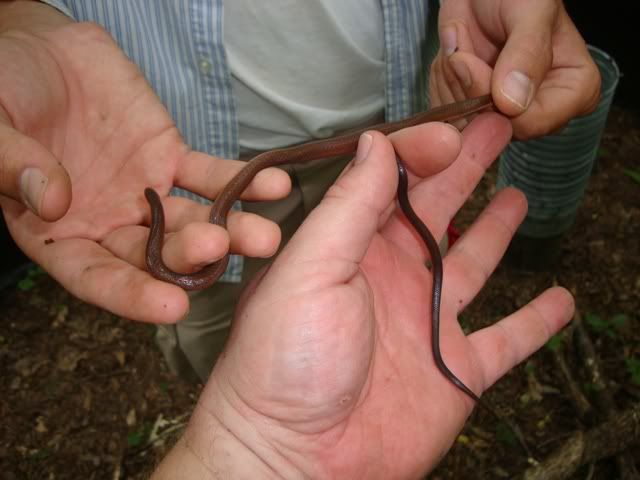
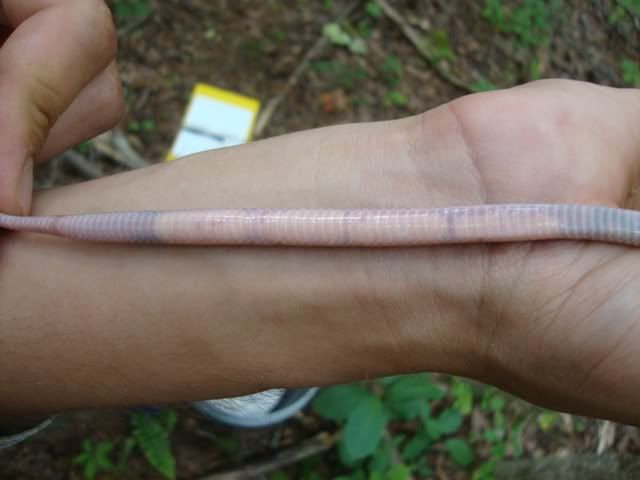
The Gravid Wormsnake (Carphophis amoenus):  This is a very commonly captured species at our sites, and I've reported capturing them in the past.  However, on Thursday we first noticed definitive evidence that the females at one of our sites are gravid (i.e. carrying eggs).  I had thought previous females looked as if they might have eggs....but the one we caught this Thursday has eggs that are clearly visible in the second picture below.  

It's that time of year for the egg-laying snakes and turtles!

Above: the gravid female and juvenile wormsnakes captured in an upland forest drift fence this week.  They were found in one of the pitfall traps.

Above: the whitish blobs in her belly (visible through her ventral scales) are individual eggs.  It appears she has four eggs ready to be laid.

____________________________________________________________________________

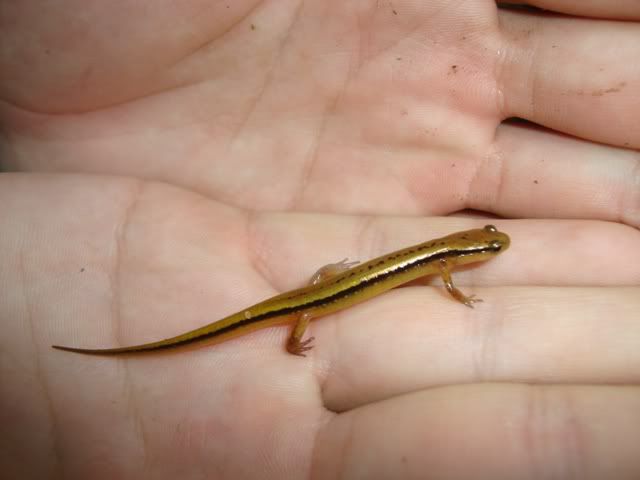
The Southern Two-lined Salamander (Eurycea cirrigera).  We captured this juvenile in a pitfall trap along one of our lowland forest drift fences.  It is the first time we've captured Two-Lined Sallys in the drift fences at this site (although we'd found them flipping rocks in the stream edge nearby).  We hadn't seen any this year at this site.  At our other site, we captured an adult in an upland drift fence back in May.

There's not much to add.....the pictures are just cool.

In addition, it's just another example of the juvenile amphibians we're seeing this week.


_________________________________________________________________________

The metamorphosed Spotted Salamander (Ambystoma maculatum).  You may recall that last week we were still seeing larval Spotted Salamanders (note: as larvae most salamanders are fully aquatic, breathing with gills and spending all of their time in water).  Last month we found many larvae in the ephemeral wetlands on-site, but slowly the numbers we captured began to dwindle, which meant they were metamorphosing (i.e. transforming from aquatic larvae to land-dwelling adults and leaving the water).  But until this week, we hadn't captured any juveniles that had metamorphosed and began living terrestrially (i.e. on land).

Finally, we captured a pair of them in the pitfall trap of a lowland forest drift fence.

Above: a small juvenile Spotted Salamander, just beginning his new life as a land-dwelling organism.

____________________________________________________________________________

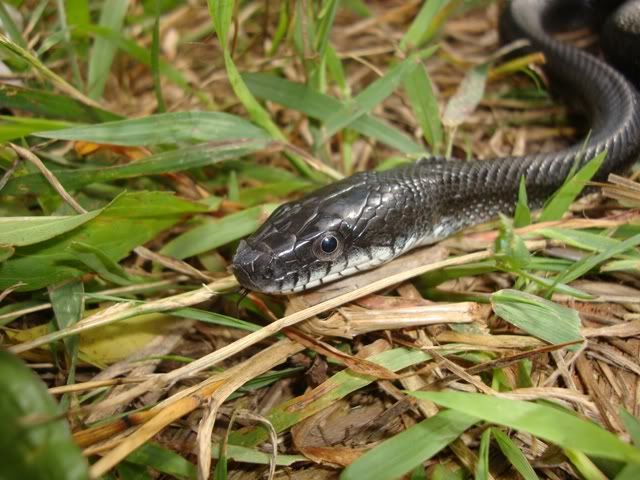
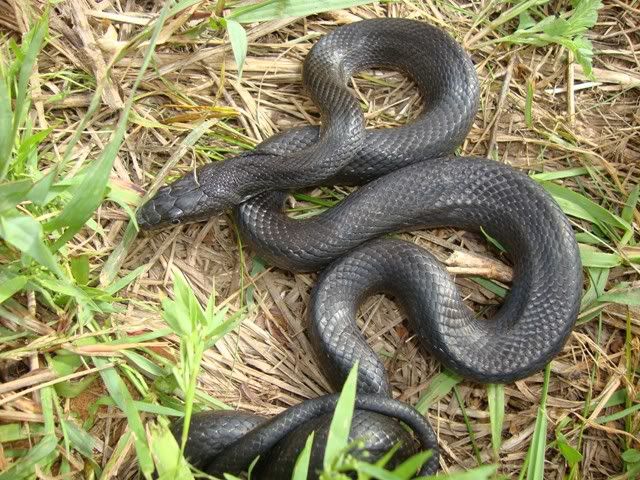
The Adult Eastern Ratsnake (Pantherophis alleghaniensis).  You may recall that we captured a juvenile Eastern Ratsnake a few weeks back in a lowland forest drift fence.  In that post, I made mention of how different adult individuals look compared to juveniles.  Well, here's another chance to see what I mean!

This adult female was captured in a funnel trap along a grassland drift fence at the same site that we caught the juvenile.

You can see, she's very black....no real discernible pattern.

A very cool snake!  Back home, these are very rare (listed as "Special Concern" by the Wisconsin Department of Natural Resources).  Here, they are one of the most common large constrictors encountered (I've even caught them in the university's "community garden" just outside my office door).

Funny what a difference geography makes.

Above: although it may be possible to confuse the Eastern Ratsnake with the Black Racer (Coluber constrictor), there are two basic differences that most folks can figure out.  (1) if its warm out, the Racer will be gone almost immediately after you see it....they are FAST....while the Ratsnake is a bit more pokey.  (2) if you can capture the snake (and you will probably get bitten in the process...trust me) look at the underside.  The Racer's belly is basically solid-black with the exception of the area around the chin.  Although it also has a white chin, the Ratsnake often has a "checkerboard" pattern along parts of the belly....not the solid-black scales of the Racer.

Hopefully, we'll have more to report from our surveys next week.  And hopefully we wont have any more camera thefts!
____________________________________________________________________________

Literature Cited:

Fitch, H.S. 1960. Autecology of the copperhead.  University of Kansas Publications of the Museum of Natural History 13:85-288.

Temple, D.L. et al. 2010. Spatial ecology, survival and cause-specific mortality of gray foxes (Urocyon cinereoargenteus) in a longleaf pine ecosystem.  American Midland Naturalist 163:413-422.