Showing posts with label Long-tailed Weasel. Show all posts

Saturday, August 10, 2013

The Frenetic Mustelid

I've been cam-trapping this property for about two years.  Just when I think I've got a very complete inventory of the species on-site, I get a surprise!

As we poured through the video footage from our cameras on-site, we saw this (from July 29th).... You may have to "maximize" the clip to see the critter.  It's sort of in the lower right of the frame and you can see the eye-shine in the shrubs a few seconds later.

...and this....(same date, lower left-hand corner now).....

Looks "weaselly" to me.  This also wasn't far from where I found Poor Ol' Slim dead on the road earlier in the summer.  So...weasels are a real possibility on-site.

There are also gillions of Eastern Cottontail clips (Sylvilagus floridanus), including babies, from this exact camera set.  They often move in and out of the shrubs where the weasel went.  I was desperately hoping for an awesome predation event on camera, but alas....it was not to be.

These clips were pretty cool, but the weasel only makes a brief appearance in each of them.

So, I was incredibly thrilled to see this video clip from July 31st.  Different camera on the same site.

I'm going with a Long-tailed Weasel (Mustela frenata) on the ID for this critter.  The tail appears to be at least 1/3 or greater of the total body length (you might have to maximize the clip size to see it).  The length of the tail suggests M. frenata.  If correct, this would be a different species than Ol' Slim, which I think was the Short-tailed Weasel M. erminea.

Weasels are always tough for me to get pics or vids of.  It's only happened once or twice before (see a previous post).  Having never seen any evidence of them on-site after about two years (no tracks in the snow nor other camera pics), I had given up on them for this property.

I guess....if nothing else....it really shows the importance of being patient and acquiring a long-term dataset when cam-trapping!

Friday, June 28, 2013

The Beaten Bear, Poor Ol' Slim, and a Size-13 Snapper!

A random conglomeration of stuff from recent happenings during summer field work.  There's been alot of things going on.  There's so much to share that I can't fit it into a blog post in any type of logical order.

We've been running the drift fences surveys since the beginning of May, which has resulted in many excellent captures (one of which is below).

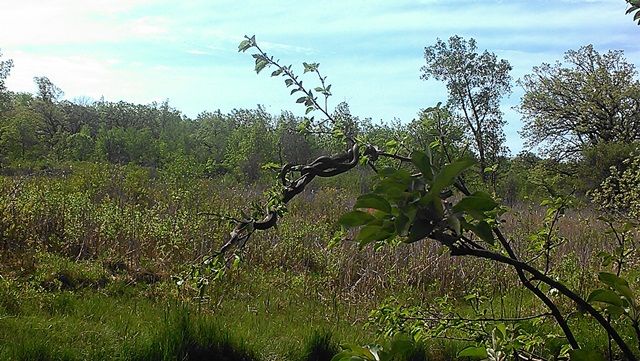
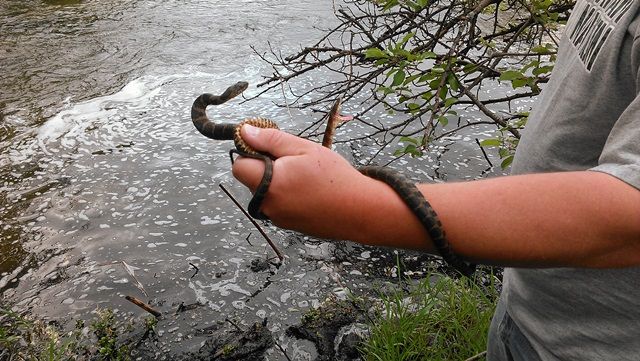
Yet, we also see cool stuff while we are walking out to our fences.  For example, there's an old gnarled tree that overhangs the creek near one of our fences.  Every day there are multiple Northern Watersnakes (Nerodia sipedon) hanging on the branches catching some rays.

Photo by N. Rudolph

They never really appreciate my grabbing them...and the result is usually a bit of drawn blood (as you can see on my hand below).  The bite looks much worse than it is, however.  They are non-venomous, and their teeth feel like nothing more than tiny pin-pricks.
Photo by N. Rudolph

The poor watersnake frequently suffers greatly at the hands of humans.  When the average person sees a snake near the water with a body pattern that is NOT similar to a gartersnake, they often think: "cottonmouth!" or "water moccasin!" and the snake is killed.  There are NO cottonmouths or moccasins in the upper Midwest, unless one inlcudes southern Illinois (and I don't think they do?). 

Amazingly, folks often argue with me about this!  Here are example responses I get to telling them it wasn't a cottonmouth they saw: "Nope, I saw a cottonmouth on that canoe trip.  There's nothing else it could have been." ...or..... "Well, I'm pretty sure that it was a moccasin that swam along the bank next to me while I was fishing." 

But, let me re-iterate: the snakes in my hand above are NOT cottonmouths/moccasins!  We do not have said venomous species 'round these parts.

BUT....none of this is even the point of my current post!  So, I'll get on with it....

_________________________________________________________________________

The Beaten Bear:

Below is an impressive and "battle worn" Black Bear (Ursus americanus) that the wolf researchers captured on one of the camera traps.

Take a look at the lip on the left side of his face (right at the beginning of the clip).  It looks to be torn....and his ears have clearly seen better days.  He must be a wily sort to have avoided the hunters all these years.

I wonder whom he had a run-in with to have acquired all of that damage?  Males compete for breeding rights, and perhaps his
I wonder whom he had a run-in with to have acquired all of that damage?  Males compete for breeding opportunities and perhaps this was from another male Black Bear?  They certainly run afoul of wolves, which may be particularly problematic when wolves have pups in the den. Hunting dogs are another possibility, I suppose.  But all of that damage is to the face and head.  Is this type of damage typical of such encounters?  Could the torn up ears be where identifying ear tags were yanked out?

I love a natural history mystery!
________________________________________________________________________

Poor Ol' Slim:

Poor Slim.....the unfortunate Short-tailed Weasel (Mustela erminea) that I found dead on the road not far from my house.  I caught a glimpse of it while my daughter and I were driving home one day....and I thought it looked like a weasel, so we had to turn around so I could pull over and snap a picture (it wasn't in good enough condition to turn into much of a specimen).

Slim is either a juvenile Long-Tailed Weasel (Mustela frenata) or an adult Short-Tailed Weasel (M. erminea), based on the size and the black tip on the tail.  The other weasel in our state...the Least Weasel (M. nivalis) has no black tail tip. 

Adult Long-Tailed Weasels attain average sizes (13-16 inches) and this individual is not that large.  Yet, this could be a juvenile Long-tailed Weasel....which would also make sense, seeing that the Long-Tailed Weasel is more common in the southern part of the state (where I am located) than the Short-tailed.  But the tail on this specimen looks to be particularly short. 

Hmmm.....

Another good mystery!

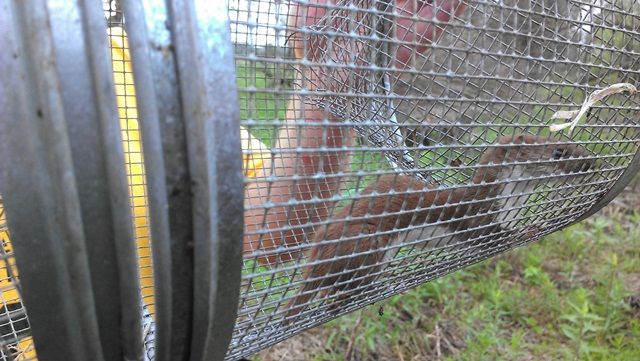
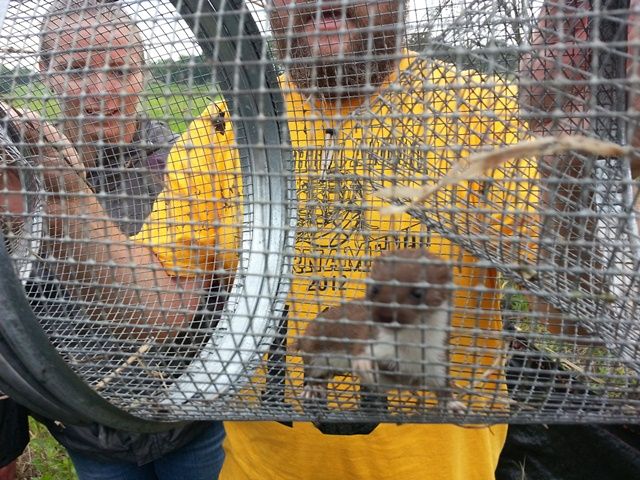
Fortunately, the summer hasn't been only negative encounters with weasels.  Below are pictures of a little Least Weasel my students and I captured in a drift fence a few weeks ago (note the lack of black-tip on the tail).  The drift fences are primarily for amphibians and reptiles, but we get just as many small mammals.  In fact, the hidden secret of this herpetological technique: it's probably just as effective and less work day-in and day-out for small mammals as Sherman Traps.  Although the fence takes alot of effort to install initially, there isn't the hassle of setting and re-baiting traps all the time.  Plus, we get many intectivores (Shrews) and the occassional weasel, which Sherman Traps aren't effective at catching.

I imagine these little carnivores are attracted to the fence due to the smell of vole, which we catch many of.  According to King and Powell (2007, The Natural History of Weasels and Stoats, Oxford University Press) the Least Weasel is the weasel that is the most narrow in its dietary preferences....eating almost exclusively on rodents and then focused primarily on voles (especially Microtus sp.).  I've caught Least Weasels on several occassions in drift fences in years past, so I wasn't totally shocked.  This is also not my first weasel post in the last year (see here).

But that doesn't mean I wasn't incredibly excited to see one!  The Least Weasel, in particular, is rare 'round here....so it was quite a treat!  Holding still is not the strong-suit of these frenetic little carnivores....so forgive the blurry pics (these were the best of about 30 attempts).
Photo by N. Rudolph

Photo by K. Rutzen
 
Photo by K. Rutzen
I love me some Mustelids.....

A Size-13 Snapper:

Mid-summer is when I often do most of my turtle trapping.  As part of survey work this summer, I've been trapping in wetlands with the hopes of catching some Blanding's Turtles (Emydoidea blandingii).  I've caught a few (as you can see)....

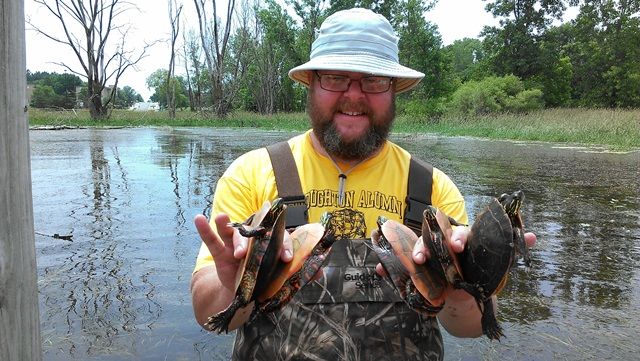
We also catch many, many Painted Turtles (Chrysemys picta)....

Photo by N. Rudolph
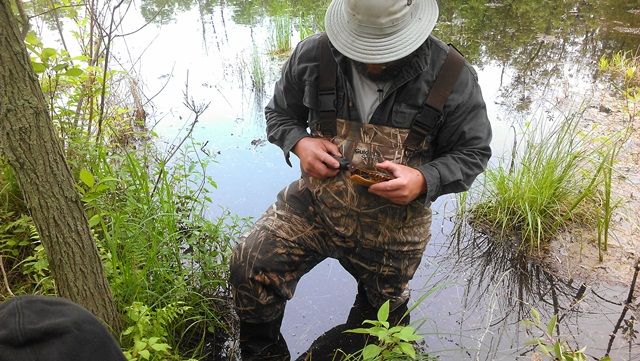
Frequently these are given a unique mark.  This is done by notching the edge of their shells in a certain order with a file or dremel tool so that we can identify the turtles in the future.
Photo by N. Rudolph
But, in addition to the Painted Turtles, I almost always also catch Northern Snapping Turtles (Chelydra serpentina).  In fact, I would not be shocked if just about every water body in the state (from tiny pond to giant river) has at least one snapper lurking in the depths.  The Northern Snapping Turtle (previously called the "Common" Snapping Turtle) rarely leaves the water.  It doesn't usually sit on logs and bask in the sun, like many other pond turtles.  It mostly remains unseen in the mud and muck on the murky bottom.  The females are seen more frequently on land during the nesting season, when they must traverse the dangers of an over-land movement to lay their eggs.  It's during these times that snappers must frequently head out into vehicular traffic.  Poor snappers.  Especially considering that people apparently swerve to hit turtles crossing roads.

Regardless, the Northern Snapping Turtle is one of my favorite turtles: ornery, cantakerous, dirty, smelly, mean-looking.....everything I like in a critter :)
Photo by N. Rudolph
This summer, we've been lucky enough to catch many snapping turtles, like the individuals above.  At one particular pond, I caught at least five individual snappers in a single night that had carapaces (upper shells) which ranged from 8 to 12.5 inches.  The one below is a prime example.....
 
But that one pictured above wasn't even the biggest captured this summer.

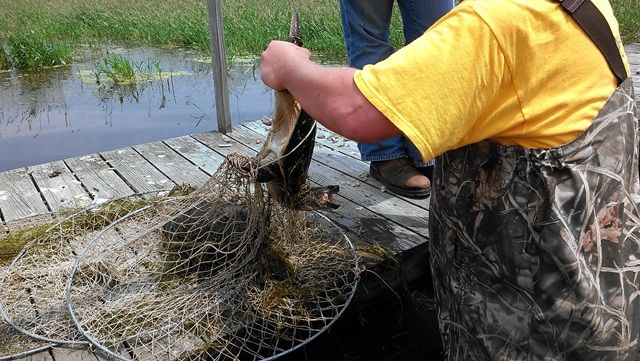
That prize belongs to the individual below.  To put this into perspective, the boot on my chest-waders in this photo is a size 13.

It would be nice if more snapping turtles could make it to this size (or bigger). 

I guess we have to start by getting folks to restrain from hitting them on purpose (I can't believe I had to actually say that). 

Next we can try and come up with ways in which the average person can avoid hitting them on accident.

-sigh-


Friday, January 18, 2013

Getting Rid of the Winter Blues: 2013 Edition


The time has come again.  The annual ice fishing trip with my high school buddies, which always occurs in January.  I've posted about this trip in the past (see here).  It's a great time, filled with laughs, reminiscing....and food (lots and lots of food). Our friend, Nate, is an outstanding wild-game chef...and we are spoiled by his cooking throughout the weekend.  It's always a trip to look forward to.

This year was a strange one, from a standpoint of local climate.  We are accustomed to very cold temperatures (-20 to -40 F is not uncommon) and lots of snow. 

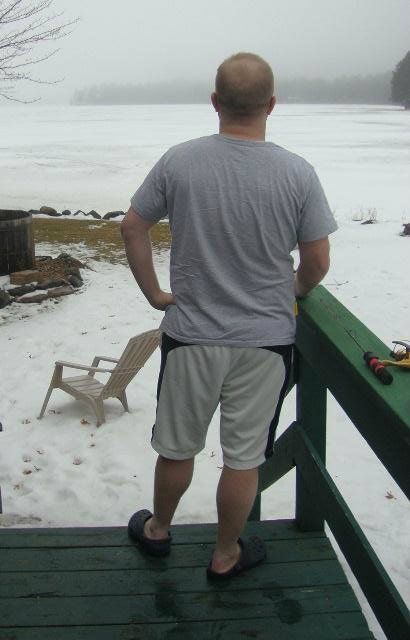
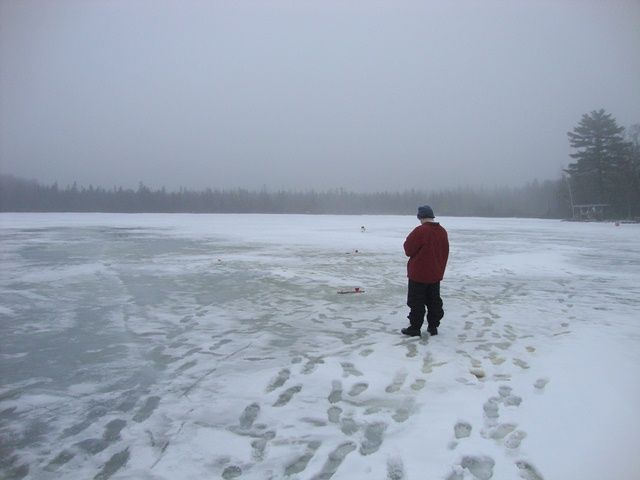
Justin and I arrived at the cabin early on Friday to a very different state of affairs.
Above: Justin assesses the situation on the ice (note the shorts and sandals)

Temperatures were in the mid-40s....the snow was melting, or had melted, and there was slush on what ice remained over the lake.  Shorts and t-shirts were tolerable on-site....at least for a half-hour or so....and then they were only mildly uncomfortable.  But...regardless...there was work to do.  First, the tip-ups (an important bit of ice fishing gear) had to be gathered for deployment. 

Typically, Nate checks all the gear over before we schlep it out onto the ice, but he and the others wouldn't be arriving for several hours.  So, Justin and I got to work drilling holes in the ice and setting out some of the tip-ups.

We also took some time to get a few camera traps hung in the woods.  I had three available for the task.  It's a fun endeavor and based on tracks observed during past trips I know there are weasels, fishers, fox, and bobcats in the area.  There's also Wolves that pass through, although they don't exist in as high of densities there as in other parts of the state.

But there was a lot working against the success of the cameras I set out.  For example, the short time frame (2 to 3 nights, at maximum).  Then, there's the typically harsh weather....which can result in some critters not moving quite as frequently.  Also, with such large areas of undeveloped land, there's a lot of space for critters to roam.  Thus, they are not concentrated on small patches of suitable habitat, as they are in the more developed and agriculture-dominated landscapes further south.  Finally, there's the fact that I don't want to tresspass and have a limited amount of land available to hang cameras in.

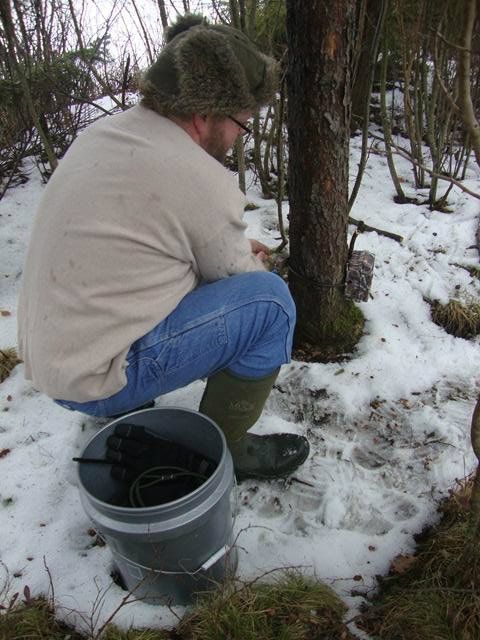
Yet, half of the fun is finding spots and hanging cameras.
Above: deploying camera traps.  Note the lite long-sleeved shirt and muck boots (not snow boots). 
It was warm out there!

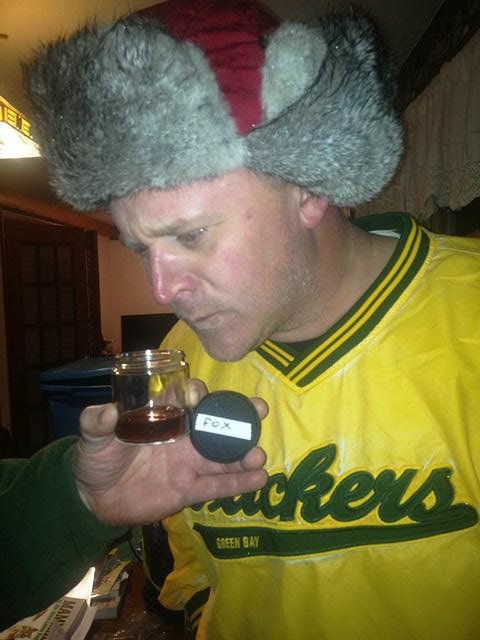
I decided to pull out all of the stops again this year.  I brought some scent lures, Fox urine and Beaver castor, and an electronic predator caller to deploy with one of the cameras.  We also had ample minnows (fishing bait) to put in front of the cams.
Above: "Let ME come to IT" instructed Andy when I asked if he wanted to smell fox urine. 
Apparently, there was concern I would shove it in his face.  When have I ever...?!

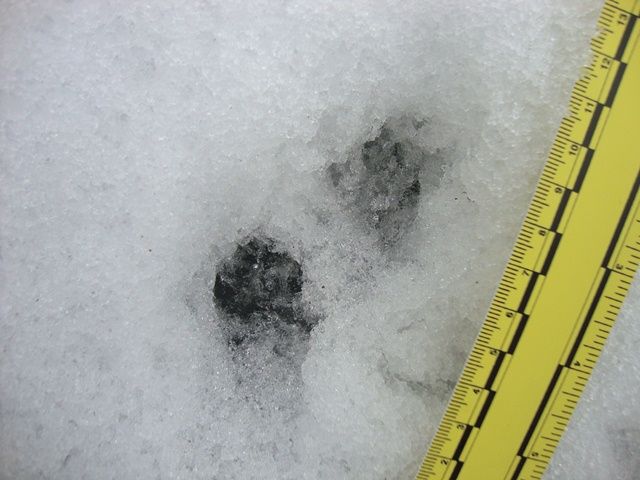
I've always had a soft spot for any members of the family Mustelidae (the weasels, otters, badgers, mink, etc.).  So I always try and find spots for weasels or fishers on-site.  I've seen their tracks in several of our past years at this location and this year was no different.
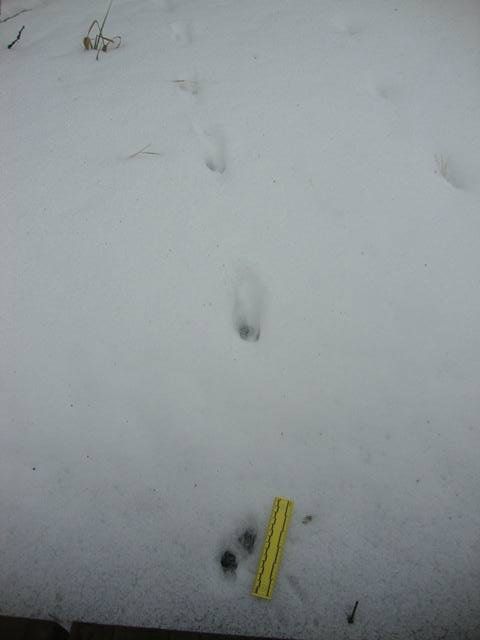
Above two pictures: notice the size of the tracks...I'm guessing either a Long-tailed or Short-tailed Weasel (Mustela frenata or M. erminea).  Also notice the "dumb-bell" pattern in the trail in the second picture,
created by the weasel's bounding gait.

So, the presence of the weasel tracks confirmed that our first camera location was good.  This set was located on a sort of peninsula separating the lake from a small backwater wetland area.  I hung the camera on a tree about where two breaks occurred in the trees/shrubs, creating easy paths that crossed between the wetland and the lake's edge.  Although I didn't see a large number of tracks...the snow was melting everywhere and I figured it was still a natural corridor.  This spot got a dab of beaver castor, smeared on a bit of alpaca wool (for a visual attractant) and a few dead minnows as bait.
Above: camera 1 location, facing the backwater wetland (past the shrubs in the current field of view)

The second location was along the dirt road heading out to the cabin.  The cabin itself is on another large peninsula and there is very little vehicle traffic on the road.  I always see lots of tracks here and can't resist mounting a camera.  This spot received a combination of beaver Castor, fox urine and some minnows.
Above: camera 2 location along the dirt road

The last location was selected based on seeing many tracks in the snow covering the lake in previous years (usually near our fishing holes).  I always find fox tracks and see the minnows we have accidentally dropped on the ice getting chewed up by morning.  Yet, in the past there has been a constant string of snow mobiles on the lake.  These make me nervous.  I worry that any camera I leave on the ice will be stolen or run-over. 

This year, however, the slushy conditions on the lake were not conducive to snow mobiles.  So I felt comfortable enough to put a camera on the ice (strapped to an over-turned 5-gallon pail).  I also strapped the speaker for the electronic predator caller on this bucket.  The remote control had a range of over 50 yards and I was able to stand on the porch of the cabin and trigger sounds day or night (usually rabbit in distress or a coyote howl).  This set also received a bit of fox urine and some bait minnows.
Above: Camera 3 location on day 2.  Resting on the ice facing the nearby shore.

It was not long before the others arrived.  Nate went through the remaining fishing gear to insure things were in working order.
Above: Nate gives the gear a once over, while Justin helps (apparently)

At roughly 9:30 pm that night....our first fish was caught: a very nice walleye.  Not sure why I didn't get a picture of it!  But, then the weather grew even more unfriendly, and it misted/rained for most of the evening.  This made the conditions on the ice even sloppier. 
____________________________________________________________________________

The next morning we awoke to a total slushy mess.  There was still 8 to 10 inches of ice over the lake, so it was completely safe.  But on top of that ice was a mix of ankle-deep water and melting snow.  I quickly discovered it was actually better to wear my muck boots than my snow boots as we drilled holes and deployed the remaining tip-ups.
Above: Justin, Nate and Chad hope for better ice conditions during Day 1 of the trip

That first full-day produced nothing but a few stolen minnows, an average-sized Northern Pike, and a very small walleye (that was promptly returned to the water). Furthermore, the strange weather conditions continued.  Over the course of the day, the temperature made complete 180 degree turn and dropped from the 40s down into the teens by that evening.  And so it was that we spent the second night waiting....playing Scrabble and cribbage....hoping for better luck on day two.
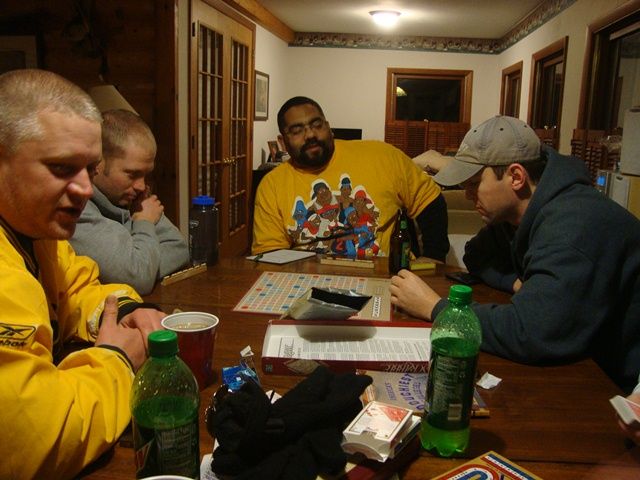
Above: Andy, Chad, Nate and Dan spend a quiet evening over the Scrabble board

_______________________________________________________________________
The sun rose on a very frigid second morning (hovering around 10 degrees F).  The slush upon the ice had frozen into a solid, smooth sheen that was treacherous to walk over.  With the drop in temperature, the ice on the lake started to thicken.  This resulted in a spectacular (and intimidating) sound that occurs when ice forms over a large area, like a lake.  As the ice expands, which happens with extreme temperature changes, stress cracks can occur across existing ice over a lake.  Because these stress cracks are transmitted and resonate through the ice, they can sound like a loud "boom".  Although it can be unnerving, it doesn't necessarily mean the ice is dangerous.....this sound is a result of the ice thickening, in this case.  It is an awesome sound.

So....we started the day by deploying our equipment as the lake sang around us.

We re-drilled our holes and set our tip-ups out again.....
Above: Andy and Dan re-setting one of the tip-ups.

Because of the cold conditions, we had to frequently re-check our setups throughout the day.  It was often necessary to remove new ice that formed in our hole around our tip-ups....and re-bait hooks that were robbed of their minnows by hungry fish.
Above: Chad breaks the ice away that has formed in the hole under a tip-up

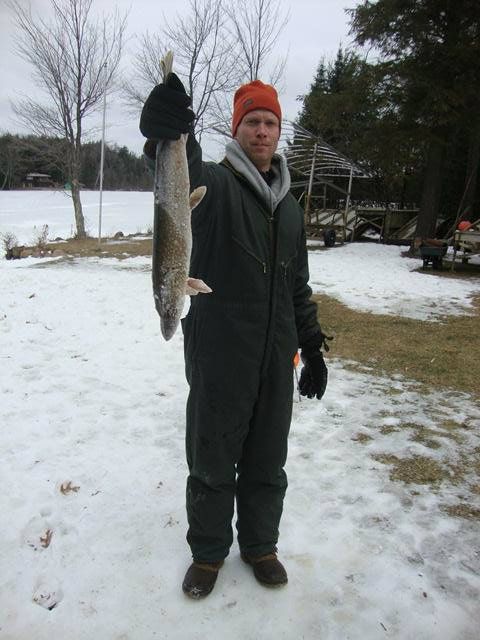
After a few missed opportunities....finally....success!  A 25" Northern Pike (Esox lucius)!
_________________________________________________________________________
Later that day, a flag from one of our tip-ups popped.  We threw on our gear and trudged out over the ice to assess the situation.  I happened to arrive first and saw that the line was going out quickly.  Not wanting to scare the fish, I carefully lifted the tip-up and handed it to Justin, who kept the lined spooled in as I quickly jerked the line to set the hook.  At that point, I began to gingerly draw the fish up towards the hole in the ice.....but he would have none of it.  On at least seven or eight occasions, we got the fish near the hole only to have it turn and run.  We always allowed it to do so.....hoping the fish would tire and be easier to pull through the ice, but it never seemed to happen.  It even once tangled into line on an adjacent tip-up!

Finally, it seemed as if we were starting to win the battle.  I could barely make out the end of the line coming up through the dark water.  The snow on the ice had melted so we were able to see through into the water below.  Chad was next to me as we got our first glimpse of the fish...and what a glimpse it was!  As the fish flashed its broad-side up towards us, there was no doubt.  It was a Muskellunge....a Muskie......the dragon of the inland waters! 
A Muskie (Esox masquinongy);
Photo Source: Sport Fishing Americas


The Muskie is a relative of the Northern Pike, but can grow to massive sizes.
Photo source: Outdoor Life Blogs

We later "guestimated" that it was 35-40".....nowhere near a size worth bragging about.....but that didn't diminish my excitement.  It would be the first Muskie I'd ever caught.  I've had one or two on the line in the past (accidentally hooked them while fishing for Northern Pike), and never landed one. 

After getting the fish close, however, it reminded me of my naivete.  He rolled to his side and turned his giant baleful eye towards me through the hole in the ice, looking more like a mythical beast than a fish. 

He apparently did not like what he saw.

With one lazy shake of his head, the line snapped and he was gone.  The tip-ups we had deployed were not geared towards catching Muskie.  But at least we went away with a good story to tell!
_________________________________________________________________________

The rest of the day was a lazy one......
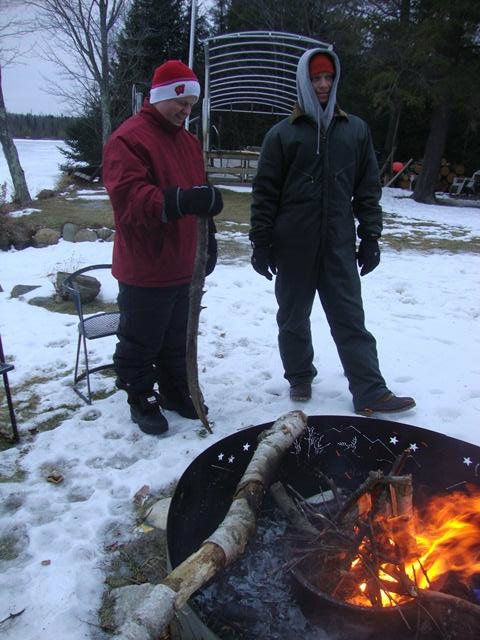
Above: Justin and Chad show us how to relax around the fire

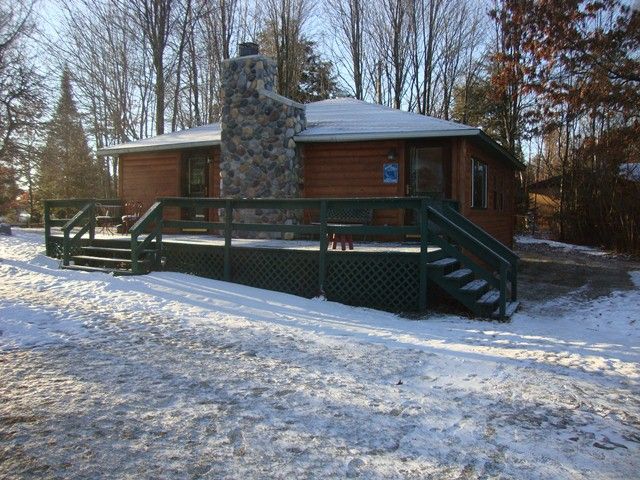
And all too soon the next day was upon us and it was time to say farewell to the cabin for another year.

Unfortunately, all of my efforts with the camera traps yielded no wildlife!  The strange weather and short time-frame are all I can blame.  This was very similar to my camera haul last year at the cabin.

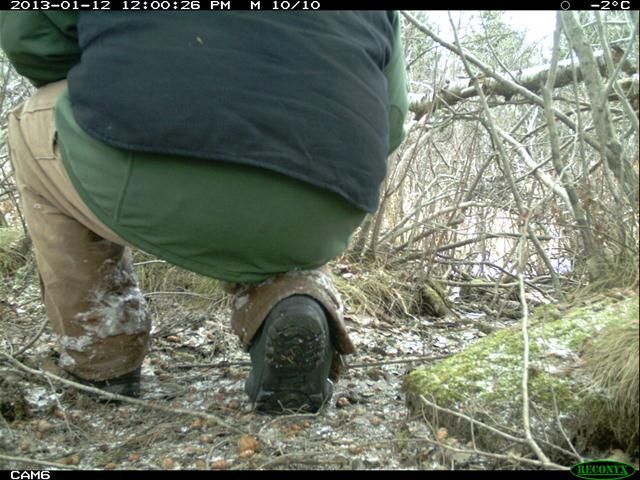
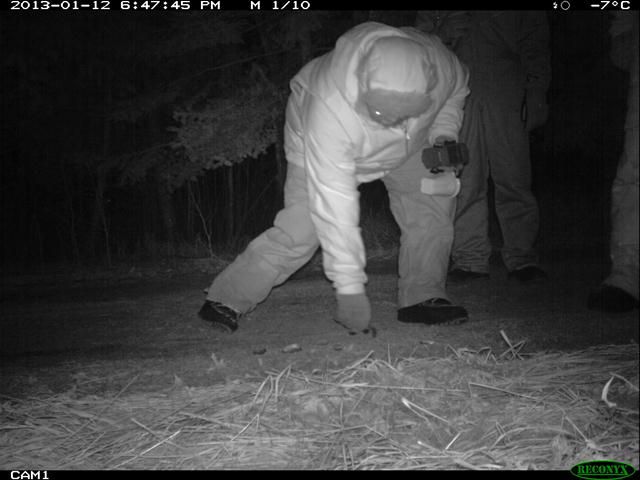
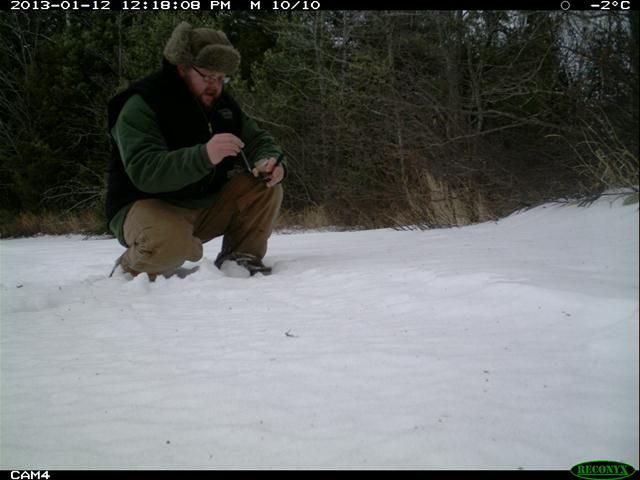
Camera one didn't take a single picture of anything but me.....

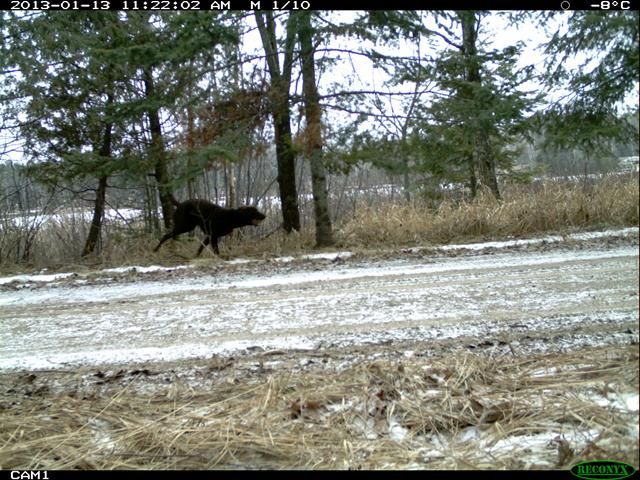
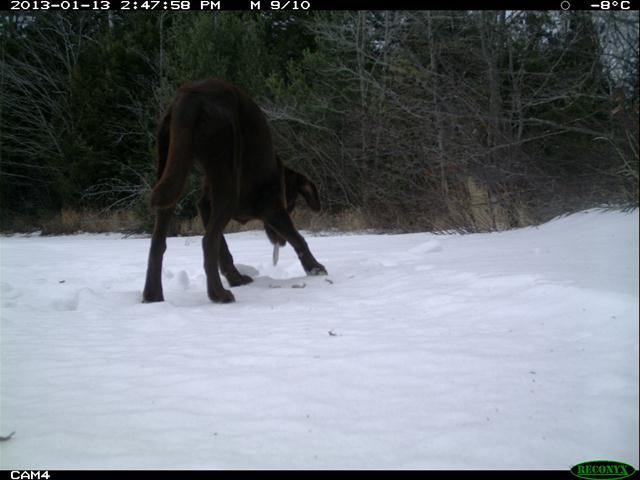
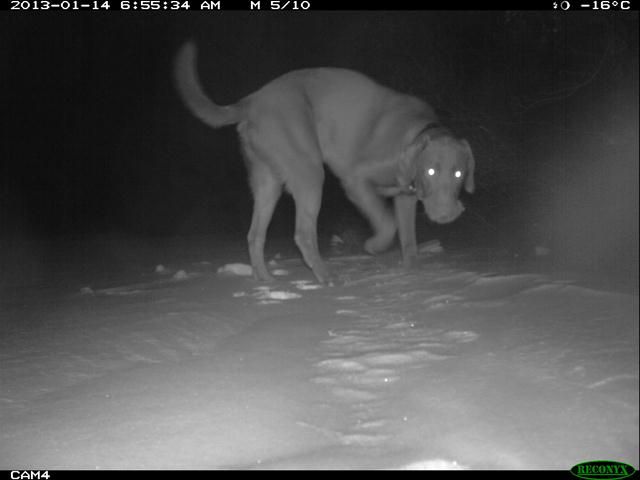
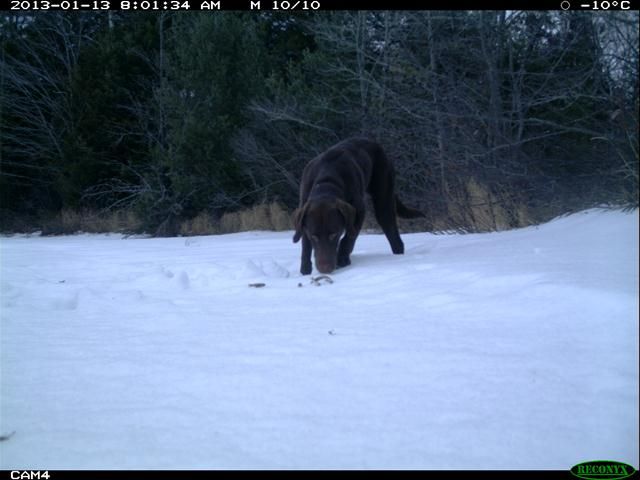
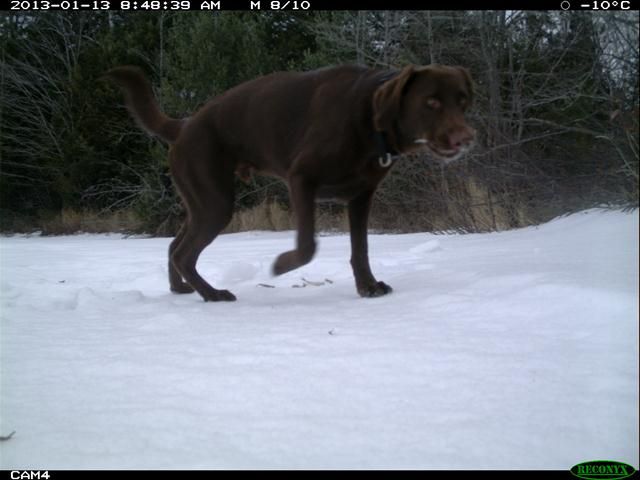
Camera two snapped a few pics of Hank (Nate's dog).

It's possible that Hank played a small role in the lack of success on camera three.

Watch the time stamp and know that I have a pile of bait minnows in front of this camera.

Bad dog, Hank!  :)

And so our time at the cabin ended for the 2013 ice-fishing season. 

We always (always) have a good time, regardless of how many fish we catch or pics of wildlife I get on my cameras.....and I already can hardly wait until next year.

Saturday, October 13, 2012

A weasel on the stink poles....

Mustelids are my personal "Holy Grail" when it comes to camera trapping.

For years I have went the extra mile for pictures of otters, mink, fishers and weasels.

Usually, my efforts go un-rewarded (they are a difficult group to camera trap 'round these parts!)....and although I've had some success with otters and mink, the others have eluded me.

Occassionally, though....one gets lucky.


I *believe* this is a Long-tailed Weasel (Mustela frenata).  Unfortunately, the animal is pretty far away, but there are a few lines of evidence that would suggest M. frenata to me.  This species is slightly larger than the other weasels found in our area: the Short-tailed Weasel (M. erminea) and the Least Weasel (M. nivalis).  They can reach lengths of 18 inches and, based on the distance this one is from the camera (which would be about 15 ft), the size would indicate it's a Long-tailed.  Furthermore, according to Long (2008), the tail has a very distinct black tip, which is fairly obvious from these clips.  Now....the Short-tailed Weasel also has a black-tipped tail, but it is generally not found this far south.  Furthermore...and also according to Long (2008)......if the tail length is 1/3 or greater of the body length, it's a Long-tailed.  From what I can tell in this video clip, the tail length conforms with what I'd expect for M. frenata. 

Yet...there is one more wrinkle in all of this. 

This part of the state is also the unnatural home of a Mustelid introduced from Europe: The Stone Marten (Martes foina).  It was believed to have been introduced by a fur breeder in the '40s, and although apparently established, is not common.  For example, reports have trickled through that a few have been captured annually for roughly the last 15 years (Long 2008).  The Stone Marten's dorsal and ventral surfaces (or back and belly) are concolor (or...of one color), although, the limbs and tail fur is apparently slightly darker than the dorsal fur.  All three weasel species native to the area are bicolored (of two colors): with a brown back and a cream or buff belly.  Stone Martens do have a striking white patch on the throat, but no black-tipped tail.

It's hard to see for certain in this video, but I don't believe there is an obvious white patch on the throat of this animal...and it also doesn't appear that the belly/back are the same color.   Then...of course....there's the fact that the individual in these clips has a black tail.

Anyways.....I'm leaning towards Mustela frenata.

People are not kidding when they refer to weasels as bundles of energy.  Look at that thing go!


They have to be that quick if they want to catch some of their preferred prey items (which are also very quick) and avoid being eaten themselves.  Weasels prey upon many types of small animals, ranging from insects and snakes to small mammals.  Yet, rodents are often a favored dish.  In fact, they so frequently dine upon mice, that this behavior is even reflected in their genus name (Mustela), which translates to "one who carries off mice" (Cold 1998).  Long-tailed weasels are excellent examples of dietary generalists, and apparently readily switch to alternate prey when normal prey densities are to low.  According to a review by Sheffield and Thomas (1997) these generalist behaviors have resulted in their relatively stable populations.

Another cool thing about weasels and their relatives is that they don't shy away from bigger fare.  They are well-known to take down an animal as large as a cottontail.  Check out this footage of a "Stoat" from BBC's oustanding series LIFE, which includes a stunning series of one killing a rabbit (warning: this footage may be too intense for some viewers, but it is amazing!). 

Note: "Stoats" are apparently the common name used for Mustela erminea throughout the rest of the world, although in North America we refer to it as the Short-tailed Weasel (King and Powell 2007).

So....no question: weasels are very neat little critters.

I have never actually seen a Long-tailed Weasel before.  I've encountered Least Weasels several times in the past.  Well........I'm assuming they were Least Weasels given the fact that Leasts are found in the southern part of the state and like grassy or marshy habitats/forest edges where I encountered these (Long 2008). 

The weasels that I encountered were captured.....basically by accident.  They were all captured in funnel traps that I had along drift fences to catch snakes (this would have been back in 2006-2007).  We had been running these surveys for an entire summer and had been catching many small rodents in the funnel traps, in addition to snakes.  Then...suddenly....for a breif period (maybe a week or two), I caught four Least Weasels spread across two sites.

Two were completely alive and kicking (in fact, they basically ran circles loop-de-loop style inside of my minnow traps when I picked them up).  They were gone in the grass the second I opened the trap.

One, unfortunately, was dead upon my arrival (died from exposure), which I felt terrible about. 

The last individual appeared dead (at first) when I picked the trap up.  However, closer inspection revealed that he was still alive, but appeared groggy and suffering from stress/exposure/dehydration.  I didn't know exactly what to do...and of course I had no special gloves or anything with to deal with a critter like this.

But...against sound judgement.....I took it back to my car (in the trap).  I found a pair of extra socks in my car and placed the weasel inside one of my socks so that his head was poking out.  Then I poured a bit of water into the bottle cap from one of my water bottles and barely touched his chin with the water.  Immediately, the weasel started lapping the water up.  I continued to fill the little cap as long as the weasel would drink....and quit when he sort of coughed/sneezed a bit from the water. 

I tried to come up with some sort of a plan for this little guy.  He was still groggy (eyes closed), breathing seemed regular.....but he was listless.  I called a nearby vet clinic, but they said that they didn't deal with injured wildlife.  They told me to contact the Humane Society in the area....which I did only to find out they were closed.

So, there I was....with a sleepy-looking weasel in one of my socks on the front seat of my car.
Not knowing what else to do, I waited.  Eventually, the animal seemed to start perking up.  He opened his eyes, became semi-alert and looked like he might want to move.
At this point, I took the critter (in the sock) back out to the field location near the drift fence.  I found a nice protected spot under a dense growth of dogwood and placed the weasel there (in my sock).  I watched for a minute...but decided I didn't want to stress the animal out any more...so I walked away.

Several hours later, I came back to find my sock laying there....uninhabited.

I hope that means the little weasel went safely on about his way.


Literature Cited:

King, C.M., and R.A. Powell. 2007. The Natural History of Weasels and Stoats: ecology, behavior, and management. Oxford University Press.

Long, C.A. 2008. Wild Mammals of Wisconsin. Publication No. 65 of the Museum of Natural History, University of Wisconsin-Stevens Point. Pensoft Publishers, Bulgaria.

Sheffield, S.R. and H.H. Thomas. 1997. Mustela frenata.  Mammalian Species no. 570.  Published by the American Society of Mammalogists.