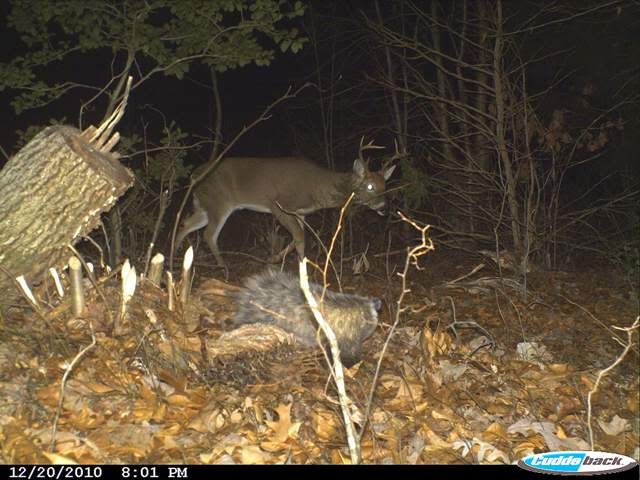
Because of this, I was relatively surprised to see these pictures...taken by one of my North Carolina camera traps about a year ago.
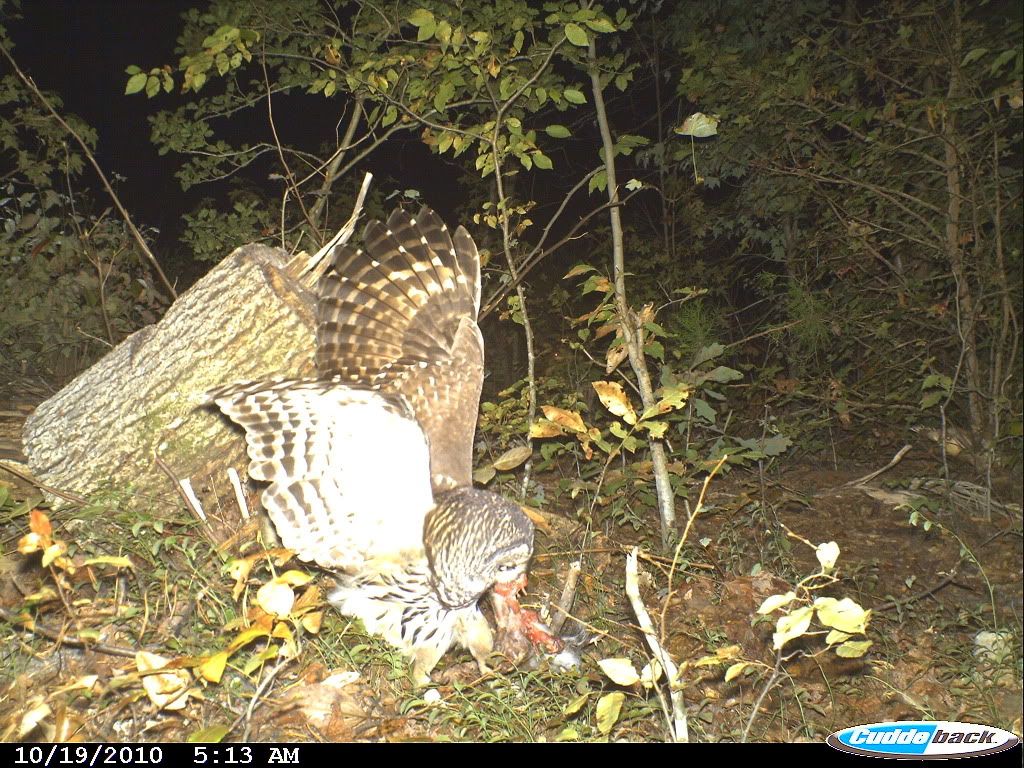
A colleague at the university had brought me a freshly dead road-killed squirrel. He gave it to me thinking I'd turn it into a specimen (it was in good shape). Although the thought crossed my mind, I didn't really have a good facility set up for dealing with skinning mammals and making specimens from them. I decided the best use for this carcass was as an attractant in front of one of my cameras.
There is a tendency to just throw bait like this down in front of the camera and hope for the best. However, raccoons were rampant at this site....and although this particular camera set was "high and dry"....and not along a stream corridor....I knew raccoons would find it all the same.
So, I wired the carcass to a wood stake, which I drove into the ground in front of the camera.
I also put a spray of coyote urine on the stump and a small dab of gland lure (including some good old essence of skunk) near the stake with the carcass.
I was hoping for Coyotes.
But...that's not what I got.
There was the standard cast of characters (white-tailed deer, oppossum, raccoon, gray fox, etc.).
But I was not expecting the Barred Owl (Strix varia) that showed up and tore into the carcass.

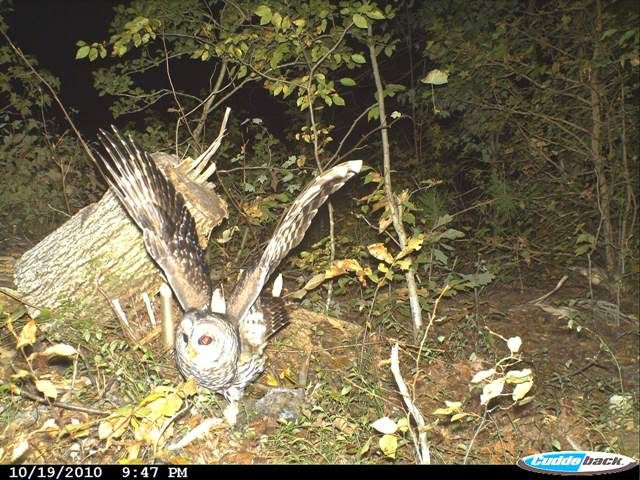

The individual (or individuals) pictured above came to the carcass roughly 5.5 days after we estimated the squirrel had died. Between the morning and the subsequent evening of October 19th, we recorded pictures of Barred Owls (or a Barred Owl) over a 250 minute time period! An Owl also showed up on the evening of October 20th, which would have been roughly 7 days after we estimated the squirrel had died!
___________________________________________________________________________
Later, I drug the ribs and spine of a roadkilled white-tailed deer to the site and got STILL MORE Barred Owl pictures!
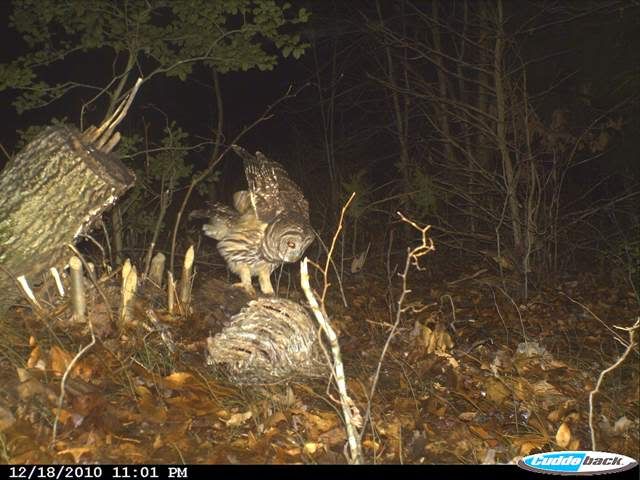
The carcass was deployed on December 17th, and the first Barred Owl showed up on the 18th. On December 30th, another picture of a Barred Owl on the carcass was obtained.
__________________________________________________________________________
Substantiated reports of Owls (especially Barred Owls) eating carrion are uncommon in scientific literature. Owls are known for to store food...so they aren't adverse to eating dead things. However, finding a dead thing that YOU killed and hid yourself seems different than actively searching for something that's already dead. Dead things don't exhibit the visual and auditory cues that I'd assume owls use when hunting. So, perhaps carrion-feeding is purely opportunistic.
Many reports of owls injured along roadsides occur annually. It is usually assumed these individuals are hunting along roadsides. But....several anecdotal reports exist that mention Barred Owls on roadside carcasses (apparently) feeding. I wonder how many owls injured on roadsides are actually scared when feeding on carrion and get whacked by a car when they try and flee.
Further Readings on Owls and Carrion Feeding, or Studies on Scavenging Rates:
DeVault, T.L., and O.E. Rhodes Jr. 2002. Identification of vertebrate scavengers of small mammal carcasses in a forested landscape. Acta Theriologica 47:185-192.
DeVault, T.L. et al. 2003. Scavenging by vertebrates: behavioral, ecological and evolutionary perspectives on an important energy transfer pathway in terrestrial ecosystems. Oikos 102:225-234.
Diaz-Ruiz, F. et al. 2009. First record of rabbit carrion consumption by Eurasian Eagle-Owl (Bubo bubo) on the Iberian Peninsula. Journal of Raptor Research. 44:78-79.
Eckert, A.W., and K.E. Karalus. 1987. the owls of North America. Weatervane Books, New York, USA.
Hiraldo, F. et al. 1991. Unspecialized exploitation of small carcasses by birds. Bird Study 38:200-207.
Kapfer, J.M., D.E. Gammon, and J.D. Groves. 2011. Carrion feeding by Barred Owls (Strix varia). The Wilson Journal of Ornithology 123: 646-649.
Kostecke, R.M. et al. 2001. Survival of avian carcasses and photographic evidence of predators and scavengers. Journal of Field Ornithology 72:439-447.
Prosser, P. C. Nattrass, and C. Prosser. 2008. Rate of removal of bird carcasses in arable farmland by predators and scavengers. Ecotoxicology and Environmental Safety 71:601-608.