The benign adventures and ponderings of a wildlife ecologist who is interested in old school, down-and-dirty field research. Not cutting edge, but occassionally forced to blaze a trail when in the outdoors.
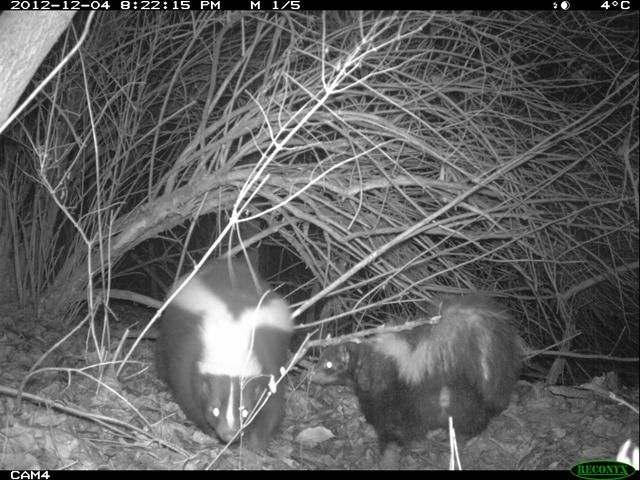
During the week February 20th, we saw evidence of active Striped Skunks (Mephitis mephitis) for the first time since December.
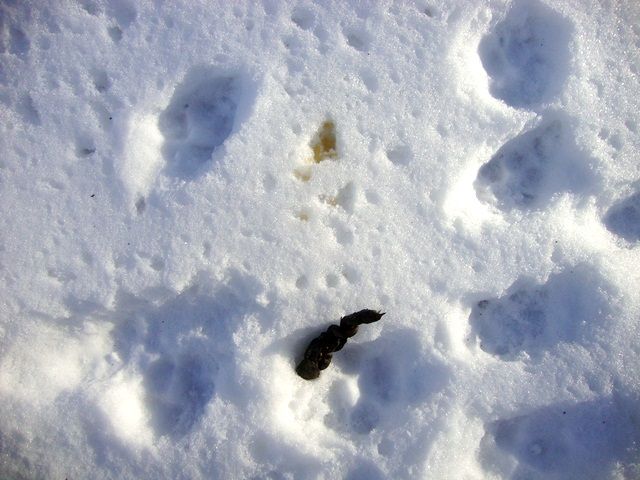
For example, while out and about with my advanced ecology students, I found some nice tracks.
These are some of the better skunk tracks I've come across. As Halfpenny and Biesiot (1988)mention, skunks have a plantigrade print. In other words, as they walk, their flat foot (heel and all) comes entirely into contact with the ground. Contrast this with the digitigrade tracks of canines, whom basically walk on their toes (or digits....see the fox prints below and elsewhere on this blog). Skunk tracks can be fairly easy to identify, if you get a good print, due to the chunky-looking pads on the heel and ball of the foot (which are clearly separated from eachother). Yet, Halfpenny and Biesiot also also state that skunk tracks are often "indistinct due to the sloppy walking and long hairs on the feet".
So, I felt fortunate to find such nice prints.
The last good evidence of active skunks on-site was a brief glimpse during our first snow-storm of the winter (seen below investingating an old burrow) back in late December.
Prior to that, it was early December. This was an also during an uncharacteristically warm beginning to the winter.
But...now they are on the prowl again. February can be an important breeding period for them 'round here. Interestingly, it is also the same time (within a couple of days) that I first got pics of them active in 2012 at this site (see here).
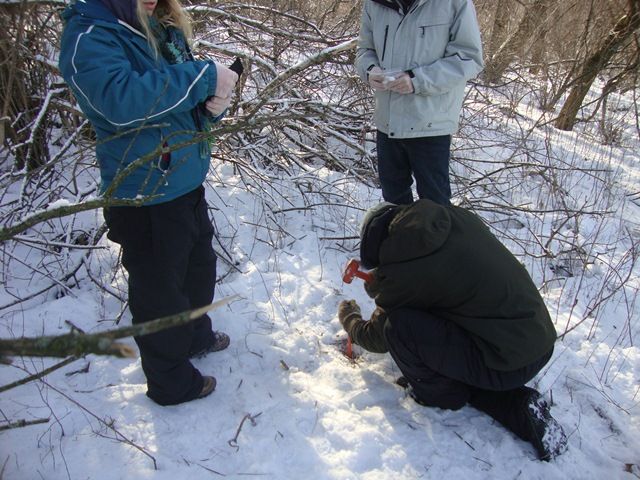
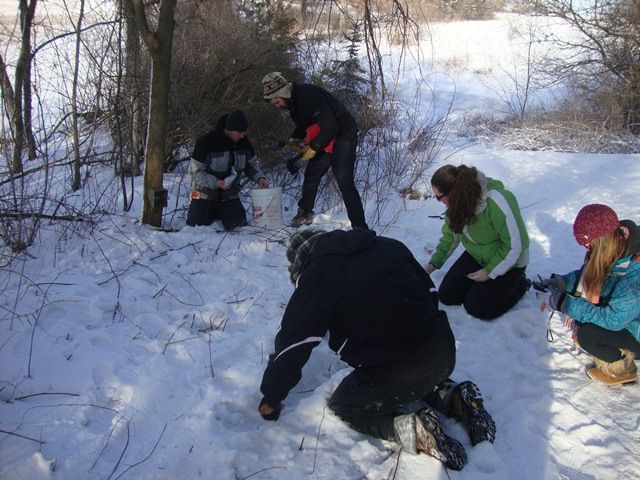
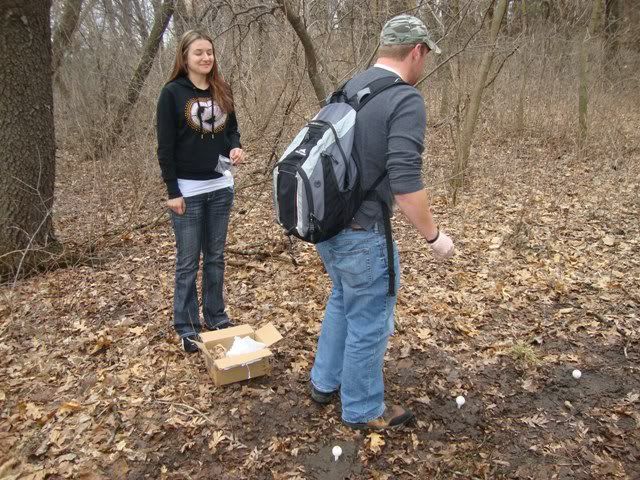
The students were also setting up some scent stations last week during "lab" (outdoor lab, that is....indoor labs give me a case of the BORINGS! :) ). This is similar to the experiment we set up last year.
A good indication that you've found a decent spot is the presence of scat....tracks....or a urine mark. So, how about all three?!
I'd say that if a Red Fox (Vulpes vulpes) decides to leave that much sign around, it's a good spot for a camera set and scent station. An interesting thing to note: look at how small that urine spot is? Probably not alot of urine deposited when marking that location. Do you y'all think that might give a good indication of how much scent one should put down to attract fox?
This year, unlike last year, frozen ground was a force to be reckoned with.
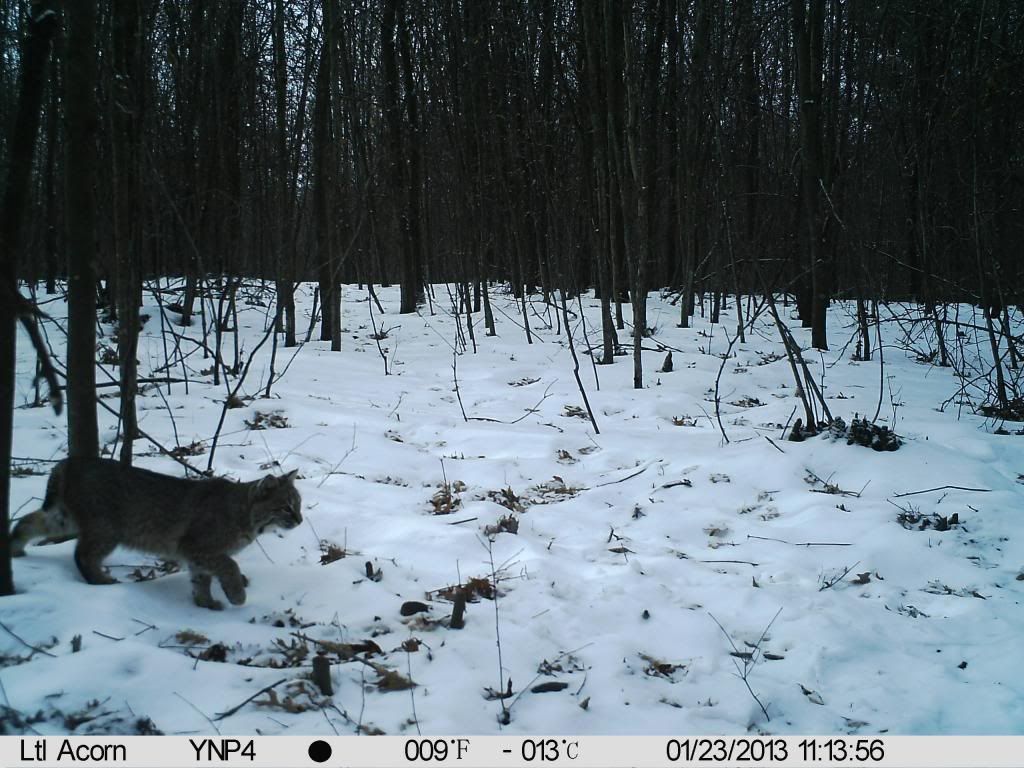
There are lots of reasons to celebrate getting pictures of a Bobcat (Lynx rufus). In fact, a picture of any feline that isn't a feral puddy tat is cause for celebration.
Bob-tailed Cats are not rare in some parts of the upper Midwest. We don't get them further south, down by the university...but they are fairly common in northern locations.
Yet, even in the north where they are more common, they exist in lower densities than some of the other carnivores (e.g., Red Fox, Coyote, and even Wolves). They are solitary....which is part of the reason their densities are naturally lower (i.e., they don't run in packs and rarely in pairs outside of the breeding or young-rearing seasons).
The picture above and associated video clip below were obtained during one of the Wolf projects my students currently have ongoing. All of my other 'cat pics are night shots....so it was nice to get a daytime color picture. They consume many species of small mammal (from rabbits to rodents), and I imagine this one is on the prowl for calories day and night to maintain a positive energy balance in these cold winter months.
The video clip shows him checking out some of the scent we put down. From that twitching tail, I'd guess he's interested......
"Wolves which batten upon lambs, lambs consumed by wolves, the strong who immolate the weak, the weak victims of the strong: there you have Nature, there you have her intentions, there you have her scheme: a perpetual action and reaction, a host of vices, a host of virtues, in one word, a perfect equilibrium resulting from the equality of good and evil on earth."
-Marquis De Sade
__________________________________________________________________________
Wolves.....
Wolves sniffing....
From Mech and Boitana (2003):"Inside the nose of the dog, and presumably the wolf, the surface containing the olfactory receptors is much enlarged by extensive folding suported by a thin, bony structure (Hare 1975). This feature accomodates an estimated 280 million olfactory receptors, more than the number of visual receptors in the retina (Wieland 1938, cited in Moulton 1967)."
Wolves loping....
From Mech and Boitani (2003): "Wolves usually travel at a lope. Since they are narrow-chested, and since their elbows are turned inward and their feet outward (Iljin 1941; Young and Goldman 1944), they put their feet one almost directly in front of the other as they walk. They can maintain this tireless gait for hours at a rate of about 8-9 km/hr [4.9-5.6 mph, TB] (Burkholder 1959; Mech 1966, 1994......."
Coyotes risking....
Wolves searching for the next one they shall "immolate"....
From Mech and Boitani (2003):"Reports of wolves killing coyotes are common (Seton 1929; Young and Goldman 1944; Munro 1947; Stenlund 1955; Carbyn 1982; Paquet 1991; Thurber et al. 1992).....By July 2001, at least twenty-seven coyotes had been killed by wolves in YNP [Yellowstone National Park-TB], eighteen (67%) near wolf kills when coyotes approached to scavenge. There are no reported cases of coyotes killing wolves."
These video clips were taken during an ongoing student project initiated in January. I hope to have many more videos and pictures of Wolves (Canis lupus) to share with you. As for the direct quotes....I figure....what better voices to hear of wolves from than those of experts and poets?
Literature Cited:
Burkholder, B.L. 1959. Movements and behavior of a wolf pack in Alaska. Journal of Wildlife Management 23:1-11.
Carbyn, L.N. 1982. Coyote population fluctuations and spatial distribution in relation to wolf territories in Riding Mountain National Park, Manitoba. Canadian Field Naturalist 96:176-183.
Hare, W.C.D. 1975. Carinvore respiratory system. Pp. 1559-1575 in Sisson and Grossman's The Anatomy of the Domestic Animals, 5th edition (R. Getty, ed.). W.B. Saunders.
Iljin, N.A. 1941. Wolf-dog genetics. Journal of Genetics 42:359-414.
Mech, L.D. 1966. The wolves of Isle Royale. U.S. National Park Service Fauna Series, no. 7. U.S. Government Printing Office.
Mech, L.D. 1994. Regular and homeward travel speeds of wolves. Journal of Mammalogy 75: 741-742.
Mech, L.D. and L. Boitani (eds.). 2003. Wolves: behavior, ecology and conservation. University of Chicago Press.
Moulton, D.G. 1967. Olfaction in mammals. American Zoologist 7:421-429.
Munro, J.A. 1947. Observations of birds and mammals in central British Columbia. Occassional Papers of the British Columbia Provincial Museum no. 6.
Paquet, P.C., 1991. Winter spatial relationships of wolves and coyotes in Riding Mountain National Park, Manitoba. Journal of Mammalogy 72:397-401.
Seton, E.T. 1929. Lives of game animals. Vol. 1: Cats, wolves and foxes. Doubleday, Doran and Co.
Stenlund, M.H. 1955. A field study of the timber wolf (Canis lupus) in the Superior National Forest, Minnesota. Technical Bulletin no. 4. Minnesota Department of Conservation, Minneapolis.
Thurber, J.M., R.O. Peterson, J.D. Woolington, and J.A. Vucetich. 1992. Coyote coexistance with wolves on the Kenai Peninsula, Alaska. Canadian Journal of Zoology 70:2494-2498.
Young, S.P., and E.A. Goldman. 1944. The wolves of North America. American Wildlife Institute.
These are probably some of my favorite Coyote (Canis latrans) video clips that I've been lucky enough to get with a camera trap.
The majority of the pictures and video clips that I have of Coyotes are fleeting....mostly I have quick shots, or blurry shots of an individual before it was spooked and ran off.
Not the case here. In fact, this Coyote appears to be luxuriating in the fact that he can roll around in a bit of urine. Red Fox (Vulpes vulpes) urine to be precise.
I'm obviously anthropomorphizing, but he almost appears to dive in with great relish.....and expresses little obvious concern for any potential threats. This is not at all what I'm used to from Coyotes on my cameras....
He also gets alittle mouthy on one of the stakes that I use to hold scent....
Now.....in the past, I've gotten pictures that appear to indicate Coyotes show some hefty aversion to the red LEDs on the camera traps (see here and here).
This individual shows none of that (particularly in the second clip below, where he must be getting a face-full of red LED). I've been camera trapping this site for over a year now. Perhaps that's enough time for them to fully acclimate. Also...the fact that we are not too ridiculously far out of the mating season (January/February) may have something to do with it.
Also of interest: there is a similar scent stake on the left of our field of view that is holding Coyote urine.
Untouched.
Once satisfied, Wil E. decides to move along in search of other opportunities.
I've posted on this type of "scent rolling" behavior in the past (involving a Gray Fox, Urocyon cinereoargenteus) from North Carolina. I also included a brief review of existing literature that I could find on the topic, which I'll re-post at the bottom.
Roughly half an hour later, a trio of rather concerned White-tails cautiously come along to check things out.
If they are the group I've seen most of the summer/fall, it's a doe and her twin boys.....
The reason why canines roll in scented-stuff is not fully understood or agreed upon. Although a plethora of anecdotal and pseudo-scientific explanations for this behavior can be found on many websites (usually associated with training domestic dogs), I have not found one that backs their claims up with hard data, or references to scientific literature.
Mech and Boitani (Wolves: Behavior, Ecology & Conservation, 2003) summarize research that has been done on wolves to help better understand this phenomenon. But even the work they cite, although giving good information about what type of scent-stimuli wolves will choose to roll in, does not clearly indicate why they do it!
The general possibilities proposed to explain this behaior include: (1) "familiarization with novel odors or change in odors", (2) "strong attraction or aversion to particular odors", (3) "concealing one's own scent with something more pungent" (an obvious advantage for a hunting carnivor), and (4) "making oneself more attractive by applying novel odor". An interesting study on African wild dogs found that females will roll in the urine of the lead male in a pack they are trying to join. This may increase their chances of acceptance becuase they are coated in a scent familiar to the pack they are hoping to get in with (Frame et al. 1979). It has also been proposed that individuals roll in specific scents to bring back information to others in their packs. For example, bringing back information about the age of a carcass found to others in the pack.....
Literature Cited and Further Readings on Scent-Rubbing in Carnivores:
Frame, L.H., J.R. Malcolm, G.W. Frame, and H. van Lawick. 1979. Social organization of African Wild Dogs (Lycaon pictus) on the Serengeti Plains, Tanzania 1967-1978. Zoological Tierpsychology 50:225-249. (note: I could not find the above article, and was not able to read it....so my comments on this study are based on what Mech and Boitani report)
Reiger, I. 1979. Scent rubbing in carnivores. Carnivores 2:17-25.
Mustelids are my personal "Holy Grail" when it comes to camera trapping.
For years I have went the extra mile for pictures of otters, mink, fishers and weasels.
Usually, my efforts go un-rewarded (they are a difficult group to camera trap 'round these parts!)....and although I've had some success with otters and mink, the others have eluded me.
Occassionally, though....one gets lucky.
I *believe* this is a Long-tailed Weasel (Mustela frenata). Unfortunately, the animal is pretty far away, but there are a few lines of evidence that would suggest M. frenata to me. This species is slightly larger than the other weasels found in our area: the Short-tailed Weasel (M. erminea) and the Least Weasel (M. nivalis). They can reach lengths of 18 inches and, based on the distance this one is from the camera (which would be about 15 ft), the size would indicate it's a Long-tailed. Furthermore, according to Long (2008), the tail has a very distinct black tip, which is fairly obvious from these clips. Now....the Short-tailed Weasel also has a black-tipped tail, but it is generally not found this far south. Furthermore...and also according to Long (2008)......if the tail length is 1/3 or greater of the body length, it's a Long-tailed. From what I can tell in this video clip, the tail length conforms with what I'd expect for M. frenata.
Yet...there is one more wrinkle in all of this.
This part of the state is also the unnatural home of a Mustelid introduced from Europe: The Stone Marten (Martes foina). It was believed to have been introduced by a fur breeder in the '40s, and although apparently established, is not common. For example, reports have trickled through that a few have been captured annually for roughly the last 15 years (Long 2008). The Stone Marten's dorsal and ventral surfaces (or back and belly) are concolor (or...of one color), although, the limbs and tail fur is apparently slightly darker than the dorsal fur. All three weasel species native to the area are bicolored (of two colors): with a brown back and a cream or buff belly. Stone Martens do have a striking white patch on the throat, but no black-tipped tail.
It's hard to see for certain in this video, but I don't believe there is an obvious white patch on the throat of this animal...and it also doesn't appear that the belly/back are the same color. Then...of course....there's the fact that the individual in these clips has a black tail.
Anyways.....I'm leaning towards Mustela frenata.
People are not kidding when they refer to weasels as bundles of energy. Look at that thing go!
They have to be that quick if they want to catch some of their preferred prey items (which are also very quick) and avoid being eaten themselves. Weasels prey upon many types of small animals, ranging from insects and snakes to small mammals. Yet, rodents are often a favored dish. In fact, they so frequently dine upon mice, that this behavior is even reflected in their genus name (Mustela), which translates to "one who carries off mice" (Cold 1998). Long-tailed weasels are excellent examples of dietary generalists, and apparently readily switch to alternate prey when normal prey densities are to low. According to a review by Sheffield and Thomas (1997) these generalist behaviors have resulted in their relatively stable populations.
Another cool thing about weasels and their relatives is that they don't shy away from bigger fare. They are well-known to take down an animal as large as a cottontail. Check out this footage of a "Stoat" from BBC's oustanding series LIFE, which includes a stunning series of one killing a rabbit (warning: this footage may be too intense for some viewers, but it is amazing!).
Note: "Stoats" are apparently the common name used for Mustela erminea throughout the rest of the world, although in North America we refer to it as the Short-tailed Weasel (King and Powell 2007).
So....no question: weasels are very neat little critters.
I have never actually seen a Long-tailed Weasel before. I've encountered Least Weasels several times in the past. Well........I'm assuming they were Least Weasels given the fact that Leasts are found in the southern part of the state and like grassy or marshy habitats/forest edges where I encountered these (Long 2008).
The weasels that I encountered were captured.....basically by accident. They were all captured in funnel traps that I had along drift fences to catch snakes (this would have been back in 2006-2007). We had been running these surveys for an entire summer and had been catching many small rodents in the funnel traps, in addition to snakes. Then...suddenly....for a breif period (maybe a week or two), I caught four Least Weasels spread across two sites.
Two were completely alive and kicking (in fact, they basically ran circles loop-de-loop style inside of my minnow traps when I picked them up). They were gone in the grass the second I opened the trap.
One, unfortunately, was dead upon my arrival (died from exposure), which I felt terrible about.
The last individual appeared dead (at first) when I picked the trap up. However, closer inspection revealed that he was still alive, but appeared groggy and suffering from stress/exposure/dehydration. I didn't know exactly what to do...and of course I had no special gloves or anything with to deal with a critter like this.
But...against sound judgement.....I took it back to my car (in the trap). I found a pair of extra socks in my car and placed the weasel inside one of my socks so that his head was poking out. Then I poured a bit of water into the bottle cap from one of my water bottles and barely touched his chin with the water. Immediately, the weasel started lapping the water up. I continued to fill the little cap as long as the weasel would drink....and quit when he sort of coughed/sneezed a bit from the water.
I tried to come up with some sort of a plan for this little guy. He was still groggy (eyes closed), breathing seemed regular.....but he was listless. I called a nearby vet clinic, but they said that they didn't deal with injured wildlife. They told me to contact the Humane Society in the area....which I did only to find out they were closed.
So, there I was....with a sleepy-looking weasel in one of my socks on the front seat of my car.
Not knowing what else to do, I waited. Eventually, the animal seemed to start perking up. He opened his eyes, became semi-alert and looked like he might want to move.
At this point, I took the critter (in the sock) back out to the field location near the drift fence. I found a nice protected spot under a dense growth of dogwood and placed the weasel there (in my sock). I watched for a minute...but decided I didn't want to stress the animal out any more...so I walked away.
Several hours later, I came back to find my sock laying there....uninhabited.
I hope that means the little weasel went safely on about his way.
Literature Cited:
King, C.M., and R.A. Powell. 2007. The Natural History of Weasels and Stoats: ecology, behavior, and management. Oxford University Press.
Long, C.A. 2008. Wild Mammals of Wisconsin. Publication No. 65 of the Museum of Natural History, University of Wisconsin-Stevens Point. Pensoft Publishers, Bulgaria.
Sheffield, S.R. and H.H. Thomas. 1997. Mustela frenata. Mammalian Species no. 570. Published by the American Society of Mammalogists.
The scent sticks in the clips below are part of an ongoing research project. The field work for this project was initiated back in early spring....and I've discussed it briefly here.
These are new camera sets and scent sticks for this same project.
Mostly, there's been the same cast of characters (which I would expect).
This camera set, however, must be alittle closer to the resident fox family's home, and Mr. Fantastic Fox has showed up a time or two to check things out. He (or, perhaps, she....it's hard to tell) usually act with alot of apprehension, as you can see in this clip from about 4 am on Independence Day (wait until the very end and you can see one last backward glance in the upper left-hand of the screen).
______________________________________________________________________
A rather interesting series of events occurred over the last week at this particular camera.
Our center stick is given a bit of attention by an Oppossum on July 11 at 9:55 pm....but not much attention.
The next critter to focus on this stick is a youngish buck on July 13 at 10:30 pm.
But, Mr. Fantastic apparently doesn't think much of these other critters (or our study, it appears) and lets this be known.
Actually, the individuals captured on these video clips are probably depositing scent from their glands.....
There are scents in the stakes in these video clips, which I believe are eliciting this response.
Regardless of whether they are scratching or depositing scent....seeing these clips makes me happy that I wear gloves when I change out the scents in those stakes!!
There seems to be some disagreement among raccoon authorities about whether they are primarily solitary....or whether they run in loose social groups (particularly females). In the first video clip above, we clearly have an example of two individuals moving together. According to Zeveloff (2002) they frequently have overlapping home ranges, so don't regularly defend territories (especially when resources are high). Odors (like gland secretions, urine and feces) can be used to mark home range boundaries and leave information about their presence to other raccoons. I would assume the individual above is marking his/her home range. The second video clip could be of a different individual depositing a reply to the first raccoon that left his or her message.
Literature Cited
Zeveloff, S.I. 2002. Raccoons: a natural history. Smithsonian Books, Washington, D.C..
I'm taking you all back in time a bit. The subject of this post is based around a long-term exercise that started in Week 6 of our lab this semester. Although we started this assessment back in February....student analyses of the results were not due until near the end of the semester. The semester has since ended, and the early results are in.
To give you a bit more background...I wrote this lab exercise in mid-January. It sounded fun and was something I had been wanting to do myself for a while, just had never had the time. In general, the whole exercise seemed reasonable when I wrote it....but because I came up with it from scratch right before the beginning of the semester, it had never been tested and I had no idea if it would even work!
The goal of lab was to set up an experiment involving camera traps to test the responses of certain species to various urines, and perhaps getting an idea of how territorial they are.
The focus was our local canines: the Coyote (Canis latrans) and the Red Fox (Vulpes vulpes).
First, finding a location for each set-up is key. The strongest smelling urine in the world wont work, if you (a) don't have critters on-site to respond and (b) don't pick a good location. Despite what manufacturers of commercial trapper lures promote, a scent lure will rarely draw critters in from miles away. It can, however, be used to coax a critter that's already in the vacinity into standing in front of your camera.
So...as with many things involving camera traps....it's location, location, location.
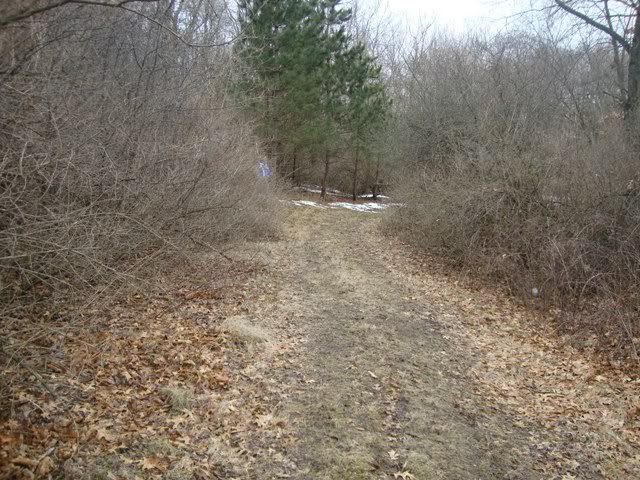
A maintained trail between a woodland edge and an agricultural field seemed to be a promising spot....
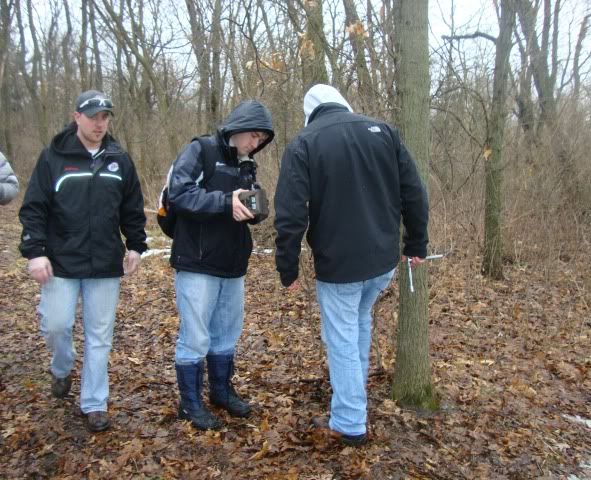
But even then....setting up the experiment takes alittle bit of explanation.......
Photo by J. Scherer
...once the students got a feel for it, they sallied-forth to find their own locations and set up their own experimental camera sets.
All cameras were programed to record video clips. Much easier to see response of individuals in video clips than in still photos.
Eventually, it came to application of the experimental treatments.
First, a cotton ball soaked in Red Fox urine was placed within a commercially purchased wooden scent egg.
...next a cotton ball was soaked in Coyote urine and placed in another scent egg....
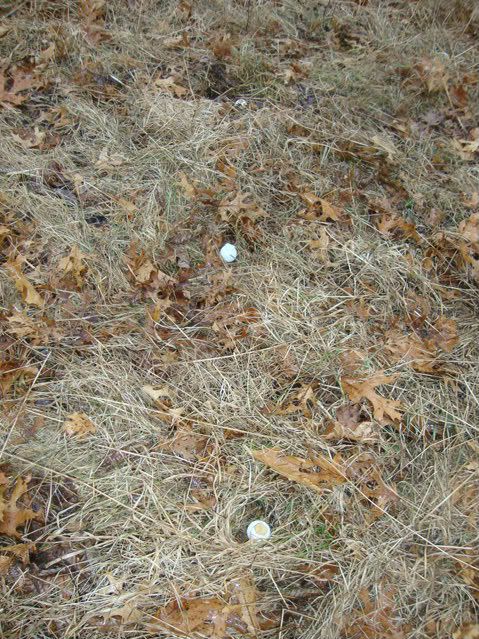
The urine scent eggs were placed 4 ft apart in front of the camera, with a control (cotton ball soaked with de-ionized water) placed in a scent egg exactly between them. See what I mean in the two pictures below.
The set-up during lab went relatively well, and I was feeling good about our possibilities......which is always dangerous.
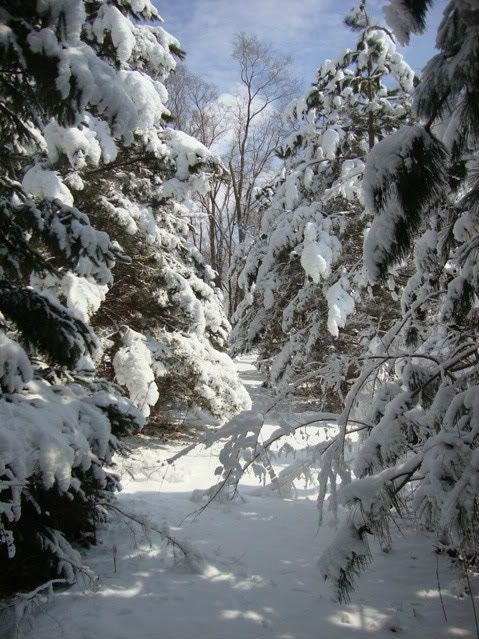
But, my good feelings were soon to be dashed because two days after we set the project up, it looked like this outside.
-sigh-
The best-laid plans.....
Then....it rained the night after we "freshened" the scent during the second week of the experiment.
double-sigh-
The third week, though.....no rain afterwards....but from that point on for the rest of the semester, it seemed like rain always followed our "freshening" of the urine.
________________________________________________________________________
Whether that made a difference or not, I can't say....but for six weeks the results rolled in.
Below are some of the highlights.
When viewing these video clips, please note...
the scent egg on the left contains a cottonball soaked in Coyote Urine,
the egg in the center contains a cottonball soaked in Deionized Water (Control)
the egg on the right contains a cottonball soaked in Fox Urine.
Also, remember that the wooden "scent eggs" holding the urine are not always visible (covered in grass, etc.) but they are within the camera's field-of-view.
We started data collection on this project in late February.
Basically, what we found was that some individuals were obviously interested......
March 2nd
March 2nd (same deer)
March 15
March 17
March 24
March 28th
March 29
April 3rd
Some individuals were wary.....
March 2nd
April 5th (love the moon in the background)
Some individuals completely ignored our efforts.....
March 9
March 12
March 17
March 25
March 25
March 30
April 9
EVEN obvious prey of Coyotes and Red Fox seemed oblivious sometimes (also....I hate to be the bearer of bad news for you who put Coyote/Fox urine around your garden to scare away bunnies...but.....)
...and SOME individuals were absolutely no help in determining which scent was preferred at all!
But the canids were the target......
Interestingly, we ended up getting almost no response from Coyotes and Red Fox. One might assume this was because they were not on-site. Our other camera traps (the ones without scent) proved this was not true (particularly for red fox).
Here are our best videos of canines responding. We assumed the coyote in the second video was over the 'yote urine. We got two others clips of canines, but neither were showing an obvious response to the scents.
April 2nd
April 8
Despite their lack of response on our urine cams.....we nabbed many pictures of red fox in other locations on-site. Below are the dates where Red Fox were photographed by other cameras (non-urine cameras) on-site during our scent experiments:
Feb. 29
March 6
March 17
March 18
March 20
March 21
March 22
March 24
March 25
March 26
March 27
April 2
During the experiment, Coyotes were photographed by one of our non-scent cameas only once: March 19.
This would suggest, perhaps, avoidance of the urine cameras, but I want more data.
I did have the students conduct statistical analyses on the data. However, we had almost no response from Canines, so I had them combine the response of all wildlife to each urine and compare their combined response to fox vs. 'yote urine. Basically, there was no difference detected. However, this could be due to short survey period (only 6 weeks) and small camera sample size (n=4). By just watching the critters in the videos, it really seems as if they were more often lingering on the fox urine.....but the stats don't back this up.
I have become interested enough in our findings so far that I'm continuing these experiments indefinately and rotating camera locations periodically.
'Tis the season for alot of things....including Canids!
I always have the best luck camera trapping Canids in December and January. This is a phenomenon other "trappers" have made anecdotal observations about in regards to Bobcats and Mountain Lions...although I haven't had much (or any) experience with either species.
Allow me to show you an example from my time in North Carolina.
The pictures below are almost a year old.
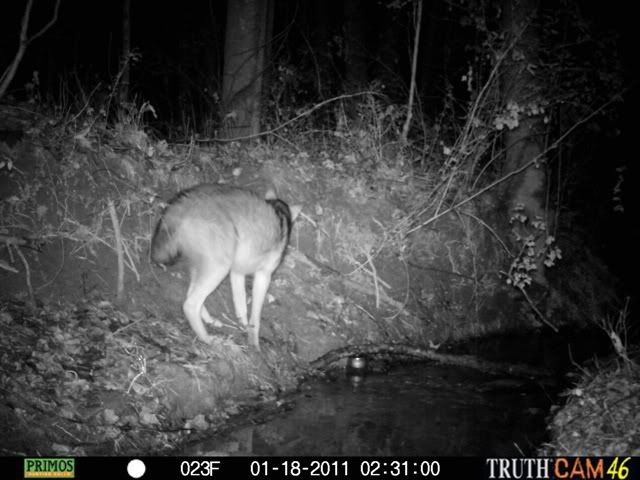
The location is a stream corridor with steep banks, one side buffered by deciduous hardwood forest....the other side has a power line right-of-way running parallel. Great spot for 'yotes to run.
And they do....
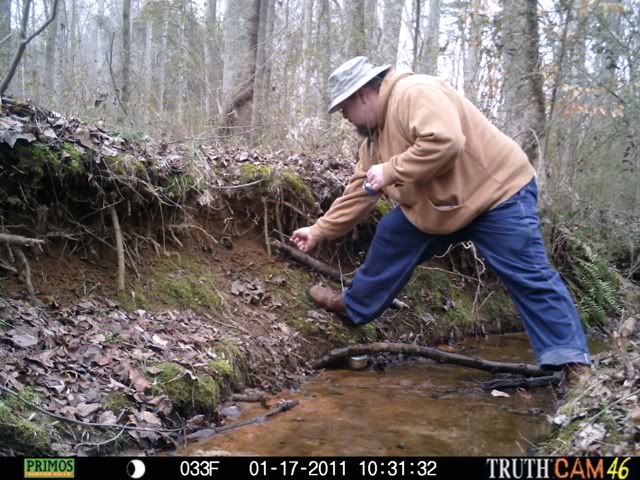
For those interested, I'm applying a dab of Lennon's Brand, Super Coyote All-Call to the stick poking out of the bank.
It's also worth noting that I don't make any attempt to cover my own scent when I'm out.
Not long before a big old 'yote comes along to check out the smell.....
To be fair, this isn't the only time I put some sort of scent lure out at this location to attract critters. It doesn't always work this perfectly....but when it does it always makes me feel smarter than I am :)
This is the same camera where I've been getting pictures of a (to-date) unidentifiable animal.
I was going to hold on to this picture and try and incorporate it into another post (I don't want this blog to become a bunch of random photographs posted haphazardly).
However, there's just something about this picture that I like. I can't fully explain it. The slightly lifted front left paw....as if it came in for a second, but was prepared to move-on even before it stopped to take a sniff. The nice condition of its coat...no mange...no skin and bones, that I can tell.
That, and I have to admit, I like coyotes. I don't want to give the impression that I'm some hippy-dippy tree hugger, or some patchouli oil and hemp-wearing activist. I'm not at all. But, I like the coyote. Mostly becuase they are an amazing example of the cunning, adaptability, and perserverence that wildlife have to possess in order to hang on in the modern era. Unfortunately, for the coyote, these traits also give it a bad name...to the point that folks "hate varmits, like coyotes", mostly because they will take white-tailed deer and livestock. Not that there ain't plenty of deer around....but whatever.
I'll talk about studies of coyote diet in a later post.
I've been getting more (and better) pictures of coyotes lately. But they have been so wary around here, that any picture of them is a treat for me. But this one...in particular...is unique. I've not gotten a coyote picture on my one-and-only traditional white flash camera prior to this. The flash scares them off quicker than the red glow of the IR cameras do, it seems. Thus, they never really get close enough to be in frame when the flash goes. So, I suspect the big bright flash fires when they are warily skirting around the edge of an area where I put out scent and/or bait....probing for danger. When the flash fires, the 'yotes are too far out to be in the picture, and then skeedaddle for good (I wonder how many of the blank white-flash pictures I get are the result of such a series of events).
This one came in just right, however. Didn't get picked up by the camera until he was right on the scent I put out. Interestingly, this time it was a commercial lure to attract Otters, as this camera is along a river bank.
Anyways, I liked this picture enough that I decided it warranted its own post.
Well, we finally deployed our drift fence traps and engaged them for the first time on Wednesday.
No captures.
Also, nothing under the coverboards.
Despite the fact that we had gotten a brief warm up and rain over the weekend, the temperature dropped this week.
During the day it's been in the 50s and 60s....but at night is a different story. I checked the temperature when I woke up this morning and it had dipped down to 27.
So, no new herp-related stuff to share, which means I'll continue to regale you with mammals and camera traps.
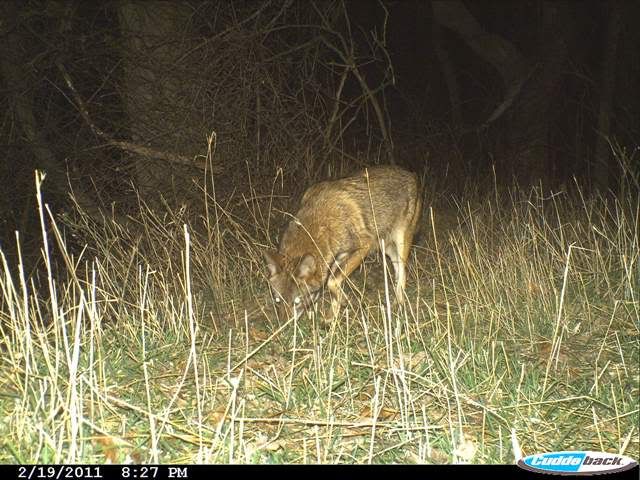
Last fall, after a summer of no carnivore activity (aside from raccoons and oppossums), I started getting alittle antsy. I wanted to see some fox or 'yotes, or something. The 'yotes did show eventually (see here: Coyote Cams, posted Feb 19, 2011), but it was the gray fox (Urocyon cinereoargenteneus) that first decided to play ball (although it took alittle bit of persuading).
In mid-September 2010, I set one of my cameras along a small wooded stream. The stream ran parrallel to a game trail (the stream is on the left of the field of view in the picture above, and the game trail is on the right). I placed the camera in between these two, hoping something would cross from the stream to the game trail and vice-versa.
At first, I baited the camera with an open can of dog-food that I buried about 3-4 inches. I also added a drip of my secret weapon to a stick that I placed on the soil: skunk essence! Something about it draws in the critters.
My first glimpse of a carnivore was actually a gray fox...but it was just a glimpse. The animal really was not interested in getting right up to the bait, and although he came close, he never really gave in to temptation. Perhaps it was the red LEDs that glow when this camera takes a photo at night? Perhaps it was the noise that the IR filter on the camera makes when taking a picture? Who knows?
He's difficult to see in the picture below, but he's there.....
Not long after his appearance, a steady string of raccoons finally dug up the can of bait and removed it to an undisclosed location.
The gray fox, however wary at first, appeared to acclimate to the camera enough to return. The thought of a potential meal, coupled with curiosity, must have brought him back.
First, he stuck his nose in the empty hole left by the removal of the dog food can.
When nothing presented itself, he took a second to roll in that good ol' skunky stink!
The reason why canines roll in scented-stuff is not fully understood or agreed upon. Although a plethora of anecdotal and pseudo-scientific explanations for this behavior can be found on many websites, I have (to-date) not found one that backs their claims up with hard data, or references to scientific literature.
Mech and Boitani (Wolves: Behavior, Ecologyh & Conservation, 2003) summarize research that has been done on wolves to help better understand this phenomenon. But even the work they cite, although giving good information about what type of scent-stimuli wolves will choose to roll in, does not clearly indicate why they do it!
The general possibilities proposed to explain this behaior include: (1) "familiarization with novel odors or change in odors", (2) "strong attraction or aversion to particular odors", (3) "concealing one's own scent with something more pungent" (an obvious advantage for a hunting carnivor), and (4) "making oneself more attractive by applying novel odor". An interesting study on African wild dogs found that females will roll in the urine of the lead male in a pack they are trying to join. This may increase their chances of acceptance becuase they are coated in a scent familiar to the pack they are hoping to get in with (Frame et al. 1979). It has also been proposed that individuals roll in specific scents to bring back information to others in their packs. For example, bringing back information about the age of a carcass found to others in the pack.....
But...I digress....
Some time in October, I had the good fortune to come across a freshly road-killed eastern gray squirrel. I took the carcass and wired it to a stake in front of the camera. I placed a dollop of commercial trapper lure, specifically for coyotes, on the stake and sprayed the stake with some commercially purchashased/preserved coyote urine. So, the stake (a.k.a. the stink pole) has becomes very hard to resist!
Although a raccoon and opossum fought over and removed most of the squirrel carcass before a fox or 'yote could get at it.....a gray fox eventually shows some interest.
Still alittle shy, however.
Each week, I continued to add alittle more scent lure and coyote urine to the post, until...finally....he grew bold enough to really show off for a close-up!
It's around this time, that my gray fox captures on many of my cameras goes through the roof...even cameras that I didn't put scent or bait in front of.
A combination of seasonal activity shift and acclimation, perhaps.
BTW...I have many more gray fox pics to show you!! They are one of my favorite critters in our area, so I hope you all don't mind!
Literature Cited and Further Readings on Scent-Rubbing in Carnivores:
Frame, L.H., J.R. Malcolm, G.W. Frame, and H. van Lawick. 1979. Social organization of African Wild Dogs (Lycaon pictus) on the Serengeti Plains, Tanzania 1967-1978. Zoological Tierpsychology 50:225-249. (note: I could not find the above article, and was not able to read it....so my comments on this study are based on what Mech and Boitani report)
Reiger, I. 1979. Scent rubbing in carnivores. Carnivores 2:17-25.