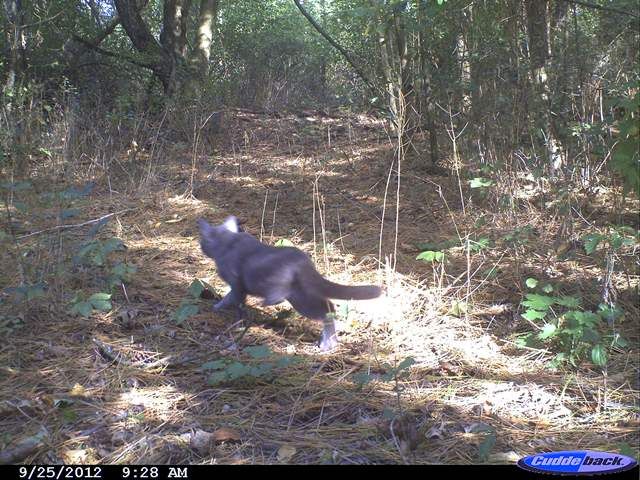
Whiskers is doing what feral cats do best.....
Finals are coming...the end of the semester is looming and time for blogging is limited!
The benign adventures and ponderings of a wildlife ecologist who is interested in old school, down-and-dirty field research. Not cutting edge, but occassionally forced to blaze a trail when in the outdoors.
Showing posts with label conservation. Show all posts
Monday, December 10, 2012
Thursday, November 1, 2012
That Darn Cat!
The number of feral cats round these parts is staggering. Last year, I posted a round of mugshots from individuals skulking around the property (see here). Since that time, our local feral cat population has not appeared to decline much.
This summer we experienced an unusually long period of drought (weeks long, in fact). We don't normally feed the birds because we have a nice variety already without spending the cash on birdseed. Yet, after seeing American Robins hopping around our back porch trying to drink water from the saucers below our potted plants....we caved and put up a makeshift bird bath.
It wasn't long before Sylvester started stalking around the perimeter of the bath, watching the inhabitants. I made sure that every puddy-tat I saw got chased off...hoping to instill in them some negative association of the Pavlovian variety with our house.
Didn't seem to work, though.
A manuscript published several years ago estimated that feral cats and pet cats allowed to roam free kill roughly 1 BILLION wild birds annually in the U.S. (and this is a conservative estimate; Dauphine and Cooper 2009).
Believe it or not, I haven't seen a cat take a bird on our property (although I'm sure it happens). I have, however, obtained evidence that they get other wild prey (see below).
Several of the original inhabitants, first photographed when we arrived over a year go, are still around......although a few seem to be gone.
There are are also some new faces.
Calico Joe
This one had been a constant figure on the property from last fall through early spring. But I haven't seen much of old Joe this summer and fall. He may no longer be around....although the other night as I drove up to the house I saw a kitty that looked very similar dart across the street. Might have been him.
Mr. Marmalade:
He's definitely been around since last year and was the individual I captured a picture of killing a chipmunk a year ago. He must be a wily sort. Others have come and gone since last year, but Mr. Marmalade keeps on showing up. He's the only one that I've consistently gotten pictures over the last year. Probably his coat color helps him blend in.....something useful for hunting and hiding.
Tiger
I first saw this one in early spring 2012, but he has been a permanent figure on my cameras since. I probably have more pictures of Tiger than any other feral puddy tat on-site. Although I don't think he's been around as long as Mr. Marmalade, he has staying power.
Mr. Boots
I only have one picture of Bootsie from this spring. He almost looks like a Siamese, but I haven't gotten a face-shot of him, and he's only been through once.
Misty
I don't think I'd seen this one until late September of this year. Yet, since that time she/he's been photographed consistently. He/She seems a bit small, so might be a juvenile.
Whiskers
Another new one from late summer 2012. Also looks on the small side, like it might be a juvenile. Since late August, he has shown up on my cameras frequently. (Note; this picture also portrays how dry it was this summer. Compare this picture to the picture taken of Mr. Boots above at the same location in May).
These are just the cats that have passed this one camera location. There are others on-site, and some that appear to have moved on.
For example:
Here Tiger is following a long haired such-n-such that I saw commonly last fall and in the early spring, but has been AWOL since.
There's also El Diablo, whom I've posted about before. He was everywhere this spring, but has been gone for months.
BUT....don't be fooled by the cutesy names. These kitties have claws! And they use them to great effect on native wildlife.
_________________________________________________________________________
What I find the most un-fathomable is that, of the literally tens of thousands of camera trap pictures and video clips generated from projects I've been involved with....I've only ever gotten pictures that definitively show predation being committed by one species:
Felis catus
No fox predation shots, no coyotes, no nothing. But I have a numerous pictures of kitties carrying a meal of native wildlife in their mouth.
The first of these incidences involved an Eastern Chipmunk (Tamias striatus), which was in my post from a year ago.
There have been more acts of predation captured since that time....
Here is a picture of Calico Joe from last fall, as he saunters by with a bit of din-din.
Below is Tiger trotting home with his meal of hapless Eastern Chipmunk.
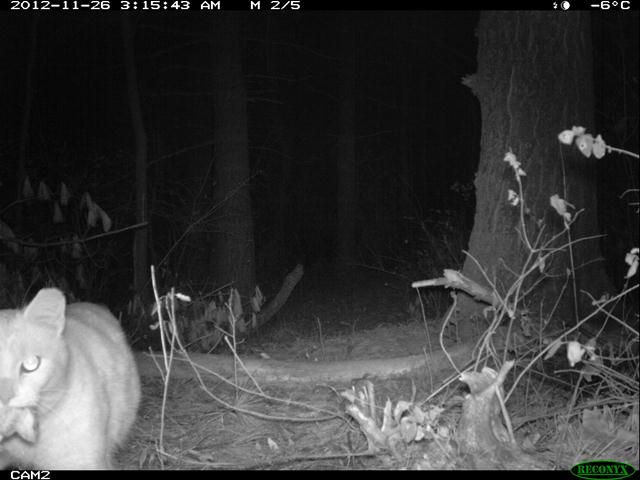
The new crop of kitties don't want to be left out either. Below is a shot of Whiskers with a mouse in tow (another Peromyscus sp.). Note the set of eyes watching him in the background. I have no idea what they are from.
Of course, we already know that Mr. Marmalade is very effective at catching wildlife. But here's another shot of him in the act again (appears to be another Peromyscus).
Whenever I'm depressed about the impacts of feral cats on native wildlife, I like to watch this clip from the Muppet Show. Rowlf sings The Cat Came Back in a way that makes me smile every time...
_________________________________________________________________________
Literature Cited
Dauphine and Cooper. 2009. Impacts of free-ranging domestic cats (Felis catus) on birds in the United States: a review of recent research with conservation and management recommendations. Proceedings of the Fourth International Partners in Flight Conference: Tundra to Tropics, p 205-219.
Further Reading .
Crooks and Soule, 1999. Mesopredator release and avifauna extinctions in a fragmented system. Nature 400:563-566.
Guttilla, G.A. and P. Stapp. 2010. Effects of sterilization on movements of feral cats at a wildlife-urban interface. Journal of Mammalogy 91:482-489.
Foley, et al. 2005. Analysis of the impact of trap-neuter-return programs on populations of feral cats. Journal of the American Veterinary Medical Association 227:1775-1781.
Hawkins, C.C., et al. 2004. Effects of house cats, being fed in parks, on California birds and rodents. Pgs. 164-170. In Shaw et al. (Eds.) Proceedings of the 4th International Urban Wildlife Symposium.
Lepczyk, C.A. et al. 2003. Landowners and cat predation across rural-to-urban landscapes. Biological Conservation 115:191-201.
Levy, J.K., et al. 2003. Evaluation of the effect of a long-term trap-neuter-return and adoption program on a free-roaming cat population. Journal of the American Veterinary Medical Association. 222:42-46.
Nogales, M. et al. 2004. A review of feral cat eradication on islands. Conservation Biology 18:310-317.
Risbey, D.A. et al. 2005. The impact of cats and foxes on the small vertebrate fauna of Heirisson Prong, Western Australia. II. A field experiment. Wildlife Research 27:223-235.
The Wildlife Society. 2011. In Focus: the impacts of free-roaming cats (multiple entries by several authors). The Wildlife Professional 5: 50-68.
This summer we experienced an unusually long period of drought (weeks long, in fact). We don't normally feed the birds because we have a nice variety already without spending the cash on birdseed. Yet, after seeing American Robins hopping around our back porch trying to drink water from the saucers below our potted plants....we caved and put up a makeshift bird bath.
It wasn't long before Sylvester started stalking around the perimeter of the bath, watching the inhabitants. I made sure that every puddy-tat I saw got chased off...hoping to instill in them some negative association of the Pavlovian variety with our house.
Didn't seem to work, though.
A manuscript published several years ago estimated that feral cats and pet cats allowed to roam free kill roughly 1 BILLION wild birds annually in the U.S. (and this is a conservative estimate; Dauphine and Cooper 2009).
Believe it or not, I haven't seen a cat take a bird on our property (although I'm sure it happens). I have, however, obtained evidence that they get other wild prey (see below).
Several of the original inhabitants, first photographed when we arrived over a year go, are still around......although a few seem to be gone.
There are are also some new faces.
Calico Joe
This one had been a constant figure on the property from last fall through early spring. But I haven't seen much of old Joe this summer and fall. He may no longer be around....although the other night as I drove up to the house I saw a kitty that looked very similar dart across the street. Might have been him.
Mr. Marmalade:
He's definitely been around since last year and was the individual I captured a picture of killing a chipmunk a year ago. He must be a wily sort. Others have come and gone since last year, but Mr. Marmalade keeps on showing up. He's the only one that I've consistently gotten pictures over the last year. Probably his coat color helps him blend in.....something useful for hunting and hiding.
Tiger
I first saw this one in early spring 2012, but he has been a permanent figure on my cameras since. I probably have more pictures of Tiger than any other feral puddy tat on-site. Although I don't think he's been around as long as Mr. Marmalade, he has staying power.
Mr. Boots
I only have one picture of Bootsie from this spring. He almost looks like a Siamese, but I haven't gotten a face-shot of him, and he's only been through once.
Misty
I don't think I'd seen this one until late September of this year. Yet, since that time she/he's been photographed consistently. He/She seems a bit small, so might be a juvenile.
Whiskers
Another new one from late summer 2012. Also looks on the small side, like it might be a juvenile. Since late August, he has shown up on my cameras frequently. (Note; this picture also portrays how dry it was this summer. Compare this picture to the picture taken of Mr. Boots above at the same location in May).
These are just the cats that have passed this one camera location. There are others on-site, and some that appear to have moved on.
For example:
Here Tiger is following a long haired such-n-such that I saw commonly last fall and in the early spring, but has been AWOL since.
There's also El Diablo, whom I've posted about before. He was everywhere this spring, but has been gone for months.
BUT....don't be fooled by the cutesy names. These kitties have claws! And they use them to great effect on native wildlife.
_________________________________________________________________________
What I find the most un-fathomable is that, of the literally tens of thousands of camera trap pictures and video clips generated from projects I've been involved with....I've only ever gotten pictures that definitively show predation being committed by one species:
Felis catus
No fox predation shots, no coyotes, no nothing. But I have a numerous pictures of kitties carrying a meal of native wildlife in their mouth.
The first of these incidences involved an Eastern Chipmunk (Tamias striatus), which was in my post from a year ago.
There have been more acts of predation captured since that time....
Here is a picture of Calico Joe from last fall, as he saunters by with a bit of din-din.
After zooming in a bit, you can see he's carrying something in its mouth, which is the right size for a rodent (Peromyscus is common on site).
Below is Tiger trotting home with his meal of hapless Eastern Chipmunk.
The new crop of kitties don't want to be left out either. Below is a shot of Whiskers with a mouse in tow (another Peromyscus sp.). Note the set of eyes watching him in the background. I have no idea what they are from.
Of course, we already know that Mr. Marmalade is very effective at catching wildlife. But here's another shot of him in the act again (appears to be another Peromyscus).
Whenever I'm depressed about the impacts of feral cats on native wildlife, I like to watch this clip from the Muppet Show. Rowlf sings The Cat Came Back in a way that makes me smile every time...
Literature Cited
Dauphine and Cooper. 2009. Impacts of free-ranging domestic cats (Felis catus) on birds in the United States: a review of recent research with conservation and management recommendations. Proceedings of the Fourth International Partners in Flight Conference: Tundra to Tropics, p 205-219.
Further Reading .
Crooks and Soule, 1999. Mesopredator release and avifauna extinctions in a fragmented system. Nature 400:563-566.
Guttilla, G.A. and P. Stapp. 2010. Effects of sterilization on movements of feral cats at a wildlife-urban interface. Journal of Mammalogy 91:482-489.
Foley, et al. 2005. Analysis of the impact of trap-neuter-return programs on populations of feral cats. Journal of the American Veterinary Medical Association 227:1775-1781.
Hawkins, C.C., et al. 2004. Effects of house cats, being fed in parks, on California birds and rodents. Pgs. 164-170. In Shaw et al. (Eds.) Proceedings of the 4th International Urban Wildlife Symposium.
Lepczyk, C.A. et al. 2003. Landowners and cat predation across rural-to-urban landscapes. Biological Conservation 115:191-201.
Levy, J.K., et al. 2003. Evaluation of the effect of a long-term trap-neuter-return and adoption program on a free-roaming cat population. Journal of the American Veterinary Medical Association. 222:42-46.
Nogales, M. et al. 2004. A review of feral cat eradication on islands. Conservation Biology 18:310-317.
Risbey, D.A. et al. 2005. The impact of cats and foxes on the small vertebrate fauna of Heirisson Prong, Western Australia. II. A field experiment. Wildlife Research 27:223-235.
The Wildlife Society. 2011. In Focus: the impacts of free-roaming cats (multiple entries by several authors). The Wildlife Professional 5: 50-68.
Monday, August 29, 2011
The Problem with Feral Cats....
Feral and/or stray cats abound around our new rural home. I'd gotten pictures of them in the woods behind our house on several occassions, but didn't realize the level of the "problem" until I put a cam along the back of our garage facing an Eastern Chipmunk (Tamias striatus) burrow. Although I thought it was a tad too soon, I checked the camera after 24 hours to see if the angle I used was good.
I was shocked too see how many times a puddy tat passed in front of the camera during that time. Four different individuals (mugshots below), passed the camera a total of seven times within 24 hours.
They are obviously interested in the Chipmunk burrow as well....I've gotten pics of other rodents scampering around in this spot too, so it's a kitty buffet trail.
The worst part is that I only one of these individuals is one that I've caught pictures of before. I now believe I have observed a total of SIX different individuals slinking around the property.
The last kitty kat pictured above has been camera-trapped in several different locations near our house. In one case, the pictures of him depicted dastardly activities (see below)!
_______________________________________________________________________
Some folks are shocked when I tell them that I am a wildlife conservation biologist, and that I could care less about protecting stray or feral cats...or even protecting pet cats allowed to run loose. They seem to think that because I like "animals", I also like feral stray cats.
However, "Wildlife" and "Domestic Animals" or "Feral Domestic Animals" are very different things. There is nothing "natural" about a feral or stray cat on the loose. There is also nothing natural about a domestic cat that is allowed by its owners to come and go as it pleases. They are not native wildlife. They are an introduced exotic species. As such, in my humble opinion, they have no business loose on the landscape.
We have a number of native wild Felids in North America. Several once had fairly extensive ranges in the US: the Bobcat (Lynx rufus) and the Cougar (Puma concolor). The others had historic ranges that barely entered U.S. borders to the south, such as the Jaguar (Panthera onca; which once had a somewhat extensive range in the southwestern US), the Ocelot (Leopardus pardalis) and the Jaguarundi (Puma yagouaroundi). To the north, the Canada Lynx (Lynx canadensis) had a range that once included a fair portion of the northern U.S..
Most of these wild felids have been extirpated from the U.S., or had their ranges and populations drastically decreased in the last 100 years. The Bobcat still has a fairly extensive range compared to the other species. The Cougar is relatively common in the west, and expanding its range eastward (although east of the Mississippi River it is still very uncommon or nonexistent).
So, we have native cats that could actually use protection or conservation. Yet some folks will immediately jump on board with protecting feral cats as fast as they will native wildlife. There are, in fact, entire organizations devoted to stray pet advocacy, and promote the trap-neuter-release policy for feral cats. Alot of these folks may actually get down-right angry at any mention of actively controlling feral cat populations via lethal removal. I often hear it implied that such activities are inhumane. They seem to prefer the trap-neuter-release method of population control. Granted, this may result in a decrease in feral cat populations over a longer time period (at least in areas where the method is rigorously practiced and upheld), but a neutered cat still needs to eat. Trap-neuter-release doesn't make up for the fact that these feral neutered individuals must still hunt for the remainder of their lives.
I'm also confused about how lethal removal of feral cats is viewed as inhumane, while granting these unnatural predators free reign to eat wildlife is not.
If we must protect feral cats, why not protect all feral animals? Where are the feral hog advocacy groups? Why not protect invasive species of snakes? How 'bout some pro-zebra mussel propaganda? I'll tell you why feral cats are treated differently: they're cute and make us think of our pets (or they actually are pets). Who can identify with a giant bristling feral hog, with tusks like bananas tearing up native vegetation? Who can identify with an exotic snake that eats something "desirable", like a bird (or a house cat)? Thus, decisions about which side to be on are driven by emotion.
But, I digress.....
I had originally planned to review papers that have studied the impact of feral cats preying on native wildlife in this blog post. Yet, I've found that this just results in a powder keg of constant squabbling by folks on both sides, so I decided to drop that.
__________________________________________________________________________
At any length, I knew there were feral cats in the area after only two nights of camera trapping (see my previous post). It only took another week to get pictures of them preying on wildlife. I believe the prey in the pictures below is an Eastern Chipmunk. We have several that run around the backyard caching food in various places.
Chipmunks are, obviously, not a rare species...but that is not the issue. The problem is that, in less than a month, I have captured pictures of six different feral cats in the vicinity of our house. Within the first week of us being here, I captured three cat pictures just off our back porch. One of these was a photograph of a predation event.
The numbers of predation events that go undetected are likely substantial. All of these cats are going to eat somehow.
Further Reading (just a smattering from the diverse body of literature that exists on this subject).
Crooks and Soule, 1999. Mesopredator release and avifauna extinctions in a fragmented system. Nature 400:563-566.
Guttilla, G.A. and P. Stapp. 2010. Effects of sterilization on movements of feral cats at a wildlife-urban interface. Journal of Mammalogy 91:482-489.
Foley, et al. 2005. Analysis of the impact of trap-neuter-return programs on populations of feral cats. Journal of the American Veterinary Medical Association 227:1775-1781.
Hawkins, C.C., et al. 2004. Effects of house cats, being fed in parks, on California birds and rodents. Pgs. 164-170. In Shaw et al. (Eds.) Proceedings of the 4th International Urban Wildlife Symposium.
Lepczyk, C.A. et al. 2003. Landowners and cat predation across rural-to-urban landscapes. Biological Conservation 115:191-201.
Levy, J.K., et al. 2003. Evaluation of the effect of a long-term trap-neuter-return and adoption program on a free-roaming cat population. Journal of the American Veterinary Medical Association. 222:42-46.
Nogales, M. et al. 2004. A review of feral cat eradication on islands. Conservation Biology 18:310-317.
Risbey, D.A. et al. 2005. The impact of cats and foxes on the small vertebrate fauna of Heirisson Prong, Western Australia. II. A field experiment. Wildlife Research 27:223-235.
The Wildlife Society. 2011. In Focus: the impacts of free-roaming cats (multiple entries by several authors). The Wildlife Professional 5: 50-68.
I was shocked too see how many times a puddy tat passed in front of the camera during that time. Four different individuals (mugshots below), passed the camera a total of seven times within 24 hours.
The worst part is that I only one of these individuals is one that I've caught pictures of before. I now believe I have observed a total of SIX different individuals slinking around the property.
The last kitty kat pictured above has been camera-trapped in several different locations near our house. In one case, the pictures of him depicted dastardly activities (see below)!
_______________________________________________________________________
Some folks are shocked when I tell them that I am a wildlife conservation biologist, and that I could care less about protecting stray or feral cats...or even protecting pet cats allowed to run loose. They seem to think that because I like "animals", I also like feral stray cats.
However, "Wildlife" and "Domestic Animals" or "Feral Domestic Animals" are very different things. There is nothing "natural" about a feral or stray cat on the loose. There is also nothing natural about a domestic cat that is allowed by its owners to come and go as it pleases. They are not native wildlife. They are an introduced exotic species. As such, in my humble opinion, they have no business loose on the landscape.
We have a number of native wild Felids in North America. Several once had fairly extensive ranges in the US: the Bobcat (Lynx rufus) and the Cougar (Puma concolor). The others had historic ranges that barely entered U.S. borders to the south, such as the Jaguar (Panthera onca; which once had a somewhat extensive range in the southwestern US), the Ocelot (Leopardus pardalis) and the Jaguarundi (Puma yagouaroundi). To the north, the Canada Lynx (Lynx canadensis) had a range that once included a fair portion of the northern U.S..
Most of these wild felids have been extirpated from the U.S., or had their ranges and populations drastically decreased in the last 100 years. The Bobcat still has a fairly extensive range compared to the other species. The Cougar is relatively common in the west, and expanding its range eastward (although east of the Mississippi River it is still very uncommon or nonexistent).
So, we have native cats that could actually use protection or conservation. Yet some folks will immediately jump on board with protecting feral cats as fast as they will native wildlife. There are, in fact, entire organizations devoted to stray pet advocacy, and promote the trap-neuter-release policy for feral cats. Alot of these folks may actually get down-right angry at any mention of actively controlling feral cat populations via lethal removal. I often hear it implied that such activities are inhumane. They seem to prefer the trap-neuter-release method of population control. Granted, this may result in a decrease in feral cat populations over a longer time period (at least in areas where the method is rigorously practiced and upheld), but a neutered cat still needs to eat. Trap-neuter-release doesn't make up for the fact that these feral neutered individuals must still hunt for the remainder of their lives.
I'm also confused about how lethal removal of feral cats is viewed as inhumane, while granting these unnatural predators free reign to eat wildlife is not.
If we must protect feral cats, why not protect all feral animals? Where are the feral hog advocacy groups? Why not protect invasive species of snakes? How 'bout some pro-zebra mussel propaganda? I'll tell you why feral cats are treated differently: they're cute and make us think of our pets (or they actually are pets). Who can identify with a giant bristling feral hog, with tusks like bananas tearing up native vegetation? Who can identify with an exotic snake that eats something "desirable", like a bird (or a house cat)? Thus, decisions about which side to be on are driven by emotion.
But, I digress.....
I had originally planned to review papers that have studied the impact of feral cats preying on native wildlife in this blog post. Yet, I've found that this just results in a powder keg of constant squabbling by folks on both sides, so I decided to drop that.
__________________________________________________________________________
At any length, I knew there were feral cats in the area after only two nights of camera trapping (see my previous post). It only took another week to get pictures of them preying on wildlife. I believe the prey in the pictures below is an Eastern Chipmunk. We have several that run around the backyard caching food in various places.
Chipmunks are, obviously, not a rare species...but that is not the issue. The problem is that, in less than a month, I have captured pictures of six different feral cats in the vicinity of our house. Within the first week of us being here, I captured three cat pictures just off our back porch. One of these was a photograph of a predation event.
The numbers of predation events that go undetected are likely substantial. All of these cats are going to eat somehow.
Further Reading (just a smattering from the diverse body of literature that exists on this subject).
Crooks and Soule, 1999. Mesopredator release and avifauna extinctions in a fragmented system. Nature 400:563-566.
Guttilla, G.A. and P. Stapp. 2010. Effects of sterilization on movements of feral cats at a wildlife-urban interface. Journal of Mammalogy 91:482-489.
Foley, et al. 2005. Analysis of the impact of trap-neuter-return programs on populations of feral cats. Journal of the American Veterinary Medical Association 227:1775-1781.
Hawkins, C.C., et al. 2004. Effects of house cats, being fed in parks, on California birds and rodents. Pgs. 164-170. In Shaw et al. (Eds.) Proceedings of the 4th International Urban Wildlife Symposium.
Lepczyk, C.A. et al. 2003. Landowners and cat predation across rural-to-urban landscapes. Biological Conservation 115:191-201.
Levy, J.K., et al. 2003. Evaluation of the effect of a long-term trap-neuter-return and adoption program on a free-roaming cat population. Journal of the American Veterinary Medical Association. 222:42-46.
Nogales, M. et al. 2004. A review of feral cat eradication on islands. Conservation Biology 18:310-317.
Risbey, D.A. et al. 2005. The impact of cats and foxes on the small vertebrate fauna of Heirisson Prong, Western Australia. II. A field experiment. Wildlife Research 27:223-235.
The Wildlife Society. 2011. In Focus: the impacts of free-roaming cats (multiple entries by several authors). The Wildlife Professional 5: 50-68.
Subscribe to:
Posts (Atom)