The benign adventures and ponderings of a wildlife ecologist who is interested in old school, down-and-dirty field research. Not cutting edge, but occassionally forced to blaze a trail when in the outdoors.
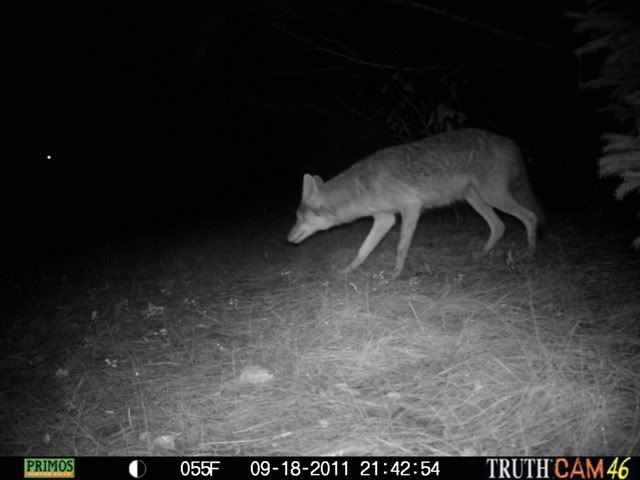
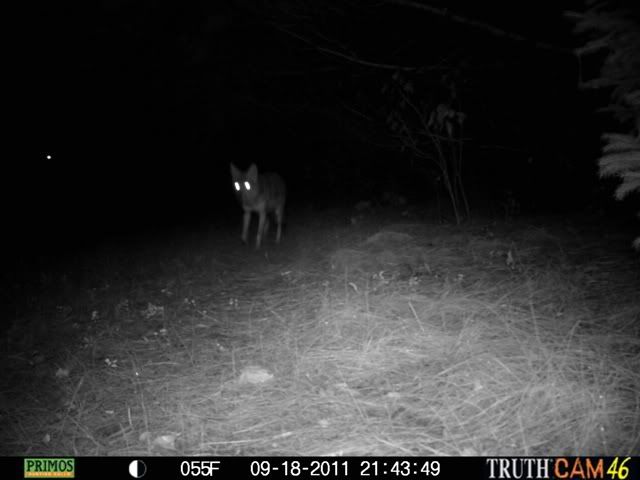
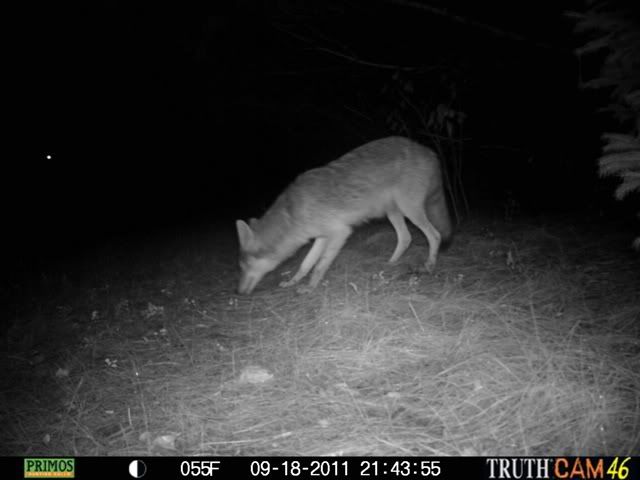
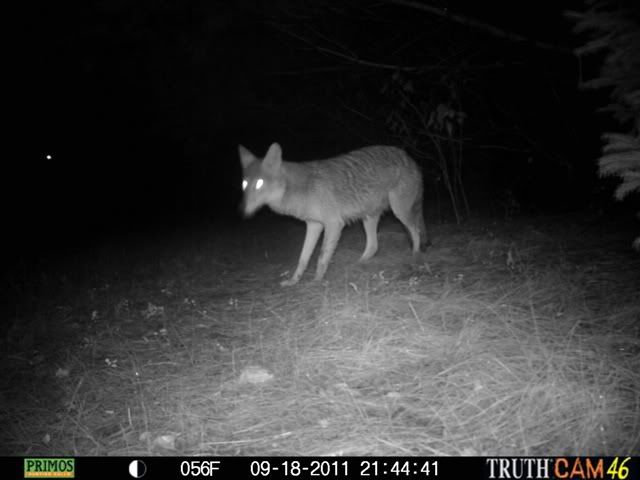
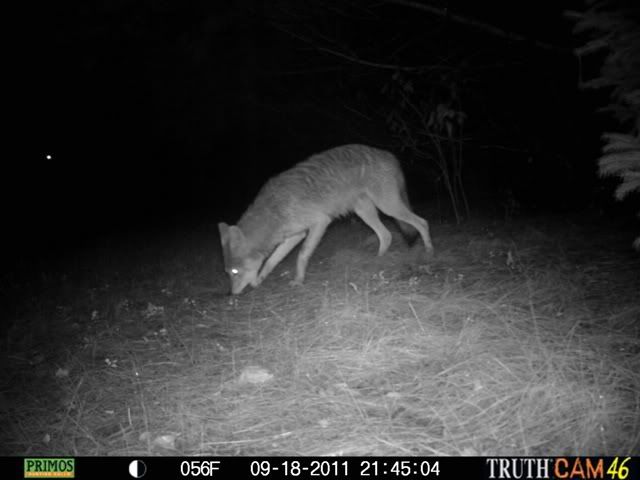
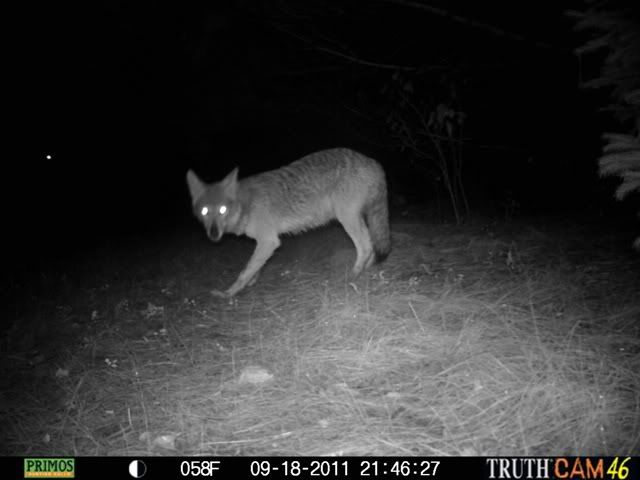
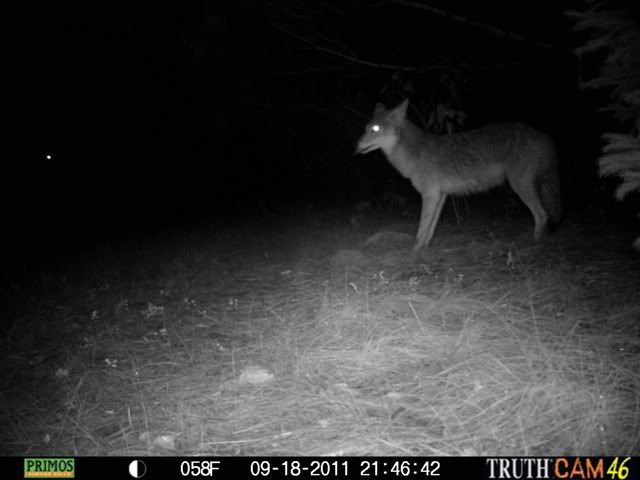
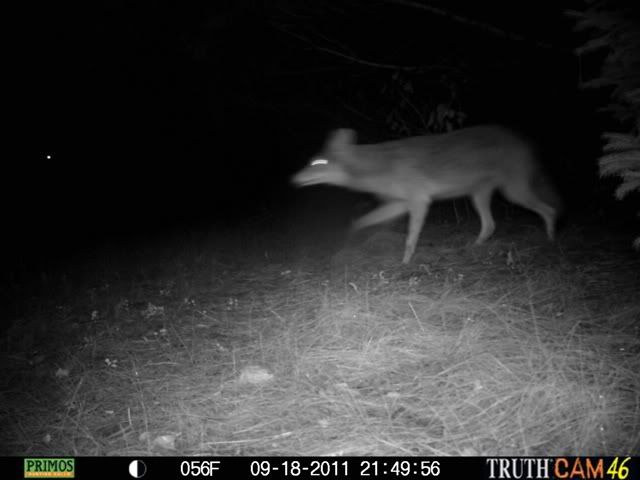
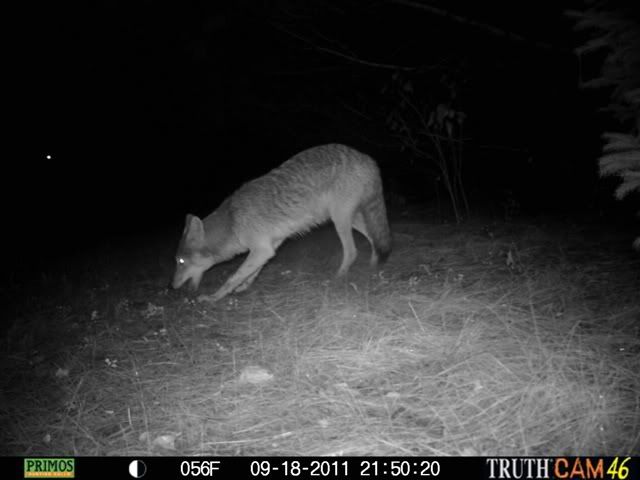
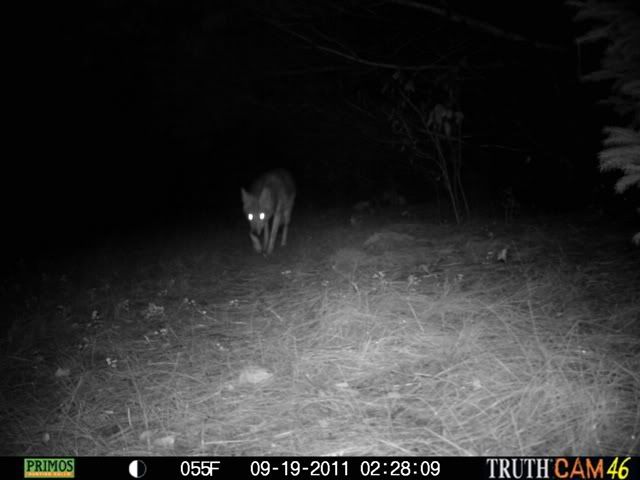
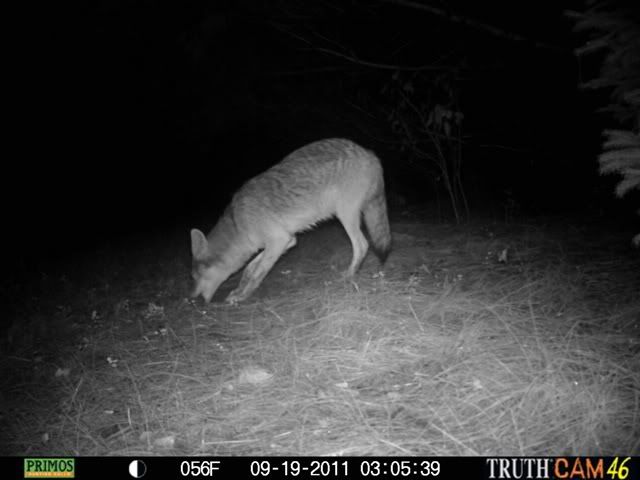
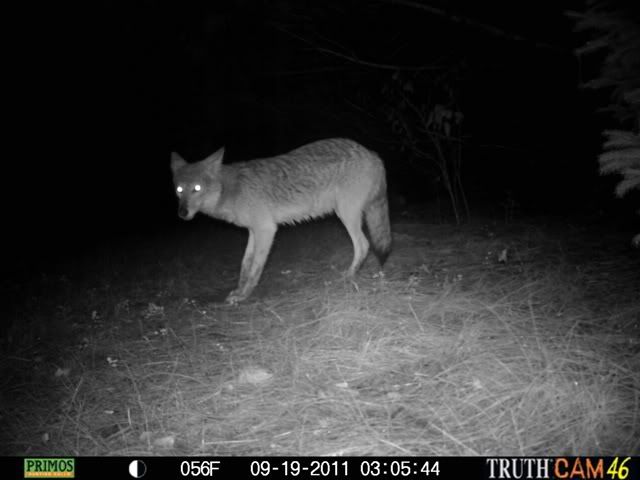
The Coyote (Canis latrans) activity has picked up substantially at several of our camera trapping locations. This makes sense, as it has corresponded with the mating season and (soon) parturition for our region. As Jackson (1961) reports, breeding primarily occurs in February, and most pups are born in April (gestation period of 60-63 days).
So, the timing is perfect.
Below are two clips of males at the same site for comparison.
....and now the pregnant female.....she just looks uncomfortable, doesn't she?
The den must be nearby, and I hope we can get clips of the pups......
As most know, the Coyote is often vilified and looked upon with scorn. Jackson (op. cit.) mentioned several historic accounts of negative attitudes towards Coyotes in our region (note the "wolf" referenced in the passsages below is the "prairie wolf", which is an old common name for the Coyote).
"Among the other evidences of the rude and primitive condition of the town [of Mineral Point-TB] was the almost unceasing howling and barking of the wolves during the night, around and within its very borders, sounding at times as though the town was invested by scores of the brutes, much to the annoyance and alarm of timid strangers." (S.M. Palmer, 1872; 302).
Jackson also recounts some of the methods used in the past to eradicate these rude, brutish and annoying animals....
"A grand wolf hunt will come off Monday the 17th of December, 1863. There will be a line formed, commencing at ...... the town of Fulton, extending up .....in the town of Janesville. Said line will be formed and ready to march at 10 o'clock A.M. There will also be a line formed on the west side of the river to act in conjunction with the first. ........ We invite all to take part, for the wolves are troublesome (Janesville Daily Gazette, Dec. 7, 1863)."
The distance that this line of 'yote-hunters would have spanned was probably anywhere from 12-14 miles, as the crow flies. Now, I don't want to sound hippy-dippy......but that's alot of effort to kill little ol' Wil E., which would suggest a very deep-seeded dislike or fear.
I wonder if the folks who orchestrated those hunts (or anyone today who dislikes Coyotes) would feel differently about them if they saw them acting just like their beloved domestic dog?
This doesn't appear to be skittishness. This behavior looks just like that of my dog when he's excited to go outside.
These are probably some of my favorite Coyote (Canis latrans) video clips that I've been lucky enough to get with a camera trap.
The majority of the pictures and video clips that I have of Coyotes are fleeting....mostly I have quick shots, or blurry shots of an individual before it was spooked and ran off.
Not the case here. In fact, this Coyote appears to be luxuriating in the fact that he can roll around in a bit of urine. Red Fox (Vulpes vulpes) urine to be precise.
I'm obviously anthropomorphizing, but he almost appears to dive in with great relish.....and expresses little obvious concern for any potential threats. This is not at all what I'm used to from Coyotes on my cameras....
He also gets alittle mouthy on one of the stakes that I use to hold scent....
Now.....in the past, I've gotten pictures that appear to indicate Coyotes show some hefty aversion to the red LEDs on the camera traps (see here and here).
This individual shows none of that (particularly in the second clip below, where he must be getting a face-full of red LED). I've been camera trapping this site for over a year now. Perhaps that's enough time for them to fully acclimate. Also...the fact that we are not too ridiculously far out of the mating season (January/February) may have something to do with it.
Also of interest: there is a similar scent stake on the left of our field of view that is holding Coyote urine.
Untouched.
Once satisfied, Wil E. decides to move along in search of other opportunities.
I've posted on this type of "scent rolling" behavior in the past (involving a Gray Fox, Urocyon cinereoargenteus) from North Carolina. I also included a brief review of existing literature that I could find on the topic, which I'll re-post at the bottom.
Roughly half an hour later, a trio of rather concerned White-tails cautiously come along to check things out.
If they are the group I've seen most of the summer/fall, it's a doe and her twin boys.....
The reason why canines roll in scented-stuff is not fully understood or agreed upon. Although a plethora of anecdotal and pseudo-scientific explanations for this behavior can be found on many websites (usually associated with training domestic dogs), I have not found one that backs their claims up with hard data, or references to scientific literature.
Mech and Boitani (Wolves: Behavior, Ecology & Conservation, 2003) summarize research that has been done on wolves to help better understand this phenomenon. But even the work they cite, although giving good information about what type of scent-stimuli wolves will choose to roll in, does not clearly indicate why they do it!
The general possibilities proposed to explain this behaior include: (1) "familiarization with novel odors or change in odors", (2) "strong attraction or aversion to particular odors", (3) "concealing one's own scent with something more pungent" (an obvious advantage for a hunting carnivor), and (4) "making oneself more attractive by applying novel odor". An interesting study on African wild dogs found that females will roll in the urine of the lead male in a pack they are trying to join. This may increase their chances of acceptance becuase they are coated in a scent familiar to the pack they are hoping to get in with (Frame et al. 1979). It has also been proposed that individuals roll in specific scents to bring back information to others in their packs. For example, bringing back information about the age of a carcass found to others in the pack.....
Literature Cited and Further Readings on Scent-Rubbing in Carnivores:
Frame, L.H., J.R. Malcolm, G.W. Frame, and H. van Lawick. 1979. Social organization of African Wild Dogs (Lycaon pictus) on the Serengeti Plains, Tanzania 1967-1978. Zoological Tierpsychology 50:225-249. (note: I could not find the above article, and was not able to read it....so my comments on this study are based on what Mech and Boitani report)
Reiger, I. 1979. Scent rubbing in carnivores. Carnivores 2:17-25.
I often put a camera out in the backyard when we lived there. This began as an intermittent, when I remembered it, sort of thing.
After a while it became interesting to the point where every night, with few exceptions, I'd set a camera out and pull it in the morning.
Why did it become interesting, you ask?
Thanks to the little critter with the big scientific name: Urocyon cinereoargenteus.
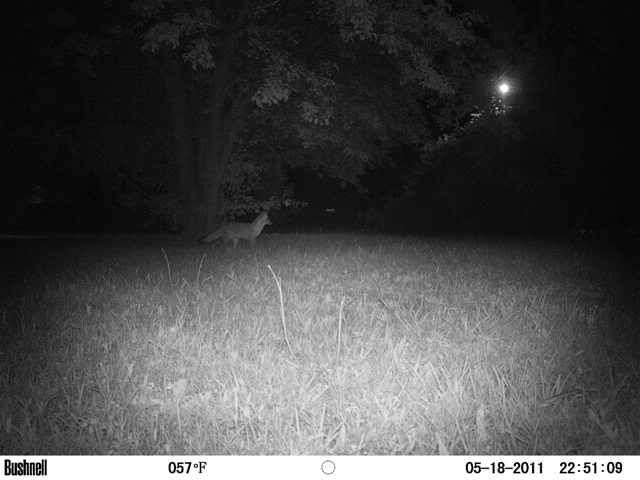
But....let me back up a bit. As I mention in the Gray Ghost post referenced above, I first started seeing Gray Fox first-hand in our neighborhood back in Spring of 2010. Their sightings became frequent enough that I was prompted to actually put a camera back there some time in early 2011 and started getting serious about recording my camera trapping records and visual sightings.
My first pictures of Gray Fox in the back yard occurred in January of 2011 (see the Gray Ghost post referenced above). Around this time, our family also saw a Gray Fox trotting along the back lot line at dusk as we played outside. This led to a brief string of photographs, which ultimately dried up some time in February. This short dry spell snapped a few weeks later, and March yielded two pictures: one on March 9...the other on March 21 (see above picture).
Then the observations ground to a halt until about mid-May.
On 5/11/2011, I took the dog out with me while programming the camera for the evening's deployment. We walked slowly, and my attention was focused on the little plastic box in my hand. Suddenly there was a tug on the leash, and I turned around to see the dog squatting in the middle of the yard.
Dang it, Sampson!, I said....knowing I'd have to go inside and get a bag to remove the pile o' shite, lest our daughter find it interesting the next day.
But...then the wheels started turning. How could I both (a) avoid having to go all the way inside for a bag and (b) use this steaming pile to my advantage?
The answer was clear! I placed the camera on one of my daughter's kiddie chairs directly overlooking the dog's evacuation. If anything was moving about that night, perhaps they'd come to investigate. I'd used Sampson's "leavings" in this manner at my study sites with good results. I'd even had success placing my cameras over an area where he had emptied his bladder in the yard (see pic at the top of this post).
However, the first night (post-fecal evacuation) was eventless!
Bummer, I thought.
But..still...why go all the way inside and get a bag to clean up this fine pile of animal attractant?
I'll just keep an eye on my daughter when in the yard and make sure she doesn't step on it (-I know...I know...your minds are racing wildly...coming up with a million terrible father things to put in a comment on this post). If I'm going to be lazy...then I better also be right about being lazy. As such...failure was not an option!
On the afternoon of 5/13/2011, I even upped the ante. We cooked burgers on the grill. HUGE patties of succelent grass-fed beef acquired from a local farmer. They were...to put it mildly...an absolute delight. As an aside, let me just say: for those of you squandering your taste buds on hamburger from a giant corporate beef producer that you've picked up from your big box grocery store....you are missing out! Seriously. There is NOTHING like hamburger from a grass-fed cow that you buy at your farmer's market.
Anyways...that beautiful aroma wafted out for hundreds of yards from my grill, I'm sure. Spreading the news that something good to eat might be here.
That night, a storm blew through the area.......one of many storms that plagued us that spring. Seemed like we'd had one a week from the beginning of April to the end of May! I put the camera out because I forgot we were supposed to get storms and I was excited about the new olfactory cues I had introduced into the backyard. I didn't usually leave the backyard camera out during a lightning storm. But when the thunder and lightning started, I shrugged and figured the camera wouldn't catch any critters.
Perhaps it was the unintentional lures...perhaps it was the storm...who knows. But...low and behold....I had a surprise on the camera the next morning.
Above: The offending pile can be seen at the right in the field of view. In the background is an Eastern Cottontail that triggered the camera before the storm hit. Note: I don't, and never will, seriously attempt to draw carnivores into the yard with food or scent lures....but scent remains from Sampson's crap were all over out there anyways, so I figured I'd make it work to my advantage.
Above: My first backyard Coyote (Canis latrans) sniffing at my dog's home-brewed scent lure. I'm not shocked by the fact that Coyotes were in this suburban neighborhood. I'm more shocked that I hadn't gotten pictures of them before. Too bad the camera lense was covered with moisture from the recent rain!
Above: The Gray Ghost (Urocyon cinereoargenteus) investigates things. I've obviously seen these in the yard before. What's strange is that it came by not long AFTER the coyote did. I figured any evidence of the Coyote might scare them off.
Above: either a different, or the same, Gray Fox noses around near the camera again alittle later.
A few nights after this, Sampson and I went through our usual routine for deploying the backyard camera. This time, the cam quickly captured activity after our departure.
Above: Sampson and I leaving....
Above: Note the difference in time-stamps. This little fella slinks through less than 10 minutes after my dog and I passed the camera
Unfortunately, about three days before the pictures above were taken (on May 15th) a rabid Gray Fox bit two people not less than a mile from where we live. In one case, the fox first tangled with the person's dog while they were out on an evening walk. When the owner tried to intervene with his foot, the fox moved on to him. The second rabid fox incident did not involve a domestic dog. This one occurred in the morning (8:30 am) rather than at night.
On May 25th, someone in a neighboring county (about 25 minutes away) was attacked by a rabid Gray Fox while walking his dog. He actually grabbed the fox by the neck after it bit him and threw it as far as he could. The fox, however, did not give up so easily. It apparently ran all the way back up the hill and attacked him again. The man grabbed it once more, but this time was was able to secure it in a garbage can for animal control officers.
Rabies was relatively common in that part of North Carolina. For example, from January 1 to June 1, 2011 there had been four confirmed cases in our county alone. Incidence of rabies may increase when potential carriers reach high densities, as the fox currently are in this general area. HOWEVER, as Gehrt and Riley (2010) point out, there is not much information known on how living in urban areas alters wildlife disease dynamics for canids.
Don't take the wrong message from this post. The risk of rabies from wild animals is low (see other posts regarding Wildlife Disease, including rabies here). You're more likely to contract it from an unvaccinated domestic dog bite, according to many sources.
Yet, given the number of fox we'd been seing around, I figured I'd start carrying a bit of personal protection when I took the dog out at night.
Not that a bat would really help....especially considering I'm also dumb enough to wear shorts and sandals. Even a small nip from a rabid animal can expose one to the virus and result in having to get the very unpleasant treatment. Thus, to really protect yourself, you'd have to kill the rabid critter in one quick swing of the bat, before it's actually on you. Even if we assume I'm deft enough to swing a bat so perfectly that it kills the rabid critter (a huge assumption), I almost certainly couldn't do it in one quick shot and without a scratch.
But it at least made me feel a tad better.
Also, as an aside, my dog wouldn't have been much help to me. Despite his intimidating size and bark, he's not much of a brawler....but at least he's vaccinated.
Thankfully, the Gray Fox in our neighborhood didn't exhibit any signs of strange behavior.
They kept right on coming through the yard.
Above: our last Gray Fox picture on the camera trap for the month of May.
In fact, the sightings continued even without the aid of a camera trap!
At 5 pm on May 26th, my wife called me at work and told me she had witnessed a Gray Fox crossing the road into neighbor's yard with something hanging out of its mouth (a prey item, although she couldn't tell what). The area that our two yards made up was large...and wide open (no trees). So the Fox was very exposed when he crossed here. My wife asked if she should be concerned, given the recent rabies cases not far away. I said that if the fox was out during the day and appeared to be wandering aimlessly, acting unafraid of people, or acting aggressive, then there should be concern. If it was moving with a purpose, and away from human activity.....that was probably normal fox behavior. Especially considering there were likely pups in the picture this time of year. Perhaps this was the male bringing some food to the female while she nursed. My wife then saw ANOTHER fox at about 8:30 pm that evening heading the same direction.
At 11 am on May 29th we saw the Gray running across the street and adjacent yards again. We were all outside (including my dog), which didn't deter the little fox. He moved with a purpose and was gone before the dog even got wind of him. That night at about 10 pm, I took Sampson out and saw the fox's outline in the glow from a lone street lamp about 50 yds away. He actually crossed through the area illuminated by the street lamp twice as I watched. I say "he", because I'm still assuming it was a male who had a gal nursing pups nearby. As such, he was on the move constantly to forage for himself and her.
Interestingly, despite the camera being in the yard every night....I didn't catch any more fox activity until the early morning of June 6th at about 2:14 am.
Back then, I rarely used the video function on my cameras. Mostly becuase it took up too much memory card space. But, for a while, I felt like trying it with the backyard camera for a while...and got a nice clip of the gray.
The clip below was taken just off of the cement slab of my backporch (the camera is sitting on my daughter's little play picnic table). So, this one came all the way up to the house, rather than skirting the back lot line.
He takes sniff, wanders off in one direction and then cuts back across the yard a few seconds later.
In the early morning of June 14, 2011, the camera grabbed another video clip of a Gray Fox in our yard. However, it wasn't a very good clip (about 1 second of fox, and 19 seconds of nothing) so I didn't post it.
June 16, 2011 (in the early morning), the camera took two pictures. I had set the camera on a chair on the edge of the concrete slab of our back porch, facing out into the yard.
This is the second Coyote (that we know of) that passed through our yard. He was on a mission, apparently, and the camera only recorded one blurry photo of him.
A few hours later, the little Gray Fox carefully sniffs his way through....following the same path as the 'yote.
On June 24 at about 12:51 am, a Gray Fox also meanders through the yard....but the picture isn't particularly good.
On June 27 at 10:00 am, I was out at my study sites when my phone rang. It was my wife, and she was calling to report seeing fox pups for the first time! She first saw an adult run across the road with four pups in-tow, as she pushed my daughter in the swing not 50 yds away.
On July 7, again at 10:00 am, I stopped home after field work to get some things together before heading out. My daughter (not even three years old at the time) was standing by the window as I milled about next to her in the kitchen.
Suddenly, I heard her say:
"Look Daddy! A Fox!"
Now, my daughter said stuff like this often (she had quite an imagination for a nearly 3 yr old). I often heard things like "Look Daddy! Creatures!" or "Woody and Buzz want to talk to you!" and so on. Because of that, I almost ignored her comment about the fox. But couldn't help but take a look (I was impressed she remembered the word Fox at all, so I had to at least look).
To my amazement, there was an adult Gray Fox running across the adjacent road and lawn! On the opposite side of the road from the adult, I also saw one of the pups. It ran part-way across the road, but turned abruptly and retreated back into the brush. The adult sat completely exposed for a good thirty seconds looking back at the juvenile. Eventually, a car came along and the adult casually trotted off in the opposite direction.
A half hour later, Dave had come by. We were all going somewhere as a group (Dave, me, my daughter and wife). Just before we left, my daughter saw the fox again with the juvenile. She turned to Dave and said "Look a Fox, Dave! The big fox is looking for the little one!"
Now, I can't help but brag a little about my daughter.
Prior to that day, she'd only gotten one fleeting glimpse of a fox in the backyard...and maybe a few black and white IR pictures from my cameras. Not only did she see the fox (which was more than 50 yds away), but she remembered it was a fox AND told me and Dave! This on top of the fact that she was not even three years old at the time.
Interestingly, the pictures of them at my more "natural" study sites had ceased as of March. They must have been tending to young some where on-site that didn't happen to be close to the cameras.
There were also no more accounts of rabies in the area to my knowledge during that spring/summer.....
I miss those little canines. They are much more rare up here in the midwest and I don't get the pleasure of seeing them anymore.
Further Notes on Urban Gray Fox and Coyotes:
Coyotes (I cite a variety of sources below, but have taken liberally from the outstanding review by Gehrt and Riley, 2010):
According to Bekoff and Gese (2003) Coyotes are one of the most-studied canids in North America. Despite this, as Gehrt and Riley (2010) point out, relatively little of this work has focused on Coyotes in urban or suburban settings. The most detailed work on this subject probably comes from Stanley Gehrt and his colleagues, who have focused on Coyotes in very urban areas in or around Chicago, Illinois. Furthermore, Seth Riley has worked on urban Coyotes in southern California, and Jonathan Way has done considerable research in Cape Code, Massachussets.
Population Density and Survival-. Densities of Coyotes in urban/suburban landscapes have generally been found to be higher than in rural settings. As Gehrt and Riley (2010) review, urban density estimates in a site from southern California (a site considered "urban-adjacent") were 2.4-3.0 per square kilometer. Increased food sources (i,e, trash and domestic fruit) may be contributing factors, as "anthropogenic food items" were 14-24% of the diet of these coyotes. In the greater Chicago area, density estimates of 2 to 6 coyotes per square kilometer were calculated. On the other hand, Bekoff and Gese (2003) review density estimates in a variety of more natural settings and report numbers of 0.1-0.9 coyotes per square kilometer and one fall estimate of 1.5-2.3 / square kilometer. Survivorship is generally high in urban areas...with survival estimates being comparable to un-hunted or un-trapped populations in natural settings. Yet despite high survivorship, threats to survival of urban coyotes still exist. For example, vehicle collisions represented 62% of all Coyote mortality in the greater Chicago area. In southern California, over a nine year period, 27% of coyote mortalities were the result of anticoagulant rodenticide poisoning (perhaps picked up by eating dead or dying rodents that have consumed the rodenticide). In the same study, vehicles were found to be the cause of 51% of the coyote mortalities (Riley et al. 2003).
Activity and Habitat-. Several studies have confirmed that Coyotes in urban areas shift their activity to be mostly nocturnal (rather than crepuscular or diurnal). This is largely believed to be because it allows urban Coyotes the opportunity to avoid humans during the day, while also making it possible to move around when the volume of traffic is lower. This would explain the fact that the pictures I have collected of them both in my yard and at my study sites are all in the evening or very early morning. Furthermore, studies that have occurred in a variety of geographic locations have found that the habitats selected by urban coyotes usually involve a small natural island or natural buffer, which is used as the core of the home range (Riley et al. 2003, Gehrt et al. 2009). Their territories then include forays into the adjacent fragmented urban landscape from this central natural location.
Urban Diet and Threats to Pets or People-. Urban Coyotes have slightly different diets than their counterparts living in more rural landscapes. In the Chicago area, for example, an important dietary stable were the eggs and hatchlings of Canada Geese (Branta canadensis). These have become very abundant around a variety of water sources, including man-made stormwater retention ponds, making them an easy food source. Coyotes are also an important predator of urban white-tailed deer fawns. As Gehrt and Riley point out, this may be a useful means by which urban deer are managed, given the fact that hunting may not be allowed within city limits. Domestic cats that allowed to roam freely and feral cats also fall victim to Coyotes, a phenomenon that increases in frequency in residential areas. This has been correlated with higher songbird densities by Crooks and Soule (1999). Urban coyotes may also attack domestic dogs. According to Gehrt and Riley, most attacks are on smaller breeds (e.g., Jack Russel Terriers, Shih Tzus), but a group of coyotes may attack larger domestic dogs, as well (Gehrt and Riley 2010). Attacks appear to peak during the mating season (December-February) and in April when pups are born.
Attacks on humans are known to occur. White and Gehrt (2009) reviewed 142 coyote attacks on humans and place them in the following categories.
Predatory (37%), primarily involving children
investigative (22%), including a a minor bite, or nip, usually directed towards adults
pet-related (6%)
defensive (4%), usually directed towards adults
due to rabies (7%), usually directed towards adults
Attacks on people possibily involve some level of habituation, but this is poorly understood in urban coyotes (Gehrt and Riley 2010). Coyotes are known to actively avoid humans most of the time, and the context surrounding habituation of urban coyoes has not been rigorously investigated. Yet, habituation (much like attacks on humans) are not common. For example, of 150 coyotes followed with radio telemetry in the Chicago area, only five adopted problematic behaviors (Gehrt and Riley, 2010). This included taking frequent advantage of food sources in residential yards, such as birds at bird feeders. Yet, as Gehrt and Riley point out, seeing Coyotes near residential homes eating trash, fruit, pets, or being active during the day should not be automatically considered a sequeway to attacking humans. Instead this is equally indicative of the behavior exhibited by a "flexible" generalist predator. Instead, concern should be raised when certain types of aggression are shown, such as failing to run from humans, or growling and barking in the presence of humans.
Gray Foxes:
Surprisingly little research has been conducted on urban/suburban Gray Fox. According to Riley and White (2010), the most detailed studies come from California (Riley 2001, Riley 2006 and Riley et al. 2004), and New Mexico (Harrison 1997, but also see Kapfer and Kirk 2012). Farias et al. (2005) also radio tracked Gray Fox near Los Angeles, but the tracked animals did not use urban or suburban areas. Riley and White (2010) indicate that Gray Fox cannot stand landscapes inhabited by humans as well as other carnivores. In fact, Harrison (1997) suggested that they would only withstand a housing density of 1 house/3.1 acres (or 50-125 residence per km-squared). Geographical Information System (GIS) analysis of our neighborhood in NC revealed a much greater density of buildings (237-347 buildings/km squared) then Harrison suggested Gray Fox would tolerate (Kapfer & Kirk 2012). However, we also have some pretty sizeable woodland buffers in our area, which may explain why our Gray Fox withstand heavier development than in Harrison's (1997) study (Kapfer & Kirk 2012).
Use of Urban Areas and Periods of Activity -. The work in California found that most of the radio-tracked Gray fox (which were associated with a national park north of San Francisco) used urban areas only sparingly. This use included forays into developed areas during the evening. Harrison's work in New Mexico found that, although Gray Fox avoided urban areas during the day, they actually selected for them at night. This seems similar to what I've seen this species doing in NC, with the exception of the time period when the males were bringing food for nursing females. In California, vehicles are a known source of mortality for urban Gray Fox...and I'd seen at least three dead on the roads near our home from 2010 to 2011.
Diet and Threats-. Interestingly, food associated with people was not a major portion of fox diets in the previously mentioned studies. We don't leave dog food outside, and there's really no other food for them to get into around our house, aside from maybe the trash....but I'd never noticed any problems there. I had found a dried up roadkilled squirrel husk in the backyard the morning after witnessing two Gray Fox run along the lot line one evening. The most commonly consumed food in the diet of urban Gray Fox are small rodents (Riley and White 2010). Attacks on pets and people are apparently rare. Probably the biggest threat in this regard is possible attacks by rabid individuals.
I'm glad that I finally came back to this topic of urban wildlife (even though it was after we had moved from our suburban home). A few of my "ongoing" post topics have been in need of revisitation for some time. I have other Backyard Denizens from NC that I will report on in the future.
Literature Cited:
Bekoff, M. and E.M. Gese. 2003. Coyote (Canis latrans). In G.A. Feldhammer, B.C. Thompson, and J.A. Chapman. (eds.). Wild Mammals of North America: biology, managment and conservation. 2nd Edition. Johns Hopkins University Press.
Farias, V, T.K. Fuller, R.K. Wayne, and R.M. Sauvajot. 2005. Survival and cause-specific mortality of grey foxes (Urocyon cinereoargenteus) in Southern California. Journal of Zoology 266:249-254.
Gehrt, S.D., C. Anchor, and L.A. White. 2009. Home range and landscape use of coyotes in a major metropolitan landscape: coexistence or conflict? Journal of Mammalogy 90:1045-1057.
Gehrt, S.D, and S.P.D Riley. 2010. Coyotes (Canis latrans). In S.D. Gehrt, S.P.D. Riley and B.L. Cypher (eds.). Urban Carnivores: ecology, conflict and conservation. Johns Hopkins Press.
Harrison, R.L. 1997. A comparison of gray fox ecology between residential and undeveloped rural landscapes. Journal of Wildlife Management 61:112-122.
Kapfer, J.M., and R.W. Kirk. 2012. Observations of gray foxes (Urocyon cinereoargenteus) in a suburban landscape in the Piedmont of North Carolina. Southeastern Naturalist 11:507-516.
Riley, S.P.D. 2001. Spatial and resource overlap of bobcats and gray foxes in urban and rural zones of a national park. In A. Woolf, and C.K. Nielsen (eds.). Proceedings of a Symposium on the Ecology and Management of Bobcats. Illinois Department of Natural Resources, Champaign. (NOTE: I could not find a copy of this report and cited the interpretation of it given by Riley and White, 2010).
Riley, S.P.D. 2006. Spatial ecology of bobcats and gray foxes in urban and rural zones of a national park. Journal of Wildlife Management 70:1425-1435.
Riley, S.P.D., R.M. Sauvajot, T.K. Fuller, E.C. York, D.A. Kamradt, C. Bromley, and R.K. Wayne. 2003. Effects of urbanization and habitat fragmentation on bobcats and coyotes in Southern California. Conservation Biology 17:566-576.
Riley, S.P.D., J. Foley, and B. Chomel. 2004. Exposure to feline and canine pathogens in bobcats and gray foxes in urban and rural zones of a national park in California. Journal of Wildlife Diseases 40:11-22.
Riley, S.P.D., and P.A. White. 2010. Gray Fox (Urocyon cinereoargenteus) in Urban Areas. In S.D. Gehrt, S.P.D. Riley and B.L. Cypher (eds.). Urban Carnivores: ecology, conflict and conservation. Johns Hopkins Press.
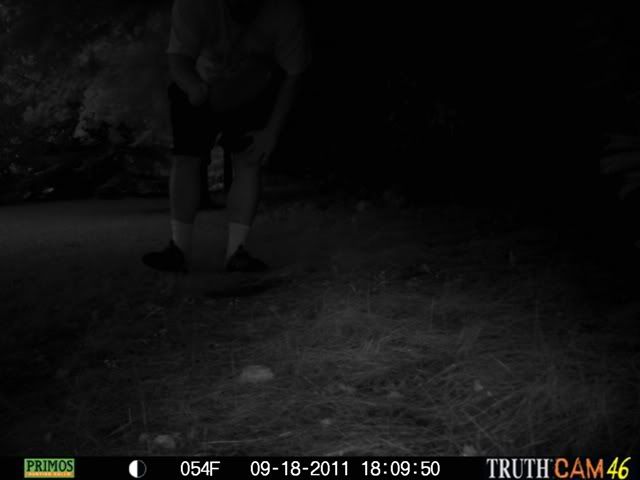
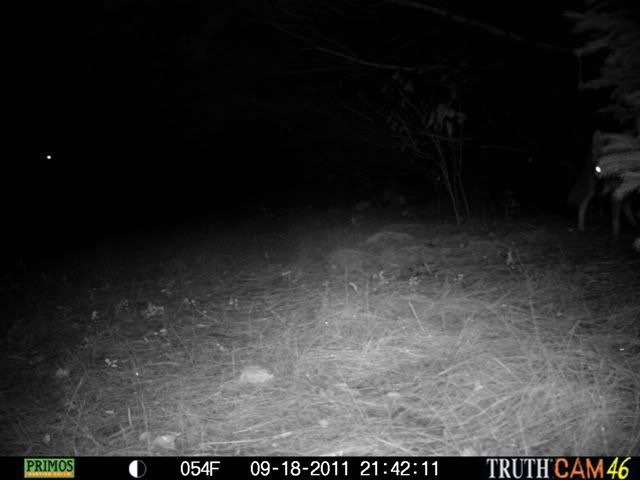
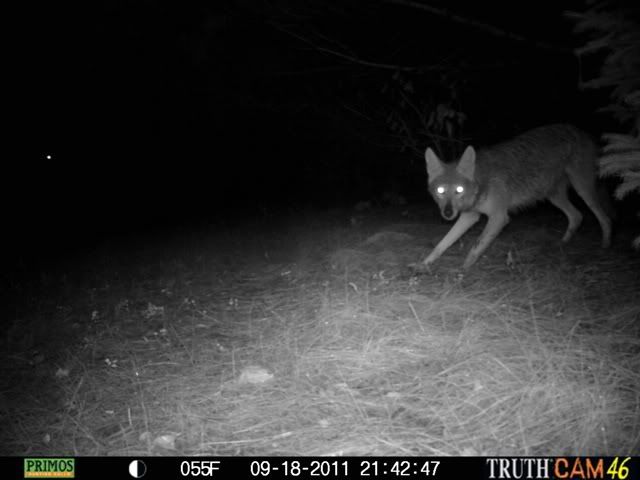
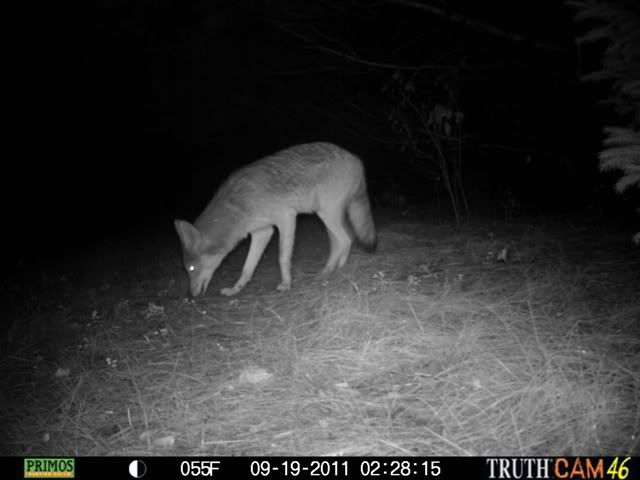
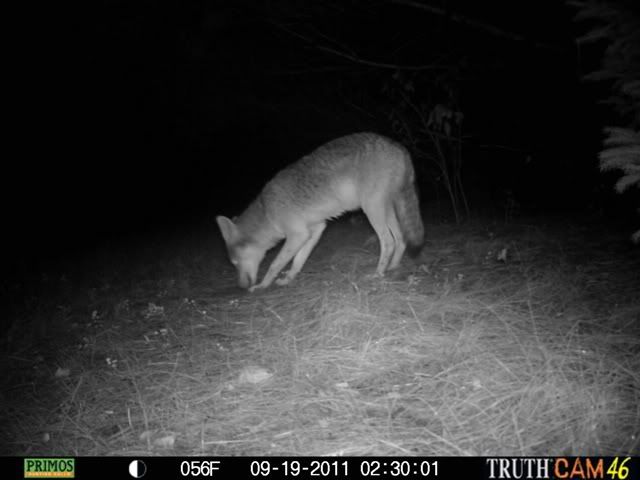
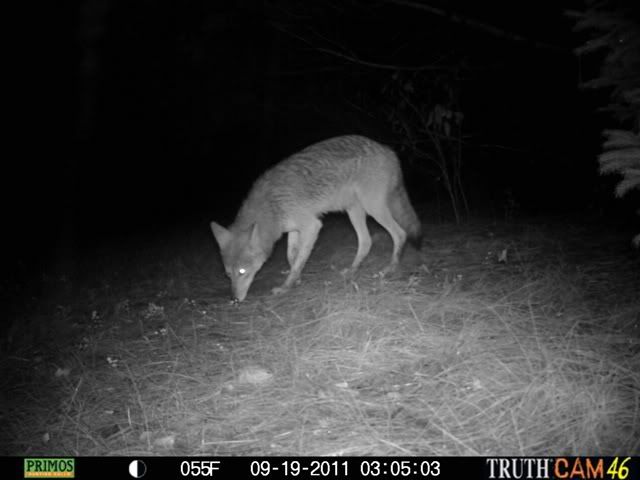
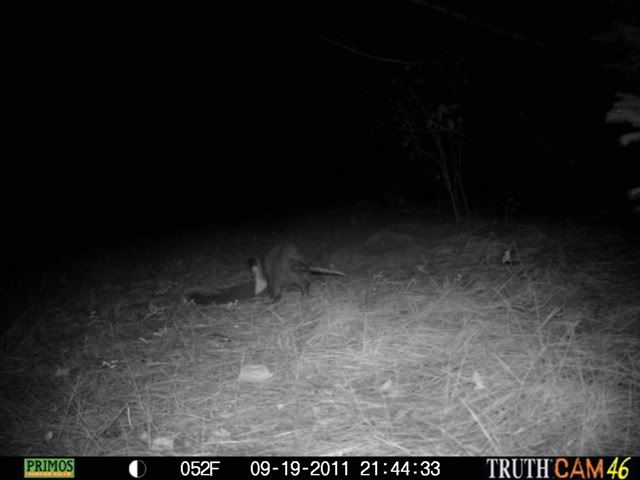
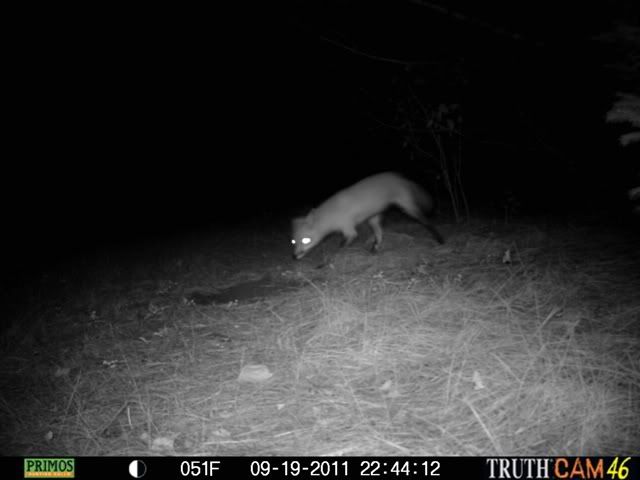
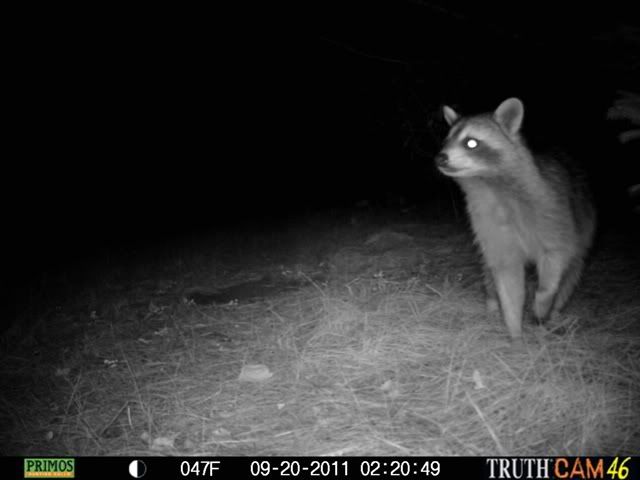
The Primos Truthcam46 is a camera that has a pretty loud "clunk" whenever it takes a picture. Although it has lots of good qualities too, I've made past posts about why this camera gets on my nerves (see here). The up-side is that I can use it in areas where I don't really have any specific purpose but "messing about" with my cams, and it doesn't matter.
So, not long ago, I walked into the kitchen and my lovely bride pointed to a pan of recently used cooking oil on the stove.....complete with bits of crusty breading that had fallen off whatever delicious morsel had been fried there. My wife's comment to me was: "could you get rid of this oil?" A normal person might dump it in an empty tin can, allow it to congeal and then throw it away.
I call that WASTEFUL!
Especially when there is a camera nearby with no specific purpose but to catch pictures just for fun-zies!
So, our story begins with the application of the attractant.
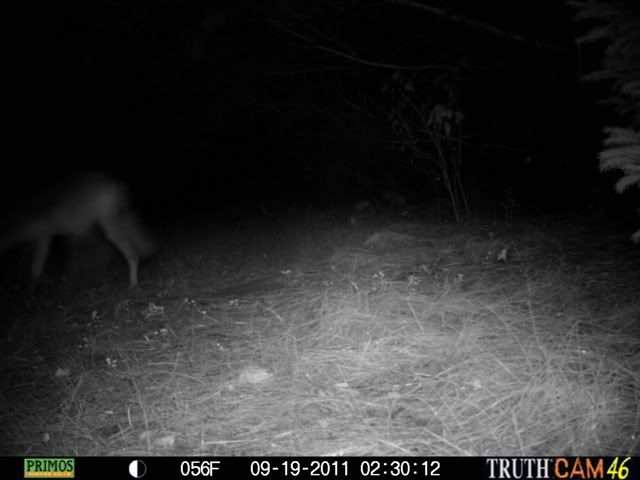
Remember....for a camera trap......this brand is loud as hell when it takes a picture. Pay special attention to the time-stamp.
The question is: what's more important? Food or fear? (especially if you're a Coyote)
There's nothing like a good river corridor if you want to get pictures on a camera trap.
Especially if that river corridor experiences reduced human disturbance.
I've posted pictures from this camera set before. Originally, I was hoping to identify a mystery animal (which I determined was a mink; Neovison vison), and then the goal became to monitor Whistlepig (Marmota monax) activity near their burrow entrance, and I've also reported a nice Coyote picture (Canis latrans).
However, lots of critters skirt the Whistlepig burrow while following the river corridor.
Here are a few more shots from this location, and a summary of everything that passed by.
The Opossum (Didelphis virginiana): Early on in the spring, a 'possum passed the camera just this once. The picture below was before I repositioned the camera.
On the day I deployed this cam...as I walked along the river perusing potential camera set locations, I remember having a strange feeling of being watched. I glanced to my right, and sitting not far away was a 'possum, watching me pass by. I stopped and looked at him for a second, which prompted him to slowly turn and amble back into the woods.
I wonder if this picture is of that same 'possum?
Gray Fox (Urocyon cinereoargenteus): A Gray Fox has only wandered by once. It was about this time that I also had one pass near my Otter Latrine set, which isn't too far away.
White-tailed Deer (Odocoileus virginianus):
One of the reasons commercial cameras with white-flash have been slowly taken over by infra-red flash cameras is because it's been promoted that perhaps the white-flash deter deer. I find this incredibly difficult to believe in alot of situations. Canines and cats, I'll perhaps buy (although see the recent post over at Camera Trapping Campus).....but even they're smart enough to acclimate to flash. Regardless, I still don't buy that the white flash really deters many deer. I suppose that big trophy buck might be wary and not come around as often with a white-flash camera (and this is what many camera owners are most interested in photographing), but I'll bet deer in general couldn't care less. I have no hard data to back this up.....just some anecdotal observations like the one below.
The individual in the lower two pictures lays down in front of this camera, and takes that bright flash directly in the face repeatedly for an entire HOUR AND A HALF! This resulted in 57 pictures of this one deer, and on the Cuddeback (which doesn't take multiple pictures per wildlife pass) this is alot of pics of one individual.
This is just one of at least five similar incidents. Although during the other such incidents a deer catches the flash right in the face and continues to graze right in front of the camera...they don't hang around as long as this individual (and don't lay down in front of the camera).
Eastern Cottontail (Sylvilagus floridanus): Another common critter at this location. Almost all of the pics from this spot are like the one below (i.e., of a rabbit in mid-leap). The Cuddeback does have a lightening fast trigger time!
Coyote (Canis latrans): the "talking dog" has floated past more than once (three times, in fact). I would think the flash would deter them. It's possible these are all different individuals. If the same individual...they may have acclimated to the flash, which I've seen them do with Infra Red flash cameras (See Coyote Cams, posted on Feb. 19th, 2011).
Beaver (Castor canadensis): A Flat-tail ambled by only this once.
Racoons (Procyon lotor): By far the most commonly captured critter by this camera trap. Since February 8, 2011, I've had Racoons pass by over 160 times! See summary below.
Whistlepig (Marmota monax): Of course the whistlers are still about! Check out the claws on the individual in the second picture. No wonder they are such great diggers!
Summary of results:
Camera deployed on February 8, 2011 and retrieved on June 27, 2011.
I summarized the number of animal "passes" to-date. To apply some sort of general criteria to what was considered an individual "pass", if two pictures of the same species appeared on the camera close together in time, I considered them separate "passes" if they were at least two minutes apart. Within two minutes, it's feasible that the same individual just turned around and came back...but this time criteria is arbitrary. Obviously, I can't identify individual animals that well, so I may be counting the same individual more than once (as I'm sure I am with the Whistlepigs). If there were unique marks to identify individuals back-to-back within within 2 minutes of eachother, I only counted it as one "pass".
I wish I wasn't such a dunce and could figure out how to imbed a graph from Excel on my blog, as I think that would be more informative than what I have below. Unfortunately, I haven't been able to figure it out (without having to get some additional piece of software), so you'll just have to view the results as is.
What I find most interesting is the shift in the number of Racoon, Rabbit and Whistlepig passes as the months advance.
February Totals: A fairly low number of captures, overall. But, this was the only month of the "mystery animal". The number of Racoon passes is also respectable.
Coyote= 1
Beaver= 0
Deer = 13
Gray Fox= 0
Mystery Animal/Mink= 6
Opossum = 1
Rabbit (eastern cottontail)= 5
Racoon= 40
Squirrel (eastern gray squirrel)=2
Whistlepig = 0
March Totals: March is the Month of the Racoon and the Rabbit! Also, the Whistlepig starts to show (but not until late in the month).
Coyote= 0
Beaver= 1
Deer = 14
Gray Fox= 1
Mystery Animal/Mink= 0
Opossum = 0
Rabbit (eastern cottontail)= 46
Racoon= 94
Squirrel (eastern gray squirrel)=3
Whistlepig = 14
April Totals: A month of low activity. Look at how far the Racoon total has dropped!
Coyote= 2
Beaver= 0
Deer = 2
Gray Fox= 0
Mystery Animal/Mink= 0
Opossum = 0
Rabbit (eastern cottontail)= 10
Racoon= 13
Squirrel (eastern gray squirrel)= 0
Whistlepig = 3
May Totals: May is the Month of the Whistlepig...and the Rabbit is all but a memory.
Coyote= 0
Beaver= 0
Deer = 3
Gray Fox= 0
Mystery Animal/Mink= 1
Opossum = 0
Rabbit (eastern cottontail)= 3
Racoon= 29
Squirrel (eastern gray squirrel)= 3
Whistlepig = 48
June Totals: The Raccoon is now the most abundant again, and the number of Whistlepig passes has decreased substantially.
Coyote= 0
Beaver= 0
Deer = 8
Gray Fox= 0
Mystery Animal/Mink= 1
Opossum = 0
Rabbit (eastern cottontail)= 6
Racoon= 18
Squirrel (eastern gray squirrel)= 0
Whistlepig = 10
Overall Totals for this location:
Coyote= 3
Beaver= 1
Deer = 40
Gray Fox= 1
Mystery Animal/Mink= 8
Opossum = 1
Rabbit (eastern cottontail)= 76
Racoon= 194
Squirrel (eastern gray squirrel)= 8
Whistlepig = 75
The camera was pulled from this location on June 27, 2011.