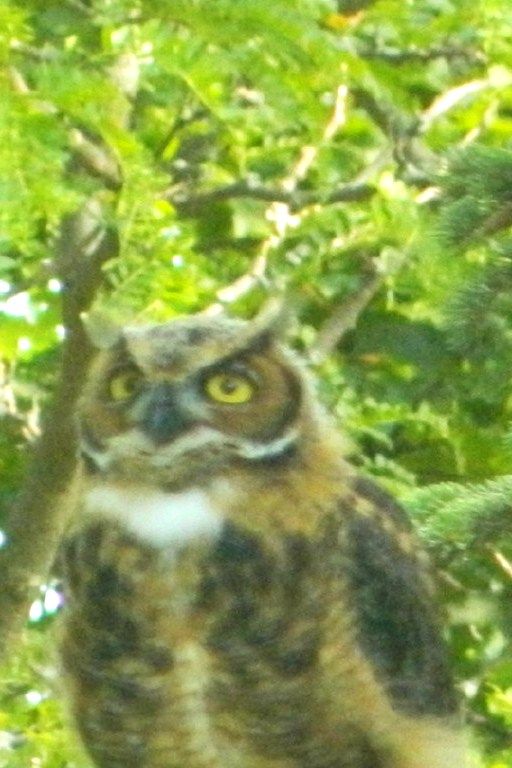
Photo by C. Weimar
Today (January 7th), as I went on a forced walk in a futile effort to undue the damage of the Holidays, I heard my first Great Horned Owl (Bubo virginianus) call of the year. I had heard them calling in the woods behind the house at roughly this time last year, as well.
Great Horned Owls have a fairly early calling/nesting season here in the upper Midwest. The Phenology calendar for our state indicates that courtship activities for this species begins around January 30th. The Department of Natural Resources suggests that calling individuals can be heard from late November through December and January.
Nesting is also a very early affair for this species. In fact, my friend Bill over at The Future of Birds once told me that it's not unheard of for females to incubate eggs with a thin layer of snow covering their heads and shoulders! Stout (2008) reported an average egg-laying date of February 7th for various monitored nests from 2002-2005. He also reported average hatching dates to be March 12th.
Yet, this is not the earliest known report for this species, from our neck of the woods.
Again, Stout (2008) has the honor. He details a nesting pair observed copulating on December 22nd (2007) and then observed one of these incubating eggs on January 1, 2008 (estimated clutch initiation of December 29th)! At another location in the same year, he also reported eggs observed in a nest on January 8th.
This is the earliest reported and confirmed nesting activity for Great Horned Owls in our state (by over 20 days!).
Both nesting locations that Stout observed were in relatively warm and protected micro-climates, and both were in anthropogenically altered landscapes (one located in a cemetary, the other associated with a power plant). He suggests the protected nature of the nesting sites may have encourage these early egg-laying dates.
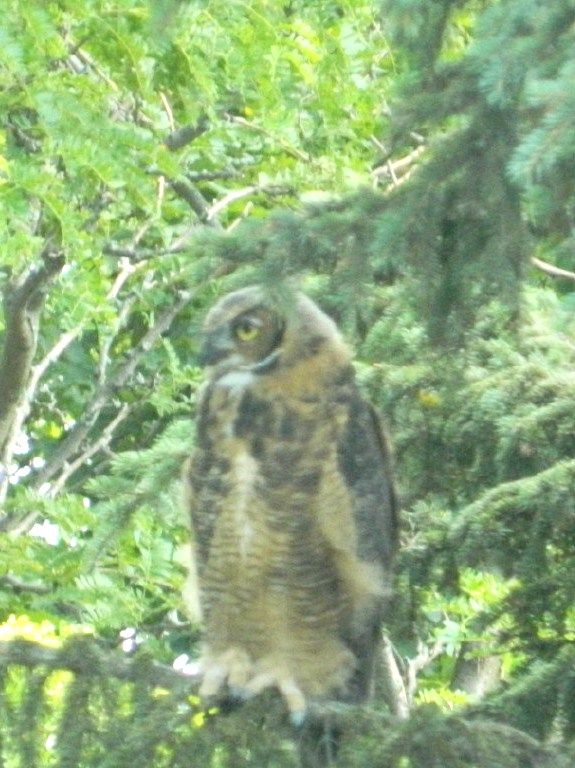
Photo by C. Weimar
The Great Horned Owl is known to occupy tree cavities for nesting, but will very often take-over abandoned nests of other species (such as Red-Tailed Hawks, Herons and Crows). Interestingly, Stout postulates that prior to extensive logging in our region, this species may have had larger trees (with larger tree cavities) available to nest in. Such large cavity nesting sites may have been traditionally preferred by Great Horned Owls over the abondoned nests of other species. Because sites within such tree cavities were likely more sheltered than an abandoned hawk nest, Stout suggests that very early nesting dates may have historically been the norm for this species. Yet as the original forests were logged from the landscape, so to were all of those large trees and nice nesting cavities.....and the owls were forced to adapt.
It's always fascinating (and alittle depressing) to think about how the wild critters carried on before our arrival....and how massively different things must have been.
Regardless, I was happy to hear the Great Ones calling again this year.

