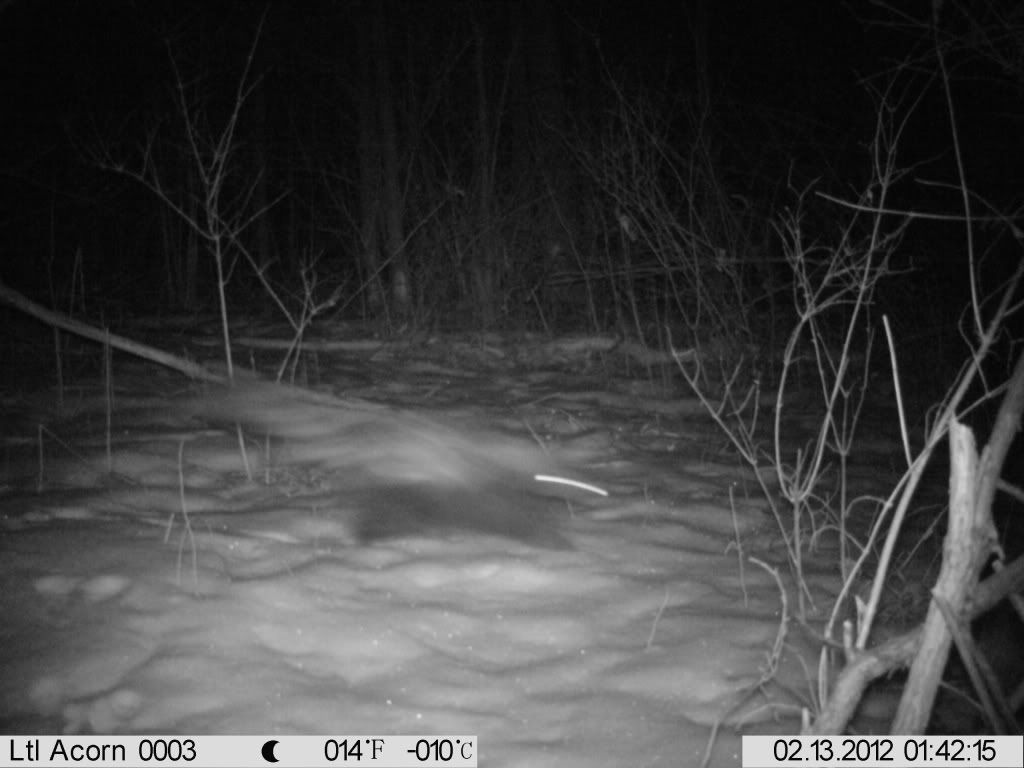
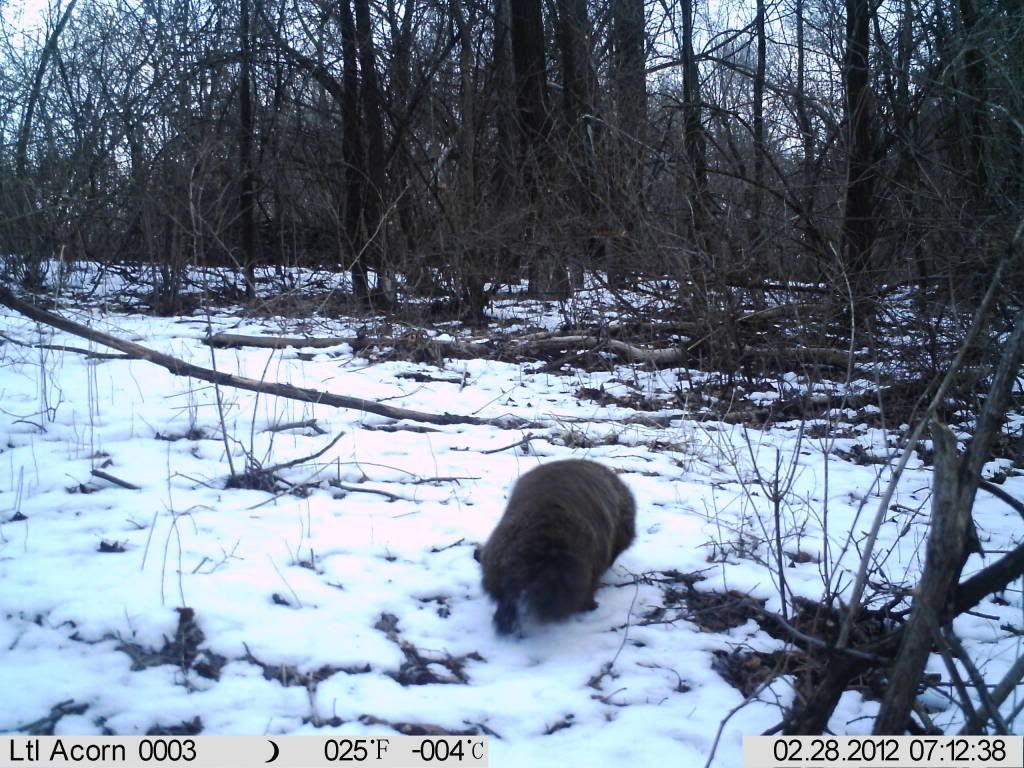
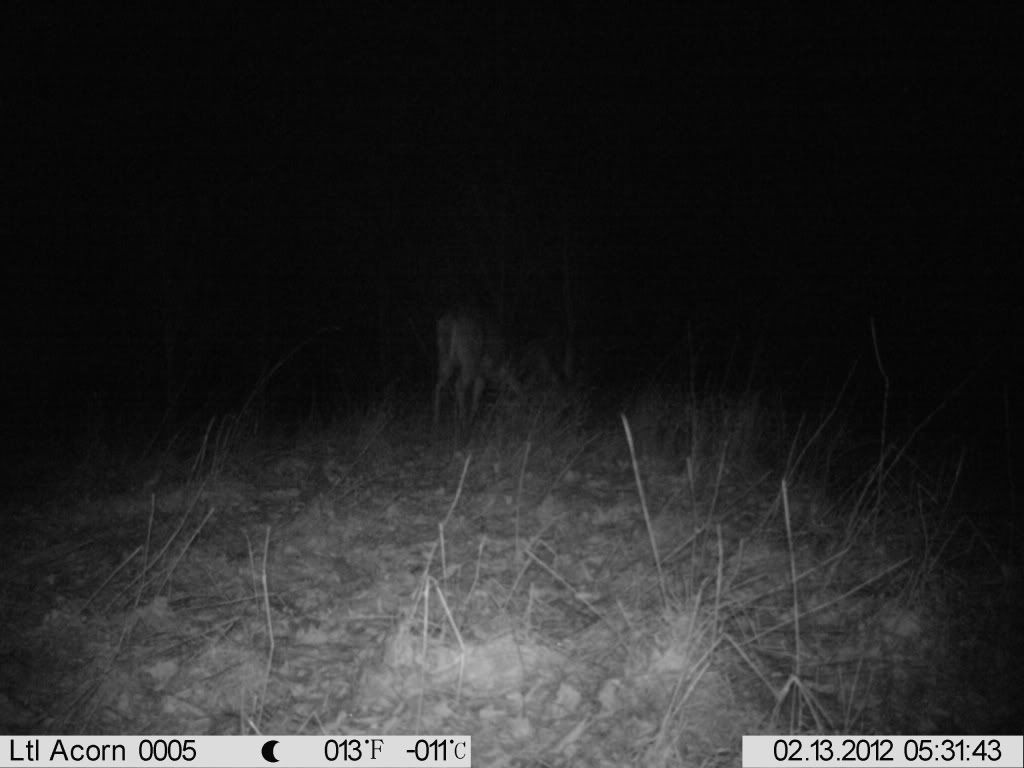
This was taken at 7 am on February 18th, 2013.
Given the soft-spot I have for Mustelids.....I thought it was pretty neat to get a Fisher clip, and the students were excited as well. Fishers are particularly interesting because they are a carnivore that has figured out how to get around that battery of quills protecting the North American Porcupine (Erethizon dorsatum). The Fisher apparently achieves this by focusing its efforts on the Porcupine's face, where there are no quills, with repeated attacks until the prickly rodent is worn down by blood loss and/or shock.
The history of the Fisher, the Porcupine and overharvesting is particularly interesting, as it starts way back in 19th and early 20th centuries (reviewed by Nowak 2005). Fishers were heavily harvested by early trappers in North America during this time, which also happened to other furbearing species, such as the Beaver (Castor canadensis, a story I've recounted for you all before). As a result, the Fisher-Cat was nearly extirpated from the U.S., and with numbers dramatically lowered in Canada. At this point, it is probably important to appreciate the effect that Fishers can apparently have on Porcupine populations. An interesting study was published by Earle and Kramm (1982) that compared porcupine populations in two locations: one with Fishers (due to a re-introduction) and one without. They estimated Porky population densities of 40 / 100 km-squared in the area with Fishers, and densities of 350 / km-squared in areas without Fishers! According to Nowak (op. cit.) the loss of the Fisher to excessive trapping lead to a concomitant rise in Porcupine numbers, who proceeded to do "considerable forest damage". This made the Porcupine unpopular within the timber industry (Roze 2009). Thus, efforts were made to protect the Fisher in order to control the number of Porcupines. Such efforts included more stringent laws and closed trapping seasons to help conserve the Fisher.....which were coupled with several successful re-introductions....has lead to the re-bound of Martes pennanti in the U.S.
________________________________________________________________________
Phenology:
The last week (March 10th through the 15th) has also yielded a host of new phenological events for 2013.
On Sunday (March 10th) I saw the first Sandhill Cranes (Grus canadensis) of the year.

Photo source: Wikipedia
On March 10th I also saw the first American Robin (Turdus migratorius) of the season.

Photo source: Wikipedia
Today (March 15th) I observed two other "firsts" for the year: I heard the first Red-winged Blackbirds (Agelaius phoeniceus) calling of 2013, and the first strutting/displaying Tom walkin' birds (Meleagris gallopavo) of the year (THREE Toms displaying amongst a group of 15 birdds near campus). As an aside, the first Red-winged Blackbird call I heard last year was March 1st.

Photo source: Wikipedia
Things have been chaotic busy! Hopefully more to post soon!
_______________________________________________________________________
Literature Cited:
Earle, R.D., and K.R. Kramm. 1982. Correlation between fisher and porcupine abundance in upper Michigan. The American Midland Naturalist 107:244-249.
Nowak, R.M. 2005. Walker's Carnivores of the World. Johns Hopkins University Press, Baltimore.
Roze, U. 2009. The North American Porcupine (second edition). Comstock Publishing, Ithaca.