Showing posts with label slimy salamander. Show all posts

Friday, June 3, 2011

Week's End Survey Round Up II: Of Turtle Traps, Sexually Mature Sallys, and Poisonous Mammals

So, I'm going to continue my series of posts regarding our captures during weekly surveys (so long as we actually continue to catch stuff).

Dave (the undergraduate researcher working with me this summer) and I have been busting our back-sides the last two weeks. 

We start at 7 am every day because the heat has gotten brutal.  High of 97 degrees F this wednesday...and let me tell you that is NOT a dry heat.  We should probably start even earlier, but after field days in that brutal heat one just has a helluva time climbing outta bed earlier than 6 am to prepare for the day (I'm glad I don't study birds). 

Mondays are the most work.  We deploy traps along the drift fences.  We do our weekly rounds to all the camera traps.  Finally, we track all our radio tagged box turtles (see The Turtle in the Box posted on February 23, 2011; and Up and About for Spring posted on May 10, 2011 posted here).  The rest of the week involves daily checking of drift fences and cover boards.  Last year we also Sherman trapped the area, but the results became predictable (always White-footed Mice, Peromyscus leucopus).  We catch plenty of Peromyscus in our drift fences, in addition to many other small mammals that we don't catch in Shermans.  This coupled with the tediousness associated with baiting and setting Sherman Traps lead us to discontinue it.

This week...however....we FINALLY got the turtle traps deployed for an official first run.  I'd thrown them in about a month ago and gotten nothing, but hadn't had the time to run them again since.  Now they are part of our circuit and we'll run them the rest of the summer (barring unforseen circumstance).

So, we bust our humps all morning.  On a good day we're done with field work by 10:30 am and beat the worst heat (by 11 am, you're looking at near mid/upper 80s and high humidity).  On bad days, we'll be out until nearly noon.  As an overweight male of germanic/irish descent....I'm usually completely drenched in sweat and stumbling around in fogged-up glasses by about 9 am.

The afternoons are spent inputting data, working on analyses and etc. until about 5 pm....then we call it a day.  This will be our schedule for the rest of the summer. 

Not very glamorous, and a ton of work, but incredibly fun!  Plus, I usually give Dave Fridays off (it is supposed to be his summer break, afterall :)  ).  Although, honestly, I think he'd just as soon do field work on Friday too.
________________________________________________________________________

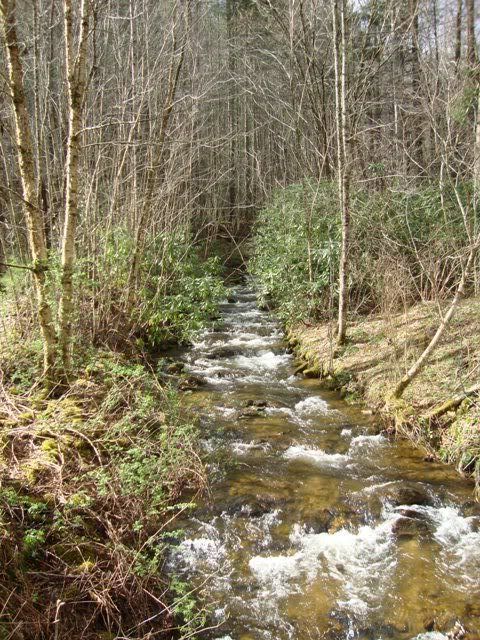
Anyhow, below is a picture of a location we've been trapping for turtles.  The river bed here is hard and rocky...so we've had to anchor the trap by fastening the hoops to cinder blocks with rope.  If we were trapping a pond or lake, we could probably just jam stakes through the hoops and into the soft sediment to secure the traps.  But we ain't so lucky this time.
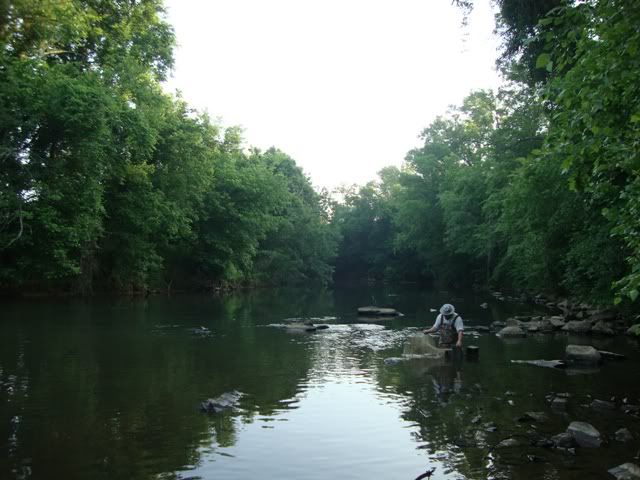

This trap caught a decent-sized common snapping turtle (Chelydra serpentina) after the first day. 

Unfortunately, we didn't get a picture of it. 

Thought the location was pretty nice, though.

________________________________________________________________________

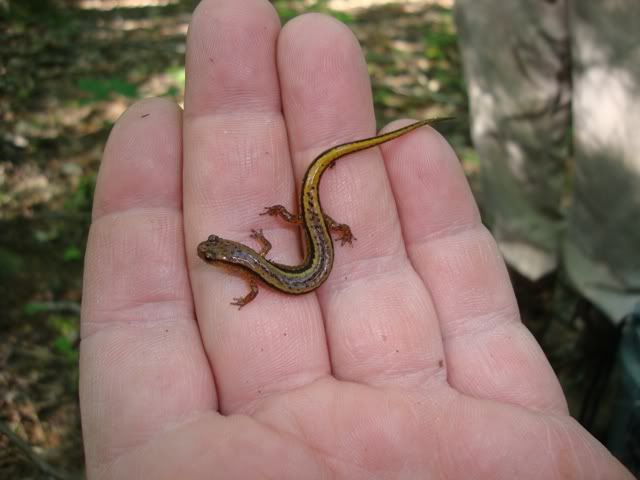
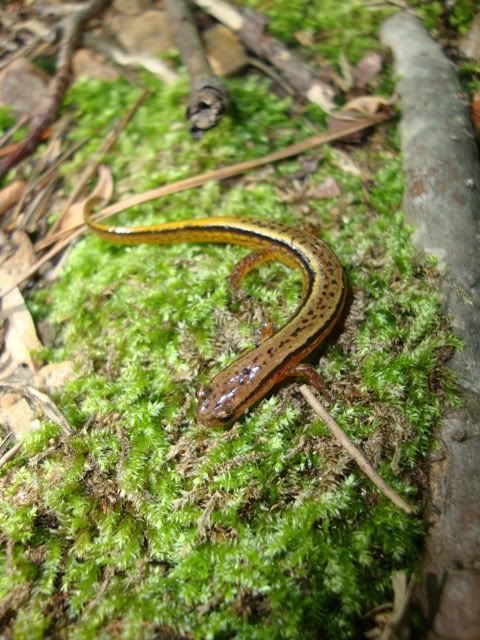
The White-spotted Slimy Salamander (Plethodon cylindraceus).  This isn't a rare find.  In fact, I've reported finding them in the drift fences already.  What makes this a particularly interesting capture was the fact that we caught a fully mature adult male (we usually get juveniles). 
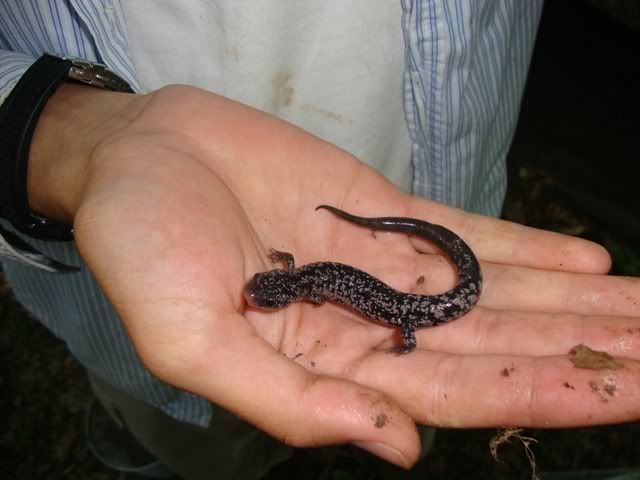

Adult males of many plethodon species have large mental glands under the chin (occassionally referred to as hedonic glands, so you can probably imagine what their function is).  What many may not realize is that salamanders can have very complicated courtship behaviors.  In many species, it's almost like a dance that they play out, where the female follows the male closely, rubbing her chin on the base of his tail, as they move together in circles (this is sometimes called the tail straddling walk).  It is during the tail straddling walk that the mental gland of the male comes into play.  The male will turn around periodically and slap the female on the nose with his mental gland.  Thus, it's believed that important olfactory cues, such as pheromones, are tranferred from male to female in this fashion.  The male then eventually deposits a spermatophore (i.e. packet of sperm) on the ground that the female walks over and picks up with her cloaca....and.....bingo!  Fertilization!
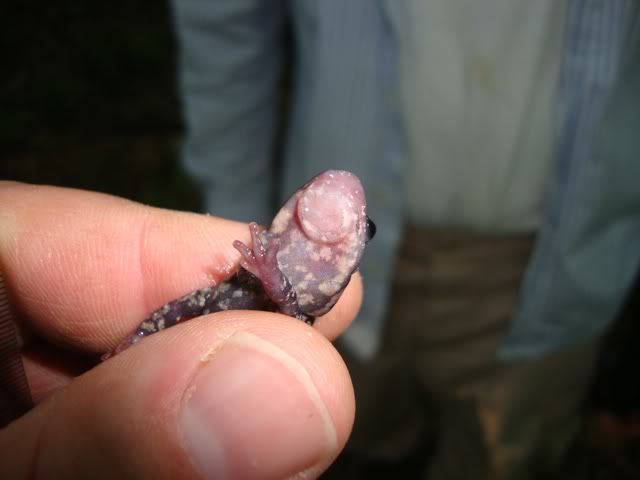
Above Two Pictures: the obvious mental gland on the chin of this adult male white-spotted slimy salamander.

For more information about the courtship behaviors of Plethodon salamanders, see here.  Also check out the bible of amphibian biology/ecology: Duellman and Trueb's (1994) Biology of Amphibians (second edition).  A wealth of information is carried therein.
_______________________________________________________________________

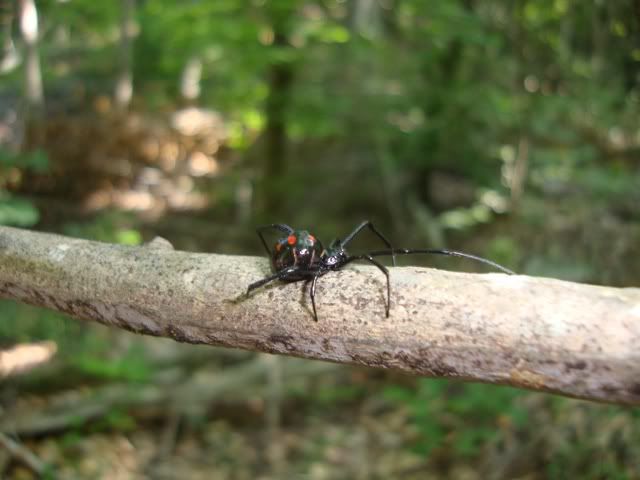
The Black Widow (Latrodectus mactans): We found two large gals in their webs along the same drift fence this week.  Each time, I carefully transfered them on a stick to some location far away from the fence.  I'm sure other widows will move in to take their place.  As usual, they were completely unaggressive during the relocation process.  Yet, they still must be treated with a hefty dose of respect!
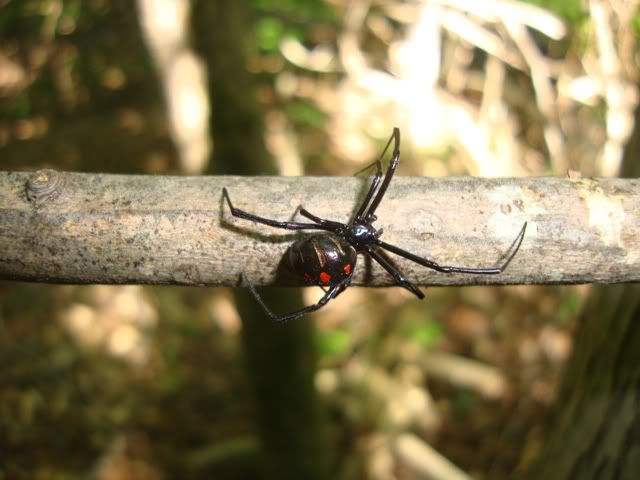
Above Two Pictures: one of the Black Widows that had set up shop along one of our drift fences this week.

___________________________________________________________________________
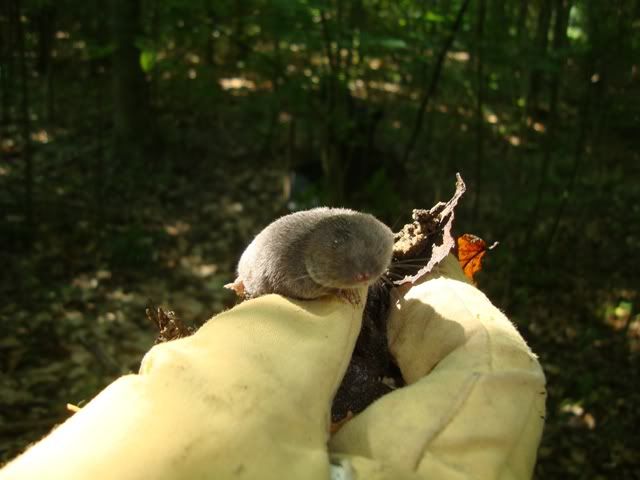
The Southern (or Carolina) Short-Tailed Shrew (Blarina carolinensis).  Although we captured some eastern Harvest Mice again, the most commonly captured small mammal this week was the Short-tailed Shrew.  All ended up in the pitfall traps along the fences.  At our sites, this is the most commonly captured member of the Order Insectivora (which includes primarily shrews and moles in our neck of the woods).  They are often reported from woodland habitats with moist soil and lots of ground debris (which is where the captures pictured below came from).  However, we've also seen them under our coverboards laid out in grasslands/old fields...sometimes with little "nests" of shredded vegetation (often grass) gathered up nearby.

Although we have two species of Short-tail Shrew in the state: The Southern Short-Tail (B. carolinensis) and the Northern Short-Tail (B. brevicauda), their ranges do not overlap (Webster et al. 2003, Mammals of the Carolinas, Virginia and Maryland). 
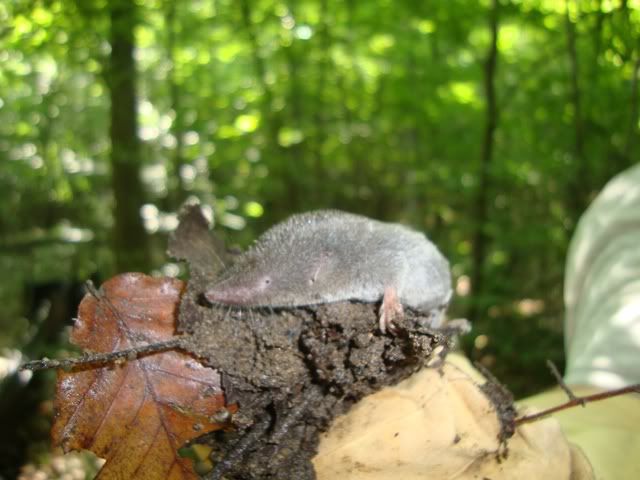
Above Two Pictures: Note the incredibly small eyes, but large whiskers.  As burrowing mammals, sight is less important than the tactile sensitivity that whiskers can provide when hunting soil invertebrates!
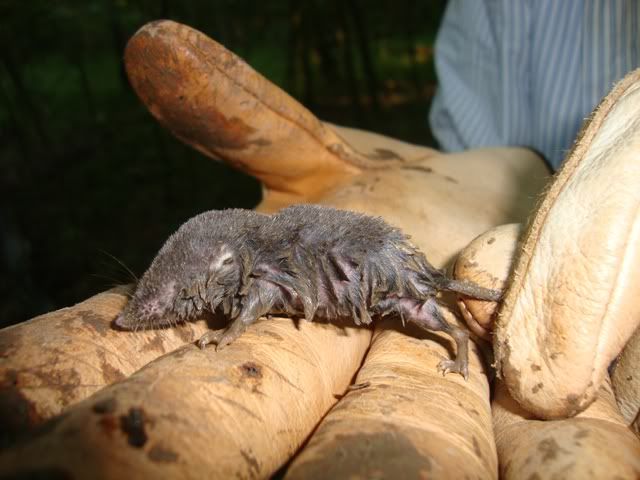
Above: a different individual that we captured.  Note the conical head shape of this species, which (in my opinion) separates them from other shrews, such as the Pygmy Shrew, which have more "elephantine" noses.  The short tail relative to body length is also a helpful clue.


As some of the only poisonous mammals species in the world, members of the Genus Blarina must be handled carefully.  They do not have a sophisticated venom-delivery system as do snakes of the Families Viperidae (vipers and pit-vipers) or Elapidae (cobras, kraits, mambas, etc.).  The toxins are in the saliva (according to George et al. 1986, the account published for the American Society of Mammalogists), and they have grooved teeth that allows it to flow into the bite wound more effectively.  This is somewhat similar to the venom-delivery system of Gila Monsters and Mexican Beaded Lizards, and I'm still up-in-the-air about whether this means they are considered "poisonous" or "venomous".  The toxins are reportedly both hemotoxic (destroys tissue) and neurotoxic (impairs neurological function), and function primarily to aid in prey capture.  It has also been suggested that, becuase they cause paralyses in their prey, these toxins may serve as a means by which Short-tails can cache (or save food) for later.  Their diet includes mostly invertebrates, such as earthworms and millipedes, but they will also eat vertebrates larger than they are, such as mice and voles.  It is believed that their toxic saliva allows for this.

As George et al. (1986) summarize, humans have reported experiencing "serious effects" after being bitten by these shrews.
_______________________________________________________________________


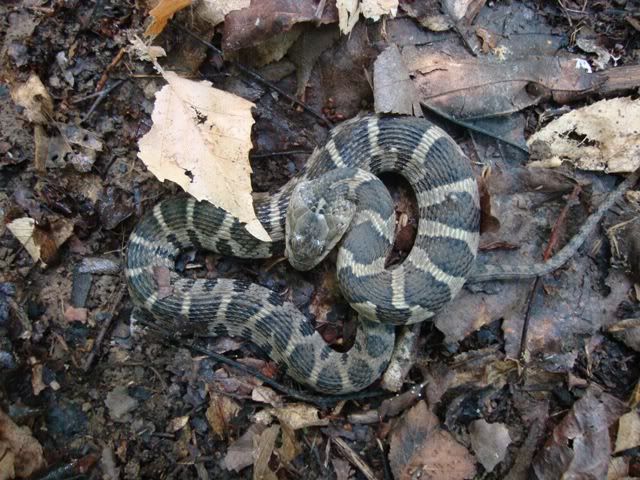
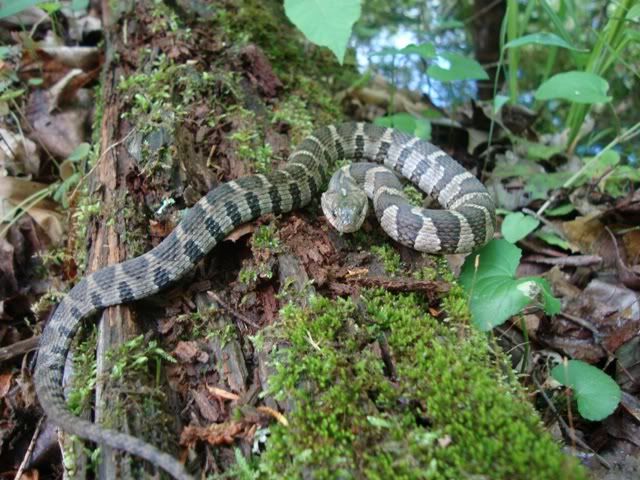
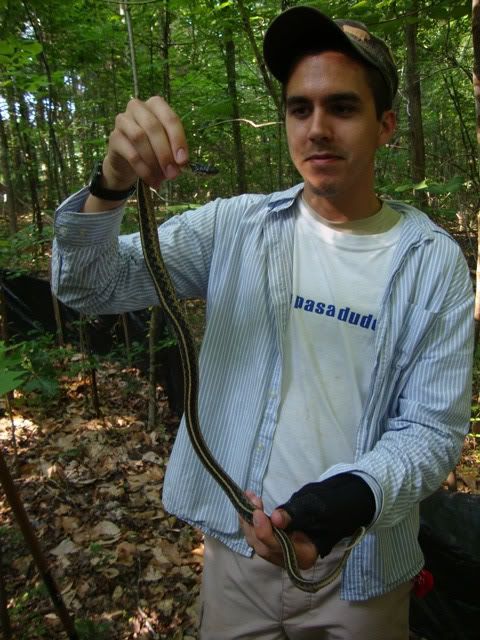
The Common Gartersnake (Thamnophis sirtalis): The Common Gartersnake is probably one of (if not the) most widely distributed snakes in North America (Ernst and Ernst, 2003, Snakes of the United States and Canada).  It's geographic range includes the entire Eastern US, the Entire Midwestern US, a good portion of the Western US....while also reaching far into Canada from coast to coast. Aside from the more northern reaches of Canada, the only regions in North America that the Common Gartersnake is absent from are the hot/dry habitats of the southwestern US, and much of the Rocky Mountains (as far north as Wyoming and the southeastern corner of Montana).

Needless to say, I've spent alot of time with this species (both in WI and in the Southeastern US).  They are ecologically very similar here, as in the upper Midwest: liking damp habitats, but also grassland edges and even disturbed environments.  They are not as abundant down here as up there, but we still catch them often.

One difference I've noticed is that the Southeastern individuals are much quicker to slap a bite down on your finger.  Luckily they don't have much in the way of teeth...and it rarely breaks the skin.

I guess I'd be ornery too if I had to live outside in this hot & humid part of the US 24 hours a day, 7 days a week. 
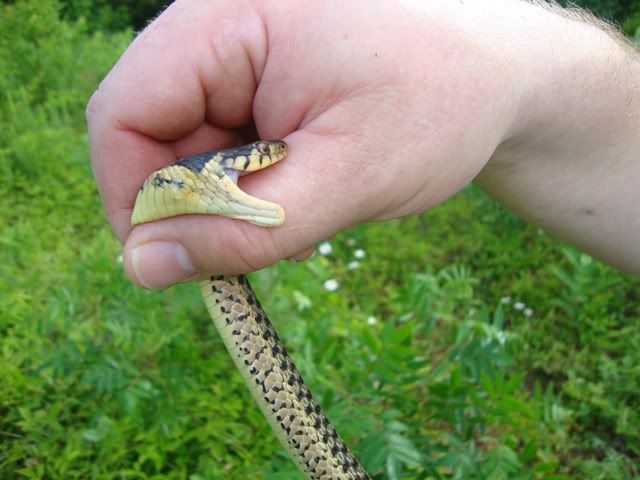

They also seem to have this very handsome checkerboard pattern more often (at least in my experience).  Nice looking snakes.
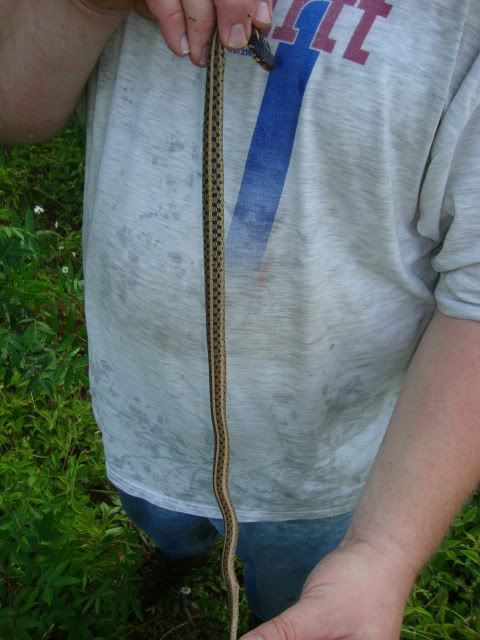
The above individual was captured in a grassland drift fence.  The one below, however, came from a lowland deciduous forest drift fence.  It was much bigger than the first snake.
So...that's it for this week.  There will hopefully be more captures to report in the future.

Enjoy the weekend!

Friday, May 27, 2011

Week's End Survey Round-Up: Snakes, Salamanders, and Mice (and toads), oh my!

Although we caught more than what I'm going to show...these were some of the week's highlights from our drift fence and coverboard surveys.

The Northern Watersnake (Nerodia sipedon): This very common species can occur in just about any lowland habitat in our region (swamps, ponds, marshes, streams, rivers, resevoirs, etc.).  Although it's always a treat to catch them, it's not neccessarily unusual.....except the circumstances under which we captured this individual.  We usually throw funnel traps into ephemeral wooded wetlands at the study sites to catch amphibian larvae.  These funnel traps have been chalk-full of salamanders larvae lately (Ambystoma maculatum larvae).  This juvenile watersnake was captured inside one of those funnel traps in the wetland, which shocked the heck out of me when I pulled it out of the water.  He was probably taking advantage of a captured food source....but I guess he couldn't figure out how to get himself back out! 

Note the vaguely triangular-shaped head that occurs when the animal is threatened....this superficially resembles a venomous snake.   Unfortunately for the watersnake, its penchant to be alittle nippy and the tendency to flatten its head when threatened reminds folks of a venomous snake (often a Cottonmouth).  Thus, the harmless watersnake is often treated as harshly as venomous species are.


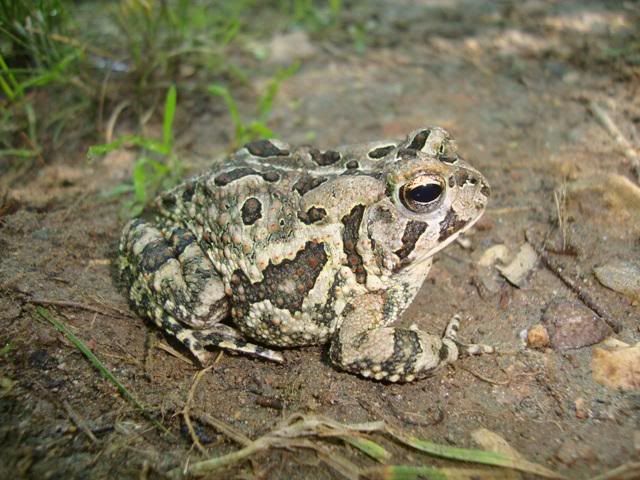
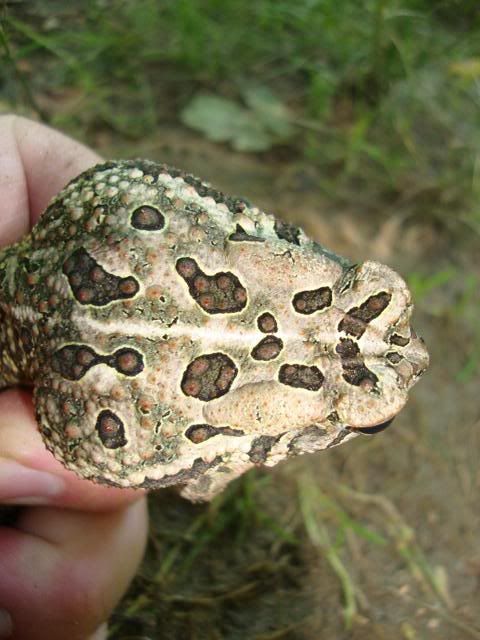
Fowler's Toad (Bufo fowleri) is a species that I had no experience with prior to moving down south.  The individual pictured below was hopping along the trail as we walked into the site earlier this week.  They are superficially similar to the American Toad (Bufo americanus), which is also common in this region.  Interestingly, though...at this particular site almost all of the toads I find are Fowler's, not Amercan Toads.  Not sure why.  The habitat is good for both.  I can't imagine they competitively exclude eachother.

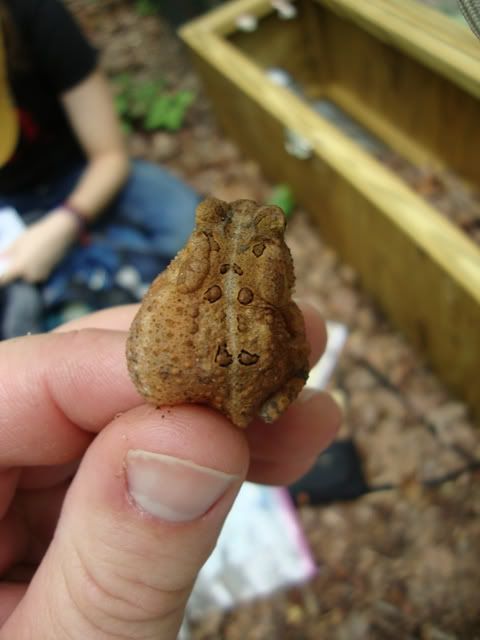
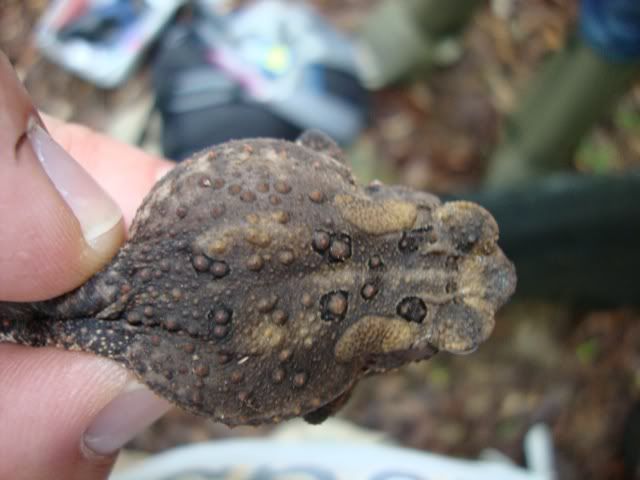
The Fowler's can be distinguished from the American in several ways.  First, is the number of tubercules (or "warts", or bumps) inside of the dark circles on their backs.  If any of the dark circles have 3 or more large tubercules, then you probably have a Fowler's Toad (the American Toad has only 1 or 2 tubercules in each circle).

Also, the Fowler's has relatively small tubercules (or "warts" or bumps) on their legs, as below.  In contrast the American toad has large tubercules in this region.

For comparison, see two examples of American Toads that I captured at a different site last year.   Note the 1-2 tubercules in the dark circles on the back.


Juvenile White-Spotted Slimy Salamanders (Plethodon cylindraceus) were very common under the woodland coverboards at one of the sites this week.  I've posted about capturing them in the past too (see A Good Day for Herps posted on March 23, 2011).


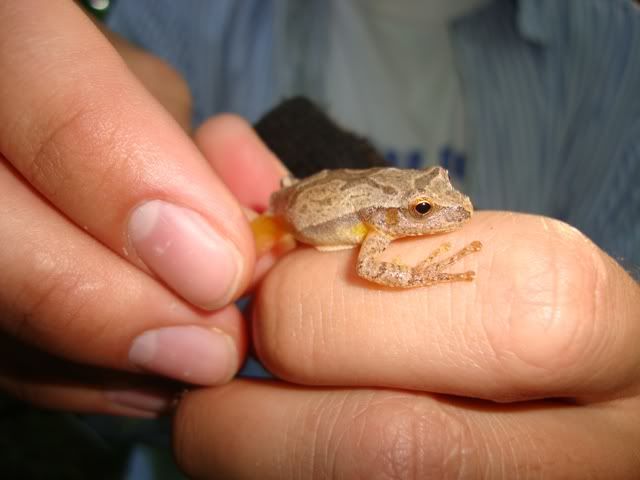
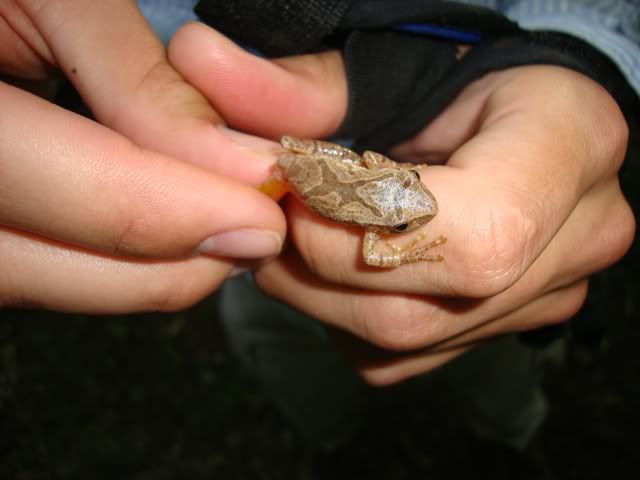
The Spring Peeper (Pseudacris crucifer) is a relatively common species, but one that hadn't been detected at this site until this week.  Last year, I found them at the other site nearby.  The individual below was captured while searching for box turtles in a lowland deciduous forest.  This species can exist in very high densities back home in Wisconsin and I am used to finding hundreds of them in the spring.  This does not seem to be the case in my experience here in the southeast to-date.

As an aside, the specific latin name of crucifer refers to the "X"-shaped mark on their back (second picture below).


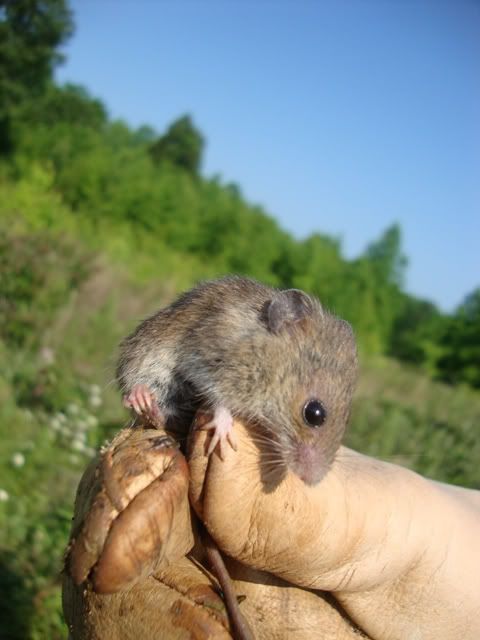
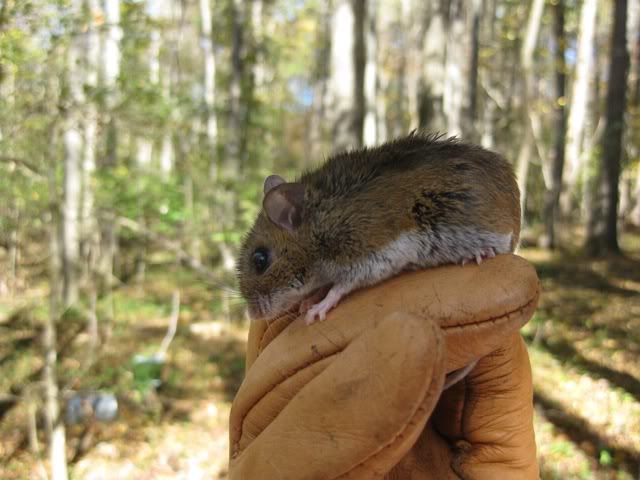
The Eastern Harvest Mouse (Reithrodontomys humulis) is not the most common rodent species we encounter at our sites.  Usually, that is reserved for the White-Footed Mouse (Peromyscus leucopus), which we catch frequently in drift fences, under coverboards and in Sherman Traps.  Every so often, however, we get alittle Harvest Mouse.  The individual below was captured in a pitfall trap of one of the grassland drift fences we're running. 

Some general rules for distinguishing them from the white-footed (aside from the obvious fact that white-footed mice tend to have lighter, more whitish feet):  the ears aren't (proportionally) as large in the Harvest Mouse as in the White-Footed Mouse.  Also, the light fur on the underbelly of the White-Footed is more clearly delineated and comes higher up onto the sides than on the Harvest.  Finally, they can be distinguished by habitat.  While the White-Footed is most often encountered in woodlands, the Harvest Mouse is more common in grasslands, old fields and field edges.


For comparison, here are two pictures of White-footed Mice captured in a drift fence (top) and a Sherman Trap (bottom) earlier this year. 


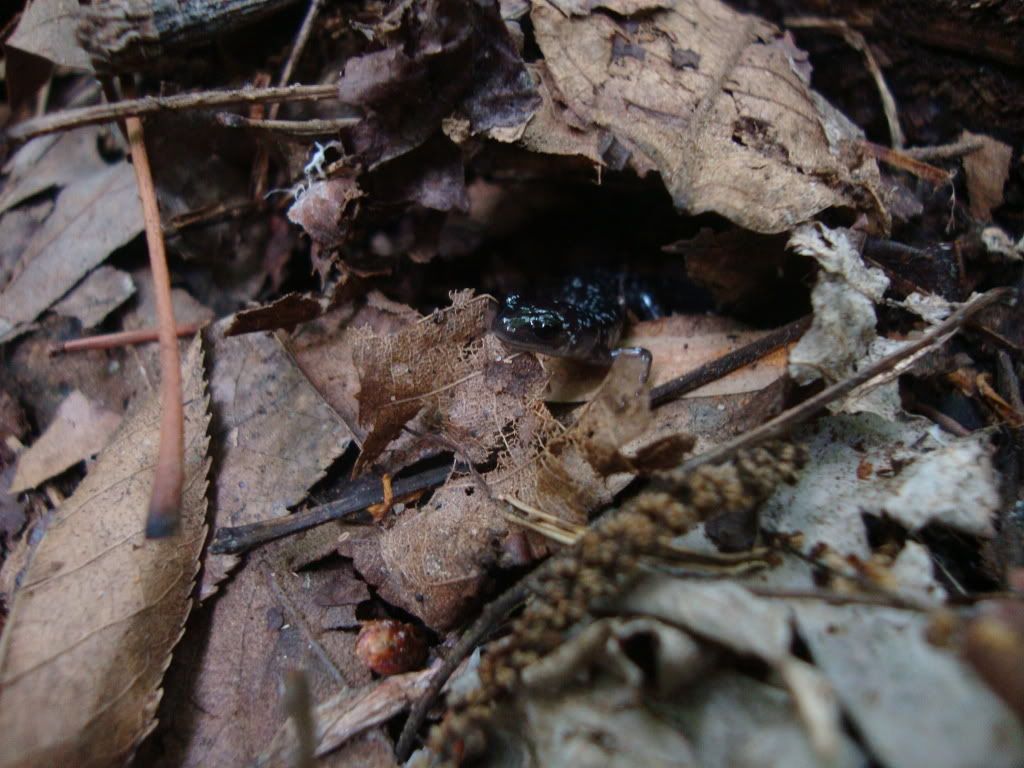
The Southern Two-Lined Salamander (Eurycea cirrigera) pictured below was a first-time capture at this site.  We'd found them in relatively high numbers at our other study site...but hadn't gotten them at this one yet.  Another lungless salamander of the family Plethodontidae, this rather delicate little critter is more often encountered near streams. In fact, the way we find them at our other site is by flipping flat rocks along a stream edge.  This fella was captured in our upland forest drift fence, which borders a rather dry pine stand.  Not where I expected to catch him.


More to survey info will be posted in the coming weeks, I hope.

Have a good weekend!

Thursday, April 21, 2011

All The Myriad Salamanders

The Appalachain Mountains posses a dizzying array of salamander species.  The diversity of these amphibians is so great that it can take one years to learn how to identify them in the field.  Take the genus Desmognathus: this genus alone has 17 species that are spread throughout the mountains in portions of the Carolinas and Virginia.  The Genus Eurycea: 10 species.  The genus Plethodon: 29 species!!!  This isn't even including the "less" speciose genuses (Ambystoma, Pseudotriton, etc.). 

These are all members of the Family Plethodontidae....which are "generically" referred to as the "lungless salamanders".  The name is apt, as almost none of these species have lungs, but instead absorb oxygen through their skin.  The explanation for why having no lungs is a good adaptation for these species varies.  A plausible explanation surrounds the habitats they have evolved to prefer (cool, clear, fast-flowing streams).  Because the water in these flowing streams is moving rapidly, it's is well oxygenated.  Furthermore, cold water typically has a higher oxygen concentration than warm water.  So...oxygen is plentiful in the soggy habitats they prefer....so plentiful that they can absorb the oxygen through their skin very effectively in these damp environs. 

But what is the advantage of having no lungs?

Because they eat primiarly small invertebrates, being able to squeeze into the tight crevices and burrows, where their prey exists is critical.  Lungs, and the muscles to control them, take up alot of room inside one's chest cavity, making it neccessary for the chest cavity to be more broad.  A broad chest cavity makes it harder to squeeze or burrow into tight places....which makes it harder to find food.

____________________________________________________________________

Having grown up in a state where the total number of salamander species is less than 10 (7, to be precise)....the salamaanders of the Appalachain Mountains are daunting, to say the least.

Couple this with the fact that I do not live in the mountainous portion of the state, and encounter a much smaller number of species during field work........I am a complete dunce when it comes to salamander identification in the mountains!

So, earlier this month, I had the opportunity to take part in a salamander workshop in the mountains lead by a salamander expert: Lori Williams (NC Wildlife Resources Commission).  Also, Jeff Beane (NC Musuem of Natural Sciences), who is another salamander ID expert was along.  As expected, I had no clue what species I was finding.  Luckily, I had help with the identification and we found some salamanders that were life-species for me!

First of all, salamander habitats in the mountains are beautiful.  Plus, I was able to do field work with some very knowedgable folks.  Pictured below, among a variety of graduate and undergraduate students, are Lori, Jeff and Bryan Stuart (NC Museum of Natural Sciences).
________________________________________________________________________

Mountain streams are a goldmine for salamanders in this region.  Typically one flips rocks, rotten woody debris and moist leaf litter along the stream edge, or in the adjacent riparian zone to find the little beasties.

Unfortunately, a nasty storm blew threw the area the night before our workshop, and the temperature dropped down to what is considered cold by southeastern standards.  As a result (I'm told), we didn't get quite as many species as we would have otherwise.

Regardless, I was thrilled with our findings!

First, we checked out a little over-flow seep along a stream.  The stream flowed past quickly up the hill from where we stood, and at the location pictured immediately below, the water from that stream was slowly seeping through the hillside.  Moss was plentiful, as were rocks and leaves with water-logged soil beneath.

Above: The two Daves searching a seep for salamanders

So, we worked our way long the stream and associated seeps, flipping rocks, leaves and peeling back moss.  Our first captures (which I'll admit were not mine) were a few very nice adult Santeetlah Dusky Salamanders (Desmognathus santeetlah).

Next, a juvenile Seal Salamander (Desmognathus monticola) was found beneath some rocks (note the paired blotches running along the salamander's back).

Someone also uncovered a hefty adult white-spotted slimy salamander (Plethodon cylindraceus), a species I have posted about finding before.  This widespread salamander is found throughout much of the state.

Later, in some woodlands associated with another beautiful stream (below), we found some different species.

I uncovered a juvenile Ocoee Salamander (Desmognathus ocoee).

Next, a southern red-backed salamander (Plethodon serratus).
The two species pictured above look very similar.  The whitish line running from the back of the eye to the corner of the mouth on the Ocoee Salamander can help distinguish these two (or so I'm told :) ).

Next, I moved over to a very picturesque stream-side habitat and started flipping rocks....which lead to another nice Seal Salamander.

My first salamander hunt in the mountains was a success, thanks mostly to the folks I was with.

I also have to thank Jeff Beane, who helped me identify the critters I had taken pictures of.  I was too absent-minded to write down what I had been told they were when in the field (thinking I could ID them from the book later).  HA!  Luckily, I was able to send my pictures to Jeff for some help!

The herps have been out and about alot lately....I have some more great findings that I'll share with you soon!


For more information on Salamanders:

Beane, J.C., A.L. Braswell, J.C. Mitchell, W.M. Palmer, and J.R. Harrison III. 2010. Amphibians and Reptiles of the Carolinas and Virginia (second edition).  University of North Carolina Press.

Petranka, J.W. 1998. Salamanders of the United States and Canada. Smithsonian Books.

Mitchell, J.C. 2010. Salamanders of the Southeast. Wormsloe Foundation Publication.

Wednesday, March 23, 2011

A Good Day for Herps!

The posts will come more frequently in the spring, I imagine. 

Especially now that the herps are active, as I'll have more to talk about in between camera trap photos!

As a little background, let me tell you about this project.  I have two study sites that I'm comparing mammal and herp communities at.  The camera traps are part of that project, but I've also got a suite of other survey equipment deployed for small mammals and herps.

At each site we are surveying three habitats.  In each habitat we have a transect of 10 cover boards and a drift fence (200 ft of fencing with three types of live trap: funnel traps, box traps and pitfalls). 

So, for those of you keeping track, that's 60 coverboards (hauled out on the back of your's truly last year) and 1,200 ft of fence dug in (again, by your's truly).  The boards create cover, and a microclimate beneath that are attractive to herps and small mammals.  They are passive, so you can go out and flip them whenever.  The drift fences also capture herps and small mammals.  Problem is, they are not passive.  If the traps are engaged, you have to check them every 24 hrs and release the critters captured.

We are also supplementing with sherman traps (only for small mammals).

So, I run the surveys in the summer and off semesters, and in the semesters that I teach Wildlife Ecology, the students run the surveys as part of their lab exercises.

Two weeks ago, the drift fences were opened for the first time (no class this semester...so it's done by me, or any student willing to volunteer).  Because the semester is still in session, time is limited, and we are only opening them for one or two 24 hr perios per week.

In the first week: no captures.
In the second week: a single cricket frog and a white-footed mouse (and that's it for ALL of that survey equipment!).

Clearly, stuff was not ready to start hopping yet.

Today, I had the first good haul of herps to indicate the season is upon us (I hope!).

First, in one of the grassland coverboard transects, got a cute little juvenile racer (Coluber constrictor).

Although the adults are typically a sleek black (with a white chin), hatchling racers are patterned.  This pattern is retained by juveniles (as seen in the pics above) for a time and fades as they grow to adulthood.   Racers are aptly named.  They can move like the dickens and even an experienced herpetologist can loose them in long grass or brushy edges should they take off.  Luckily it was cool this morning when I checked the boards, and this guy wasn't moving very fast....so I was able to snap a few pics!  Although the specific epithet "constrictor" implies....well...something that constricts, racers typically don't.  They often prey on animals they can overpower without constriction....although bigger prey may be held down with a coil or two.  They hunt by smell, but also by sight.  Nussbaum et al. 1983 report that they are able to detect crickets up to 50 METERS away, and can see larger prey at even greater distances!  Their dietary choices are not narrow. 

In fact, Uhler et al. (1939) reported the prey occurence (by volume) in the stomachs of racers surveyed in Virginia as follows:
  • snakes=26%,
  • birds=18%,
  • shrews=12%,
  • caterpillars and moths=10%,
  • frogs=9%,
  • moles and lizards=6%,
  • squirrels=5%
  • other insects/arthropods=5%
Hamilton and Pollack (1956) found the percent occurrence of food types selected by racers in Georgia to be as follows:
  • Lizards=65%
  • Snakes=28%
  • amphibians=9%
  • mammals=3.5%
  • insects=1.7%
In North Carolina, Brown (1979) found that reptiles, mammals and insects made up roughly 80% of selected prey.

Interestingly, a different trend was observed in Illinois by Klimstra (1959):
  • insects = 48%
  • mammals = 43.5%
  • birds = 16.5%
  • THEN reptiles= 12%.
A similar trend was also reported by Fitch (1963) for racers in Kansas:
  • Insects = 77%
  • mammals = 15%
  • snakes = 5%
So, not only do they have broad dietary interests, they also vary greatly by geographic location.

________________________________________________________________

My next coverboard discoveries occurred in the woods, specifically in lowland deciduous woods.  There is a wooded riparian area (stream corridor) nearby, and a number of ephemeral wetlands in the general vicinity.  That means one thing!  GREAT SALAMANDER HABITAT!

The first volunteer was a very young white-spotted slimy salamander (Plethodon cylindraceus).  He was under a board located within 15 ft of an ephemeral pool.  He was so small that I actually almost didn't see him.

I had found many young slimy salamanders at this site last year, but no big adults.  That changed today, however!  I found a big male under a different board in the same transect.

Slimy salamanders are members of the family Plethodontidae, which are generically referred to as the "lungless salamanders".  The name is accurrate, as members of this Family truly have no lungs!  They absorb oxygen through their skin (called cutaneous respiration).  The taxonomy of the "slimy salamander complex", specifically, is amazingly confusing and constantly in flux.  Members of this "complex" are found throughout the southeastern and eastern USA.  According to Beane et al. (2010), all slimy salamanders in our region were once thought to be a single species (P. glutinosus).  These have now been split into 4 species that exist in the state: P. glutinosus, P. cylindraceus, P. chattahoochee and P. chlorobryonis. 

Luckily, in my particular part of the state, I only have to worry about one (P. cylindraceus, the white-spotted slimy salamander).  Whew!

__________________________________________________________

I round out this post with another coverboard encounter: the spotted salamander (Ambystoma maculatum). 

A member of the family Ambystomatidae (the "mole salamanders") these chucky little salamanders are fairly common in this region of the state.  Amazingly, I had not found one until today!  So, I added a new species to the list for one of my sites.  The breeding season for this species is late winter, early spring and has already passed.  I imagine this fella was taking advantage of the nice cover created by the board and will soon move on to his permanent borrow for the summer.

Drift fence captures to be reported in the future!

Literature Cited:

Beane, J.C., J.C. Mitchell, W.M. Palmer, and J.R. Harrison III. 2010. Amphibians and Reptiles of the Carolinas and Virginia (2nd edition).  University of North Carolina Press.

Brown, E.E, 1979.  Some snake food records from the Carolinas. Brimleyana 1:113-124.

Fitch, H.S. 1963. Natural history of the racer Coluber constrictor.  University of Kansas, Publications of the Museum of Natural History 15:351-468.

Hamilton, W.J., Jr., and J.A. Pollack. 1956. The food of some colubrid snakes from Fort Benning, Georgia. Ecology 37:519-536.

Nussbaum, R.A., E.D. Brodie, Jr., and R.M. Storm. 1983. Amphibians and reptiles of the pacific northwest.  University of Idaho Press.

Klimstra, W.D. 1959. Food of the racer, Coluber constrictor, in southern Illinois. Copeia 1959:210-214.

Uhler, F.M., C. Cottam, and T.E. Clarke. 1939. Food of snakes of the George Washington National Forest, Virignia. Transactions of the North American Wildlife Conference 4:605-622.